I will keep my covenant with you …

Fifth Sunday of Lent
March 22, 2026

I will keep my covenant with you … to be your God and the God of your descendants after you.
Genesis 17:7

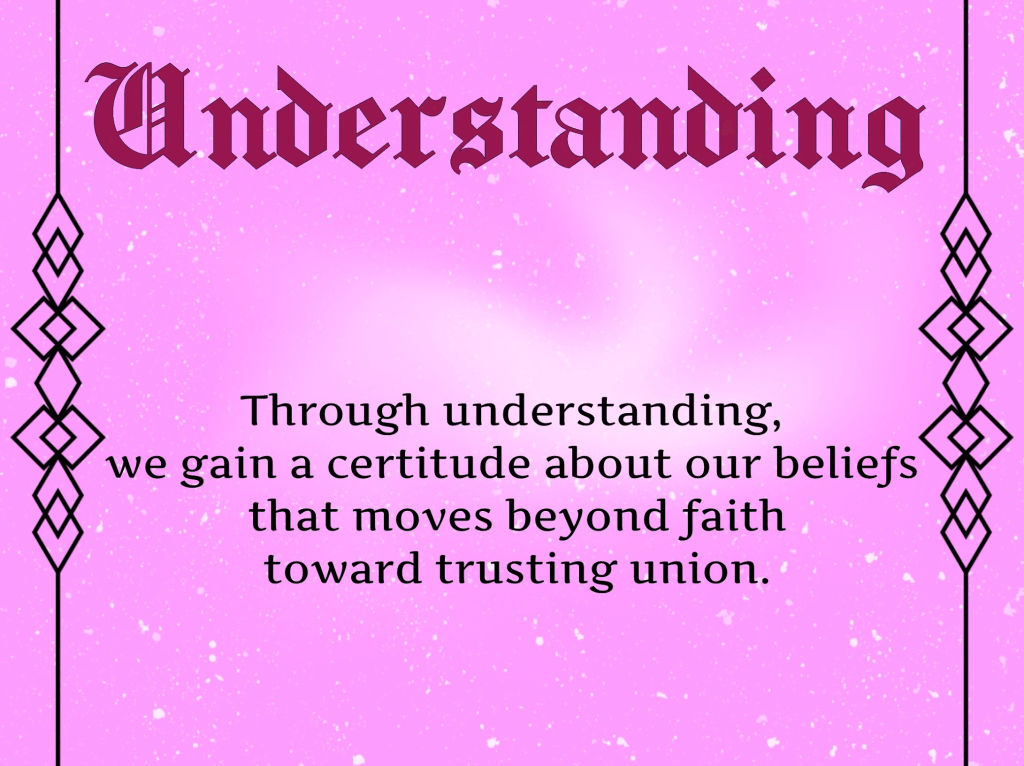
Understanding is a Gift of the Holy Spirit which allows us
to grasp, at least in a limited way,
the essence of the truths of our faith.
Through understanding, we gain a trust in God
that moves beyond circumstances,
enabling us to find meaning and peace in our lives.

The fifth week of Lent is filled with high drama. Impossible things happen at the hand of God: Lazarus comes back from the dead; both innocent Suzanna and the adulterous woman are saved; three men pass unharmed through Nebuchadnezzar’s fire; and Jesus proclaims he is the Son of God. It is a week when the truth of God’s power confronts the security of human conventions. From what symbolic graves is God asking me to rise?


(This story is a repeat for those of you who are familiar with the blog. But I choose to include it again because I love it so much. These two individuals were very precious to me and taught me so much. I hope I have been able to share some of that learning with you, my readers.)

The golden morning had broken bright and warm through the hospital windows. With its breaking, the attending physician and chaplain had received a page. Dorothy had taken an unexpected turn. She was struggling both to live and to die. 
As they attended and comforted her, Dorothy managed to whisper,” … wait for Henry.” Henry, her husband of fifty-eight years, had arrived promptly at 7:00 a.m. daily for all the weeks of Dorothy’s hospitalization. Glancing at her watch, the chaplain saw that it was just 6:50 AM. 

When, after ten prolonged minutes, Henry appeared at the door, he carried a small bouquet of yellow roses from their beloved garden. Quickly comprehending the changed situation, he laid the roses aside and hurried to hold Dorothy for the last few minutes of her life. In the loving, covenanted presence Dorothy had waited for, she finally embraced a peaceful death.

It had not been easy for Dorothy to die nor, from then on, had it been easy for Henry to live. Still, through many bereavement visits, the chaplain watched their long, honest love arise to heal Henry. Through prayer and the benediction of memories, Henry understood that their love, like the roses still blooming in their garden, was both fragile and perpetual.
In this week’s readings, God again calls us to such a love.

As God brought Lazarus, Suzanna and Shadrack out of darkness and death, so God promises to bring us. “I will keep my covenant with you,” God says. “Whoever keeps my word will never die.”

Accompanying Jesus, as he nears Jerusalem, let us trust and cherish these promises in our own darknesses and bereavements.


Music: Surrexit Dominus

Latin Lyrics & English Translation:
Latin:
Surrexit Dominus vere,
Alleluia, alleluia.
Victimae paschali laudes,
Immolent Christiani.

Mors et vita duello,
Conflixere mirando:
Dux vitae mortuus,
Regnat vivus.

Surrexit Christus spes mea,
Praecedet vos in Galilaeam.
Credamus cum Maria,
Et gaudeamus cum Ecclesia.

English:
The Lord is truly risen,
Alleluia, alleluia.
To the Paschal Victim, let Christians offer praise.

Death and life contended
In wondrous conflict:
The Prince of Life, once slain,
Now lives and reigns.

Christ, my hope, has risen,
He goes before you into Galilee.
Let us believe with Mary,
And rejoice with the Church.


Suggested Scripture: John 11:1-45

For your reflection:

  • What feelings or reactions do I have after reading this reflection?
  • Do my feelings or reactions remind me of any passage or event in scripture, especially in the life of Christ? 
  • What actions might I take today because of my response to these readings?
The Great Forgiveness

March 20, 2026
Spring Equinox


Forgiveness is the conscious choice
to release resentment and a desire for vengeance,
while still acknowledging the wrong done,
and is rooted in God’s mercy and grace.


Ah, Equinox – respite from the cold!

Today our Earth will put away her winter jewels, her cold snow pearls and glistening ice diamonds stored until distant December. With them, she lays aside her cool reserve, the stark elegance of silhouetted trees against a white landscape. She says, “I have finished my silent retreat.”

Instead, Lady Earth unveils her costume jewelry – that improbable mix of pinks, purples, greens, and yellows. Even if this morning, she wraps them in a silver cashmere fog, we know it hides a riotous, tumbling April.

Every year, we wonder if those bare trees and barren hillsides will ever green again. But they do! Spring is the act of “Great Forgiveness”. It is the time when Nature mirrors the Infinite Mercy of her Creator and says, “Fear not, Winter. I am deeper than your cold. My resilience has redeemed us both for another chance at life.”


We, too, as human beings, are capable of such resilience. I remember my mother’s infinite patience with a sometimes-annoying neighbor. Edna’s seemingly innocent conversation harbored veiled references to her economic superiority. Little wintry comments like, “It’s a shame you can’t get a Hoover. It would make your life so much easier”. Even as a child, (who had no idea what a Hover was) I was nettled beyond tolerance by the insensitivity of the statement.

But my mother, who was no pushover and who did not suffer fools gladly, was patient and faithful. She knew Edna, though careless in her opinions, didn’t mean to hurt or shame her.

Such thoughtless remarks could have hung like icicles in mid-air, but my Mom clipped them with her wonderful capacity for humorous honesty. “Eddie,” she said, “you can bring your Hoover over and do my rugs every Friday.” Edna laughed at herself, rescinding the tactless comment with an “I’m sorry, El. You know I didn’t mean anything by it.”

My mother taught me to live from the “Great Forgiveness” which can warm any cold. She left a great space for people before ever closing in with judgement.


At one point when I was still very young, my mother became quite ill and after a long hospitalization, returned home for an extended recuperation. During that time, Edna came every day to cook for our large working family. Weekly, she cleaned our house with the same decrepit vacuum she had earlier criticized.

Without a word, Edna challenged me to learn another lesson about the nature of fidelity and true friendship and the commitment to give it voice without words.


Years later, I read a quote that captured these lessons: “Always be kind. We never know the battles someone else is fighting.” These are lessons I remember with gratitude today in this equinox of another “Great Forgiveness”. Forgiveness is a largesse we can imitate if we simply remember the mercies we ourselves have received.

Blessings to you all and a joyous Spring!


Music: Forgiveness – Matthew West

Suggested Reading: Psalm 19


For Your Reflection:

  • What feelings or reactions do I have after reading this reflection?
  • Do my feelings or reactions remind me of any passage or event in scripture, especially in the life of Christ? 
  • What actions might I take today because of my response to these readings?

The Gentle Face of God

Feast of St. Joseph
March 19, 2026


Filial Piety is the virtue of deep respect and tenderness
for one’s parents, elders, mentors, and ancestors


How Jesus must have loved Joseph – this man so holy that he gave his whole life over to the nurturing of God!

But Joseph’s choice was not easy.


The choice was confusing.

This is how the birth of Jesus the Messiah came about: His mother Mary was pledged to be married to Joseph, but before they came together, she was found to be pregnant through the Holy Spirit. Because Joseph her husband was faithful to the law, and yet did not want to expose her to public disgrace, he had in mind to divorce her quietly.

Matthew 1:18-19

The choice took courage.

When they had gone, an angel of the Lord appeared to Joseph in a dream. “Get up,” he said, “take the child and his mother and escape to Egypt. Stay there until I tell you, for Herod is going to search for the child to kill him.”

Matthew 2:13

The choice took patience.

After the festival was over, while his parents were returning home, the boy Jesus stayed behind in Jerusalem, but they were unaware of it. Thinking he was in their company, they traveled on for a day. Then they began looking for him among their relatives and friends. When they did not find him, they went back to Jerusalem to look for him. After three days, they found him in the temple courts, sitting among the teachers, listening to them and asking them questions. Everyone who heard him was amazed at his understanding and his answers. When his parents saw him, they were astonished. His mother said to him, “Son, why have you treated us like this? Your father and I have been anxiously searching for you.”

Luke 2:43-48

The choice took humility.

After the above incident in the Temple, we do not hear of Joseph again. We can assume that for the remaining decade before Jesus’s public ministry, he worked side by side with Joseph to sustain their little family. In the Divine Plan, it appears that Joseph’s role is humbly and silently concluded by a quiet death in Nazareth before Jesus turns thirty.


Most of all, the choice took immense and sustained faith.

Joseph’s faith sustained his life, protected and companioned Mary, taught and nurtured the Son of God. That was one extraordinary faith! Yet, in many ways, it is a faith we ordinary believers are also all called to:

  • to hear God’s call
  • to step into salvation history with trust and courage
  • to do what needs to be done without braggadocio
  • to end in quiet grace, acknowledging that it all belonged to God

Music: Hymn to St. Joseph

Christum Dei Filium qui putari
dignatus est filius Joseph:
Venite adoremus.
O come, let us adore Christ the Son of God,
Who deigned to be
thought to be the son of Joseph!
Blessed be the eyes that have seen what thou hast seen,
Blessed be the ears that have heard what thou hast heard.
Blessed be the arms that have held thy Creator.
Blessed be the hands that have labored for the Word.
Blessed is thy Heart all aflame with ardent love,
Chosen and Beloved by the Holy Trinity.
Blessed be thy Virgin spouse entrusted unto thee.
Bless all, dear Joseph, who love and honor thee.


For Your Reflection:

  • What feelings or reactions do I have after reading this reflection?
  • Do my feelings or reactions remind me of any passage or event in scripture, especially in the life of Christ? 
  • What actions might I take today because of my response to these readings?

I Am the Truth …

Fourth Sunday of Lent
March 15, 2026

Veracity is the virtue of being truthful in all things.


Recently, I heard our culture referred to as “The Post-Truth Age”. I found that statement to be both accurate and frightening. In a world completely entangled in lies, veracity is a lonely virtue. Jesus knew that. As he nears Jerusalem, it becomes increasingly apparent that those who live by the Lie will seek to exterminate him. But, in Jesus, Truth is eternal. Through his Resurrection, we are welcomed into that infinite Veracity.

Throughout this week, the Word of God is leading us – out of darkness, out of blindness, out of fear, out of all that inhibits the eternal life of grace within us. Time is drawing close to Calvary, when our faith will be tested. Jesus wants us to remember the miracles and words of this week so that our faith will not be shaken by the days to come.

Like Antonia, in the story below, Jesus wants us to find the Truth that supersedes circumstances. It is a Truth that rests in full and honest relationship with him.


“End stage melanoma,” the doctor pronounced, after Antonia requested complete honesty.

It seemed unfair to those who knew her: an ebony spot, unnoticed on her back, soon would bleed its ink across her death certificate. For Antonia, though, the irony lay not in her diagnosis, but in the thought that so few people really knew her or would care.

An unmarried, retired teacher, Antonia was an only child. With only distant cousins, she had made the parish her family. She was a daily communicant, a generous contributor, and a respected neighbor. Antonia knew this. But, for decades, she had still gone home each night to a lonely house and a solitary life.

How surprised she was when, during her final weeks in hospice, visitors came in waves to comfort her. Students spoke of her steady influence; neighbors of her charity. Colleagues remembered her patience. When one visitor lamented Antonia’s situation, she stopped him, mid-sentence. “I have never been happier,” she said. “I had no idea so many people loved me.”

Life’s circumstances can conspire to convince us that we are unimportant, unloved, even useless. Sometimes, these perceptions are self-imposed. At other times, they are pressed on us by hostile forces, as they were on Jesus at the end of his life. But Jesus assures us in this week’s readings: “The one who believes in me will never die.” He touches the blind man with light and the royal official’s son with resurrection. Jesus calls us to trust that we are infinitely loved. Believing it, we have the strength – even the joy- to go with him to Calvary.


Music: Jerusalem, My Destiny – Rory Cooney


Suggested Reading: Ephesians 5:8-14


For Your Reflection:

  • What feelings or reactions do I have after reading this reflection?
  • Do my feelings or reactions remind me of any passage or event in scripture, especially in the life of Christ? 
  • What actions might I take today because of my response to these readings?

Come Home to Faith, Hope, and Love

March 8, 2026
Third Sunday of Lent


The theological virtues are faith, hope, and love (charity).
These are considered supernatural gifts from God
that cannot be earned through human effort alone,
but are received at Baptism
and help guide a person’s moral life
by directing them toward God.


In our readings during this third week of Lent, we travel the distances between despair and hope, hard-heartedness and repentance, law and mercy. We enter the experience of Hosea as he longs for the return of grace, of the courageous woman at the well, of Peter as he matures in faith, of the Pharisee and tax collector at prayer. Again and again, we are offered the threads of repentance, mercy, and hope that knit us into God’s heart and eternal imagination for us.


During Philadelphia’s harsh winter, Joe lived on a steam grate in center city. George had met him there while volunteering with a homeless outreach program. Joe, articulate and engaging, was easy to befriend. Nevertheless, he was afraid to come in to the shelter.

One morning, on his way to a downtown meeting, George stopped to pick up coffee. He decided it would be nice to take a cup to Joe on his way. Sitting down on Joe’s grate, George offered him the steaming coffee. “Oh, thanks anyway, but I only drink tea,” Joe said. George burst out laughing at his noble mistake. “You didn’t think homeless people had choices, did you?” Joe countered. George, a good-hearted, generous man, learned a lesson that day about the human dignity often hidden under accretions of poverty, neglect and disenfranchisement.

Jesus made no such mistake when he met the woman at the well. Instead, he peeled through her accretions by respectful engagement and questioning. The woman, heartened by him, responded wholeheartedly.

This week, God invites us to strip away any pretense or fear keeping us from coming home to Mercy. The readings remind us to hear, observe, and teach the Divine Law. They encourage us to soften our hearts for God’s voice.

God knows our brokenness and hard-heartedness. Yet, God invites us to repent and to believe that we are not far from the kingdom. This week is a good time to seek God’s feedback on our lives by a sincere examination of conscience and a fearless request for healing. It is a perfect time to come home to Love.


Music: Hosea – Gregory Norbet

Suggested Scripture: Romans 5:1-8