Sister Renee Yann, RSM, D.Min, is a writer and speaker on topics of spirituality, mission, and ethical business practice. After twenty years in teaching and social justice ministry, she served for over thirty years in various mission-related roles in Mercy Health System of Southeastern Pennsylvania.
Today, in Mercy, we join Mary and the disciples as they deal with Christ’s death. No doubt, the range of emotions among them was as great as it would be among any group or family losing someone they dearly loved.
They had entered, with heart-wrenching drama, into a period of bereavement over the loss of Jesus. Doubt, hope, loss, fear, sadness and remembered joy vied for each of their hearts. They comforted one another and tried to understand each other’s handling of their terrible shared bereavement.
They did just what we all do as families, friends and communities when our beloved dies.
But ultimately, our particular bereavement belongs to us alone, woven from the many experiences we have had with the person who has died. These are personal and indescribable, as is the character of our pain and loss.
Do not be afraid of your bereavement. It is a gift of love.
Holy Saturday, like bereavement, is a time of infrangible silence. No matter how many “whys” we throw heavenward, no answer comes. It is a time to test what Love has meant to us and, even as it seems to leave us, how it will live in us.
As we pray today with the bereaved Mother and disciples, let us fold all our bereavements into their love. We already know the joyful end to the story, so let us pray today with honesty but also with unconquerable hope that we will live and love again.
Separately, I will send two poems today that I hope may help with your prayer.
Calvary was a glass box where God,
confined, no longer touched the world.
It was a white plain, without sound,
not the groaning, blood-soaked hill
the scriptures leave us.
I know.
Calvary hewed itself inside me once
with the chisel of a long sorrow
that fell, persistent, merciless
like cold, steel rain.
It was a place bereft of feeling.
Only the anticipation and
the memory of pain are feelings.
Pain itself is a huge abyss,
bled by the silence that mimics death,
but is not as kind as death.
Calvary is the place where
all strength is given
to the drawing of a breath
to linger in it unfulfilled.
God, now I go quietly inside
where you are dying in a glass box, still.
I am changing now to glass
to pass through and companion you.
I watch the rain, itself like glass,
crashing to an unknown life
beneath the earth. Where love roots
absolute, unbreakable, I cling to you
in a transparent act of will.
Today, in Mercy, we celebrate the gift of the Eucharist, infinitely profound in meaning and effect.
The scripture passages for this evening’s liturgy are filled with symbols to help us pray with this profundity:
the Lamb
its exonerating blood on the lintel
the blessing-cup of Psalm 116
the bread
the wine
the towel, basin and water
There is an action connected to each of these symbols which actualizes its meaning:
sacrifice – the Lamb
sign– its exonerating blood on the lintel
lifting– the blessing-cup of Psalm 116
breaking – the bread
pouring– the wine
washing – the towel, basin and water
With his final command in today’s Gospel, Jesus tells us how important action is for those who want to follow him:
I have given you a model to follow, so that as I have done for you,
you should also do.
As we look at our own lives on this Holy Thursday, what symbol and action speak to our hearts?
Is there a sacrifice we are called to make for the sake of goodness in the world?
Are there signsof our faith that we need to make evident?
Do we lift up our praise to God in all aspects of our life?
What needs to be broken and poured for Christ to be fully alive in us?
How are we called to be servant like Him?
On Holy Thursday, Jesus makes it clear that sacrament and service are inextricably tied to each other. As his followers, it is not enough to venerate the symbols. They must be memorialized in our loving actions for one another.
Dear Friends, on this beautiful feast of Christic Love,
let us pray wholeheartedly for one another.
I promise you that in a special way today.
Music: two offerings today
Pange Lingua- traditional Holy Thursday hymn written by St. Thomas Aquinas
Song for Holy Thursday – English rendering of the Pange Lingua
Today, in Mercy, the shadows of “Spy Wednesday” threaten. In our Gospel, Judas asks the chief priests,
“What are you willing to give me if I hand him over to you?”
How terribly sad! This man whom Judas loved and admired! This man who loved and trusted Judas in return! Judas sells Divine Friendship for thirty pieces of silver … about a season’s wages. Hence, for all time, the name “Judas” has been tied to betrayed trust.
We give a great gift when we trust someone. We hope they will be honest and respectful of that gift. We hope they will be truthful in relationship with us. We hope that, if the relationship frays, they will try with us to re-knit it, or at least to lay it aside in reverence and gratitude. Judas proved unworthy of the trust Jesus had given him.
Trust is a precious and scant commodity in our modern culture. Our entertainment media presents us constantly with examples of cheating, treachery, greed, and a host of other deadly sins. It shows us relationships built on whim and appearances rather than long and tested fidelity and honor. Our culture has become confused, like Judas, about what is really important for our lives.
Perhaps some of our errant culture has seeped into our spiritual lives? Today is a good day to test the quality of our relationship with God. Do we trust him, speak with him, choose for him, stand by him? Will God find us faithful? Or are there some little pieces of silver in our lives for which we sometimes trade him?
Music: May the Lord Find Us Faithful – Mac and Beth Lynch
Today, in Mercy, as Holy Week deepens, so does confusion, fear, and even betrayal among Christ’s disciples.
In today’s Gospel, we see Judas turn from his own truth to a disastrous treachery.
We see John and Peter full of questions, confused by the turn of events. Jesus foretells the impending denial by Peter, his chosen successor.
The great trials of Christ’s Passion and Death emerge from the shadows of rumor and deception. Jesus makes it clear that the end is near.
As we read the passage, we can feel the fear mounting in everyone but Jesus. In him, we see see Isaiah’s description strengthening- the Lord’s Glorious Servant rising as the Light of Nations.
Fear destroys while trust and hope liberate.
Praying with this Gospel this morning, I remember the face of a woman I had seen on the evening news. At a contentious political rally, she was loudly shouting her preference to live under a dictator rather than live in a country “full of filthy immigrants”. She thought her raging made her strong. But I saw a person filled with ignorance and fear.
I can’t forget her face. It so saddened me to see the child of a beautiful God so distorted by weakness, prejudice and fear. She could no longer see the face of God in another human being. I think hers would have been the face I saw on Judas, had I met him as he left the Last Supper.
Fear is a disfiguring disease. It seeps into our heart and mind to blind and deafen us to God’s power in our life. It cripples our graced potential. It eventually kills the “glorious servant” we too have been called to become.
Paula D’Arcy says this:
Who would I be, and what power
would be expressed in my life, if I were not dominated by fear?
It’s a powerful question.
How does fear keep me:
from loving?
from hoping?
from believing?
from giving?
from receiving?
Today’s Responsorial Psalm, filled with beautiful phrases, offers us a heartfelt prayer as we place our fears in God’s hands:
R. I will sing of your salvation. In you, O LORD, I take refuge; let me never be put to shame. In your justice rescue me, and deliver me; incline your ear to me, and save me. R. I will sing of your salvation. Be my rock of refuge, a stronghold to give me safety, for you are my rock and my fortress. O my God, rescue me from the hand of the wicked. R. I will sing of your salvation. For you are my hope, O LORD; my trust, O God, from my youth. On you I depend from birth; from my mother’s womb you are my strength. R. I will sing of your salvation. My mouth shall declare your justice, day by day your salvation. O God, you have taught me from my youth, and till the present I proclaim your wondrous deeds. R. I will sing of your salvation.
Come close with Mary, Martha, Lazarus
so close the candles stir with their soft breath
and kindle heart and soul to flame within us,
lit by these mysteries of life and death.
For beauty now begins the final movement
in quietness and intimate encounter.
The alabaster jar of precious ointment
is broken open for the world’s true Lover.
The whole room richly fills to feast the senses
with all the yearning such a fragrance brings.
The heart is mourning but the spirit dances,
here at the very center of all things,
here at the meeting place of love and loss,
we all foresee, and see beyond the cross.
Today, in Mercy, as we set out with Jesus on the path to Calvary, we might consider his companions who accompanied him.
Closest to Christ’s heart on this journey is his Father. Today’s first reading gives us some insight into that profound divine sharing:
Thus says God, the LORD, who created the heavens and stretched them out, who spreads out the earth with its crops, Who gives breath to its people and spirit to those who walk on it: I, the LORD, have called you for the victory of justice, I have grasped you by the hand; I formed you, and set you as a covenant of the people, a light for the nations, To open the eyes of the blind, to bring out prisoners from confinement, and from the dungeon, those who live in darkness.
In other words, “Have courage, Son, I am with you.”
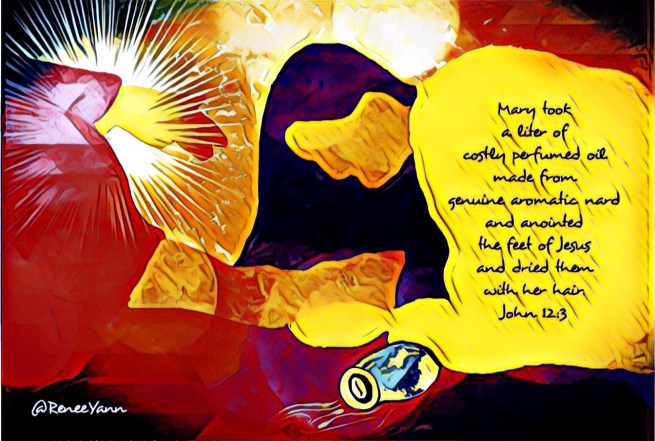
His disciples, women and men committed to the Gospel, also share the dramatic events of these days. Our Gospel today gives us Mary of Bethany, a leader and gatherer of the early Christian community. Her heart is broken at the now obvious prospect of Jesus’s death. In the name of their primal church, Mary offers Jesus the first sacrament of anointing.
In other words, “Have courage, Beloved Leader, we are with you.”
On this Monday morning of Holy Week, where are we in the community gathered around Jesus? How are we speaking to him, comforting him, loving him?
Jesus’s Passion is enfleshed in our time in the suffering of the poor, the refugee, the sick, the disenfranchised, those called “vermin” by the powerful. How am I with Jesus in his anguish today?
Music:Two offerings today, one classical, one modern.
Timor et Tremor – from Quatre motets pour un temps de pénitence (Four Penitential Motets) by Francis Poulenc
( I wrote this reflection for the Sisters of Mercy. It will be available on that blog as well. You may be interested in some of the other excellent articles to be found there. Click here for Sisters of Mercy blog.)
Today, in Mercy, we enter the sacred embrace of Holy Week.
Palm Sunday is a feast with two faces.
Jesus rides in triumph into Jerusalem, but his deep heart realizes that the road ultimately leads to his death. Jesus, who once called himself the Vine, knows that the bright green branches waved in adulation will soon be trampled to the ground.
In these final days of Lent, we are faced with the question, “What turns green hope to crumbled brown in us – and how can it be green again?”
Many years ago, I sat in a marbled, flowered funeral home with a bereaved father.
“There are things worse than death,” he said. After several absent years, his drug-addicted son had been found dead in an alley, under the cardboard box where he lived. “At least I know where he is now. Finally, we can all be at peace.”
Jack’s son had been lost to him. In the stranglehold of heroin, the great hope of his young life had degenerated into profound suffering. The vigor of his early dreams had withered, like broken tendrils on the once hopeful vine. It was, in every sense, a human tragedy.
Jesus understood such withering. He prayed for his disciples that they would not suffer it. He knew what would face him and them in the week following the lifted palms. He knows what will face us as we try to discern the honest path to joy, peace and fulfillment.
The enticements of evil are deceptive. Greed comes clothed as entitlement. Lust masquerades as passion, addiction as pleasure. They entwine and choke us in a false embrace that whispers, “This is for you.” Fed by the fear of never having or being enough, we resort to these very catalysts that will destroy us. Even the voice of love struggles to reach someone locked in this cycle of self-absorption. Like every barren branch, they wilt and sever themselves from all that could enliven them.
Jesus acknowledges that the choice for life is not always easy. He tells the disciples that, indeed, they will be pruned. No life escapes the incisions of hard experience. Like his followers, we too will face loss, pain, frustration and diminishment. But if our hearts have been fed by his word, we will hold to grace and we will thrive.
Much of the Palm Sunday crowd shifted gears by Friday, becoming a rabble of accusers. They could not follow Jesus through Calvary to his Resurrection.
But there is no true life apart from God. There is no path to perfection and joy but through God’s Will. The Passion and Death of Jesus have already set our roots in this blessed soil. May we cling by grace to that treasured Vine.
Music: J.S. Bach – Cantata; Himmelskönig, sei willkommen / King of Heaven, be Thou welcome – BWV 182
Evidently, this was needed. Because people need
to be screamed at with proof.
But Jesus knew his friends. Before they were,
he knew them; and they knew
that he would never leave them
desolate here. So he let his exhausted eyes close
at first glimpse of the village.
And immediately he seemed to be standing in their midst.
Here was Martha, the dead boy’s sister.
He knew he would always find her
at his right hand, and beside her
Mary. They were all here.
Yet opening his eyes it was not so.
He was standing apart,
even the two women
slowly backing away,
as if from concern for their good name.
Then he began to hear voices
muttering under their breath
quite distinctly; or thinking, Lord, if you had been here
our friend might not have died. (At that, he seemed to reach out
to touch someone’s face
with infinite gentleness,
and silently wept.) He asked them the way
to the grave. And he followed
behind them, preparing
to do what is not done
to that green silent place
where life and death are one.
Merely to walk down this road
had started to feel like a test,
or a poorly prepared-for performance with actors unsure of their lines, or which play they were supposed to be in;
a feverish outrage rising inside him
at the glib ease with which words like “living”
and “being dead” rolled off their tongues.
And awe flooded his body
when he hoarsely cried,
“Move the stone!”
“By now he must stink,”
somebody helpfully shouted.
(And it was true, the body
had been lying in the tomb
four days.) But he was far away,
too far away inside himself
to hear it, beginning
to fill with that gesture
which rose through him:
no hand this heavy
had ever been raised, no human hand
had ever reached this height
shining an instant in air, then
all at once clenching into itself
at the thought all the dead might return
from that tomb where the enormous cocoon
of the corpse was beginning to stir.
In the end, though, nobody stood
there at its entrance
but the young man
who had freed his right arm
and was pulling at his face,
at small strips of grave wrappings.
Peter looked across at Jesus
with an expression that seemed to say You did it, or What have you done? And all
saw how their vague and inaccurate
life made room for him once more.
~ by Franz Wright from a fragment by Rainer Maria Rilke ~






 Lavish Mercy