For God so loved the world that he gave his only Son, so that everyone who believes in him might not perish but might have eternal life. For God did not send his Son into the world to condemn the world, but that the world might be saved through him.
John 3:16-17
For some of us, it’s hard to believe in a God we do not see. This passage from John suggests that God understands how hard it is. So that believers might not “perish” in their natural doubts, God made Divinity visible in Jesus Christ. The reason? Infinite Love for and desire to be one with us.
Today, in God’s Lavish Mercy:
Let’s rest in the confidence and gratitude this passage ignites in our hearts. God loves us — loves you — enough to become like you so that you might become like God.
Poetry: Infinite Love – Julian of Norwich, who was an English anchoress of the Middle Ages. Her writings, now known as Revelations of Divine Love, are the earliest surviving English language works by a woman. They are also the only surviving English language works by an anchoress. ( An anchoress is someone who, for religious reasons, withdraws from secular society to be able to lead an intensely prayer-orientated, ascetic, or Eucharist-focused life.)
Infinite Love
Because of the great,
infinite love which God has for all humankind,
he makes no distinction in love
between the blessed soul of Christ
and the lowliest of the souls that are to be saved . . . .
We should highly rejoice that God dwells in our soul
and still more highly should we rejoice
that our soul dwells in God.
Our soul is made to be God’s dwelling place,
and the dwelling place of our soul
is God who was never made.
Music: God So Loved the World – Mormon Tabernacle Choir
The Lord our God is Lord alone! You shall love the Lord your God with all your heart, with all your soul, with all your mind, and with all your strength.
The second is this: ‘You shall love your neighbor as yourself.’ There is no other commandment greater than these.
Mark 12: 29-31
Is there even such a thing as a half-hearted love? When we truly love, we love completely. Otherwise, let’s call half-hearted love what it really is
convenience: I “love” because it fits my purposes
fear: I “love” because I am afraid of isolation and loneliness
pretense: I “love” because I don’t trust that I am loved in return
habit: I “love” because it’s the way I’ve always done things
keeping up appearances: I “love” because I don’t want anyone to know that I don’t really love
Today, in God’s Lavish Mercy:
Let’s pray to love God for God’s purposes with a love that is fearless, trustful, passionate, and committed.
Jesus teaches that such wholehearted love of God is demonstrated by merciful love of neighbor. It’s an easy test — or is it?
Quote: from Rumi
A thousand half-loves must be forsaken
to take one whole heart home.
Music: Wholehearted – by Newsong (lyrics below)
Trying to live in two worlds at one time Holdin’ on to all the things that I call mine Sayin’ one thing, but really livin’ two It’s not just hard, it’s impossible to do
Lord, I want You to know That this double life is through And everything, all of me I’m giving to You
And with my whole heart I’m gonna love You And with my whole life I’m gonna live it for You Take my heart, every secret part I’m wholehearted in love with You
Talk about peace and talk about real joy I’m talking about things I’ve never talked about before Two roads to go, but only one road for me I’ve seen both sides and I’m as sure as I can be
But, Lord, I want You to know That this double life is through And everything, all of me I’m giving to You
And with my whole heart I’m gonna love You And with my whole life I’m gonna live it for You Take my heart, every secret part I’m wholehearted in love with You
I’m not divided in my heart anymore (‘Cause I know it’s You) I said, it’s You and only You that I’m living for (Only with my whole heart)
And with my whole heart (Gonna love You) With my whole heart I’m gonna love You And with my whole life You know, I’m gonna live all it for You Take my heart, every secret part I’m wholehearted in love with You
With my whole heart You know, I’m gonna love You And with my whole life I’m gonna live it all for You Jesus, take my heart, every secret part I’m wholehearted in love
Wholehearted in love I’m in love with You, Lord… You know, I’m gonna live it all for You, Jesus Take my heart, take my soul Wholehearted in love…
Peter approached Jesus and asked him, “Lord, if my brother sins against me, how often must I forgive him? As many as seven times?” Jesus answered, “I say to you, not seven times but seventy-seven times.
Matthew 18: 21-22
Today’s parable reminds us that often our desire to be forgiven does not match our desire to forgive others. Of course, we understand our personal circumstances and see clearly how they deserve leniency. Can’t you hear yourself saying:
“I didn’t mean it!”
“I just forgot.”
“Give me another chance!”
“I won’t let it happen again.”
Many times people do hurtful things because of their own fears. Mercy calls us to receive and forgive those fears and limitations with the same generous grace as God receives us. And our merciful openness must extend endlessly .. “77 times”. That kind of sincere forgiveness takes a lot of grace. Let’s pray for it today.
Poetry: Forgiveness – George MacDonald
God gives his child upon his slate a sum –
To find eternity in hours and years;
With both sides covered, back the child doth come,
His dim eyes swollen with shed and unshed tears;
God smiles, wipes clean the upper side and nether,
And says, ‘Now, dear, we’ll do the sum together!’
Jesus said to his disciples: “Be merciful, just as your Father is merciful.
“Stop judging and you will not be judged. Stop condemning and you will not be condemned. Forgive and you will be forgiven. Give and gifts will be given to you; a good measure, packed together, shaken down, and overflowing, will be poured into your lap. For the measure with which you measure will in return be measured out to you.”
Luke 6: 36-38
How many times in our lives have we realized that, in giving or serving, we have received much more than we have given? No material recompense can rival the gift of another’s gratitude and trust. When we are merciful as God is merciful, we know a joy beyond measure.
Today, in God’s Lavish Mercy:
A wise older friend said this to me long ago, challenging me to live my life by the abundance of Divine Measure. You might like to reflect on her phrase as you pray today’s Gospel:
Never resist a generous impulse.
Prose: from Gratitude by David Whyte
Thankfulness finds its full measure
in generosity of presence,
both through participation and witness.
We sit at the table as part of every other person’s world
while making our own world without will or effort,
this is what is extraordinary and gifted,
this is the essence of gratefulness,
seeing to the heart of privilege.
Thanksgiving happens when our sense of presence
meets all other presences.
Being unappreciative might mean
that we are simply not paying attention.
Moses spoke to the people, saying: “This day the LORD, your God, commands you to observe these statutes and decrees. Be careful, then, to observe them with all your heart and with all your soul.
Deuteronomy 26:16
… you are to be a people peculiarly God’s own, as promised you; and provided you keep all his commandments,
Deuteronomy 26:18
… and you will be a people sacred to the LORD, your God, as he promised.”
Deuteronomy 26:19
Be perfect, just as your heavenly Father is perfect.
Matthew 5:48
In our readings today, God calls us to BE in the fullness of grace. For the people of the Old Testament, that path was found in the Law and Commandments. For Christians, that fullness is found in patterning our lives on Jesus. He showed us that God’s perfection is beyond Law. It is absolute Love and Mercy.
Today, in God’s Lavish Mercy:
In our prayer, we might ask for a deeper understanding of the “perfection” God asks of us – not a measurable, demonstrable alignment with subjective guidelines, but an unlimited openness to grace. God’s perfection is a Love without boundaries. Jesus is that Love made Flesh. In God, we are called to live in their example.
Poetry: Easy to Love a Perfect God – Shams-i of Tabrizi
Shams-i Tabrīzī (1185–1248) was a Persian poet who is credited as the spiritual instructor of Rumi and is referenced with great reverence in Rumi’s poetic collection. The tomb of Shams-i Tabrīzī was recently nominated to be a UNESCO World Heritage Site.
It’s easy to love a perfect God,
unblemished and infallible that God is.
What is far more difficult
is to love fellow human beings
with all their imperfections and defects.
Remember, only you can know
what you are capable of loving.
There is no wisdom without love.
Unless we learn to love God’s creation,
we can neither truly love
nor truly know God.
Today, in God’s Lavish Mercy, our readings are connected by the topic of leprosy.
The LORD said to Moses and Aaron, “If someone has on his skin a scab or pustule or blotch which appears to be the sore of leprosy, he shall be brought to Aaron, the priest, or to one of the priests among his descendants. If the man is leprous and unclean, the priest shall declare him unclean by reason of the sore on his head.
Leviticus 13:2-3
“Leprosy” (Hebrew “tzaraat“) is first mentioned in chapters 13 and 14 of the Book of Leviticus. The term referred not only to many types of skin maladies but to ritual impurities and visually perceptible “punishments for sin”. In ancient times, someone suffering from an affliction as common as eczema might have been shunned as a leper.
Essentially, Levitical Law could base moral judgment of a person on their physical appearance. One might be seen to suffer physical deformity because of their own sins or the sins of their ancestors. The illness or deformity was then used as an excuse to condemn and isolate the suffering person.
Cleansing of the Leper by Harold Copping
Even though our scripture readings today are ostensibly about “leprosy”, they are about much more. Our readings challenge our ability or inability to see, love, and support our neighbor for who they are, not for how they appear.
Jesus sees the person who comes to him, not the disease or disfigurement which inhibits him.
A leper came to Jesus and kneeling down begged him and said, “If you wish, you can make me clean.” Moved with pity, he stretched out his hand, touched him, and said to him, “I do will it. Be made clean.”
Mark 1: 40-41
Praying with today’s Gospel reminds me of the powerful movie “Philadelphia” starring Tom Hanks who won an Academy Award for his role as Andrew Beckett, a lawyer suffering from AIDS.
“Philadelphia” is notable for being one of the first mainstream Hollywood films not only to explicitly address HIV/AIDS and homophobia, but also to portray gay people in a positive light. Andrew Beckett is a senior associate at the largest corporate law firm in Philadelphia. He conceals his homosexuality and his status as an AIDS patient from others in the office. A partner in the firm notices a lesion on Beckett’s forehead. Although Beckett attributes the lesion to a racquetball injury, it indicates Kaposi’s sarcoma, an AIDS-defining condition.
wikipedia
My own reflection today benefitted from revisiting this scene from the film. Like any parable, the story invites us to find ourselves somewhere in it.
People can be cut off from society for many conditions, be they leprosy, AIDS, or any other visible impediment. But the underlying reason they are shunned is fear — something about the person frightens us, or threatens to upset our religious, political, or economic securities.
If we want to be like Jesus, we must move beyond those fears and judgments – to see and love the person whom Mercy sees.
Music: “La Mamma Morta”, a 1950 Studio recording by Renata Tebaldi
Those who remember this movie will also remember this beautiful aria, played when Denzel Washington comes to consult with Tom Hanks in his home. The moment is a turning point for Washington who is fighting his own fears and prejudices as he takes on Hank’s case.
“La mamma morta” (They killed my mother) is a soprano aria from act 3 of the 1896 opera Andrea Chénier by Umberto Giordano. It is sung by Maddalena di Coigny to Gérard about how her mother died protecting her during the turmoils of the French Revolution.
Today, in God’s Lavish Mercy, we finish with the Book of Kings. And, as several of my readers have told me, they’ll be glad for it. There may have been points in our journey through Samuel and Kings, when you thought, “WHY am I even reading this! Who cares about Rehoboam, Jeroboam or any other “boams”!
I understand, but here are two of my “WHY”s:
The Hebrew Scriptures show us how human beings deepened, over thousands of years, in their understanding of God. Throughout that extended deepening, God remains unchangingly faithful. Even though the cultural context of some Old Testament stories may upset, befuddle, or offend us, they still express the human attempt to find God in one's experience.
The Hebrew Scriptures inform and underlie the theology of the Christian Scriptures, and the culture in which Jesus lived and taught. Like a butterfly is the fulfillment of the chrysalis, Jesus was the fulfillment of the Promise to Abraham. Without an appreciation of that Promise, and how Israel lived out its long realization, our comprehension of Christ's meaning is limited.
Our Gospel today gives us the familiar story of the feeding of the multitude. Mark describes a large crowd engaged in the search for God. They follow Jesus for three days, listening, learning, and being amazed at his miracles. They are so hungry to find something to believe in that they forget to feed their human hungers!
I love the compassionate way Jesus takes notice of their predicament:
“My heart is moved with pity for the crowd, because they have been with me now for three days and have nothing to eat. If I send them away hungry to their homes, they will collapse on the way, and some of them have come a great distance.”
In this pivotal miracle, Jesus teaches a core lesson of faith.
In Christ, we are given the gift of full and abundant life. Our hearts then must become like his, moved in mercy toward those who are still hungry, both spiritually and physically.
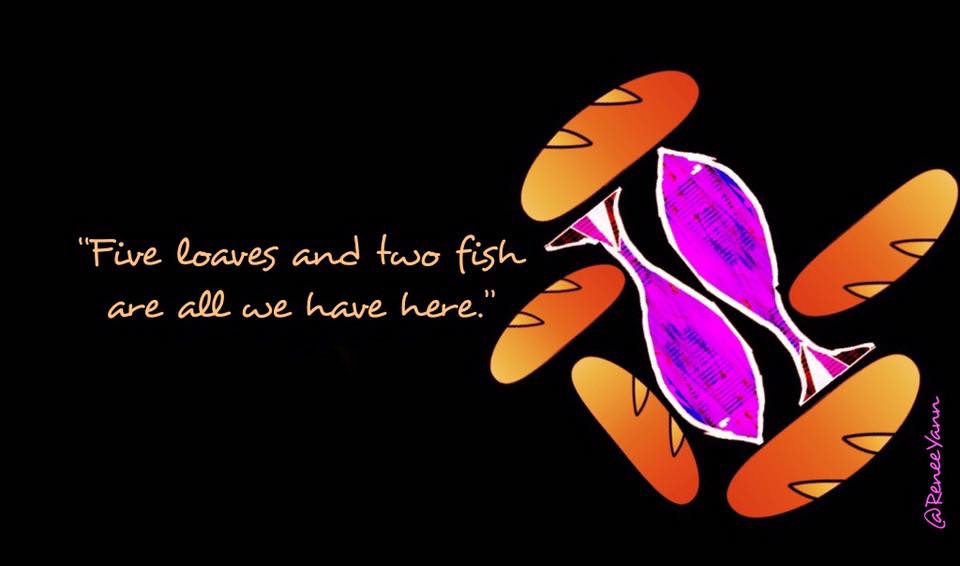
The miracle of the loaves and fishes calls the faithful community to the practice of shared abundance. It invites us to notice the hungers around us and within our world. It moves us to understand the distances people experience from love, inclusion, respect, security, and peace. It convinces us that the need to have more and more will only yield less and less for our spirits.
Our culture works to convince us that we can never work hard enough or accumulate enough. It deludes us to believe that we matter because of what we have, not because of who we are. In this miracle, Jesus models another way to live in relationship with God, ourselves and with Creation:
Trust in and respect for the abundant generosity of God’s Creation
His disciples answered him, “Where can anyone get enough bread
to satisfy them here in this deserted place?”
Still he asked them, “How many loaves do you have?”
They replied, “Seven.”
He ordered the crowd to sit down on the ground.
Deep reverence and gratitude for God’s Presence in all life
Then, taking the seven loaves he gave thanks, broke them,
and gave them to his disciples to distribute,
and they distributed them to the crowd.
They also had a few fish.
He said the blessing over them
and ordered them distributed also.
They ate and were satisfied.
Acknowledgement of our need to replenish our spirits in rest and solitude
He dismissed the crowd and got into the boat with his disciples
and came to the region of Dalmanutha.
Somewhere in each of our lives, we might find a few loaves or minnows hidden away. Or we might be the famished one with an empty basket after a long journey. Today’s Gospel tells us to invite God’s transformative grace into our needs, hungers, inhibitions, or emptiness. Like this amazed Gospel crowd, we might be wowed at what God can do with our generous hearts!
Poetry: In the Storm – Mary Oliver
Some black ducks
were shrugged up
on the shore.
It was snowing
hard, from the east,
and the sea
was in disorder.
Then some sanderlings,
five inches long
with beaks like wire,
flew in,
snowflakes on their backs,
and settled
in a row
behind the ducks --
whose backs were also
covered with snow --
so close
they were all but touching,
they were all but under
the roof of the duck's tails,
so the wind, pretty much,
blew over them.
They stayed that way, motionless,
for maybe an hour,
then the sanderlings,
each a handful of feathers,
shifted, and were blown away
out over the water
which was still raging.
But, somehow,
they came back
and again the ducks,
like a feathered hedge,
let them
crouch there, and live.
If someone you didn't know
told you this,
as I am telling you this,
would you believe it?
Belief isn't always easy.
But this much I have learned --
if not enough else --
to live with my eyes open.
I know what everyone wants
is a miracle.
This wasn't a miracle.
Unless, of course, kindness --
as now and again
some rare person has suggested --
is a miracle.
As surely it is.
Music: Krystian Zimerman – Beethoven: Piano Concerto No. 5 in E Flat Major, Op. 73: II. Adagio un poco moto
A lovely piece to accompany our reflection on faith, miracles, and abundance.
Today, in God’s Lavish Mercy, our readings might lead us to consider what we pay attention to in our spiritual lives and why.
In our first reading, Solomon prays simply and sincerely before the presence of God. It is the prayer of one who is spiritually vulnerable to God’s grace in whatever way it comes.
Solomon stood before the altar of the LORD in the presence of the whole community of Israel, and stretching forth his hands toward heaven, he said, “LORD, God of Israel, there is no God like you in heaven above or on earth below; you keep your covenant of mercy with your servants who are faithful to you with their whole heart.
1 Kings 8:22-23
Solomon’s focus in prayer is to honor and acknowledge God and to ask mercy for himself and the people for whom he is responsible.
Today’s Responsorial Psalm 84
The Pharisees, on the other hand, fear the presence of God in Jesus because he threatens the collapse of their false religionism. To protect their man-made securities, they have constructed an elaborate maze of rules and judgments which hardens them to renewing grace.
Rather than listen to Jesus who offers them redemption, they focus on the lifeless particularities of the Law:
When the Pharisees with some scribes who had come from Jerusalem gathered around Jesus, they observed that some of his disciples ate their meals with unclean, that is, unwashed, hands.
Mark 7:1-2
The Pharisees’ recalcitrance disappoints and angers Jesus:
He responded, “Well did Isaiah prophesy about you hypocrites, as it is written:
This people honors me with their lips, but their hearts are far from me; In vain do they worship me, teaching as doctrines human precepts.
You disregard God’s commandment but cling to human tradition.” He went on to say, “How well you have set aside the commandment of God in order to uphold your tradition!
Mark 7:6-8
We live our lives always in the Presence of God. Do we even realize this? Do we pray, like Solomon, with an open heart for the grace to grow ever closer to God in every circumstance that is offered to us?
Do we ask for the grace to see where judgments, measurements, and definitions limit our spiritual growth?
As I read today’s Gospel, I think of Pope Francis’s recent decision to allow the blessing of same-sex couples. Francis looked beyond traditional constraints to offer healing mercy to those seeking God’s love. Some people, caught in strictures similar to those of the Pharisees, have not only resisted but condemned the Pope for his decision.
The situation is not dissimilar from that of today’s Gospel. What can we learn about our own attitudes and spiritual openness as we pray with these readings? What can Solomon teach us about sincere, humble, and transparent prayer?
Poetry: Peace Is This Moment Without Judgment – Dorothy Hunt
Do you think peace requires an end to war? Or tigers eating only vegetables? Does peace require an absence from your boss, your spouse, yourself?… Do you think peace will come some other place than here? Some other time than Now? In some other heart than yours? Peace is this moment without judgment. That is all. This moment in the Heart-space where everything that is is welcome. Peace is this moment without thinking that it should be some other way, that you should feel some other thing, that your life should unfold according to your plans. Peace is this moment without judgment, this moment in the Heart-space where everything that is is welcome.
Music: Heart of Gold – Nicholas Gunn
I think this song can be like a prayer asking God’s warmth and mercy in our judgments and prayers.
Today, in God’s Lavish Mercy, Jesus shows us how to live a merciful life – through loving, generous, joyfully responsive service.
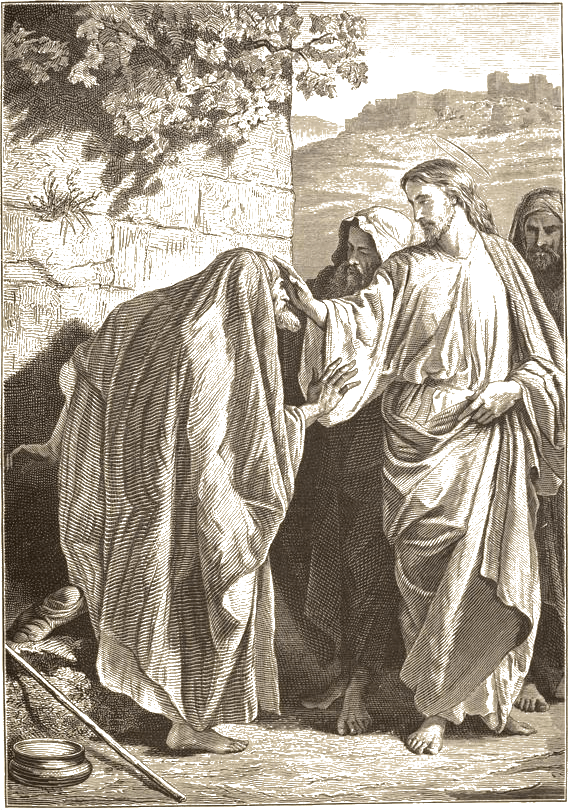
A leper came to him and kneeling down begged him and said, “If you wish, you can make me clean.” Moved with pity, he stretched out his hand, touched the leper, and said to him, “I do will it. Be made clean.”
Mark 1: 40-41
A pitiable leper interrupts Jesus on his journey to ask for help. People like this man were scorned, feared, and isolated. Their leprosy impoverished them, making them annoying beggars. Their cries usually met with indifference at best and banishment at worst.
But when this leper poses his proposal to Jesus – “If you want to, you can heal me.” — Jesus gives the spontaneous answer of a true, merciful heart: “Of course I want to!”
Jesus heals the Leper – Alexandre Bida
There is no annoyance, no suggestion that other concerns are more important. There is just the confirmation that – Yes- this is my life’s purpose: to heal, love, and show mercy toward whatever suffering is in my power to touch. There is simply the clear message that “You, too, poor broken leper, are Beloved of God.”
What an example and call Jesus gives us today! We are commissioned to continue this merciful touch of Christ along the path of our own lives. When circumstances offer us the opportunity to be Mercy for another, may we too respond with enthusiasm, “Of course I want to!” May we have the eyes to see through any “leprosy” to find the Beloved of God.
Poetry: from Naming the Leper – Christopher Lee Manes
Between 1919 and 1941, five relatives of Christopher Lee Manes were diagnosed with an illness then referred to as “leprosy” and now known as Hansen’s disease. After their diagnosis, the five Landry siblings were separated from their loved ones and sent to the National Leprosarium in Carville, Louisiana, where they remained in quarantine until their deaths. Drawing on historical documents and imaginative reconstructions, Naming the Leper tells through poetry this family’s haunting story of exile and human suffering.
Manes won the Summerlee Book Prize for his work. Here is an excerpt that conveys the aimless desolation felt by “the leper” — likely felt by Jesus’s leper too.
” the trouble with this place…”
Dear Claire,
The trouble with this place
is getting out of bed to live
through the corpse of another day;
letting the world roll as God wants it,
while we sit on the front porch
and wave flies
from our face.

Isn’t it a wonder
more of us do not go crazy,
forced to live brooding over these
unfortunate conditions;
thrown into a contact so intimate and prolonged
we let go our reflections in the river,
and our loved ones—but most importantly,
the very children we’ve begotten—
forget us.
Today, in God’s Lavish Mercy, John is gentle but scathingly direct in his teaching:
Children, let no one deceive you. The person who acts in righteousness is righteous, just as God is righteous. Whoever sins belongs to the Devil, because the Devil has sinned from the beginning.
1 John 3: 7-8
John tells us that good is good, and bad is bad. Don’t let anyone fool you. And don’t make excuses when you fool yourself!
John gives us a clear measuring stick to test alignment with his teaching:
In this way, the children of God and the children of the Devil are made plain; no one who fails to act in righteousness belongs to God, nor anyone who fails to love their sisters and brothers.
1 John 3:10
It’s so simple but so hard to be the kind of person John calls us to be!
In our deep hearts, we know what righteousness looks like. It looks like peace, forgiveness, reverence, truth-telling, kindness, service, faithfulness, hope.
And we know what unrighteousness looks like. It looks like war, vengeance, brutality, bigotry, manipulation, indifference, greed, selfishness, megalomania, dishonesty, fear-mongering.
How has our society gotten so mixed up that we allow unrighteousness to parade in the costume of justice! How have we gotten so lazy, greedy, or indifferent that we refuse to look for and remedy the root causes of our societal grievances? For example, when I dig deeper in my prayerful thinking, I might realize that:
Thousands of immigrants are not crossing their borders just to bother me or take my job! They are in fear for their lives and well-being because of a lopsided global economy and a classist devaluation of life.
The armament and weapons industries are not founded on a mission to protect me and my loved ones. Like all businesses, they operate to make money. The more guns they sell, and the more expensive and destructive they are, all the better. We are their marketplace not their protectorate.
The Scriptures are God’s living Word. They are not to be read and set aside as a completed devotional practice meaningless for today’s world.
They teach us about the past but they speak to us of the present. As we pray with them, we are called to be changed by them into persons who more clearly reflect Jesus and the Gospel. That is the hard work of righteousness – work that is the everyday stuff of our lives.
Deeply internalizing John’s teaching today is a good place to start our transforming prayer.
Poetry:And 2morrow – Tupac Shakur, (1971 – 1996), was an American rapper. He is widely considered one of the most influential and successful rappers of all time. Shakur is among the best-selling music artists, having sold more than 75 million records worldwide. Much of Shakur’s music has been noted for addressing contemporary social issues that plagued inner cities. His life was filled with violence and eventually, he was murdered, but his creative work revealed a deep though conflicted longing for justice and peace.
Today is filled with anger
fueled with hidden hate
scared of being outcast
afraid of common fate
Today is built on tragedies
which no one wants 2 face
nightmares 2 humanities
and morally disgraced
Tonight is filled with rage
violence in the air
children bred with ruthlessness
because no one at home cares
Tonight I lay my head down
but the pressure never stops
knawing at my sanity
content when I am dropped
But 2morrow I c change
a chance 2 build a new
Built on spirit intent of Heart
and ideals
based on truth
and tomorrow I wake with second wind
and strong because of pride
2 know I fought with all my heart 2 keep my
dream alive
Music: Beauty for Brokenness (God of the Poor) – Graham Kendrick









 Lavish Mercy