Grace-filled Water

Third Sunday of Lent

March 15, 2020

Click here for readings

Today, in Mercy, water flows through all our readings, inviting us to God’s refreshing Mercy.
Gen_rock

For the thirsty and testy Israelites, the water flows from the rock of their hopelessness. Wandering in the desert for days on end, they are exhausted and bewildered. Each sunrise seems to push their destination farther away rather than bring it closer. They are thirsty … but for a lot more than a cool drink.

And God gives everything they need – not only water, but surprised hope and renewed confidence as they witness the mighty rock split at Moses’ touch.

Paul points out that it is, indeed, that hope which truly slakes the deeper thirst. 

And hope does not disappoint,
because the love of God has been poured out into our hearts
through the Holy Spirit who has been given to us.

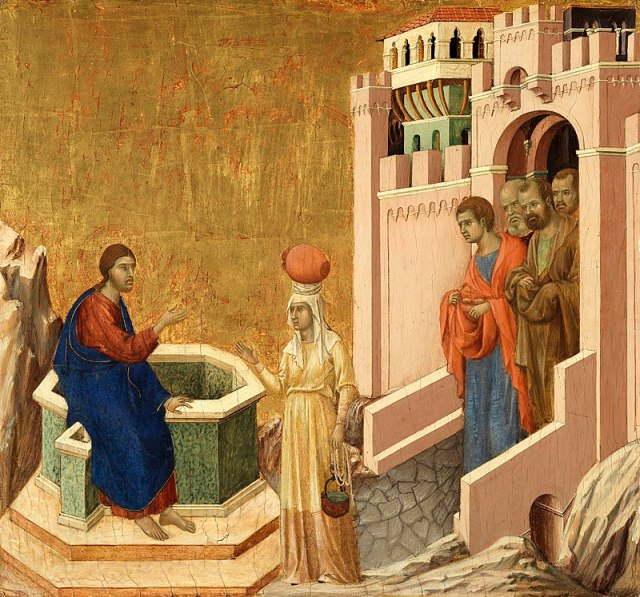
In our Gospel story, Jesus awakens in the Samaritan woman a thirst and hope she didn’t know she had. The layers of her tangled life had formed an impervious rock around her, insulating her from her own soul’s needs.
800px-Duccio_di_Buoninsegna_-_Christ_and_the_Samaritan_Woman_-_Google_Art_Project
Christ and the Samaritan Woman by Duccio di Buoninsegna

Jesus, “tired from the journey”, expressed his own need to her. This simple request unleashes a cascade of searching from the woman. Jesus, seeing her readiness for grace, catches all that pours out from her. He transforms it into a challenge for conversion:

Jesus answered and said to her,
“If you knew the gift of God
and who is saying to you, ‘Give me a drink, ‘
you would have asked him
and he would have given you living water.”

And she accepts the challenge:

Sir, give me this water,
so that I may not be thirsty again.

As we pray today, we may sense a desert within us. Or we may feel that our soul’s journey has become frustratingly circuitous. We may be like the Samaritan woman, sitting beside a well that seems slowly drying out. Maybe the juices have dwindled in our souls.

In these readings, as we listen to the Ancients call out for flowing grace, we may find a way to ask God for the refreshment we need just now.

Living Waters – Gettys

Come Back!

Saturday of the Second Week of Lent

March 14, 2020

Click here for readings

Today, in Mercy, our readings are soaked in Mercy itself … seasoned by repentance, forgiveness, hope, and trust.

Both in Micah’s lilting, poetic words and in Jesus’s  parable, we are embraced by the infinite tenderness of God.

You may find the following comparison odd at first, but stay with me a minute. Reading this morning’s scriptures, I thought of Lidia Bastianich, the famous chef. To me, her show is the perfect combination of instruction, humor, and familial camaraderie. Still, even though Lydia offers tons of invaluable culinary tips, it is her repeated farewell phrase that I most treasure: “Tutti a tavola a mangiare!”. “Let everyone come to the table and eat!”

Lydia


Micah, who prophesied just prior to the Siege of Jerusalem in 587 BC, condemned the sinfulness rampant in Israel and Judah. At the same time, he consoled the “remnant” people and, àla Lydia, invited them to the table of forgiveness and reconciliation. Here’s the way Micah asks God to “set the table” for God’s repentant People:

Shepherd your people with your staff,
the flock of your inheritance,
That dwells apart in a woodland,
in the midst of Carmel.
Let them feed in Bashan and Gilead,
as in the days of old …


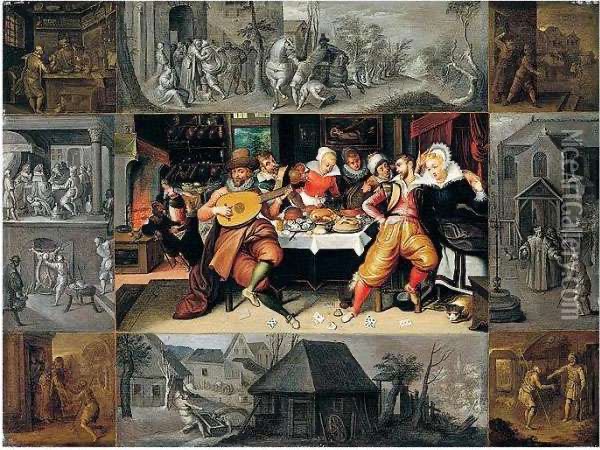
prodigal dinner
The Parable of the Prodigal Son by Frans II Francken

Jesus describes a similar banquet offered to the repentant son:

The father ran to his son, embraced him and kissed him.
His son said to him,
‘Father, I have sinned against heaven and against you;
I no longer deserve to be called your son.’
But his father ordered his servants,
‘Quickly, bring the finest robe and put it on him;
put a ring on his finger and sandals on his feet.
Take the fattened calf and slaughter it.
Then let us celebrate with a feast
because this son of mine was dead, and has come to life again;
he was lost, and has been found.’

As I pray today, I ask if there is any lost or hungry part of my spirit that longs to return to the table of Peace and Mercy. I pray also for those places and souls throughout our world who hunger to hear:

Tutti a tavola a mangiare!”

Music: Father, I Have Sinned -written by Fr. Eugene O’Reilly

Turn and See

Thursday of the Second Week of Lent

March 12, 2020

Click here for readings

Today, in Mercy, our readings offer us studies in dramatic contrasts.

the barren bush in a lava waste
vs.
the tree planted beside the waters

that turns its roots to the stream

Jere17_7barrentree


a rich man who dressed in purple garments and fine linen

vs.
a poor man named Lazarus, covered with sores

Gustave_Dore_Lazarus_and_the_Rich_Man
Lazarus and the Rich Man by Gustave Dore (1891)


What are Jeremiah and Jesus teaching us with these unforgettable images?

Jeremiah summarizes his point in the very first verse:

Cursed is the one who trusts in human beings,
who seeks strength in flesh,
whose heart turns away from the LORD.

In his parable, Jesus has Abraham deliver the point:

You received what was good during your lifetime
while Lazarus likewise received what was bad;
but now he is comforted here, whereas you are tormented.


Praying with these passages, we might determine to make sure we don’t end up like the barren bush or the ultimately tormented rich person. 

But how can we do that?

I think the key lies in Jeremiah’s phrase, “one whose heart turns away from the LORD.” 

In his parable, Jesus shows us what that “turning” looks like. It is any blind indifference in us that allows us to ignore another’s suffering. 

Most of us don’t consciously choose that indifference. We simply fail to turn from our own comfort … plans, needs, agenda … to observe the pain or need around us.

So as we leave our prayer today, perhaps we can do so determined to turn from our self-interests … to see if there is a “Lazarus” right beside us whom we had failed to notice.

Music: Turn My Heart – Lynn DeShazo (Lyrics below)

Turn my heart O Lord
Like rivers of water
Turn my heart O Lord
By Your hand
‘Til my whole life flows
In the river of Your Spirit
And my name
Bring honor to the Lamb

Lord I surrender to
Your work in me
I rest my life within
Your loving hands

(Repeat chorus 3 times)

‘Til my name brings honor
To the Lamb

Here’s That Cup, Again!

Wednesday of the Second Week of Lent

March 11, 2020

Click here for readings

Today, in Mercy, we learn a lesson in humble leadership, thanks once againto “Mrs. Zebedee”.

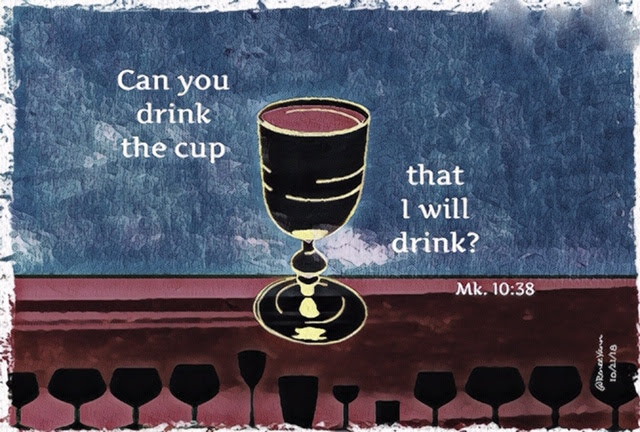
Mk 10_38 cup

Our Gospel recounts the story of the mother of James and John interceding for her sons with Jesus. Like many overprotective mothers, she intervenes even into their adult lives. She wants to make sure they get the best deal for their investment with Jesus.

Listen, I understand and love her! I would be the same way with my kids if I had any. I often say it’s best I had none because “Overprotective Me” would have had to shadow them to school, dances, playgrounds etc. until they were about 35 years old!

But the point of this Gospel story isn’t Mrs. Zebedee’s overprotectiveness.  It has little to do with Mrs. Zebedee at all.

The point is that “Mrs. Zebedee” (like many of us) has missed the whole POINT. The Gospel story is about US and the integrity of our choice to live a life in the pattern of Jesus.

Christ’s disciples have decided to follow a man who says things like this:

  • The last shall be first and the first, last.
  • Unless you lay down your life, you cannot follow me.
  • Whoever takes the lowly position of a child is the greatest in the Kingdom of Heaven.

The seats at Christ’s right and left, which Mrs. Zebedee requests for her sons, will bring them rewards only through humility and sacrificial service.


Here’s the way a 14th century artist imagined the Zebedee family. (Dad looks happy!)

sons of zebedee
Mary Salome and Zebedee with their Sons James the Greater and John the Evangelist (c.1511) by Hans von Kulmbach, Saint Louis Art Museum


Jesus is gentle with “Mrs. Zebedee”. He understands how hard it is for any of us to comprehend the hidden glory of a deeply Christian life. We are surrounded by a world that screams the opposite to us:

  • Me first!
  • Stand your ground!
  • Good guys finish last!

So Jesus turns to James and John (and to us). One can imagine the bemused look on Christ’s face. He knows the hearts of his disciples. He knows they have already given themselves to him. So he asks them for a confession of faith, “Can you drink the cup that I will drink?”

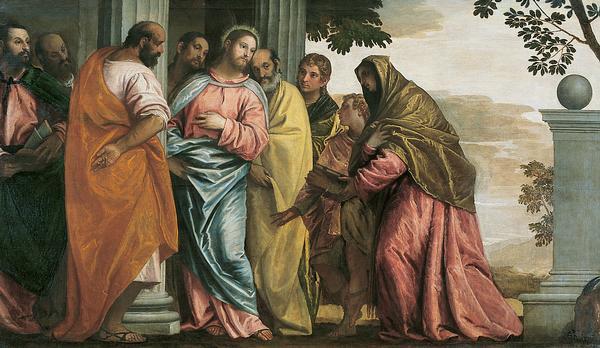
veronese-le-christ-rencontrant-la-femme-et-les-fils-de-zebedee_-_grenoble
The meeting of Christ with Zebedee’s wife and sons by Paolo Veronese

Their humble, faith-filled answer no doubt stuns their mother. She is left in wonder at the holy men her sons have become. Perhaps it is the beginning of her own deep conversion to Christ.

As we pray with this passage, where do we find ourselves in this scene? How immediate, sincere, and complete is our response to Jesus’ question: “Can you drink the cup….?”

Music: To Be a Servant – David Haas

Refrain:
For I have come not to be served but to serve;
To give my life.
If you wish to be the first you must seek
To be a servant, to be a servant.

1. Can you drink the cup that I must drink;
Are you willing?
Can you be baptized like I have been baptized?
Are you able? Are you able?

2. For to sit at my right hand or at my left,
Is not for me to give.
But for those for whom it has been prepared,
It will be given. It will be given.

A Plea for Mercy

Monday of the Second Week in Lent

March 9, 2020

Click here for readings

bruggemann

Today, in Mercy, our reading from Daniel gives us one of the Great Prayers of the Old Testament (according to Walter Brueggemann’s like-named book.)

The Book of Daniel and chapter nine in particular, have been the subjects of extensive biblical exegesis. Chapter nine in considered one of the Messianic Prophecies, Old Testament markers pointing to Christ. So there is much we could study about today’s first reading.


But how might we pray with it?

Naming the sins of all the People, Daniel’s great prayer is a plea for mercy:

Lord, great and awesome God,
you who keep your merciful covenant
toward those who love you
and observe your commandments! …
… yours, O Lord, our God,
are compassion and forgiveness!

Three themes, so strikingly germane to Lent, arise from Daniel’s prayer:

Repentance
Forgiveness
Transformation


Our Responsorial Psalm picks up this plea to Mercy for Mercy:

Remember not against us the iniquities of the past;
may your compassion quickly come to us,
for we are brought very low.
R.    Lord, do not deal with us according to our sins.
Help us, O God our savior,

because of the glory of your name;
Deliver us and pardon our sins
for your name’s sake.


The questions for each of us as we pray today —

Is there someplace in my life
longing for such mercy and healing?

Where can my spirit grow
from repentance, forgiveness, and transformation?

be Mercy

In our Gospel Jesus tells us how to open our hearts to this merciful healing.

Be merciful, just as your Father is merciful.
Stop judging and you will not be judged.
Stop condemning and you will not be condemned.
Forgive and you will be forgiven.
Give and gifts will be given to you;
a good measure, packed together, shaken down, and overflowing,
will be poured into your lap.
For the measure with which you measure
will in return be measured out to you.”

There it is in black and white. Whether or not the advice changes my heart is up to me!

Music: Kyrie Eleison (Lord, have mercy) Beethoven- Missa Solemnis

It’s Your Turn!

Second Sunday of Lent

March 8, 2020

Click here for readings

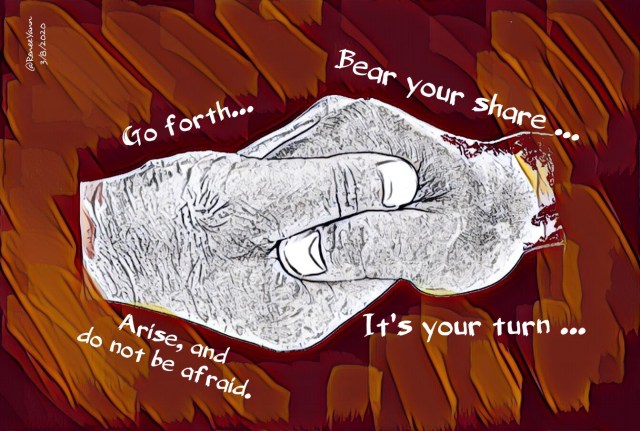
Today, in Mercy, as I prayed with these readings, I heard the words “It’s your turn.”

In our passage from Genesis, it’s the message God gives Abram:

Go forth from the land of your kinsfolk
and from your father’s house
to a land that I will show you.

In other words, I have reached from my Infinite Perfection to call you into a covenant of love. Now, it’s your turn to leave your comfort zone and go find my hope for you and for my people.


In Timothy’s letter, the call comes in this form:

Bear your share of hardship for the gospel
with the strength that comes from God.

Again Timothy tells us that Christ carried the cross so that we could have eternal life. It’s our turn now to bear any cross all the way to the empty tomb.


And in our Gospel, the just transfigured Jesus calls his beloved disciples to a new courage:

“Rise, and do not be afraid.”

In other words.. things are going to get really tough. You have just seen a Glorious Light that will take you through the darkness. It’s your turn to walk beside me on the coming journey.


Folded in each of these messages is the implication that, although challenges may come, a stronger commitment to God and God’s hope is being opened before each listener — before us.

its ur turnJPG

Scripture records the long, ensuing story of Abram’s response. We know, too, how Timothy’s early Christian community turned persecution into indomitable witness. And the commitment of Peter, James, and John built the foundation of our faith.


Every morning when God wakes us up, the Holy Voice shining in the morning light whispers, “It’s your turn. Today will be part of your journey into my Heart. How will you respond to the many calls being offered you?”

Let this “Transfiguration Moment” give us brave, loving, and insightful hearts! Let us walk the path Christ would walk, especially as we deepen into the lovely blessings of Lent.

Music:  Transfiguration – Carey Landry

We behold the splendor of God
shining on the face of Jesus.
We behold the splendor of God
shining on the face of the Son.

And oh, how his beauty transforms us,
the wonder of presence abiding.
Transparent hearts give reflection
of Tabor’s light within, of Tabor’s light within.

Jesus, Lord of Glory, Jesus, Beloved Son,
oh, how good to be with you;
how good to share your light;
how good to share your light.

We behold the splendor of God
shining on the face of Jesus.
We behold the splendor of God
shining on the face of the Son.

And oh, how his beauty transforms us,
the wonder of presence abiding.
Transparent hearts give reflection of
Tabor’s light within, of Tabor’s light within.

Jesus, Lord of Glory,
Jesus, Beloved Son,
oh, how good to be with you;
how good to share your light;
how good to share your light.

Beyond Measure

Friday of the First Week of Lent

March 6, 2020

Click here for readings

ps130 iniquities

Today, in Mercy, our readings could confuse us with their threads of legalistic logic. We see several examples of “if-then” admonitions that can make us picture God as an accountant measuring every choice we make.

  • If the wicked man turns, … then he shall surely live
  • If the virtuous man turns, … then none of his good deeds shall be remembered.
  • If you, O Lord, Mark iniquities … then who can stand.
  • If you go to the altar unreconciled … then leave and be reconciled.

measure

Sometimes, we can get obsessive about the “if-then” aspects of religion. And IF we do, THEN we probably miss the whole point. Because folded in today’s “if-then” seesaws is the truth of these passages: that the Lord does NOT sit miserly in Heaven to mark our iniquities.

The Lord measures the righteousness of love.


“Thus says the LORD, “Let not a wise man boast of his wisdom, and let not the mighty man boast of his might, let not a rich man boast of his riches; but let him who boasts boast of this, that he understands and knows Me, that I am the LORD who exercises lovingkindness, justice and righteousness on earth; for I delight in these things,” declares the LORD.—Jeremiah 9:23-24


Today’s Responsorial Psalm offers us a beautiful prayer for this morning as we pray in the embrace of God’s Lavish Mercy:

I trust in the LORD;
my soul trusts in his word.
My soul waits for the LORD
more than sentinels wait for the dawn.
Let Israel wait for the LORD.
For with the LORD is kindness
and with him is plenteous redemption;
And he will redeem Israel
from all their iniquities.

Let’s wait for the Lord today to see where God’s Grace invites us to the righteousness of Love.

Music: Everlasting Love – Mark Hendrickson & Family (Lyrics below)

Chorus
With an everlasting love
I love you I love you
With an everlasting love
a love that’ll never end
I love you.

Till the stars lose their way
In the heavens up above
And the oceans all run dry
Till the clouds in the sky
Keep the rain all to themselves
Even longer I’ll love you
This I promise I’ll love you
My word I give it’s true
I love you

Till the morning sun ceases to arise
And the moon forgets to shine
Until heaven’s blue is erased from the sky
Even longer I’ll love you
This I promise I’ll love you
My word I give it’s true
I love you

A Second Chance

Wednesday of the First Week in Lent

March 4, 2020

Click here for readings

Jonah3_1another chance

Today, in Mercy, one line from our readings hit me like a lightening bolt:

The word of the LORD
came to Jonah
a second time.

Yes, it’s the truth! God will keep coming back again and again to encourage us to hear his true message for our lives.


Our Gospel gives us a hint about how resistant we sometimes are to this deep listening:

This generation is an evil generation;
it seeks a sign, but no sign will be given it,
except the sign of Jonah.


What is the sign of Jonah anyway?

res and life


To put it simply, it is the witness of the Resurrection – that overarching event that changed everything for believers. For just as Jonah was able to return from certain death in the whale’s belly, so Christ conquered death and rose to new life, promising us the same power.

This is the central, life-changing belief for Christians. It should make a difference in how we live.


By our Lenten repentance, we can be like Jonah, grasping the second chance God always gives us to respond to our life circumstances with faith, hope, and love.

I would bet there is something in your life right now that is calling you to such a response. Someplace in your life, you may be caught in a bit of a “whale’s belly 🐳” about some issue, am I right?

God makes us ask ourselves questions most often when He intends to resolve them. He gives us needs that He alone can satisfy, and awakens capacities that He means to fulfill. Any perplexity is liable to be a spiritual gestation, leading to a new birth and a mystical regeneration.” ― Thomas Merton, The Sign of Jonas

Today’s readings remind us that we already have the glorious sign of the Resurrection to inspire us to leap from that dark “belly” into God’s hope for us!

Music:  a fun song “In the Belly of  Whale” – The Newsboys

No Apples!

First Sunday of Lent

March 1, 2020

Click here for readings

Today, in Mercy, we encounter themes of creation, life, temptation, sin, death, and repentance. I’d say that’s a pretty loaded Sunday!

apples

We start out with the simple, but heavily misinterpreted, story of Adam and Eve. This creation myth shared by Judea-Christian and Islamic religions serves as a foundation of these great faith traditions. 

The story is often the first we learn as we are introduced to our family’s faith practice. We imagine Adam and Eve as historically real personalities and the snake as a flesh and blood devil. Some of us never get beyond that elementary understanding of the story.

A and EA few decades ago, I taught New Testament Studies to a class of men aspiring to become deacons. During the session on today’s reading from Romans, a discussion arose about whether an entire human race could descend from just a “first man and woman”. When I pointed out that the creation story uses mythical elements to represent a broader reality, one man reacted adamantly. He could not imagine that there were not a specific “Adam” and “Eve”, but that instead these names represented humankind in their evolving relationship with God. The thought was so shattering to him that he dropped the class. 

That made me sad. But it also caused me to focus on the creation story myself to examine ways in which I might be missing or blocking its deep spiritual significance. Is it really just about temptation, sin, punishment, and death? Or is there a much deeper message for our faith?

One of my go-to theologians has helped me significantly. Walter Brueggemann says this about our consideration of the Creation Story:


Like the people in this narrative, our concern is not finally the danger of sex, the origin of evil, the appearance of death, or the power of the fall. It is, rather, the summons of this calling God for us to be his creatures, to live in his world on his terms.


We struggle throughout our lives to understand God and God’s ways – to live on God’s terms. We will never accomplish it.  We will always meet the “snakes” of questions like:
why

  • Why is there evil in the world?
  • Why does God let innocent people suffer?
  • Why is “this” (Whatever trial) happening to me?
  • Why did he or she have to die so young?
  • Why don’t the bad people die instead?
  • Why? Why? Why?

We want KNOWLEDGE – just what the “serpent” facetiously offered from the forbidden tree!


But this beautiful creation story teaches us that what God desires from us is not knowledge but rather TRUST – trust to live in the unfolding, but never fully-unfolded, mystery of God’s faithfulness to us.

So much in us wants to pluck the magic apple that will make us the “gods” of our existence, controlling life as we would like it to be.

God says instead that we should trust, and delight in sitting under the mysterious, nurturing tree of God’s irreversible, covenantal love – the same love Jesus trusts in today’s challenging Gospel.

Music: Nothing I Hold on To – Will Reagan ( Listen to it like a mantra and let your breathing synch to it. Breathe in Love. Breathe out Trust. No apples necessary.)

Lent: The Wound

Friday after Ash Wednesday

February 28, 2020

Click here for readings

Today, in Mercy, Isaiah cuts his listeners no slack — and we too are his listeners.

Is58_7_10

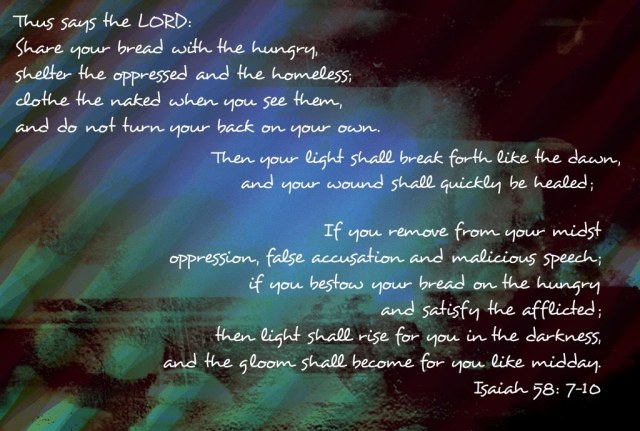
In this powerful passage, the prophet shatters the pretenses of those who make a show of religion. Speaking with God’s voice, Isaiah lambastes those who fast and pray but practice no works of justice and mercy.

“Lo, on your fast day you carry out your own pursuits,
and drive all your laborers.
Yes, your fast ends in quarreling and fighting,
striking with wicked claw.”

These “fake fasters” are left wondering why God doesn’t answer their prayers. The prophet tells them that God isn’t fooled by their pretenses:

Is this the manner of fasting I wish,
of keeping a day of penance:
That a man bow his head like a reed
and lie in sackcloth and ashes?

Isaiah says that God’s not into sackcloth and ashes. God’s into good works of mercy and justice. These are the actions that change our hearts, opening us to deeper relationship with God.

This, rather, is the fasting that I wish:
releasing those bound unjustly,
untying the thongs of the yoke;
Setting free the oppressed,
breaking every yoke;
Sharing your bread with the hungry,
sheltering the oppressed and the homeless;
Clothing the naked when you see them,
and not turning your back on your own.


Listen, dear friends. It can’t be clearer than that.

priscilla-du-preez-FOsina4f7qM-unsplash
Photo by Priscilla Du Preez on Unsplash

In a world full of prosperity gospels, false piety and pretend religion – used to justify all kinds of injustice – we may get mixed up sometimes about what pleases God.

Let’s really open our hearts to Isaiah’s message and try to rid our own lives of any pretense about these things.

Let’s confront such hypocrisy when we see it used to subtly oppress rather than to lift up others.


Then your light shall break forth like the dawn,
and your wound shall quickly be healed.

Perhaps we might spend sometime today thinking about that “wound” we need healed. Might there be some harbored prejudice, indifference, fear, or ignorance that distances us from others who are different, vulnerable, or in need?

Isaiah cautions that until that wound is healed, we will never hear God’s true answer to our prayers.

Music:  Respond – Collin Campbell (Lyrics below)


Oh how long will you cry out
And never truly seek my face
You come to me with heavy hearts
But you ignore what makes mine break

I see your thoughts, I hear your words
And I have watched you as you’ve prayed
I’ve told you my desires
But you don’t follow all the way

Children, I’m crying out
Break the chains
Let the oppressed go free
Empty yourselves to those in need
Be my hands Be my feet
What you do unto them You do unto Me

Every day you lift your voice
And await my swift response
But I see only what’s inside
And it’s (what i see on the inside) an offering I don’t want

Children, I’m crying out
Break the chains
Let the oppressed go free
Empty yourselves to those in need
Be my hands Be my feet
What you do unto them You do unto Me

Then your Salvation will come like the dawn
And my glory will be your shield
When you call on My name I will not turn away
I am Your God And I am here
And your light it will shine from the dark
You will be like a free flowing stream
And when you call on My name I will not turn away
I am your God And I am here