Today, in God’s Lavish Mercy, we have a choice in readings between the 24th Monday or the Holy Name of Mary. I’m going with Mary, especially since the passage from Corinthians is about people overeating and drinking (and stealing parking spots?) at their church meetings. Can you imagine! Well, yes, maybe we’ll save that for another day. 😉
When the fullness of time had come,
God sent his Son, born of a woman..
Galatians 4:4
It’s such a brief and simple phrase from Galatians, isn’t it? But it carries the whole possibility of our redemption, and the infinite hope of our eternal life.
We owe it all, of course to God’s Mercy, but in a very real way, we owe it to this “woman” who is not even named in Galatians!
Today, let’s simply say her holy name in prayer, asking to be strengthened in faith, courage, hope, fidelity, and love – the hallmarks of her life.
Praying her name slowly – Mary……… Mary…… Mary …. let each breath deepen our love for her. Let each quiet thought ask for the grace to learn from her.
Today, in God’s Lavish Mercy, there is a powerful urgency in Paul’s preaching.
Do you not know that the runners in the stadium all run in the race, but only one wins the prize? Run so as to win. Every athlete exercises discipline in every way. They do it to win a perishable crown, but we an imperishable one. Thus I do not run aimlessly; I do not fight as if I were shadowboxing. No, I drive my body and train it, for fear that, after having preached to others, I myself should be disqualified.
1 Corinthians 9:24-27
Let’s face it: Paul must have been a seriously intense guy. I mean look at his life! Early on, he took it on himself to personally go around “murderously” persecuting Christians. He got knocked off his high horse in a bolt from heaven, was struck blind, cured, and converted. This man did not live a laid-back life!
Conversion of Paul – Caravaggio
In today’s scripture, Paul tells the Corinthians to have an equal passion in living out their Christian faith. He describes his own complete dedication and chosen sacrifices to live and preach Christ’s message, saying:
All this I do for the sake of the Gospel, so that I too may have a share in it.
In our Gospel, Jesus says that to live the faith sincerely, we must be rid of anything that blinds us. Paul got his corrected vision in a lightning induced horse-fall. Maybe we need similar drama to achieve ours. Or maybe we just need to consistently place our judgements, beliefs, passions, and convictions before God humbly asking for the grace of discernment.
Why do you notice the splinter in your brother’s eye, but do not perceive the wooden beam in your own? How can you say to your brother, “Brother, let me remove that splinter in your eye,’” when you do not even notice the wooden beam in your own eye? You hypocrite! Remove the wooden beam from your eye first; then you will see clearly to remove the splinter in your brother’s eye.”
Poetry: The Racer – John Masefield
And as he landed I beheld his soul
Kindle, because, in front, he saw the Straight
With all its thousands roaring at the goal,
He laughed, he took the moment for his mate.
I saw the racer coming to the jump,
Staring with fiery eyeballs as he rusht,
I heard the blood within his body thump,
I saw him launch, I heard the toppings crusht.
Would that the passionate moods on which we ride
Might kindle thus to oneness with the will;
Would we might see the end to which we stride,
And feel, not strain, in struggle, only thrill.
And laugh like him and know in all our nerves
Beauty, the spirit, scattering dust and turves.
Music: Chariots of Fire – Vangelis
God bless Queen Elizabeth II who has faithfully run the race. May she rest in peace.
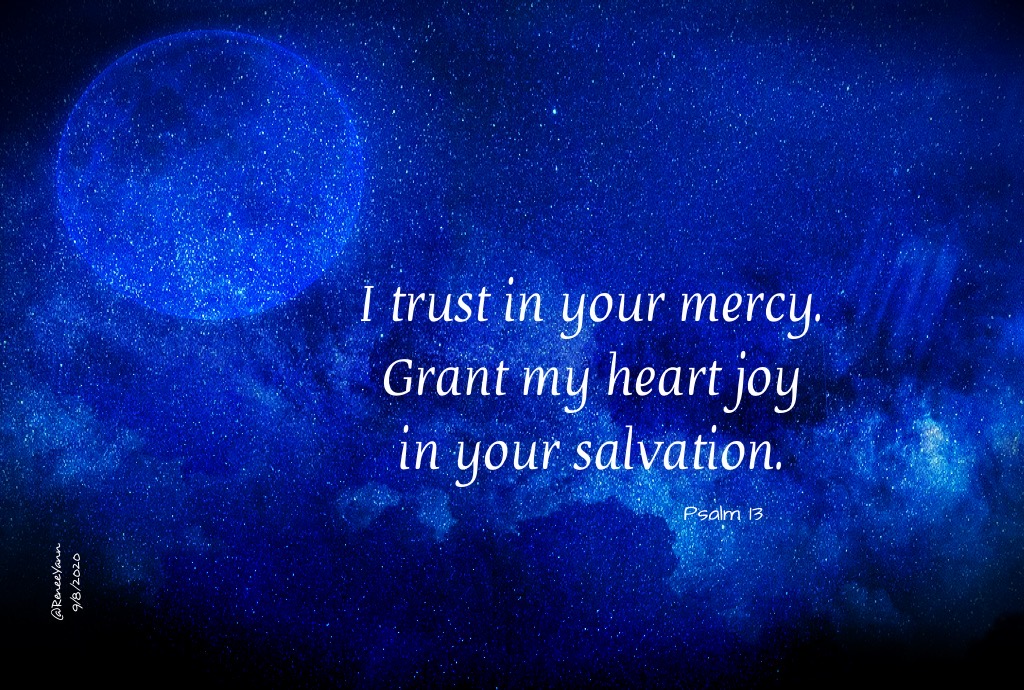
Today, in God’s Lavish Mercy, on our Blessed Mother’s birthday, we pray with the beautiful final verses of Psalm 13.
These verses embody an immense shift in form from the psalm’s early lines. Early on, the psalmist cries out four times, “How long, O Lord?”.
How long:
Will you forget me?
Will you hide your face from me?
Must I carry sorrow in my soul?
Will my enemy triumph over me?
Referring to these early verses reminds us that Mary’s life was full of sorrow as well as joy. On a feast like today, we think of Mary in her heavenly glory. But in her lifetime, Mary suffered many sorrows. She was an unwed mother, a refugee, and a widow. She was the mother of an executed “criminal” and a leader of his persecuted band.
The Julian of Norwich, “Her Showing of Love”
What was it that allowed Mary to transcend sorrow and claim joy? Our psalm verses today help us to understand. They show the psalmist turning to heartfelt prayer., trusting God’s abiding protection.
Look upon me, answer me, LORD, my God! Give light to my eyes lest I sleep in death, Lest my enemy say, “I have prevailed,” lest my foes rejoice at my downfall.
That deep trust ultimately yields not only peace, but joy. Mary, singer of the Magnificat, is the quintessence of that holy joy.
But I trust in your mercy. Grant my heart joy in your salvation, I will sing to the LORD, Who has dealt bountifully with me!
Today, in our prayer, we ask Mary to love and guide us through the challenges of our lives.
Poetry: Three Days – Madeleine L’Engle
Friday:
When you agree to be the mother of God
you make no conditions, no stipulations.
You flinch before neither cruel thorn nor rod.
You accept the tears; you endure the tribulations.
But, my God, I didn't know it would be like this.
I didn't ask for a child so different from others.
I wanted only the ordinary bliss,
to be the most mundane of mothers.

Saturday:
When I first saw the mystery of the Word
made flesh I never thought that in his side
I'd see the callous wound of Roman sword
piercing my heart on the hill where he died.
How can the Word be silenced? Where has it gone?
Where are the angel voices that sang at his birth?
My frail heart falters. I need the light of the Son.
What is this darkness over the face of the earth?
Sunday:
Dear God, He has come, the Word has come again.
There is no terror left in silence, in clouds, in gloom.
He has conquered the hate; he has overcome the pain.
Where, days ago, was death lies only an empty tomb.
The secret should have come to me with his birth,
when glory shone through darkness, peace through strife.
For every birth follows a kind of death, and only after pain comes life.
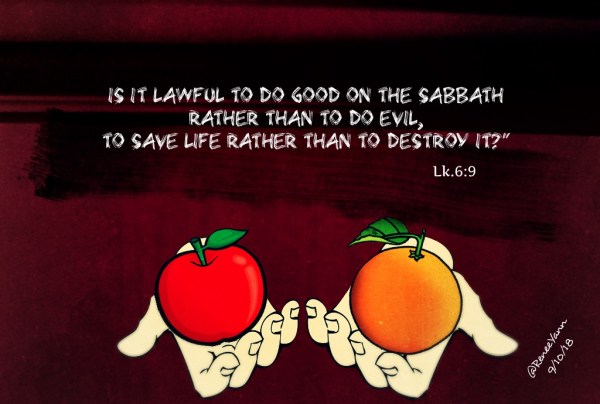
Today, in God’s Lavish Mercy, our Gospel finds the Pharisees once again confronting Jesus with a dilemma. It is the Sabbath, a day when any kind of “work” is prohibited. Yet, a man with a withered hand approaches Jesus needing to be cured. Should Jesus do this work?
It is the classic, Pharisaical confrontation: appearing to weigh two equal responses which in reality are incomparable – like apples and oranges. They are similar only on the surface. Their essences are quite distinct.
Jesus’ continuing debate with the Pharisees always swirls around the balance between law and spirit. The Pharisees have idolized the Law, allowing it to swallow the Spirit. Under their intransigent interpretation, the poor crippled man in today’s Gospel would have lost the chance for healing.
We call quandaries like this being “between a rock and a hard place”. The ancient Greeks called it “between Scylla and Charybdis” – an adjacent huge rock and whirlpool which threatened to swallow their ships passing through. The image powerfully captures the angst accompanying these dilemmas.
We navigate such hazards throughout our lives, facing choices which are often unclear and confusing. Our alternatives sail the wide range between “law” and “spirit”, between what seems advantageous and what seems right, between what is comfortable and what is spiritually challenging, between what is “legal” and what is just and merciful.
How do we choose according to the pattern of Christ? How do we choose forgiveness, mercy, inclusive love, peace and charity in a world that screams “Choose selfishly. You deserve it!”
Through prayer, scriptural reflection, and merciful service, our spirits absorb that Sacred Pattern of Christ. It is in the shape of the Cross. It will guide us between our Scylla and Charybdis.
Poetry: Scylla and Charybdis – from The Aeneid by Virgil
                    BUT when near the coasts
Of Sicily, Pelorus’ narrow straits
Open to view, then take the land to the left,
And the left sea, with a wide circuit round,
And shun the shore and sea upon the right.         5

Those lands, ’t is said, by vast convulsions once
Were torn asunder (such the changes wrought
By time), when both united stood as one.
Between them rushed the sea, and with its waves
Cut off the Italian side from Sicily,         10

And now between their fields and cities flows
With narrow tide. There Scylla guards the right,
Charybdis the implacable the left;
And thrice its whirlpool sucks the vast waves down
Into the lowest depths of its abyss,         15

And spouts them forth into the air again,
Lashing the stars with waves. But Scylla lurks
Within the blind recesses of a cave,
Stretching her open jaws, and dragging down
The ships upon the rocks. Foremost, a face,         20

Human, with comely virgin’s breast, she seems,
E’en to the middle; but her lower parts
A hideous monster of the sea, the tails
Of dolphins mingling with the womb of wolves.
Better to voyage, though delaying long,         25

Around Pachyna’s cape, with circuit wide,
Than once the shapeless Scylla to behold
Under her caverns vast, and hear those rocks
Resounding with her dark blue ocean hounds.
Today’s song is simple, almost childlike – but that simplicity is often just what we need in the face of a dilemma. Music: I Choose You – Libby Allen Songs
Thursday of the Twenty-second Week in Ordinary Time September 1, 2022
Today, in God’s Lavish Mercy, our readings lead us to consider our call.
The call to discipleship comes to us within the other calls of our life: the call to be a good parent, spouse, sibling, child. It comes in the call to be a moral, values-driven employer; an honest, hard-working employee; a supportive, engaged co-worker. Christ asks us to mirror him as neighbor, friend, colleague, and citizen.
In whatever skill or profession we practice, Christ asks us to exercise it as he would – to choose, judge and behave as he would.
In our Gospel, the first disciples are astonished at the miracle of the fishes. Like a lightening bolt, that astonishment transforms their world view. They now see Christ as the Center of their lives. They drop their nets on the seashore. They leave everything to follow him.
What is it that we must leave to make Christ the center of our lives? What nets are we caught in that keep us from freeing the call within us?
We are challenged by a world filled with the entanglements of greed, destructive power, aggression, bigotry, lies, and political & social pretense. How much have these infected the purity of our desire to follow Jesus?
Poetry: On St. Peter Casting Away His Nets at Our Saviour’s Call – Richard Crashaw
Thou hast the art on't Peter; and canst tell
To cast thy Nets on all occasions well.
When Christ calls, and thy Nets would have thee stay:
To cast them well's to cast them quite away.
Music: Lord, You Have Come to the Seashore- Caesareo Gabarain
Lord, You have come to the seashore Neither searching for…the rich nor the wise,… desiring only…that I should follow Refrain: O Lord, with your eyes set upon me, gently smiling, you have spoken my name; all I longed for I have found by the water. At your side, I will seek other shores.
Lord, see my goods, my possessions; in my boat you find…no power, no wealth… Will you accept then…my nets and labor?
Lord,…take my hands and direct them Help me spend myself in seeking the lost,… returning love for…the love you gave me.
Lord,…as I drift on the waters… be the resting place…of my restless heart,… my life’s companion,…my friend and refuge.
Alleluia, alleluia. Blessed are those who are persecuted for the sake of righteousness, for theirs is the Kingdom of heaven.
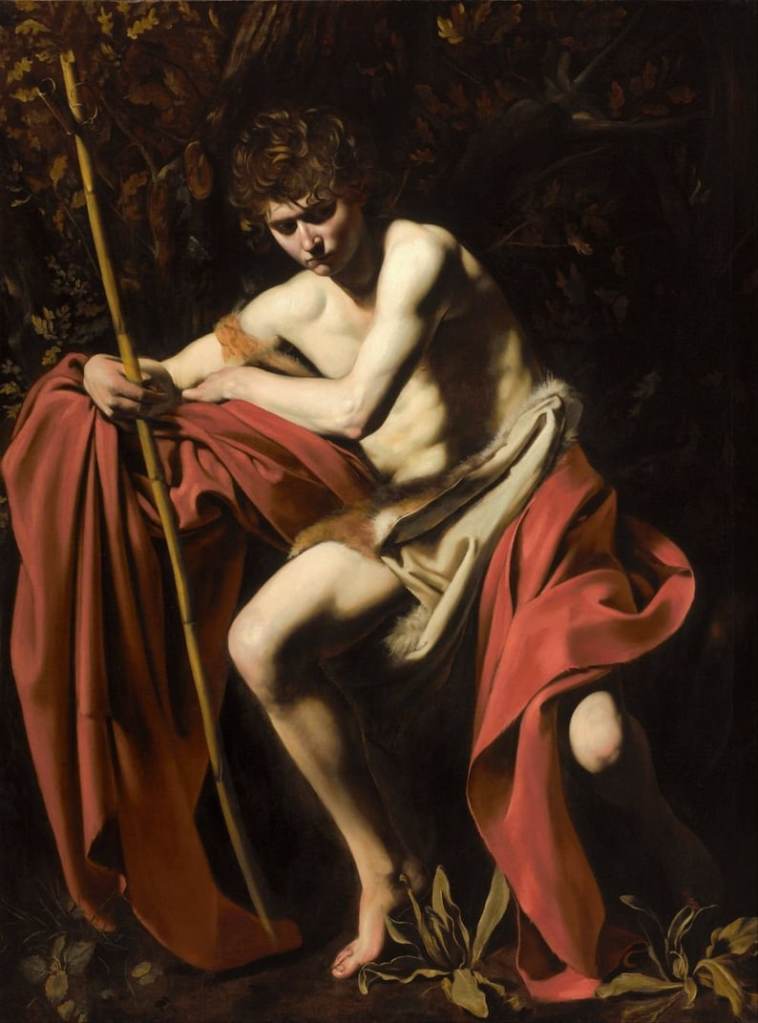
Today, in God’s Lavish Mercy, we commemorate the Passion of John the Baptist who, besides Mary, was the greatest saint embracing both the Old and the New Testaments.
When I was young, the memorial was simply referred to as “The Beheading of John the Baptist”. The term “passion” captures its meaning so much more clearly:
it inclines us to realize the similarities between John’s passion and death and that of Jesus.
it shifts the power of the event to John, who chose his fate by the courage of his witness, rather than to see Herod, the “beheader”, as the agent of the story.
John’s whole prophetic life was part of his “passion”. It inevitably led him to this ultimate confrontation with evil.
Walter Bruggemann, in his transformational book “The Prophetic Imagination” writes about prophets. He indicates that prophets emerge in the context of “totalism” – those paralyzing systems which attempt to control and dominate all freedom and possibility.
Totalism kills ideas, hope, freedom, choice, self-determination, and creativity for the sake of controlling reality for its own advantage. Totalism is the ultimate “abusive relationship“.
Brueggemann defines the prophet as one engaged in these three tasks:
the prophet is clear on the force and illegitimacy of the totalism.
the prophet pronounces the truth about the force of the totalism that contradicts the purpose of God.
the prophet articulates the alternative world that God has promised, and that God is actually creating within the chaos around us.
Every age requires prophets because every age is infected with “Herods” trying to thwart God’s reign of love, mercy, truth, freedom, and joy. In our own time, the poison of totalism is quite evident in those systems fueled by racism, militarism, financial duplicity, desecration of the earth, and the sad array of other ideologies that cripple humanity.
Today, as we pray with this great saint, may we be inspired to respond to our own prophetic call – to be prophetic signs of love, mutual reverence, joy, Gospel justice, holy encouragement and lavish mercy for our world.
Poetry: On Reason and Passion – Rabindranath Tagore
And the priestess spoke again and said: Speak to us of Reason and Passion.
     And he answered, saying:
     Your soul is oftentimes a battlefield, upon which your reason and your judgement wage war against your passion and your appetite.
     Would that I could be the peacemaker in your soul, that I might turn the discord and the rivalry of your elements into oneness and melody.
     But how shall I, unless you yourselves be also the peacemakers, nay, the lovers of all your elements?

     Your reason and your passion are the rudder and the sails of your seafaring soul.
     If either your sails or your rudder be broken, you can but toss and drift, or else be held at a standstill in mid-seas.
     For reason, ruling alone, is a force confining and passion, unattended, is a flame that burns to its own destruction.
     Therefore let your soul exalt your reason to the height of passion, that it may sing;
     And let it direct your passion with reason, that your passion may live through its own daily resurrection and like the phoenix rise above its own ashes.

     I would have your consider your judgment and your appetite even as you would two loved guests in your house.
     Surely you would not honour one guest above the other; for he who is more mindful of one loses the love and the faith of both.

     Among the hills, when you sit in the cool shade of the white poplars, sharing the peace and serenity of distant fields, and meadows—then let your heart say in silence, “God rests in reason.”
     And when the storm comes, and the mighty wind shakes the forest, and thunder and lightning proclaim the majesty of the sky,—then let your heart say in awe, “God moves in passion.”
     And since you are a breath in God’s sphere, and a leaf in God’s forest, you too should rest in reason and move in passion.
Music: I think of this song by Simon and Garfunkel as the modern day song of John the Baptist.
Alleluia, alleluia. Mary is taken up to heaven; a chorus of angels exults.
Today, in God’s Lavish Mercy, we honor Mary on the Feast which celebrates her assumption, “that the Immaculate Mother of God, the ever Virgin Mary, having completed the course of her earthly life, was assumed body and soul into heavenly glory.”
The Catholic Church’s teaching on the Assumption of Mary was promulgated in 1950 by Pope Pius XII in an Apostolic Constitution entitled “MUNIFICENTISSIMUS DEUS (the Most Bountiful God). Having experienced the horrors of a world war, and aware of the ensuing evils of the Cold War, Pope Pius XII looked to Mary for healing for himself and the whole world:
We, who have placed our pontificate under the special patronage of the most holy Virgin, to whom we have had recourse so often in times of grave trouble, we who have consecrated the entire human race to her Immaculate Heart in public ceremonies, and who have time and time again experienced her powerful protection, are confident that this solemn proclamation and definition of the Assumption will contribute in no small way to the advantage of human society, since it redounds to the glory of the Most Blessed Trinity, to which the Blessed Mother of God is bound by such singular bonds. It is to be hoped that all the faithful will be stirred up to a stronger piety toward their heavenly Mother, and that the souls of all those who glory in the Christian name may be moved by the desire of sharing in the unity of Jesus Christ’s Mystical Body and of increasing their love for her who shows her motherly heart to all the members of this august body. And so we may hope that those who meditate upon the glorious example Mary offers us may be more and more convinced of the value of a human life entirely devoted to carrying out the heavenly Father’s will and to bringing good to others. Thus, while the illusory teachings of materialism and the corruption of morals that follows from these teachings threaten to extinguish the light of virtue and to ruin the lives of men by exciting discord among them, in this magnificent way all may see clearly to what a lofty goal our bodies and souls are destined. Finally it is our hope that belief in Mary’s bodily Assumption into heaven will make our belief in our own resurrection stronger and render it more effective.
MUNIFICENTISSIMUS DEUS (42)
Maybe, like me, the fact of the Assumption doesn’t matter a whole lot to you. I love Mary whether she was “assumed” or not. But in its time, the declaration of this dogma was important in order to turn the world’s focus toward Mary, a figure of goodness, courage, love, mercy and justice – virtues desperately necessary for healing in the aftermath of war.
Our own world could surely benefit from a prayerful, loving contemplation of Mary.
Mary was a woman so open to God that she enfleshed God’s Spirit in the person of Jesus. She was a vessel of love – for God and for all Creation. By living her ordinary life with extraordinary love and holy courage, she became blessed.
Mary, the Blessed Mother of all of us, can teach us to love, reverence, strengthen and support one another when we pray with her as we meet her in the Gospel.
Elizabeth said:
“Blessed are you who believed that what was spoken to you by the Lord would be fulfilled.”
And Mary said: “My soul proclaims the greatness of the Lord; my spirit rejoices in God my Savior for God has looked on my simplicity with favor . From this day all generations will call me blessed: the Almighty has done great things for me and holy is God’s Name. In every generation, God has mercy on those with holy reverence and awe.
Poetry: The Blessed Virgin compared to the air we breathe… by Gerard Manley Hopkins, SJ
( I know this is a really long poem, and Hopkins can seem a little convoluted. But the images in this poem are spectacular … even if you just read a bit at a time. It’s so worth it.)
Wild air, world-mothering air, Nestling me everywhere, That each eyelash or hair Girdles; goes home betwixt The fleeciest, frailest-flixed Snowflake; that’s fairly mixed With, riddles, and is rife In every least thing’s life; This needful, never spent, And nursing element; My more than meat and drink, My meal at every wink; This air, which, by life’s law, My lung must draw and draw Now but to breathe its praise, Minds me in many ways Of her who not only Gave God’s infinity Dwindled to infancy Welcome in womb and breast, Birth, milk, and all the rest But mothers each new grace That does now reach our race— Mary Immaculate, Merely a woman, yet Whose presence, power is Great as no goddess’s Was deemèd, dreamèd; who This one work has to do— Let all God’s glory through, God’s glory which would go Through her and from her flow Off, and no way but so.
I say that we are wound With mercy round and round As if with air: the same Is Mary, more by name. She, wild web, wondrous robe, Mantles the guilty globe, Since God has let dispense Her prayers his providence: Nay, more than almoner, The sweet alms’ self is her And men are meant to share Her life as life does air. If I have understood, She holds high motherhood Towards all our ghostly good And plays in grace her part About man’s beating heart, Laying, like air’s fine flood, The deathdance in his blood; Yet no part but what will Be Christ our Saviour still. Of her flesh he took flesh: He does take fresh and fresh, Though much the mystery how, Not flesh but spirit now And makes, O marvellous! New Nazareths in us, Where she shall yet conceive Him, morning, noon, and eve; New Bethlems, and he born There, evening, noon, and morn Bethlem or Nazareth, Men here may draw like breath More Christ and baffle death; Who, born so, comes to be New self and nobler me In each one and each one More makes, when all is done, Both God’s and Mary’s Son. Again, look overhead How air is azurèd; O how! nay do but stand Where you can lift your hand Skywards: rich, rich it laps Round the four fingergaps. Yet such a sapphire-shot, Charged, steepèd sky will not Stain light. Yea, mark you this: It does no prejudice. The glass-blue days are those When every colour glows, Each shape and shadow shows. Blue be it: this blue heaven The seven or seven times seven Hued sunbeam will transmit Perfect, not alter it. Or if there does some soft, On things aloof, aloft, Bloom breathe, that one breath more Earth is the fairer for. Whereas did air not make This bath of blue and slake His fire, the sun would shake, A blear and blinding ball With blackness bound, and all The thick stars round him roll Flashing like flecks of coal, Quartz-fret, or sparks of salt, In grimy vasty vault. So God was god of old: A mother came to mould Those limbs like ours which are What must make our daystar Much dearer to mankind; Whose glory bare would blind Or less would win man’s mind. Through her we may see him Made sweeter, not made dim, And her hand leaves his light Sifted to suit our sight. Be thou then, thou dear Mother, my atmosphere; To wend and meet no sin; Above me, round me lie Fronting my froward eye With sweet and scarless sky; Stir in my ears, speak there Of God’s love, O live air, Of patience, penance, prayer: World-mothering air, air wild, Wound with thee, in thee isled, Fold home, fast fold thy child.
Music: Magnificat – Mina
Magnificat anima mea Magnificat Dominum et exsultavit spiritus meus In Deo salutari meo Magnificat, Magnificat Quia respexit humilitatem ancillae suae Ecce enim ex hoc beatam me dicent omnes generationes Magnificat anima mea Magnificat Dominum et exsultavit spiritus meus In Deo salutari meo Magnificat, Magnificat Quia fecit mihi magna qui potens est Et sanctum nomen ejus Magnificat, Magnificat Dominum et exsultavit spiritus meus In Deo Magnificat, Magnificat
Lyrics translation
My soul magnifies the The lord and my spirit rejoices In God my saviour Magnificat, Magnificat For he has looked on his servant in her lowliness Behold this blessed shall call me blessed all generations The Magnificat my soul Magnifies the The lord and my spirit rejoices In God my saviour Magnificat, Magnificat Because I made a big who is able And holy is his name Magnificat, Magnificat The lord and my spirit rejoices In God Magnificat, Magnificat
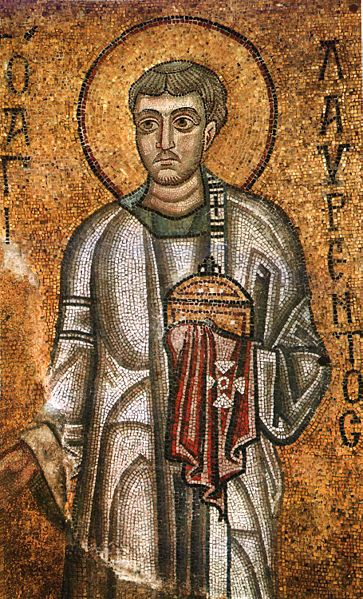
Saint Lawrence. Mosaic from the Saint Sophia Cathedral in Kiev.
Today, in God’s Lavish Mercy, we celebrate the feast of St. Lawrence who is noted for his love for those who were poor. Legend has it that Lawrence was demanded, before his martyrdom, to turn over the Church’s riches to the emperor Valerian. Instead, he distributed all the resources among the poor. Lawrence then gathered all these people, presenting them before Valerian with these words:
Behold in these poor persons the treasures which I promised to show you – these are the true treasures of the Church.
Lawrence was likely inspired by readings like today’s. In Corinthians, Paul encourages us to be cheerful givers. He says this delights God, the Giver of Divine Abundance, whom we are imitating.
In our reading from John, Jesus says that only in dying to ourselves do we live – the ultimate generosity. He says that only by doing this can we truly follow him.
While these readings are clear and simple, they are so profound that we can hardly take in their message. What they ask of us is daunting! The encouragement Jesus gives us to respond to his challenge is this:
The Father will honor whoever serves me.
St. Lawrence believed and lived this promise. What about us?
Poetry: St. Laurence – Joyce Kilmer
Within the broken Vatican
The murdered Pope is lying dead.
The soldiers of Valerian
Their evil hands are wet and red.
Unarmed, unmoved, St. Laurence waits,
His cassock is his only mail.
The troops of Hell have burst the gates,
But Christ is Lord, He shall prevail.
They have encompassed him with steel,
They spit upon his gentle face,
He smiles and bleeds, nor will reveal
The Church's hidden treasure-place.
Ah, faithful steward, worthy knight,
Well hast thou done. Behold thy fee!
Since thou hast fought the goodly fight
A martyr's death is fixed for thee.
St. Laurence, pray for us to bear
The faith which glorifies thy name.
St. Laurence, pray for us to share
The wounds of Love's consuming flame.
Music: Before the Bread – Elizabeth Alexander
We all want our lives to be full and complete – to be “bread”. But there are many steps before the grain of wheat becomes bread, as captured in this elegant acapella canon.
Today, in God’ Lavish Mercy, we celebrate the Feast of the Transfiguration of the Lord.
Alleluia, alleluia. This is my beloved Son, with whom I am well pleased; listen to him.
Peter, James, and John – those whom the Lord would most heavily depend on at the time of the Crucifixion – these three were given a sacred privilege. They witnessed Christ transformed by his Divinity, shining before the Creator whose voice came down from heaven.
Icon of Transfiguration by Alexander Ainetdinov
Peter’s account in today’s second reading might seem almost too much to believe. Yet, Peter’s very human telling of the event is most convincing. He doesn’t wax eloquent about how privileged the three were. He simply describes the event and says, “We were terrified.” — as indeed we all might be if we came face to face with God’s glory.
Perhaps they received this gift in order to bolster them through the Passion and Death of Christ, or to open their hearts to believe in the Resurrection. These men were the key leaders who would pick up the message of Jesus when it appeared to fall to the earth at the foot of Cross. They needed a deeply confirmed faith.
So do we. We face a lot of faith-sapping realities in our world. And God does give us “Transfiguration Moments” too – times when the thin veil of hard reality is lifted and we glimpse the face of God. These moments may come at the birth of a child, the devotion of a beloved, the majesty of nature, the simplicity of silence, the deliverance from harm, the momentary awareness that our breath belongs to God.
We must savor and store these Lights, like the three disciples did, to strengthen ourselves for the shadows. As Peter says in his epistle:
… we possess the prophetic message that is altogether reliable. You will do well to be attentive to it, as to a lamp shining in a dark place, until day dawns and the morning star rises in your hearts.
Poetry: Transfiguration – Malcolm Guite
For that one moment, ‘in and out of time’,
On that one mountain where all moments meet,
The daily veil that covers the sublime
In darkling glass fell dazzled at his feet.
There were no angels full of eyes and wings
Just living glory full of truth and grace.
The Love that dances at the heart of things
Shone out upon us from a human face
And to that light the light in us leaped up,
We felt it quicken somewhere deep within,
A sudden blaze of long-extinguished hope
Trembled and tingled through the tender skin.
Nor can this blackened sky, this darkened scar
Eclipse that glimpse of how things really are.
Music: Transfiguration by Carey Landry
We behold the splendor of God shining on the face of Jesus. We behold the splendor of God shining on the face of the Son. And oh, how his beauty transforms us, the wonder of presence abiding. Transparent hearts give reflection of Tabor’s light within, of Tabor’s light within. Jesus, Lord of Glory, Jesus, Beloved Son, oh, how good to be with you; how good to share your light; how good to share your light.
Today, in God’s Lavish Mercy, we begin with a puzzling passage from Jeremiah. Verses 12-15 describe an Israel which, spiritually, is terminally ill.
For thus says the LORD: Incurable is your wound, grievous your injury;
There is none to plead your case, no remedy for your running sore, no healing for you.
Jeremiah 30: 12-14
The puzzling part comes with the dramatic shift at verses 16-17 when God seems to step out of Israel’s storm to cure her:
Yet all who devour you shall be devoured, all your enemies shall go into exile. All who plunder you shall become plunder, all who pillage you I will hand over to be pillaged.l
For I will restore your health; I will heal your injuries—oracle of the LORD. “The outcast” they have called you, “whom no one looks for.”
Jeremiah 30: 16-17
So what’s the point of the whole Jeremiah passage for us? Perhaps for today we can find that meaning in Matthew’s story of the stormy sea.
… the boat, already a few miles offshore, was being tossed about by the waves, for the wind was against it. During the fourth watch of the night, he came toward them, walking on the sea. When the disciples saw him walking on the sea they were terrified. “It is a ghost,” they said, and they cried out in fear.
It’s rather easy to find God on a clear, pleasant day. It’s not so easy when God walks toward us out of life’s storms. Jeremiah was challenging Israel to find God in a storm. Jesus is challenging Peter to trust and do the same.
God doesn’t send storms to test us. Life is just stormy some times — that’s just the way it is. Faith asks us to trust that God is with us at such times and can use even chaotic circumstances to bring us closer to God’s heart. Hananiah was afraid to believe that so he made up a lie. Peter was half-brave enough to try to believe, and Jesus helped him the rest of the way.
At once Jesus spoke to them, “Take courage, it is I; do not be afraid.” Peter said to him in reply, “Lord, if it is you, command me to come to you on the water.” He said, “Come.”
Oh boy, that first step into nothing but waves is a doozy, isn’t it! But with God’s help, we can pass through the storm holding God’s hand into even deeper faith and trust for the rest of life’s voyage.
But when Peter saw how strong the wind was he became frightened; and, beginning to sink, he cried out, “Lord, save me!” Immediately Jesus stretched out his hand and caught him, and said to him, “O you of little faith, why did you doubt?” After they got into the boat, the wind died down. Those who were in the boat did him homage, saying, “Truly, you are the Son of God.”
Poetry: Catastrophe Is Next to Godliness – Franny Choi
Lord, I confess I want the clarity of catastrophe but not the catastrophe.
Like everyone else, I want a storm I can dance in.
I want an excuse to change my life.
The day A. died, the sun was brighter than any sun.
I answered the phone, and a channel opened
between my stupid head and heaven, or what was left of it. The blankness
stared back; and I made sound after sound with my blood-wet gullet.
O unsayable—O tender and divine unsayable, I knew you then:
you line straight to the planet’s calamitous core; you moment moment moment;
you intimate abyss I called sister for a good reason.
When the Bad Thing happened, I saw every blade.
And every year I find out what they’ve done to us, I shed another skin.
I get closer to open air; true north.
Lord, if I say Bless the cold water you throw on my face,
does that make me a costume party. Am I greedy for comfort
if I ask you not to kill my friends; if I beg you to press
your heel against my throat—not enough to ruin me,
but just so—just so I can almost see your face—











 Lavish Mercy