Lent: The Deep Dive

March 29, 2022
Tuesday of the Fourth Week of Lent

Today, in God’s Mercy, our readings describe a deep and hidden stream revealed by God –

first to Ezechiel …

Raffael-vision-ezechiel
The Vision of Ezechiel by Rafael

then to a long-paralyzed man …

Schönherr_The_pool_of_Bethesda
The pool of Bethesda, by Schönherr.

So many stories in Scripture are laced with the same theme: there is a infinite mystery hidden under the surface of life:

  • Keep searching. Keep searching. 
  • The precious pearl that awaits discovery. 
  • The lost coin that must be found. 
  • The mustard seed buried in circumstance. 
  • The stream running deep under appearances.

We might be tempted to dismiss our first reading from Ezechiel as over-described allegory. But its rendition of the slow, steady deepening, through which God leads the prophet, offers us an apt image to reflect on our own graced journey. 

Ez47_9 stream

Hasn’t God led us gently to the faith we have today? Like young children learning to ride the ocean breakers, we have been taught by a patient God Who returns in every tide to take us deeper into our next capacity for grace.


For thirty-eight years, the man in today’s Gospel has been paralyzed by the water’s edge. Maybe we know how he feels.

duck

He believes that his life is beyond transformation. He cannot dive under the surface of his circumstances to find the quickening waters.


Jesus gives him the key to unlock his paralysis. In a short phrase, Jesus offers the man a multilayered question:

  • What do you really want in your deepest heart?
  • When you find the answer, break through all that has kept you from that deepest desire. 
  • Step with Me through the next wave, and the next until, finally, we swim together in the great ocean of covenanted trust.

As our Responsorial Psalm-poem promises:

God is our refuge and our strength,
an ever-present help in distress.
Therefore we fear not, though the earth be shaken
and mountains plunge into the depths of the sea.

There is a stream whose runlets gladden the city of God,
the holy dwelling of the Most High.
God is in its midst; it shall not be disturbed;
God will help it at the break of dawn.

Music: I Am – Marty Goetz (Lyrics below)

Come, behold the works of the Lord
How He has wrought the desolation
How He has brought His early help
The Lord of Hosts is with us
The God of Jacob is our refuge
When the nations rage and all the kingdoms fall
He says I Am, I Am, I Am all

And there’s a river whose streams make glad the city of God
They flow to His Holy habitation
They flow to the home of the Most High
The Lord of Hosts is with us
The God of Jacob is our refuge
He breaks the bow, he shatters the spear
And says I Am, I Am, I Am here!

So we will not fear
Though the worlds should change
Though the waters roar
Though the mountains shake and tremble
For He’s a present help in trouble, in trouble

Be still and know that I am God
I Am exalted in the nations
I Am exalted in the earth
The Lord of Hosts is with us
The God of Jacob is our refuge
To the ends of the earth He causes wars to cease and says
I Am, I Am, I Am peace
He says I Am, I Am, I Am peace

Lent: The Miracle of Transformation

March 21, 2022
Monday of the Third Week of Lent

Today, in God’s Lavish Mercy, our readings are about prophets and miracles, brought to us by Elisha and Jesus.

The core of the readings is this: some of us want the prophets’ miracles, but we don’t want their challenge to live in God’s freedom. We want their cures, only to return to lifestyles that make us spiritually sick or imprisoned.

Wanting to write about these themes, I decided to check with my favorite Old Testament scholar, Walter Brueggemann to see if he had any wisdom on the story of Naaman.

Naaman
Naaman brings his retinue and gifts… from The Pictorial History of Palestine and the Holy Land (1844) by John Kitto

Well, Walter certainly did…. something so good and wise that I won’t water it down with my own words. The link is below. It’s a little long, but so worth your reading and meditation. I hope you’ll take the time.

Click here for Walter Brueggemann’s article


Music: some instrumental music to listen to while you’re reading

Beloved St. Joseph

Saturday, March 19, 2022
Solemnity of Saint Joseph

Today, in Mercy, we celebrate our beloved Saint Joseph.

saint-joseph-with-the-christ-child-ca-1650-oil-on-canvas-sebastian-martinez
St. Joseph and the Christ Child by Sebastian Martinez

Our first reading describes the line of descent from David down through the ages to Joseph of the House of David.

God promises David:

I will raise up your heir after you, sprung from your loins,
and I will make his kingdom firm.
It is he who shall build a house for my name.
And I will make his royal throne firm forever.

Joseph is the realization of that House.  He was the one who ultimately gave shelter, both literally and physically, to the Promised One.


Beloved Joseph, provider of safe and sacred shelter, opens his arms to our fearful and pleading prayers. Often in my life when I had a particularly difficult need, I have prayed the Litany of St. Joseph. Just a few of its beautiful phrases may bring you confidence and peace.

Praying with today’s Gospel, let’s imagine ourselves being invited by Joseph, Mary and Jesus to go down with them  to our own “Nazareth” — to find the voice of God in the sacred protection of our homes and hearts.

Jesus went down with Mary and Joseph
and came to Nazareth,

and he obediently listened to them.


Poetry: The Temptation Of St. Joseph by W. H. Auden

From For the Time Being

I

JOSEPH
My shoes were shined, my pants were cleaned and pressed,
And I was hurrying to meet
My own true Love:
But a great crowd grew and grew
Till I could not push my way through,
Because
A star had fallen down the street;
When they saw who I was,
The police tried to do their best.

CHORUS [off]
Joseph, you have heard
What Mary says occurred;
Yes, it may be so.
Is it likely? No.

JOSEPH
The bar was gay, the lighting well-designed,
And I was sitting down to wait
My own true Love:
A voice I’d heard before, I think,
Cried: “This is on the House. I drink
To him
Who does not know it is too late;”
When I asked for the time,
Everyone was very kind.

CHORUS [off]
Mary may be pure,
But, Joseph, are you sure?
How is one to tell?
Suppose, for instance. . . Well. . .

JOSEPH
Through cracks, up ladders, into waters deep,
I squeezed, I climbed, I swam to save
My own true Love:
Under a dead apple tree
I saw an ass; when it saw me
It brayed;
A hermit sat in the mouth of a cave:
When I asked him the way,
He pretended to be asleep.

CHORUS [off]
Maybe, maybe not.
But, Joseph, you know what
Your world, of course, will say
About you anyway.

JOSEPH
Where are you, Father, where?
Caught in the jealous trap
Of an empty house I hear
As I sit alone in the dark
Everything, everything,
The drip of the bathroom tap,
The creak of the sofa spring,
The wind in the air-shaft, all
Making the same remark
Stupidly, stupidly,
Over and over again.
Father, what have I done?
Answer me. Father, how
Can I answer the tactless wall
Or the pompous furniture now?
Answer them. . .

GABRIEL
No, you must.

JOSEPH
How then am I to know,
Father, that you are just?
Give me one reason.

GABRIEL
No.

JOSEPH
All I ask is one
Important and elegant proof
That what my Love had done
Was really at your will
And that your will is Love.

GABRIEL
No, you must believe;
Be silent, and sit still.


Music:  I absolutely love this video of these dear Sisters of St. Joseph in Rochester singing “Hail Holy Joseph, Hail”. Having been taught by the sisters of St. Joseph for twelve years, I know the hymn very well. Looking at these Sisters, we can just imagine the long legacy of their generous ministries under the guidance of Joseph, their beloved patron. May God bless all our Sisters of St. Joseph on their Feastday!
(Lyrics below as well as the Litany of St. Joseph in a second post)

Hail, holy Joseph, Hail
by Father Frederick Faber

Hail, holy Joseph, hail!
⁠Chaste spouse of Mary, hall!
Pure as the lily flower
⁠In Eden’s peaceful vale.

Hail, holy Joseph, hail!
⁠Prince of the house of God!
May His best graces be
⁠By thy sweet hands bestow’d.

Hail, holy Joseph, hail!
⁠Belov’d of angels, hail!
Cheer thou the hearts that faint,
⁠And guide the steps that fail.

Hail, holy Joseph, hail!
⁠God’s choice wert thou alone;
To thee the Word made flesh
⁠Was subject as a Son.
O Christ’s dear Mother, bless;
⁠And bless, ye Saints on high,
All meek and simple souls
⁠That to Saint Joseph cry.

Lent: Untie the Knots

March 15, 2022
Tuesday of the Second week of Lent

Today, in God’s Lavish Mercy, in Isaiah’s prophecy, God addresses some of the most famous sinners in the Bible — the residents of Sodom and Gomorrah. And the Divine manner of that address is both gentle and direct…

Come now … let us set things right!

Come now, let us set things right,
says the LORD:
Though your sins be like scarlet,
they may become white as snow;
Though they be crimson red,
they may become white as wool.
If you are willing, and obey,
you shall eat the good things of the land;
But if you refuse and resist,
the sword shall consume you:
for the mouth of the LORD has spoken!

Isaiah 1:18-20

Setting things right! Aren’t there times in our lives when we long for that? Not in the sense of vengeance or some vigilante justice, but rather in the sense of balance, equity, peace, and understanding in our lives.


Some things go wrong in our lives – that’s just the way it is. And sometimes we struggle endlessly and futilely to realign them.

Even in the most tranquil and “together” lives, there are places of irresolution – little knots in our life story of “why” and “why not”; of “if” and “if only”.

These may be places where we can’t really “forget” and so have not really forgiven. They may be nagging questions left unanswered because we hadn’t the courage to ask. They may be reasons we wanted to explain but no one wanted to listen. They may be excuses or pretenses we have made for so long that we have begun to believe them ourselves.

In almost all such instances, a scarlet concupiscence is at the root of our suffering or pain – sin, not only in the other, but in ourselves that longs to be made white as snow.


In many such cases, the time passes when we might reach out to the other for mutual healing. Death, distance, stubborn resistance and other walls may block us from worldly reconciliation.

But in God’s realm, healing is still possible, as is the power of our desire for the other to be healed with us.

in Isaiah’s beautiful passage, God invites us to full and eternal wholeness. That wholeness is achieved through our willingness to be open before God and to practice obedient listening in our prayer.

If you are willing, and obey,
you shall eat the good things of the land.

Isaiah 1:19

Let’s listen to and trust the awesome invitation in Isaiah:
“Come now, let us set things right”
… come to Me where I will allow you to forgive yourself as I forgive you.
Let us begin to untie any grace-resistant knot in your heart.
Untied, it also frees the other to seek their own healing.


Poetry: Forgiveness – George MacDonald

God gives his child upon his slate a sum –
To find eternity in hours and years;
With both sides covered, back the child doth come,
His dim eyes swollen with shed and unshed tears;
God smiles, wipes clean the upper side and nether,
And says, ‘Now, dear, we’ll do the sum together!’

Music: White As Snow – Maranatha Singers

Live in Truth

February 25, 2022
Friday of the Seventh Week in Ordinary Time

Today, in God’s Lavish Mercy, our readings instruct us on one of life’s most important realities: truthful relationship – with God, nature, other people, and ourselves.

James reminds us that the prophets spoke the truth at great personal cost.

Take as an example of hardship and patience, brothers and sisters,
the prophets who spoke in the name of the Lord.
Indeed we call blessed those who have persevered.

James 5:10

Culture sometimes characterizes a “prophet” as one who can foresee the future, one who has a greater capacity than the normal person. And indeed there are great leaders who fit that understanding. They see things rightly and help us to realign our vision.


But, in an everyday sense, a prophet is simply someone who sees the truth and is unafraid to speak it. A prophet doesn’t pretend, deflect, lie, ignore, hide, distort or abuse Truth. The call to this kind of prophecy is one that we all share.

Such a call requires that we are honest, first and foremost, with God and with ourselves. It asks that we live a discerning and courageous life, reverently telling our truth as best we understand before God:

… let your “Yes” mean “Yes” and your “No” mean “No,”
that you may not incur condemnation.

James 5:12

In our Gospel, we find the Pharisees trying trip up Jesus with their pretend concern for the Law. Instead, what they are really concerned about is that they could lose their hold on power if the people turn to Jesus and his teaching.


Jesus calls them “hard of heart” because they are not open to the Spirit. They hide in a labyrinth of minutiae rather than the clarity of Love and Truth.

Living in the Truth of God’s grace and mercy, we grow in our ability to be prophetic. It means that people know they will get the truth from us — not opinion or advice; not bluntness or unnecessary critique — but a discernment offered in love, reverence, and mutual hope.

Like the biblical prophets, and like Jesus himself, we will meet people who don’t want that kind of truth. They haven’t been able to espouse it in themselves, so they don’t want to hear it from us. We see this played out daily in a sham political world that continually creates its own version of reality to suit its selfish ends.

In such situations, James would offer us this encouragement:

You have heard of the perseverance of Job,
and you have seen the purpose of the Lord,
because the Lord is compassionate and merciful.

And our Alleluia Verse offers us a prayer for such times:

Your word, O Lord, is truth;
consecrate us in the truth.


So persevere.
Seek your truth in prayer.
Give it to the world generously
with compassion and mercy.

Poetry: A Legend of Truth – Rudyard Kipling
“A Friend of the Family”
From “Debits and Credits” (1919-1923)

Once on a time, the ancient legends tell,
Truth, rising from the bottom of her well,
Looked on the world, but, hearing how it lied,
Returned to her seclusion horrified.
There she abode, so conscious of her worth,
Not even Pilate’s Question called her forth,
Nor Galileo, kneeling to deny
The Laws that hold our Planet ‘neath the sky.
Meantime, her kindlier sister, whom men call
Fiction, did all her work and more than all,
With so much zeal, devotion, tact, and care,
That no one noticed Truth was otherwhere.

Then came a War when, bombed and gassed and mined,
Truth rose once more, perforce, to meet mankind,
And through the dust and glare and wreck of things,
Beheld a phantom on unbalanced wings,
Reeling and groping, dazed, dishevelled, dumb,
But semaphoring direr deeds to come.

Truth hailed and bade her stand; the quavering shade
Clung to her knees and babbled, “Sister, aid!
I am–I was–thy Deputy, and men
Besought me for my useful tongue or pen
To gloss their gentle deeds, and I complied,
And they, and thy demands, were satisfied.
But this–” she pointed o’er the blistered plain,
Where men as Gods and devils wrought amain–
“This is beyond me! Take thy work again.”

Tablets and pen transferred, she fled afar,
And Truth assumed the record of the War…
She saw, she heard, she read, she tried to tell
Facts beyond precedent and parallel–
Unfit to hint or breathe, much less to write,
But happening every minute, day and night.
She called for proof. It came. The dossiers grew.
She marked them, first, “Return. This can’t be true.”
Then, underneath the cold official word:
“This is not really half of what occurred.”

She faced herself at last, the story runs,
And telegraphed her sister: “Come at once.
Facts out of hand. Unable overtake
Without your aid. Come back for Truth’s own sake!
Co-equal rank and powers if you agree.
They need us both, but you far more than me


Music: Beautiful Truth – Angela Predhomme

Pepper and Salt

February 24, 2022
Thursday of the Seventh Week in Ordinary Time

Today, in God’s Lavish Mercy, both James and Jesus pepper us with some fire and brimstone.

James is preaching against the sin of exploitation, especially as it relates to economic justice, the sanctity of work, and reverence for the worker.

Come now, you rich, weep and wail over your impending miseries…
Behold, the wages you withheld from the workers who harvested your fields are crying aloud; and the cries of the harvesters have reached the ears of the Lord of hosts.

James 5: 1;4

James, in his time, is condemning a sin that has endured throughout history. In a 2020 address, Pope Francis confronted the same evil:

The pandemic has exposed and aggravated social problems, above all that of inequality…These symptoms of inequality reveal a social illness; it is a virus that comes from a sick economy. And we must say it simply: the economy is sick. It has become ill. It is the fruit of unequal economic growth — this is the illness: the fruit of unequal economic growth — that disregards fundamental human values. In today’s world, a few wealthy people possess more than all the rest of humanity. I will repeat this so that it makes us think: a few wealthy people, a small group, possess more than all the rest of humanity. This is pure statistics. This is an injustice that cries out to heaven!

General Audience, August 26, 2020

James and Francis – speaking the same message for different times.


In our Gospel, Jesus teaches that the rewards of a well-lived life are measured in mutuality and generosity, not dollars:


In concluding his above referenced address, Pope Francis, like Jesus, focused on children:

Let us think about the children. Read the statistics: how many children today are dying of hunger because of broken distribution of riches, because of a sick economic system; and how many children today do not have the right to education for the same reason. May this image of children in want due to hunger and the lack of education help us understand that after this pandemic crisis we must learn and do better.


Jesus too measured a soul’s health by its effect on children:

Whoever causes one of these little ones who believe in me to sin,  it would be better for him if a great millstone were put around his neck and he were thrown into the sea.

Mark 9:42

These readings teach hard lessons, lessons which society still seems unable to learn. Let’s ask for the grace to see our own role in helping to realize the sacred balance of goods that Jesus, James, and Francis call for.

Let us not tire in advocating for social Justice because, as our Gospel warns:

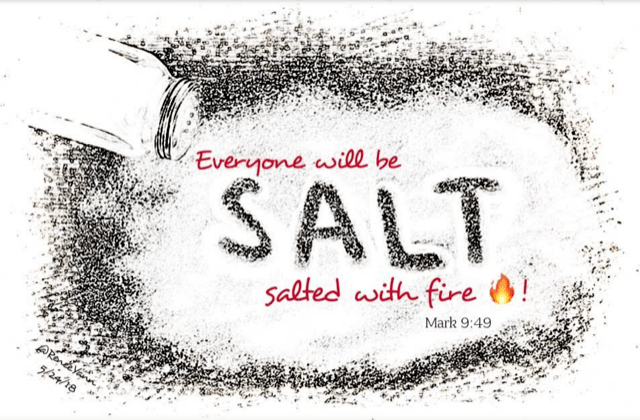
Everyone will be salted with fire. Salt is good,
but if salt becomes insipid,
with what will you restore its flavor?

Mark 9:49

Poetry and Music: Salt of the Earth – The Rolling Stones
In this song, Mick Jagger writes an anthem to the working class. But in a twice-repeated stanza, the singer professes a distance from this very group, perhaps loosing touch because of his own material success:

And when I search a faceless crowd
A swirling mass of grey and black and white
They don’t look real to meIn fact, they look so strange

The song uses a quote that refers to a passage in the Bible where Jesus encourages people to give the best of themselves:

You are the salt of the earth; but if the salt loses its flavor, how shall it be seasoned ? It is then good for nothing but to be thrown out and trampled underfoot.

Matthew 5:13

Twists of Faith

February 21, 2022
Monday of the Seventh Week in Ordinary Time

Today, in God’s Lavish Mercy, the deep undercurrent of our readings is about the power and difficulties of faith.

James talks about how our faith can be choked by the weeds of “bitter jealousy and selfish ambition”. These chokers make us “boast and be false to the truth”. They fill us with a “pretend wisdom” that is not from the Holy Spirit.

Praying with this passage, I asked myself why we allow these ugly constraints to grasp our souls when the alternative James describes is so beautiful:

… the wisdom from above is first of all pure,
then peaceable, gentle, compliant,
full of mercy and good fruits,
without inconstancy or insincerity.
And the fruit of righteousness is sown in peace
for those who cultivate peace.

James 3:17-18

The Gospel helped me with an answer.

Unconditional faith is scary. It requires us to give control over to God. It asks us to let go of fear and to trust God’s Spirit within us. It needs us to empty our hearts of pretense and self-protection in order to make room for God’s transforming Mercy and Love.

This kind of faith will change us. It will make us “foolish” and insecure in worldly terms. It will cause us to live from a Wisdom the world misunderstands and mocks.

It’s hard to live that kind of faith. The dad in today’s Gospel admits it. He wants to have a faith that invites Christ’s power into his life. But he’s afraid. What if God wants something different for him and his son? What happens if he gives control over to God?

This yearning father confesses his ambivalence
in a plea for Christ’s assistance:
Lord, I do believe. Help my unbelief!

We all find ourselves within that plea sometimes in our lives. It’s a faith of “if”, “maybe”, and “but” – all of which are hardly faith at all. Unconditional faith is “Yes”, no matter what. It is the place where Faith and Love merge.


Our faithful “Yes”, as the e.e.cummings poem might describe it:

love is a place
& through this place of
love move
(with brightness of peace)
all places

yes is a world
& in this world of
yes live
(skillfully curled)
all worlds


Music: When we live this “Yes Faith”, God’s love, God’s heart lives in us. This song by Michael Hedges, based on another poem by e.e.cummings, can be a prayer for us. We may be unused to calling God “my dear”, “my darling”. But a loving name for God can be helpful to our prayer. And it is an ancient practice of mystics like St. John of the Cross. Use whatever might feel natural for you. Don’t be hesitant about being in love with God❤️

I Carry Your Heart – Michael Hedges (Lyrics below)

I carry your heart with me
I carry it in my heart
I am never without it
Anywhere i go you go, my dear
And whatever is done by only me
Is your doing, my darling.

I fear no fate
For you are my fate, my sweet
I want no world
For beautiful you are my world, my true
And it’s you are whatever a moon has always meant
And whatever a sun will always sing is you

Here is the deepest secret nobody knows
Here is the root of the root
And the bud of the bud
And the sky of the sky
Of a tree called life;
Which grows higher than the soul can hope
Or mind can hide
And this is the wonder that’s keeping the stars apart
I carry your heart
I carry it in my heart

No More War… Never Again

February 19, 2022
Saturday of the Sixth Week in Ordinary Time

Today, in God’s Lavish Mercy, I pause in my scriptural reflections to ask all of you to join in prayer for peace in Ukraine. As I typed today’s date, it hit me that we can’t just watch the evolution of this crisis on the news, as if it were a movie that isn’t really happening. We have a responsibility to be active peacemakers in our volatile world, and to foster a resolution that honors all human life.


I’ll tell you why Saturday’s date struck my heart so forcibly.

February 19, 1945

I was not even alive yet. I was kicking around inside my Mom and waiting to be born exactly two months later. There was joyful expectation in my family that afternoon, as you can imagine. What they did not expect was that at that very moment, my mother’s nineteen year old brother had bled to death on the shores of Iwo Jima.

When the word finally reached my family, Jimmy had already been buried at sea. The coordinates are noted in the WWII War Logs: 21°N latitude; 111° E longitude. That’s where he is buried, somewhere in the middle of the Philippine Sea. It feels so very lonely when you look at it on a map.

His death, his slaughter, wounded my mother so deeply that it reached into my incipient spirit. I never knew him, but have never forgotten, my Uncle Jim. Some of you will understand how that can be.

No young man or woman should be left alone forever at the bottom of the sea, or in an mountain gorge, or under the flaming sand. No human being should suffer and die because of war, because of the bloated egos and stunted imaginations of undraftable world leaders who pretend it is the means to peace.

It may seem that we can do little to prevent these travesties, but that’s not true. We can vote; we can lobby; we can advocate for international justice and equity that ameliorate the catalysts to war: poverty, hunger, and political and economic domination.

And we can pray.

We have the power through prayer and political action to fuel the demand for peaceful and diplomatic relationships in our world. These powerful interventions can confront our unexamined militarism and transform it.


Pope Francis has said:

“The news coming out of Ukraine is very worrying. I entrust to the intercession of the Virgin Mary, and to the conscience of political leaders, every effort on behalf of peace. Let us pray in silence.”

Mother of Sorrows – Batolome Murillo

But the responsibility belongs to us as well. Will you join me on this Saturday of the Blessed Virgin Mary to ask her powerful intercession in this outrageous situation in Ukraine?

The following prayer was very meaningful to me and you may want to pray with it:

Living the Cross

February 17, 2022
Thursday of the Sixth Week in Ordinary Time

Today, in God’s Lavish Mercy, two disciples of Jesus are our teachers. James advises us on what to do. Beloved Peter, as so often is the case, shows us what not to do.

James tells us to show no partiality. He makes clear that he is talking about impartiality toward those who are materially poor. It’s a maxim that Jesus gave us time and again in the Gospel.

James reminds us that Jesus is not just impartial toward those who are poor, he actually has a preferential love for them. So Jesus was partial to the poor, right? Hmm!

Yes, I think that’s right. In order to balance our human inclination to the richest, best, strongest, etc., Jesus teaches us to go all out in the other direction.

It’s like this great cartoon that popped up on Facebook a while ago:


Our Gospel picks up the theme.

Because of his great love for the poor and his passion for mercy, Jesus tells his followers that suffering is coming. Peter doesn’t like hearing that. Can you see Peter take Jesus aside and say, “Listen, Jesus, negative talk is going to hurt your campaign. You’re God! You can just zap suffering out of your life!”


Jesus responds to Peter definitively: “Get thee behind me, Satan!”

James Tissot: Get Thee Behind me, Satan

Wow! That must have stung! But that’s how important it was to Jesus that his followers understood his mission: to preach Mercy to the poor, sick, and broken by sharing and transforming their experience.

Jesus wants us to understand that too.


Prose: from St. Oscar Romero

It is no honor for the Church 
to be on good terms with the powerful.
The honor of the Church consists in this,
that the poor feel at home in her,
that she fulfils her mission on earth,
that she challenges everyone,
the rich as well,
to repent and work out their salvation,
but starting from the world of the poor,
for they, they alone are the ones who are blessed.

Music: Beauty for Brokenness – Graham Kendrick

Witness for ?

February 6, 2022
Fifth Sunday in Ordinary Time

I bet I know the first word that popped into your mind when you read today’s headline: PROSECUTION!

But today, in God’s Lavish Mercy, our readings invite us to consider WITNESS — not for the prosecution, but for the RESURRECTION!

In our first reading, we see Isaiah dramatically commissioned to WITNESS to the vision of faith in his heart. He responds wholeheartedly:

Then I heard the voice of the Lord saying,
“Whom shall I send? Who will go for us?”
“Here I am,” I said; “send me!”

Isaiah 6:8

Our second reading, Paul describes how Christ appeared to him and commissioned him, “the least of the Apostles” to be his WITNESS. Paul, too, responds wholeheartedly:

He appeared to me.
Therefore, … so we preach and so you believed.

1 Corinthians 15:11

In our Gospel, Simon Peter, James and John are awed by the miraculous power of Jesus as their nets pull hundreds of fish from the otherwise unproductive sea. Jesus tells them that, by their WITNESS, they will attract hundreds of souls to his message. They also respond wholeheartedly:

When they brought their boats to the shore,
they left everything and followed him.

Luke 5:11

Macrina Wiederkehr, OSB, in her beautiful book, “Seven Sacred Pauses”, describes the level of WITNESS in the first disciples:

They were impelled to continue proclaiming the Gospel in the face of opposition. 
They were zealous in preaching because they felt passionate 
about being entrusted with the sacred message.

Think of this often-heard philosophical conundrum:

Photo by Vasilis Karkalas on Pexels.com

If a tree falls in the forest,
and no one is there to hear it,
does it make a sound?

Logic tells us that it does. But what does it matter if no one hears it?


If the Resurrection happened, and no one bears witness to it, what does it matter? That is the importance of our call to WITNESS – just like Isaiah, Paul, Peter, James, John, and two millennia of believers who carry on the sound of that tomb bursting open to eternal life.

How will we witness to our faith today –
not by preachy words or empty opinions,
but by our active passion for justice and mercy
in the world, and in our own everyday choices?


Poetry: In Whom We Live and Move and Have Our Being – Denise Levertov

Birds afloat in air's current,
sacred breath? No, not breath of God,
it seems, but God
the air enveloping the whole
globe of being.
It's we who breathe, in, out, in, in the sacred,
leaves astir, our wings
rising, ruffled -- but only the saints
take flight. We cower
in cliff-crevice or edge out gingerly
on branches close to the nest. The wind
marks the passage of holy ones riding
that ocean of air. Slowly their wake
reaches us, rocks us.
But storms or still,
numb or poised in attention,
we inhale, exhale, inhale,
encompassed, encompassed.

Music: I Will Stand as a Witness