A Faith that Delights God

Monday, September 17, 2018

Readings: http://www.usccb.org/bible/readings/091718.cfm

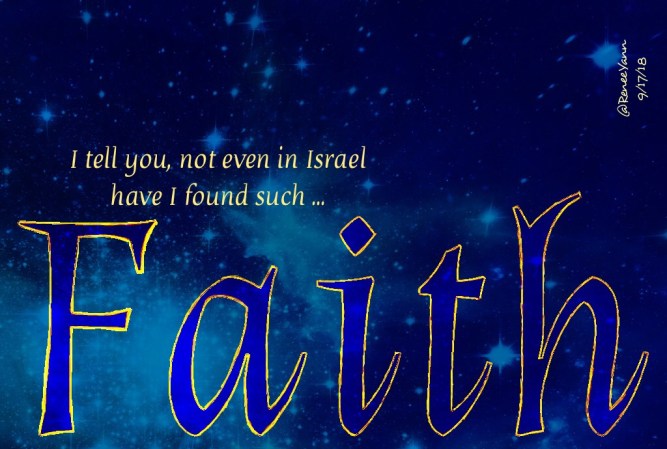
Today, in Mercy, Jesus, in amazement, praises the faith of the centurion. What was it about this man’s faith that could astound even God?  How would my faith make Jesus feel?
faith

We are taught that faith is a gift. We can’t earn it or acquire it on our own. We can though – once we have been given it – exercise it, polish it, cherish it and share it in order to make it stronger.

What is faith exactly?

Well, first off, we get faith mixed up with a lot of things that it is not. 

Faith is not the same as religion or religious denomination. Faith transcends Catholicism, Protestantism, Judaism or Islam. These are the only frameworks in which we sometimes practice our faith.

 Faith isn’t devotions, or prayers, or the formulas we pull out when we are in trouble. It is not the Prayer to St. Anthony when we can’t find our car keys. It is not the novena we say to receive a special favor. These are only practices which allow us to express our faith in human terms.

And most importantly, faith is not an ideology by which we exceptionalize and elevate ourselves, suggesting that others are less because of their choice of religious practice.

If we take a clue from today’s Gospel, we could describe faith like this:

  • It is the unshakable understanding that all Creation belongs to God, including every aspect of my life.
  • It is the trust that God wills our good in all things. 
  • It is the sure confidence that God abides with us in all circumstances.
  • It is the giving of my heart to this abiding God in a relationship of mutual love.
  • It is a life that bespeaks these confidences.

The centurion must have had this kind of faith and it delighted Jesus. Let’s pray for a faith that can do that for God!

Music: Be Still – David Kauffman
Choices

Wednesday, August 29, 2018

          Readings: http://www.usccb.org/bible/readings/082918.cfm

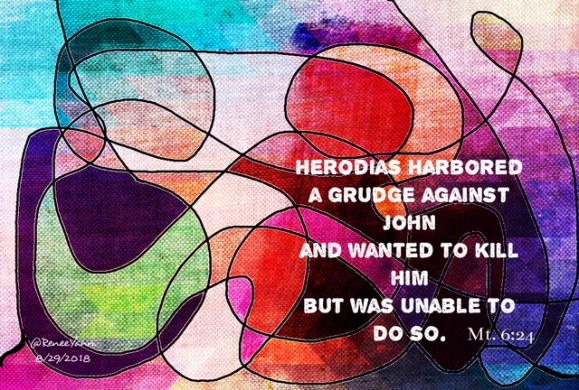
Today, in Mercy, we memorialize the Passion of St. John the Baptist, his imprisonment and beheading at the hands of Herod, the whim of Herodias, and the weakness of Salome. This incident, with its accompanying history and ensuing repercussions, is a classic psychological study in good and evil.

IMt 6_24_Baptist

The characters have repeated themselves in every generation:

Herod: the weak, corrupt, fearful man whose entire energy is spent satisfying himself at the cost of others
Herodias: the faithless, power-hungry schemer who will use any means to advance herself – the holder of grudges
Salome: the spineless sycophant who submits to her mother’s evil agenda is order to preserve her privilege
John: the enlightened protester who suffers the ultimate sacrifice for his beliefs

The passage, like all Bible stories, offers us an opportunity to measure ourselves, and our choices, against these ancestors. 

Bits of each of them rise up in us, challenging us over the course of a lifetime. Our challenges may not have the sweeping dramatic overtones of this story, but they still have the power to color our entire character.

  • Do I use my power for or against others?
  • Do I try to hurt, or shun, others because of my harbored grudges and selfish agendas?
  • How do I respond to the pressure to cooperate with, or ignore, evil?
  • Could my commitment to Christ withstand even death – not only physical death, but the death of a relationship, job, dream, or cherished possession?

John the Baptist dies because he has confronted the sins of Herod, Herodias and Salome. But they cannot disentangle themselves from their knotted immorality. They conspire to take John’s life physically, ultimately eternally strangling their own.

We all have choices – big and small. For George Jones in the attached song, the choice was about drinking. But the song works for whatever choice might divert us from the path to wholeness in God. Maybe we can plug in our own challenges as we listen. Maybe we can be braver the Herod, Herodias and Salome. Maybe John will inspire us!

Music: Choices – George Jones

Did You Say, “Die”?

Friday, August 10, 2018

Readings: http://www.usccb.org/bible/readings/081018.cfm

Today, in Mercy, on this feast of St. Lawrence, our readings are all about wheat. Then, again, they’re really not.

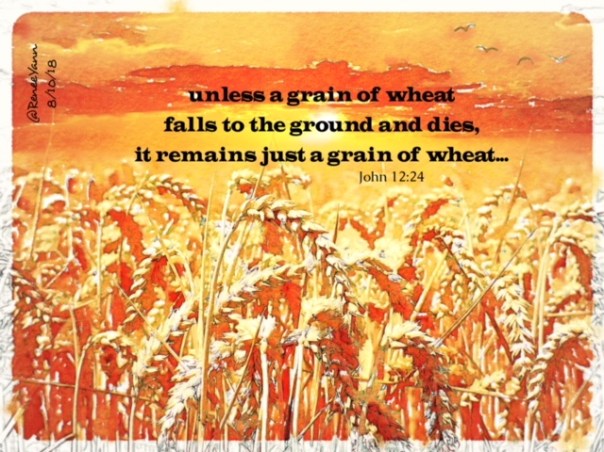
John 12_24 grain

The readings, of course, are about eternal life – lessons taught in symbols the listeners could relate to. The agrarian community of Jesus’ time understood clearly what happened to a grain of wheat when buried in the rich soil. They understood, too, how a single grain, fallen on the barn floor and lost underfoot, had no hope of life.

It is a powerful lesson about community, selflessness, and what we need to do to live a full and meaningful life. 

We have to die —  to our isolation, self-absorption, greed, objectification and domination over others, “me-firstness”. 

Basically, we have to resist the Seven Deadly Sins that make life “all about me”: 

  • Self-adulating pride
  • Vengeful anger
  • Depersonalizing lust
  • Ungrateful envy
  • Consumeristic gluttony
  • Mean Greed
  • Irresponsible laziness

To move beyond these sins, we must recognize, respect and care for others – all others – as children of God.

If we can do that, our grain of wheat will land in harmony with the faith community and will contribute to its abundant life – and to our own. That faith community might be as small as my family or as big as the world. But unless I live there in selflessness, I will never come to my full potential a human being.

Musical reflection: A Grain of Wheat ~ Torchbearers

The Work of God’s Hands

Thursday, August 2, 2018

Readings: http://www.usccb.org/bible/readings/080218.cfm

Today, in Mercy, Jeremiah provides us with the memorable image of the potter and the clay.

If you have ever worked in ceramics or sculpting, you know how the artist becomes one with her work. A shapeless lump of earth takes on an identity within your hands. Ever so delicately, you work to find the potential beauty in the clay. We might begin over and over until we find the perfect dynamic between our hands and the malleable clay.

Jer18_5 potter

Just the right touch, the perfect pressure, and something new – never here before – emerges. The new creation, while existing itself, holds the Potter’s character. It embodies her effort and hope. It is a physical testimony to her dream.

In this scripture passage, God is telling Jeremiah that this is how it is with Israel (and in place of Israel, we can read our own names.) Through the circumstances and opportunities of our lives, God is shaping his dream – the Divine hope for a loving creature who reflects the beauty of God.

As we deepen in our spiritual life, we become more sensitive to God’s touch, more aware of God’s creative presence in our lives. God reworks us, offering us the perfection of grace over the course of our lifetimes. May we have the wisdom to yield to God’s intention in our lives – to make, as Mother Theresa says, “something beautiful for God”.

Music: Abba, Father ~ John Michael Talbot

I Greet the Holy within You

Wednesday, May 16, 2018

Readings: http://www.usccb.org/bible/readings/051618.cfm

Today, in Mercy, in our reading from Acts, Paul continues his prayer for those who will safeguard and carry the faith into the future. In the Gospel, Jesus does the same thing. Both Jesus and Paul talk about the “consecration“ of those they are praying for.

Consecration is the act of making something sacred – setting it apart in God. Each one of us, by our Baptism, has been so consecrated. Jesus tells us that “the world” (read: the influences of greed, power, and self-absorption) will challenge what is sacred in us. These influences will fight against the Truth that we, and every other creature, are holy because Christ died for us.

On occasion, at very special liturgies, the celebrant will venerate the altar and the congregation with incense from a thurible. At funeral liturgies, the body of our loved one is so venerated. These acts recognize the holiness within us. In Hindu culture, the greeting, “Namaste” captures this understanding because it literally means, “I greet the Holy in you.” I was deeply moved to learn this word, many years ago, from one of our missionary Sisters returning from India.

Today’s readings encourage us to reflect on this question: Is my life an act of veneration to the sacred within me and everyone I meet?

Acts 20_32

Song: Holy Now by Peter Mayer

God Has Filled All Things Everywhere

Wednesday, May 2, 2018

Readings: http://www.usccb.org/bible/readings/050218.cfm

Today, in Mercy, we celebrate the feast of St. Athanasius who lived in 4th century Egypt. During his lifetime, the Church struggled with the heresy of Arianism which questioned whether Jesus was really God. Athanasius was named a Doctor of the Church for his steadfast defense of the doctrine of the divinity of Christ. Some of Athanasius’s writings are suggestive of the theology of our great modern theologians, and so necessary for our spirituality today.

The universe unfolds in God, who fills it completely. Hence, there is a mystical meaning to be found in a leaf, in a mountain trail, in a dewdrop, in a poor person’s face. The ideal is not only to pass from the exterior to the interior to discover the action of God in the soul, but also to discover God in all things. (Pope Francis-Laudato Sí, 84)

If we live at a distance from God, the universe remains neutral or hostile to us. But if believe in God, immediately all around us the elements, even the irksome, organize themselves into a friendly whole, ordered to the ultimate success of life. (Pierre deChardin, SJ – Christianity and Evolution)