December greetings to all of you, dear readers. May you be blessed by this beautiful month that, depending on our latitude, brings us the golden or white glory of summer or winter. I hope you enjoy this short poem by Longfellow.

December greetings to all of you, dear readers. May you be blessed by this beautiful month that, depending on our latitude, brings us the golden or white glory of summer or winter. I hope you enjoy this short poem by Longfellow.

Today’s Readings:
https://bible.usccb.org/bible/readings/120123.cfm

Today, in God’s Lavish Mercy, our Responsorial Psalm from Daniel gives us a beautiful prayer. But, in the first reading, we pray with some pretty dramatic passages from the Book of Daniel. I mean, it’s the stuff of a rather scary special effects movie!
Even Daniel indicates how disturbing his visions are:
Because of this, my spirit was anguished and I, Daniel,
Daniel 7:15
was terrified by my visions.
So does the Church, or maybe even God, want us to be disturbed in our prayer today and tomorrow with our last two readings before Advent?
Listen! If you’re not disturbed already by the strain of unholiness in the world, then Daniel isn’t going to rock your boat! But if you, like most good people, have trouble even watching the evening news without anguish, then Daniel is speaking to you.
The writer of Daniel was delivering a message to the people of their time. The visions of chapters 7–12 reflect the crisis which took place in Judea in 167–164 BCE when Antiochus IV Epiphanes, the Greek king of the Seleucid Empire, threatened to destroy traditional Jewish worship in Jerusalem.
The message was:
As with all Scripture, texts that spoke to an ancient people continue to speak to us. Our world suffers and hopes in the same way Daniel’s did. For us, the elements of today’s passage can serve as pre-Advent encouragements. Trusting them, we are moved to pray with all Creation which is ever steadfast in praising God:
Give glory and eternal praise to him!
“Mountains and hills, bless the Lord;
praise and exalt him above all forever.”
“Everything growing from the earth
“You springs, bless the Lord;
“Seas and rivers, bless the Lord;
“You dolphins and all water creatures, bless the Lord;
“All you birds of the air, bless the Lord;
“All you beasts, wild and tame, bless the Lord;
praise and exalt him above all forever.”
R. Give glory and eternal praise to him!
Poetry: The Second Coming – William Butler Yeats
Turning and turning in the widening gyre
The falcon cannot hear the falconer;
Things fall apart; the centre cannot hold;
Mere anarchy is loosed upon the world,
The blood-dimmed tide is loosed, and everywhere
The ceremony of innocence is drowned;
The best lack all conviction, while the worst
Are full of passionate intensity.
Surely some revelation is at hand;
Surely the Second Coming is at hand.
The Second Coming! Hardly are those words out
When a vast image out of Spritus Mundi
Troubles my sight: somewhere in the sands of the desert.
A shape with lion body and the head of a man,
A gaze blank and pitiless as the sun,
Is moving its slow thighs, while all about it
Reel shadows of the indignant desert birds.
The darkness drops again; but now I know
That twenty centuries of stony sleep
were vexed to nightmare by a rocking cradle,
And what rough beast, its hour come round at last,
Slouches towards Bethlehem to be born?
Music: Michael Hoppé – Shadows Fall
Today’s Readings:
https://bible.usccb.org/bible/readings/111823.cfm
Today, in God’s Lavish Mercy, we are blessed with some of the most beautiful passages in scripture.
Psalm 105 invites us to sing praise as we confidently seek God in our lives, and to always remember God’s merciful goodness to us:
Sing to God, sing praise,
Psalm 105: 2-3
proclaim all God’s wondrous deeds.
Glory in the holy name;
rejoice, O hearts that seek the LORD!
Remember the marvels the Lord has done!
Our first reading from Wisdom gives us one of the most gloriously imaginative images in Scripture.

Although the passage is a poetic recounting of the Exodus experience, it always makes me think of Christmas.
Praying with the passage this morning, I realize that my “Christmas lens” on the reading is right on target.
The Christmas event begins our Exodus story, a story completed in the Passion, Death and Resurrection of Christ.
Just as the God of Moses reached into ancient Israel’s life to free them, transform them and make them God’s People, so God reaches into our lives. God does this not only on Christmas, but in every moment of our experience.

As our media and consumer culture bombards us, all too early, with all the secularized images of Christmas, let today’s verses bring us back to the true startling grace of our own Christ/Exodus stories:
We are not alone in the midnights of our lives.
Listen underneath all the distractions
to the, at first, softly emerging sound of Love
humming under all things.
Watch for the small lights of heaven
longing to break into our human darkness.
Give yourself to their Light.
No matter where we are in our lives right now,
no matter the joy or pain of our present circumstances,
God wants to use these realities to be with us
and to teach us Love.
Let us invite God
into our willingness
to learn that Love,
to become that Love.
Music: Winter Cold Night – John Foley, SJ
Yes, it is an Advent/ Christmas song. But it fits so perfectly. Please forgive me if I am rushing the season too. 😉
Oh, the depth of the riches of God
And the breadth of the wisdom and knowledge of God
For who has known the mind of God
To Him be glory forever
A virgin will carry a child and give birth
And His name shall be called Emmanuel
For who has known the mind of God
To Him be glory forever
The people in darkness have seen a great light
For a child has been born, His dominion is wide
For who has known the mind of God
To Him be glory forever
Today’s Readings:
https://bible.usccb.org/bible/readings/111723.cfm

Today, in God’s Lavish Mercy, our two readings remind us that the journey into God is an ever-deepening passage to which we must continually open our hearts.
The Wisdom writer addresses those who sincerely seek God, but who cannot see beyond God’s handiwork. So they are satisfied to make gods of these created wonders:
All persons were by nature foolish who were in ignorance of God,
Wisdom 13:1-3
and who from the good things seen did not succeed in knowing him who is,
and from studying the works did not discern the artisan;
But either fire, or wind, or the swift air,
or the circuit of the stars, or the mighty water,
or the luminaries of heaven, the governors of the world, they considered gods.
Now if out of joy in their beauty they thought them gods,
let them know how far more excellent is the Lord than these;
for the original source of beauty fashioned them.
The writer seems astounded that these seekers get lost on their way to full knowledge of God:
For they search busily among his works,
Wisdom 13: 7-9
but are distracted by what they see,
because the things seen are fair.
But again, not even these are pardonable.
For if they so far succeeded in knowledge
that they could speculate about the world,
how did they not more quickly find its Lord?
I don’t find it so astounding. The invisible God we love and worship can be elusive, and the world through which we seek that God can be deeply distracting. I think it’s pretty easy to get stuck worshipping signs of God (which we can see) rather than God (Whom we cannot see). I think that’s what Jesus might have meant when he said, “Blessed are the pure of heart, for they shall see God.”
Our Gospel reading gives us a hint about truly seeking God. It’s a reading I have always found a little bit scary. As a child, I envisioned myself, or the dear person next to me, getting swooped up in some unexpected divine tornado. It wasn’t a comfortable image.
I tell you, on that night there will be two people in one bed;
Luke 17: 34-37
one will be taken, the other left.
And there will be two women grinding meal together;
one will be taken, the other left.”
They said to him in reply, “Where, Lord?”
He said to them, “Where the body is,
there also the vultures will gather.”
I mean, really, this is nobody’s favorite scripture passage! But what can it teach us? Maybe this: just like the unfulfilled worshippers in our Wisdom passage, the folks Jesus describes were distracted by the necessities and frivolities of life. In their spiritual journeys, they had not fully opened their hearts to the holy expectation of God. When God comes in a swoop of Infinite Grace, they’re just not ready for the swooping!
In our readings today, both the Wisdom writer and Jesus are encouraging us to meet every life experience as an opportunity to move deeper into the mystery of God.
The Wise One tells us to look beyond the beautiful distractions of our lives into the One Who ordains them:
Now if out of joy in their beauty they thought them gods,
Wisdom 13:3
let them know how far more excellent is the Lord than these;
for the original source of beauty fashioned them.
And Jesus very bluntly tells us that our visible experiences hold a deeper meaning that we will never know unless we yield our life fully to God’s transforming grace:
Whoever seeks to preserve their life will lose it,
Luke 17:33
but whoever loses it will save it.
Poetry: If only there were stillness, full, complete – Rainer Maria Rilke
If only there were stillness, full, complete.
If all the random and approximate
were muted, with neighbors’ laughter, for your sake,
and if the clamor that my senses make
did not confound the vigil I would keep —
Then in a thousandfold thought I could think
you out, even to your utmost brink,
and (while a smile endures) possess you, giving
you away, as though I were but giving thanks,
to all the living.
Music: Jessye Norman – Sanctus from Messe solennelle de Sainte Cécile in G major, by Charles Gounod
I never hear this piece without being awestruck by Ms. Norman’s magnificent voice. I had the great joy of meeting her and working with her briefly on a project over thirty years ago. She was majestic in every way. May she rest in Peace.
Today’s Readings:
https://bible.usccb.org/bible/readings/111123.cfm
Today, in God’s Lavish Mercy, there is a graceful coincidence of several themes calling me to prayer. I share them with you:

Not just today, but often, I think about what Catherine would be like if she lived among us today. In her day, she was ever practical, focusing on healing the greatest unmet needs around her.
Her “un-technologized” world was smaller than ours. She encountered need simply by a walk through Dublin’s neighborhoods. Were she here today, need would pour into her awareness from every corner of the earth via technological means. How would she focus the power of her merciful heart for our times?
Our readings prompt me to think that Catherine would do the same three things she did almost two hundred years ago:
In our first reading, Paul names a number of his companions, those who strengthened and assisted him in life and ministry. Catherine too had beloved companions without whom she could not have met the challenges of her call.
In our Gospel, Jesus affirms that our hearts must be emptied of the undue love of anything that distracts us from God and God’s Way:
No servant can serve two masters.
Luke 16: 12-15
He will either hate one and love the other,
or be devoted to one and despise the other.
You cannot serve God and mammon.”
The Pharisees, who loved money,
heard all these things and sneered at him.And he said to them,
“You justify yourselves in the sight of others,
but God knows your hearts;
for what is of human esteem is an abomination in the sight of God.”
While in her times, Catherine encountered the ravages of material poverty, I think that something much less tangible, but exponentially more destructive, would capture her ministerial awareness today.
Our world suffers from an intrinsic and debilitating fear which inclines us to amass power and possessions to the impoverishment of those around us. The fear of not being or having enough drives the systemic predation of the rich upon the poor, and the powerful over the weak. It is a fear that grows in a heart emptied of God.
While Catherine would continue to address the needs of those suffering from poverty and disenfranchisement, I think she would reach out in a new way to the healing of those underlying fears. These fears fester in a culture of spiritual ignorance endemic to our modern society. The naming and healing of that ignorance is deeply congruous with Catherine’s charism and calls to us urgently today.
About St. Martin de Porres, Pope John XXIII said this:
So did Catherine McAuley. So must we.
Poetry: Where the Mind is Without Fear – Rabindranath Tagore
Where the mind is without fear and the head is held high
Where knowledge is free
Where the world has not been broken up into fragments
By narrow domestic walls
Where words come out from the depth of truth
Where tireless striving stretches its arms towards perfection
Where the clear stream of reason has not lost its way
Into the dreary desert sand of dead habit
Where the mind is led forward by thee
Into ever-widening thought and action
Into that heaven of freedom, my Father, let us awake.
Music: There is No Fear in Love – The Bible Project
Today’s Readings:
https://bible.usccb.org/bible/readings/102023.cfm
Today, in God’s Lavish Mercy, we have a Gospel passage which is both scary and beautiful!
I tell you, my friends,
Luke 12:4-7
do not be afraid of those who kill the body
but after that can do no more.
I shall show you whom to fear.
Be afraid of the one who after killing
has the power to cast into Gehenna;
yes, I tell you, be afraid of that one.
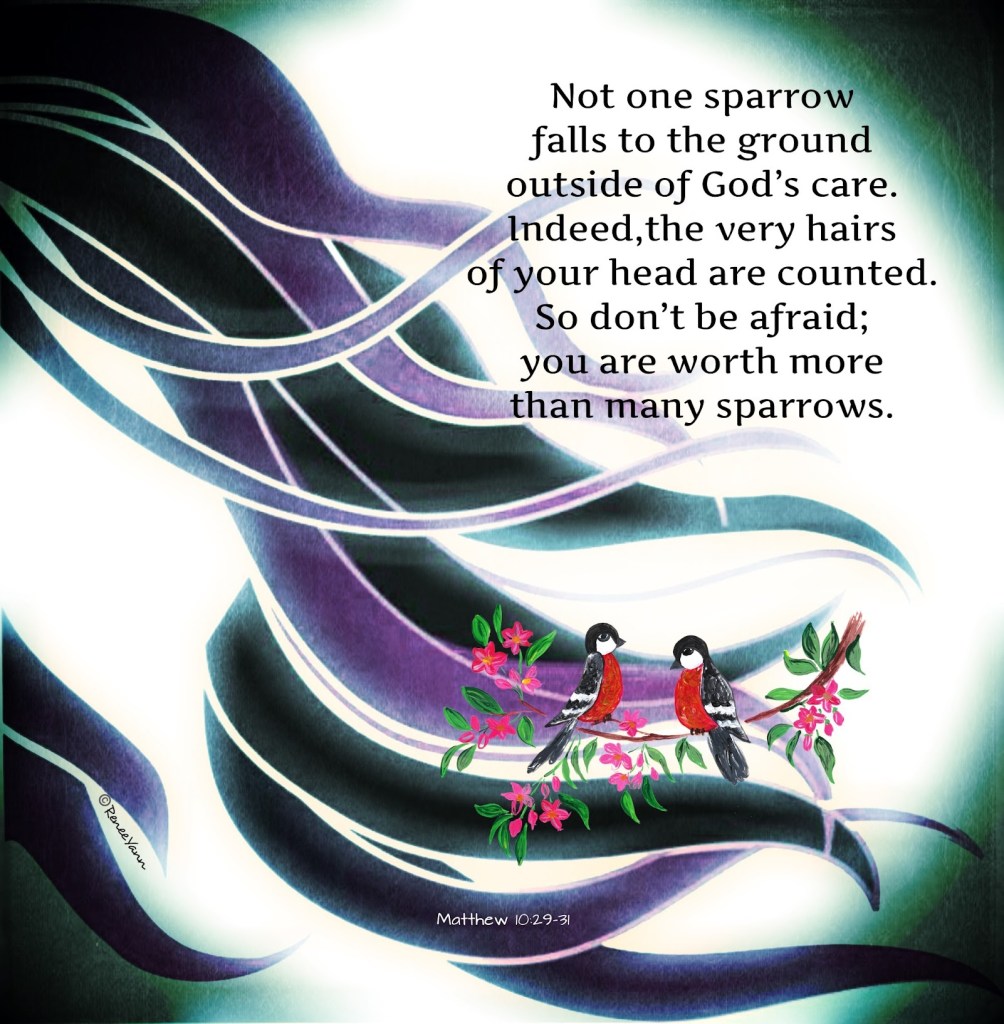
Are not five sparrows sold for two small coins?
Yet not one of them has escaped the notice of God.
Even the hairs of your head have all been counted.
Do not be afraid.
You are worth more than many sparrows.
Jesus, with radical clarity, tells us that God is both a relentless judge and a tender parent. Who God is toward us depends on our choices in life, because our choices either open or close us to know God.
Jesus says that we will be condemned if we choose to live a hypocritical life like the Pharisees.
There are many images of “Gehenna”, both within and outside of the Gospel. For some of us, that condemnation is represented in hellfire, brimstone, devils, and pitchforks.
But today’s Gospel might incline us to consider that the condemnation is more a personal choice for spiritual alienation from God – in other words, sin. By that choice, we isolate ourselves from God’s tenderness choosing instead selfishness, prevarication, and hard-heartedness. We become less than we were created to be, and that in itself is a tragic self-condemnation.
Jesus says that when that kind of choosing becomes a habitual part of our lives, it is like leaven that permeates our very personhood. It changes us from God’s child to our own biggest fan. Like the Pharisees, we live a lie of who we pretend to be. And, especially from a position of power, we can infect others with our deception. They become “leavenized”: they “drink the kool-aid”.

Ironically, at the end of this tirade, Jesus gives us two of the tenderest images of God: God the Hairdresser and God the Bird Lover. Praying with these images, I remember my mother tenderly fingering my hair as I sat beside her in the evening. I picture my father spreading birdseed on the frozen patio when the winter juncos struggled to find food.
In our prayer today, Jesus invites us to encounter God with this kind of tender familiarity.
Poetry: The Creation of the Birds – Renee Yann, RSM

O, the wonderful mood that seized You
God, as you created birds;
you dancing there, twirling in light,
flinging your crystal arms to infinite music,
flicking your hands like magic fountains,
feathers and colors splashing out from your fingertips,
chattering, rainbowed profusions
of your Boundless Life.
Your depthless, joy-filled soul laughing out
the soaring beings into the still universe,
peals of you infusing them each
to their measure with notes of your inner song.
O, I see your Holy Eyes flash color to them
as they fly, strobing their feathers
with shards of your prismed white light.
This morning, seeing only one,
free and jubilant in a thin sycamore,
I consume it as
part of your Delightful Essence,
this day’s communion with you, grey
and orange wafer filling me with mysteries
of the primal dance from which
we both began.
Music: His Eye Is On the Sparrow
Today’s Readings:
https://bible.usccb.org/bible/readings/101723.cfm
Today, in God’s Lavish Mercy, both Paul and Jesus speak forcefully against an endemic human fault: dishonesty.

Paul castigates “those who suppress the truth by their wickedness”:
The wrath of God is indeed being revealed from heaven
Romans 1:18-20
against every impiety and wickedness
of those who suppress the truth by their wickedness.
For what can be known about God is evident to them,
because God made it evident to them.
Ever since the creation of the world,
his invisible attributes of eternal power and divinity
have been able to be understood and perceived in what he has made.
These “truth suppressors” are guilty for one reason – they know better! God’s Truth is evident to them in Creation yet they deny and pervert it for the sake of their own selfish ends.
As a result, they have no excuse;
Romans 1:20-23
for although they knew God
they did not accord him glory as God or give him thanks.
Instead, they became vain in their reasoning,
and their senseless minds were darkened.
While claiming to be wise, they became fools
and exchanged the glory of the immortal God
for the likeness of an image of mortal man
or of birds or of four-legged animals or of snakes.
Jesus defines this untruth more clearly. He says that it presents itself in pretense – the external dissimulation which masquerades narcissistic motivations:
The Pharisee (who had invited Jesus to dinner) was amazed to see
Luke 11:38-41
that Jesus did not observe the prescribed washing before the meal.
The Lord said to him, “Oh you Pharisees!
Although you cleanse the outside of the cup and the dish,
inside you are filled with plunder and evil.
You fools!
Did not the maker of the outside also make the inside?
But as to what is within, give alms,
and behold, everything will be clean for you.”

Jesus indicates that charity is the perfect “cleanser” for dirty cup interiors (and dingy moral codes). Sounds easy enough, doesn’t it? Well, maybe not so easy but certainly clear and simple.
Charity is rooted in the interior recognition that we are all children of our Creator and that we have a responsibility for one another’s welfare. Acting on that recognition is “almsgiving” which comes from the same Greek root, “eleemosyne“, as the word mercy.
Our world, like Paul’s, is challenged by the suppression of truth. Much of our visible culture is based on lies and pretense. Political hoodwinking, media non-objectivity, economic duplicity, and exploitive advertising conspire to convince us that:
Jesus and Paul tell us that we must resist such lies, purify our hearts of their influence, and live a Gospel life of truth, charity, and mercy.
Prose: from the Catholic Encyclopedia:
I found this definition of almsgiving very thought-provoking because it indicates that “almsgiving or “mercy” is more than an act or actions. It is an attitude and lifestyle, a lens through which we consider all things in the light of the Gospel for the sake of the poor:
Any material favor done to assist the needy, and prompted by charity, is almsgiving. It is evident, then, that almsgiving implies much more than the transmission of some temporal commodity to the indigent. According to the creed of political economy, every material deed wrought by humans to benefit the needy is almsgiving. According to the creed of Christianity, almsgiving implies a material service rendered to the poor for Christ’s sake. Materially, there is scarcely any difference between these two views; formally, they are essentially different. This is why the inspired writer says: “Blessed is the one that considers the needy and the poor” (Psalm 40:2) — not the one that gives to the needy and the poor.
Music: The Prisoners’ Chorus – from Beethoven’s only opera Fidelio
Fidelio is inspired by a true story from the French Revolution. It centers on a woman, Leonore, whose husband Florestan has been unjustly imprisoned by his political rival – the villainous Don Pizarro. In the magnificent “Prisoners’ Chorus”, the prisoners sing powerfully about the gift and need for freedom.
Oh what joy, in the open air
Freely to breathe again!
Up here alone is life!
The dungeon is a grave.
FIRST PRISONER
We shall with all our faith
Trust in the help of God!
Hope whispers softly in my ears!
We shall be free, we shall find peace.
ALL THE OTHERS
Oh Heaven! Salvation! Happiness!
Oh Freedom! Will you be given us?
Today’s Readings:
https://bible.usccb.org/bible/readings/101323.cfm
Today, in God’s Lavish Mercy, – and tomorrow – we finish up our short journey with the minor prophets with two passages from Joel.

Joel the Prophet by Michelangelo
from the Sistine Chapel ceiling
Joel and his neighbors were living through a plague of locusts. The book begins with a stark warning to wake up and see the meaning of what is happening:
Listen to this, you elders!
Joel 1:1-5
Pay attention, all who dwell in the land!
Has anything like this ever happened in your lifetime,
or in the lifetime of your ancestors?…
What the cutter left
the swarming locust has devoured;
What the swarming locust left,
the hopper has devoured;
What the hopper left,
the consuming locust has devoured.
Wake up, you drunkards, and weep;
wail, all you wine drinkers,
Over the new wine,
taken away from your mouths.
Although Joel’s agricultural disaster is part of ancient history, like other seemingly remote scriptural passages, it bears a startlingly apropos message for us today.
Joel gave voice to a ravaged earth that could not speak for itself. In his writings, earth and its people are intimately connected – each affected by and bearing the consequences of the other’s suffering. The devastation of the wheat fields and vineyards has robbed the worshippers of their most important possession – the staples to offer in praise of God:
Gird yourselves and weep, O priests!
Joel 1:13-14
wail, O ministers of the altar!
Come, spend the night in sackcloth,
O ministers of my God!
The house of your God is deprived
of offering and libation.
Proclaim a fast,
call an assembly;
Gather the elders,
all who dwell in the land,
Into the house of the LORD, your God,
and cry to the LORD!
As Joel pleaded with his people to recognize their implication in the earth’s annihilation, so Pope Francis pleads with us in Laudate Deum:
Eight years have passed since I published the Encyclical Letter Laudato Si’, when I wanted to share with all of you, my brothers and sisters of our suffering planet, my heartfelt concerns about the care of our common home. Yet, with the passage of time, I have realized that our responses have not been adequate, while the world in which we live is collapsing and may be nearing the breaking point. In addition to this possibility, it is indubitable that the impact of climate change will increasingly prejudice the lives and families of many persons. We will feel its effects in the areas of healthcare, sources of employment, access to resources, housing, forced migrations, etc. (2) This is a global social issue and one intimately related to the dignity of human life.(3)
Pope Francis recognizes, as did the prophet Joel, that there are “deniers” – climate change deniers and deniers of the sins of complicity.
Joel warns that such sinful denial will bear consquences not only on his current generation but on their children:
Yes, it is near, a day of darkness and of gloom,
Joel 2: 1-2
a day of clouds and somberness!
Like dawn spreading over the mountains,
a people numerous and mighty!
Their like has not been from of old,
nor will it be after them,
even to the years of distant generations.
Pope Francis voices a similar warning:
Climate change is one of the principal challenges facing society and the global community. The effects of climate change are borne by the most vulnerable people, whether at home or around the world. In a few words, the Bishops assembled for the Synod for Amazonia said the same thing: “Attacks on nature have consequences for people’s lives”. And to express bluntly that this is no longer a secondary or ideological question, but a drama that harms us all, the African bishops stated that climate change makes manifest “a tragic and striking example of structural sin”. (3)

Many of us don’t want to read about climate change much less pray about it. A lot of us don’t have a clue how we can help reverse the cataclysmic tide. We may even be a “denier” ourselves! But if we are, we are in a very small minority:
Robust studies of climate change perceptions in Australia, the UK and America show that only very small numbers of people actually deny that climate change is happening. The figures range from between 5 to 8% of the population. However this small minority can be influential in casting doubt on the science, spreading misinformation and impeding progress on climate policies.
from the Australian Psychological Society
The other 92% to 95% of us must pray and act with the global community to respond effectively to the summons of Pope Francis:

I ask everyone to accompany this pilgrimage of reconciliation with the world that is our home and to help make it more beautiful, because that commitment has to do with our personal dignity and highest values. At the same time, I cannot deny that it is necessary to be honest and recognize that the most effective solutions will not come from individual efforts alone, but above all from major political decisions on the national and international level. (69)
Nonetheless, every little bit helps, and avoiding an increase of a tenth of a degree in the global temperature would already suffice to alleviate some suffering for many people. Yet what is important is something less quantitative: the need to realize that there are no lasting changes without cultural changes, without a maturing of lifestyles and convictions within societies, and there are no cultural changes without personal changes. (70)
Video: from the Vatican website introducing Laudate Deum
Today’s Readings:
https://bible.usccb.org/bible/readings/1004-memorial-francis-assisi.cfm
(I chose to offer a reflection on the readings for the Memorial of St. Francis rather than for Wednesday of the Twenty-sixth Week)

Today, in God’s Lavish Mercy, we pray with St. Francis of Assisi (1181-1226) , one of the most revered figures in Christianity, an Italian mystic and Catholic friar who founded the Franciscans.
The simple holiness of St. Francis has had an immeasurable effect not only on Christianity but even on secular culture. No matter their religious interest, most people would recognize this humble, medieval itinerant preacher and understand the witness of his life.


Our current Holy Father, in a surprise move, chose St. Francis as his patron and model:
When the former Cardinal Jorge Mario Bergoglio went over the 77 votes needed to become pope, he said that his friend Cardinal Hummes “hugged me, kissed me and said, ‘Don’t forget the poor.’”
At the time of his election, Pope Francis told thousands of journalists that he took to heart the words of his friend and chose to be called after St. Francis of Assisi, “the man of poverty, the man of peace, the man who loves and protects creation.”
In our readings today, both the Responsorial Psalm and the Gospel echo a spirituality deeply compatible with the Franciscan spirit.
Francis, who renounced his wealthy lifestyle and inheritance for the riches of Christ, surely found inspiration when he prayed Psalm 16:
You are my inheritance, O Lord.
Keep me, O God, for in you I take refuge.
I say to the LORD, “My Lord are you.”
O LORD, my allotted portion and my cup,
you it is who hold fast my lot.
I bless the LORD who counsels me;
even in the night my heart exhorts me.
I set the LORD ever before me;
with him at my right hand I shall not be disturbed.
You will show me the path to life,
fullness of joys in your presence,
the delights at your right hand forever.
Most of us reading this reflection have so much in life. We are blessed beyond description with everything we need and even want. Praying in the spirit of St. Francis can help us discern how to honor and use what we have in a way that pleases God.
Keep a clear eye toward life’s end. Do not forget your purpose and destiny as God’s creature. What you are in God’s sight is what you are and nothing more. Remember that when you leave this earth, you can take nothing that you have received…but only what you have given; a full heart enriched by honest service, love, sacrifice, and courage.
Francis of Assisi
Poetry: ST. FRANCIS OF ASSISI – A SERMON TO THE BIRDS
Francis made his deep spirituality and radical teaching easily accessible with unpretentious parables like this one. He imitated Jesus himself who taught us how to live by telling simple stories in which we could find ourselves. So let’s learn from this one, my little “birds”.
My little sisters the birds, Ye owe much to God, your Creator, And ye ought to sing his praise at all times and in all places, Because he has given you liberty to fly about into all places; And though ye neither spin nor sew, He has given you a twofold and a threefold clothing For yourselves and for your offspring. Two of all your species He sent into the Ark with Noah That you might not be lost to the world; Besides which, He feeds you, though ye neither sow nor reap. He has given you fountains and rivers to quench your thirst, Mountains and valleys in which to take refuge, And trees in which to build your nests; So that your Creator loves you much, Having thus favored you with such bounties. Beware, my little sisters, of the sin of ingratitude, And study always to give praise to God.” Amen
Music: St. Francis of Assisi by Mendoza Musicals
Today’s Readings:
https://bible.usccb.org/bible/readings/1002-memorial-guardian-angels.cfm
Today, in God’s Lavish Mercy, pray with Psalm 91 from the readings for the Mass of the Guardian Angels – those magnificent beings who carry God’s Presence to us in every situation of our lives.
The Lord shall deliver you from the snare of the hunter
Psalm 91: 3-4
and from the deadly pestilence.
The wings of the Lord shall cover you,
and you shall find refuge under them;
the faithfulness of God shall be a shield and buckler.

Maybe the only angels we ever think about are chubby little cherubs on Christmas cards. The cultural tendency to represent angels in that way diminishes the real power of these mighty and loving beings to inspire and guide us. Today might be a day to rethink our relationship with our Guardian Angels – to talk with them and to listen to the good things they tell us even without words.
Praying with the angels requires the unembarrassed simplicity of deep faith. Our culture has painted the angels with a patina of childishness, but that is far from their biblical representation. Angels are supernaturally powerful beings throughout both the Hebrew and Christian scriptures. If you meet a personal block in praying with your own guardian angels, pick one of the only three named in the Bible and consider that angel’s dynamic presence.
Gabriel: The angel Gabriel is an angel of God who is mentioned by name three times in the Bible when he brought messages from God to Daniel, Zechariah, and Mary.
Michael: the only one called “archangel” in the Bible. In the books of Daniel, Jude, and Revelation, Michael is described as a warrior angel who engages in spiritual combat.
Raphael: mentioned only in the Catholic canon of the Bible, Raphael has a key role in the Book of Tobit

Poem: Touched by an Angel by Maya Angelou
We, unaccustomed to courage,
exiles from delight,
live coiled in shells of loneliness
until love leaves its high holy temple
and comes into our sight
to liberate us into life.
Love arrives
and in its train come ecstasies
old memories of pleasure
ancient histories of pain.
Yet if we are bold,
love strikes away the chains of fear
from our souls.
We are weaned from our timidity
In the flush of love’s light
we dare be brave
And suddenly we see
that love costs all we are
and will ever be.
Yet it is only love
which sets us free
Music: Angel’s Serenade – Gaetano Braga