Thunderous Son!

Feast of Saint James, Apostle
July 25, 2023

Today’s Readings:

https://bible.usccb.org/bible/readings/072523.cfm


Today, in God’s Lavish Mercy, we celebrate St. James the Greater. As you know, there were two Aposltes named James. It can get confusing. I know because about half the men in my family are named James. It’s hard to call out to one of them at a family reunion because four or five people will answer when you yell, “Hey, Jim!”

So tradition has solved the St. James name problem by designating one as “the Greater” and one as “the Less”, descriptors based on age not importance. Today we celebrate James the Greater.


Mary Salome and Zebedee with Sons James and John
according to Hans Seuss Kolmback – c.1511
(Love the hat, or what? And, baby John is already holding the “cup”!)


James and his brother John were sons of Zebedee. In Mark 17, Jesus nicknames the two of them “Sons of Thunder”, so he must have had some early insight into their fiery nature. That nature was clearly displayed after the Transfiguration when Jesus began his final journey to Jerusalem. He had sent the disciples ahead to prepare an overnight stay in a Samaritan village, but the villagers rejected Jesus. This made the Zebedee boys mad so they asked Jesus:

… the people there did not welcome him, because he was heading for Jerusalem. 
When the disciples James and John saw this, they asked,
“Lord, do you want us to call fire down from heaven to destroy them?” 
But Jesus turned and rebuked them.
Then he and his disciples went to another village.

Luke 9:53-56

You know what, I really like these guys! James and his brother John were all-in to Jesus and the Gospel. Their thundery enthusiasm got convoluted at times but, by word and example, Jesus continued to redirect their immense energy toward God’s Will.

I like their mother too. She had her own kind of fire and wanted the best for her boys as today’s Gospel indicates:

The mother of the sons of Zebedee approached Jesus with her sons
and did him homage, wishing to ask him for something.
He said to her,
“What do you wish?”
She answered him,
“Command that these two sons of mine sit,
one at your right and the other at your left, in your Kingdom.”

Matthew 20:20-21

With a surface reading of this passage, we might consider Mrs. Zebedee a little dense or arrogant. But Jesus simply responded by reminding her that her sons too, like him, would experience suffering before any heavenly reward.

The Gospel does not record Mrs. Zebedee’s response, whether she was miffed, chastened, frightened, or apologetic. What later chapters do record is that she got the message and embraced it. Of all the disciples she, with only a few other brave women and her boy John, showed up at the foot of the cross.

Where our man James the Greater was on that Good Friday we do not know. But he certainly stuck with Jesus in the long run.


The Zebedee Family, with its many Gospel appearances, can teach us so much about relationship with Jesus, about maturing slowly – sometimes haltingly – in Gospel faith, and about long-term fidelity to God’s Will. Let us pray with them today.


Poetry: from The Parables of Our Lord and Savior Jesus Christ, c.1763

PARABLE LXIII.

The two Sons of Zebedee.
The spouse of Zebedee, that bare
The sons of Thunder, made a pray'r,
As she to Christ adoring came;
And Jesus said, What would the dame?
‘Grant me, O Lord, that either son
‘Be with thee in thy kingdom; one
‘Upon thy right hand to appear,
‘The other on the left as near.’
But Jesus answer'd their desire,
‘Ye know not what ye would require.
‘Do ye yourselves of strength believe.
‘The cup I drink of to receive?
‘And in that baptism be baptiz'd,
‘Which is for Christ himself devis'd?’
O Lord, we do, they answer make.
‘Ye shall indeed my cup partake,
‘Be baptiz'd in my baptism too;
‘But 'tis not of my gifts to you,
‘On right or left to place, but theirs
‘For whom my heav'nly Sire prepares’
But when this thing was told the ten,
They were enrag'd at both the men:
But Jesus call'd them all, and said,
‘Ye know the Gentiles chuse a HEAD,
‘And that great prince that holds the reins,
‘Will plead a merit for his pains:
‘But with you it shall not be so;
‘Who would be great, he shall be low,
‘And he th'aspiring chief of all
‘A lord at ev'ry servant's call.
‘'Tis with the Son of Man the same,
‘To serve, and not be serv'd, he came;
‘A minister of no esteem,
‘Which dies the myriads to redeem.’
When Christ the multitudes had fed
With God's good fishes and his bread,
At once so great was his renown,
The people proffer'd him a crown,
From which in haste the Lord withdrew
To better points he had in view.
Christians must honour and obey
Such men as bear the sov'reign sway.
But, in respect of each to each,
The Lord and his apostles teach,
That we should neither load nor bind,
But be distributive and kind

Music: Congaudeant Catholici from the Codex Calixtinus – Music for the Feast of St. James the Apostle

The Codex Calixtinus (or Codex Compostellus) is a manuscript that is the main element of the 12th-century Liber Sancti Jacobi (‘Book of Saint James’), a pseudepigraph whose likely author is the French scholar Aymeric Picaud. The codex was intended as an anthology of background detail and advice for pilgrims following the Way of Saint James to the shrine of the apostle Saint James the Great, located in the cathedral of Santiago de Compostela, Galicia. The collection includes sermons, reports of miracles and liturgical texts associated with Saint James, and a set of polyphonic musical pieces. In it are also found descriptions of the route, works of art to be seen along the way, and the customs of the local people.

Three parts of the Codex Calixtinus include music: Book I, Appendix I, and Appendix II. These passages are of great interest to musicologists as they include early examples of polyphony. (Wikipedia)

Today’s selection is the Congaudeant Catholici. I could not find an English translation of the lyrics but, for the Latin scholars reading here, go to it with the text below! For the rest of us, it’s just a beautiful ancient melody to pray with.

Latin text

Congaudeant catholici,
letentur cives celici

Refrain: die ista

Clerus pulcris carminibus
studeat atque cantibus.

Hec est dies laudabilis,
divina luce nobilis.

Vincens herodis gladium,
accepit vite bravium.

Qua iacobus palatia,
ascendit ad celestia.

Ergo carenti termino
benedicamus domino.

Magno patri familias
solvamus laudis gratias.
Good Ground for Hope

Sixteenth Sunday in Ordinary Time
July 23, 2023

Today’s Readings:

https://bible.usccb.org/bible/readings/072323.cfm


Today, in God’s Lavish Mercy, our readings revolve around the dynamic of hope – God’s hope planted in our spirits and our hope entrusted to God’s Mercy.

As we pray with these passages, it helps to remind ourselves of the true definition of “hope”. It is a word that many of us use carelessly to the point that we may have lost the power of its meaning – as in when we say things like, “I hope it doesn’t rain”. What we really mean is that we wish it wouldn’t rain.

Hope is not the same as wishing. Wishing is a mental activity that has no power to make its object come true. Hope, on the other hand, is a resident condition of our spirits that frees us to live with enthusiasm and gratitude despite whatever outcome may arise.

Wishing dissapates when conclusions pass. Hope is eternal because it draws its energy from faith in God’s Infinite Mercy and the promise of eternal life.


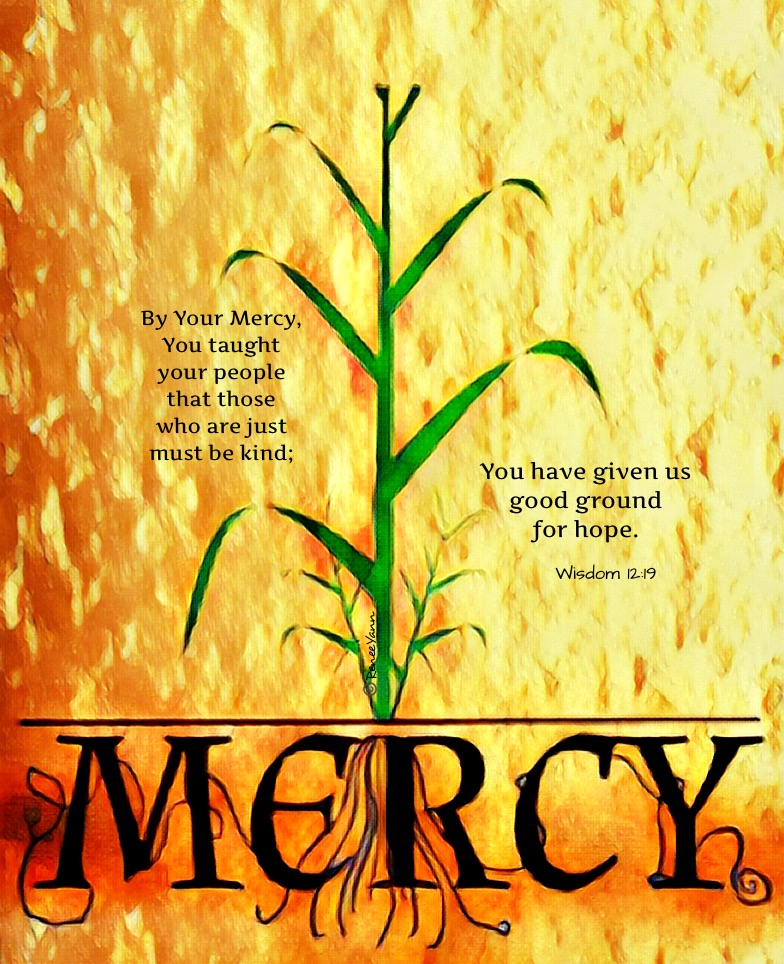
The Book of Wisdom’s author understood the Source from which hope springs:

Though you are master of might, you judge with clemency,
and with much lenience you govern us;
for power, whenever you will, attends you.
And you taught your people, by your deeds,
that those who are just must be kind;
and you gave your children good ground for hope
that you would permit repentance for their sins.

Wisdom 12:18-19

Paul, in another passage from magnificent Romans 8, acknowledges that we can sustain hopeful hearts only by the power of the Holy Spirit who lifts us up and prays within us when we are too overwhelmed to do so ourselves.

The Spirit comes to the aid of our weakness;
for we do not know how to pray as we ought,
but the Spirit intercedes with inexpressible groanings. 
And the one who searches hearts
knows what is the intention of the Spirit,
because Spirit intercedes for the holy ones
according to God’s will.

Romans 8:26-27

Jesus gives us a great parable for understanding hope. How discouraged might that farmer have been when the enemy tried to ruin his crop! But instead, the farmer realized that his field, like life, can sustain both the wheat and the weeds. If we live hopefully and faithfully, the wheat can be gathered from the harvest, and the weeds ultimately cast aside.


How many times in our own lives have we nearly been overwhelmed by the weeds! There is no life which passes without its hurts, disappointments, confusions, and dashed wishes! Some experience a sparse scattering of these weeds, and some lives are thick with difficulty. How surprising that it is often in the latter circumstance that hope rises up and sustains hearts.


As our Responsorial Psalm reminds us, those who live simply and sincerely are most able to tap deeply into the mysterious power of hope.

Blessed are you, Father, Lord of heaven and earth;
you have revealed to little ones the mysteries of the kingdom.


Poetry: From “Odes” – George Santayana was a Spanish-American philosopher known more for his aphorisms than his poetry. He came up with lines like, ‘Those who cannot remember the past are doomed to repeat it”, and “Fanaticism consists in redoubling your effort when you have forgotten your aim.”

IV

Slowly the black earth gains upon the yellow,
And the caked hill-side is ribbed soft with furrows.
Turn now again, with voice and staff, my ploughman,
Guiding thy oxen.
Lift the great ploughshare, clear the stones and brambles,
Plant it the deeper, with thy foot upon it,
Uprooting all the flowering weeds that bring not
Food to thy children.
Patience is good for man and beast, and labour
Hardens to sorrow and the frost of winter.
Turn then again, in the brave hope of harvest,
Singing to heaven.

Music: Weed and Wheat – Silayio Kirisua is a Maasi woman who represented Kenya in the Voice of Holland singing competition. After winning the competition, she has become an international sensation.

Coming to Forgiveness

Memorial of Saint Kateri Tekakwitha, Virgin
Friday of the Fourteenth Week in Ordinary Time
July 14, 2023

Today’s Readings:

https://bible.usccb.org/bible/readings/071423.cfm


Today, in God’s Lavish Mercy, our Gospel describes the suffering to be encountered by disciples as they live and preach the Gospel.

Jesus said to his Apostles:
“Behold, I am sending you like sheep in the midst of wolves;
so be shrewd as serpents and simple as doves.
But beware of men,
for they will hand you over to courts
and scourge you in their synagogues,
and you will be led before governors and kings for my sake
as a witness before them and the pagans.

Matthew 10:16-18

The suffering is predicted to come from many quarters, but perhaps the most heart-breaking is persecutioin within families:

Brother will hand over brother to death,
and the father his child;
children will rise up against parents and have them put to death.
You will be hated by all because of my name,
but whoever endures to the end will be saved.

Matthew 10:21-22

Our reading from Genesis, on the other hand, describes the loving resolution of a long-standing family rupture as Jacob (now called “Israel”) reunites with his long-lost son:

Israel had sent Judah ahead to Joseph,
so that he might meet him in Goshen.
On his arrival in the region of Goshen,
Joseph hitched the horses to his chariot
and rode to meet his father Israel in Goshen.
As soon as Joseph saw him, he flung himself on his neck
and wept a long time in his arms.
And Israel said to Joseph, “At last I can die,
now that I have seen for myself that Joseph is still alive.”

Genesis 46:28-30

Many of us have borne the pain of similar fractures in our various “families”: family of origin, community, church or friends. Sometimes the cause of these breaks may be contradictions in faith and moral practice. At other times, loving bonds break because of willfulness, arrogance, ignorance, small-heartedness or the many other forms of human limitation.

The outrageous jealousy of Joseph’s brothers cleft their otherwise contented family. But into that chasm, God poured time’s grace and Joseph’s healing. From these gifts, Joseph was able to step into reconciliation, inviting his repentant brothers to join him.


In our own lives, such a step can be inordinately huge. The longer we hesitate to take it, the more it widens, sometimes to the point of apparent no return. But the grace of forgiveness is always available to us even if actual reconciliation is impossible because of the recalcitrance, inaccessibility, or perhaps even death of the other party.

When they hand you over,
do not worry about how you are to speak
or what you are to say.
You will be given at that moment what you are to say.
For it will not be you who speak
but the Spirit of your Father speaking through you.

Matthew 10:19-20

Psalm Poem: Psalm 37 – interpreted by Christine Robinson

The evil prosper, but don’t you wallow in anger.
Do what you can and let it go.
Remember the long arc of the universe
and how it bends towards justice.
Set your feet on that path; it is True.
Be still.
Wait for God’s word to speak to your heart.
Enjoy your life as it is, find your work, love those around you.
Hold your head up and teach your children.
Notice those who are honest.
Join the upright
Make peace where you can
Trust in God.

Music: excerpts from Joseph and the Amazing Technicolor Dreamcoat – Andrew Llyod Webber

These two videos capture the story of Jacob’s arrival in Egypt and Joseph’s self-reconciliation. The first ends rather abruptly, but thesecond picks up the action. All lyrics are below.

[NARRATOR]
Joseph knew by this his brothers now were honest men
The time had come at last to reunite them all again

[JOSEPH]
Can’t you recognize my face? Is it hard to see
That Joseph, who you thought was dead, your brother
It’s me?

[ENESMBLE]
Joseph, Joseph, is it really true?
Joseph, Joseph, is it really you?

[NARRATOR & ENESMBLE]
Joseph! Joseph!

——————-

So Jacob came to Egypt
No longer feeling old
And Joseph came to meet him
In his chariot of gold
Of gold
Of gold
Of gold!

————-

[JOSEPH]
I closed my eyes, drew back the curtain
To see for certain what I thought I knew
Far, far away, someone was weeping
But the world was sleeping
Any dream will do

[JOSEPH & CHILDREN]
I wore my coat with golden lining
Bright colors shining, wonderful and new
And in the east, the dawn was breaking
And the world was waking
Any dream will do
A crash of drums

[NARRATOR]
A flash of light

[JOSEPH]
My golden coat flew out of sight

[JOSEPH & NARRATOR]
The colors faded into darkness
I was left alone

[JOSEPH, NARRATOR & CHILDREN]
May I return to the beginning?
The light is dimming, and the dream is too
The world and I, we are still waiting
Still hesitating
Any dream will do

Easy-Peasy?

Tuesday of the Twelfth Week in Ordinary Time
June 27, 2023

Today’s Readings:

https://bible.usccb.org/bible/readings/062723.cfm


Today, in God’s Lavish Mercy, both our readings express a desire for equanimity and reasonableness in our dealings with fellow human beings.

Rich old Abraham and rich young Lot can’t seem to get there unless they move away from each other. As we know from life, that’s sometimes the only and best route to peace (even though Lot ended up in a pretty bad neighborhood!)

Thus they separated from each other;
Abram stayed in the land of Canaan,
while Lot settled among the cities of the Plain,
pitching his tents near Sodom (uh oh!).

Genesis 13:11-12

In our Gospel, Jesus gives us some snippets of common sense and mutuality too:

Do not give what is holy to dogs, or throw your pearls before swine,
lest they trample them underfoot, and turn and tear you to pieces.

Do to others whatever you would have them do to you.
This is the Law and the Prophets.

Matthew 7: 6;12

However, the even-steven tone of these passages is countered by the Gospel’s closing verse:

Enter through the narrow gate;
for the gate is wide and the road broad that leads to destruction,
and those who enter through it are many.
How narrow the gate and constricted the road that leads to life.
And those who find it are few.

Matthew 7:13-14

Jesus seems to be telling us that “even-steven” is not so “easy-peasy”!

It is a huge challenge to live in sacred balance with our sisters and brothers, and with all Creation. That Balance was lost in Eden but redeemed on Calvary. For us to allow its redemption in our own lives, we must live in the pattern of Christ’s sacrificial love. That pattern is “the narrow gate”. May we be among the few who find it!


Poem: The Narrow Way – Anne Brontë, one of the noted three sisters in a famous literary family. Their stories attracted attention for their passion and originality immediately following their publication. Charlotte’s Jane Eyre was the first to know success, while Emily’s Wuthering Heights, Anne’s The Tenant of Wildfell Hall and other works were accepted as masterpieces of literature later. Anne’s famous poem The Narrow Way, while seeped in the weighty tones of Victorian literature, makes a powerful point for any generation. (ref:Wikipedia)


The Narrow Way

Believe not those who say
The upward path is smooth,
Lest thou shouldst stumble in the way,
And faint before the truth.
It is the only road
Unto the realms of joy;
But he who seeks that blest abode
Must all his powers employ.
Bright hopes and pure delights
Upon his course may beam,
And there, amid the sternest heights
The sweetest flowerets gleam.
On all her breezes borne,
Earth yields no scents like those;
But he that dares not grasp the thorn
Should never crave the rose.
Arm—arm thee for the fight!
Cast useless loads away;
Watch through the darkest hours of night,
Toil through the hottest day.
Crush pride into the dust,
Or thou must needs be slack;
And trample down rebellious lust,
Or it will hold thee back.
Seek not thy honor here;
Waive pleasure and renown;
The world’s dread scoff undaunted bear,
And face its deadliest frown.
To labor and to love,
To pardon and endure,
To lift thy heart to God above,
And keep thy conscience pure;
Be this thy constant aim,
Thy hope, thy chief delight;
What matter who should whisper blame,
Or who should scorn or slight?
What matter, if thy God approve,
And if, within thy breast,
Thou feel the comfort of His love,
The earnest of His rest?

Music: Narrow Road – Josh Baldwin


Upside-Down, Inside-Out

Thursday of the Fourth Week of Easter
May 4, 2023

Today’s Readings:

https://bible.usccb.org/bible/readings/050423.cfm

Today, in God’s Lavish Mercy, our two readings take us on a journey. We sail through Israel’s long and spectacular salvation history from Moses through David and forward to Jesus. And in the sailing, we get turned head over heels.


In our first reading, Paul encapsulates twelve hundred years in a few elegant verses. (Nice job, Paul!)

The touchpoints of his homily are these:

  • the sojourn in the land of Egypt. 
  • forty years in the desert.
  • destruction of Canaan,
  • judges up to Samuel the prophet.
  • King Saul, for forty years. 
  • King David whose descendants gave Israel …
  • JESUS
  • then a little mention of John the Baptist

Paul’s succinct preaching allows us to see God’s powerful arm reaching through the long sleeve of Isreal’s history, finally handing the Chosen People the ultimate gift — Jesus Christ the Messiah.


Ah, but then we have our Gospel – which does today what it always does so well. It turns everything upside down and inside-out.

Through the twelve hundred years of Israel’s pre-Christian history, we see an agonizingly slow rise to power and glory culminating in David’s reign. How deeply later Israelites longed for a future Savior who would shine like the royal David had – who would restore the glory of Israel. That was their cherished expectation.


But Jesus turns that long sleeve of salvation history inside out. He preaches an inverse power fueled by service, a glory dressed in humble acts of mercy and forgiveness.

His longing is not for a worldly restoration, but for a whole New Creation born of sacrificial love. His hope is not for a secular kingdom but for a transformational community enlivened in the Triune God.

When Jesus had washed the disciples’ feet, he said to them:
“Amen, amen, I say to you, no slave is greater than his master
nor any messenger greater than the one who sent him.
If you understand this, blessed are you if you do it.

John 12:16-20

As we read and pray the scriptures, we get better at seeing the sacred understory of grace sustaining us. Upside-down, inside-out, our daily life is filled with divine mystery and revelation. We just have to look at the flip side to catch hold of the sail.

I was a teenager during the golden age of the 33 and 45 rpm records. I had a slew of Elvis, Fats Domino, Roy Orbison, The Everley Brothers, Ray Charles, The Supremes and many others. Each record had a hit on one side, and I rarely bothered to look at the other side. One day I flipped one of my “Top 10s” (The Wildcat Blues) to take a look at the other side, only to find what would become one of my favorite songs of all time: Petite Fleur. After the 1950s, it faded from the top ten list, but it has stayed on my list for 60 years.

When I hear that song, it sinks into my spirit creating a feeling that resists words. Like much good music, it reorders something in my spirit so that I see the world a little differently. And I would never have found it if I hadn’t turned things upside down to listen to the understory.


If we allow ourselves to dive deep under the scriptures – to go to the “flip side” – as Jesus invites us to do in today’s Gospel, we will find our own “petite fleurs” of insight and grace.

If you understand this,
blessed are you if you do it.

John 13:17

Prose: from Seeing by Annie Dillard

The secret of seeing is, then, the pearl of great price. 
If I thought he could teach me to find it and keep it forever 
I would stagger barefoot across a hundred deserts 
after any lunatic at all. 

But although the pearl may be found,
it may not be sought. 
The literature of illumination reveals this above all: 
although it comes to those who wait for it, 
it is always, even to the most practiced and adept, 
a gift and a total surprise… 

I cannot cause light; 
the most I can do is try to put myself 
in the path of its beam. 
It is possible, in deep space, to sail on solar wind. 
Light, be it particle or wave, has force: 
you rig a giant sail and go. 

The secret of seeing is to sail on solar wind.
Hone and spread your spirit till you yourself are a sail, 
whetted, translucent, broadside to the merest puff.

Music: Petite Fleur – Chris Barber

For Us…

Good Friday
April 7, 2023

Today’s Readings:

https://bible.usccb.org/bible/readings/040723.cfm

Today, in God’s Lavish Mercy, we pray the most painful story of our faith. 

So they took Jesus, and, carrying the cross himself, 
he went out to what is called the Place of the Skull, 
in Hebrew, Golgotha.
There they crucified him, and with him two others, 
one on either side, with Jesus in the middle.
Pilate also had an inscription written and put on the cross.
It read,
“Jesus the Nazorean, the King of the Jews.”

John 19:16-18

As we watch Infinite Goodness broken on the altar of evil, our own sufferings and those of all the world pour out before us. Because it was for our suffering that Christ died, not only for that of his own time.

Yet it was our infirmities that he bore,
    our sufferings that he endured,
while we thought of him as stricken,
    as one smitten by God and afflicted.
But he was pierced for our offenses,
    crushed for our sins;
upon him was the chastisement that makes us whole,
    by his stripes we were healed.

Isaiah 53:4-5

Haven’t you asked yourself the question at least once, “Why did it have to be like this? Couldn’t our Redemption have been accomplished without this agony?

It is a question we carry with us throughout our lives as the profound contradiction of suffering challenges and often confounds us. Our faith is tested in pain’s relentless onslaught. Our souls struggle to understand what suffering is trying to tell us about God!


Jesus himself knew that struggle as we see so clearly in the Gethsemane story.

Good Friday is a day to sit quietly with that question, and to finally release it into the Mystery of God. We can never reach an answer or solution. We were not meant to.

We can only trust. That trust will allow suffering to transform us. And though we cannot find a solution, we can, like Jesus in the Garden, reach a place of sacred abandonment to God. From there, our true salvation can begin.

In the days when Christ was in the flesh, 
he offered prayers and supplications with loud cries and tears 
to the one who was able to save him from death, 
and he was heard because of his reverence.
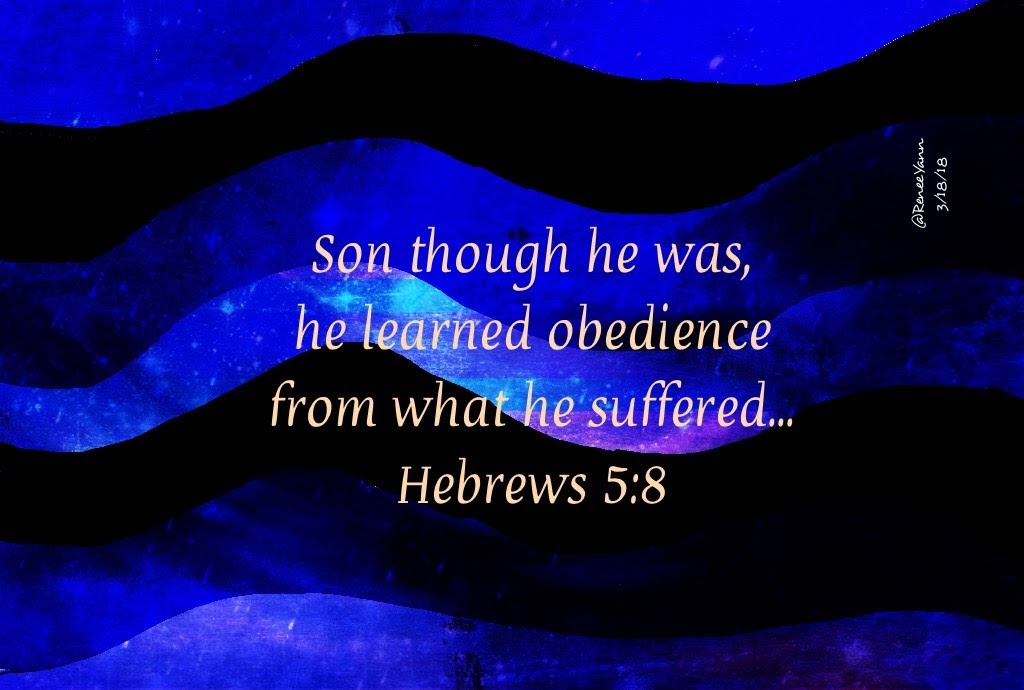
Son though he was, he learned obedience from what he suffered; 
and when he was made perfect,
he became the source of eternal salvation for all who obey him.

Hebrews 5:7-9

Poetry: What If I Fall? by Erin Hanson

There is freedom waiting for you,
On the breezes of the sky,
And you ask, "What if I fall?"
Oh, but my darling,
What if you fly?

Music: Take, Lord, Receive: the prayer of St. Ignatius of Loyola – John Foley, SJ

Take, Lord, receive.
all my liberty.
My memory, understanding, my entire will!
Give me only your LOVE, and your Grace,
that’s enough for me!
Your love and your grace, are enough for me!
Take Lord, receive,
All I have and posses.
You have given unto me,
Now I return it.
Give me only your love, and your grace,
that’s enough for me!
Your love and your grace,
are enough for me!
Take Lord receive,
all is yours now.
Dispose of it,
wholey according to your will.
Give me only your love, and your grace,
that’s enough for me!
Your love and your grace,
are enough for me!

The Pretender

Wednesday of Holy  Week
April 5, 2023

Today’s Readings:

https://bible.usccb.org/bible/readings/040523.cfm

Today, in God’s Lavish Mercy, we stand beside Jesus in a tangled world of insults, violence,  plots, and dirty money. How sickening and painful such an atmosphere must have been to him who is Love and Divine Innocence. The psalmist describes the pain like this:

Insult has broken my heart, and I am weak,
I looked for sympathy, but there was none;
for consolers, not one could I find.
Rather they put gall in my food,
and in my thirst they gave me vinegar to drink.

Psalm 69: 21-22

Despite such trauma, we see Christ’s trust and holy determination to embrace the Father’s Will however it is revealed to him.

The Lord GOD is my help,
therefore I am not disgraced;
I have set my face like flint,
knowing that I shall not be put to shame.

Isaiah 50:7

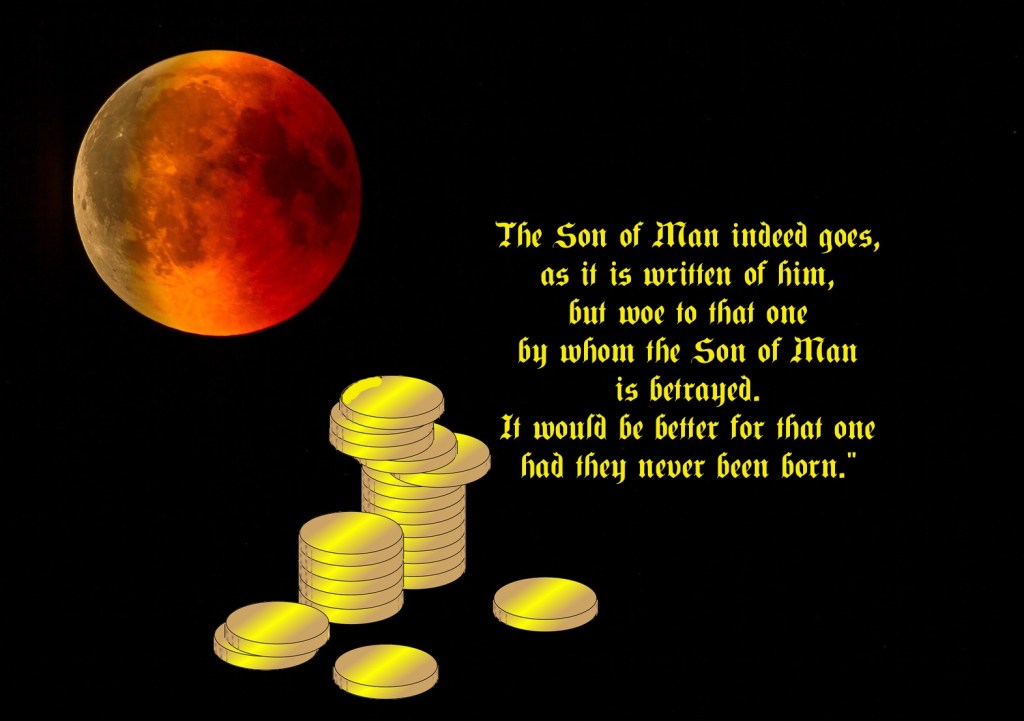
As we look to Jesus’s fidelity to find courage in our own challenges, we must also be starkly aware of what opposing infidelity looks like. We see it in the face of Judas – the Pretender who reclines at the Lord’s table, still eats the sacred food, dissembles his innocence while the blood-coins jingle in his pocket.

Once again, as the Passion story unfolds before us, we can find ourselves somewhere – perhaps many places – in its lines. Wherever that is, let us pray there with Jesus to be open in trust and fidelity to its transformative grace.


Poetry: Slow through the Dark – Paul Lawrence Dunbar

Slow moves the pageant of a climbing race;
   Their footsteps drag far, far below the height,
   And, unprevailing by their utmost might,
Seem faltering downward from each hard won place.
No strange, swift-sprung exception we; we trace
   A devious way thro’ dim, uncertain light,—
   Our hope, through the long vistaed years, a sight
Of that our Captain’s soul sees face to face.

   Who, faithless, faltering that the road is steep,
Now raiseth up his drear insistent cry?
   Who stoppeth here to spend a while in sleep
Or curseth that the storm obscures the sky?
   Heed not the darkness round you, dull and deep;
The clouds grow thickest when the summit’s nigh.


Music: The Betrayal of Judas – George Sviridov

The Twisted Kiss

Tuesday of Holy Week
April 4. 2023

Today’s Readings:

https://bible.usccb.org/bible/readings/040423.cfm

Today, in God’s Lavish Mercy, the clouds thicken around Jesus.

Reclining at table with his disciples, Jesus was deeply troubled and testified,
“Amen, amen, I say to you, one of you will betray me.”
The disciples looked at one another, at a loss as to whom he meant.

John 13:21

How painful for Jesus, and for these who have shared the glorious years of his ministry, to now sit with suspicion among yesterday’s friends. How lonely for each one as the dark force of doubt pushes them away from one another!

Only love can break through this kind of doubt, courageously exposing the truth in order that it might be reconciled and offered forgiveness:

One of his disciples, the one whom Jesus loved,
was reclining at Jesus’ side.
So Simon Peter nodded to him to find out whom he meant.
He leaned back against Jesus’ chest and said to him,
“Master, who is it?”

Jesus answered,
“It is the one to whom I hand the morsel after I have dipped it.”
So he dipped the morsel and took it and handed it to Judas,
son of Simon the Iscariot.

John 13: 21-26

As the rest of the Passion story unfolds, both Judas and Peter will need the kind of forgiveness these readings describe. Both prove false to Jesus’s trust. But one has the humble contrition to seek forgiveness. The other cannot forget himself enough to do so.


This “doubtful Tuesday” can teach us much about expectations, courage, truth, love, trust, humility, and forgiveness. Let us sit beside Jesus at the Gospel table and ask him, like the Disciples, how we measure up to his hope for us.


Poetry: Christ Washed the Feet of JudasGeorge Marion McClellan

Christ washed the feet of Judas!
The dark and evil passions of his soul,
His secret plot, and sordidness complete,
His hate, his purposing, Christ knew the whole.
And still in love he stooped and washed his feet.

Christ washed the feet of Judas!
Yet all his lurking sin was bare to him,
His bargain with the priest, and more than this,
In Olivet, beneath the moonlight dim,
Aforehand knew and felt his treacherous kiss.

Christ washed the feet of Judas!
And so ineffable his love ’twas meet,
That pity fill his great forgiving heart,
And tenderly to wash the traitor’s feet,
Who in his Lord had basely sold his part.

Christ washed the feet of Judas!
And thus a girded servant, self-abased,
Taught that no wrong this side the gate of heaven
Was ever too great to wholly be effaced,
And though unasked, in spirit be forgiven.

And so if we have ever felt the wrong
Of Trampled rights, of caste, it matters not,
What e’er the soul has felt or suffered long,
Oh, heart! this one thing should not be forgot:
Christ washed the feet of Judas


Music:  The Kiss – Joe Niemand 

Meet me in the garden
My love
Meet me there at midnight

At the place only we know
My love
A kiss awaits tonight

In the darkness between the flowers
My love
In the shadows of the moon

Your lips will tear the pretense like the curtain tomorrow afternoon

And so the glow of approaching torches
Makes the darkness dance like black flames
Ever faster to the music of every heart that refuses to be saved

I prayed this could be different
That my death could save you too
But your choices are your own
Now my friend, do what you came to do

We Begin Again

Palm Sunday of the Lord’s Passion
April 2, 2023

Today’s Readings:

https://bible.usccb.org/bible/readings/040223.cfm

Today, in God’s Lavish Mercy, we begin once again – and we know the journey so well.

When Jesus and the disciples drew near Jerusalem
and came to Bethphage on the Mount of Olives,
Jesus sent two disciples, saying to them,
“Go into the village opposite you,
and immediately you will find an ass tethered,
and a colt with her.
Untie them and bring them here to me.

Matthew 21:1-2

We have traveled this story many times with Jesus. We have seen the Sunday-green palms shrivel and darken by Friday. We have heard the careless cheers turn to frightened whispers. We have seen the thick crowd thin with fear and faithlessness.

The very large crowd spread their cloaks on the road,
while others cut branches from the trees
and strewed them on the road.
The crowds preceding him and those following
kept crying out and saying:
“Hosanna to the Son of David;
blessed is he who comes in the name of the Lord;
hosanna in the highest.”
And when he entered Jerusalem
the whole city was shaken and asked, “Who is this?”
And the crowds replied,
“This is Jesus the prophet, from Nazareth in Galilee.”

Matthew 21: 8-11

With each succeeding Holy Week, if we give ourselves to grace, Love maps itself more deeply in our souls. Our own lives, laid beside his in prayer, align us more closely to our own unique Redemption, as we can pray in this most beautiful of scripture passages:

Christ Jesus, though he was in the form of God,
    did not regard equality with God
    something to be grasped.
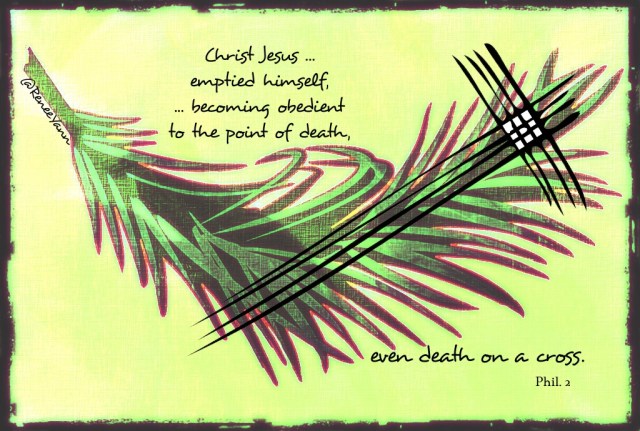
Rather, he emptied himself,
    taking the form of a slave,
    coming in human likeness;
    and found human in appearance,
    he humbled himself,
    becoming obedient to the point of death,
    even death on a cross.

Philippians 2:6-8

The rich treasures of our Holy Week readings and rituals carry us deeper into the eternal current of Love Who is Jesus Christ. We are changed, if we let ourselves, because we witness and believe the Divine Contradiction of the Cross and Resurrection – and we let it happen within our own souls.

Indeed, we are privy to the profound intimacy between Jesus and his Father … between Love Incarnate and Love Enlivening. It is an intimacy we pray to be part of because it changes everything to Love.

Because of this, God greatly exalted him
    and bestowed on him the name
    which is above every name,
    that at the name of Jesus
    every knee should bend,
    of those in heaven and on earth and under the earth,    
    and every tongue confess that
    Jesus Christ is Lord,
    to the glory of God the Father.

Philippians 2: 9-11

In our readings today, and each day this week, try to find the small phrase where your life meets Christ’s journey. Listen with Jesus to the Father’s stunning revelation that Life is accomplished through death to all that is not born of God.

But Jesus cried out again in a loud voice,
and gave up his spirit.
And behold, the veil of the sanctuary
was torn in two from top to bottom.
The earth quaked, rocks were split, tombs were opened,
and the bodies of many saints who had fallen asleep were raised.
And coming forth from their tombs after his resurrection,
they entered the holy city and appeared to many.
The centurion and the men with him who were keeping watch over Jesus
feared greatly when they saw the earthquake
and all that was happening, and they said,
“Truly, this was the Son of God!”

Matthew 27:50-54

Poetry: Primary Wonder – Denise Levertov

Days pass when I forget the mystery.
Problems insoluble and problems offering
their own ignored solutions
jostle for my attention, they crowd its antechamber
along with a host of diversions, my courtiers, wearing
their colored clothes; cap and bells.
                                                        And then
once more the quiet mystery
is present to me, the throng's clamor
recedes: the mystery
that there is anything, anything at all,
let alone cosmos, joy, memory, everything,
rather than void: and that, O Lord,
Creator, Hallowed One, You still,
hour by hour sustain it.

Music: Jerusalem, My Destiny by Rory Cooney

O Earliest Witness!

Feast of Saint Stephen, first martyr
December 26, 2022

Today’s Readings:

https://bible.usccb.org/bible/readings/122622.cfm

The Demidoff Altarpiece: Saint Stephen
Representation of St. Stephen from The Demidoff Altarpiece by Carlo Crivelli, an Italian Renaissance painter of the late fifteenth century. This many-panelled altarpiece or polyptic painted by Crivelli in 1476, sat on the high altar of the church of San Domenico in Ascoli Piceno, east central Italy. It is now in the National Gallery in London, England.

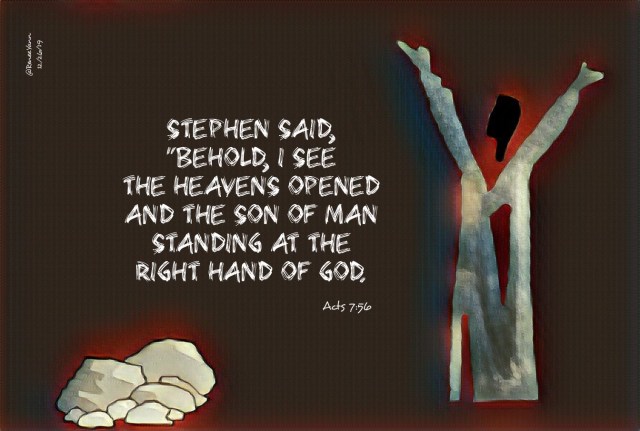
Today, in God’s Lavish Mercy, we celebrate the Feast of St. Stephen, first martyr for the Christian faith. He must have been a beautiful soul.

Stephen, filled with grace and power,
was working great wonders and signs among the people.
Certain members of the so-called Synagogue of Freedmen,
Cyrenians, and Alexandrians,
and people from Cilicia and Asia,
came forward and debated with Stephen,
but they could not withstand the wisdom and the spirit with which he spoke.

Acts of the Apostles 6: 8-10

The commemoration and readings are a drastic turn from singing angels and worshiping shepherds.The Liturgy moves quickly from welcoming a cooing baby to weeping at the death of innocence.

They threw him out of the city, and began to stone him.
The witnesses laid down their cloaks
at the feet of a young man named Saul.
As they were stoning Stephen, he called out
“Lord Jesus, receive my spirit.”

Acts 7: 54-59

Why does the Church make such a drastic turn in the tone of worship? One thought might be to keep us practical and focused on what life in Christ truly means, even as we’re all still wrapped in angels and alleluias.

Stephen, like Jesus, “was filled with grace and power, … working great wonders and signs among the people.” He, as Jesus would, met vicious resistance to his message of love and reconciliation. He, as Jesus would, died a martyr’s death while forgiving his enemies.


The Church turns us to the stark truth for anyone who lets Christ truly be born in their hearts. WE will suffer as Jesus did – as Stephen did. The grace and power of Christ in our life will be met with resistance, or at least indifference.

We may not shed blood but, in Christ, we will die to self. When we act for justice for the poor and mercy for the suffering, we will be politically frustrated and persecuted. When we forgive rather than hate, we will be mocked. Powerful people, like the yet unconverted Saul in today’s second reading, may catalyze our suffering by their determined hard-heartedness.

Our Gospel confirms the painful truth as Jesus says:

You will be hated by all because of my name,
but whoever endures to the end will be saved.

Matthew 10:22

Tomorrow, the liturgy picks up the poetic readings from John’s letters. These are delights to the soul. 

But for today, it is a hard look, with Stephen, at what Christmas ultimately invites us to.


Poetry: O Captain of the Martyr Host – This is an English adaptation of a medieval hymn O qui tuo, dux martyrum, written by Jean Baptiste de Santeüil. It appeared in the Cluniac Breviary, 1686.

O Captain of the Martyr Host!
O peerless in renown! 

Not from the fading flowers of earth 
Weave we for thee a crown.
The stones that smote thee, in thy blood 
Made beauteous and divine, 
All in a halo heavenly bright 
About thy temples shine. 
The scars upon thy sacred brow 
Throw beams of glory round; 
The splendours of thy bruised face 
The very sun confound. 
Oh, earliest Victim sacrificed 
To thy dear Victim Lord! 
Oh, earliest witness to the Faith 
Of thy Incarnate God! 
Thou to the heavenly Canaan first 
Through the Red Sea didst go, 
And to the Martyrs' countless host, 
Their path of glory show. 
Erewhile a servant of the poor, 
Now at the Lamb's high Feast, 
In blood-empurpled robe array'd, 
A welcome nuptial guest! 
To Jesus, born of Virgin bright, 
Praise with the Father be; 
Praise to the Spirit Paraclete, 
Through all eternity.

Music: Gabriel’s Oboe from the movie “The Mission”, played by Henrik Chaim Goldschmidt,  principal oboist of The Royal Danish Orchestra in Copenhagen, Denmark.