The Other Cheek

Monday of the Eleventh Week in Ordinary Time
June 19, 2023

Today’s Readings:

https://bible.usccb.org/bible/readings/061923.cfm


Today, in God’s Lavish Mercy, Matthew hits us right between the eyes with one of the most difficult Gospel passages to defend, to explain, and – most certainly – to practice.

Jesus said to his disciples:
“You have heard that it was said,
An eye for an eye and a tooth for a tooth.
But I say to you, offer no resistance to one who is evil.


“Oh, wow’, we might think. “Did Jesus have any idea what kind of a world I’d be living in someday?!”


Violence is so rampant in our society that some of us have stopped looking at the news because we can’t stand it! Here in the U.S., we are traumatized by statistics around the number and kind of artillery in our neighborhoods and who dies as a result – children, worshippers, movie-goers, picnickers. Are these the “enemy” for whom we have designed our lethal weapons?

We see gunpoint carjackings, drive-by shootings, and unlicensed militia defending their political prejudices. We see children afraid to go to school. Mothers afraid to go shopping. Believers afraid to go to their place of worship. We have even seen an assault on the American government stoked by a nationalistic rhetoric of hostility, hatred, and aberrant machismo.

There are so many guns now on American streets that we may think the best response is to carry our own. The “law” allows that. We may consider ourselves valiant if we “stand our ground”, legally shooting some innocent bystander who happened to wander onto our property or drive into our traffic lane!

So what, in God’s Name, does this Gospel have to say to us who have descended almost beyond recue into the chasm of violence?


Remember, Jesus has just finished talking about the Law. He has assured his followers that he has come to fulfill the Law rather than to abolish it. Jesus honors and recognizes the Law as the framework that has held in place Israel’s centuries-long relationship with God.

But Jesus indicates that following the letter of the Law while not fulfilling its spirit is contradictory to the Reign of God. We can use the “law” as an excuse for our complacency – keeping in place those unexamined tenets that make us comfortable, rich, and more powerful to the detriment of others. This is what the Pharisees and Saducees had done.


In each of the five situations listed in today’s Gospel, Jesus isn’t telling us to lie down like a doormat and let ourselves be walked on. What he’s saying is that with God’s help, there is a better way, a deeper response that we can give to the conflicts in our lives.

Jesus encourages his followers not to meet the other with resistance. So often, resistance is our first defense rather than patience, negotiation, honesty, listening, or forgiveness. Jesus is asking us to stand still for a moment before lashing back – and in that moment move toward a more graced and courageous resolution. He is counseling us to listen, to imagine mutuality, and to work together for an equilibium of justice with mercy.

It must be admitted that sometimes this just doesn’t seem to work. Those with the power to make positive change can block the way, just as they did for Jesus. We can end up looking like “losers” – or even die – like Jesus did. But even though he had the power – the Omnipotence to do so – Jesus did not resist. If we really understand the Paschal Mystery and believe in the Resurrection, we will know why, and we will try to imitate him.


So where do we start? I think it starts with:

  • the level of reverence in our everyday interactions,
  • our attitudes toward “the other” – someone different from me in race, ethnicity, religion, sexuality, nationality, economic status, or opinion.
  • with our efforts toward reasonable gun legislation, educational equity for all children, universally available mental health services, and the eradication of abysmal poverty in our cities.

Can I do something to advance these changes? Not all by myself. But as a community of faith, Christians can bring amazing influence to these issues. Today’s Gospel is telling me to act on that belief.


Poem: Some – Daniel Berrigan, SJ

Some stood up once and sat down.
Some walked a mile and walked away.
Some stood up twice and sat down
I’ve had it, they said.
Some walked two miles and walked away
It’s too much, they cried.
Some stood and stood and stood.
They were taken for dummies
They were taken for fools
They were taken for being taken in.
Some walked and walked and walked.
They walked the earth
They walked the waters
They walked the air.
Why do you stand?
they were asked, and
Why do you walk?
Because of the children, they said, and
Because of the heart, and
Because of the bread.
Because
the cause
is the heart’s beat
and the children born
and the risen bread.

Music: Where Have All the Flowers Gone – written by Pete Seeger, sung by Joan Baez

Come to Me

Solemnity of the Most Sacred Heart of Jesus
June 16, 2023

Today’s Readings:

https://bible.usccb.org/bible/readings/061623.cfm

Today, in God’s Lavish Mercy, we hear Moses tell the People:

You are a people sacred to the LORD, your God;
he has chosen you from all the nations on the face of the earth
to be a people peculiarly his own.

Deuteronomy 7:6

We modern readers may be a little put off by the use of the word “peculiar” which, since the 16th century, has taken on the connotation of “odd” or “uncommon”. But the original meaning of the word is “to belong exclusively to one person“, as in “Honey, I love you and you belong to me!” Moses is telling Israel that this is the way God loves them.


Below is a song many us will remember. Maybe as teenagers we even did the “Stroll” to its dulcet tones. The love described in this song is but a pale shadow of the love God has for us, and the longing sung about is but a weak imitation of God’s longing for us. Listen to it and let God sing to you – singing around the words and into the meaning behind them.

Thinking of God as we listen to a song like this can make God very human. And, of course, that is exactly who Jesus Christ is. Jesus loves us with a human heart and a divine love. He loves us with a Sacred Heart.


All love is refined and proven in sacrifice. Jesus testified to his infinite love for us in his Passion, Death and Resurrection. In that miracle of redemptive love, God embraces, strengthens and commissions us. We are to love as God loves – to have hearts themselves made sacred by imitation of Christ.

“Come to me, all you who labor and are burdened,
and I will give you rest.
Take my yoke upon you and learn from me,
for I am meek and humble of heart;
and you will find rest for yourselves.
For my yoke is easy, and my burden light.”

Matthew 11:28-30

Prose: In the late 17th, St. Margaret Mary Alacoque shared her vision of Christ’s Sacred Heart. In a book of her writings published after her death we read:

Christ showed me that it was His great desire
to be loved by human beings
and of withdrawing them from the path of ruin
that made Him form the design
of manifesting His Heart to us,
with all the treasures of love, of mercy, of grace,
of sanctification and salvation which it contains,
in order that those who desire
to render Him and procure Him
all the honor and love possible,
might themselves be abundantly enriched
with those divine treasures
of which His heart is the source.

Devotion to the Sacred Heart was fostered by the Jesuits and Franciscans, but it was not until the 1928 encyclical Miserentissimus Redemptor by Pope Pius XI that the Church validated the credibility of St. Margaret Mary’s visions of Jesus Christ in having “promised her that all those who rendered this honor to His Heart would be endowed with an abundance of heavenly graces.”

( see: https://sacredheartfla.org/sunday-mornings/seasonal/feast-days-solemnities/the-solemnity-of-the-most-sacred-heart-of-jesus/


Music: Empty Space – Jose Mari Chan

Jesus, the Eternal “Yes”

Memorial of Saint Anthony of Padua
June 13, 2023

Today’s Readings:

https://bible.usccb.org/bible/readings/061323.cfm


Today, in God’s Lavish Mercy, our readings are about Truth, Spiritual Vigor, Holy Light.

For the Son of God, Jesus Christ, whom we proclaimed to you
was not “yes” and “no,” but only “Yes”.
For however many are the promises of God,
their Yes is in Jesus Christ …

2 Corinthians 1:19-20

A good friend of mine has taught me a lot about “Yes”, the kind of “Yes” I think Paul is describing in this passage. Sometimes, as with all friends, we might need a favor from each other – picking up a quart of milk, typing out a letter, providing transportation to a doctor.

I usually begin such a request with the phrase, “Could you do ^ me a favor…?” Somewhere in between “do” and “me”, my friend always shouts, “YES!!!” even before she hears what the favor is. Her “Yes”, rooted in loving friendship, is complete, unqualified, and inexhaustible.


God’s “Yes” to us, incarnate in the Gift of Jesus Christ, is eternally complete, unqualified, and inexhaustible!

Wow! Just think about that! Believing it can release immense power in our relationship with God! It can drag our Light out from under the bushel basket and into the world which is aching in darkness!


Our Gospel today, which continues Jesus’ Sermon on the Mount, describes what a Christian looks like who is trying to live their own “yes” back to God.

Such a believer is like salt, like light, like an elevated city calling us higher.

  • Salt – which releases and accents the good already inherent in our nature
  • Light – which makes the sacred path discoverable even in life’s shadows
  • City on the hilltop – which not only assures us that the journey can be accomplished, but turns to beckon and encourage us in our climb

Poetry: love is a place – e.e.cummings

love is a place
& through this place of
love move
(with brightness of peace)
all places

yes is a world
& in this world of
yes live
(skillfully curled)
all worlds

Music: Salt and Light – Lauren Daigle

Blessed

Monday of the Tenth Week in Ordinary Time
June 12, 2023

Today’s Readings:

https://bible.usccb.org/bible/readings/monday-tenth-week-ordinary-time


Today, in God’s Lavish Mercy, we resume reading Matthew’s Gospel which will last all the way to the beginning of September. What a gift to spend the summer with Jesus as Matthew came to understand and proclaim him.

So who is the “Jesus of Matthew”? Matthew’s Jesus is the Messiah, the long-awaited fulfillment of God’s promise to Abraham, a promise woven throughout the Hebrew Scriptures. Matthew writes to an audience who believe in Christ but who are nevertheless steeped in the Jewish religion. Matthew is intent on showing Jesus as the fulfillment of all they have believed.

Matthew’s Jesus is very Jewish. He is the Promise realized, the Hope fulfilled, Salvation achieved.


But Matthew’s Jesus is also the Challenger, the Upsetter and the Revolutionary.

In his Gospel sermon today, Jesus asks his believers to invert their worldly thinking and to take on the new mind of God – a God who loves the losers more than the winners! In the Beatitudes, Jesus gives an astounding new meaning to the word ‘blessed”.

In the Sermon on the Mount, Jesus contradicted all human judgments and all nationalistic expectations of the kingdom of God. The kingdom is given to the poor, not the rich; the feeble, not the mighty; to little children humble enough to accept it, not to soldiers who boast that they can obtain it by their own prowess.

John R. W. Stott, The Message of the Sermon on the Mount

I’ve been reading the Beatitudes my whole life, and they still confound me. I can’t honestly say that I want to be poor, mourning, meek, hungry, or thirsty. The only way I have been able to comprehend the Beatitudes is when I have found them in someone else and they have been kind enough to teach me.

I found “Blessed are the poor in spirit” one morning where he lived on a steam vent in downtown Philadelphia. He taught me courage and honesty.

Blessed are those who mourn” was a brokenhearted young wife who taught me how to love by steadfastly caring for her dying husband during his hospice journey.

Blessed are the meek” was a Cuban exile physician who was barred from a U.S. medical license. He taught me by lovingly serving as an orderly in the E.R. where I worked.

Blessed are those who hunger for righteousness” was an old Franciscan sister who was arrested with me in the Nevada desert as we protested nuclear war. Authorities had to handcuff her to her walker so that she could remain standing in the holding cell in the wretched heat.

Blessed are the merciful” is the name of our sisters and nurses at our healthcare facility who teach me by their tireless tenderness toward those who suffer

Blessed are the pure of heart” has sat with me a thousand times to pray and discern God’s Spirit in our hearts

Blessed are the peacemakers” have walked beside me in protests, written letters, made phone calls, witnessed peace in their own lives

Blessed are the persecuted” are my Black, Latino, differently-abled, and LGBTQ friends who have both taught and forgiven me for my prejudices, stereotyping, and ignorance


Learning to really live the Beatitudes is key to the Christian life, and it is an ongoing education until the day we die. As we pray with today’s Gospel, may we receive abundant grace for our learning.


Poetry: The Beatitudes – Malcolm Guite

We bless you, who have spelt your blessings out,
And set this lovely lantern on a hill
Lightening darkness and dispelling doubt
By lifting for a little while the veil.
For longing is the veil of satisfaction
And grief the veil of future happiness
We glimpse beneath the veil of persecution
The coming kingdom’s overflowing bliss
Oh make us pure of heart and help us see
Amongst the shadows and amidst the mourning
The promised Comforter, alive and free,
The kingdom coming and the Son returning,
That even in this pre-dawn dark we might
At once reveal and revel in your light.

Music: The Beatitudes – John Michael Talbot

Blessed are the poor in spirit
Theirs is the kingdom of heaven
Blessed are those who mourn
They shall be comforted

Blessed are the lowly of heart
They shall inherit the earth
Blest are those who hunger for God
Nevermore shall they hunger or thirst

CHORUS:
Blessings upon the disciples of Jesus
Blessings upon al the multitudes
Blessings upon those who climb the mountain
With Jesus the Lord, with Jesus our Lord

Blessed are those who show mercy
They shall inherit the mercy of God
Blessed are the pure of heart
They shall see the face of God

Blest are those who strive for peace
They shall be the children of God
Blest are those who suffer for holiness
Theirs is the kingdom of God

Give It All You’ve Got

Saturday of the Ninth Week in Ordinary Time
June 10, 2023

Today’s Reading:

https://bible.usccb.org/bible/readings/061023.cfm

Today, in God’s Lavish Mercy, we come to nearly the last chapter in the Book of Tobit. We hear a passage from Tobit only once again in the entire liturgical year. So if you want to know the whole story, you’ll have to pick up your Bible and do some reading!


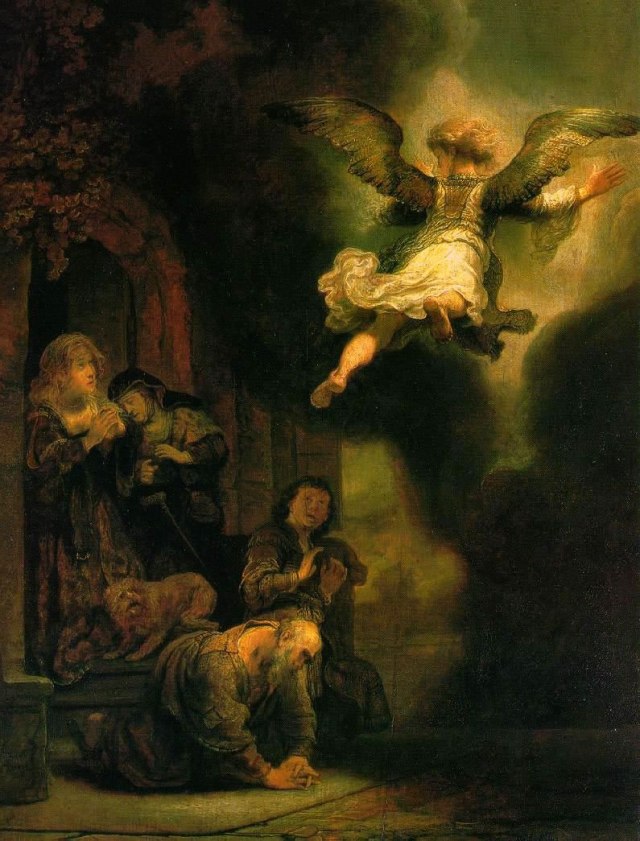
Archangel Raphael Leaves Tobias’s Family – Rembrandt

In today’s passage, Raphael reveals himself as God’s elite angel sent in answer to Tobit’s and Anna’s prayers. Before leaving to return to heaven, Rafael gives the family a bundle of advice about righteousness and sanctity. In reality, it is the author of Tobit giving his audience this advice as they cope with the anxieties of the diaspora.


In our Gospel, Jesus finishes up a chapter too. The scribes, Sadducees, and Pharisees have been wrangling with Jesus throughout the week’s readings. Today, rather than enter into debate with them, Jesus uses a visual example to make his point.

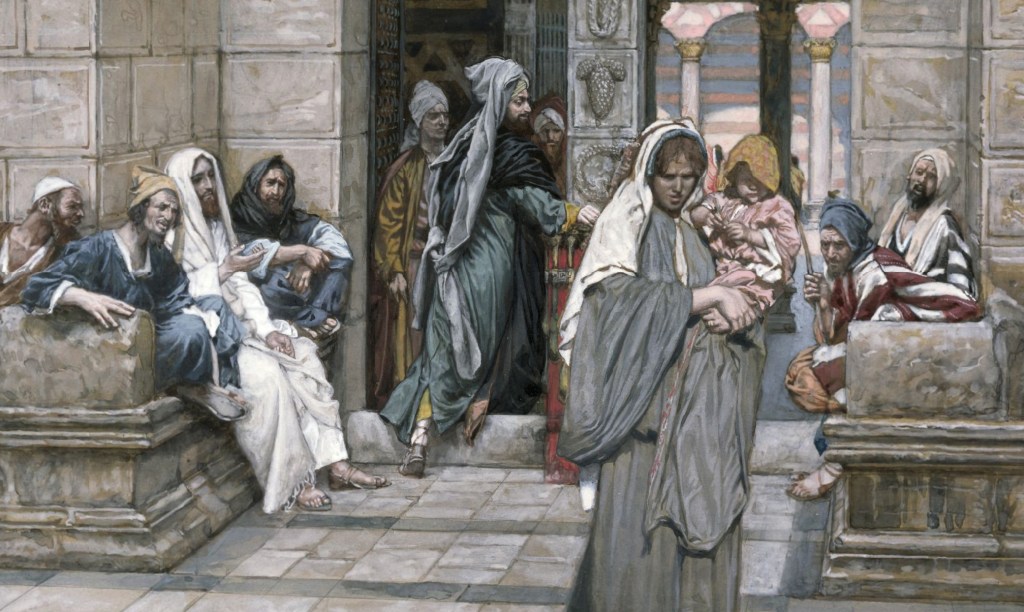
Where Jesus sits debating with these elitist religionists, there is a “poor box” to make offerings. The rich and privileged pass by, maybe tossing in a few left over coins from their marketing. But a poor widow approaches the box with a nearly invisible yet momumental gift. Jesus seizes the moment to make a consummate point with an economy of words:

Many rich people put in large sums.
A poor widow also came and put in two small coins worth a few cents.
Calling his disciples to himself, he said to them,
Amen, I say to you, this poor widow put in more
than all the other contributors to the treasury.
For they have all contributed from their surplus wealth,
but she, from her poverty, has contributed all she had,
her whole livelihood
.”

The Widow’s Mite – James Tissot


Humble Tobit and the Generous Widow teach us volumes about how to love and serve God. They teach us about righteousness and spiritual wealth, about justice and freedom, about fidelity and hope.

As we close this week of wonderful readings, let’s sit with these teachers, and with Jesus, to discern the most important lessons for us.


Poetry: The Widow’s Mites – Richard Crashaw

Two mites, two drops, yet all her house and land,
Fall from a steady heart, though trembling hand :
The other's wanton wealth foams high, and brave ;
The other cast away, she only gave.

Music: Give It All You’ve Got – 3rd Force

“Ordinary” Assurance

Tuesday of the Eighth Week in Ordinary Time
May 30, 2023

Today’s readings:

https://bible.usccb.org/bible/readings/053023.cfm

Today, in God’s Lavish Mercy, we return to the Ordinary Time of the Church liturgical year. We might picture Ordinary Time as that great cycle of life which carries us through our “ordinary days”, the holy companion that helps us find God in our dailyness.

We left the ordinary cycle way back on February 22nd, when we launched into Lent, Holy Week, and Eastertide. Now we pick up where we left off and, over the next two weeks, will finish the Gospel of Mark and the Book of Tobit which we were reading in February.

How has your life been in the meantime?


As we begin our scriptural prayer today, we might want to list the ups and downs, the ins and outs of the past few months. Have we walked through these round-about days holding fast to the anchor of scriptural prayer? How have we changed, grown or deepened in the process?

I know it has been a time of immense change for me. The “me” who was reading Mark’s Gospel on February 21st was a different “me” from the one who will pick it up today.

Realizing the pattern and constancy of our liturgical cycle can be a stabilizing influence in our spiritual lives. The liturgical year is steadily revolving under the frenzied whirling of the world. The unfolding of the scriptures is constant and true at the still core of our sometimes spiraling lives.


As we left Mark in February, the rich young man had just walked away sad and Jesus was talking about a camel passing through the needle’s eye. The metaphor was meant to teach us how hard it can be to live the Christian life well. In today’s reading, Peter begins to ask how much harder can it get for them because the disciples have already given up everything for Jesus.

But Jesus doesn’t even let Peter finish before assuring him that his life will be blessedly different because of all that he has given over to Christ. It will not be without difficulty, but it will be eternally vital and confirmed in God. As we pray with this holy Gospel – in our ordinary time – may we be blessed with the same assurance.

Peter began to say to Jesus,
‘We have given up everything and followed you.”
Jesus said, “Amen, I say to you,
there is no one who has given up house or brothers or sisters
or mother or father or children or lands
for my sake and for the sake of the Gospel
who will not receive a hundred times more now in this present age…
… with persecutions, and eternal life in the age to come.
But many that are first will be last, and the last will be first

Mark 18:28-31

Poetry: initial verses frrom Burnt Norton by T.S. Eliot

Burnt Northon is the first of the Four Quartets, a series of magnifcent (and at times confounding) poems that are well worth contemplating. Below Burnt Norton is a link to the whole work if you are interested.


segment from BURNT NORTON
(No. 1 of ‘Four Quartets’)

Time present and time past
Are both perhaps present in time future,
And time future contained in time past.
If all time is eternally present
All time is unredeemable.
What might have been is an abstraction
Remaining a perpetual possibility
Only in a world of speculation.
What might have been and what has been
Point to one end, which is always present.
Footfalls echo in the memory
Down the passage which we did not take
Towards the door we never opened
Into the rose-garden. My words echo
Thus, in your mind.

http://www.davidgorman.com/4quartets/1-norton.htm


Music: Blessed Assurance – written by Fanny J. Crosby, (1820 – 1915), was an American mission worker, poet, lyricist, and composer. She was a prolific hymnist, writing more than 8,000 hymns and gospel songs, with more than 100 million copies printed. She is also known for her teaching and her rescue mission work. By the end of the 19th century, she was a household name. Crosby was known as the “Queen of Gospel Song Writers” and as the “Mother of modern congregational singing in America”, with most American hymnals containing her work.

Mary, Mother of the Church

May 29, 2023

Today’s Readings:

https://bible.usccb.org/bible/readings/052923.cfm


Today, in God’s Lavish Mercy, we pray with Mary, the Mother of Christ and thus of the Church. 

With her “Yes”, Mary engaged the Spirit of God and, like the ancient Holy City, became a dwelling place of Grace.

Glorious things are said of you,
    O city of God!
And of Zion they shall say:
    “One and all were born in her;
And the One who has established her
    is the Most High LORD.

Psalm 87

In her book “Truly Our Sister”, theologian Elizabeth Johnson, CSJ, helps us to understand Mary as a companion, guide, and inspiration:

One fruitful approach to the theology of Mary, historically the mother of Jesus, called in faith the Theotokos or God-bearer, is to envision her as a concrete woman of our history who walked with the Spirit.


As I pray with Mary today, I picture her sitting with the young disciples after the mind-blowing experience of Pentecost. The whiff of Divine Electricity still pervades the room, still jars their senses to an indescribable timbre!

Mary is stilled with a silent understanding. From the abundance of her wisdom, gained in her daily presence with Jesus, Mary gently focuses, calms and directs these new evangelists for the task before them.

Mary is someone who has had her own “visitation by the Spirit”, many years before. Pentecost, for Mary, is a kind of “second Annunciation “. She knows what the willing reception of the Spirit will mean for one’s life.

Indeed, this moment – and their response, like hers so long ago – will bear God’s life into their world.


We call on Mary today, as Church and as individuals, to be with us as we are re-fired in the Holy Spirit. As we reflect on her and the way she opened her life to God, may we grow in faith and desire to open our own lives to the Spirit’s transformative power.


Elizabeth Johnson encourages us:

“to relate to Miriam of Nazareth as a partner in hope in the company of all the graced women and men who have gone before us; to be encouraged by her mothering of God to bring God to birth in our own world; to reclaim the power of her dangerous memory for the flourishing of suffering people; and to draw on the energy of her memory for a deeper relationship with the living God and stronger care for the world.”


Poetry: Annunciation – Denise Levertov

We know the scene: the room, variously furnished, 
almost always a lectern, a book; always
the tall lily.
       Arrived on solemn grandeur of great wings,
the angelic ambassador, standing or hovering,
whom she acknowledges, a guest.

But we are told of meek obedience. No one mentions
courage.

       The engendering Spirit
did not enter her without consent.
         God waited.

She was free
to accept or to refuse, choice
integral to humanness.

                  ____________________

Aren’t there annunciations
of one sort or another
in most lives?
         Some unwillingly
undertake great destinies,
enact them in sullen pride,
uncomprehending.
More often
those moments
      when roads of light and storm
      open from darkness in a man or woman,
are turned away from

in dread, in a wave of weakness, in despair
and with relief.
Ordinary lives continue.
                                 God does not smite them.
But the gates close, the pathway vanishes.

                  ____________________

She had been a child who played, ate, slept
like any other child–but unlike others,
wept only for pity, laughed
in joy not triumph.
Compassion and intelligence
fused in her, indivisible.

Called to a destiny more momentous
than any in all of Time,
she did not quail,
  only asked
a simple, ‘How can this be?’
and gravely, courteously,
took to heart the angel’s reply,
the astounding ministry she was offered:

to bear in her womb
Infinite weight and lightness; to carry
in hidden, finite inwardness,
nine months of Eternity; to contain
in slender vase of being,
the sum of power–
in narrow flesh,
the sum of light.

                     Then bring to birth,
push out into air, a Man-child
needing, like any other,
milk and love–

but who was God.
This was the moment no one speaks of,
when she could still refuse.

A breath unbreathed,
                                Spirit,
                                          suspended,
                                                            waiting.
                  ____________________
She did not cry, ‘I cannot. I am not worthy,’
Nor, ‘I have not the strength.’
She did not submit with gritted teeth,
                                                       raging, coerced.
Bravest of all humans,
                                  consent illumined her.
The room filled with its light,
the lily glowed in it,
                               and the iridescent wings.
Consent,
              courage unparalleled,
opened her utterly.

Music: Vespro Della Beata Vergine – Claudio Monteverdi

From the baroque period, Monteverdi praises Mary in his masterpiece, Vespro Della Beata Vergine commonly referred to as Vespers of 1610. The work is monumental in scale and difficult to perform, requiring two large choirs who are skillful enough to cover up to 10 voice parts accompanied by an orchestral ensemble. Here is just an excerpt.

Lauda, Jerusalem, Dominum: lauda Deum tuum, Sion.
Quoniam confortavit seras portarum tuarum: benedixit filiis tuis in te.
Qui posuit fines tuos pacem: et adipe frumenti satiat te.
Qui emittit eloquium suum terræ: velociter currit sermo ejus.
Qui dat nivem sicut lanam: nebulam sicut cinerem spargit.
Mittit crystallum suam sicut buccellas: ante faciem frigoris ejus quis sustinebit?
Emittet verbum suum, et liquefaciet ea: flabit spiritus ejus, et fluent aquæ.
Qui annunciate verbum suum Jacob: justitias et judicia sua Isræl.
Non fecit taliter omni nationi:
et judicia sua non manifestavit eis.
Gloria Patri et Filio et Spiritui Sancto.
Sicut erat in principio, et nunc, et semper, et in sæcula sæculorum. Amen

Praise the Lord, O Jerusalem; praise thy God, O Zion.
For he hath strengthened the bars of thy gates; he hath blessed thy children within thee.
He maketh peace in thy borders,
and filleth thee with the finest wheat.
He sendeth his commandment to the earth; his word runneth swiftly.
He giveth snow like wool;
he scattereth hoar frost like ashes.
He casteth forth his ice like morsels; before his cold who can stand?
He sendeth out his word, and melteth them; his spirit blows, and the waters flow.
He sheweth his word unto Jacob, his statutes and judgements to Isræl.
He hath not dealt so with any nation;
and his judgments he hath not made manifest.
Glory be to the Father and to the Son and to the Holy Spirit.
As it was in the beginning, is now, and ever shall be, without end. Amen.

Do You Love Me?

Memorial of Saint Philip Neri, Priest
May 26, 2023

Today’s Readings:

https://bible.usccb.org/bible/readings/052623.cfm


Today, in God’s Lavish Mercy, we stand beside Peter as Jesus asks him the most important question of his life.

After Jesus had revealed himself to his disciples and eaten breakfast with them,
he said to Simon Peter,
“Simon, son of John, do you love me more than these?”

John 21:15

What was Jesus really getting at? Here they all are enjoying a nice breakfast on the beach. Their hearts are overjoyed to be in the presence of their Eastered Lord. Life must have felt good that sunny, post-Resurrection morning. And probably all that Peter really wanted out of life was another piece of fired fish or toasted bread, and for their seashore picnic to linger into an eternal evening.

Then here comes Jesus with his cosmic questions! What does he mean, “Do I love him”! Of course, I love him! Haven’t I hung around for three years trying to make this thing work, climbing out of my several missteps to try to be everything he wanted and needed? Oh my goodness, where is he going to call me now with this confusing question: Do you love me?


Yes, Jesus knows that Peter loves him in Peter’s way. He trusts Peter’s affection, devotion, and utter commitment to him. But Jesus’s question is pulling Peter way beyond the salted scents of that Tiberias beach. He wants Peter to love him in God’s way!

Jesus is calling Peter to a timeless answer and a transcendent love. What he is asking Peter is this:

  • Will you leave the man who was “Simon, son of John” to become “Peter, the Rock on which I build my Church”.
  • Will you love me to the point of giving yourself completely so that I may continue to love through you?

Today, as we settle into the sandy dunes with Jesus and his BFFs, Jesus might glance at us as he passes his smoked fish our way. His beautiful eyes might hold a question for us as well as for Peter. Through each of us, Jesus wants to continue to love the world into wholeness. Let’s ask his help in learning how to do that.


Maxim: from St. John of the Cross, a 16th century mystic, who understood Jesus’s eternal question and answered it in this way:

In the evening of our lives we will be judged on love.
Let us therefore learn to love God as God wishes to be loved.


Music: Fill the World with Love – from “Goodbye, Mr. Chips”, music and lyrics by Leslie Bricusse

In the morning of my life I shall look to the sunrise.
At a moment in my life when the world is new.
And the blessing I shall ask is that God will grant me,
To be brave and strong and true,
And to fill the world with love my whole life through.

And to fill the world with love
And to fill the world with love my whole life through.

In the noontime of my life I shall look to the sunshine,
At a moment in my life when the sky is blue.
And the blessing I shall ask shall remain unchanging.
To be brave and strong and true,
And to fill the world with love my whole life through.

And to fill the world with love
And to fill the world with love my whole life through.

In the evening of my life I shall look to the sunset,
At a moment in my life when the night is due.
And the question I shall ask only God can answer.
Was I brave and strong and true?
Did I fill the world with love my whole life through?

Did I fill the world with love?
Did I fill the world with love
My whole life through?

Valedictories

Tuesday of the Seventh Week of Easter
May 23, 2023

Today’s Readings:

https://bible.usccb.org/bible/readings/tuesday-seventh-week-easter


Today, in God’s Lavish Mercy, we listen to both Jesus and Paul as they offer their farewell addresses to their beloved disciples.

It seems an appropriate time for these readings here as students close their educational years and move on to their future. The disciples of Jesus and Paul are doing the same thing. And their valedictorians are the beloved masters on whom they have come to depend.


Paul and his disciples share a tearful good-bye as he departs for Rome

In Acts, Paul prepares to depart from Ephesus where he has lived for three years. It is his cherished community as we can assess from the beautiful letters Paul writes to the Church there. The disciples are heartbroken to see Paul leave, and he is quite emotional himself in his remarks:

I earnestly bore witness for both Jews and Greeks
to repentance before God and to faith in our Lord Jesus.
But now, compelled by the Spirit, I am going to Jerusalem.
What will happen to me there I do not know…

But now I know that none of you
to whom I preached the kingdom during my travels
will ever see my face again.
And so I solemnly declare to you this day
that I am not responsible for the blood of any of you,
for I did not shrink from proclaiming to you the entire plan of God.

Acts 20

Paul, declaring that he has done all that he can for the Gospel, sternly charges his followers to carry on the work of evangelization.


Jesus is a little gentler but no less dramatic in describing the charge to his disciples:

I pray for them.
I do not pray for the world but for the ones you have given me,
because they are yours, and everything of mine is yours
and everything of yours is mine,
and I have been glorified in them.
And now I will no longer be in the world,
but they are in the world, while I am coming to you

John 17

Both these readings speak to us, not only about the disciples’ experience of commissioning, but of our own. Our Baptismal incorporation into the faith came with a price tag — “Carry on the Gospel in your life.”

As we listen to the passion with which both Jesus and Paul advised their followers, let’s hear them speaking to us as well. Let’s listen for the unique call we are receiving through the circumstances of our particular life. Not everyone is called to be Paul, or Peter, or Lydia, or Apollos, or Silas or the others we have read about throughout Eastertide.

But we ARE called to be

_________________________________
(Fill in your name)
a believer and doer in the Name of Jesus Christ


Poem: by Hafiz from Love Poems from God – Daniel Ladinsky

I am
a hole in a flute
that the Christ’s breath moves through—
listen to this
music.

Music: By Faith – Keith and Kristyn Getty

Eternal Life

Seventh Sunday of Easter
May 21, 2023

Today’s Readings:

https://bible.usccb.org/bible/readings/052123-Sunday.cfm

A little explanation: For those of my readers who do not live in the Archdiocese of Philadelphia, today’s readings will be different from the ones used for the reflection. In the archdioceses and dioceses within the Ecclesiastical Provinces of Boston, Hartford, New York, Newark, Omaha, and Philadelphia, the Ascension of the Lord always falls on Thursday of the Sixth Week of Easter and is a Holyday of Obligation. In all other archdioceses and dioceses, the Ascension of the Lord is transferred to the Seventh Sunday of Easter.

If you wish, you may use the Ascension reflection from last Thursday, or refer to this reflection by the always excellent Mary McGlone from this week’s NCR.


Could this be a rarely seen 1st century photo of Mary (in blue)
with some friends and the Eleven.


Today, in God’s Lavish Mercy, our reading from Acts gives us a group photo of the “Apostolic Council”. Think of it as the foundational selfie of Catholic history. And all the big names are there in indelible magic marker with a few “also ran”s mentioned as a seeming afterthought.

Let’s talk about those “also ran”s – those unnamed champions of the faith who are there, who show up, who do the heavy lifting, and whose names disappear into history like the black powder in an Etch-a-Sketch. Let’s talk about them because they are us.


In his letter, Peter tells us to be joyful when our devotion to the faith brings us suffering! Doing so, we become the unnamed disciples of the Gospel carrying human history forward to eternal life.

Rejoice to the extent that you share in the sufferings of Christ,
so that when his glory is revealed
you may also rejoice exultantly.
If you are insulted for the name of Christ, blessed are you,
for the Spirit of glory and of God rests upon you.


Living with that kind of resolute joy is a huge challenge unless we understand the reason for it. Jesus explains the reason clearly in our Gospel – eternal life.

Father, the hour has come.
Give glory to your son, so that your son may glorify you,
just as you gave him authority over all people,
so that your son may give eternal life to all you gave him.
Now this is eternal life,
that they should know you, the only true God,
and the one whom you sent, Jesus Christ.


We not talking about a good life, a happy life, a complete life, an inspiring life. They are all really wonderful things. What we’re talking about here is THE only thing that matters:

Let’s ask for it. Let’s pray for it. Let’s do everything we can to open our hearts to it!


Poetry: Forever Is Composed of Nows – Emily Dickinson

Forever – is composed of Nows –
’Tis not a different time –
Except for Infiniteness –
And Latitude of Home –

From this – experienced Here –
Remove the Dates – to These –
Let Months dissolve in further Months –
And Years – exhale in Years …


Music: Song to the Moon – from Rusalka

Rusalka Op. 114, is an opera (‘lyric fairy tale’) by Antonín Dvořák. The “Song to the Moon” is so beautiful and one of my favorite arias. The vocal version is thrilling, but I found this instrumental version which is more fitting for meditation. I hope you enjoy it.