Today, in God’s Lavish Mercy, each of our readings presents a story of vocation and how it is fulfilled in a lifespan.
Our reading from Genesis describes four people at different stages of their life’s vocation: Abraham and Sarah in its fulfillment, Isaac and Rebekah in its initial hope.
For my prayer, I focused on Abraham who is closing out his story in peace, prosperity, and active hope for a future he will not see:
Abraham had now reached a ripe old age, and the LORD had blessed him in every way. Abraham said to the senior servant of his household, who had charge of all his possessions: “Put your hand under my thigh, and I will make you swear by the LORD, the God of heaven and the God of earth, … … that you will go to my own land and to my kindred to get a wife for my son Isaac.”
Genesis 24:1-4
Both Abraham and Sarah lived long and fruitful lives, matured in faith, and died in peace. Through the extensive history of their lives, they listened to and trusted God (on and off!), acted for God’s glory, and guided their household in God’s way.
They listened, responded and connected their lives irrevocably to God’s vision. It is at once a simple and a challenging formula for spiritual fulfillment.
In our Gospel, Matthew is called to the same formula which is the underpinning of any vocation:
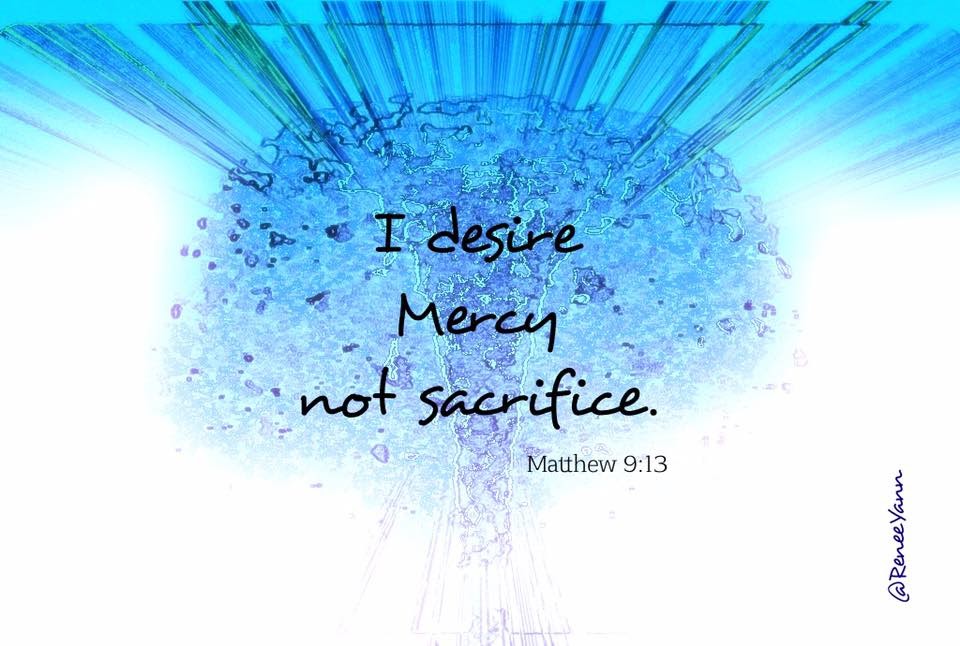
As Jesus passed by, he saw a man named Matthew sitting at the customs post. He said to him, “”Follow me.”” And he got up and followed him. While he was at table in his house, many tax collectors and sinners came and sat with Jesus and his disciples. The Pharisees saw this and said to his disciples, “”Why does your teacher eat with tax collectors and sinners?”” He heard this and said, “Those who are well do not need a physician, but the sick do. Go and learn the meaning of the words, I desire mercy, not sacrifice.”
Matthew 9:9-12
Matthew listens to Jesus’ call, responds, and connects his life irrevocably to Jesus’ vision.
The continuing call for each of us is clear. Each of our lives offers us a particular expression of “vocation”. It may be as religious, priest, parent, spouse, family member, teacher, caregiver, public servant, or any other role that places us in loving and responsible relationship with our neighbor.
In that role, can we/do we:
listen for God in every circumstance
respond in faith, hope, and love
witness a Christ-rooted life by our actions for Gospel justice and mercy
Poetry: Vocation by William E. Stafford
This dream the world is having about itself
includes a trace on the plains of the Oregon trail,
a groove in the grass my father showed us all
one day while meadowlarks were trying to tell
something better about to happen.

I dreamed the trace to the mountains, over the hills,
and there a girl who belonged wherever she was;
but then my mother called us back to the car:
she was afraid; she always blamed the place,
the time, anything my father planned.

Now both of my parents, the long line through the plain,
the meadowlarks, the sky, the world's whole dream
remain, and I hear him say while I stand between the two,
helpless, both of them part of me:
"Your job is to find what the world is trying to be."
Music: The Call – Celtic Women sing a song written by Anthony Downes
Today, in God’s Lavish Mercy, we pray with Psalm 117. We do so in the spirit of Thomas, who now offers his unquestioning faith to our patient and forgiving Jesus.
Praise the LORD, all you nations; glorify him, all you peoples! For steadfast is his kindness for us, and the fidelity of the LORD endures forever
Psalm 117: 1-2
Faith is not a commodity or an achievement. Faith is relationship and a journey.
It is a gift and an exercise of grace. Never stretched, it withers like a brittle ligament.
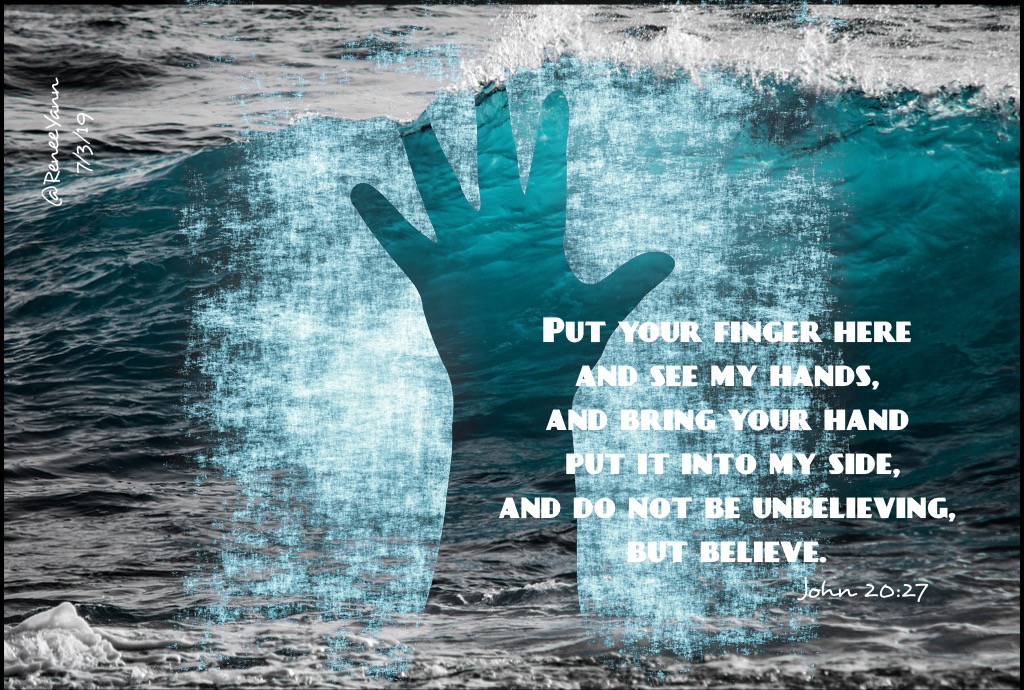
It ebbs and flows with our personal and communal dramas. It deepens with prayer, silent reaching, and a listening obedience to our lives. It shallows with our demands, like Thomas’s, only to see and to touch.
It is fed by the Lavish Mercy of God Who never cuts its flow to our souls if we but take down the seawall around our heart.
On this day when we celebrate the power of tested and proven faith, may we bring our needs into the circle gathered in that Upper Room.
Standing beside Thomas today in our prayer, may we place our trust in the glorified wounds of Christ.
A video today for our prayer: Blessed Are They That Have Not Seen
Music: Healing Touch – Deuter
As we reach out in faith with Thomas to touch Christ’s wounds, let us open our hearts to receive the returning touch of God’s Lavish Mercy.
Today, in God’s Lavish Mercy, our readings instruct us on the nature of prophecy.
Walter Bruggemann, in his transformational book “The Prophetic Imagination” writes about prophets. He indicates that prophets emerge in the context of “totalism” – those paralyzing systems which attempt to control and dominate all freedom and possibility.
Totalism kills ideas, hope, freedom, choice, self-determination, and creativity for the sake of controlling reality for its own advantage. Totalism is the ultimate “abusive relationship“. Examples in our society include cults, hate groups, mob rule, or any relationship that subjugates another’s free will.
Brueggemann defines the prophet as one engaged in these three tasks to restore hope and freedom:
the prophet is clear on the force and illegitimacy of the totalism.
the prophet pronounces the truth about the force of the totalism that contradicts the purpose of God.
the prophet articulates the alternative world that God has promised, and that God is actually creating within the chaos around us.
Our first reading comes from the Second Book of Kings which was written about 600 years before Christ. The Jewish people experienced the totalism of the Babylonian Captivity.. First and Second Kings was written to help the people understand their situation, to remain faithful to God, and to move toward freedom.
These two books are full of powerful figures pulling the people both toward and away from God – biblical Baddies and Goodies who carried profound messages about faith or its abandonment.
One of the Goodies is Elisha the Prophet whom we meet in today’s verses. Elisha confronts barrenness and death with the transformative power of faith. The Summanite woman is able to benefit from this power because she believes.
In our second reading, Paul doesn’t use the word “prophet” but he talks about the Resurrection Power we receive through our Baptism. This power calls us and confirms us as bearers of God’s transformative Word in a hostile and unfree world.
In our Gospel, Jesus is direct with his disciples about the rewards which fall to those who have prophetic faith:
“Whoever receives you receives me, and whoever receives me receives the one who sent me. Whoever receives a prophet because he is a prophet will receive a prophet’s reward, and whoever receives a righteous man because he is a righteous man will receive a righteous man’s reward. And whoever gives only a cup of cold water to one of these little ones to drink because the little one is a disciple— amen, I say to you, he will surely not lose his reward.”
Matthew 10:40-42
So, are we actually called to be prophets? The answer is YES. We are called by the Gospel and through our Baptism to do what Walter Brueggemann describes above:
to name the structures of unfreedom in our lives and in our world
to speak truth and stand against those things which contradict God’s Mercy and Love
to witness hope and courage by the joyous, generous service of our lives
You are not surprised at the force of the storm— you have seen it growing. The trees flee. Their flight sets the boulevards streaming. And you know: he whom they flee is the one you move toward. All your senses sing him, as you stand at the window.
The weeks stood still in summer. The trees’ blood rose. Now you feel it wants to sink back into the source of everything. You thought you could trust that power when you plucked the fruit: now it becomes a riddle again and you again a stranger.
Summer was like your house: you know where each thing stood. Now you must go out into your heart as onto a vast plain. Now the immense loneliness begins.
The days go numb, the wind sucks the world from your senses like withered leaves.
Through the empty branches the sky remains. It is what you have. Be earth now, and evensong. Be the ground lying under that sky. Be modest now, like a thing ripened until it is real, so that he who began it all can feel you when he reaches for you.
Music: When the Prophet Speaks – Van Morrison (lyrics below)
When the prophet speaks, mostly no one listens
When the prophet speaks and no one hears
Only those who have ears to listen
Only those that are trained to hear

Come closer now, I'll tell you what they whisper
Closer now, we'll whisper it in your ear
What big ears you've got when you get the details
Do you understand, do I make it clear?

When the prophet speaks, yeah, no one listens
When the prophet speaks, mostly no one hears
Only those that are trained to listen
Only those who have ears to hear

When the prophet speaks, yeah, no one listens
Baby, baby, baby, baby, baby
Don't you have no fear
You gotta get the truth on what is happening

When the prophet speaks, have to make it clear
Come closer now and I will whisper
Whisper the secret in your ear
What thick ears you've got when you get all the details

Do you understand, do I make myself clear?
When the prophet speaks, you've got to listen
When the prophet speaks, you've got to get the truth
When the prophet speaks, don't need no explanation

When the prophet speaks, have to make it move
Prophet speaks, no one listens
When the prophet speaks, mainly nobody hears
Only those that are trained to listen

Only those who have ears to hear
Today, in in God’s Lavish Mercy, we celebrate the great Apostles Peter and Paul, first architects of the Christian faith.
From our 21st century perspective, we may be tempted today to celebrate the totality of their accomplishments – the scriptures ascribed to them, the theology traced to them, the cathedrals named for them.
But there is a deeper message given to us in today’s readings, one that challenges our practice of faith. We can access that message by asking an obvious question:
Why were Peter and Paul, simple religious leaders, persecuted, imprisoned, harassed, and eventually executed? What was the terrible threat these unarmed preachers presented to political power?
In those days, King Herod laid hands upon some members of the Church to harm them. He had James, the brother of John, killed by the sword, and when he saw that this was pleasing to the Jews he proceeded to arrest Peter also. –It was the feast of Unleavened Bread.– He had him taken into custody and put in prison under the guard of four squads of four soldiers each.
Acts 12:1-3
The answer:
It was their testimony to the transformative Gospel message of Jesus Christ – the Gospel of Mercy and Justice.
But Jesus’ proclamation of God’s kingdom constituted a serious challenge to the Romans who ruled Israel during his lifetime. The cheering crowds who greeted him, especially during his entry into Jerusalem, as well as his confrontation with the moneychangers in the Temple, constituted such a threat to the unjust power of empire that the rulers crucified Jesus in order to silence him. – Elizabeth Johnson, CSJ
Peter and Paul, and every committed Christian after them, bears the same holy threatto ensuing cultures of domination, violence and greed.
As Jesus, Peter, Paul and so many others down through Pope Francis show us, faith and politics always work hand in hand. The work of faith is to build a world where every person can live, and find their way to God, in dignity and peace. It is to witness to an alternative to any power that feeds on the freedom, joy and peace of another person – especially those who are poor, sick and vulnerable.
May Peter and Paul inspire us to continue the daunting task of such an apostolic faith.
Poetry: The Passion of the Apostles Peter and Paul by Aurelius Prudentius Clemens, a Roman Christian poet, born in 348 AD. With his merger of Christianity with classic culture, Prudentius was one of the most popular medieval authors, being aligned as late as the 13th century alongside such figures as Horace and Statius. (Wikipedia)
Reading this poem, I was pleasantly reminded of my long-ago Latin classes. For those who might want to read the original Latin composition, here is a link:
Today, in God’s Lavish Mercy, both our readings express a desire for equanimity and reasonableness in our dealings with fellow human beings.
Rich old Abraham and rich young Lot can’t seem to get there unless they move away from each other. As we know from life, that’s sometimes the only and best route to peace (even though Lot ended up in a pretty bad neighborhood!)
Thus they separated from each other; Abram stayed in the land of Canaan, while Lot settled among the cities of the Plain, pitching his tents near Sodom (uh oh!).
Genesis 13:11-12
In our Gospel, Jesus gives us some snippets of common sense and mutuality too:
Do not give what is holy to dogs, or throw your pearls before swine, lest they trample them underfoot, and turn and tear you to pieces.
Do to others whatever you would have them do to you. This is the Law and the Prophets.
Matthew 7: 6;12
However, the even-steven tone of these passages is countered by the Gospel’s closing verse:
Enter through the narrow gate; for the gate is wide and the road broad that leads to destruction, and those who enter through it are many. How narrow the gate and constricted the road that leads to life. And those who find it are few.
Matthew 7:13-14
Jesus seems to be telling us that “even-steven” is not so “easy-peasy”!
It is a huge challenge to live in sacred balance with our sisters and brothers, and with all Creation. That Balance was lost in Eden but redeemed on Calvary. For us to allow its redemption in our own lives, we must live in the pattern of Christ’s sacrificial love. That pattern is “the narrow gate”. May we be among the few who find it!
Poem: The Narrow Way – Anne Brontë, one of the noted three sisters in a famous literary family. Their stories attracted attention for their passion and originality immediately following their publication. Charlotte’s Jane Eyre was the first to know success, while Emily’s Wuthering Heights, Anne’s The Tenant of Wildfell Hall and other works were accepted as masterpieces of literature later. Anne’s famous poem The Narrow Way, while seeped in the weighty tones of Victorian literature, makes a powerful point for any generation. (ref:Wikipedia)
The Narrow Way
Believe not those who say
The upward path is smooth,
Lest thou shouldst stumble in the way,
And faint before the truth.
It is the only road
Unto the realms of joy;
But he who seeks that blest abode
Must all his powers employ.
Bright hopes and pure delights
Upon his course may beam,
And there, amid the sternest heights
The sweetest flowerets gleam.
On all her breezes borne,
Earth yields no scents like those;
But he that dares not grasp the thorn
Should never crave the rose.
Arm—arm thee for the fight!
Cast useless loads away;
Watch through the darkest hours of night,
Toil through the hottest day.
Crush pride into the dust,
Or thou must needs be slack;
And trample down rebellious lust,
Or it will hold thee back.
Seek not thy honor here;
Waive pleasure and renown;
The world’s dread scoff undaunted bear,
And face its deadliest frown.
To labor and to love,
To pardon and endure,
To lift thy heart to God above,
And keep thy conscience pure;
Be this thy constant aim,
Thy hope, thy chief delight;
What matter who should whisper blame,
Or who should scorn or slight?
What matter, if thy God approve,
And if, within thy breast,
Thou feel the comfort of His love,
The earnest of His rest?
Today, in God’s Lavish Mercy, our readings are studies in darkness and light.
Jeremiah – from the Sistine Chapel ceiling painted by Michelangelo c. 1512
Our first reading comes from Jeremiah, sometimes referred to as “the weeping prophet”. Jeremiah was pretty much a sad sack, as today’s selection demonstrates. He wrote for the Jews during the darkness of the Babylonian exile, helping them to mourn their situation which had been brought upon themselves by their unfaithfulness and sin. Jeremiah calls the people to repent and to find a healing grace by trusting God.
Sing to the LORD, praise the LORD, who has rescued the life of the poor from the power of the wicked!
Jeremiah 22:13
Paul, addressing the Romans, uses the same light/dark, sin/redemption theme. He says that all of us display an inclination to darkness by any choice to break relationship with God, neighbor and Creation.
In the Genesis allegory of Adam and Eve, they choose to supersede God’s terms of relationship, eschewing the pure abundance of Creation for the sake of a self-satisfying “apple”.
The magnificent encyclical “Laudato Si” leads us through an enlightened understanding of of this Genesis story:
The creation accounts in the book of Genesis contain, in their own symbolic and narrative language, profound teachings about human existence and its historical reality. They suggest that human life is grounded in three fundamental and closely intertwined relationships: with God, with our neighbor and with the earth itself. According to the Bible, these three vital relationships have been broken, both outwardly and within us. This rupture is sin. The harmony between the Creator, humanity and creation as a whole was disrupted by our presuming to take the place of God and refusing to acknowledge our creaturely limitations. This in turn distorted our mandate to “have dominion” over the earth (cf. Gen 1:28), to “till it and keep it” (Gen 2:15). As a result, the originally harmonious relationship between human beings and nature became conflictual (cf. Gen 3:17-19). It is significant that the harmony which Saint Francis of Assisi experienced with all creatures was seen as a healing of that rupture. Saint Bonaventure held that, through universal reconciliation with every creature, Saint Francis in some way returned to the state of original innocence. This is a far cry from our situation today, where sin is manifest in all its destructive power in wars, the various forms of violence and abuse, the abandonment of the most vulnerable, and attacks on nature.
Laudato Sì, paragraph 66
Our Gospel so beautifully complements this enlightened understanding. Jesus encourages his disciples not to be afraid because the Creator embraces them in love and care. They, as we, need not make parsimonious choices that fracture essential relationships with God, neighbor, self, or Creation. We are already safe and whole in God.
Jesus said to the Twelve: “Fear no one. Nothing is concealed that will not be revealed, nor secret that will not be known. What I say to you in the darkness, speak in the light; what you hear whispered, proclaim on the housetops…
… Are not two sparrows sold for a small coin? Yet not one of them falls to the ground without your Father’s knowledge. Even all the hairs of your head are counted. So do not be afraid; you are worth more than many sparrows…
Matthew 10:26-33
Poetry: The Root of the Root of Yourself – Rumi
(Reading this poem, we might imagine that the Trinity is inviting us to recover the pristine goodness of our creation.)
Don’t go away, come near.
Don’t be faithless, be faithful.
Find the antidote in the venom.
Come to the root of the root of yourself.
Molded of clay, yet kneaded
from the substance of certainty,
a guard at the Treasury of Holy Light —
come, return to the root of the root of your Self.
Once you get hold of selflessness,
You’ll be dragged from your ego
and freed from many traps.
Come, return to the root of the root of your Self.
You are born from the children of God’s creation,
but you have fixed your sight too low.
How can you be happy?
Come, return to the root of the root of your Self.
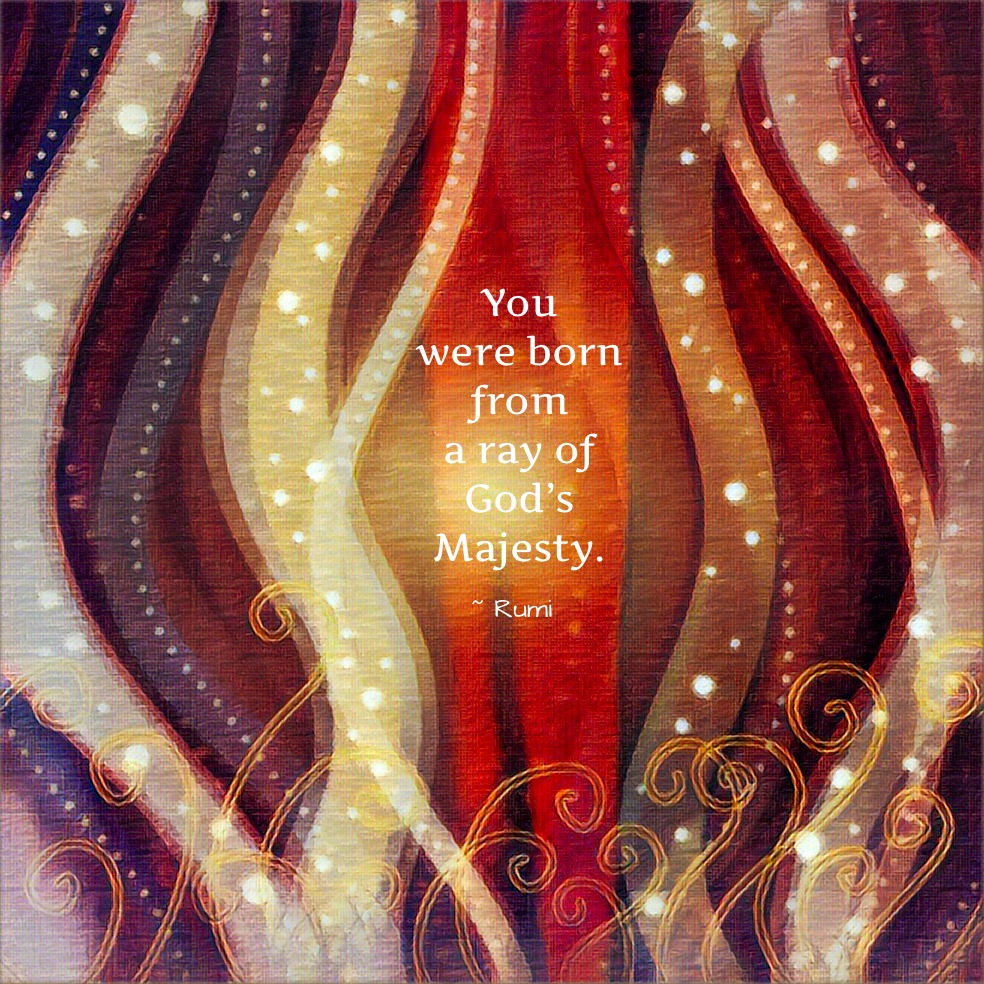
You were born from a ray of God’s majesty
and have the blessings of a good star.
Why suffer at the hands of things that don’t exist?
Come, return to the root of the root of your Self.
You are a ruby embedded in granite.
How long will you pretend it’s not true?
We can see it in your eyes.
Come to the root of the root of your Self.
You came here from the presence of that fine Friend,
a little dazed, but gentle, stealing our hearts
with that look so full of fire; so,
come, return to the root of the root of your Self.
Today in God’s Lavish Mercy, our dear Apostle Paul is pretty much around the twist with the Corinthians. As the Church grows and the faith spreads, many “Christian” teachers arise. Some are truly called to the mission and ministry. They engage it and discharge it with humility and grace.
But some get their motives all mixed up with their own agenda for aggrandizement. They are flashy eloqutionists who can mesmerize an audience with their practiced charms. But they have missed the point of the Gospel of Jesus Christ. Instead they make the mission all about themselves – their wealth, success, prosperity and power. . These are the ones who are driving Paul “nuts” – to the point of speaking “insanely” in verse 23:
Are they ministers of Christ? (I am talking like an insane person.) I am still more, with far greater labors, far more imprisonments, far worse beatings, and numerous brushes with death.
2 Corinthians 11:23
Living the Gospel is not easy, and preaching it with integrity may be even harder. The Gospel contradicts everything our unredeemed human nature craves. To demonstrate this, Paul says that he too will boast like the errant preachers boast. But Paul contradicts them by boasting not of his personal gifts and powers, but of his sufferings, weaknesses, anxieties and catastrophes. He shows that he loves the Gospel and the Church so much that he will suffer for it to keep it aligned with the Truth of Jesus Christ.
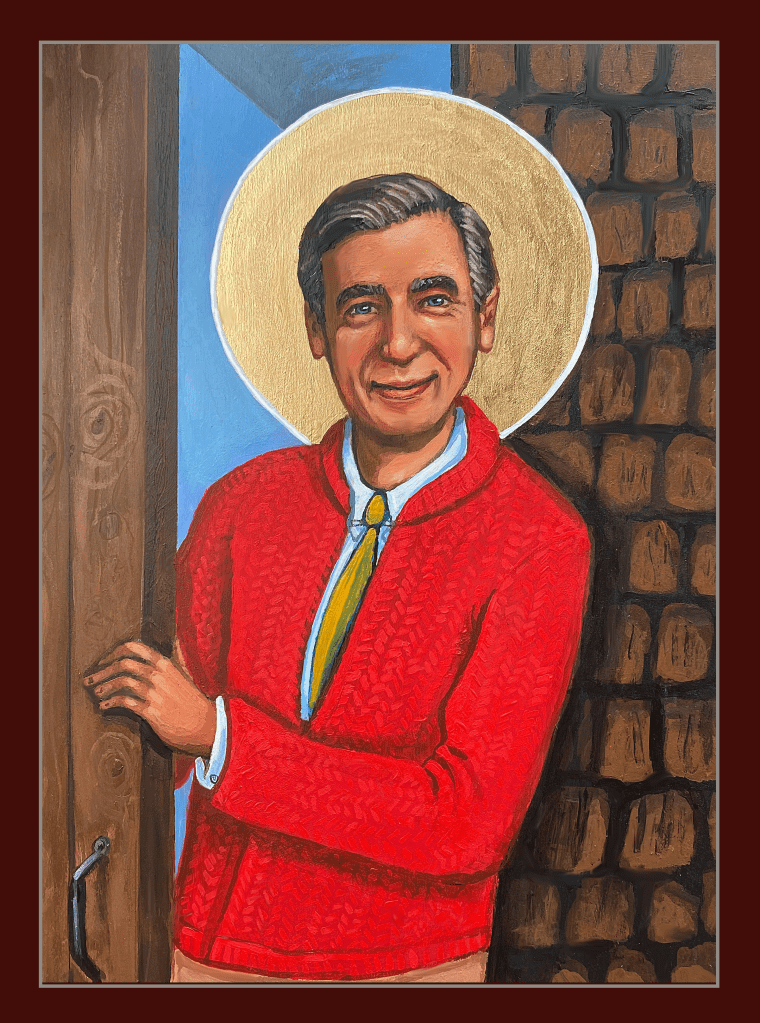
Kelly Latimore Icons – Mr. Rogers ( a truthful preacher himself)
When I read 2 Corinthians, I realize that Paul was no Mr. Rogers humming soft philosophy to his followers. Paul could be a fiery hot head unafraid to show his anxious love and indignant frustration for a dense yet beloved community. When they were “stupid” enough to be infatuated with a worldly teacher, Paul suffered intensely for their loss of the Gospel:
And apart from these things, there is the daily pressure upon me of my anxiety for all the churches. Who is weak, and I am not weak? Who is led to sin, and I am not indignant?
2 Corinthians 11:28-29
In our Gospel, Jesus paints an ominous metaphor for those who distort truth for their own purposes. If we allow ourselves, as individuals or as a culture, to normalize dishonesty, we are doomed to an incomprehensible darkness. When we practice such normalization, we eventually forget how to even discern the truth and we become convinced of the lie we have become.
“The lamp of the body is the eye. If your eye is sound, your whole body will be filled with light; but if your eye is bad, your whole body will be in darkness. And if the light in you is darkness, how great will the darkness be.”
These are powerful readings and have much to say to us and to our socio-political institutions. If we truly are people of faith, we will listen.
Poetry: We Grow Accustomed to the Dark – Emily Dickinson
We grow accustomed to the Dark –
When Light is put away –
As when the Neighbor holds the Lamp
To witness her Good bye –
A Moment – We Uncertain step
For newness of the night –
Then – fit our Vision to the Dark –
And meet the Road – erect …
Today, in God’s Lavish Mercy, Matthew hits us right between the eyes with one of the most difficult Gospel passages to defend, to explain, and – most certainly – to practice.
Jesus said to his disciples: “You have heard that it was said, An eye for an eye and a tooth for a tooth. But I say to you, offer no resistance to one who is evil.
“Oh, wow’, we might think. “Did Jesus have any idea what kind of a world I’d be living in someday?!”
Violence is so rampant in our society that some of us have stopped looking at the news because we can’t stand it! Here in the U.S., we are traumatized by statistics around the number and kind of artillery in our neighborhoods and who dies as a result – children, worshippers, movie-goers, picnickers. Are these the “enemy” for whom we have designed our lethal weapons?
We see gunpoint carjackings, drive-by shootings, and unlicensed militia defending their political prejudices. We see children afraid to go to school. Mothers afraid to go shopping. Believers afraid to go to their place of worship. We have even seen an assault on the American government stoked by a nationalistic rhetoric of hostility, hatred, and aberrant machismo.
There are so many guns now on American streets that we may think the best response is to carry our own. The “law” allows that. We may consider ourselves valiant if we “stand our ground”, legally shooting some innocent bystander who happened to wander onto our property or drive into our traffic lane!
So what, in God’s Name, does this Gospel have to say to us who have descended almost beyond recue into the chasm of violence?
Remember, Jesus has just finished talking about the Law. He has assured his followers that he has come to fulfill the Law rather than to abolish it. Jesus honors and recognizes the Law as the framework that has held in place Israel’s centuries-long relationship with God.
But Jesus indicates that following the letter of the Law while not fulfilling its spirit is contradictory to the Reign of God. We can use the “law” as an excuse for our complacency – keeping in place those unexamined tenets that make us comfortable, rich, and more powerful to the detriment of others. This is what the Pharisees and Saducees had done.
In each of the five situations listed in today’s Gospel, Jesus isn’t telling us to lie down like a doormat and let ourselves be walked on. What he’s saying is that with God’s help, there is a better way, a deeper response that we can give to the conflicts in our lives.
Jesus encourages his followers not to meet the other with resistance. So often, resistance is our first defense rather than patience, negotiation, honesty, listening, or forgiveness. Jesus is asking us to stand still for a moment before lashing back – and in that moment move toward a more graced and courageous resolution. He is counseling us to listen, to imagine mutuality, and to work together for an equilibium of justice with mercy.
It must be admitted that sometimes this just doesn’t seem to work. Those with the power to make positive change can block the way, just as they did for Jesus. We can end up looking like “losers” – or even die – like Jesus did. But even though he had the power – the Omnipotence to do so – Jesus did not resist. If we really understand the Paschal Mystery and believe in the Resurrection, we will know why, and we will try to imitate him.
So where do we start? I think it starts with:
the level of reverence in our everyday interactions,
our attitudes toward “the other” – someone different from me in race, ethnicity, religion, sexuality, nationality, economic status, or opinion.
with our efforts toward reasonable gun legislation, educational equity for all children, universally available mental health services, and the eradication of abysmal poverty in our cities.
Can I do something to advance these changes? Not all by myself. But as a community of faith, Christians can bring amazing influence to these issues. Today’s Gospel is telling me to act on that belief.
Poem: Some – Daniel Berrigan, SJ
Some stood up once and sat down.
Some walked a mile and walked away.
Some stood up twice and sat down
I’ve had it, they said.
Some walked two miles and walked away
It’s too much, they cried.
Some stood and stood and stood.
They were taken for dummies
They were taken for fools
They were taken for being taken in.
Some walked and walked and walked.
They walked the earth
They walked the waters
They walked the air.
Why do you stand?
they were asked, and
Why do you walk?
Because of the children, they said, and
Because of the heart, and
Because of the bread.
Because
the cause
is the heart’s beat
and the children born
and the risen bread.
Music: Where Have All the Flowers Gone – written by Pete Seeger, sung by Joan Baez
Today, in God’s Lavish Mercy, we hear Moses tell the People:
You are a people sacred to the LORD, your God; he has chosen you from all the nations on the face of the earth to be a people peculiarly his own.
Deuteronomy 7:6
We modern readers may be a little put off by the use of the word “peculiar” which, since the 16th century, has taken on the connotation of “odd” or “uncommon”. But the original meaning of the word is “to belong exclusively to one person“, as in “Honey, I love you and you belong to me!” Moses is telling Israel that this is the way God loves them.
Below is a song many us will remember. Maybe as teenagers we even did the “Stroll” to its dulcet tones. The love described in this song is but a pale shadow of the love God has for us, and the longing sung about is but a weak imitation of God’s longing for us. Listen to it and let God sing to you – singing around the words and into the meaning behind them.
Thinking of God as we listen to a song like this can make God very human. And, of course, that is exactly who Jesus Christ is. Jesus loves us with a human heart and a divine love. He loves us with a Sacred Heart.
All love is refined and proven in sacrifice. Jesus testified to his infinite love for us in his Passion, Death and Resurrection. In that miracle of redemptive love, God embraces, strengthens and commissions us. We are to love as God loves – to have hearts themselves made sacred by imitation of Christ.
“Come to me, all you who labor and are burdened, and I will give you rest. Take my yoke upon you and learn from me, for I am meek and humble of heart; and you will find rest for yourselves. For my yoke is easy, and my burden light.”
Matthew 11:28-30
Prose: In the late 17th, St. Margaret Mary Alacoque shared her vision of Christ’s Sacred Heart. In a book of her writings published after her death we read:
Christ showed me that it was His great desire
to be loved by human beings
and of withdrawing them from the path of ruin
that made Him form the design
of manifesting His Heart to us,
with all the treasures of love, of mercy, of grace,
of sanctification and salvation which it contains,
in order that those who desire
to render Him and procure Him
all the honor and love possible,
might themselves be abundantly enriched
with those divine treasures
of which His heart is the source.
Devotion to the Sacred Heart was fostered by the Jesuits and Franciscans, but it was not until the 1928 encyclical Miserentissimus Redemptor by Pope Pius XI that the Church validated the credibility of St. Margaret Mary’s visions of Jesus Christ in having “promised her that all those who rendered this honor to His Heart would be endowed with an abundance of heavenly graces.”
Today, in God’s Lavish Mercy, our readings are about Truth, Spiritual Vigor, Holy Light.
For the Son of God, Jesus Christ, whom we proclaimed to you was not “yes” and “no,” but only “Yes”. For however many are the promises of God, their Yes is in Jesus Christ …
2 Corinthians 1:19-20
A good friend of mine has taught me a lot about “Yes”, the kind of “Yes” I think Paul is describing in this passage. Sometimes, as with all friends, we might need a favor from each other – picking up a quart of milk, typing out a letter, providing transportation to a doctor.
I usually begin such a request with the phrase, “Could you do ^ me a favor…?” Somewhere in between “do” and “me”, my friend always shouts, “YES!!!” even before she hears what the favor is. Her “Yes”, rooted in loving friendship, is complete, unqualified, and inexhaustible.
God’s “Yes” to us, incarnate in the Gift of Jesus Christ, is eternally complete, unqualified, and inexhaustible!
Wow! Just think about that! Believing it can release immense power in our relationship with God! It can drag our Light out from under the bushel basket and into the world which is aching in darkness!
Our Gospel today, which continues Jesus’ Sermon on the Mount, describes what a Christian looks like who is trying to live their own “yes” back to God.
Such a believer is like salt, like light, like an elevated city calling us higher.
Salt – which releases and accents the good already inherent in our nature
Light – which makes the sacred path discoverable even in life’s shadows
City on the hilltop – which not only assures us that the journey can be accomplished, but turns to beckon and encourage us in our climb
Poetry: love is a place – e.e.cummings
love is a place
& through this place of
love move
(with brightness of peace)
all places

yes is a world
& in this world of
yes live
(skillfully curled)
all worlds














 Lavish Mercy