Here’s That Cup, Again!

Wednesday of the Second Week of Lent

March 11, 2020

Click here for readings

Today, in Mercy, we learn a lesson in humble leadership, thanks once againto “Mrs. Zebedee”.
Mk 10_38 cup

Our Gospel recounts the story of the mother of James and John interceding for her sons with Jesus. Like many overprotective mothers, she intervenes even into their adult lives. She wants to make sure they get the best deal for their investment with Jesus.

Listen, I understand and love her! I would be the same way with my kids if I had any. I often say it’s best I had none because “Overprotective Me” would have had to shadow them to school, dances, playgrounds etc. until they were about 35 years old!

But the point of this Gospel story isn’t Mrs. Zebedee’s overprotectiveness.  It has little to do with Mrs. Zebedee at all.

The point is that “Mrs. Zebedee” (like many of us) has missed the whole POINT. The Gospel story is about US and the integrity of our choice to live a life in the pattern of Jesus.

Christ’s disciples have decided to follow a man who says things like this:

  • The last shall be first and the first, last.
  • Unless you lay down your life, you cannot follow me.
  • Whoever takes the lowly position of a child is the greatest in the Kingdom of Heaven.

The seats at Christ’s right and left, which Mrs. Zebedee requests for her sons, will bring them rewards only through humility and sacrificial service.


Here’s the way a 14th century artist imagined the Zebedee family. (Dad looks happy!)

sons of zebedee
Mary Salome and Zebedee with their Sons James the Greater and John the Evangelist (c.1511) by Hans von Kulmbach, Saint Louis Art Museum


Jesus is gentle with “Mrs. Zebedee”. He understands how hard it is for any of us to comprehend the hidden glory of a deeply Christian life. We are surrounded by a world that screams the opposite to us:

  • Me first!
  • Stand your ground!
  • Good guys finish last!

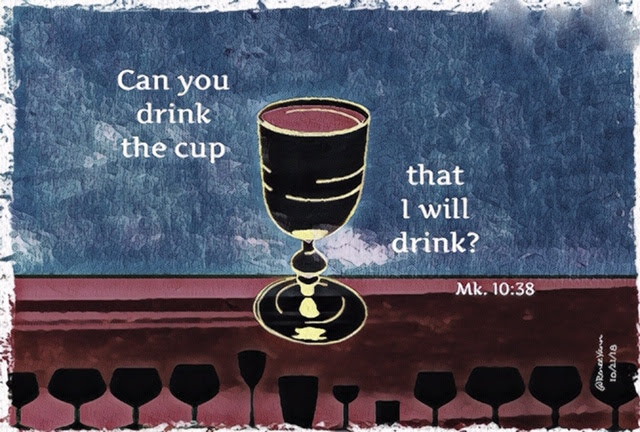
So Jesus turns to James and John (and to us). One can imagine the bemused look on Christ’s face. He knows the hearts of his disciples. He knows they have already given themselves to him. So he asks them for a confession of faith, “Can you drink the cup that I will drink?”
veronese-le-christ-rencontrant-la-femme-et-les-fils-de-zebedee_-_grenoble
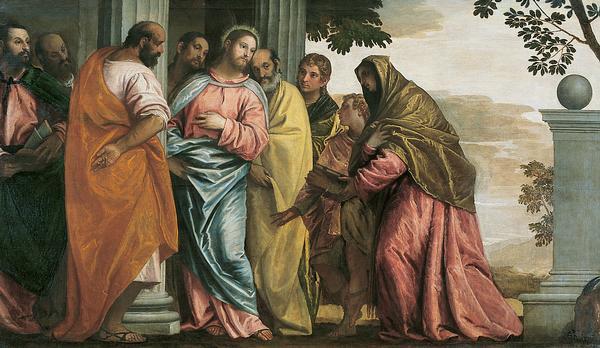
The meeting of Christ with Zebedee’s wife and sons by Paolo Veronese

Their humble, faith-filled answer no doubt stuns their mother. She is left in wonder at the holy men her sons have become. Perhaps it is the beginning of her own deep conversion to Christ.

As we pray with this passage, where do we find ourselves in this scene? How immediate, sincere, and complete is our response to Jesus’ question: “Can you drink the cup….?”

Music: To Be a Servant – David Haas

Refrain:
For I have come not to be served but to serve;
To give my life.
If you wish to be the first you must seek
To be a servant, to be a servant.

1. Can you drink the cup that I must drink;
Are you willing?
Can you be baptized like I have been baptized?
Are you able? Are you able?

2. For to sit at my right hand or at my left,
Is not for me to give.
But for those for whom it has been prepared,
It will be given. It will be given.
It’s Your Turn!

Second Sunday of Lent

March 8, 2020

Click here for readings

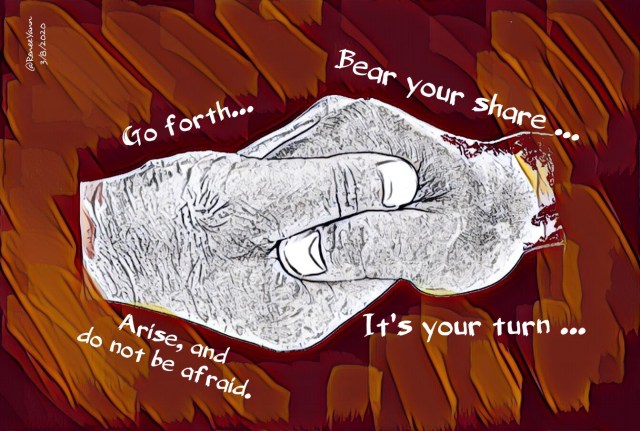
Today, in Mercy, as I prayed with these readings, I heard the words “It’s your turn.”

In our passage from Genesis, it’s the message God gives Abram:

Go forth from the land of your kinsfolk
and from your father’s house
to a land that I will show you.

In other words, I have reached from my Infinite Perfection to call you into a covenant of love. Now, it’s your turn to leave your comfort zone and go find my hope for you and for my people.


In Timothy’s letter, the call comes in this form:

Bear your share of hardship for the gospel
with the strength that comes from God.

Again Timothy tells us that Christ carried the cross so that we could have eternal life. It’s our turn now to bear any cross all the way to the empty tomb.


And in our Gospel, the just transfigured Jesus calls his beloved disciples to a new courage:

“Rise, and do not be afraid.”

In other words.. things are going to get really tough. You have just seen a Glorious Light that will take you through the darkness. It’s your turn to walk beside me on the coming journey.


Folded in each of these messages is the implication that, although challenges may come, a stronger commitment to God and God’s hope is being opened before each listener — before us.

its ur turnJPG

Scripture records the long, ensuing story of Abram’s response. We know, too, how Timothy’s early Christian community turned persecution into indomitable witness. And the commitment of Peter, James, and John built the foundation of our faith.


Every morning when God wakes us up, the Holy Voice shining in the morning light whispers, “It’s your turn. Today will be part of your journey into my Heart. How will you respond to the many calls being offered you?”

Let this “Transfiguration Moment” give us brave, loving, and insightful hearts! Let us walk the path Christ would walk, especially as we deepen into the lovely blessings of Lent.

Music:  Transfiguration – Carey Landry

We behold the splendor of God
shining on the face of Jesus.
We behold the splendor of God
shining on the face of the Son.

And oh, how his beauty transforms us,
the wonder of presence abiding.
Transparent hearts give reflection
of Tabor’s light within, of Tabor’s light within.

Jesus, Lord of Glory, Jesus, Beloved Son,
oh, how good to be with you;
how good to share your light;
how good to share your light.

We behold the splendor of God
shining on the face of Jesus.
We behold the splendor of God
shining on the face of the Son.

And oh, how his beauty transforms us,
the wonder of presence abiding.
Transparent hearts give reflection of
Tabor’s light within, of Tabor’s light within.

Jesus, Lord of Glory,
Jesus, Beloved Son,
oh, how good to be with you;
how good to share your light;
how good to share your light.

Be Careful of Love

Saturday of the First Week of Lent

March 7, 2020

Click here for readings

Moses spoke to the people, saying:
“This day the LORD, your God,
commands you to observe these statutes and decrees.
Be careful, then,
to observe them with all your heart and with all your soul.


Today, in Mercy, Moses tells us this:

Be careful, then …

Be careful of what? Does he mean be careful like,”Don’t fall down the steps!”. Or does he mean be careful like, “Hold tenderly to love in your life.”?

In this passage from Deuteronomy, Moses goes on to say one of my favorite biblical phrases:

… today the LORD is making this agreement with you:
you are to be a people peculiarly his own, as he promised you…

Since the 17th century, the word “peculiar” has taken on the meaning of “odd” or “unusual”.  But the original sense comes from the Latin peculiaris meaning “of private property”

Moses is reminding us that we belong to God and God to us in a covenant similar to, but far exceeding, the mutuality of a marriage.

So we should “be careful”, full of care, in appreciation for this infinite love.


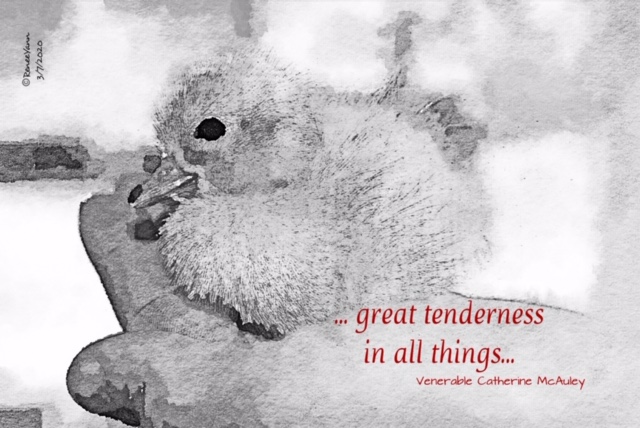
chick

In our Gospel, Jesus tells us how to take this exquisite care of our precious relationship with God:

But I say to you, love your enemies,
and pray for those who persecute you,
that you may be children of your heavenly Father,
for God makes the sun rise on the bad and the good,
and causes rain to fall on the just and the unjust.
… Be compassionate as your Heavenly Father is compassionate.

So, let’s be careful of love today when we find this precious God in our sisters and brothers and in all God’s Creation. Let us be compassionate.

Music:  Compassion Hymn – The Gettys 

The Word Will Not Be Void

Tuesday of the First Week of Lent

March 3, 2020

Click here for readings

Today, in Mercy, as I pray with today’s readings, I ask myself two questions:

      • “What has God’s Word accomplished in me?”
      • “What does God’s Word yet want to accomplish in me?”

If you’re like me, you’re always thinking about what you haven’t done, still must do, wish you had done. 

STOP

Let’s STOP and praise our gracious God for the good accomplished through our lives. I know every one of you reading this blog is an amazingly good person. God has already done beautiful things through you. Thank God. Give God the glory.

Lyrics:

How can I say thanks
For the things You have done for me?
Things so undeserved,
Yet You gave to prove Your love for me;
The voices of a million angels
Could not express my gratitude.
All that I am and ever hope to be,
I owe it all to Thee.

To God be the glory,
To God be the glory
For the things He has done.

With His blood He has saved me,
With His power He has raised me;
To God be the glory
For the things He has done.

Just let me live my life,
Let it pleasing, Lord to Thee,
And if I gain any praise,
Let it go to Calvary.


And then ask to go on, to open up your heart, to see God’s next desire for your precious life.

waterfal

For my young readers, give your dynamism to God’s imagination for you. There are great and holy things around every corner! Trust! Ride the grace-filled wave! Do not be afraid! Be a waterfall for God’s Word.


wellJPGFor some of us, as we get older, we do not have the physical energy to DO all that we once did. But oh, my dears, we can now BE more wonderful for God because of the long accumulation of his generous grace. Be a Well for God’s Word! Sink into grace! Do not be afraid!



For thus says the LORD:
Just as from the heavens
the rain and snow come down
And do not return there
till they have watered the earth,
making it fertile and fruitful,
Giving seed to the one who sows
and bread to the one who eats,
So shall my word be
that goes forth from my mouth;
It shall not return to me void,
but shall do my will,
achieving the end for which I sent it.


How amazing that promise is! Trust it! Let the Word transform you every day of your life.

Let’s consciously pray for one another today as today’s Gospel encourages us:

Our Father who art in heaven,
hallowed be thy name,
thy Kingdom come,
thy will be done,
on earth as it is in heaven.
Give us this day our daily bread;
and forgive us our trespasses,
as we forgive those who trespass against us;
and lead us not into temptation,
but deliver us from evil.

Music:  So Will I – Hillsong

Sheep or Goat?

Monday of the First Week of Lent

March 2, 2020

Click here for readings

sheep mosaic

Today, in Mercy, we are invited to be like God:

The LORD said to Moses,
“Speak to the whole assembly of the children of Israel
and tell them:
Be holy, for I, the LORD, your God, am holy.

Our first reading goes on to tell us how: be a decent person.

  • Don’t steal, lie, or cheat
  • Pay just wages
  • Respect and help those physically burdened
  • Be impartial and just
  • Defend life
  • Don’t slander, hate, take revenge, or hold a grudge

Basically, the message is about kindness … deep kindness, the type that comes from realizing how infinitely kind God is to us.

Leviticus, after a long list of practical examples, sums it up:

You shall love your neighbor as yourself.
I am the LORD.


Our Gospel tells us what happens when we make the choice to take the Old Testament advice — or not.

little lamb

We are all familiar with the parable of the sheep and the goats. And we all hope our scorecard gets us in the right herd “When the Son of Man comes in his glory, and all the angels with him …”


Basically, in this parable, Jesus puts the advice of Leviticus into practical form for his followers. But he adds one dynamic element that not only invites but impels our wholehearted response:

Amen, I say to you,
what you did not do for one of these least ones,
you did not do for me.

Leviticus invites us to become holy as God is holy. But Jesus reveals the secret that this Holy God lives in the poor, hungry, homeless, imprisoned and sick. By embracing these most beloved of God, we find the pattern of Holiness.

Music: The Least of These – Karl Kohlhase

No Apples!

First Sunday of Lent

March 1, 2020

Click here for readings

Today, in Mercy, we encounter themes of creation, life, temptation, sin, death, and repentance. I’d say that’s a pretty loaded Sunday!

apples

We start out with the simple, but heavily misinterpreted, story of Adam and Eve. This creation myth shared by Judea-Christian and Islamic religions serves as a foundation of these great faith traditions. 

The story is often the first we learn as we are introduced to our family’s faith practice. We imagine Adam and Eve as historically real personalities and the snake as a flesh and blood devil. Some of us never get beyond that elementary understanding of the story.

A and EA few decades ago, I taught New Testament Studies to a class of men aspiring to become deacons. During the session on today’s reading from Romans, a discussion arose about whether an entire human race could descend from just a “first man and woman”. When I pointed out that the creation story uses mythical elements to represent a broader reality, one man reacted adamantly. He could not imagine that there were not a specific “Adam” and “Eve”, but that instead these names represented humankind in their evolving relationship with God. The thought was so shattering to him that he dropped the class. 

That made me sad. But it also caused me to focus on the creation story myself to examine ways in which I might be missing or blocking its deep spiritual significance. Is it really just about temptation, sin, punishment, and death? Or is there a much deeper message for our faith?

One of my go-to theologians has helped me significantly. Walter Brueggemann says this about our consideration of the Creation Story:


Like the people in this narrative, our concern is not finally the danger of sex, the origin of evil, the appearance of death, or the power of the fall. It is, rather, the summons of this calling God for us to be his creatures, to live in his world on his terms.


We struggle throughout our lives to understand God and God’s ways – to live on God’s terms. We will never accomplish it.  We will always meet the “snakes” of questions like:
why

  • Why is there evil in the world?
  • Why does God let innocent people suffer?
  • Why is “this” (Whatever trial) happening to me?
  • Why did he or she have to die so young?
  • Why don’t the bad people die instead?
  • Why? Why? Why?

We want KNOWLEDGE – just what the “serpent” facetiously offered from the forbidden tree!


But this beautiful creation story teaches us that what God desires from us is not knowledge but rather TRUST – trust to live in the unfolding, but never fully-unfolded, mystery of God’s faithfulness to us.

So much in us wants to pluck the magic apple that will make us the “gods” of our existence, controlling life as we would like it to be.

God says instead that we should trust, and delight in sitting under the mysterious, nurturing tree of God’s irreversible, covenantal love – the same love Jesus trusts in today’s challenging Gospel.

Music: Nothing I Hold on To – Will Reagan ( Listen to it like a mantra and let your breathing synch to it. Breathe in Love. Breathe out Trust. No apples necessary.)

Lent: A Closer Walk

Thursday after Ash Wednesday

February 27, 2020

Click here for readings

Today, in Mercy, our readings confirm that a life patterned on Christ contradicts worldly definitions.

Dt.30_19 Chhose

Deuteronomy gives us stark, either-or, advice:

I have set before you life and death,
the blessing and the curse.
Choose life, then,
that you and your descendants may live,
by loving the LORD, your God,
heeding his voice,
and holding fast to him.

It’s definitive, but we could probably do that, right? Choose life, love God, heed God’s voice, hold fast to God? Sounds OK, doesn’t it?


It’s when Jesus comes along that it sounds difficult. 

Jesus tells us, “Here’s how you choose life –

“Whoever wishes to save his life will lose it,
but whoever loses his life for my sake will save it.”


Jesus tells us, “Here’s the God you must love, one who

“suffers greatly, is rejected, and is killed.”


Jesus tells us, “Here’s what my voice says to you –

“What profit is there for you to gain the whole world
yet lose or forfeit yourself?”


Jesus tells us, “Here’s how you hold fast to me –

‘Take up your cross daily and follow me.”

mcA Cross


Some have huge crosses to carry in their lives – perhaps famine, enslavement, untended illness, homelessness, persecution, poverty. Those who carry such crosses are singularly loved by God who dwells with them.

But if we don’t have big, obvious crosses in our lives – if we are among those the world deems fortunate – how do we follow the crucified Jesus to find our way to eternal life?

How do we really CHOOSE LIFE?


cross icon WP

We need to get close to the ones God singularly loves. We need to walk beside them and lift some of their heavy crosses. We need to help their voices be heard, their needs be met, their rights be honored.

Not all of us can do this by direct service. But we can do it by our advocacy, our material contributions, and our articulated support for justice.

We need to make these choices for life all the time. But Lent is a great time to examine the vigor and commitment of our choices, a time to take a closer walk with our suffering Christ and ask him to inspire our courage.

Music:  Just a Closer Walk with Thee – Patsy Cline and Willie Nelson

Creeping Up to Lent?

Tuesday of the Seventh Week of Ordinary Time

February 25, 2020

Click here for readings

Today, in Mercy, we are creeping up to Lent’s doorstep.

Doorstep

Are you beginning to consider your Lenten rituals? Our readings today might help orient us.

They leave this question hanging in the air: Who do I really want to be in my life?

Mk9_34 first last

James says that if we are someone who loves the world, we will find ourselves at enmity with God. James defines “the world” as a place in discord, conflicted by covetousness, envy, frustration, and death-dealing.

James is directly addressing damaging squabbles within the Church itself. Infighting has caused fractures within his believing community. Failures in mutual charity and sincere prayer have generated “wars” among the members.

Why would anybody choose to contribute to such a negative environment? 

James pins it on one thing: jealousy. We are jealous to be, have, control, and possess more than others. We are tempted by power, riches and esteem. We want our opinions to be honored, our needs to be met above and before others.


The reality exists today as well, as we know too well.

  • We see it in the Church from factions who want to bend the Gospel to their own agenda.
  • We see it within and between nations who raise the advantage of some over the welfare of others.
  • We see it in families, businesses, and social circles where individuals volley for position, influence, or control over others.

These conflicts pour out in criticism, judgements, biases, shunning, and all kinds of failures in compassion, respect, and honesty. They blind us to our common creaturehood in God, and to its demand for an equity of love, mercy, and justice.

Otherwise, 

  • How could we ever kill or enslave one another, either by aggression or neglect?
  • How could we separate parents from their children and put babies in cages?
  • How could we participate in a global economic tyranny that leaves some without land, homes, health care, or hope?
  • How could we use other human beings – or their vital resources – only for our own pleasure, power or enrichment?

Most of us do not outrightly choose these sinful behaviors. But we must ask ourselves to what degree we are complicit in them by our failures in just judgement, advocacy, political responsibility, globally sustainable choices, — just plain care and reverence for all human beings, all Creation.


The approach of Lent is a great time to revisit the question James hangs in the air for us:

  • Who do I really want to be in my life? 
  • Do I need to make changes to do that? 
  • How can I prepare for a Lent that helps me make those Grace-filled changes?

We are grown-ups now, and our Lenten repentances demand more than those we learned in grade school. Fasting from candy won’t cut it anymore. 

  • How about we fast from cable news that feeds our biases?
  • Or actually do something for our parish besides critique the Sunday sermon?
  • Maybe give up some of our polluting behaviors requiring plastic and other non-recyclables?
  • How about including a outsider in something where they are otherwise ignored?
  • Or providing for someone’s need who would hesitate to ask for your attention?

I think James would approve of choices like that because he says:

God bestows a greater grace; therefore, it says:
God resists the proud,
but gives grace to the humble.
So submit yourselves to God.

Resist the Devil, and he will flee from you.
Draw near to God, and he will draw near to you.

Music: When It’s All Been Said and Done – Robin Mark

Help My Unbelief!

Monday of the Seventh Week in Ordinary Time

February 24, 2020

Click here for readings

Today, in Mercy, the deep undercurrent of our readings is about the power and difficulties of faith.

James talks about how our faith can be choked by the weeds of “bitter jealousy and selfish ambition”. These chokers make us “boast and be false to the truth”. They fill us with a “pretend wisdom” that is not from the Holy Spirit.

Praying with this passage, I asked myself why we allow these ugly constraints to grasp our souls when the alternative James describes is so beautiful:

… the wisdom from above is first of all pure,
then peaceable, gentle, compliant,
full of mercy and good fruits,
without inconstancy or insincerity.
And the fruit of righteousness is sown in peace
for those who cultivate peace.


The Gospel helped me with an answer.

Unconditional faith is scary. It requires us to give control over to God. It asks us to let go of fear and to trust God’s Spirit within us. It needs us to empty our hearts of pretense and self-protection in order to make room for God’s transforming Mercy and Love.

This kind of faith will change us. It will make us “foolish” and insecure in worldly terms. It will cause us to live from a Wisdom the world misunderstands and mocks.

It’s hard to live that kind of faith. The dad in today’s Gospel admits it. He wants to have a faith that invites Christ’s power into his life. But he’s afraid. What if God wants something different for him and his son? What happens if he gives control over to God?

This yearning father confesses his ambivalence in a plea for Christ’s assistance:

Mk9_24 unbelief

We all find ourselves within that plea sometimes in our lives. It’s a faith of “if”, “maybe”, and “but” – all of which are hardly faith at all. Unconditional faith is “Yes”, no matter what. It is the place where Faith and Love merge.

Our faithful “Yes”, as the e.e.cummings poem might describe it:

love is a place
& through this place of
love move
(with brightness of peace)
all places

yes is a world
& in this world of
yes live
(skillfully curled)
all worlds


Music:
  When we live this “Yes Faith”, God’s love, God’s heart lives in us. This song by Michael Hedges, based on another poem by e.e.cummings, can be a prayer for us. We may be unused to calling God “my dear”, “my darling”. But a loving name for God can be helpful to our prayer. Substitute what works for you. Don’t be hesitant about being in love with God❤️

I Carry Your Heart – Michael Hedges (Lyrics below)

I carry your heart with me
I carry it in my heart
I am never without it
Anywhere i go you go, my dear
And whatever is done by only me
Is your doing, my darling.

I fear no fate
For you are my fate, my sweet
I want no world
For beautiful you are my world, my true
And it’s you are whatever a moon has always meant
And whatever a sun will always sing is you

Here is the deepest secret nobody knows
Here is the root of the root
And the bud of the bud
And the sky of the sky
Of a tree called life;
Which grows higher than the soul can hope
Or mind can hide
And this is the wonder that’s keeping the stars apart
I carry your heart
I carry it in my heart

Simple Not Easy

Seventh Sunday in Ordinary Time

February 23, 2020

Click here for readings

Today, in Mercy, our readings focus us on how to live a good,honest, holy life.

Leviticus makes it simple:

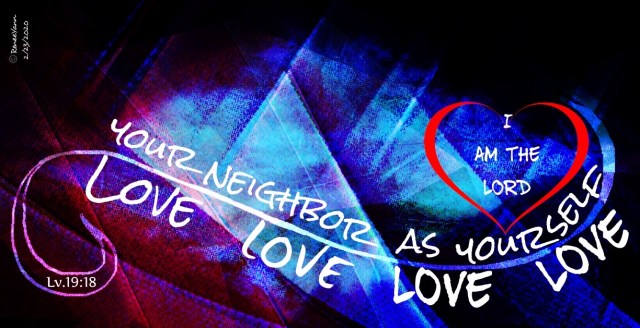
Lv19_18 neighbor

But “simple” does not mean easy. Jesus makes that clear in the Gospel. He tells us that we may thinks it’s enough to love our neighbor by:

  • an “eye for an eye” justice
  • accepting that one slap on the cheek
  • giving over some of our possessions
  • serving them for the time they ask

But Jesus says, “No. Not enough!” We must go all in for love:

  • take no “eye”, no legal repayment 
  • turn the other cheek
  • give both shirt AND jacket off your back
  • work twice as long and hard as demanded

kidding


Guess what? He’s not kidding. He goes on to double down on his words:

  • Don’t just love your neighbor as yourself, as Leviticus requires. Love your enemy that way too.
  • Do it because your Creator loves you, and all of us, that way — with Lavish Mercy.
  • Be that Mercy in the world.

Paul gives us an added incentive for living this challenge. He acknowledges that to live in Christian love and mercy seems foolish in the eyes of the world … BUT:

Let no one deceive himself.
If any one among you considers himself wise in this age,
let him become a fool, so as to become wise.
For the wisdom of this world is foolishness in the eyes of God,
for it is written:
God catches the wise in their own ruses,
and again:

The Lord knows the thoughts of the wise,
that they are vain.


As I said at the outset, it’s simple, but it’s not easy. So much in our culture promotes the opposite approach to life – me first, exclude others, win at all costs, money matters over everything, use people and things then discard them, and on and on…..

Using our beautiful Responsorial Psalm, let us pray for the insight to see through to God’s Truth and Love, and for the courage to live them. 

Music: The Lord Is Kind and Merciful – Jean Cotter 

Refrain
The Lord is kind and merciful;
The Lord is kind and merciful.
Slow to anger, rich in kindness,
The Lord is kind and merciful.

Bless the Lord, O my soul;
All my being bless God’s name.
Bless the Lord, O my soul;
Forget not all God’s blessings.

The Lord is gracious and merciful,
Slow to anger, full of kindness.
God is good to all creation,
Full of compassion.

The goodness of God is from age to age,
Blessing those who choose to love.
And justice toward God’s children;
On all who keep the covenant.