The Raising of Lazarus – fresco by Giotto diBondone
The Raising of Lazarus
by Franz Wright from a fragment by Rainer Maria Rilke
Evidently, this was needed
because people need to be screamed at with proof.
But Jesus knew his friends. Before they were, he knew them; and they knew that he would never leave them desolate here. So he let his exhausted eyes close at first glimpse of the village. And immediately he seemed to be standing in their midst.
Here was Martha, the dead boy’s sister. He knew he would always find her at his right hand, and beside her Mary. They were all here. Yet opening his eyes it was not so. He was standing apart, even the two women slowly backing away, as if from concern for their good name.
Then he began to hear voices muttering under their breath quite distinctly; or thinking, Lord, if you had been hereour friend might not have died.
(At that, he seemed to reach out to touch someone’s face with infinite gentleness, and silently wept.) He asked them the way to the grave. And he followed behind them, preparing to do what is not done to that green silent place where life and death are one.
Merely to walk down this road had started to feel like a test, or a poorly prepared-for performance with actors unsure of their lines, or which play they were supposed to be in; a feverish outrage rising inside him at the glib ease with which words like “living” and “being dead” rolled off their tongues. And awe flooded his body when he hoarsely cried, “Move the stone!”
“By now he must stink,” somebody helpfully shouted. (And it was true, the body had been lying in the tomb four days.) But he was far away, too far away inside himself to hear it, beginning to fill with that gesture which rose through him: no hand this heavy had ever been raised, no human hand had ever reached this height shining an instant in air, then all at once clenching into itself at the thought all the dead might return from that tomb where the enormous cocoon of the corpse was beginning to stir.
In the end, though, nobody stood there at its entrance but the young man who had freed his right arm and was pulling at his face, at small strips of grave wrappings. Peter looked across at Jesus with an expression that seemed to say You did it, or What have you done? And all saw how their vague and inaccurate life made room for him once more.
Today, in Mercy, our first reading from the Ezekiel seems so pertinent to our times:
Thus says the Lord GOD: O my people, I will open your graves and have you rise from them, and bring you back to the land you love…
Indeed, our times do carry a funereal feeing — a sense of loss, confinement, and death. The way one does with sudden death, we ask ourselves what happened! We long to see the light of God’s promise breaking over the stormy horizon.
photo by Yousef Espanioly
Our readings this Fifth Sunday of Lent are about just such transformation. They are about passing through the valley of bereavement to new life.
In this unprecedented time, each one of us and all of us are being called forth from old graves to a new understanding of life… called from a universal blindness to a new light. Our Gospel story of the raising of Lazarus invites us to think about our own tombs, our own darknesses from which the Lord summons us to “Come forth!”
Our rising is not easy, because this deadly blindness is deceptive. It is like someone walking through the Louvre, staring into a mirror. It is the blindness of self-absorption despite a surrounding sea of miracles.
When we exist within such blindness, we are as good as dead. We are Lazarus lost in a tomb. We become buried in all the manifestations of such egotism: greed, denial worry, obsession, anxiety, self-righteousness, regret and their myriad companions.
These are illusions we nurture that the world exists only as we choose to see it; that we are the universal center; that all depends on our preferences; that should we fail, the world ends.
When we operate under these illusions, all life’s energy turns inward where it fizzles in a cyclonic vacuum. The world of “me” is a tomb sealed off from the world of “us”. Ultimately, it is we who bind ourselves in its sepulchral wrappings.
But Jesus calls, “Come out!” He tells us to leave the mirror in the tomb as we walk into the true light. We are called to new life together in Him. We are released now to see the world through God’s eyes.
Having known a deadly darkness, how precious the light of new life was to Lazarus! How profound his appreciation, given a renewed vision!
What would it be like for us to live our lives with this second sight? How might we love people differently, as Lazarus must have newly treasured his sisters? How might the fabricated walls between us disappear within the grace of a second understanding? How might we see creation anew, apprehend time in eternal dimensions, embrace ourselves and others as Divine children?
Caught in our mirrors, we disregard the sacred dust around us, failing to recognize it as the stuff of stars. May we turn toward the brilliant call of Jesus. “Look”, he says. “Look at what I have given you!” May we seek the Lazarus moment in every experience – even the stunning shock of pandemic. May the grace of Jesus’s summons unbind us with resurrected joy!
Music: Lazarus, Come Forth – The Bishops (Lyrics below)
Please see second post today for a poem I like about this story.
Heartbroken, tears falling
Martha found Jesus
She questioned why Lazarus had died.
When she had thus spoken, her doubts were then silenced.
He walked toward the body and cried.
Lazarus, come forth.
Awake like the morning.
Arise with new hope, a new life is born.
Lazarus, come forth.
From death now awaken.
For Jesus has spoken.
Death’s chains have been broken.
Lazarus, come forth.
The tomb now was empty.
Martha stopped crying.
Her brother now stood by her side.
The Pharisee’s wondered about what had happened.
How could one now live who had died?
The reason this story gives hope to so many
Is although we know we must die.
Our bodies won’t stay there
In cold and dark silence.
We’ll hear Jesus cry from on high.
Children come forth
Awake like the morning.
Arise with new hope, a new life is born.
Children come forth.
From death now awaken.
For Jesus has spoken.
Death’s chains have been broken.
Children come forth.
For Jesus has spoken.
Death’s chains have been broken.
My Children come forth.
Children come forth.
Children, come forth.
Today, in Mercy, danger continues to escalate for Jesus.
Our first reading from Jeremiah foreshadows Jesus’s situation. Some powerful people didn’t want to hear what Jeremiah preached. And we can understand why: Jeremiah prophesied the destruction of Jerusalem because of Israel’s unfaithfulness. It’s a message that was hard to swallow.
The core of Jeremiah’s teaching was this: You people have to change. This is not the way God created the world to be.
But the people couldn’t listen. They had let the skewed reality of their lives become normal and needed. They couldn’t accept the world of mutual love and justice that God imagined for them.
Jesus meets the same kind of stonewalling.
In today’s passage, the hard-hearted rationalize their resistance:
“The Christ will not come from Galilee, will he? Does not Scripture say that the Christ will be of David’s family and come from Bethlehem, the village where David lived?”
But their antagonism isn’t really about geography and lineage. It’s about blind comfort in a world balanced toward their advantage. It’s about the fear of grace-inspired change.
Isn’t it the truth that we’ll use almost any argument to resist what demands our conversion? I understand why these guys “each went to his own house”, as the Gospel says in closing. They took refuge from grace in the little pretense of their own control.
They didn’t have the courage to open their hearts to Jesus. Do we?
Music:Spirit, Open My Heart –Alfred V. Fedak
(P.S. For those who grew up with classic rock and roll, check out the second song below.)
Second Song:
While I was drawing today’s picture, I was listening to my 50s playlist. Please don’t think me irreverent, but I was struck how this song (written by Hank Williams and sung by Jerry Lee Lewis) could really be God singing to cold-hearted humanity. I also thought some of you might need a little rock and roll as much as I do right now 🙂 Lyrics below.
Cold Cold Heart
I tried so hard my dear to show that you’re my every dream.
Yet you’re afraid each thing I do is just some evil scheme
A memory from your lonesome past keeps us so far apart
Why can’t I free your doubtful mind and melt your cold cold heart
Another love before my time made your heart sad and blue
And so my heart is paying now for things I didn’t do
In anger unkind words are said that make the teardrops start
Why can’t I free your doubtful mind, and melt your cold cold heart
You’ll never know how much it hurts to see you sit and cry
You know you need and want my love yet you’re afraid to try
Why do you run and hide from life, to try it just ain’t smart
Why can’t I free your doubtful mind and melt your cold cold heart
There was a time when I believed that you belonged to me
But now I know your heart is shackled to a memory
The more I learn to care for you, the more we drift apart
Why can’t I free your doubtful mind and melt your cold cold heart
Today, in Mercy, our reading from the Book of Wisdom clearly describes the machinations and motivations of an evil heart. We see fear, jealousy, control, and greed all strangling the described plotters.
Wisdom also shows us the characteristics of the good heart: justice, holy knowledge, purity, gentleness, patience, strength and perseverance.
The struggle between these two dimensions has defined human interactions ever since Eden.
Our Gospel tells us that these forces met their ultimate contest in the Passion and Death of Jesus Christ. And the Victor has been revealed in the triumph of the Resurrection.
These beliefs are the foundation of our faith, bedrocks we can live by when life’s circumstances test our resolve and courage.
We face such a test right now. Some people ask if God is punishing us, or has God abandoned us. Some people wonder if there is really a God at all who could let this happen to his people.
Today’s readings might help us rebalance our faith and dig deeper into its mysteries – because faith is a relationship, not a handbook. No matter how hard we search, pat answers don’t exist … just the daily learning to which the Gospel invites us.
In the life of Jesus, the Father neither caused evil nor removed it. The Father simply remained one with Jesus – living, loving, suffering with him. God does that with us too.
So when we pray, do we pray for miracles? Sure we do! Some miracles would be really great right now. Even Jesus prayed for that kind of intervention in Gethsemane:
Father, if you will, take this cup from me.
But when that didn’t happen, Jesus stayed the faithful course, trusting that he was already safe in his Father, no matter what swirled around him.
We may want to pray our poignant Responsorial Psalm today, asking God to help us faithfully abide in its promise. Here is a beautiful translation by Steven Mitchell from his book, A Book of Psalms:Reflections Adapted from the Hebrew (Available on Amazon – C)lick here for Amazon
I will bless the Lord at all times; my lips will sing out his praise. I will thank him for the love he has shown me and the clarity that gladdens my heart.
Sing out with me and thank him; be grateful for all his gifts. Turn to him; let your soul feel his presence; oh taste and see that the Lord is good; happy are those who trust him.
You who desire true life and wish to walk on God’s path: Depart from evil; do good; seek peace with all your soul.
The Lord cares for the righteous and watches over the merciful.
He is near when their hearts are broken; when their spirits are crushed, he is with them. And though they may undergo hardships, he fills them with blessings in the end.
Music:The Poor Man Cries – Marty Goetz (Lyrics below)
Lyrics
The Lord On High is very near
To all who call on Him
This poor man cries and He hears
And delivers him from all his fears
For the Lord is nigh to them that fear Him
The contrite will have light never dim
The righteous cry and He hears
And delivers them from all their fears
From all their fears
“Gad-lu l’Adonai ee’ti,
Oon’ ram’ma sh’mo yach-dau”
I will bless Him all my days
His praise shall continually be in my mouth
To the King I sing with pride
And the humble hear
And the sad, are glad in Him
His angels fly ’round those near
If you ever listen close you might hear
You just might hear
“Gad-lu l’Adonai ee’ti,
Oon’ ram’ma sh’mo yach-dau”
I will bless Him all my days
His praise shall continually be in my mouth
He brings good things so I know
He’s always here
Never denied I’m supplied by Him
For He has his eyes on those He holds dear
And He delivers them from all their fears
From all their fears
This Poor Man Cries, and He hears
And delivers him from all his fears, from all his fears
(I hope you will enjoy my reminiscence on this Feast of the Annunciation. I published it previously, but I loved praying with it again this morning. This strange Corona Virus time gives us all a chance to look back over the “salvation history” of our lives. Where were your “calls”, your turning points, your wake-up moments? What do you give thanks for in this moment, as we stand still and look our lives right in the eyes?)
March 25th, fifty-seven years ago, was a pleasantly warm day in Philly, with a strong hint of spring in the air. I remember the day as clearly as if it dawned just this morning.
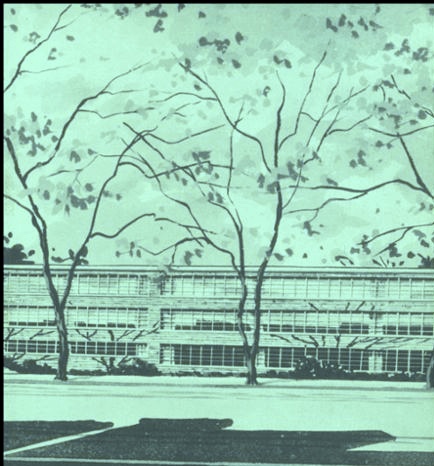
St. Hubert’s HS Windows
I sat in 2nd period senior year math class, glancing at the greening cherry tree at the window, and yearning for graduation. Sister Helen Mary, IHM ( I still remember her even though she thought I was pretty forgettable in math) decided to set the formulas aside and talk about Mary and the Feast of the Annunciation.
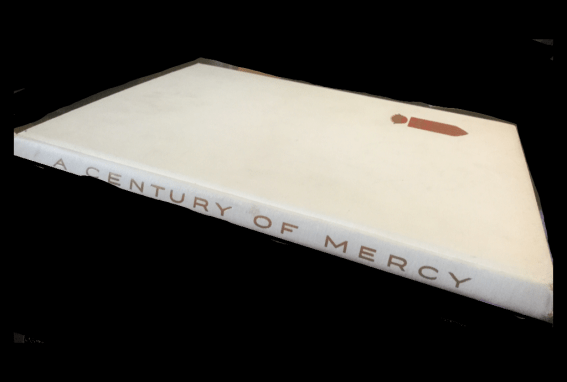
For several years, I had been toying with the thought of a religious vocation – but I hadn’t really given my heart to it. But, just three days before, while meeting up with one of my friends in her home room, I had noticed the Centenary Book of the Sisters of Mercy on Sister Mary Giovanni’s desk. I liked the pictures in it so I asked if I could borrow the book for a night or two.
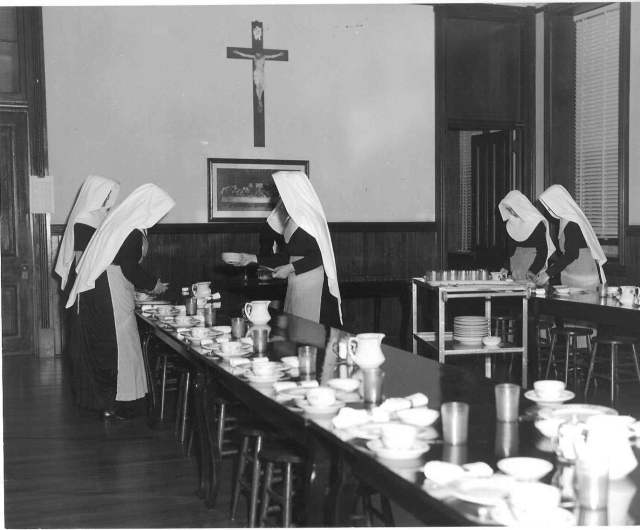
It had never crossed my mind to consider becoming a Sister of Mercy. I hadn’t really known any until high school. But as soon as I met them I liked them. They were friendly, joyful people with a beautiful mix of humanity and spirituality.
Blissfully reading that book on the evening of March 24th, I opened to the magnificent center page. It is hard to decipher it in the picture, but the motto written above the painting of the Crucifixion deeply touched me, “Love One Another”.
Another page offered a phrase that grabbed my heart and, to this day, has never let it go:
The Sisters of Mercy take a fourth vow of service of the poor, sick and ignorant.
I suppose that, during trig class the next morning, I was already primed for Sister Helen Mary’s talk. She said that Mary responded fully and joyfully when God called her. In a flash as quick as an angel-wing, I decided to do the same.
I left class, found Sister Giovanni and, before 3rd period, I had committed to become a Sister of Mercy.
Now I look back over those fifty-seven glorious years, and my heart sings in thanksgiving for my vocation, my beloved Sisters and the precious people I have served. I turn the ring, given at my profession, and read the cherished motto, “Love One Another “. Our God is a faithful God. Just as He did for MAry, God took a young girl’s gossamer promise and wove it into a divine love story.
I love this powerful poem Annunciation by Denise Levertov. May it enrich us on this sacred feast. Great song after.
Annunciation
by Denise Levertov
‘Hail, space for the uncontained God’
From the Agathistos Hymn, Greece, Sixth Century
We know the scene: the room, variously furnished,
almost always a lectern, a book; always
the tall lily.
Arrived on solemn grandeur of great wings,
the angelic ambassador, standing or hovering,
whom she acknowledges, a guest.
But we are told of meek obedience. No one mentions
courage.
The engendering Spirit
did not enter her without consent.
God waited.
She was free
to accept or to refuse, choice
integral to humanness.
____________________________
Aren’t there annunciations
of one sort or another
in most lives?
Some unwillingly
undertake great destinies,
enact them in sullen pride,
uncomprehending.
More often
those moments
when roads of light and storm
open from darkness in a man or woman,
are turned away from
in dread, in a wave of weakness, in despair
and with relief.
Ordinary lives continue.
God does not smite them.
But the gates close, the pathway vanishes.
______________________________
She had been a child who played, ate, slept
like any other child – but unlike others,
wept only for pity, laughed
in joy not triumph.
Compassion and intelligence
fused in her, indivisible.
Called to a destiny more momentous
than any in all of Time,
she did not quail,
only asked
a simple, ‘How can this be?’
and gravely, courteously,
took to heart the angel’s reply,
perceiving instantly
the astounding ministry she was offered:
to bear in her womb
Infinite weight and lightness; to carry
in hidden, finite inwardness,
nine months of Eternity; to contain
in slender vase of being,
the sum of power –
in narrow flesh,
the sum of light.
Then bring to birth,
push out into air, a Man-child
needing, like any other,
milk and love –
but who was God. From: The Stream & the Sapphire: Selected Poems on Religious Theme
Music: To God Be the Glory – Sandi Patty (Lyrics below)
How can I say thanks
For the things You have done for me?
Things so undeserved,
Yet You gave to prove Your love for me;
The voices of a million angels
Could not express my gratitude.
All that I am and ever hope to be,
I owe it all to Thee.
To God be the glory,
To God be the glory,
To God be the glory
For the things He has done.
With His blood He has saved me,
With His power He has raised me;
To God be the glory
For the things He has done.
Just let me live my life,
Let it pleasing, Lord to Thee,
And if I gain any praise,
Let it go to Calvary.
Today, in Mercy, I’m going to tell you a story. But first …
In our first reading, the passionate prophet Hosea offers us this quintessential Lenten advice:
Return, O Israel, to the LORD, your God; you have collapsed through your guilt. Take with you words, and return to the LORD
In our Gospel, Jesus is giving advice too. A sincere scribe seeks out Jesus’ wisdom:
One of the scribes came to Jesus and asked him, “Which is the greatest of all the commandments?”
Jesus instructs the scribe:
The Lord our God is Lord alone!
You shall love the Lord your God with all your heart,
with all your soul,
with all your mind,
and with all your strength.
Then Jesus goes on to tell him the second greatest commandment:
You shall love your neighbor as yourself.
Assessing the scribe’s sincerity, Jesus promises him:
“You are not far from the Kingdom of God.”
Praying with these passages on this particular date took me back to March 20, 1963, Wednesday of the 3rd week of Lent that year. I was almost 18 years old and, while not wise as a scribe, I too sought answers to guide my faith.
One place I found thatwisdom was at the desk of a wonderful Sister of Mercy, Sister Mary Giovanni. Like many high school girls back then, I hung around Sister’s homeroom after school. Her good humor, gentle interest, and kind encouragement nourished all of us still slightly silly but ever-so-earnest young women.
On that particular afternoon, an unusual white book sat on Sister’s desk. Its gold letters attracted me and I asked what it was. Sister said it was her community’s centenary book and that, if I wanted, I could borrow it to read.
That little book changed my life. Well, I guess what it actually did was to capture many loose threads running through my mind and heart, and to tie them into a conviction.
I had been toying with a religious vocation ever since third grade. I did love God with my whole heart, just like the young scribe in today’s Gospel. And I loved the nuns and I always wanted to be like them. But actually becoming like them was another story.
That little white book gave me the courage and will to make that commitment. Here’s what it said:
The Sisters of Mercy, in addition to the vows of poverty, chastity and obedience, take a fourth vow of service of the poor, sick, and ignorant.
That was it! That short sentence opened my understanding to see that loving God had to be demonstrated in love of neighbor. The two great commandments are always interdependent.
So I decided to “take my words”, as Hosea encourages, and to ask God if He would have me as a Sister of Mercy.
Less than a week after reading that book, I signed up to become a Sister of Mercy. And I have continued to become one every day for almost 60 years. Because just as Jesus said to the scribe, I believe I am “not far from the Kingdom of Heaven”. But I’m not there yet. Everyday is a chance to grow deeper into the glorious gift that was opened to me back in March 1963.
As you pray with these passages today, take a long view of God’s continuing call in your life. You may have been called to marriage and parenthood, priesthood, a generous single life, a profession which allowed you to serve others.
In each individual call, we are invited to love God with all our hearts and to love others as God loves them. Let’s pray for one another’s continuing deepening in our particular call.
Music: The Call – written by Vaughn Williams from the poetry of George Herbert
(Lyrics below)
Today, in Mercy, Azariah of Fiery Furnace fame meets Patrick of Ireland!☘️☘️ 🔥 🔥 – —two great champions of faith ready to bolster ours in these uncertain times.
In today’s reading from the Book of Daniel, Azariah (later Abednego) prays a moving prayer of urgency, repentance, supplication, and trust:
And now we follow you with our whole heart, we hold you in awe and we pray to you. Do not let us be put to shame, but deal with us in your kindness and great mercy. Deliver us by your wonders, and bring glory to your name, O Lord.
This prayer rang very true for me today, as I prayed for God’s mercy and miracles all over our suffering earth.
The prayer also brought to mind St. Patrick’s own prayer:
I arise today
Through the strength of heaven;
Light of the sun,
Splendor of fire,
Speed of lightning,
Swiftness of the wind,
Depth of the sea,
Stability of the earth,
Firmness of the rock.
I arise today
Through God’s strength to pilot me;
God’s might to uphold me,
God’s wisdom to guide me,
God’s eye to look before me,
God’s ear to hear me,
God’s word to speak for me,
God’s hand to guard me,
God’s way to lie before me,
God’s shield to protect me,
God’s hosts to save me
Afar and anear,
Alone or in a mulitude.
Christ shield me today
Against wounding
Christ with me, Christ before me, Christ behind me,
Christ in me, Christ beneath me, Christ above me,
Christ on my right, Christ on my left,
Christ when I lie down, Christ when I sit down,
Christ in the heart of everyone who thinks of me,
Christ in the mouth of everyone who speaks of me,
Christ in the eye that sees me,
Christ in the ear that hears me.
I arise today
Through the mighty strength
Of the Lord of creation.
In solidarity with Irish people everywhere, who today celebrate their amazing faith, let’s pray to our dear Blessed Mother for one another and wish all people good health and joy.
And for St. Patrick’s sake, lift your spirit, lift a glass, lift your hearts for the love of God and one another! PS: Sláinte means “To your health“.
Music: Hymn to Our Lady of Knock – Frank Patterson – Oh, the Voice! (Lyrics below)
(This song always gives me the Irish chills … nothing like it. A lot of Italian songs do the same thing to me. LOL!)
There were people of all ages
Gathered ’round the gable wall
Poor and humble men and women,
Little children that you called
We are gathered here before you
And our hearts are just the same
Filled with joy at such a vision
As we praise your name
Golden Rose, Queen of Ireland
All my cares and troubles cease
As I kneel with love before you
Lady of Knock, our Queen of Peace
Though your message was unspoken
Still the truth in silence lies
As we gaze upon your vision,
And the truth I try to find
Here I stand with John the teacher,
And with Joseph at your side
And I see the Lamb of God
On the Altar glorified
Golden Rose, Queen of Ireland
All my cares and troubles cease
As we kneel with love before you
Lady of Knock, our Queen of Peace
And the Lamb will conquer
And the woman clothed in the sun
Will shine Her light on everyone
Yes,
The Lamb will conquer
And the woman clothed in the sun
Will shine Her light on everyone
Golden Rose, Queen of Ireland
All my cares and troubles cease
As I kneel with love before you
Lady of Knock, my Queen of Peace
Lady of Knock, my queen of peace
Today, in Mercy, our readings are about prophets and miracles, brought to us by Elisha and Jesus.
The core of the readings is this: some of us want the prophets’ miracles, but we don’t want their challenge to live in God’s freedom. We want their cures, only to return to lifestyles that make us spiritually sick or imprisoned.
Wanting to write about these themes, I decided to check with my favorite Old Testament scholar, Walter Brueggemann to see if he had any wisdom on the story of Naaman.
Naaman brings his retinue and gifts… from The Pictorial History of Palestine and the Holy Land (1844) by John Kitto
Well, Walter certainly did…. something so good and wise that I won’t water it down with my own words. The link is below. It’s a little long, but so worth your reading and meditation. I hope you’ll take the time.
Today, in Mercy, water flows through all our readings, inviting us to God’s refreshing Mercy.
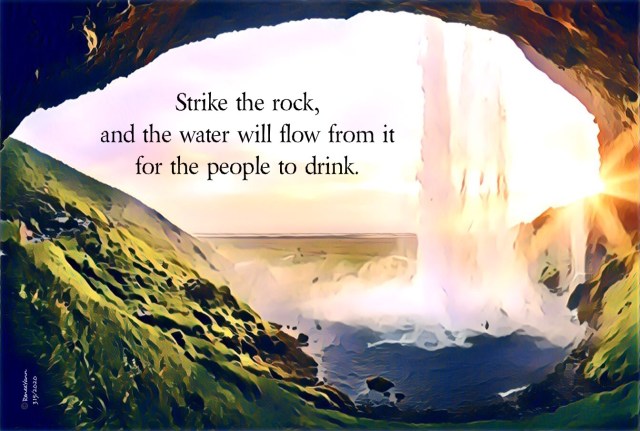
For the thirsty and testy Israelites, the water flows from the rock of their hopelessness. Wandering in the desert for days on end, they are exhausted and bewildered. Each sunrise seems to push their destination farther away rather than bring it closer. They are thirsty … but for a lot more than a cool drink.
And God gives everything they need – not only water, but surprised hope and renewed confidence as they witness the mighty rock split at Moses’ touch.
Paul points out that it is, indeed, that hope which truly slakes the deeper thirst.
And hope does not disappoint, because the love of God has been poured out into our hearts through the Holy Spirit who has been given to us.
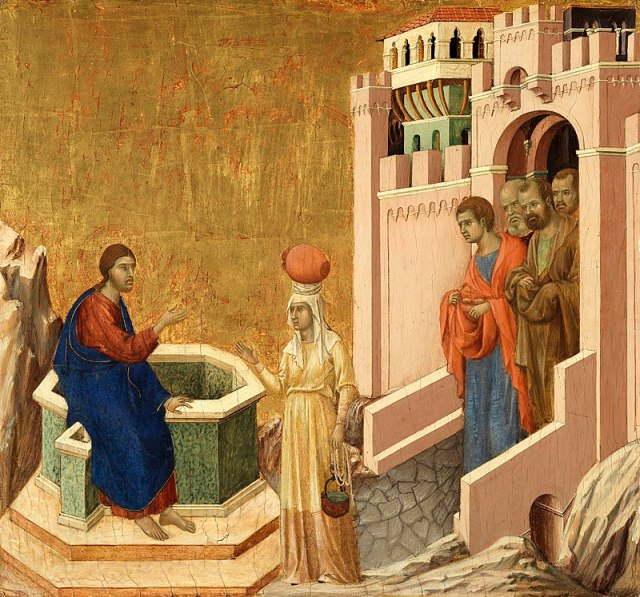
In our Gospel story, Jesus awakens in the Samaritan woman a thirst and hope she didn’t know she had. The layers of her tangled life had formed an impervious rock around her, insulating her from her own soul’s needs.
Christ and the Samaritan Woman by Duccio di Buoninsegna
Jesus, “tired from the journey”, expressed his own need to her. This simple request unleashes a cascade of searching from the woman. Jesus, seeing her readiness for grace, catches all that pours out from her. He transforms it into a challenge for conversion:
Jesus answered and said to her, “If you knew the gift of God and who is saying to you, ‘Give me a drink, ‘ you would have asked him and he would have given you living water.”
And she accepts the challenge:
Sir, give me this water,
so that I may not be thirsty again.
As we pray today, we may sense a desert within us. Or we may feel that our soul’s journey has become frustratingly circuitous. We may be like the Samaritan woman, sitting beside a well that seems slowly drying out. Maybe the juices have dwindled in our souls.
In these readings, as we listen to the Ancients call out for flowing grace, we may find a way to ask God for the refreshment we need just now.
Today, in Mercy, our readings offer us studies in dramatic contrasts.
the barren bush in a lava waste vs. the tree planted beside the waters that turns its roots to the stream
a rich man who dressed in purple garments and fine linen vs. a poor man named Lazarus, covered with sores
Lazarus and the Rich Man by Gustave Dore (1891)
What are Jeremiah and Jesus teaching us with these unforgettable images?
Jeremiah summarizes his point in the very first verse:
Cursed is the one who trusts in human beings, who seeks strength in flesh, whose heart turns away from the LORD.
In his parable, Jesus has Abraham deliver the point:
You received what was good during your lifetime while Lazarus likewise received what was bad; but now he is comforted here, whereas you are tormented.
Praying with these passages, we might determine to make sure we don’t end up like the barren bush or the ultimately tormented rich person.
But how can we do that?
I think the key lies in Jeremiah’s phrase, “one whose heart turns away from the LORD.”
In his parable, Jesus shows us what that “turning” looks like. It is any blind indifference in us that allows us to ignore another’s suffering.
Most of us don’t consciously choose that indifference. We simply fail to turn from our own comfort … plans, needs, agenda … to observe the pain or need around us.
So as we leave our prayer today, perhaps we can do so determined to turn from our self-interests … to see if there is a “Lazarus” right beside us whom we had failed to notice.
Music: Turn My Heart – Lynn DeShazo (Lyrics below)
Turn my heart O Lord
Like rivers of water
Turn my heart O Lord
By Your hand
‘Til my whole life flows
In the river of Your Spirit
And my name
Bring honor to the Lamb
Lord I surrender to
Your work in me
I rest my life within
Your loving hands
(Repeat chorus 3 times)
‘Til my name brings honor
‘Til my name brings honor
To the Lamb









 Lavish Mercy