Wisdom and Love

Sunday, October 14, 2018

       Readings:  Click here.

Today in Mercy, our readings are both beautiful and poignant.  

In our first passage, we drink from Wisdom’s sweet nectar. This book, written about fifty years before Christ’s birth, is the work of an unnamed Jewish poet and scholar. At points, as in today’s segment, the writer assumes the persona of Solomon, speaking in his name.

Ps90_fill us

We know from the Book of Kings, chapter 3, that Solomon, as a young king, led a faithful and righteous life. Because of this, God offered Solomon “whatever you want me to give you.”

Think of the possibilities for this young man, just on the cusp of kingship! Power, wealth, longevity, peace, prosperity, political dominance – all the things we are inclined to covet in this world.

But Solomon prays instead for wisdom, as described in today’s reading:

Beyond health and comeliness I loved her,
and I chose to have her rather than the light,
because the splendor of her never yields to sleep.

Our Gospel tells of a young man offered an opportunity similar to Solomon’s. Already living a faithful life, he wants to go deeper into God’s heart. 

Jesus, looking at him, loved him and said to him,

“You are lacking in one thing.
Go, sell what you have, and give to the poor
and you will have treasure in heaven;
then come, follow me.” 

But this young man, unlike Solomon, cannot accept the invitation to this deep place of love and devotion. Instead, he goes away sad. It makes me sad, too, whenever I read these verses. I always hope that, after a few steps, he turned around and shouted, “Yes! I will do what you ask. I love God that much. Help me!”

Like these young men,we have a deep desire to live within God’s love. But are we walking toward that love or away from it? Most of us don’t say an outright “No” to God’s invitation. Instead, we are distracted, lazy, or just not paying attention to the the whispers of grace.

Let’s pray today’s powerful Psalm 90 to open our minds and hearts to God’s hope for us.

Music: Fill Us With Your Love ~Ephrem Feeley 
Ask, Knock, Seek

Thursday, October 11, 2018

Readings: http://www.usccb.org/bible/readings/101118.cfm

Today, in Mercy, our Gospel gives us three comforting invitations and assurances:

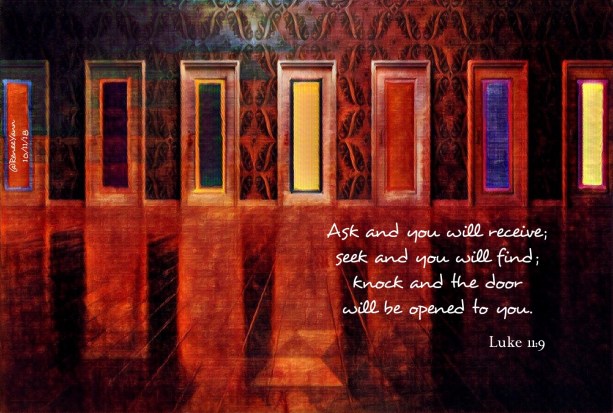
Ask, knock, seek.
If you do, you shall
receive, be welcomed, find.

That’s nice, isn’t it? But does it really work? I’ve asked for a lot of things I haven’t received. I’ve knocked and sought answers that never came to me. What about you?

Lk11_9 Ask

Perhaps we’ve been reading the passage with a closed heart.  This Gospel may be more remarkable for what it does NOT say than for what it says.

It says ask, not ask FOR something.
It says knock, not BURST IN.
It says seek, not seek AFTER something.

The reading is not about getting our particular requests presented before, heard and answered by God. It is not about how to visit a “Santa Claus” God with our wish list and get everything we asked for.

  • It is, instead, about recognizing our emptiness, and asking God to fill it – in whatever way God wishes.
  • It is about recognizing that the Spirit lives in a deeper place in our lives – a place that is opened to us only by prayer and trust.
  • It is about seeking God and God’s desire for us, far beyond any tangible gift.

When we’ve done this kind of asking, knocking and seeking, we have no “answered prayers” to show for it. Instead, we are changed in the way rivers are changed by the rush of melting mountain snows. We are fed, the way trees are fed by the rain disappearing at their roots. We are at peace, the way the deep ocean lies in peace despite any surface storm.

Music: A delightful song from the 60s that will charm you and stick in your head all day. 🤗

And the Love Come Trickling Down ~ The Womenfolk

We Belong to One Another

Monday, October 8, 2018

Readings: http://www.usccb.org/bible/readings/100818.cfm

Today, in Mercy, our Gospel gives us the parable of the Good Samaritan. It is a story in which we can all find ourselves, maybe changing roles in the changing circumstances of our lives.

IMG_6600

Have we ever been the robbers, the bullies, the outlaws who in some way used force or subterfuge to gain their own advantage? We don’t have to be a criminal to do this. We can do it by our prejudices, our preferential treatment, our secrets and our cliques. We can do it by our uninformed or willful choices which deprive others of their needs and rights.

Have we ever been the Levite, the one who claims a special religious place by family heritage? Have we ever, like the Levite in the parable, bypassed someone because of her religion or ethnic origins – because she isn’t “like us”?

Have we ever been this pathetic priest who so completely misunderstands the role of minister – who ignores God’s suffering creature for fear of some imagined contamination?

Have we ever been the victim, the one set upon by the meanness of others, the one unable to heal himself from injury? Has the memory made us more like the Samaritan or like the robbers once we were healed?

And finally, have we ever been the Samaritan? Do we even want to be? Or do we think him foolish to have given his own time and treasure for a stranger?

This parable is a study in differences and how we respond to them. Some use differences to separate rather than enrich their world. They fail to understand that we all belong to each other and will live forever as one family in heaven. If we don’t learn to do it in this life, we won’t be part of it in the life to come.

Realizing this may change how we might have responded on that ancient road – or the road right now where we’re all just walking each other home.

Music: Take All the Lost Home ~ Joe Wise

Regrets?

Friday, October 5, 2018

 Readings: http://www.usccb.org/bible/readings/100518.cfm

Today, in Mercy,  Jesus castigates  the people of Chorazin, Bethsaida, and even his beloved Capernaum for their lack of faith.

In these Galilean villages, nearby to his own hometown, Jesus has performed many of his miracles and cures. These people have been the audience for his most memorable sermons. But now, Jesus begins to meet resistance and doubt as his disciples assume greater participation in his ministry. 

Lk10_13 Chorazin

Jesus is preparing for the time when he will no longer be here. He wants to see strong faith in his followers, but he is disappointed. He tells the crowds that they will regret their hard-heartedness, their slowness of conversion. They will be more harshly judged because they failed to respond to more abundant graces.

This passage is filled with spiritual lessons. We, too, have received so many blessings from God. How have we responded? 

It is a sad thing to look back on any part of our lives with regret – to say, “I wish I had…” or “I wish I hadn’t”. The only benefit of such sadness is to learn a lesson for our future.

Let’s pray today to live ever more intentional lives – giving ourselves time to recognize and respond to our blessings, to the needs of others, and to the deepening call of faith within our spirits.

May this prayer help us turn our spirits from any crippling self-interest and lukewarm faith to a dynamic, life-giving spirituality. As our responsorial psalm today encourages us: “If today you hear his voice, harden not your hearts.”

Music: I Can Hear Your Voice ~ Michael W. Smith

Jealous for My Sake?

Sunday, September 30, 2018

                       Readings:  Click here.

Today, in Mercy, our reading from the Book of Numbers reveals a very human moment between Joshua and Moses.

Moses is getting older. He realizes that the time is approaching for him to hand over the leadership of his people. God seems to realize that too.

The LORD came down in the cloud and spoke to Moses.
Taking some of the spirit that was on Moses,
the LORD bestowed it on the seventy elders;
and as the spirit came to rest on them, they prophesied.

Joshua, ever since his youth, has been aide to Moses. Moses is his hero – the one, who having spoken with God, led the People out of Egypt. Now Joshua sees other ordinary guys assuming some of Moses’s roles. Joshua feels his own security and comfort shifting beneath him, hints of a spiritual earthquake.

Number 11_29 Jealous for my sake

An outraged Joshua alerts Moses, begging him to stop these supposed imposters. But Moses assures Joshua with words no hero-worshipper ever wants to hear:

Are you jealous for my sake?
Would that all the people of the LORD were prophets!
Would that the LORD might bestow his spirit on them all!

What a powerful question Moses poses. It searches Joshua’s heart:


Are you jealous for my sake? 

Are you fearful, biased, closed-hearted,
and self-protective because you fear
that you and I will lose position and power?


Surely Moses senses Joshua emerging as the next leader of Israel — even though Joshua might not share that awareness yet. Moses wants him to see that it is the Spirit of God Who leads the People through any human means She wishes.

When we presume to control the Spirit, or think to invest Her power only in our own particular “heroes”, we close ourselves to the amazing, surprising power of God. This Divine Power cannot be controlled and, like wildflowers through concrete, will bloom where She chooses.

We see the fruits of such presumption all over our histories: the falsely assumed superiority of men over women, whiteness over color, wealth over labor, age over youth, or any form of dominance over mutuality. These assumptions become concretized in our culture, hardening us to the movements of the Spirit.

If we have any hold on privilege in our lives, we might be inclined to profit by these assumptions. It is just such an inclination that Moses nips in Joshua in this powerful exchange between revered teacher and apprentice.

Music: An oldie, but goodie. Always brings me a deep peace.  I hope it does the same for you, dear reader.

Come Holy Ghost – The Singing Nuns

What Is, Is.

Thursday, September 27, 2018

          Readings: http://www.usccb.org/bible/readings/092718.cfm

Today, in Mercy, we meet the first of a few readings from Ecclesiastes, written by an author who calls himself Qoheleth – Teacher. The book contains many loved and oft-repeated phrases that we might recognize:

  • There is a time for everything, and a season for every activity under heaven
  • He has made everything beautiful in its time.

And today’s kick-off thought:

  • Vanity of vanities ….  All is vanity.

Reading Ecclesiastes places us in the presence of a writer who is a realist at best, and a cynic at worst. Parts of the book can be downright depressing; other parts, elegant in their spare beauty.

We can finish a passage like today’s and hear echoes around us of Star Trek’s Borg mantra: 

Resistance is futile. 

Qoheleth says as much:

What has been will be again,
what has been done will be done again;
there is nothing new under the sun.

The phrase carries at least a little tinge of hopelessness. But I think a lot depends on the way we read it.

Realizing that “things are the way they are” can give us a sense of stability and trust. It can release us from struggling needlessly against realities that will not be moved. It can encourage us to find within these “immovables” the hidden path to a new grace. It can remind us that others have endured; so can we.

What is is

One of our Wisdom Sisters taught us that by naming and accepting our reality, we can move from fighting it into growing from it. She always said, “What is, is” – implying “now deal with it”.

It sounds spartan, but it actually can be very freeing. We can’t change so many things – the weather, the tides, the hearts of others. The years will pass, friendships blossom and fade. We will get old, if we are blessed with that gift. We’ll lose our jump shot and probably some of our hair – maybe a few others things too.🤗

But God will always love us, abide with us and cherish us for eternity.

Music: In Every Age – Janét Sullivan Whitaker

In God’s Hand

Tuesday, September 25, 2018

          Readings:  http://www.usccb.org/bible/readings/092518.cfm

Today, in Mercy, our readings instruct us on what it means to really belong to God – heart and soul.

Proverbs tosses out a series of minstrel-like two-liners that could easily be overlooked for their beauty and depth. For example, the first couplet says: 

Like a stream is the king’s heart
in the hand of the LORD;

wherever it pleases him, he directs it.

Would we all not desire that kind of heart, where our thoughts and choices are so directed by God’s power and grace – held and guided into freedom by God’s loving hand? How confident, peaceful and joyful our lives would be!

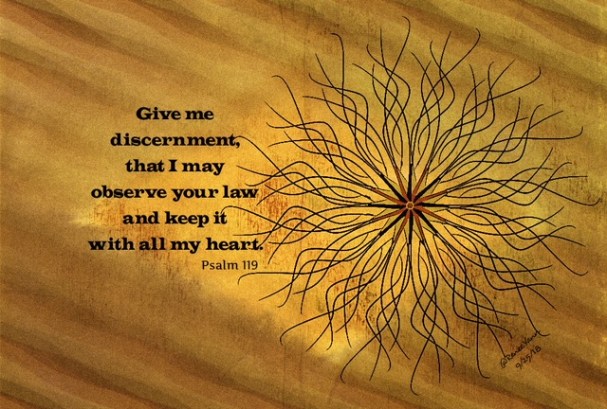
Psalm 199 discern

Today’s Psalm 119 is a passionate prayer to be guided through an entangling world by our deep loyalty to God’s own truth, learned by meditating day and night on God’s goodness.

Our Gospel, in an often misinterpreted incident, shows us how Jesus considers his true disciples as close to him as his own mother and family.

So today, to deepen our own closeness to God, let us practice making our ordinary life into a constant prayer – allowing it to flow, like water, through God’s tender, guiding hand. 

We can do this by gratefully noticing God’s Presence in nature, in our companions, in the opportunities for kindness, honesty and service  that come to us today. 

Or, sadly, our experiences today might cause us to notice God’s absence in these places. This offers us an incentive to invite, beg and pester God to transform the desert places in our lives and world.

Whichever approach we take, it will open up a constant conversation with God about our life as we experience it at each moment. We begin to listen better to the Word of God revealing itself in our daily life. We begin to live more consciously in God’s Presence… in God’s dear family.

God’s Law is already written deep in the fabric of our lives. We pray for discernment to discover that guiding grace by opening our hearts to God’s Presence in our every experience.

Music: I Belong to You ~ Hillsong

https://m.youtube.com/watch?v=WV6_nPD2sG4

Stick With It!

Saturday, September 22, 2018

       Readings: http://www.usccb.org/bible/readings/092218.cfm

Lk8_15 persevere

Today, in Mercy,  both Paul and Jesus teach their followers by using images they would be familiar with – seed, wheat, planting, and waiting for harvest.

Even those of us far removed from such images may have planted a few things at some time.  Picture a kindergartner pushing a seed into a paper cup filled with dirt.  She watches everyday for the green shoot, impatient for its appearance.

Paul’s community seems infected with the same kind of impatience regarding the end of time and their being raised to new life.

Paul makes me laugh with his own impatience at their constant questions. He responds to their nagging like this:

You fool!
What you sow is not brought to life unless it dies.
And what you sow is not the body that is to be
but a bare kernel of wheat, perhaps, or of some other kind.

Jesus is a lot gentler when he teaches about the Sower and the Seed. At the end of the parable, Jesus gives his followers the key to achieving the full harvest of grace. Perseverance! 

It is the same tool any farmer must employ in the fields. It is the same strategy we must use as we sow good works through our lives. The harvest is slow coming, but Jesus promises it is worth the investment and the waiting.

Music: When You Believe~ sung by Whitney Houston and Mariah Carey

Called like Matthew

Friday, September 21, 2018

Click here for readings

Today, in Mercy, on this feast of St. Matthew, Apostle and Evangelist, we are blessed with an inspiring reading from Ephesians. We are reminded that each of us is called in God according to our particular gifts. Paul encourages us to live “in a manner worthy of the call we have received” in our Baptism.

evangel Matthew

For most of us, it has been quite a while since we were washed in the waters of our Baptism. A lot of other waters have passed under the bridge since then. We may, or may not, have recognized and responded to our call, continually carried to us on those life waters.

Each moment, each choice, each act and decision asks us once again to choose Christ – over sin, over self, over meaninglessness. Each life opportunity calls us closer to Jesus, to the pattern of his Cross, to the witness of his Resurrection.

Matthew heard such a call as he sat, perhaps dulled by the unconscious disengagement of his life, by the failure to live with intention and openness to grace. As He passed by Matthew, Jesus reached into that ennui, calling Matthew to evangelize all the future generations by his Gospel.

Jesus calls us to be evangelists too – every moment, every day. Our “Yes” to our particular call writes its own Gospel, telling the Good News through our faith, hope and love.

Pope Francis says this:

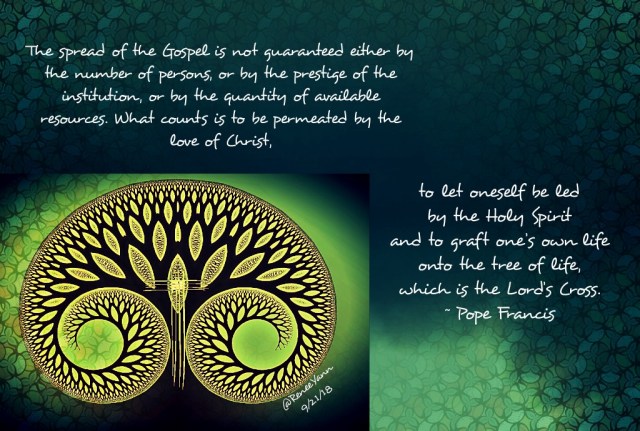
The spread of the Gospel is not guaranteed either by the number of persons, or by the prestige of the institution, or by the quantity of available resources. What counts is to be permeated by the love of Christ, to let oneself be led by the Holy Spirit and to graft one’s own life onto the tree of life, which is the Lord’s Cross.

Music: When You Call My Name ~ Brian Doerksen & Steve Mitchinson

The Harlot’s Hair

Thursday, September 20, 2018

      Click here for readings.

Can you see her? 

She is known throughout the town for the woman she is – no ordinary, unknown panderer of her body’s wares. She is a true “madam”, and a few of her customers already sit, silent and furtive, at the Pharisee’s table.

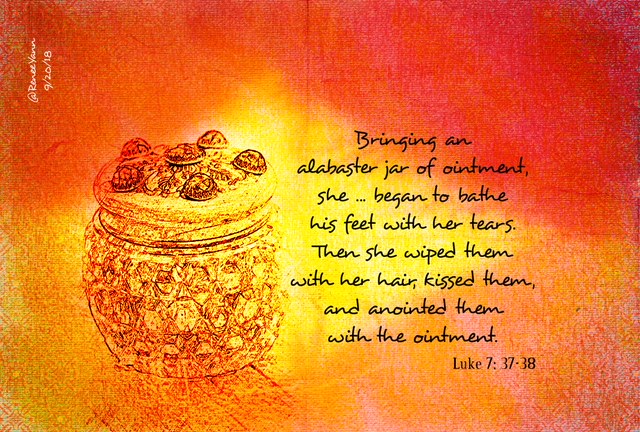
Lk7_37 jar

She wears an elegant robe, for her fees are steep. Gem-encrusted bracelets encircle her wrists and ankles. But it is her hair that crowns her beauty. Flowing like a sable river, it is wound in deep waves around her lovely face and shoulders. It is scented with a small bit of the precious ointment she now carries in her alabaster jar.

Among her many assets, it is her hair that sets her apart. Some women see it through green eyes; some men through black hearts. But she, even in the confusion of her choices, has always known it to be a gift. 

How to use the gift has been her life long challenge. Ultimately, would it prove to be her salvation or her damnation?  Is it not so with every special gift, with every leverage that makes us singular among our peers? 

These gifts may take the form of possessions, power, position, favor or myriad other shapes. They may reside in a clever wit, and incisive mind, and agile body, a profound spirit. They may rest in a dogged perseverance, an adhesive memory or a dynamic imagination. Whatever our unique power, it is the key to our self-definition. It speaks our particular presence in the world.

At some point in her soul’s journey, this gorgeous gospel woman decided that her superior beauty would serve Jesus. What might have caused that dramatic conversion in her life?

Some versions of the story say that seven devils were once cast from her by Jesus’s merciful hand. Whatever the moment might have been, we can see from today’s Gospel scene that it was profound, intimate, and complete.

Her luxuriant hair has become a sacrament of healing, offered on this night to a friend about to suffer death for the sake of Love. Because her own love is so great, she understands this suffering in Jesus long before his other followers.

This reading leaves us with so much to consider about our own gifts and how we use them; about the depth of our relationship with Jesus and how we show him our love; about what is in our alabaster jar and where we choose to pour its treasure.

Music: Pour My Love on You – Philips, Craig, and Dean