Today, in Mercy, our Sunday readings increase in dramatic tone.The passage from Isaiah describes a Savior bent on his mission despite mounting resistance and expressed hatred.
Psalm 116 describes a person set upon by suffering and death threats, still trusting in the Lord’s saving grace.
In the Epistle, James says we must demonstrate our faith by our works — by putting our money where our mouth is.
And in our Gospel, Jesus says we do this by following him, denying ourselves and taking up our cross.
This is heavy stuff. Jesus wants us to be like him — and it would be so much easier not to be!It would be so much easier to think that our life is all about ourselves, and that we have no responsibility for Beloved Creation.
It would be so much easier not to give our lives to Christ to allow Him to bless the world through our love.
But if we wish to “save” our lives like this, we will — in the end — lose them for eternity.
Let us pray today for the grace to take our life and lay it down over the Cross of Christ.
In that laying down, to conform ourselves to the pattern of his love, to place the weight of our burdens and hopes on the crossbeam of his strength
Let us ask for the strength to live
for God
for others
for good in the world
and never for self when it injures or lessens others or our Sacred Home.
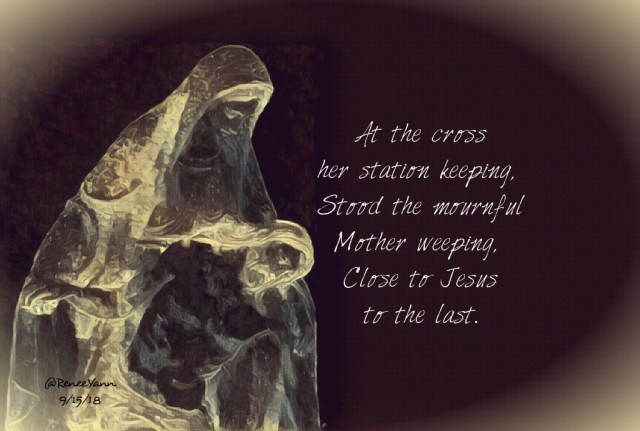
Today, in Mercy, we pray with Our Mother of Sorrows.
Mary’s greatest sorrows came, not from circumstances she bore personally, but from her anguish at the sufferings of Jesus. Like so many mothers, fathers, spouses, children and friends, Mary suffered because she loved.
It is so hard to watch someone we love endure pain. We feel helpless, lost and perhaps angry. We may be tempted to turn away from our beloved’s pain because it empties us as well as them.
This is the beauty and power of Mary’s love: it did not turn. Mary’s devotion accompanied Jesus – even through crucifixion and death – for the sake of our salvation.
Today’s liturgy offers us the powerful sequence “Stabat Mater”.
Stabat Mater Dolorosa is considered one of the seven greatest Latin hymns of all time. It is based upon the prophecy of Simeon that a sword was to pierce the heart of His mother, Mary (Lk 2:35). The hymn originated in the 13th century during the peak of Franciscan devotion to the crucified Jesus and has been attributed to Pope Innocent III (d. 1216), St. Bonaventure, or more commonly, Jacopone da Todi (1230-1306), who is considered by most to be the real author.
The hymn is often associated with the Stations of the Cross. In 1727 it was prescribed as a Sequence for the Mass of the Seven Sorrows of Mary (September 15) where it is still used today. (preces-latinae.org)
Music: Stabat Mater Dolorosa – Giovanni Battista Pergolesi (1710-1736) This is a glorious rendition. If you have time, you might listen to it on a rainy afternoon or evening as you pray.
Today, in Mercy, in our first reading, Paul assures the Corinthians that his primary mission is preaching the cross of Jesus. This awesome calling required great grace because the message of the cross sounds like foolishness to the faithless heart.
Indeed, the cross is incomprehensible in human terms. How can agony and death bring us all eternal life? Why does the truth of the cross need to be rooted in my life if I am to be fully enfolded into Christ?
These questions can’t be answered in a catechism — or even on Google! These answers blossom in us in a wordless relationship with Jesus through prayer, loving sacrifice, and merciful tending of Creation.
A half century ago, when I first came to the Convent, we had a communal practice called “Three O’clock Prayer”. Every Friday at 3:00 PM, those Sisters not engaged in ministry gathered in chapel for this brief prayer to ponder Christ’s death. It was during that prayer, on November 22, 1963, that word came to us of President Kennedy’s assassination. It was a day we all desperately reached for the deep mystery of the cross.
On many Fridays over these decades, I have returned to this time of prayer, asking God to hold our crucified world in his resurrected arms. On this last day of August, we may want to think about such a prayer. Our world surely needs it.
Music: Jesus the Lord – John Foley, SJ & Roc O’Connor, SJ
Let this magnificent hymn take you into the depth of Christ’s heart.
Today, in Mercy, our readings are full of “either – or” talk, opposing categories that render us either blessed or damned:
rich or poor
death or life
first or last
The distance between these contrasts appears to be measured in possessions and power:
Ezekiel pronounces God’s Word to the Prince of Tyre: “ … your heart has grown haughty from your riches…”
The responsorial from Deuteronomy cautions: “It is I – not you- Who give life and deal death.”
And the Gospel advises, “Anyone who has given up (possessions) for My sake … will inherit eternal life.”
For centuries, Christians have struggled with these concepts. It is counterintuitive to want to divest of one’s “riches”. Yet Jesus is telling us that it is almost impossible not to be coöpted by our possessions – not to have our spirits so distracted by their acquisition and retention that they displace God as the center of our lives. Jesus says is like a camel trying to pass through a needle’s eye.
Ezekiel suggests that to believe we possess anything is an illusion. Everything can be taken from us in an instant. Jesus says the illusion will be flipped in the Kingdom of Heaven where the “first”and “last” will switch places.
These are radical concepts that each Christian must absorb into her own life through prayer and service in order to find grace for her own circumstances. Life is not “either/or” for most of us. There is a lot of grey where we constantly weigh what God would want of us.
Through prayer and service, we can invite God to patiently change our perception of where true riches lie. The degree of change will determine whether we possess our “riches”, or they possess us.
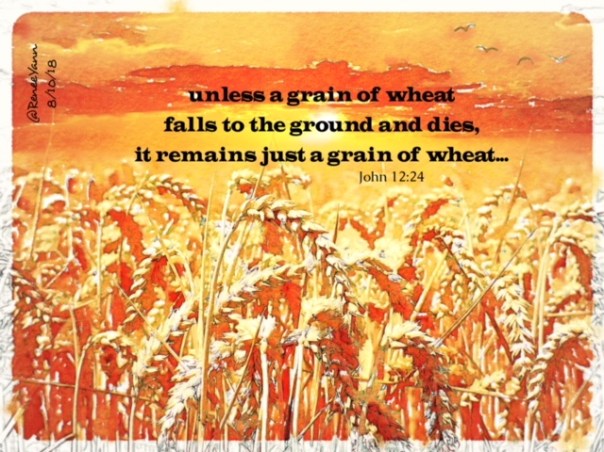
Today, in Mercy, on this feast of St. Lawrence, our readings are all about wheat. Then, again, they’re really not.
The readings, of course, are about eternal life – lessons taught in symbols the listeners could relate to. The agrarian community of Jesus’ time understood clearly what happened to a grain of wheat when buried in the rich soil. They understood, too, how a single grain, fallen on the barn floor and lost underfoot, had no hope of life.
It is a powerful lesson about community, selflessness, and what we need to do to live a full and meaningful life.
We have to die —to our isolation, self-absorption, greed, objectification and domination over others, “me-firstness”.
Basically, we have to resist the Seven Deadly Sins that make life “all about me”:
Self-adulating pride
Vengeful anger
Depersonalizing lust
Ungrateful envy
Consumeristic gluttony
Mean Greed
Irresponsible laziness
To move beyond these sins, we must recognize, respect and care for others – all others – as children of God.
If we can do that, our grain of wheat will land in harmony with the faith community and will contribute to its abundant life – and to our own. That faith community might be as small as my family or as big as the world. But unless I live there in selflessness, I will never come to my full potential a human being.
Musical reflection: A Grain of Wheat ~ Torchbearers
Today, in Mercy, our readings tell the story of the woman with the hemorrhage, and the little girl raised to life. I wrote the following homily about this passage for the Catholic Health association in 2015. I hope you find it worth reading.
For more inspiring prayer and scripture resources from CHA, please see:
Healing of the Daughter of Jairus and the Woman with a Hemorrhage
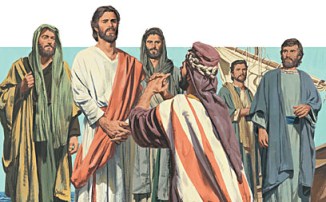
It is a soft, summer morning in Capernaum and Jesus is in the height of his ministry. Large crowds follow him wherever he goes, crowds hungry with hope; crowds fired by his counter-cultural words and miraculous deeds. This morning, Jesus prepares to speak to them, to translate into language they can comprehend the Eternal Life that lives in his heart. His back is to the gentle, sunlit sea. The hubbub softens to a murmur, finally stilled by the lapping waves.
But before Jesus can begin, a distressed man bursts through the gathered crowd. His robes fly about him as he runs to Jesus and falls at his feet. This man is important, so important that we all have known his name for two thousand years. This is Jairus who lives nearby and organizes the worship in the synagogue. Now breathless and swallowing sobs, Jairus pleads with Jesus: Please! My daughter! You can give her life!
Every loving father has been Jairus at least once in his life. We know these fathers. We are these fathers. They are the ones who burst into emergency rooms with a seizing infant in their arms. They are the ones who stare blankly at the pronouncement of a stillborn child. They are the old men in war-ravaged countries who kneel at the sides of their fallen sons and desecrated daughters. They are all the men throughout history rendered helpless by the forces of unbridled power, greed and death.
The merciful heart of Jesus understands this man and his desperate urgency. Without even a word, Jesus gets up and accompanies Jairus to the place of his pleading.
But there is another urgency pushing forward from the crowds: a woman, apparently of low importance for we have never known her name. She is a woman whom the ages have defined by her affliction. She is “The Woman with the Hemorrhage”. Without the status of Jairus, she approaches Jesus as such a woman must. She crawls behind him at his heels, reaching through the milling masses to even scrape the hem of his garment.
This is a troubled woman, a stigmatized woman. Her life has been spent, literally, in embarrassment, isolation, fatigue and, no doubt, abuse. For twelve years – coincidentally the life span of Jairus’ s daughter – her vitality has bled out of her. Her face is gaunt; her eyes sunken. Her soul’s light is all but extinguished. She is a woman who knows a particular kind of scorn.
We know these women. We are these women. They are the ones filled with remorse for an aborted baby. They are the ones who miscarry their longed-for child. They are the women whose beautiful young sons are profiled, stereotyped and hunted on the violent streets. They are the mothers of “The Disappeared”. They are the women who suffer disproportionately from war, poverty, hunger and violence. They are trafficked women, prostituted women, women victimized by the long saga of domination. They are the women whose children have been torn from them at the borders.
It is just such a broken woman who stretches her fingers through the Galilean dust in a last reckless reach for healing. She finds only the hem of his robe. Touching it, she is transformed, like a parched meadow in the spring rain. Her whole being reaches up to receive the holy restoration. She knows herself to be healed. And it is enough; it is everything. She retreats into the resignation of her otherwise lonely life.
But Jesus wants more for us than just the practical miracles we beg for. We ask for one healing; Jesus wants our eternal salvation. We ask for one blessing; Jesus wants our entire lives to be filled with grace. We ask for one prayer to be answered; Jesus wants our life to become a prayer.
Jesus feels the electrical touch of her hope. He feels the secret healing she has extracted from him. He turns to seek her. Can you see their eyes meet? Yes, the bleeding has been stemmed, but he sees the deeper wounds that scar her soul. His look of immense mercy invites her to tell him “the whole truth”. By her touch, she has commandeered a physical healing. But by his gracious turning toward her, her entire being is renewed. In this sacred glance, her history has been healed. Her future has been pulled from darkness into light. Her capacity to love has been rekindled. She now and forever will remember herself as a child of God.
Jairus waits, no doubt impatiently, at the edge of this miracle, anxious for such power to touch his daughter’s life. He fears they have lingered too long with the woman. His servants arrive, confirming his fears. He receives the dreaded report, “Your daughter has died.”
Jesus now pushes Jairus to the gauntlet of pure faith. In the face of this devastating news, Jesus tells him, “Do not be afraid; just have faith.” Is this not an almost impossible command? Like Jairus, we all know what it is to worry for our children:
Fathers of color teach their sons behaviors to protect them from profiling.
Immigrant parents fear their children will be ripped from them in a pre-dawn raid.
Famine-ravaged mothers watch their children disappear into hunger.
In hospitals and doctors’ offices, devastated parents summon the courage to accompany their critically ill child.
And Jesus says, “Don’t be afraid. Have faith.”! What can he possibly mean?
Perhaps it is this simple. In Jairus’s home, Jesus takes the dead girl’s hand. He says, “Talitha, koum – Little girl, arise.” His call to her heart tells her there is no darkness, devastation or death from which God cannot draw us into life. This is the truth Jesus brings to the little girl and to us. But it is a truth that, in our fear and need, we cannot always see.
For the moment, this girl lives. But at some time in history she, like all of us, will die. So the miracle is not the restoration of her life. The miracle is that her eyes, and her parents’ eyes, are opened to the power of God over death. Despite all appearances, God’s life endures eternally.
This is the revelation of this Gospel passage. If we live by faith, we live beyond cure into healing. If we live by faith, even death can bring life. If we live by faith, we are free to release all worry into the abundant mercy of God who grants us healing even beyond our asking or desire.
Man or woman, old or young, at some time in our lives each one of us has been Jairus. Each one of us has been one or the other of these two women. Within their stories of woundedness and deep faith, our stories shelter. Jairus and the afflicted women – unnamed like so many women throughout time – believed there was a way to new life. They reached for it. They begged for it. What is it in us that cries out for such healing? What is it in us that, without the touch of Jesus, teeters on the verge of death?
Simply by believing, these three Gospel figures became new beings. Simply by believing, their orientation changed from darkness to light. By their example, let us lift up those wounded and deadened places in our hearts and world before the loving gaze of Jesus.
To what suffering in our souls is God whispering the encouragement, “Talitha, koum”? What is the “whole truth” Jesus is inviting us to confide? Let us arise and respond to him in the full energy of our faith. Let us gaze with boundless confidence into the eyes of God’s mercy.
Today, in Mercy, Paul continues to instruct Timothy on how to deepen his life in Christ.He says,
“If we die with Christ,we shall also live with Him.”
Some of us, when we pray that verse, will picture ourselves on Calvary, literally dying beside Christ. But I think that our actual path to new life in Christ comes to us in much less dramatic ways. It comes to us in opportunities for selflessness, no matter how small.
I was at the supermarket one day, submerged in the ice cream freezer, looking for Turkey Hill Pineapple Sherbet. It is a rare find.
An elegant, older gentleman joined me, looking for the same thing.I told him the sherbet had been recommended to me and that I would like to try it.He confirmed the recommendation, saying it was his favorite.
We found only one carton. He turned to me and said, “You take it, because you’ve never had it before.I have.” It may have seemed a small kindness, but it was much more.
That man’s selflessness has stayed with me many long years after the ice cream. Whether or not he was a Christian, he had died to himself.The practice of openness to others’ needs – even a stranger’s – had become customary for him.
Our death to self and new life in Christ will be evident to others in our ordinary acts of selflessness and service.It will become the customary way we find joy in life, and the way we give witness to a redeemed heart.
Today, in Mercy, Mark’s Gospel paints a picture of Jesus in a whirlwind of emotions. He has come to Jerusalem well aware of the pharisaical negativity stalking him. Yet, recently – on Palm Sunday – the crowds had gathered around Him in what later would prove to be a fickle adulation.
After an overnight in Bethany, He returns to Jerusalem disgruntled, cursing a fig tree for its barrenness. He casts the money-changers from the Temple, tossing the tables over in an angry display. This side of Jesus must have made the disciples uneasy and afraid. They too begin to realize that the forces of evil and death are closing in on Jesus.
What lesson can we learn for our lives when dark times begin to overwhelm us? Jesus gives us the answer late in the reading:
~ Have faith in God.
~ Whatever you ask for in prayer, believe that you will receive it.
~ Forgive, so that you may be forgiven.
It is a formula we will see Jesus practice in His own Passion and Death. Like all true leaders, He practices what He preaches. He is teaching his followers – us – how to live in our dark times.
Today, in Mercy, we pray for all who have died as a result of war, especially our deceased servicemen and women.
May we, as a human family, realize the awful sinfulness of war. May we do all we can to help all people live in peace.
Music:Below is a link to Michael Hoppé’s moving album Requiem. I hope you are moved by listening to some or all of it, as we pray for world peace and justice.
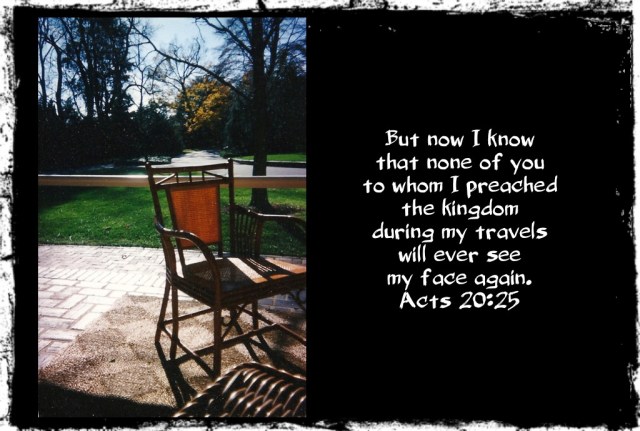
Today, in Mercy, both Paul and Jesus give a farewell discourse.They are both saying goodbye to their friends and disciples as their ministry draws to a close.
Such conversations are charged with emotion – love, hope, gratitude, sadness and loss interplay with one another in a poignant turmoil.
We may have known such times when moving on from a job or neighborhood;leaving school or work to begin something new. We may have held the hand of a loved one as they prepared for death, assuring each other of our love and thanks. Whatever the cause, there will be empty chairs in our lives where once there were beloved friends and family.Even happy times such as weddings and distant job opportunities can hold the nugget of loss for us and those we love
We can learn from Jesus and Paul in today’s readings how to say goodbye.A faithful, committed presence to our lives, our responsibilities, and our loved ones will sustain us when time or circumstance calls for change – even the ultimate change of dying.









 Lavish Mercy