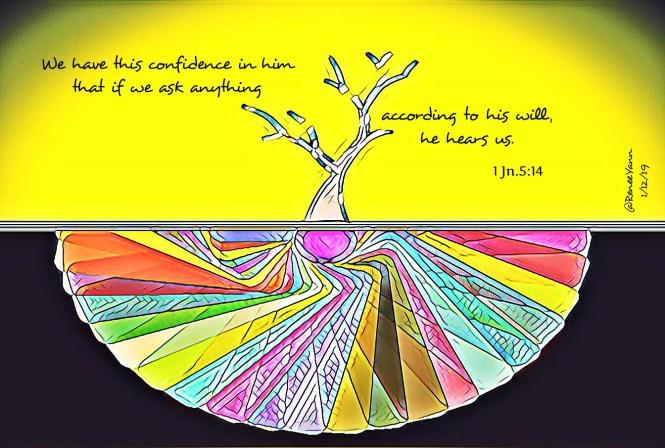
Today, in Mercy,our readings offer us a theme of CONFIDENCE. John begins with the reassuring verse:
From the Latin root meaning “to have full trust”,confidence is a rare and beautiful blessing in our lives. How many people or things are you able to trust that deeply? Are you blessed with a true confidant in your life?
John tells us that this is the kind of relationship we can and should have with God.
He says that when we pray with this confidence, we trust whatever answer we receive to bring us grace and life.
In our Gospel, John’s followers are having a little trouble with their confidence. They are unsettled by the appearance and rising popularity of Jesus. John says to trust what is happening. He had already told them that a greater One would come after him.
John’s ultimate response is worth repeating in prayer,“So this joy of mine has been made complete. He must increase; I must decrease.” When Christ shines through us without hindrance of our pride or fears, how complete our joy should be, how profoundly rooted our confidence!
Today, in Mercy, in this week after the Epiphany, we continue with John’s inspirational readings. They are intended to deepen us in love, truth and simplicity.
And we also have several Gospels this week that take us with Jesus as he begins his public ministry.
Today’s Gospel opens with a tinge of sadness. Jesus has just heard that John had been arrested. Reality dawns on them both that theirs will be no easy missionary journey. Wouldn’t it have been wonderful if these cousins could have teamed up, gone about preaching unhindered by the fears and bullying of the powerful?
But a free and easy story is not the one God chose to tell us, because our own stories are not always free and easy. Some, yes, more so than others. But all people suffer in some way and we all need a God who understands and shares that suffering.
So, “hearing that John had been arrested”, Jesus bravely begins. He goes to the Capernaum lakeshore where the common people gather to refresh themselves. He will find them hungry, confused, sinful, questioning, bereft, and battered. And he will begin by feeding and soothing them.
Where would Jesus begin with you? If you sat along that seashore in those first days, what would you lay before his tender mercy? Perhaps the need does not belong precisely to you, but to someone you love, someone who needs love in a harsh world.
Picture yourself there this morning. The sun begins to warm the salty edges of the sea. The crowd is large but quiet, as if they think themselves in church. Jesus looks out over all the gathered. But for one moment, his eyes meet yours, and that moment is enough to begin.
Today, in Mercy, we celebrate the great feast of the Epiphany of Our Lord, a day which commemorates Christ’s manifestation to the Gentiles.
Perhaps on this day, as little children, some of us placed the Three Kings in the crèche, fascinated by their journey and their majesty. These figures represented all nations bringing their gifts to the newborn Savior. In their humble generosity, the journeyers eyes were opened and they recognized Divinity in the most unlikely of places.
An epiphany is a special kind of vision. It is an insight to see something amazingly deeper in what we thought we had already perceived.
We might walk by a tree, a house, a person day after day taking them completely for granted. We see them – but don’t really see them. Then, one day, a certain turn of sun on leaves might let us see that tree differently. An open window with its curtains billowing might transform that house into a home. A caring exchange might change that person into a friend.
And we say things like, “Gosh, why had I never noticed that before…”
The Three Kings were given the grace of Epiphany to see God where others saw onlya poor newborn. They were given the wisdom to see Herod’s treachery where he pretended to offer only homage.
This feast reminds us that a sacred dimension exists beneath the surface of all appearances. Every reality contains the capacity for holiness, for goodness, for wisdom, for love. The more we are attuned to Grace, the more we recognize the presence (or the absence, as with Herod) of this capacity. The more we begin to live in deeper relationship with the seemingly ordinary in our lives.
Nothing is ordinary! Everything that comes to us is fraught with grace and divine possibility. We just need to live intentionally – to ask for and respond to the gift of Epiphany as it is given in our particular circumstances.
I think the sentiments of today’s feast thread through a beautiful poem by William Wordsworth, Ode: Intimations of Immortality from Recollections of Early Childhood – particularly in these lines:
Our birth is but a sleep and a forgetting: The Soul that rises with us, our life’s Star, Hath had elsewhere its setting, And cometh from afar: Not in entire forgetfulness, And not in utter nakedness, But trailing clouds of glory do we come From God, who is our home: Heaven lies about us in our infancy!
Poetry lovers might like to read the entire poem here:
Today, in Mercy, we pray with John’s soul-stirring words:
Beloved, we are God’s children …
When I pray these words I think of my mother. As a little child, I already bore a clear physical likeness to her. But as I grew into a young woman, and later an older woman, people remarked that we looked like twins. There were even occasions when we were confused with each other.
This visible resemblance gave me great pride. My mother was strong, courageous, funny, wise, and fiercely loving. I wanted to be like her – made of the same stuff as she was.
In our reading today, John tells us that we are made of the very stuff of God – the essence of the Sacred. He suggests that when people look at us they should see God’s features written all over us.
He says that we should see this Divine familial likeness in one another – that we are each imprinted with our Creator’s image.
If we believe John’s words, what tenderness we would bear toward ourselves and others! How could we ever belittle, hate or kill one another? How could we ever do these things to ourselves?
Music: How Can Anyone Ever Tell You – Shaina Knoll
Often, when I think of Christ on the Cross, I can hear God the Mother singing this song to Jesus, reaching from heaven to console Him in His pain.
This morning, we might ask God to sing this song over our wounded world which has so obscured God’s likeness – perhaps to sing it over us if we are in particular pain.
In our heart’s deep forgiveness, we might sing this song over anyone who has hurt us – the meanness coming from their failure to recognize their own beauty.
(PS: Speaking about my mother has inclined me to offer a second post today … a reflection I wrote 10 years ago.I thought some of you might enjoy reading it. You will receive it in a separate mailing.)
Today, in Mercy, we welcome the hope of 2019. When we were young nuns, we were introduced to the custom of letting the first thing we wrote in the New Year Be this phrase:
Jesus, Mary and Joseph
I’ve always kept the custom. It is good to remember with whom we step into this next moment in time.
Praying with our Gospel today:
It is good to rest with the infant Jesus in unconditional trust in the Father’s plan.
It is good to ponder with Mary that each moment’s meaning extends into eternity.
It is good to be with silent Joseph in listening trust and holy readiness.
As we begin again in hope and grace, let us do so in the company of this Holy Family. Let them bless us in mercy, as our psalm prays.
May we have simple trust in their presence with and care for us. May this give us the courage to live another year with renewed faith, courageous hope and transformative love.
Happy New Year, dear friends!
Music: from our beautiful Responsorial Psalm 67, rendered here in Gaelic. (English below)
God be merciful to us and bless us,
And cause His face to shine upon us.
That Your way may be known on earth,
Your salvation among all nations.
Let the peoples praise You, O God;
Let all the peoples praise You.
Oh, let the nations be glad and sing for joy!
For You shall judge the people righteously
And govern the nations on earth.
Let the peoples praise You, O God;
Let all the peoples praise You.
Then the earth shall yield her increase;
God, our own God, shall bless us.God shall bless us,
And all the ends of the earth shall obey Him.
Today, in Mercy,our first reading offers us John’s perfect honesty and simplicity:
Whoever says, “I know him,” but does not keep his commandments
is a liar, and the truth is not in him.
But whoever keeps his word,
the love of God is truly perfected in him. This is the way we may know that we are in union with him:
whoever claims to abide in him ought to walk just as he walked.
Yes, it’s that simple and that hard!
Then, in our Gospel, we meet Simeon who speaks with the holy confidence of a long and well-lived life. His lifelong dream was that he might not die before seeing the Messiah. That dream now fulfilled, Simeon intones one of the most beautiful prayers in Scripture:
Lord, now let your servant go in peace;
your word has been fulfilled:
my own eyes have seen the salvation
which you prepared in the sight of every people,
a light to reveal you to the nations
and the glory of your people Israel.
If we live in the Light, we too will see the Messiah within our life’s experiences. We too will come to our final days confident and blessed by that enduring recognition.
For as John also assures us:
Whoever says he is in the light,
yet hates his brother or sister is still in the darkness. But whoever loves his brother and sister remains in the light …
Let’s pray today for those who are dying, that they may know this kind of peace.
Let us pray for ourselves, that when our time comes, we too may experience this confidence.
Music:Nyne Otpushchayeshi ~Sergei Rachmaninoff (translated Nunc Dimittis, Now Let Your Servant Go). This was sung at Rachmaninoff’s funeral, at his prior request.(For musicians among you, point of interest: Nunc dimittis (Nyne otpushchayeshi), has gained notoriety for its ending in which the low basses must negotiate a descending scale that ends with a low B-flat (the third B-flat below middle C).
Church Slavonic text Ныне отпущаеши раба Твоего,
Владыко, по глаголу Твоему, с миром;
яко видеста очи мои спасение Твое,
еже еси уготовал, пред лицем всех людей,
свет во откровение языков
и славу людей Твоих Израиля
English translation Now let Your servant depart in peace,
Lord, by Your word;
My eyes have seen Your salvation,
Which You have prepared,
In view of all the people,
A light revealed to all tongues
and to the glory of Your people, Israel
Today, in Mercy, and for the next two weeks, our first readings take us into the beautiful mind and heart of John the Apostle, whose feast we celebrate today.
John, as I have met him in his Gospel and Letters, is a lover and a poet. He is, at the same time, a precise and exquisite engineer of thought and insight.
Often, a single word or phrase of John’s writing captures more than our minds can hold. Thus, praying with his writings should be a slow savoring, morsel by morsel, of Eternal Light captured for us in an elegant word.
Let these phrases rest with you in prayer today:
“What was from the beginning …Jesus, Uncreated, pre-existent Word of God
what we have heard, … Whose voice John heard
what we have seen with our eyes, … Whose acts of love John witnessed
what we looked upon … Whose crucified body John held
and touched with our hands … Whose wounds he wept over
concerns the Word of life …this Jesus is John’s whole life.
And John proclaims this treasure to us today so that our joy may be complete — so that we, too, might find our whole and eternal life in this Beloved Word of God.
In our Gospel, John remembers the moment when he “saw and believed”. It was at the first Easter morning when he was very young. As he writes today’s epistle, John is very old. Thousands of acts of faith have spread across his long life like so many sunrises. But he still remembers that first amazed belief at an empty tomb.
Do you remember your first faith? Do you cherish its many dawns over your life? It might be good to pray with John about these things today.
Representation of St. Stephen from The Demidoff Altarpiece by Carlo Crivelli, an Italian Renaissance painter of the late fifteenth century. This many-panelled altarpiece or polyptic painted by Crivelli in 1476, sat on the high altar of the church of San Domenico in Ascoli Piceno, east central Italy. It is now in the National Gallery in London, England.
Today, in Mercy, we celebrate the Feast of St. Stephen, first martyr for the Christian faith.
The commemoration and readings are a drastic turn from singing angels and worshiping shepherds.The Liturgy moves quickly from welcoming a cooing baby to weeping at the death of innocence. Why?
One thought might be to keep us practical and focused on what life in Christ truly means.
Stephen, like Jesus, “was filled with grace and power, … working great wonders and signs among the people.” He, as Jesus would, met vicious resistance to his message of love and reconciliation. He, as Jesus would, died a martyr’s death while forgiving his enemies.
The Church turns us to the stark truth for anyone who lets Christ truly be born in their hearts. WE will suffer as Jesus did – as Stephen did. The grace and power of Christ in our life will be met with resistance, or at least indifference.
We may not shed blood but, in Christ, we will die to self. When we act for justice for the poor and mercy for the suffering, we will be politically frustrated and persecuted. When we forgive rather than hate, we will be mocked. Powerful people, like the yet unconverted Saul in today’s second reading, may catalyze our suffering by their determined hard-heartedness.
Our Gospel confirms the painful truth:
“You will be hated by all because of my name,
but whoever endures to the end will be saved.”
Tomorrow, the liturgy picks up the poetic readings from John’s letters. These are delights to the soul.
But for today, it is a hard look, with Stephen, at what Christmas ultimately invites us to.
Music: Gabriel’s Oboe from the movie “The Mission”, played by Henrik Chaim Goldschmidt, principal oboist of The Royal Danish Orchestra in Copenhagen, Denmark.
The miracle of Christmas lies in this Latin word, “hodie”.
The Divine Immediacy of it! The Eternal Regeneration of it! The Omnipotent Presence of it! Hodie – Today!Now!
Christ is born in this moment, in this effort, this thought, this choice, this breath of my life.
As this Christmas morning dawns, indeed we commemorate an historical event that has redirected history toward Grace.But hidden in that sacred observance is the deep mystery of what we truly celebrate.
The birth of Christ, Eternal Love, is not contained by time. Every breaking moment bears Christ to the world. As history rolls on beneath this mystery, every generation – every human being – becomes the agent of His birth.
Christ was born in Bethlehem, and we rejoice.
But Christ is born in me – today, and today, and today. And we are awe-struck by Eternal Love.
I open my heart in humility, readiness and worship for Emmanuel’s Presence in my life.
This is the “Christus Moment”, where those passing vagaries of time which conspire to break our hearts, to break our lives, to break our world, are rendered soulless.
This is the moment when death is eviscerated, sin erased, division healed, brokennesssoothed, and hope blazingly restored. This is the “Hodie Moment” of Christ’s eternal birth in my heart, in our Church, in our world.
As we listen to the glorious chant of Christmas morning, “Christus Natus Est”, may we let our lives proclaim its transforming melody by:
every peaceful word we speak
every forgiving glance
every courageous stretch to hope
every grateful generosity
May Christ be born in us today
by our active love for Him in suffering humanity
by the vigor of our merciful justice
by our steady dismantling of selfishness to allow Him the fullness of glory
May Mary, who carried Jesus to life, teach us and guide us to be Bearers of Christ today – “hodie” – and every day.
Music: Hodie Christus Natus Est
Merry Christmas and God’s blessings to all of you and your loved ones!
Today is Christ born; today the Savior has appeared;
today the Angels sing, the Archangels rejoice;
today the righteous rejoice, saying: Glory to God in the highest. Alleluia!
Hodie Christus natus est hodie Salvator apparuit:
hodie in terra canunt Angeli, laetantur Archangeli:
hodie exsultant justi, dicentes: Gloria in excelsis Deo, Alleluia.
Today, in Mercy, our Gospel places us with Jesus, as he descends the mountain after the Transfiguration.
He speaks about two great prophets – Elijah and John the Baptist:
Elijah – the fiery reformer who “turned back hearts” to the day of the Lord
John – who cried out in the desert, “Prepare the way of the Lord!”
These prophets open the door to our final approach to Christmas – our last few days to heed their advice and ready our hearts for the awesome, yet humble, coming of Christ.
Is there anything in my heart that needs to be turned back to God — any energy, dedication or insight that has shifted from God’s Way to my own selfish way?
Is there anything I must prepare so that my life is ready to receive Christ?
These are the questions Elijah and John offer us today..
Music: Prepare the Way, O Zion – Fernando Ortega (Lyrics below)
Prepare the way O Zion
Your Christ is drawing near
Let every hill and valley
A level way appear
Greet One who comes in glory
Foretold in sacred story
Chorus:
O blest is Christ that came
In God’s most holy name
Christ brings God’s rule O Zion
He comes from heaven above
His rule is peace and freedom
And justice truth and love
Lift high your praise resounding
For grace and joy abounding
Fling wide your gates, O Zion
Your Savior’s rule embrace
And tidings of salvation
Proclaim in every place
All lands will bow rejoicing
Their adoration voicing






 Lavish Mercy