Back to the Fig Tree

Memorial of Saint John Neumann, Bishop
January 5, 2024

Today’s Readings:

https://bible.usccb.org/bible/readings/010524.cfm


Today, in God’s Lavish Mercy, John gives us this powerful verse:

Beloved, if our hearts do not condemn us,
we have confidence in God.


In our Gospel, we meet Nathaniel who has been sitting under a fig tree, perhaps examining his heart in the manner that John describes. I have frequently sat under the fig tree with Nathaniel because his was the name I was given over sixty years ago when I began my religious life.

I had never heard of him before that, nor at least had I paid attention to him. When Mother Bernard solemnly pronounced his name over me, it fell with a thud into my consciousness. Who was this guy anyway??? And what happened to “Regina”, “James Marita”, and “Eleanor Mary” – the names I had humbly requested! I imagine my eyebrows knit into a skeptical question mark!

I remember Mother Anthony peeking over Mother Bernard’s shoulder, encouraging me to smile as the superior’s hands rested on my head in blessing. Later she told me that she wasn’t so sure I would like the name, but that Mother Bernard really did. So I decided that I would learn to really like it too. That’s when I first met Nathaniel under the multi-trunked tree where he sat pondering his life.


Oddly enough at that first meeting, Nathaniel was young like I was then. He was trying to figure out, and plot out, his whole life in that one afternoon, much like I used to do when I was very young. I wanted to make the right decisions to set my life on a perfect course. So did Nathaniel I think.

Well. over the years since, both Nathaniel and I have met Jesus who has intervened in our self-interested ponderings. Jesus has called us beyond our mirror-bound reflections to the “greater things” of God’s vision for us and for Creation.

Nathaniel said to him, “How do you know me?”
Jesus answered and said to him,
“Before Philip called you, I saw you under the fig tree.”
Nathaniel answered him,
“Rabbi, you are the Son of God; you are the King of Israel.”
Jesus answered and said to him,
“Do you believe
because I told you that I saw you under the fig tree?
You will see greater things than this.”

John 1:47-50

When I meet Nathaniel these days under the aging fig, we too have aged and mellowed. Asking God’s sustaining intervention for just the day or the hour has become sufficient. Now as the plump fruit falls occasionally from the limb, we listen more than we think or speak. Jesus has joined us there under the leaves’ broad shadows. We share the fruit that has been given to us. And yes, Jesus still knows us in ways that amaze, challenge, and comfort.


Poetry: Seeing for a Moment – Denise Levertov

I thought I was growing wings—
it was a cocoon.

I thought, now is the time to step
into the fire—
it was deep water.

Eschatology is a word I learned
as a child: the study of Last Things;

facing my mirror—no longer young,
the news—always of death,
the dogs—rising from sleep and clamoring and howling, howling,

nevertheless
I see for a moment
that’s not it: it is
the First Things.

Word after word
floats through the glass.
Toward me.

Music: Under the Fig Tree – Lake Isabel
Let No One Deceive You

Memorial of Saint Elizabeth Ann Seton, Religious
January 4, 2024

Today’s Readings:

https://bible.usccb.org/bible/readings/010424.cfm


Today, in God’s Lavish Mercy, John is gentle but scathingly direct in his teaching:

Children, let no one deceive you.
The person who acts in righteousness is righteous,
just as God is righteous.
Whoever sins belongs to the Devil,
because the Devil has sinned from the beginning.

1 John 3: 7-8

John tells us that good is good, and bad is bad. Don’t let anyone fool you. And don’t make excuses when you fool yourself!

John gives us a clear measuring stick to test alignment with his teaching:

In this way,
the children of God and the children of the Devil are made plain;
no one who fails to act in righteousness belongs to God,
nor anyone who fails to love their sisters and brothers.

1 John 3:10

It’s so simple but so hard to be the kind of person John calls us to be!

In our deep hearts, we know what righteousness looks like. It looks like peace, forgiveness, reverence, truth-telling, kindness, service, faithfulness, hope.

And we know what unrighteousness looks like. It looks like war, vengeance, brutality, bigotry, manipulation, indifference, greed, selfishness, megalomania, dishonesty, fear-mongering.


How has our society gotten so mixed up that we allow unrighteousness to parade in the costume of justice! How have we gotten so lazy, greedy, or indifferent that we refuse to look for and remedy the root causes of our societal grievances? For example, when I dig deeper in my prayerful thinking, I might realize that:

  • Thousands of immigrants are not crossing their borders just to bother me or take my job! They are in fear for their lives and well-being because of a lopsided global economy and a classist devaluation of life.
  • The armament and weapons industries are not founded on a mission to protect me and my loved ones. Like all businesses, they operate to make money. The more guns they sell, and the more expensive and destructive they are, all the better. We are their marketplace not their protectorate.

The Scriptures are God’s living Word. They are not to be read and set aside as a completed devotional practice meaningless for today’s world.

They teach us about the past but they speak to us of the present. As we pray with them, we are called to be changed by them into persons who more clearly reflect Jesus and the Gospel. That is the hard work of righteousness – work that is the everyday stuff of our lives.

Deeply internalizing John’s teaching today is a good place to start our transforming prayer.


Poetry: And 2morrow – Tupac Shakur, (1971 – 1996), was an American rapper. He is widely considered one of the most influential and successful rappers of all time. Shakur is among the best-selling music artists, having sold more than 75 million records worldwide. Much of Shakur’s music has been noted for addressing contemporary social issues that plagued inner cities. His life was filled with violence and eventually, he was murdered, but his creative work revealed a deep though conflicted longing for justice and peace.

Today is filled with anger
fueled with hidden hate
scared of being outcast
afraid of common fate
Today is built on tragedies
which no one wants 2 face
nightmares 2 humanities
and morally disgraced
Tonight is filled with rage
violence in the air
children bred with ruthlessness
because no one at home cares
Tonight I lay my head down
but the pressure never stops
knawing at my sanity
content when I am dropped
But 2morrow I c change
a chance 2 build a new
Built on spirit intent of Heart
and ideals
based on truth
and tomorrow I wake with second wind
and strong because of pride
2 know I fought with all my heart 2 keep my
dream alive

Music: Beauty for Brokenness (God of the Poor) – Graham Kendrick

See!

Christmas Weekday
January 3, 2023

Today’s Readings:

https://bible.usccb.org/bible/readings/010324.cfm


Today, in God’s Lavish Mercy, we again have John the evangelist and John the Baptist as the “bookends” of our prayer. Each one calls his listeners to see the world differently – more deeply, under the surface – with the eyes of God.

See what love God has lavished upon us
that we may be called the children of God.
Yet so we are.
The reason the world does not know us is that it did not know him.

1 John 3:1

The spiritual vision the Evangelist describes comes through our knowledge of Jesus Christ. Through his life, death, and Resurrection, Jesus taught us how God loves and wants us to love. That is why a prayer life rooted in scripture, particularly the Gospel, is so critical to our spiritual integrity.


John the Baptist was steeped in this kind of integrity. Stripped of worldliness by ardent desert prayer, the Baptist was ready to not only hear the Word, but to see it when it came to him across the Jordan.

John testified further, saying,
“I saw the Spirit come down like a dove from the sky
and remain upon him.
I did not know him,
but the one who sent me to baptize with water told me,
‘On whomever you see the Spirit come down and remain,
he is the one who will baptize with the Holy Spirit.’
Now I have seen and testified that he is the Son of God.”

John 1:32-34

Our readings today tell us that we too, through our Baptism into Christ, have been born to a new vision. Every day, this side of heaven, we are challenged to live within that vision – to see the world as God sees it, to live in the world as Jesus would live. The courage to do that comes from our hope which, with faith and love, purifies and fires our heart.

Beloved, we are God’s children now;
what we shall be has not yet been revealed.
We do know that when it is revealed we shall be like him,
for we shall see him as he is.
Everyone who has this hope based on him makes himself pure,
as he is pure.

1 John 3:2-3

Poetry: Into the Eye of God – Macrina Wiederkehr, OSB

For your prayer, your journey into God
May you be given a small storm,
A little hurricane named after you,
persistent enough to get your attention
violent enough to awaken you to new depths
strong enough to shake you to the roots
majestic enough to remind you of your origin:
Made of the earth yet steeped in eternity
Frail human dust yet soaked with infinity.
You begin your storm under the eye of God
A watchful caring eye gazes in your direction
as you wrestle with the life force within.
In the midst of these holy winds
In the midst of this divine wrestling
Your storm journey, like all hurricanes
Leads you in to the eye of God
Into the eye of God where all is calm and quiet
the stillness beyond imagining
Into the eye of God after the storm
Into the silent beautiful darkness
into the eye of God.

Music: Apple of My Eye – Sal Arico

Praying with Anna

The Sixth Day in the Octave of Christmas
December 30, 2023

Today’s Readings:

https://bible.usccb.org/bible/readings/123023.cfm


rembrant anna
Presentation in the Temple – Rembrandt van Rijn

There was a prophetess, Anna,
the daughter of Phanuel, of the tribe of Asher.
She was advanced in years,
having lived seven years with her husband after her marriage,
and then as a widow until she was eighty-four.
She never left the temple,
but worshiped night and day with fasting and prayer.
And coming forward at that very time,
she gave thanks to God and spoke about the child
to all who were awaiting the redemption of Jerusalem.

Luke 2:36-38

Today, in God’s Lavish Mercy, we meet the venerable prophetess Anna. Oh, what she has to teach us!

  • Perseverance: she had waited eight decades for the revelation
  • Unconditional Faith: throughout those decades, she prayed always believing
  • Pure Spirit: she believed that, like the pure in spirit, she would see God
  • Unquestioning Receptivity to the Holy: when the Savior appeared, not in glory nor a fiery chariot, she received his vulnerability without hesitation
  • Adoration: “She never left the temple,but worshiped night and day with fasting and prayer.”
  • Sacred Satisfaction: “And coming forward at that very time, she gave thanks to God” because her faith and hope had been affirmed.
psalm_light

There is so much in this reading for each one of us. Find yourself somewhere within it today as you pray. Perhaps:

  • Am I expecting God in every moment of my life?
  • If I have received the gift of “old age”, how has the long wait blessed and/or challenged me to keep hold of God’s hand?
  • If I am still “young”, how do I invite God into my unfolding journey?
  • Am I asking God to continually reveal Divinity in my daily life?
  • Am I purifying my heart of self-interest so that I can better perceive God’s Presence?
  • Can I welcome God no matter how the Divine Presence clothes itself?
  • Do I stay with my prayer, creating a deep temple in my spirit?
  • Can I find contentment and peace with how God chooses to be with me – even in suffering?

(In a second post, I will share a powerful reflective poem by Leddy Hammock & Sue Kelly – Prayer of Imagination for Anna, the Prophetess. I hope you love this piece as much as do.)


Music: While I Wait – Lincoln Brewster

Let Me Go Now

The Fifth Day in the Octave of Christmas
December 29, 2023

Today’s Readings:

https://bible.usccb.org/bible/readings/122923.cfm


Lk2_29 Nunc

Today, in God’s Lavish Mercy,  our first reading offers us John’s perfect honesty and simplicity:

Whoever says, “I know him,” but does not keep his commandments
is a liar, and the truth is not in him.
But whoever keeps his word,
the love of God is truly perfected in him.
This is the way we may know that we are in union with him:
whoever claims to abide in him ought to walk just as he walked.

1 John 1:3-6

Yes, it’s that simple and that hard!


Then, in our Gospel, we meet Simeon who speaks with the holy confidence of a long and well-lived life. His lifelong dream was that he might not die before seeing the Messiah. That dream now fulfilled, Simeon intones one of the most beautiful prayers in Scripture, the Nunc Dimittis:

Lord, now let your servant go in peace;
your word has been fulfilled:
my own eyes have seen the salvation
which you prepared in the sight of every people,
a light to reveal you to the nations
and the glory of your people Israel.

Luke 2:29-32

If we live in the Light, we too will see the Messiah within our life’s experiences. We too will come to our final days confident and blessed by that enduring recognition.

For as John also assures us:

Whoever says he is in the light,
yet hates his brother or sister is still in the darkness.
But whoever loves his brother and sister remains in the light …

1 John 1:9-10

Let’s pray today for those who are dying, that they may know this kind of peace.

Let us pray for ourselves, that when our time comes, we too may experience this confidence.


Poetry: Song Silence By Madeleva Wolff, CSC
 
Yes, I shall take this quiet house and keep it
With kindled hearth and candle-lighted board,
In singing silence garnish it and sweep it
                For Christ, my Lord.
 
My heart is filled with little songs to sing Him—
I dream them into words with careful art—
But this I think a better gift to bring Him,
                Nearer his heart.
 
The foxes have their holes, the wise, the clever;
The birds have each a safe and secret nest;
But He, my lover, walks the world with never
A place to rest.
 
I found Him once upon a straw bed lying;
(Once on His mother’s heart He laid His head)
He had a bramble pillow for His dying,
A stone when dead.
 
I think to leave off singing for this reason,
Taking instead my Lord God’s house to keep,
Where He may find a home in every season
                To wake, to sleep.
 
Do you not think that in this holy sweetness
Of silence shared with God a whole lifelong
Both he and I shall find divine completeness
                Of perfect song?


Music:  Nyne Otpushchayeshi ~Sergei Rachmaninoff (translated Nunc Dimittis, Now Let Your Servant Go). This was sung at Rachmaninoff’s funeral, at his prior request. (For musicians among you, point of interest: Nunc dimittis (Nyne otpushchayeshi), has gained notoriety for its ending in which the low basses must negotiate a descending scale that ends with a low B-flat (the third B-flat below middle C).

Church Slavonic text
Ныне отпущаеши раба Твоего,
Владыко, по глаголу Твоему, с миром;
яко видеста очи мои спасение Твое,
еже еси уготовал,
пред лицем всех людей,
свет во откровение языков
и славу людей Твоих Израиля

English translation
Now let Your servant depart in peace,
Lord, by Your word;
My eyes have seen Your salvation,
Which You have prepared,
In view of all the people,
A light revealed to all tongues
and to the glory of Your people, Israel

She burns …

Solemnity of the Immaculate Conception of the Blessed Virgin Mary
December 8, 2023

Today’s Readings:

https://bible.usccb.org/bible/readings/120823.cfm


Today, in God’s Lavish Mercy, our Gospel offers us the luminous account of Gabriel’s Annunciation to young Mary. In my prayer, I think I would just like to sit beside Mary and wait for the graces God wishes to give me – to wait confidently as she did, and to do so with her guidance.

Annunciation – Edward Burns-Jones


I will use the powerful poem by Scott Cairns to focus my heart. You may want to use it as well.

Deep within the clay, and O my people
very deep within the wholly earthen
compound of our kind arrives of one clear,
star-illumined evening a spark igniting
once again the tinder of our lately
banked noetic fire. She burns but she
is not consumed. The dew lights gently,
suffusing the pure fleece. The wall comes down.
And—do you feel the pulse?—we all become
the kindled kindred of a King whose birth
thereafter bears to all a bright nativity.

Music: Monteverdi – Vespro della Beata Vergine led by John Eliot Gardiner

Claudio Giovanni Antonio Monteverdi (1567 – 1643) was an Italian composer, choirmaster and string player. A composer of both secular and sacred music, and a pioneer in the development of opera, he is considered a crucial transitional figure between the Renaissance and Baroque periods of music history.

The Vespro della Beata Vergine consists of 14 components: an introductory versicle and response, five psalms interspersed with five “sacred concertos”, a hymn, and two Magnificat settings. Collectively these pieces fulfil the requirements for a Vespers service on any feast day of the Virgin.

In March 1964, as a student at King’s College, Cambridge, John Eliot Gardiner led a performance of Monteverdi’s Vespers that not only launched his conducting career, but also his world-renowned Monteverdi Choir.

An Obstinate Faith

Thursday of the First Week of Advent
Memorial of Saint Ambrose, Bishop and Doctor of the Church
December 7, 2023

Today’s Readings:

https://bible.usccb.org/bible/readings/120723.cfm


Today, in God’s Lavish Mercy, Isaiah describes the upside-down nature of God’s Reign:

Trust in the LORD forever!
For the LORD is an eternal Rock,
who humbles those in high places,
and the lofty city he brings down;
He tumbles it to the ground,
levels it with the dust.
It is trampled underfoot by the needy,
by the footsteps of the poor.

Isaiah 26:4-6

God humbles the haughty, dwindles the lofty, tramples the elite with the “footsteps of the poor”. Wow! God turns our messy world on its head to right it!

This eloquent prophecy was intended to bolster the hopes of Isaiah’s careworn exiled community. It imagines the embodiment of the hope for which they have no evidence. Isaiah tells a geographically imprisoned people that they will be the ultimate conquerors. He assures a shackled community that their trust will earn them jubilant liberation. He enjoins them to believe!


It is really hard to have that kind of faith and trust when we have no evidence of delivery from whatever imprisons or assails us. Sometimes we wait a lifetime for a prayer to be answered but it seems that it never is. Are we fools to keep believing under such circumstances? Or are we wise enough to trust that the answers have come in ways we could not yet discern?


Our Gospel summons us to the same type of wildly hopeful trust. Jesus says that we cannot foresee nor control what kind of weather will assail us in life. Therefore, we must have a firm and sure foundation in faith so that we may survive any storm.

Jesus tells us to hear the sacred word with integrity and to measure ourselves according to it, because simply murmuring “Lord, Lord” doesn’t merit a pass to eternal life.

Everyone who listens to these words of mine and acts on them
will be like a wise one who built the house on rock. 
The rain fell, the floods came,
and the winds blew and buffeted the house. 
But it did not collapse; it had been set solidly on rock. 
And everyone who listens to these words of mine
but does not act on them
will be like a fool who built the house on sand. 
The rain fell, the floods came,
and the winds blew and buffeted the house. 
And it collapsed and was completely ruined.

Matthew 7:24-27

In this Advent time, let’s pray for a simple, wise and strong faith for ourselves and for those we love.


Prose: from On Obstinacy in Belief by C.S. Lewis

… a little bit long from Lewis but so worth it! If you like the excerpt, here’s a link to the entire essay:

https://thesewaneereview.com/articles/on-obstinacy-and-belief


Christians seem to praise an adherence to the original belief which holds out against any evidence whatever. I must now try to show why such praise is in fact a logical conclusion from the original belief itself.

This can be done best by thinking for a moment of situations in which the thing is reversed. In Christianity such faith is demanded of us; but there are situations in which we demand it of others. There are times when we can do all that a fellow creature needs if only he will trust us.

In getting a dog out of a trap, in extracting a thorn from a child’s finger, in teaching a boy to swim or rescuing one who can’t, in getting a frightened beginner over a nasty place on a mountain, the one fatal obstacle may be their distrust.

We are asking them to trust us in the teeth of their senses, their imagination, and their intelligence. We ask them to believe that what is painful will relieve their pain and that what looks dangerous is their only safety. We ask them to accept apparent impossibilities: that moving the paw further back into the trap is the way to get it out; that hurting the finger very much more will stop the finger hurting; that water which is obviously permeable will resist and support the body; that holding onto the only support within reach is not the way to avoid sinking; that to go higher and onto a more exposed ledge is the way not to fall.

To support all these incredibilia we can rely only on the other party’s confidence in us—a confidence certainly not based on demonstration, admittedly shot through with emotion, and perhaps, if we are strangers, resting on nothing but such assurance as the look of our face and the tone of our voice can supply, or even, for the dog, on our smell. Sometimes, because of their unbelief, we can do no mighty works.

But if we succeed, we do so because they have maintained their faith in us against apparently contrary evidence. No one blames us for demanding such faith. No one blames them for giving it. No one says afterward what an unintelligent dog or child or boy that must have been to trust us. If the young mountaineer were a scientist it would not be held against him, when he came up for a fellowship, that he had once departed from Clifford’s rule of evidence by entertaining a belief with strength greater than the evidence logically obliged him to.

Now to accept the Christian propositions is ipso facto to believe that we are to God, always, as that dog or child or bather or mountain climber was to us, only very much more so.

Music: Sheep May Safely Graze – J. S. Bach from from Cantata No. 208, “Was mir behagt” (Hunt Cantata), BWV 208, arr. by Egon Petri, (Oliver Schnyder – Piano)

Eyes Unveiled

Wednesday of the First Week of Advent
December 6, 2023

Today’s Readings:

https://bible.usccb.org/bible/readings/120623.cfm


Today, in God’s Lavish Mercy, Isaiah tantalizes us with his vision of the sumptuous heavenly banquet:

On this mountain the LORD of hosts
will provide for all peoples
A feast of rich food and choice wines,
juicy, rich food and pure, choice wines.

Isaiah 25:6-7

I can picture myself at that table munching on a savory turkey leg washed down by a bottomless pilsner. But if I stop there in my meditation I will have missed the whole point! The menu is not even the tip of the treasures to be had when we gather on Isaiah’s “Parousia Mountain”.

On that mountain, the veil will be lifted from our perception. The tangly web of our stresses and confusions will be wiped away. We will see ourselves and all Creation with God’s clear and loving eyes. Death – the lurking intruder threatening every earthly table – will have been eradicated, dissolved into Eternal Being.

On this mountain God will destroy
the veil that veils all peoples,
The web that is woven over all nations;
God will destroy death forever.

Isaiah 25:7-8

In our first reading, Isaiah paints the picture of a mountain lifted from time and transformed with heaven. In our Gospel, Jesus too is on a mountain when he pulls heaven down to heal and feed the yearning crowd.

Jesus walked by the Sea of Galilee,
went up on the mountain, and sat down there. 
Great crowds came to him,
having with them the lame, the blind, the deformed, the mute,
and many others. 
They placed them at his feet, and he cured them. 

Matthew 15:29-30

No doubt the gathered people, cured of their nagging maladies, were stunned into an instant faith. But Jesus knows that they can not stay on this heaven-charged mountain forever. They have their life’s journey ahead of them, and the energy of nascent faith may wane on the long road. So he reinforces the healing miracles with the comfort and sustenance of common food:

My heart is moved with pity for the crowd,
for they have been with me now for three days
and have nothing to eat. 
I do not want to send them away hungry,
for fear they may collapse on the way.

Matthew 15:32

In this incident, which is another version of the miracle in Matthew 14, the simple common folk have with them only the merest provisions. It is these that Jesus uses to fuel an enduring faith in these earth-bound believers:

Jesus said to them, “How many loaves do you have?” 
“Seven,” they replied, “and a few fish.” 
He ordered the crowd to sit down on the ground. 
Then he took the seven loaves and the fish,
gave thanks, broke the loaves,
and gave them to the disciples, who in turn gave them to the crowds. 
They all ate and were satisfied. 
They picked up the fragments left over–seven baskets full.

Matthew 15:34-37

God uses our merest provisions too to charge our daily life with faith’s energy. But we must take the holy time to let any misleading webs and obstructive veils fall from our perceptions. Our godless culture layers the world with so many distractions and fallacies that we are hard-pressed to see what’s really essential to true life.

Especially at Christmas time, God is nearly buried in tinsel, hype, and commercialism. A good Advent, spent in the awe-filled silence of scriptural reflection, is the antidote to this malady. Let’s be committed to it.


Poetry: Adult Advent Announcement – by David A. Redding, (from If I Could Pray Again – 1965)

O Lord,
Let Advent begin again
In us,
Not merely in commercials;
For that first Christmas was not
Simply for children,
But for the
Wise and the strong.
It was
Crowded around that cradle,
With kings kneeling.
Speak to us
Who seek an adult seat this year.
Help us to realize,
As we fill stockings,
Christmas is mainly
For the old folks —
Bent backs
And tired eyes
Need relief and light
A little more.
No wonder
It was grown-ups
Who were the first
To notice
Such a star.

Music: When I Can Read My Title Clear – arranged by Tim Sharpe
This is an acapella version of the hymn text by Isaac Watts (1674 – 1748) interpreting Isaiah 25:8.It is set to the tune PISGAH, an American Folk Melody by the 19th-century composer Joseph C. Lowry

A Budding Promise

Tuesday of the First Week of Advent
December 5, 2023

Today’s Readings:

https://bible.usccb.org/bible/readings/120523.cfm


Today, in God’s Lavish Mercy, Isaiah challenges us with his outrageously hopeful poetry.

After describing, in lyrical magnificence, the Messianic Ruler, Isaiah tells us this:

Then the wolf shall be a guest of the lamb,
and the leopard shall lie down with the kid;
The calf and the young lion shall browse together,
with a little child to guide them.
The cow and the bear shall be neighbors,
together their young shall rest;
the lion shall eat hay like the ox.
The baby shall play by the cobra’s den,
and the child lay his hand on the adder’s lair.
There shall be no harm or ruin on all my holy mountain;
for the earth shall be filled with knowledge of the LORD,
as water covers the sea.

Isaiah 11:6-10

We love this lilting Advent balladry, don’t we? Its movement is laced with hidden bells and waft of pine. It makes us remember Handel’s Messiah and resolve to find and play the CD we put away last January.

But as much as we might love the passage, do we believe it? Is the era of messianic peace possible, and will it be realized through the mystery of Divine Love incarnate in Jesus Christ?


Well, here are the facts:

Isaiah lived and prophesied a redeemed kingdom about 700 years before Christ. When Christ was born, the world was in pretty much the same sad shape as it was when Isaiah wrote.

Jesus lived 2000 years ago, speaking and modeling specific instructions for the world’s transformation. But the world is in pretty much the same sad shape today as it was when Jesus lived.

So where is all this “peaceable kingdom” stuff happening? Is it non-existent or just invisible? Is it just the rather lunatic imagining of ancient prophets?


Today’s Gospel offers us an understanding of God’s Reign too deep for the world’s logic. By the gift of faith and the grace of Baptism, we have been given a new set of eyes, charged with the same outrageous yet real hope evident in Isaiah and enfleshed in Christ.

I give you praise, Father, Lord of heaven and earth,
for although you have hidden these things
from the wise and the learned
you have revealed them to the childlike…

… Turning to the disciples in private he said,
“Blessed are the eyes that see what you see.
For I say to you,
many prophets and kings desired to see what you see,
but did not see it,
and to hear what you hear, but did not hear it.

Luke 10:21-24

If we can give ourselves to the vulnerable simplicity Jesus describes, faith can transform us. The “Kingdom” can live in us and because of us!

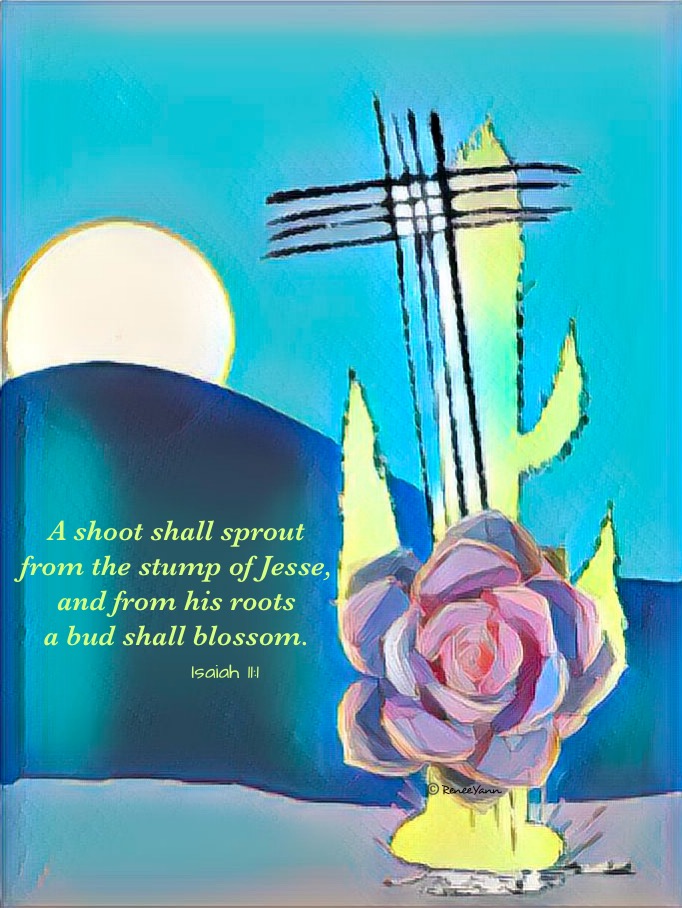
We too will see the bud beyond the stump. New life will arise from what appears lifeless. The worldly fears and inhospitalities that prey on us will be tamed by a holy confidence. In life’s sinuous circumstances, we will see the Holy Mystery unfolding.

The Kingdom, so indiscernible in our fractious world, will “advent” in us. This is what we long for in our Advent prayer.


Poetry: Advent Credo – Allan Boesak, a South African pastor in the Dutch Reformed Church, politician, anti-apartheid activist, and author of fifteen books. This poem is taken from his book Walking on Thorns (Eerdmans, 1984), and is often but wrongly attributed to Daniel Berrigan.


It is not true that creation and the human family are doomed to destruction and loss—
This is true: For God so loved the world that He gave his only begotten Son, that whoever believes in Him shall not perish but have everlasting life;
It is not true that we must accept inhumanity and discrimination, hunger and poverty, death and destruction—
This is true: I have come that they may have life, and that abundantly.
It is not true that violence and hatred should have the last word, and that war and destruction rule forever—
This is true: Unto us a child is born, unto us a Son is given, and the government shall be upon his shoulder, his name shall be called wonderful councilor, mighty God, the Everlasting, the Prince of peace.
It is not true that we are simply victims of the powers of evil who seek to rule the world—
This is true: To me is given authority in heaven and on earth, and lo I am with you, even until the end of the world.
It is not true that we have to wait for those who are specially gifted, who are the prophets of the Church before we can be peacemakers—
This is true: I will pour out my spirit on all flesh and your sons and daughters shall prophesy, your young men shall see visions and your old men shall have dreams.

It is not true that our hopes for liberation of humankind, of justice, of human dignity of peace are not meant for this earth and for this history—
This is true: The hour comes, and it is now, that the true worshipers shall worship God in spirit and in truth.

So let us enter Advent in hope, even hope against hope. Let us see visions of love and peace and justice. Let us affirm with humility, with joy, with faith, with courage: Jesus Christ—the life of the world.

Music: Lo, How a Rose E’er Blooming – pre-17th century anonymous hymn

From Wikipedia: The hymn was originally written with two verses that describe the fulfillment of the prophecy of Isaiah foretelling the birth of Jesus. It emphasizes the royal genealogy of Jesus and Christian messianic prophecies. The hymn describes a rose sprouting from the stem of the Tree of Jesse, a symbolic device that depicts the descent of Jesus from Jesse of Bethlehem, the father of King David. The image was especially popular in medieval times, and it features in many works of religious art from the period. It has its origin in the Book of Isaiah:

And there shall come forth a rod out of the stem of Jesse, and a Branch shall grow out of his roots.— Isaiah 11:1

All Nations …

Monday of the First Week of Advent
December 4, 2023

Today’s Readings:

https://bible.usccb.org/bible/readings/120423.cfm


Today, in God’s Lavish Mercy, Isaiah opens our prayer with this amazingly inclusive passage, both a vision and an invitation:

In days to come,
The mountain of the LORD’s house
shall be established as the highest mountain
and raised above the hills.
All nations shall stream toward it;
many peoples shall come and say:
“Come, let us climb the LORD’s mountain,
to the house of the God of Jacob,
That he may instruct us in his ways,
and we may walk in his paths.”

Isaiah 2:2-3

These first chapters of Isaiah were written about 8oo years before Christ, near the time of the Babylonian Captivity. The faith, vision, and hope of Israel were being sorely tested. Isaiah’s core message to these beleaguered people is that even when we do not see God, God abides. This abiding God will lead them to a new reality … to the “highest mountain” as opposed to their current valley of tears.

Isaiah is clear that this abiding promise is extended not only to Israel, but to all nations! What a surprising statement to find in the precious literature of Israel’s exceptionalism!


Jesus Heals a Centurion’s Servant – William Brassey Hole

To confirm this open invitation to “all nations”, our Gospel relates a complementary story. One of the first figures presented to us early in this Advent journey is the Gospel centurion, a Gentile with imperceptible religion but striking faith. His humble response to Jesus acknowledges that he, with all Creation, is subject to an infinitely loving Authority:

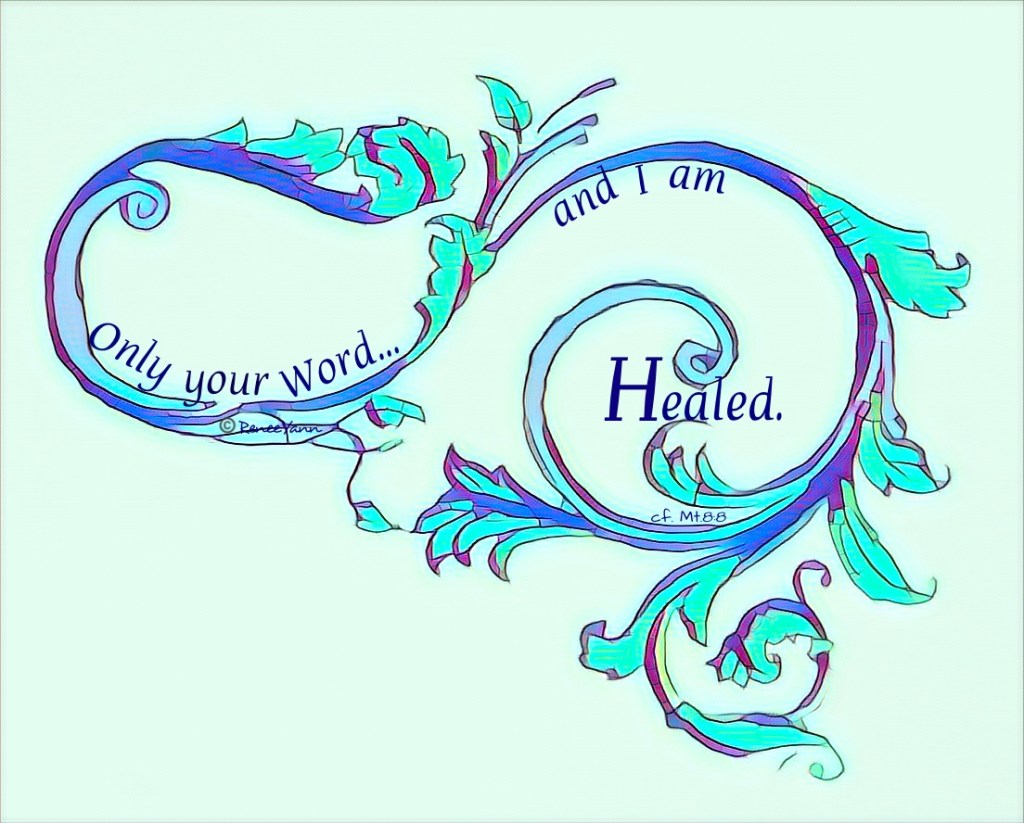
Lord, I am not worthy to have you enter under my roof;
only say the word and my servant will be healed.
For I too am a man subject to authority,
with soldiers subject to me.
And I say to one, ‘Go,’ and he goes;
and to another, ‘Come here,’ and he comes;
and to my slave, ‘Do this,’ and he does it.” 

Matthew 8:6-9

Our Advent lesson? Maybe this. To bring, as the centurion did, our beloved hopes and needs before God. To place them lovingly, confidently in the Divine Heart. To trust and receive God’s answers with all the faith we can gather. And to look, not past the moment, but through it to the holy mountain in the distance – a distance which is shortened by our faithful Advent prayer.


Poetry: I couldn’t come up with a written poem today, so I drew one:


Music: Healing – Peter Kater