The Queen of Sheba

Wednesday of the Fifth Week in Ordinary Time
February 7, 2024

Today’s Readings:

https://bible.usccb.org/bible/readings/020724.cfm


Today, in God’s Lavish Mercy, the Queen of Sheba visits Solomon. It’s another Solomon story worthy of the big screen where, in fact, it has been loosely fictionalized and adulterated many times.

sheba

Many trusted scripture scholars question the historicity of the story. Several agree that Solomon never rose to the kind of material glory described in the passage. The two books of Kings were written 500 years after Solomon lived. In many aspects, the writings offer a reflection on the meaning of his reign in Israel’s covenanted life rather than a strict account of his life.


So what might we glean from today’s passage on the mysterious queen. The story demonstrates that Solomon is so accomplished that a revered leader will come to learn from him. Once she arrives, she is overwhelmed by his material successes and strength. Solomon has constructed a dominant, rich and subservient culture.

But wait. Is there a bit of ironic judgement and, perhaps, prophetic reminder woven into the Queen’s accolades? Shifting the focus from an increasingly arrogant Solomon back to Israel’s God, she says:

Blessed be the LORD, your God,
whom it has pleased to place you on the throne of Israel.
In his enduring love for Israel,
the LORD has made you king to carry out judgment and justice

1 Kings 10:9

In fact, the great wealth and power of Solomon’s kingdom was built, not on justice and judgement, but on the backs of the poor and excluded. For example, Walter Brueggemann says this:

(Solomon’s kingdom) … was an economy of extraction that regularly transferred wealth from subsistence farmers to the elite in Jerusalem, who lived off the surplus and the device and the strategy for that extraction was an exploitative tax system.


When the Biblical scribe puts the words judgment and justice into the Queen’s remarks, it may be intended to forecast the miserable end Solomon will meet because he has abandoned his responsibilities to care for all the people according the the Lord’s covenant.

This glorious, shining realm which so impressed the Queen is a kingdom built on corruption, greed, militarism, and manipulation of the poor.

The lessons for our world are obvious.


As Jesus tells us in today’s Gospel, it doesn’t matter whether we’re gilded in gold on the outside and spin our words in glorious promises. What matters are the true intentions of our hearts and the compassionate actions they inspire:

But what comes out of the person, that is what defiles him.
From within, from the heart,
come evil thoughts, unchastity, theft, murder,
adultery, greed, malice, deceit,
licentiousness, envy, blasphemy, arrogance, folly.

Mark 7:20-23

Ultimately, the great Solomon misses the boat on this. May his story help us not to do the same.


Poetry: The Queen of Sheba by Hadewijch
English version by Mother Columba (Elizabeth) Hart, OSB
Original Language Dutch

The Queen of Sheba
Came to Solomon;
That was in order to gain wisdom.
When she had found him, indeed,
His wonders streamed upon her so suddenly
That she melted in contemplation.
She gave him all,
And the gift robbed her
Of everything she had within --
In both heart and mind,
Nothing remained:
Everything was engulfed in love.

Music: La Reine de Saba – Raymond LeFevre

Presence

Memorial of Saint Agatha, Virgin and Martyr
Monday of the Fifth week in Ordinary Time
February 5, 2024

Today, in God’s Lavish Mercy, both our readings lead us to pray with the mystery of God’s Presence.

In the passage from Kings, Solomon has completed his most memorable task – the rebuilding of the Temple in Jerusalem. Today’s verses describe the transfer of the Ark of the Covenant from its holding place to its permanent home in the Temple.

Upon the completion of that festive transfer, the Divine Presence is manifested by a cloud which fills the Holy of Holies.

When the priests left the holy place,
the cloud filled the temple of the LORD
so that the priests could no longer minister because of the cloud,
since the LORD’s glory had filled the temple of the LORD.
Then Solomon said, “The LORD intends to dwell in the dark cloud;
I have truly built you a princely house,
a dwelling where you may abide forever.”

1 Kings 8:10-11

In Mark’s Gospel today, the townspeople of Gennesaret become aware that Jesus is present in their vicinity. They have heard about his miracles. As Mark puts it, they scurry to gather all their needy friends and relatives into Christ’s healing Presence.

After making the crossing to the other side of the sea,
Jesus and his disciples came to land at Gennesaret
and tied up there.
As they were leaving the boat, people immediately recognized him.
They scurried about the surrounding country
and began to bring in the sick on mats
to wherever they heard he was.
Whatever villages or towns or countryside he entered,
they laid the sick in the marketplaces
and begged him that they might touch only the tassel on his cloak;
and as many as touched it were healed.

Mark 6:53-56

As we pray these passages, we might long for the tactile presence of God in the cloudiness of our own lives. Sometimes God seems far away, hidden somewhere beyond the stars – disconnected from the flesh-and-bone challenges of our existence.

But as we pray today we might remind ourselves that we are a Temple. God dwells in us as truly as God dwelt in the Holy of Holies. Any felt distance is not on God’s part, it is on ours and our restrained and anxious faith.

May these readings inspire us to be as sincere in our prayer as were the Gennesarenes – to scurry to the hem of Christ’s garment, to grasp its tassel in the fullness of faith, hope, and love.


Thought:

‘The mystery of God hugs you
in its all-encompassing arms.”-

Hildegard von Bingin

Music: Invocation: Hildegard von Bingen ~ Written by Emma Bergen, sung by Anonymous 4

Traditionally the Hebrew term Shekinah שכינה means ‘dwelling’, as a way of describing the Presence of the Divine. As the term is feminine, it also has come to be used to describe the feminine aspect of the divinity: the Divine Feminine.

Emma Bergen writes: “I came to learn about the Shekinah while I was writing about the Gnostic Sophia, and was inspired to write my ‘Invocation’ as a way, both of expressing what such a contact means to me personally, and to reach out in the spirit (and within myself) to what has been described as ‘the feminine face of God’. Oppression has many faces, some serious, and others so subtle that they might remain unnoticed by others. I invite you to join me in this invocation, written for all women everywhere, in whatever circumstances they might find themselves.”

(To see the words more clearly in the video, click on the little white square in the lower right-hand corner of the YouTube screen.)

Praise God Always

Fifth Sunday in Ordinary Time
February 4, 2024

Today’s Readings:

https://bible.usccb.org/bible/readings/020424.cfm


Today, in God’s Lavish Mercy, we pray with Psalm 147 which invites us to:

Praise the LORD Who is good;
    sing praise to our God, Who is gracious;
   the One it is fitting to praise.

It is a psalm for the left-brained who, like Job in our first reading, might need some explanation about just why we should praise when life seems so unpraiseworthy at times!

Job spoke, saying:
Is not man’s life on earth a drudgery?
    Are not his days those of hirelings?
He is a slave who longs for the shade,
    a hireling who waits for his wages.
So I have been assigned months of misery,
    and troubled nights have been allotted to me.

Job 7: 1-4

Job, like many of us when we suffer, feels crushed under life’s burdens. However, an extended reading of the Book of Job reveals that humility and repentance allow Job to “see God”, and to rediscover the richness and flavor of his life.

Calling us to the same kind of awareness, Psalm 147 presents a series of reasons for praising God, including God’s continual attention to the city of Jerusalem, to brokenhearted and injured individuals, to the cosmos, and to nature.

For me, the most moving of these reasons comes in verse 3:

The Lord heals the brokenhearted
    and binds up their wounds.
The Lord tells the number of the stars;
    calling each by name.


This is a beautiful picture of our infinitely compassionate God who is able to recognize our broken-heartedness. 

This loving God, who knows the stars by name, knows us as well. We, like Job, begin to heal within the divine lullaby God patiently sings over our broken hearts.

Jesus is that Healing Song, the Word hummed over the world by the merciful Creator. In today’s Gospel, we see that Melody poured out over the suffering:

When it was evening, after sunset,
they brought to him all who were ill or possessed by demons.
The whole town was gathered at the door.
He cured many who were sick with various diseases,
and he drove out many demons,
not permitting them to speak because they knew him.

Mark 1: 32-34

As we pray today, 
let us hear God’s song of mercy 
being sung over all Creation. 
Let us rest our own brokenness 
there in its compassionate chords. 
Let us bring the world’s pain to our prayer.


Poetry: A Cure Of Souls by Denise Levertov

The pastor
of grief and dreams
guides his flock towards
the next field
with all his care.
He has heard
the bell tolling
but the sheep
are hungry and need
the grass, today and
every day. Beautiful
his patience, his long
shadow, the rippling
sound of the flocks moving
along the valley.

Music: God Heals My Broken Heart – Patty Felker

If Job were singing his sadness today, it might sound like this song.

Now It’s Your Turn

Thursday of the Fourth Week in Ordinary Time
February 1, 2024

Today’s Readings:

https://bible.usccb.org/bible/readings/020124.cfm

Today, in God’s Lavish Mercy, as February’s deep season unrolls, we are just about two weeks away from the beginning of Lent. Our first readings during this time will give a little taste of 1 Kings and then briefly shift to James’s epistle before we pick up the treasured readings of the Lenten Season.


The passage today bears a royal gravity. After preparing his son Solomon for kingship, David solemnly dies.

Keep the mandate of the LORD, your God, following his ways
and observing his statutes, commands, ordinances, and decrees
as they are written in the law of Moses,
that you may succeed in whatever you do,
wherever you turn, and the LORD may fulfill
the promise he made on my behalf….

… David rested with his ancestors and was buried in the City of David.
The length of David’s reign over Israel was forty years:
he reigned seven years in Hebron
and thirty-three years in Jerusalem.

Solomon was seated on the throne of his father David,
with his sovereignty firmly established.

1 Kings 2; 3-4;10-12

David’s advice to Solomon is basically this: there is work to be done for God and God’s People. And now it’s your responsibility. Keep the course!

In our Gospel, Jesus gives the same sort of mandate to this disciples:

Jesus summoned the Twelve and began to send them out two by two
and gave them authority over unclean spirits.
He instructed them to take nothing for the journey but a walking stick
–no food, no sack, no money in their belts.

Mark 6:7-8

The disciples are ready. It is now their turn to spread the Gospel and to continue the ministry that they have learned at Jesus’s side:

So they went off and preached repentance.
The Twelve drove out many demons,
and they anointed with oil many who were sick and cured them.

Mark 6:12-13

If any of us are wondering what we are supposed to do today for the Reign of God, our answer may be somewhere in these readings as we pray them with an open heart.


Poetry: The Poem of Tecumseh – Tecumseh (1768 –1813) was a Shawnee chief and warrior who promoted resistance to the expansion of the United States onto Native American lands. A persuasive orator, Tecumseh traveled widely, forming a Native American confederacy and promoting intertribal unity. Even though his efforts to unite Native Americans ended with his death in the War of 1812, he became an iconic folk hero in American, Indigenous, and Canadian popular history. (Wikipedia)


Music: Heal the World – Michael Jackson

Rejected at Nazareth

Memorial of Saint John Bosco, Priest
Wednesday of the Fourth Week in Ordinary Time
January 31, 2024

Today’s Readings:

https://bible.usccb.org/bible/readings/013124.cfm


Today, in God’s Lavish Mercy, David gets himself in trouble once again.

King David said to Joab and the leaders of the army who were with him,
“Tour all the tribes in Israel from Dan to Beer-sheba
and register the people, that I may know their number.”
Joab then reported to the king the number of people registered:
in Israel, eight hundred thousand men fit for military service; 
in Judah, five hundred thousand.

Afterward, however, David regretted having numbered the people,
and said to the LORD:
“I have sinned grievously in what I have done.
But now, LORD, forgive the guilt of your servant,
for I have been very foolish.”

2 Samuel 24: 2;10

In the later years of his kingship, David is pretty impressed with himself. The kingdom has grown exponentially. There is peace and prosperity. David wants a census taken so that he can assess his capacity for new expansion.

So why does God get so mad about this census? The Book of Exodus sets out that a person has the right to number only his own belongings. The People belong to God, not to David. David’s pride and self-satisfaction has taken him over.

Ps32_deep waters

However, as usual, David repents. This is probably the best lesson we can learn from him. Then, in a greatly allegorized treatment, God gives David a choice of three punishments.


Passages like this can confuse us if we interpret them literally. Does God really interact and punish like this? 

It helps to remember the purpose of these writings — not to relay a factual history, but rather to tell a story that helps us grow in relationship with God.

What I believe happened here is that a pestilence did fall upon the country. At the same time, David realized that his heart had grown selfish and graceless. He took the natural event as a sign to turn back to God. And then the writers told the story in a way that the ancient peoples could relate to – with a metaphorical image of a God that forgives but gets even.


In our Gospel, Jesus preaches a clearer and true vision of God – a vision of Complete Mercy, especially toward the vulnerable, weak, and sinful. That pretty much includes all of us.

Jesus releases the power of this Divine Mercy by his words and miracles. But his own family and neighbors reject him. They are more comfortable with a God who behaves like they do – meting out more judgement and punishment (preferably toward others!😉) than mercy and inclusive benediction.


In this Gospel, we begin to see Jesus as One who asks not only for repentance but for conversion – for a new way of being with God and neighbor, the way of Love.

How might we have responded had we been in that neighborhood synagogue? How are we responding today?


Film Excerpt from The Chosen: Jesus is rejected at Nazareth


Music: Today’s Responsorial Psalm 32 – Marty Goetz ( Lyrics below)

Psalm 32 – Marty Goetz

These are periled times we live in, trouble everywhere
Weary hearts will often give in to this world’s despair
But high and over all, our Father knows our every care
And in His Book, if you will look, you’ll find His promise there

(Chorus)
He who trusts in the Lord
Mercy shall surround him
He who trusts in the Lord
Mercy shall surround him
Be glad in the Lord and rejoice
You upright in heart, lift up your voice
For great is His mercy toward all who trust in the Lord

Soon will be the time when we will see the Holy One
Oh how sweet to know that He’ll complete what He’s begun
And blessed is the man who stands forgiven in God’s son
And blessed are they who in that day will hear Him say, “Well done”

(Chorus)

Gracious is He and slow to anger
His loving kindness has no end
With love to embrace both friend and stranger
Reaching out to one and all, who upon His name will call

(Chorus)

Mercy is His reward
For all who trust, for the pure and just
Who put their trust in the Lord
For all who trust for the pure and just who put their trust in the Lord

Listen Tenderly

Fourth Sunday in Ordinary Time
January 28, 2024

Today’s Readings:

https://bible.usccb.org/bible/readings/012824.cfm


Today, in God’s Lavish Mercy, we pray with Psalm 95, once again a call to a holy tenderheartedness – that mix of love, discernment, and generosity that magnetizes us into dynamic relationship with God.

Oh, that today you would hear his voice:
    “Harden not your hearts as at Meribah,
    as in the day of Massah in the desert,
Where your fathers tempted me;
    they tested me though they had seen my works.

Psalm 95: 7-9

Our other Sunday readings, which Psalm 95 anchors, clarify the reason we seek this tenderheartedness. It is so that we might not only hear, but really listen and respond to the Truth of God in our lives.

Those who will not listen to my words 
which a prophet speaks in my name,
I myself will make them answer for it.

Deuteronomy 18:18

In our first reading from Deuteronomy, the people were confused. They were passing into a new land with lots of rivaling religions and spiritualities. Moses was nearing the end of his life and leadership over them. They wanted to know who to listen to and how to behave in order to stay in God’s favor.

God promises that God’s voice will come through a prophet like Moses:

I will raise up for them a prophet like you from among their kin,
and will put my words into his mouth;
he shall tell them all that I command him.

Deuteronomy 18:19

In our Gospel, we see Jesus – the fulfillment of the Deuteronomic Promise. The people witnessing his power are amazed. They struggle with whether they can believe in him when he seems just one of them, a Nazarene, Joseph’s son.

But some could believe – readily. Some, like the disciples, discerned quickly the Truth Jesus was. They heard, listened, believed and obeyed the Word.

Our psalm suggests that such readiness, such tenderheartedness comes from the consistent practice of relationship with God through praise, witness, thanksgiving, prayer, worship, humility, and obedience.


To me, it boils down to this:

  • let your life unfold in God’s Presence
  • be silent under God’s loving gaze
  • thank God for all you have been given
  • realize you are nothing without God
  • listen to your life as God speaks it to you
  • act on what you hear
Come, let us sing joyfully to the LORD;
    let us acclaim the rock of our salvation.
Let us come into God’s presence with thanksgiving;
    let us joyfully sing psalms to the Lord.
R. If today you hear God’s voice, harden not your hearts.
Come, let us bow down in worship;
    let us kneel before the LORD who made us.
For the Lord is our God,
    and we are the people God shepherds, the flock God guides.

Poetry: Rumi

I keep telling my heart,
“Go easy now.
I am submerged in golden treasure.”
It replies,
“Why should I be afraid of love?”

Music: Soften My Heart – by Music Meets Heaven

… the seed would sprout…

Memorial of Saints Timothy and Titus, bishops
January 26, 2024

Today”s Readings:

https://bible.usccb.org/bible/readings/012624.cfm


Today, in God’s Lavish Mercy, we have two beautiful readings to enrich our prayer.

In our first reading, Paul blesses and encourages his young disciple Timothy. Reminding Timothy of his faith heritage, received from his mother and grandmother, Paul inspires Timothy to live a spiritually courageous life:

I remind you to stir into flame
the gift of God that you have through the imposition of my hands.
For God did not give us a spirit of cowardice
but rather of power and love and self-control.
So do not be ashamed of your testimony to our Lord,
nor of me, a prisoner for his sake;
but bear your share of hardship for the Gospel
with the strength that comes from God.

2 Timothy 1: 6-8

Praying with this passage, we can look both back and forward – to those who have encouraged our faith, and to those who depend on us for edification.


Image by Rosy / Bad Homburg / Germany from Pixabay

In our Gospel, Jesus paints a picture for his disciples of what the Kingdom of Heaven is like. This is a realm in which we already live – the eternal universe of the Creator’s love and grace. But our time-bound eyes can’t see that world clearly. It is more real than our physical world, but perceptible only to the awakened spirit.

Jesus tries to explain this “kingdom” to his followers. He says that like the growth of a seed, this world is a sacred mystery whose energy is generated by God, not by us:

This is how it is with the Kingdom of God;
it is as if someone were to scatter seed on the land
and would sleep and rise night and day
and the seed would sprout and grow,
they know not how.
Of its own accord the land yields fruit,
first the blade, then the ear, then the full grain in the ear.
And when the grain is ripe, they wield the sickle at once,
for the harvest has come.

Mark 4: 26-29

Paul and Jesus encouraged their followers to live in joyous alignment with this Divine Order – the “Kingdom of God”, as scripture calls it. In our prayer today, let’s listen to their counsel, for it is meant for us as well.


Poetry: Let This Darkness Be a Bell Tower – Rainer Maria Rilke, Sonnets to Orpheus II, 29

“Quiet friend who has come so far,
feel how your breathing makes more space around you.
Let this darkness be a bell tower
and you the bell. As you ring,
what batters you becomes your strength.
Move back and forth into the change.
What is it like, such intensity of pain?
If the drink is bitter, turn yourself to wine.
In this uncontainable night,
be the mystery at the crossroads of your senses,
the meaning discovered there.
And if the world has ceased to hear you,
say to the silent earth: I flow.
To the rushing water, speak: I am.”

Music: Lamb of God – from the Mass of St. Timothy – Matt Maher

Rise and Fall of Kings

Day of Prayer for the Legal Protection of Unborn Children
Monday of the Third Week in Ordinary Time
January 22, 2024

Today’s Readings:

https://bible.usccb.org/bible/readings/012224.cfm


Today, in God’s Lavish Mercy, our readings place us at watershed moments in the lives of David and Jesus.

All the tribes of Israel came to David in Hebron and said:
“Here we are, your bone and your flesh.
In days past, when Saul was our king, 
it was you who led the children of Israel out and brought them back.
And the LORD said to you, ‘You shall shepherd my people Israel 
and shall be commander of Israel.’”
When all the elders of Israel came to David in Hebron, 
King David made an agreement with them there before the LORD, 
and they anointed him king of Israel.

2 Samuel 5:1-4

In 2 Samuel 5, David fully assumes the kingship through the approbation of the community. The scene marks the culmination of his rise to power and “the beginning of the rest of his life”.

Through our readings in Samuel until now, we have ascended with David to the pinnacle of his life. We are about to begin weeks of moving down “the other side of the mountain”.


Scholars generally see the David narrative in two primary units, the Rise of David (I Sam. 16:1—II Sam. 5:10) and the Succession Narrative (II Sam. 9:1—20:26; I Kings 1:1—2:46). Chapters 5:11—8:18, fall between two larger units. Whereas the first presents David in his ascendancy, the second presents David in his demise and expresses pathos and ambiguity. Our chapters thus come after the raw vitality of the rise of David and before the terrible pathos of the succession narrative. They show the painful process whereby this beloved chieftain is transformed into a hardened monarch, who now has more power than popular affection.

Walter Brueggemann: First and Second Samuel

In our Gospel, Jesus also comes to a sort of “continental divide”. But rather than community approbation, Jesus encounters the condemnation of the scribes who have come from Jerusalem to assess him.

The scribes who had come from Jerusalem said of Jesus, 
“He is possessed by Beelzebul,” and
“By the prince of demons he drives out demons.”

Mark 3: 22

From this moment in his life, Jesus too launches into his “kingship”, one that looks very different from David’s. The ensuing chapters of Samuel will reveal how David struggles and succumbs to the temptations of power and domination. The Gospels, on the other hand, describe Jesus’s “kingdom” as one of humility, mercy, and love for those who are poor and suffering.


Only through faith can we understand the inverse power of God present in the Life, Death and Resurrection of Jesus, and in our own lives. Jesus, the “new David”, is anointed in the Spirit to reveal and incorporate us into the kingdom of God.


Prose: from Immanuel Jakobovits who was the Chief Rabbi of the United Hebrew Congregations of the Commonwealth from 1967 to 1991.

To those without faith
there are no answers.
To those with faith, 
there are no questions.


Music: King David, music by Herbert Howells, sung by Sarah Connolly from a poem by Walter de la Mare

King David – Walter de la Mare

King David was a sorrowful man:
    No cause for his sorrow had he;
    And he called for the music of a hundred harps,
    To ease his melancholy.

    They played till they all fell silent:
    Played-and play sweet did they;
    But the sorrow that haunted the heart of King David
    They could not charm away.

    He rose; and in his garden
    Walked by the moon alone,
    A nightingale hidden in a cypress-tree
    Jargoned on and on.

    King David lifted his sad eyes
    Into the dark-boughed tree-
    ''Tell me, thou little bird that singest,
    Who taught my grief to thee?'

    But the bird in no wise heeded
    And the king in the cool of the moon
    Hearkened to the nightingale's sorrowfulness,
    Till all his own was gone.

Grief, Honor, and Mercy

Saturday of the Second Week in Ordinary Time
January 20, 2024

Today’s Readings:

https://bible.usccb.org/bible/readings/012024.cfm


Today, in God’s Lavish Mercy, our readings center on the themes of grief, honor, and mercy.

In the passage from 2 Samuel, Saul has been killed in battle. The news is brought to David by a scheming Amalekite who (later verses reveal) hopes to profit from his enterprise. He has stripped Saul’s dead body of its kingly insignia, obsequiously depositing it at David’s feet. The messenger expects David’s vengeful rejoicing and a hefty reward.

Instead David, with reverence and honor appropriate to a future king, launches a deep public mourning for Saul and Jonathan. It is a bereavement necessary to both cleanse and heal the community’s heart from all the strife leading up to it.

David seized his garments and rent them, 
and all the men who were with him did likewise.
They mourned and wept and fasted until evening 
for Saul and his son Jonathan, 
and for the soldiers of the LORD of the clans of Israel, 
because they had fallen by the sword.

2 Samuel 1:11-12

David’s lament is profound; it is ”splancha”, sprung from his innards, like the anguish Jesus felt for the suffering persons he encountered, as described in our Gospel.

A callous or indifferent heart cannot comprehend such pathos. Seeing it in Jesus, even his relatives thought him insane!

Jesus came with his disciples into the house.
Again the crowd gathered,
making it impossible for them even to eat.
When his relatives heard of this they set out to seize him, 
for they said, “He is out of his mind.” 

Mark 3: 20-21

Our God is a God of boundless love 
and impractical mercy. 
David models a bit of that godliness. 
Jesus is its complete Incarnation.

Poetry: Talking to Grief – Denise Levertov

Ah, Grief, I should not treat you
like a homeless dog
who comes to the back door
for a crust, for a meatless bone.
I should trust you.
I should coax you
into the house and give you
your own corner,
a worn mat to lie on,
your own water dish.
You think I don't know you've been living
under my porch.
You long for your real place to be readied
before winter comes. You need
your name,
your collar and tag. You need
the right to warn off intruders,
to consider
my house your own
and me your person
and yourself
my own dog.

Music: Lascia Ch’io Pianga (Let Me Weep)- Georg Frideric Handel – a single piece of beautiful music today in two version, an aria and an instrumental interpretation.

Julia Lezhneva – soprano

Elusive Peace

Thursday of the Second Week in Ordinary Time
January 18, 2024

Today’s Readings:

https://bible.usccb.org/bible/readings/011824.cfm


Today, in God’s Lavish Mercy, our readings are about the growing popularity and power of David and Jesus. Accompanying that growth is the fearful jealousy of their peers, requiring both Jesus and David to take precautions.

David Calming Saul’s Fury with the Harp by Silvestro Lega

In our first reading, Saul is plagued by a lethal insecurity. As David’s star rises among the people, a plot to kill him festers in Saul’s heart. Right in the middle of this developing drama, Jonathan attempts to conciliate the relationship between his father and his friend.

Saul was very angry and resentful of the song, for he thought:
“They give David ten thousands, but only thousands to me.
All that remains for him is the kingship.”
And from that day on, Saul was jealous of David.

Saul discussed his intention of killing David
with his son Jonathan and with all his servants.
But Saul’s son Jonathan, who was very fond of David, told him:
“My father Saul is trying to kill you.

1 Samuel 18:8; 19:1

Over the course of our lives, haven’t we found ourselves in one, or maybe all, of these roles? Jealous, insecure, envious, like Saul? Unexpectedly successful, perhaps to another’s disadvantage, like David? Trying to make peace between two beloveds who can’t see past themselves, like Jonathan?

Praying with this passage leads us to ask ourselves, “How is God with me when I find myself in such situations?” What would have been God’s hope for Saul at this point in his life? For David? For Jonathan?


When I think of Saul, I wonder what could have happened if he had been big-hearted, if he had been brave enough to offer David mentorship and encouragement. It can be very hard to step back from a role where we have been in control and prominence. Generously advancing a successor is the sign of a graceful heart. Sadly, Saul did not meet the challenge.


When I think of David, I wonder how he might have better included Saul in his success. None of us achieves success alone. Sometimes the people and circumstances that have supported us are invisible — even to us. Especially in the vigor of youth, we may be tempted to think that we are solely responsible for our achievements. Developing an aware and grateful heart can help us realize life’s profound interdependence.


When I think of Jonathan, I just want to be like him. He was such a good person who loved without self-interest. Jonathan is a figure of Christ who sought reconciliation and loved generously to the point of death. Praying with Jonathan is an invitation to holiness.


In our Gospel, we meet Jesus as he seeks the same peace, reconciliation, and love. Still, even as Jesus heals and does good among the people, he is aware of the sinful weakness in some people’s hearts. He therefore calls for care in making his name known:

He had cured many and, as a result, those who had diseases
were pressing upon him to touch him.
And whenever unclean spirits saw him they would fall down before him
and shout, “You are the Son of God.”
He warned them sternly not to make him known.

Mark 3: 10-12

So many ways to pray with today’s Scripture! Given your place with God today, what are these passages suggesting for you?


Poetry: Not Like a Cypress by Yehuda Amichai, (1924 – 2000) was an Israeli poet and author, one of the first to write in colloquial Hebrew in modern times. Much of his work tries “to make sense of the world that created the Holocaust”.

Amichai was invited in 1994 by Prime Minister Yitzhak Rabin to read his poems at the ceremony in Oslo when Rabin, Yasser Arafat, and Shimon Peres were awarded the Nobel Peace Prize for their efforts to establish peace in the Middle East. Perhaps we might send a prayer to these honored men for a blessing of sanity and peace over today’s Middle East leaders.

I chose this poem because it mentions Saul, “the single man” whom the “multitudes” made great. But not like Saul does one find meaning and peace. The poet suggests that “becoming like the rain” and giving one’s life is the way to meaning, so reflective of Jesus’s advice, “Unless the grain of wheat …”


Not like a cypress,
not at once, not all of me,
but like the grass, in thousands of cautious green exits,
to be hiding like many children
while one of them seeks.

And not like the single man,
like Saul, whom the multitude found
and made king.
But like the rain in many places
from many clouds, to be absorbed, to be drunk
by many mouths, to be breathed in
like the air all year long
and scattered like blossoming in springtime.

Not the sharp ring that wakes up
the doctor on call,
but with tapping, on many small windows
at side entrances, with many heartbeats.

And afterward the quiet exit, like smoke
without shofar-blasts, a statesman resigning,
children tired from play,
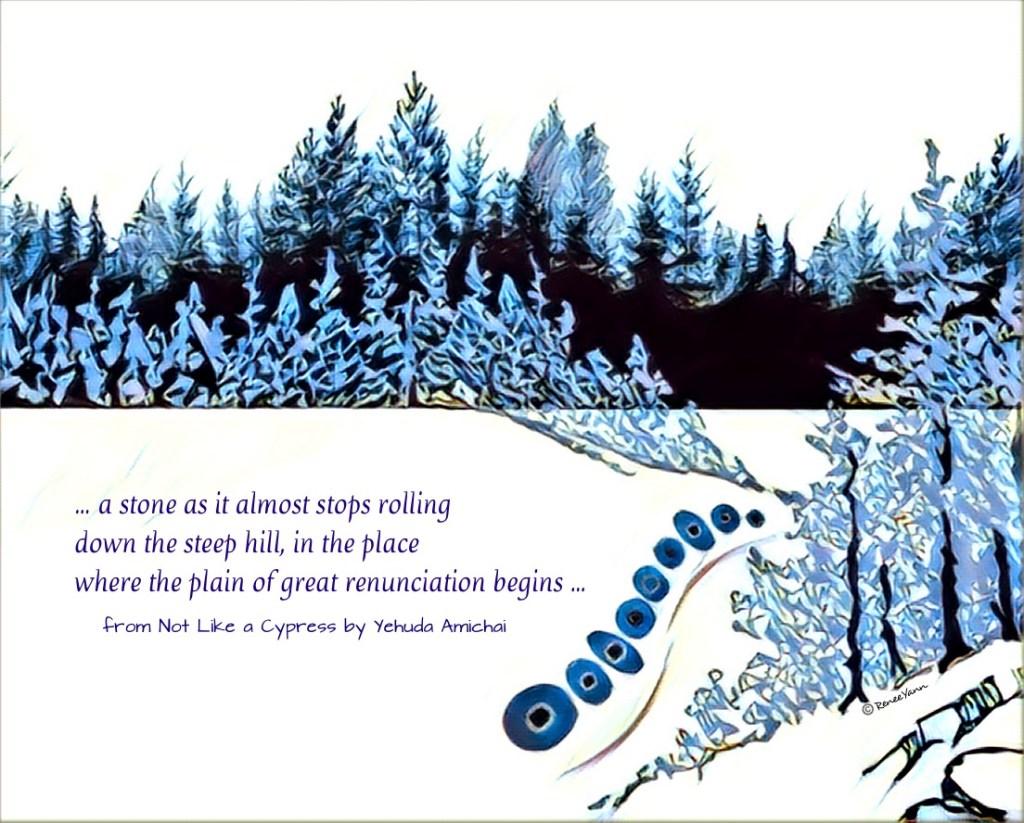
a stone as it almost stops rolling
down the steep hill, in the place
where the plain of great renunciation begins,
from which, like prayers that are answered,
dust rises in many myriads of grains.


Music: Paintbox – Ofra Haza and Kobi Oshrat

Ofra Haza accompanied by pianist and composer Kobi Oshrat at the Nobel Peace Prize Award Ceremony on December 10, 1994 at the Oslo City Hall in Oslo, Norway, honoring Nobel Laureates Israeli Prime Minister Yitzhak Rabin (1922-1995), Israeli Foreign Minister Shimon Peres (1923-2016) and Palestine Liberation Organization Chairman Yasser Arafat (1929-2004) for their efforts to create peace in the Middle East. She performed here at the request of Israeli Prime Minister Yitzhak Rabin. (Lyrics below)

I had a paintbox
Each color glowing with delight
I had a paintbox with colors
Warm and cool and bright

I had a paintbox
Each color glowing with delight
I had a paintbox with colors
Warm and cool and bright

I had no red
I had no red for wounds and blood
I had no black for an orphaned child

I had no white
I had no white for the face of the dead
I had no yellow for burning sands

I had a paintbox
Each color glowing with delight
I had a paintbox with colors
Warm and cool and bright

I had orange
I had orange for joy and life
I had green
Green for buds and blooms

I had blue
I had blue for a clear, bright skies
I had pink
Pink for dreams and rest

I had a paintbox
Each color glowing with delight
I had a paintbox with colors
Warm and cool and bright

I had a paintbox
Each color glowing with delight
I sat down
I sat down and painted peace
Peace, peace