Chaos, Prayer, and Mercy

Tuesday of the Thirteenth Week in Ordinary Time
July 4, 2023

Today’s Readings:

https://bible.usccb.org/bible/readings/070423.cfm


Today, in God’s Lavish Mercy, we resume our readings from Genesis and Matthew – and they’re packed with action and inspiration!

Sodom and Gomorrha by Henry Osawa Tanner

(Note Lot’s wife left behind in white)


If you’re “of an age” like me, you might remember your old Bible History class and first hearing the story of Lot and his “mortonized” wife.

I spent a lot of my 7-year-old energy wondering what she looked like as a salty pillar. I even imagined how she might have melted in the next rain after the meteor set Sodom on fire.

But most of all, I felt bad for her. I mean, really, one glance backward and ZAP! And by correlation, I felt bad for myself because, even at that young age, I realized that I was quite capable of backward glances once God had spoken. And it scared me.

Was God really like that?!


Looking back on those childhood feelings, I consider how my faith and perception of God have evolved over the course of my now long life. The God of my grade school years was not the God of my late teens and twenties. Nor was that God of my young adulthood the God of my 50s and 60s.

Did God grow and change during those years? Of course not. It was I who deepened, widened, and mellowed in experience and grace.


The stories in Genesis, and throughout the Hebrew Scriptures, were told and interpreted over many centuries before they were ever written down. After being written down, they have continued to be studied and parsed even into our own times.

Just as we grow in the spiritual understanding of our own lives, we mature in our ability to look through the surface of scriptures to their deep and sacred meaning.


As Christians, we must read the ancient scriptures in the light of the Gospel. We have the advantage and responsibility to seek the deep spiritual understanding resident within these stories. Buried in a sometimes bizarre passage is the fundamental truth of God’s abiding Presence, no matter our circumstances.

The particular words used to convey these stories were designed for and by people of a very different culture from ours. Some of the concepts are relayed in a primitive manner that may not speak to a modern reader. But we can’t let ourselves get stuck on those cultural differences — the way I did when I was seven years old.


The story of Abraham, Lot and Lot’s wife is not a news report about some family that avoids a natural disaster save for one disobedient member.

It is instead a parable which invites us to consider God’s persistent desire for our wholeness despite our own resistance to that grace. If we continually harden our spirits to God’s invitation to relationship, it is we, not God, who make the choice to distance ourselves in spiritual exile.

Yet, Genesis tells us that, even if we make that distancing choice, all is not lost. We cannot cause God to disassociate from us, no matter how hard we might try. There is always a path back to the heart of God – even if it leads through a storm of brimstone.


As our Gospel assures us, even in the scariest of storms, our God is with us:

They came and woke him, saying,
“Lord, save us! We are perishing!”
He said to them, “Why are you terrified, O you of little faith?”
Then he got up, rebuked the winds and the sea,
and there was great calm.


Poetry: Lot’s Wife – Anna Akhmatova

And the just man trailed God's shining agent,
over a black mountain, in his giant track,
while a restless voice kept harrying his woman:
"It's not too late, you can still look back
at the red towers of your native Sodom,
the square where once you sang, the spinning-shed,
at the empty windows set in the tall house
where sons and daughters blessed your marriage-bed."
A single glance: a sudden dart of pain
stitching her eyes before she made a sound . . .
Her body flaked into transparent salt,
and her swift legs rooted to the ground.
Who will grieve for this woman? Does she not seem
too insignificant for our concern?
Yet in my heart I never will deny her,
who suffered death because she chose to turn.

Music: The Love I Have for You , O Lord – sung by James Kilbane


Me? A Prophet?

Thirteenth Sunday in Ordinary Time
July 2, 2023

Today’s Readings:

https://bible.usccb.org/bible/readings/070223.cfm

Today, in God’s Lavish Mercy, our readings instruct us on the nature of prophecy.


Walter Bruggemann, in his transformational book “The Prophetic Imagination” writes about prophets. He indicates that prophets emerge in the context of “totalism” – those paralyzing systems which attempt to control and dominate all freedom and possibility.

Totalism kills ideas, hope, freedom, choice, self-determination, and creativity for the sake of controlling reality for its own advantage. Totalism is the ultimate “abusive relationship“. Examples in our society include cults, hate groups, mob rule, or any relationship that subjugates another’s free will.

Brueggemann defines the prophet as one engaged in these three tasks to restore hope and freedom:

  • the prophet is clear on the force and illegitimacy of the totalism.
  • the prophet pronounces the truth about the force of the totalism that contradicts the purpose of God.
  • the prophet articulates the alternative world that God has promised, and that God is actually creating within the chaos around us.

Our first reading comes from the Second Book of Kings which was written about 600 years before Christ. The Jewish people experienced the totalism of the Babylonian Captivity.. First and Second Kings was written to help the people understand their situation, to remain faithful to God, and to move toward freedom.


These two books are full of powerful figures pulling the people both toward and away from God – biblical Baddies and Goodies who carried profound messages about faith or its abandonment.


One of the Goodies is Elisha the Prophet whom we meet in today’s verses. Elisha confronts barrenness and death with the transformative power of faith. The Summanite woman is able to benefit from this power because she believes.


In our second reading, Paul doesn’t use the word “prophet” but he talks about the Resurrection Power we receive through our Baptism. This power calls us and confirms us as bearers of God’s transformative Word in a hostile and unfree world.


In our Gospel, Jesus is direct with his disciples about the rewards which fall to those who have prophetic faith:

“Whoever receives you receives me,
and whoever receives me receives the one who sent me.
Whoever receives a prophet because he is a prophet
will receive a prophet’s reward,
and whoever receives a righteous man
because he is a righteous man
will receive a righteous man’s reward.
And whoever gives only a cup of cold water
to one of these little ones to drink
because the little one is a disciple—
amen, I say to you, he will surely not lose his reward.”

Matthew 10:40-42

So, are we actually called to be prophets? The answer is YES. We are called by the Gospel and through our Baptism to do what Walter Brueggemann describes above:

  • to name the structures of unfreedom in our lives and in our world
  • to speak truth and stand against those things which contradict God’s Mercy and Love
  • to witness hope and courage by the joyous, generous service of our lives

Photo by Ashley Batz on Unsplash


Poetry: Onto a Vast Plane – Rainer Maria Rilke

You are not surprised at the force of the storm—
you have seen it growing.
The trees flee. Their flight
sets the boulevards streaming. And you know:
he whom they flee is the one
you move toward. All your senses
sing him, as you stand at the window.

The weeks stood still in summer.
The trees’ blood rose. Now you feel
it wants to sink back
into the source of everything. You thought
you could trust that power
when you plucked the fruit:
now it becomes a riddle again
and you again a stranger.

Summer was like your house: you know
where each thing stood.
Now you must go out into your heart
as onto a vast plain. Now
the immense loneliness begins.

The days go numb, the wind
sucks the world from your senses like withered leaves.

Through the empty branches the sky remains.
It is what you have.
Be earth now, and evensong.
Be the ground lying under that sky.
Be modest now, like a thing
ripened until it is real,
so that he who began it all
can feel you when he reaches for you.


Music: When the Prophet Speaks – Van Morrison (lyrics below)

When the prophet speaks, mostly no one listens
When the prophet speaks and no one hears
Only those who have ears to listen
Only those that are trained to hear

Come closer now, I'll tell you what they whisper
Closer now, we'll whisper it in your ear
What big ears you've got when you get the details
Do you understand, do I make it clear?

When the prophet speaks, yeah, no one listens
When the prophet speaks, mostly no one hears
Only those that are trained to listen
Only those who have ears to hear

When the prophet speaks, yeah, no one listens
Baby, baby, baby, baby, baby
Don't you have no fear
You gotta get the truth on what is happening

When the prophet speaks, have to make it clear
Come closer now and I will whisper
Whisper the secret in your ear
What thick ears you've got when you get all the details

Do you understand, do I make myself clear?
When the prophet speaks, you've got to listen
When the prophet speaks, you've got to get the truth
When the prophet speaks, don't need no explanation

When the prophet speaks, have to make it move
Prophet speaks, no one listens
When the prophet speaks, mainly nobody hears
Only those that are trained to listen

Only those who have ears to hear

Is Anything Impossible for God?

Saturday of the Twelfth Week in Ordinary Time
July 1, 2023

Today’s Readings:

https://bible.usccb.org/bible/readings/070123.cfm


Today, in God’s Lavish Mercy, our readings build on yesterday’s themes of promise and patience, faith and resistance.

The Trinity or The Hospitality of Abraham –
Icon by Sister Petra Clare


Genesis tells the rich and instructive story of the visiting angels who come as spokespeople for God’s Promise. Abraham, in a flurry of Middle Eastern hospitality convinces the three visitors to linger at his home. Exuding a deferential hospitality certain to gain them a blessing, Abraham and Sarah lay out a lovely dinner. The blessing comes in an unexpected reiteration of that nagging, and still unfulfilled, promise:

They asked him, “Where is your wife Sarah?” 
He replied, “There in the tent.” 
One of them said, “I will surely return to you about this time next year,
and Sarah will then have a son.”

Genesis 18:9-10

This time, post-menapausal Sarah has had it with the inconclusive, and seemingly outlandish, promise!

Sarah was listening at the entrance of the tent, just behind him.
Now Abraham and Sarah were old, advanced in years,
and Sarah had stopped having her womanly periods.
So Sarah laughed to herself and said,
“Now that I am so withered and my husband is so old,
am I still to have sexual pleasure?”

Genesis 18:10-12

God doesn’t think it’s funny. To Abraham and Sarah, God poses the elemental faith question that will be posed to every potential believer:

But the LORD said to Abraham: “Why did Sarah laugh and say,
‘Shall I really bear a child, old as I am?’
Is anything too marvelous for the LORD to do?

Genesis 18:13

Our Gospel centurion has already answered that question for himself. When Jesus agrees to come heal the beloved suffering servant, the centurion expresses his humble and unconditional faith in God’s promise:

The centurion said in reply,
“Lord, I am not worthy to have you enter under my roof;
only say the word and my servant will be healed.”

Matthew 8:8

This prayer, repeated at every Eucharistic celebration, allows us to measure our own faith and to ask for our own healing.


Poetry: Thou Art Just Indeed, Lord, If I Contend – Gerard Manley Hopkins

Hopkins questions God about his suffering, stating that he’s a good priest and if God treats him this poorly, how must God treat enemies! Like Abraham, Hopkins needs fruitfulness – “send my roots rain?”


Justus quidem tu es, Domine, si disputem tecum; verumtamen
justa loquar ad te: Quare via impiorum prosperatur? &c.


Thou art indeed just, Lord, if I contend
With thee; but, sir, so what I plead is just.
Why do sinners’ ways prosper? and why must
Disappointment all I endeavour end?
Wert thou my enemy, O thou my friend,
How wouldst thou worse, I wonder, than thou dost
Defeat, thwart me? Oh, the sots and thralls of lust
Do in spare hours more thrive than I that spend,
Sir, life upon thy cause. See, banks and brakes
Now, leavèd how thick! lacèd they are again
With fretty chervil, look, and fresh wind shakes
Them; birds build – but not I build; no, but strain,
Time’s eunuch, and not breed one work that wakes.
Mine, O thou lord of life, send my roots rain.


Music: Abraham and Sarah – Bryan Sirchio

I just love this song. I hope you do too! Lyrics below.


Ha Ha Ha – Ho Ho Ho
I wonder what’s so funny?

Abraham and Sarah were very old and grey.
An angel of Lord showed up and said to them one day,
“I know you’re very old and that you’ve never had a kid,
but God says, “Better find a baby crib!”

And they said:
Ha Ha Ha – Ho Ho Ho
You can’t have a baby when you get this old.
Abraham and Sarah had to laugh.
Oh, bend at the knees

Ha Ha Ha – Ho Ho Ho
So now Abraham and Sarah know
that nothing is too hard for God.

Abraham and Sarah were very old and grey.
An angel of Lord showed up and said to them one day,
“I know you’re very old and that you’ve never had a kid,
but God says, “Better find a baby crib!”

And they said:
Ha Ha Ha – Ho Ho Ho
You can’t have a baby when you get this old.
Abraham and Sarah had to laugh.
Oh, bend at the knees

Ha Ha Ha – Ho Ho Ho
So now Abraham and Sarah know
that nothing is too hard for God.

And sure enough they had a baby
and they named the baby Isaac
which means “Laughter”!

The Root of Your Self

Twelfth Sunday in Ordinary Time
June 25, 2023

Today’s Readings:

https://bible.usccb.org/bible/readings/062523.cfm


Today, in God’s Lavish Mercy, our readings are studies in darkness and light.

Jeremiah – from the Sistine Chapel ceiling painted by Michelangelo c. 1512


Our first reading comes from Jeremiah, sometimes referred to as “the weeping prophet”. Jeremiah was pretty much a sad sack, as today’s selection demonstrates. He wrote for the Jews during the darkness of the Babylonian exile, helping them to mourn their situation which had been brought upon themselves by their unfaithfulness and sin. Jeremiah calls the people to repent and to find a healing grace by trusting God.

Sing to the LORD,
praise the LORD,
who has rescued the life of the poor
from the power of the wicked!

Jeremiah 22:13

Paul, addressing the Romans, uses the same light/dark, sin/redemption theme. He says that all of us display an inclination to darkness by any choice to break relationship with God, neighbor and Creation.


In the Genesis allegory of Adam and Eve, they choose to supersede God’s terms of relationship, eschewing the pure abundance of Creation for the sake of a self-satisfying “apple”.


The magnificent encyclical “Laudato Si” leads us through an enlightened understanding of of this Genesis story:

The creation accounts in the book of Genesis contain, in their own symbolic and narrative language, profound teachings about human existence and its historical reality. They suggest that human life is grounded in three fundamental and closely intertwined relationships: with God, with our neighbor and with the earth itself. According to the Bible, these three vital relationships have been broken, both outwardly and within us. This rupture is sin. The harmony between the Creator, humanity and creation as a whole was disrupted by our presuming to take the place of God and refusing to acknowledge our creaturely limitations. This in turn distorted our mandate to “have dominion” over the earth (cf. Gen 1:28), to “till it and keep it” (Gen 2:15). As a result, the originally harmonious relationship between human beings and nature became conflictual (cf. Gen 3:17-19). It is significant that the harmony which Saint Francis of Assisi experienced with all creatures was seen as a healing of that rupture. Saint Bonaventure held that, through universal reconciliation with every creature, Saint Francis in some way returned to the state of original innocence. This is a far cry from our situation today, where sin is manifest in all its destructive power in wars, the various forms of violence and abuse, the abandonment of the most vulnerable, and attacks on nature.

Laudato Sì, paragraph 66

Our Gospel so beautifully complements this enlightened understanding. Jesus encourages his disciples not to be afraid because the Creator embraces them in love and care. They, as we, need not make parsimonious choices that fracture essential relationships with God, neighbor, self, or Creation. We are already safe and whole in God.

Jesus said to the Twelve:
“Fear no one.
Nothing is concealed that will not be revealed,
nor secret that will not be known.
What I say to you in the darkness, speak in the light;
what you hear whispered, proclaim on the housetops…

… Are not two sparrows sold for a small coin?
Yet not one of them falls to the ground without your Father’s knowledge.
Even all the hairs of your head are counted.
So do not be afraid; you are worth more than many sparrows…

Matthew 10:26-33

Poetry: The Root of the Root of Yourself – Rumi

(Reading this poem, we might imagine that the Trinity is inviting us to recover the pristine goodness of our creation.)

Don’t go away, come near.
Don’t be faithless, be faithful.
Find the antidote in the venom.
Come to the root of the root of yourself.
Molded of clay, yet kneaded
from the substance of certainty,
a guard at the Treasury of Holy Light —
come, return to the root of the root of your Self.
Once you get hold of selflessness,
You’ll be dragged from your ego
and freed from many traps.
Come, return to the root of the root of your Self.
You are born from the children of God’s creation,
but you have fixed your sight too low.
How can you be happy?
Come, return to the root of the root of your Self.
You were born from a ray of God’s majesty
and have the blessings of a good star.
Why suffer at the hands of things that don’t exist?
Come, return to the root of the root of your Self.
You are a ruby embedded in granite.
How long will you pretend it’s not true?
We can see it in your eyes.
Come to the root of the root of your Self.
You came here from the presence of that fine Friend,
a little dazed, but gentle, stealing our hearts
with that look so full of fire; so,
come, return to the root of the root of your Self.

Music: Rainlight – David Lanz

No One Greater

Solemnity of the Nativity of Saint John the Baptist
June 24, 2023

Today’s Readings:

https://bible.usccb.org/bible/readings/062423.cfm


Today, in God’s Lavish Mercy, we celebrate John the Baptist of whom Jesus said, “no man greater has been born of women”.

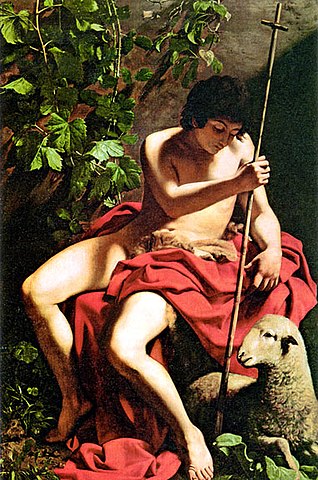
John the Baptist – Caravaggio

Today’s Gospel talks about the surprise conception of John, and all the drama surrounding his birth. Several other Gospel passages tell us about John’s preaching, his challenges to Herod, and his eventual martyrdom at the request of Salome. These are worth a read today, if you have a little time, just to be reacquainted with this extraordinary man.

http://www.usccb.org/bible/matthew/3

http://www.usccb.org/bible/matthew/11

http://www.usccb.org/bible/matthew/14


John the Baptist was the living bridge between the Old Law and the New. He was the doorway from a religion of requirements to a religion of love. That bridge and doorway were built on a baptism of repentance in order to clear one’s heart to receive the Good News.


The magnificent Greek word for repentance is “metanoia” which indicates a turning of one’s mind and heart after realizing a new truth. Metanoia is to have awareness dawn on us, and to feel sorrow for our former blindness or hardness of heart.

May our prayer today help us to receive the grace of metanoia wherever our spirits are hardened or closed – or just plain deadened by routine. May we hear the Baptist calling to us, “Prepare your hearts – EVERYDAY- for the Lord. There is always room for you to be surprised by God.”


Poetry: Song of Zechariah – Irene Zimmerman, OSF

At the circumcision of his son,
relatives and neighbors came
to speak for Zechariah of the tied
tongue. The child, they concurred,
would bear his worthy father’s name.
But during her husband’s silence,
old Elizabeth had found her voice.
“His name will be John,” she said. 

Why this strange, unprecedented choice,
the relatives and neighbors wondered.
Armed with writing instrument,
back they went to poor, dumb Zechariah.
But during the long confinement,
as young Mary and Elizabeth
spoke about the missions of their sons,
he had listened and grown wise.
Straightaway, he wrote: “His name is John.”
He caught Elizabeth’s smiling eyes,
felt his old tongue loosen, found his voice,
sang of God’s tender mercy,
sang of the breaking dawn,
sang of the prophet, their son,
who would make straight the way
for the long awaited One.

Music: Ut Queant Laxis ( English translation below)

“Utqueant laxis” or “Hymnus in Ioannem” is a Latin hymn in honor of John the Baptist written in Horatian Sapphics and traditionally attributed to Paulus Diaconus, the eighth-century Lombard historian. It is famous for its part in the history of musical notation, in particular solmization (do-re-mi-fa-so-la-ti-do). The hymn is sung to a Gregorian chant, and introduces the original do-re-mi music.

1. O for your spirit, holy John, to chasten
Lips sin-polluted, fettered tongues to loosen;
So by your children might your deeds of wonder
Meetly be chanted.

2. Lo! a swift herald, from the skies descending,
Bears to your father promise of your greatness;
How he shall name you, what your future story,
Duly revealing.

3. Scarcely believing message so transcendent,
Him for a season power of speech forsaketh,
Till, at your wondrous birth, again returneth,
Voice to the voiceless.

4. You, in your mother’s womb all darkly cradled,
Knew your great Monarch, biding in His chamber,
Whence the two parents, through their offspring’s merits,
Mysteries uttered.

5. Praise to the Father, to the Son begotten,
And to the Spirit, equal power possessing,
One God whose glory, through the lapse of ages,
Ever resounding. Amen.

Radical Prayer

Thursday of the Eleventh Week in Ordinary Time
June 22. 2023

Today’s Readings:

https://bible.usccb.org/bible/readings/062223.cfm

Today, in God’s Lavish Mercy, Jesus teaches us how to pray.

Jesus said to his disciples:
“In praying, do not babble like the pagans,
who think that they will be heard because of their many words.
Do not be like them.
Your Father knows what you need before you ask him.

“This is how you are to pray:
‘Our Father…

Matthew 6:7-9

Don’t babble …”. Gosh, haven’t you wanted to say that to a few people when they ramble around the point without ever making it! And here we have Jesus saying it to us, kindly and instructively, but nonetheless directly.


This morning, I was thinking about the quality of my own prayer, realizing that every now and again I do babble a lot of nonsense to God before coming to a point of grateful adoration and listening.

And then I remembered a brief clip of conversation from yesterday.

One of the blessings of living in our large Motherhouse is that I am surrounded by wise and holy women steeped in decades of deepening prayer. One of these beloved elders chatted with me last night about her recent retreat. She said, “It was such a peaceful time to pray. And I really wanted to pray… me and God, God and me.” The joyful sincerity and clarity of her statement blessed me with an equal desire to pray that simply.


In today’s Gospel, Jesus opens the door for us to this kind of radical prayer.

It is a prayer which:
grants us the privilege of calling heaven down to earthOur Father who art in heaven
basks in God’s awesome Presencehallowed be thy name
invokes that Presence to unfold Love’s designthy Kingdom come,
thy will be done,
on earth as it is in heaven.
It is a prayer of:
consistent trustGive us this day our daily bread
willing repentanceand forgive us our trespasses
unmeasured forgiveness as we forgive those who trespass against us
and a quenchless hunger for graceand lead us not into temptation,
but deliver us from evil.

Jesus is teaching us how to pray. His prayer is simple, authentic, and direct. He begins by naming his relationship with God, Abba, Father – an act of humble, intimate mutuality. How do we speak to God in our prayer? How do we name God in the deep silence of our hearts? Father, Mother, Beloved, Sweet Light, Tender Mercy? And by what name does God call me in the quiet rhythm of prayer? Perhaps with words, or with unwordable love.


Poetry: Praying – Mary Oliver

It doesn't have to be
the blue iris, it could be
weeds in a vacant lot, or a few
small stones; just
pay attention, then patch

a few words together and don't try
to make them elaborate, this isn't
a contest but the doorway

into thanks, and a silence in which
another voice may speak.

Music: Prayer – Ernest Bloch

“Nigun” means a traditional synagogue melody, with tones that Jesus might have heard as he prayed.

The Heart to Give My All

Memorial of Saint Aloysius Gonzaga, Religious
Wednesday, June 21, 2023

Today’s Readings:

https://bible.usccb.org/bible/readings/062123.cfm


Today, in God’s Lavish Mercy, Paul and Jesus give us some tips on sound Christian living.

Paul instructs us to live out of our abundance rather than our scarcity.

Brothers and sisters, consider this:
whoever sows sparingly will also reap sparingly,
and whoever sows bountifully will also reap bountifully.
Each must do as already determined, without sadness or compulsion,
for God loves a cheerful giver.
Moreover, God is able to make every grace abundant for you,
so that in all things, always having all you need,
you may have an abundance for every good work.

2 Corinthians 9:6-8

It seems like responding to Paul’s challenge shouldn’t be hard for those of us who actually have an abundance of this world’s goods and benefits. But I think sometimes it is.

It’s pretty easy to assess our generosity when we look at money or physical goods. It’s clear when I give someone in need $5.00 or a warm shirt. What’s not so clear is how generous I am , both locally and globally, with non-material goods like my prayer, respect, time, service, patience, understanding, forgiveness, tolerance, appreciation, encouragement or the many hidden awarenesses that might make someone else’s life more gracefully abundant.


Jesus tells us that if we offer these invisible generosities, we will be divinely enriched:

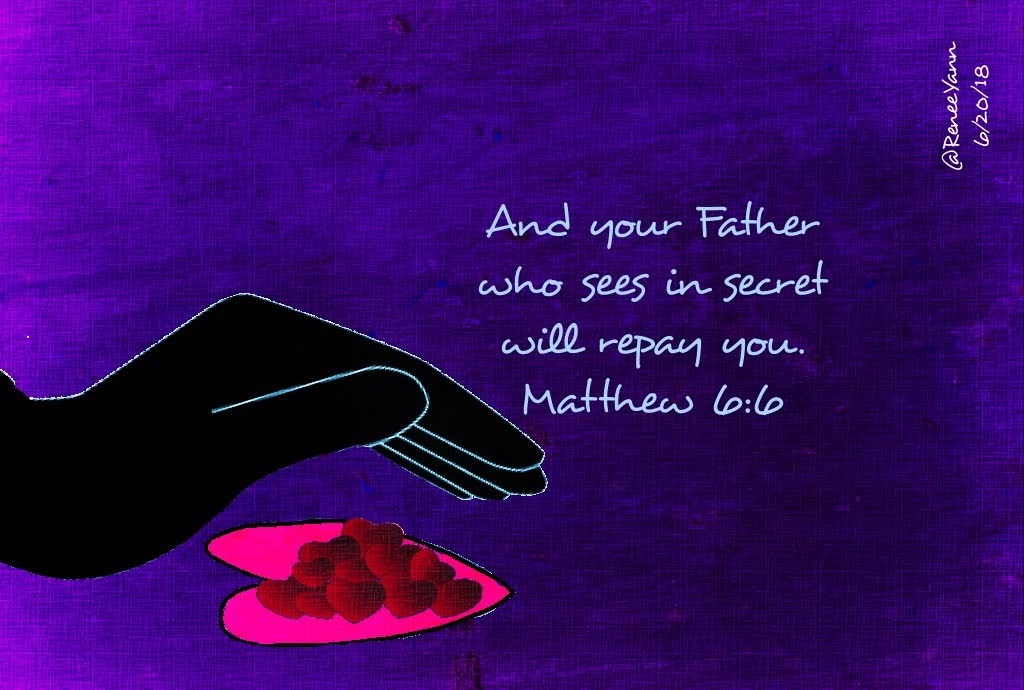
… your Father who sees what is hidden will repay you.


Jesus also expects us to make that offering. Notice that, when describing good works, Jesus doesn’t say “IF” you do these things. He says “WHEN” you do them:

When you give alms, do not blow a trumpet before you…
when you give alms,
do not let your left hand know what your right is doing,
so that your almsgiving may be secret.
And your Father who sees in secret will repay you.


When you pray, do not be like the hypocrites,
who love to stand and pray on street corners …
when you pray, go to your inner room, close the door,
and pray to your Father in secret.
And your Father who sees in secret will repay you.


When you fast, do not look gloomy like the hypocrites …
when you fast, anoint your head and wash your face,
so that you may not appear to others to be fasting,
except to your Father who is hidden.
And your Father who sees what is hidden will repay you.”


Many of us are embarrassingly blessed in this life. Living gratefully is the first step to easing that embarrassment and turning it into spiritual self-knowledge. That deep gratitude will strengthen us for quiet, joyous generosity and the recognition that all our true abundance belongs to God.


Prose: from Gitanjali 50 – Rabindranath Tagore

I had gone a-begging from door to door in the village path, when thy golden chariot appeared in the distance like a gorgeous dream and I wondered who was this King of all kings!

My hopes rose high and methought my evil days were at an end, and I stood waiting for alms to be given unasked and for wealth scattered on all sides in the dust.

The chariot stopped where I stood. Thy glance fell on me and thou camest down with a smile. I felt that the luck of my life had come at last. Then of a sudden thou didst hold out thy right hand and say “What hast thou to give to me?”

Ah, what a kingly jest was it to open thy palm to a beggar to beg! I was confused and stood undecided, and then from my wallet I slowly took out the least grain of corn and gave it to thee.

But how great my surprise when at the day’s end I emptied my bag on the floor to find a least little grain of gold among the poor heap. I bitterly wept and wished that I had had the heart to give thee to my all.

Music: Soul Food – Dean Evenson

The Other Cheek

Monday of the Eleventh Week in Ordinary Time
June 19, 2023

Today’s Readings:

https://bible.usccb.org/bible/readings/061923.cfm


Today, in God’s Lavish Mercy, Matthew hits us right between the eyes with one of the most difficult Gospel passages to defend, to explain, and – most certainly – to practice.

Jesus said to his disciples:
“You have heard that it was said,
An eye for an eye and a tooth for a tooth.
But I say to you, offer no resistance to one who is evil.


“Oh, wow’, we might think. “Did Jesus have any idea what kind of a world I’d be living in someday?!”


Violence is so rampant in our society that some of us have stopped looking at the news because we can’t stand it! Here in the U.S., we are traumatized by statistics around the number and kind of artillery in our neighborhoods and who dies as a result – children, worshippers, movie-goers, picnickers. Are these the “enemy” for whom we have designed our lethal weapons?

We see gunpoint carjackings, drive-by shootings, and unlicensed militia defending their political prejudices. We see children afraid to go to school. Mothers afraid to go shopping. Believers afraid to go to their place of worship. We have even seen an assault on the American government stoked by a nationalistic rhetoric of hostility, hatred, and aberrant machismo.

There are so many guns now on American streets that we may think the best response is to carry our own. The “law” allows that. We may consider ourselves valiant if we “stand our ground”, legally shooting some innocent bystander who happened to wander onto our property or drive into our traffic lane!

So what, in God’s Name, does this Gospel have to say to us who have descended almost beyond recue into the chasm of violence?


Remember, Jesus has just finished talking about the Law. He has assured his followers that he has come to fulfill the Law rather than to abolish it. Jesus honors and recognizes the Law as the framework that has held in place Israel’s centuries-long relationship with God.

But Jesus indicates that following the letter of the Law while not fulfilling its spirit is contradictory to the Reign of God. We can use the “law” as an excuse for our complacency – keeping in place those unexamined tenets that make us comfortable, rich, and more powerful to the detriment of others. This is what the Pharisees and Saducees had done.


In each of the five situations listed in today’s Gospel, Jesus isn’t telling us to lie down like a doormat and let ourselves be walked on. What he’s saying is that with God’s help, there is a better way, a deeper response that we can give to the conflicts in our lives.

Jesus encourages his followers not to meet the other with resistance. So often, resistance is our first defense rather than patience, negotiation, honesty, listening, or forgiveness. Jesus is asking us to stand still for a moment before lashing back – and in that moment move toward a more graced and courageous resolution. He is counseling us to listen, to imagine mutuality, and to work together for an equilibium of justice with mercy.

It must be admitted that sometimes this just doesn’t seem to work. Those with the power to make positive change can block the way, just as they did for Jesus. We can end up looking like “losers” – or even die – like Jesus did. But even though he had the power – the Omnipotence to do so – Jesus did not resist. If we really understand the Paschal Mystery and believe in the Resurrection, we will know why, and we will try to imitate him.


So where do we start? I think it starts with:

  • the level of reverence in our everyday interactions,
  • our attitudes toward “the other” – someone different from me in race, ethnicity, religion, sexuality, nationality, economic status, or opinion.
  • with our efforts toward reasonable gun legislation, educational equity for all children, universally available mental health services, and the eradication of abysmal poverty in our cities.

Can I do something to advance these changes? Not all by myself. But as a community of faith, Christians can bring amazing influence to these issues. Today’s Gospel is telling me to act on that belief.


Poem: Some – Daniel Berrigan, SJ

Some stood up once and sat down.
Some walked a mile and walked away.
Some stood up twice and sat down
I’ve had it, they said.
Some walked two miles and walked away
It’s too much, they cried.
Some stood and stood and stood.
They were taken for dummies
They were taken for fools
They were taken for being taken in.
Some walked and walked and walked.
They walked the earth
They walked the waters
They walked the air.
Why do you stand?
they were asked, and
Why do you walk?
Because of the children, they said, and
Because of the heart, and
Because of the bread.
Because
the cause
is the heart’s beat
and the children born
and the risen bread.

Music: Where Have All the Flowers Gone – written by Pete Seeger, sung by Joan Baez

God Has Always Been in Love with Us!

Eleventh Sunday in Ordinary Time
January 18, 2023

Today’s Readings:

https://bible.usccb.org/bible/readings/061823.cfm


Today, in God’s Lavish Mercy, our beautiful readings this Sunday paint the picture of a God Who is eternally in love with us.

The writer of Exodus twenty-five hundred years ago knew this.

Then the LORD called to Moses and said,
“Thus shall you say to the house of Jacob;
tell the Israelites:
You have seen for yourselves how I treated the Egyptians
and how I bore you up on eagle wings
and brought you here to myself.
Therefore, if you hearken to my voice and keep my covenant,
you shall be my special possession,
dearer to me than all other people
,
though all the earth is mine.

Exodus 19:3-5

Yes, God is eternally in love with us. Paul knew this when he wrote to the Romans about a half-century after Jesus lived on earth.

For Christ, while we were still helpless,
yet died at the appointed time for the ungodly.
Indeed, only with difficulty does one die for a just person,
though perhaps for a good person one might even find courage to die.
But God proves his love for us in that
while we were still sinners Christ died for us
.

Romans 5:6-8

And Matthew knew that God is eternally in love with us when he recorded this memory of his beloved Jesus:

At the sight of the crowds, Jesus’ heart was moved with pity for them
because they were troubled and abandoned,
like sheep without a shepherd.
….
Jesus sent out these twelve after instructing them thus,
“Do not go into pagan territory or enter a Samaritan town.
Go rather to the lost sheep of the house of Israel.
As you go, make this proclamation: ‘The kingdom of heaven is at hand.’
Cure the sick, raise the dead, cleanse lepers, drive out demons.

Matthew 9:36; 10:5-8

If God has loved us this long and this much, isn’t it time for us to really love God back?

In the above situations, and in our own lives, all that God ever asks for is faithfulness – through ups and downs, through ins and outs – God longs for our unwavering relationship.

A deep loving relationship like that requires our complete attention toward the Beloved.

How’re you doing with that?

It’s a question I’ll be asking myself – and God – in my prayer today.


Poetry: from Love’s Fire: Re-Creations of Rumi by Andrew Harvey

It is He who suffers his absence in me 
Who through me cries out to himself.
Love’s most strange, most holy mystery--
We are intimate beyond belief.

Music: The Everlasting Love of God – Matt Boswell and Matt Papa

Come to Me

Solemnity of the Most Sacred Heart of Jesus
June 16, 2023

Today’s Readings:

https://bible.usccb.org/bible/readings/061623.cfm

Today, in God’s Lavish Mercy, we hear Moses tell the People:

You are a people sacred to the LORD, your God;
he has chosen you from all the nations on the face of the earth
to be a people peculiarly his own.

Deuteronomy 7:6

We modern readers may be a little put off by the use of the word “peculiar” which, since the 16th century, has taken on the connotation of “odd” or “uncommon”. But the original meaning of the word is “to belong exclusively to one person“, as in “Honey, I love you and you belong to me!” Moses is telling Israel that this is the way God loves them.


Below is a song many us will remember. Maybe as teenagers we even did the “Stroll” to its dulcet tones. The love described in this song is but a pale shadow of the love God has for us, and the longing sung about is but a weak imitation of God’s longing for us. Listen to it and let God sing to you – singing around the words and into the meaning behind them.

Thinking of God as we listen to a song like this can make God very human. And, of course, that is exactly who Jesus Christ is. Jesus loves us with a human heart and a divine love. He loves us with a Sacred Heart.


All love is refined and proven in sacrifice. Jesus testified to his infinite love for us in his Passion, Death and Resurrection. In that miracle of redemptive love, God embraces, strengthens and commissions us. We are to love as God loves – to have hearts themselves made sacred by imitation of Christ.

“Come to me, all you who labor and are burdened,
and I will give you rest.
Take my yoke upon you and learn from me,
for I am meek and humble of heart;
and you will find rest for yourselves.
For my yoke is easy, and my burden light.”

Matthew 11:28-30

Prose: In the late 17th, St. Margaret Mary Alacoque shared her vision of Christ’s Sacred Heart. In a book of her writings published after her death we read:

Christ showed me that it was His great desire
to be loved by human beings
and of withdrawing them from the path of ruin
that made Him form the design
of manifesting His Heart to us,
with all the treasures of love, of mercy, of grace,
of sanctification and salvation which it contains,
in order that those who desire
to render Him and procure Him
all the honor and love possible,
might themselves be abundantly enriched
with those divine treasures
of which His heart is the source.

Devotion to the Sacred Heart was fostered by the Jesuits and Franciscans, but it was not until the 1928 encyclical Miserentissimus Redemptor by Pope Pius XI that the Church validated the credibility of St. Margaret Mary’s visions of Jesus Christ in having “promised her that all those who rendered this honor to His Heart would be endowed with an abundance of heavenly graces.”

( see: https://sacredheartfla.org/sunday-mornings/seasonal/feast-days-solemnities/the-solemnity-of-the-most-sacred-heart-of-jesus/


Music: Empty Space – Jose Mari Chan