The Darks and Lights of Scripture

Saturday of the Nineteenth Week in Ordinary Time
August 19, 2023

Today’s Readings:

https://bible.usccb.org/bible/readings/081923.cfm


Today, in God’s Lavish Mercy, we have the last of our readings from the Book of Joshua, writings that tell the story of Israel from the conquest of Canaan to the Babylonian exile. Joshua is a difficult book to read for at least two reasons: it is dull and boring, and it is full of brutality and violence.

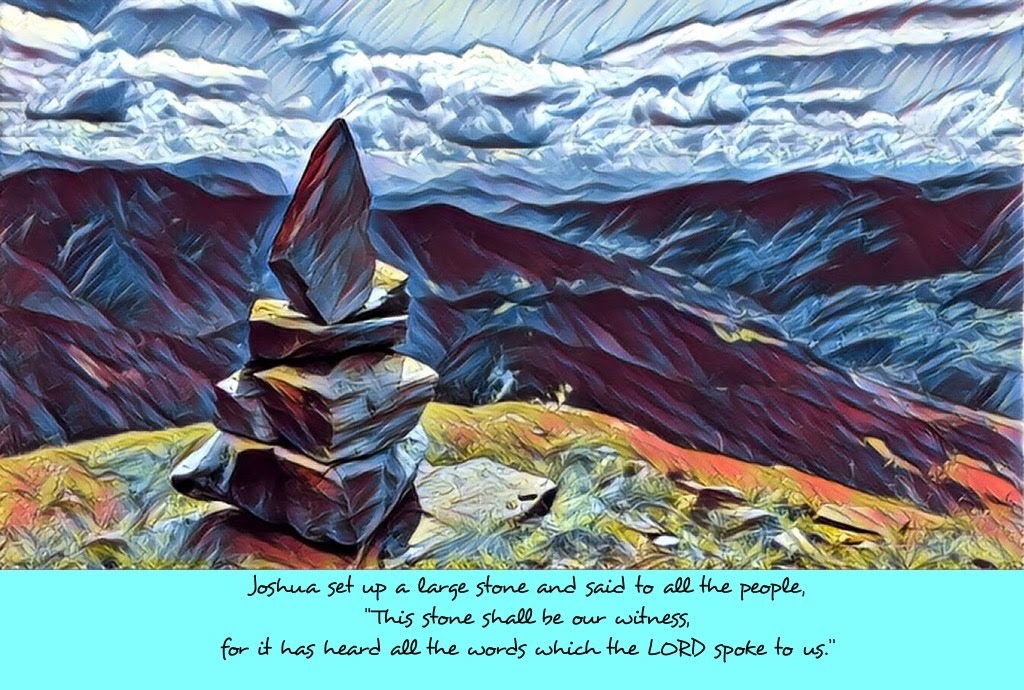
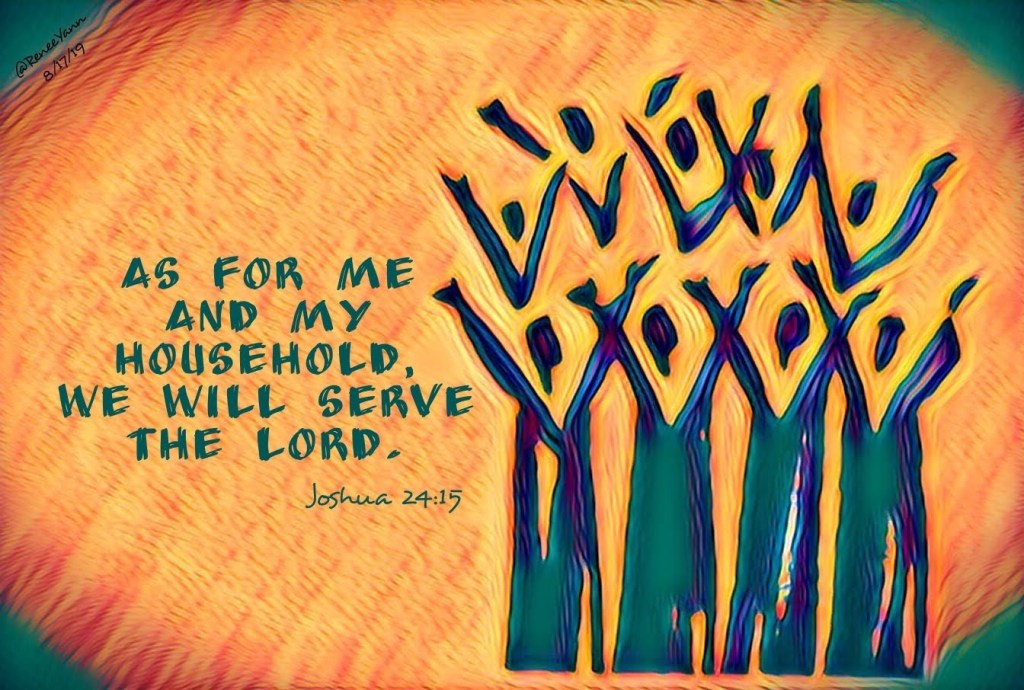
Modern scholars tend to agree that the bloody battles described in Joshua never happened and that the Book should be viewed more as legend or myth. So why is it even included in the Bible to which we look for inspiration in building a peaceful and just world? It is hard work to find nuggets of this kind of inspiration in the Book of Joshua! (But there are a few, I must admit. Here is one of my favorites:)


Actually, the Book of Joshua is not alone in the challenges it tosses at its readers.. There are many passages in the Hebrew Scriptures that might cause us to flinch at their tone or violence. They are particularly upsetting when they implicate God as a condoner of such violence.

God’s tone in today’s passage might strike us in this way:

Joshua in turn said to the people,
“You may not be able to serve the LORD, for he is a holy God;
he is a jealous God who will not forgive
your transgressions or your sins.
If, after the good he has done for you,
you forsake the LORD and serve strange gods,
he will do evil to you and destroy you.

Joshua 24:19-20

When I read that passage I say to myself, “Wait a minute, Joshua!!! That’s not the God I know and love. So what can this passage teach me?”

Feminist theologian Carolyn Sharp writes that Joshua has “important potential to draw contemporary communities of faith into reflection on their own subjectivity, the power dynamics that energize and fracture their common life, and their need for robust and ongoing reformation. Joshua remains a disturbing book, and the first step toward ethical appropriation of its truth is to acknowledge that.”


We may choose to skip over disturbing and confusing passages like some found in Joshua. But the Church includes some of them in the liturgical readings because every scripture passage has something to teach us – just like every person has something to teach us.

From some people, we learn what we want to be like in life. And from others we learn exactly the opposite. So it is with scripture. Reading with a critical eye and a converted heart, we can benefit both from the positive and the negative energy in various Bible passages. And, as Christians, we must read all Scripture in the ultimate light of Jesus Christ and his Gospel.


Of course, as we pray with Scripture, we more readily appropriate those passages that touch our spirits with light and joy. We have such a passage in today’s Gospel:

Children were brought to Jesus
that he might lay his hands on them and pray.
The disciples rebuked them, but Jesus said,
“Let the children come to me, and do not prevent them;
for the Kingdom of heaven belongs to such as these.”
After he placed his hands on them, he went away.

Matthew 19:13-15

Poetry: God’s Grandeur – Gerard Manley Hopkins

The world is charged with the grandeur of God.
It will flame out, like shining from shook foil;
It gathers to a greatness, like the ooze of oil
Crushed. Why do men then now not reck his rod?
Generations have trod, have trod, have trod;
And all is seared with trade; bleared, smeared with toil;
And wears man’s smudge and shares man’s smell: the soil
Is bare now, nor can foot feel, being shod.
And for all this, nature is never spent;
There lives the dearest freshness deep down things;
And though the last lights off the black West went
Oh, morning, at the brown brink eastward, springs—
Because the Holy Ghost over the bent
World broods with warm breast and with ah! bright wings.

Music: Speak, O Lord – Stuart Townend

Transfigured before Them

Feast of the Transfiguration of the Lord
August 6, 2023

Today’s Readings:

https://bible.usccb.org/bible/readings/080623.cfm

Today, in God’s Lavish Mercy, on this glorious Feast of the Transfiguration, we pray with Psalm 97 which prophesies the messianic era when God will reign supreme over the earth. Its verses announce God’s sovereignty, the establishment of justice, and universal joy.

Transfiguration by Giovanni Bellini

Our Gospel describes the moment when Jesus gave his three disciples a glimpse of that future glory in order to sustain them through the sufferings to come.

Jesus took Peter, James, and his brother, John,
and led them up a high mountain by themselves.
And he was transfigured before them;
his face shone like the sun
and his clothes became white as light…

Matthew 17:1-2

As we pray Psalm 97 today, we might think of our experiences of God’s beauty, tenderness, and joy. Remembering and storing these small, accumulated revelations helps us to hold faith in times of darkness or trouble.

In Martin Luther King’s final speech the night before he was assassinated, he spoke of his own transfiguring moments and the courageous faith they inspired in him:

Well, I don’t know what will happen now. We’ve got some difficult days ahead. But it doesn’t matter with me now. Because I’ve been to the mountaintop. And I don’t mind. Like anybody, I would like to live a long life. Longevity has its place. But I’m not concerned about that now. I just want to do God’s will. And He’s allowed me to go up to the mountain. And I’ve looked over. And I’ve seen the promised land. I may not get there with you. But I want you to know tonight, that we, as a people, will get to the promised land. And I’m happy, tonight. I’m not worried about anything. I’m not fearing any man. Mine eyes have seen the glory of the coming of the Lord.


Also in our prayer today, we are mindful of the anniversary of the atomic bombings of Hiroshima and Nagasaki, events which represent the complete inversion of God’s will for the Peaceful Kingdom.

Majesty, turned inside out by our sin, becomes terror.

Oppenheimer is a popular film showing in theaters right now. Robert Oppenheimer, one of the designers of the atomic bomb, reflecting on the bomb’s first test, said that as he watched the huge blast wave ripple out over the New Mexico desert, a line from the Hindu scripture Bhagavad Gita came to mind: “Now I am become Death the Destroyer of Worlds.


Psalm 97 reminds us that all Creation belongs to God:

The LORD is king; let the earth rejoice;
let the many islands be glad.
Clouds and darkness are round about him,
justice and judgment are the foundation of his throne.

Psalm 97:1-2

If, by faith, we learn to see and reverence God’s glory in all things, we can be delivered from the terrors of war, racism, and every other deathly weapon which threatens us. As Psalm 97 so encouragingly closes:

You who love the LORD, hate evil,
God protects the souls of the faithful,
rescues them from the hand of the wicked.
Light dawns for the just,
and gladness for the honest of heart.
Rejoice in the LORD, you just,
and give thanks at the remembrance of his holiness.

Psalm 97:10-12

Poetry: Origami by Joyce Sutphen 

In Hiroshima’s Peace Park there is a statue of Sadako Sasaki lifting a crane in her arms. Sadako was two years old when the atomic bomb was dropped; she was diagnosed with leukemia ten years later. The Japanese believe that folding a thousand origami cranes brings good fortune. Sadako spent the last months of her young life folding hundreds of paper cranes. She folded 644 before she died.


Origami

It starts 
with a blank sheet,
an undanced floor,

air where no sound
erases the silence.
As soon as

you play the first note,
write down a word,
step onto the empty stage,

you've moved closer
to the creature inside.
Remember—

a square
can end up as frog, cardinal,
mantis, or fish.

You can make
what you want,
do what you wish.

Music: Our God Reigns – James Kilbane

How lovely on the mountains

Are the feet of him

Who brings good news,good news

Announcing peace, proclaiming

News of happiness.

Our God reigns; our God reigns!

Chorus:

Our God reigns!

Our God reigns!

Our God reigns!

Our God reigns!

He had no stately form;

He had no majesty,

That we should be

drawn to Him.

He was despised,

and we took no account of Him,

Yet now He reigns

With the Most High.

Out of the tomb He came

With grace and majesty;

He is alive, He is alive.

God loves us so see here His hands,

His feet, His side.

Yes, we know

He is alive.

Outside the Lines

Memorial of Saint John Vianney, Priest
Friday of the Seventeenth Week in Ordinary Time
August 4, 2023

Today’s Readings:

https://bible.usccb.org/bible/readings/080423.cfm


Today, in God’s Lavish Mercy, we dip our toes into the Book of Leviticus which is basically a set of instructions on how to live a good life.

Leviticus 23 establishes five holy times of prayer, reflection, and action for the people to grow in friendship with God.

  • the Sabbath (vv. 1–3)
  • the Feast of the Unleavened Bread, or Passover (vv. 4–14)
  • the Feast of Weeks, or Pentecost (vv. 15–23);
  • on the Day of Atonement (vv. 26-32)
  • the Feast of the Tabernacles (vv.33-44)

As Christians, we may be more familiar with Sabbath and Passover because their patterns are embodied in our Sunday and Easter celebrations. In the other less familiar feasts, we might recognize harvest sharing (Weeks), repentance (Atonement), reflection and recommitment (Tabernacles).


The Book of Leviticus is a formation manual for Israel’s spiritual life. Realizing that fact this morning, I thought about my Novitiate and early formation experiences in religious life. Readers who are religious sisters or brothers might share my experience, and those who are lay can probably think of their own comparisons. What were our earliest steps in our journey into God?

I wasn’t completely clueless when I came to the convent at 18 years of age. I did have a vigorous spiritual life and a deep desire to grow in relationship with God. What I needed was spiritual discipline and a quiet reverence in my whole being. And, in those early years, I received abundant amounts of both from multiple sources. It was my “Leviticus Time”.


But our “Leviticus Time” is only a launchpad. If we refuse to leave it, we will never fly. What we must move on to is a personal relationship with God, grounded in loving faith and Gospel commitment. While enhanced by exterior resources, the power of that relationship springs from an interior intimacy with God, as realized so clearly by our saint for today, John Vianney.


Today’s Gospel shows us a group of people unable to take that next step – beyond rules and practices into committed relationship. (“beyond” not “without” rules and practices – more on that in tomorrow’s reflection)

Jesus came to his native place and taught the people in their synagogue.
They were astonished and said,
“Where did this man get such wisdom and mighty deeds?
Is he not the carpenter’s son?
Is not his mother named Mary
and his brothers James, Joseph, Simon, and Judas?
Are not his sisters all with us?
Where did this man get all this?”
And they took offense at him.
But Jesus said to them,
“A prophet is not without honor except in his native place
and in his own house.”
And he did not work many mighty deeds there
because of their lack of faith.

Matthew 13:54-58

This is such a sad Gospel! Here God was right in the midst of these people! They could see him and hear him. He personally invited them to believe. But they refused to see God in Jesus. All they could see was their stagnated prejudgments and inert definitions.

These were probably good people. They more than likely kept all the Leviticus regulations. They colored within the lines, so to speak. Then Jesus came and asked them to step outside the lines. He asked them to believe that the poor are blessed and the persecuted happy. He asked them to cast their nets again into a sea that had denied them all night. He asked them to walk to him across the water. He asked them to sell everything they had and follow. He asked them to fall into the ground and die, as he would.

Only a courageous few set their safe scroll of Leviticus aside to give Jesus a wholehearted “Yes”.

What might we have done — what are we doing — when Jesus invites us outside the lines?


Poetry: Of Being – Denise Levertov

I know this happiness
is provisional:

the looming presences --
great suffering, great fear --

withdraw only
into peripheral vision:
but ineluctable this shimmering
of wind in the blue leaves:
this flood of stillness
widening the lake of sky:
this need to dance,
this need to kneel:
this mystery:

Music: Only You

Something a little different this morning – a picture to contemplate while you listen to a beautiful song. Just click the little white arrowhead in the grey bar below. Let the song take you where it will in your own spiritual landscape.

image by David Mark from Pixabay

Little Things Mean a Lot

Memorial of Saint Ignatius of Loyola, Priest
Monday of the Seventeenth Week in Ordinary Time
July 31, 2023

Today’s Readings:

https://bible.usccb.org/bible/readings/073123.cfm


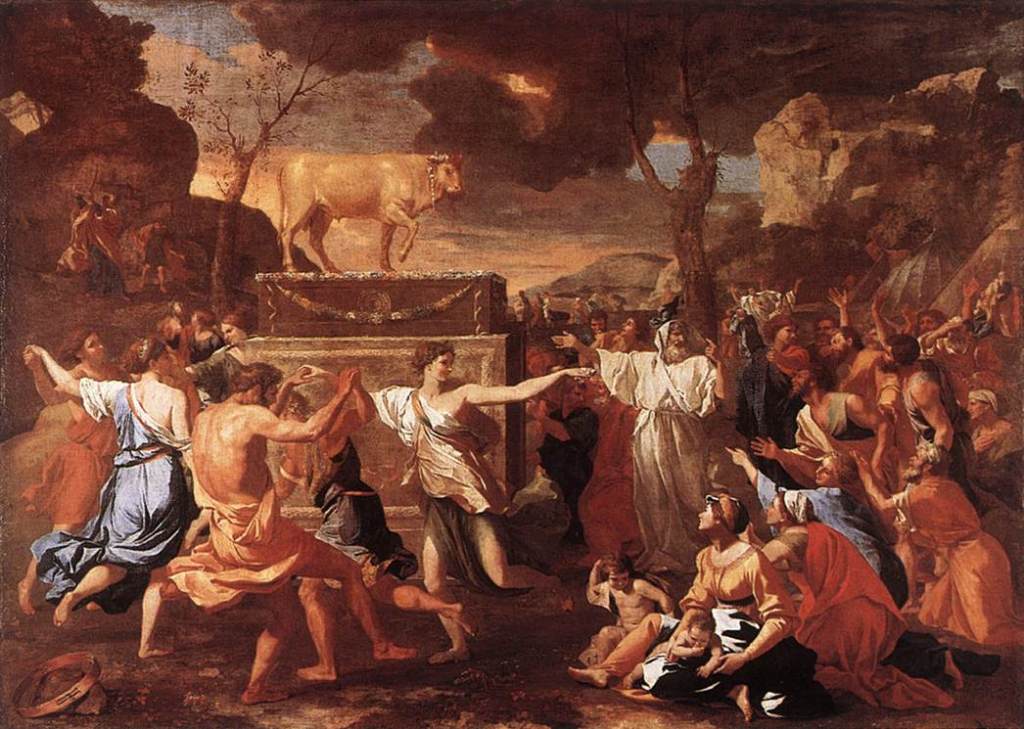
The Adoration of the Golden Calf – Nicholas Poussin

Today, in God’s Lavish Mercy, Aaron, brother of Moses, gets an “F” as a substitute teacher. While Moses is on the mountain negotiating with God for Israel’s future, Aaron caves to the people’s demands and assists them in creating an idol – the infamous “golden calf”.

As Walter Brueggemann says, “All it takes is a little gold to make a god”:

All you need in order to make a god is a measure of the substance that is most valuable in the community, in this case gold…and a mold that can shape the gold. The mold readily available to Aaron is a calf, well, better a “bull” – a symbol and embodiment of virility and fertility, the strength, power, and capacity to generate new life! All you need to make a god is a little gold and a pattern of vitality and fertility that bespeaks self-sufficiency,

Walter Brueggemann – from a Sunday sermon delivered in 2020

Moses was on the mountain for forty days. In his absence, and with God’s silence, the people became frightened. They felt powerless. In that powerlessness, they had a choice: to believe that God would be true to God’s word, or to construct an alternate god of their own design, one that made them feel powerful again. They made the wrong choice.


Praying with this passage today, we might ask ourselves what we do when circumstances render us powerless. What do we do when God seems silent and the supports we have trusted disappear or fail? What do we do when there seems to be no answer to our prayers?

And what is the substance, as Bruegemann notes, most valued in my various communities – the substance most likely to be turned to an idol: reputation, status, resources, influence, political power, physical strength or appearance?

Do we make the mistake of thinking things like this: My power rests in my money, or my looks, or my family name, or my business success, or my intelligence, or my intimidating reputation?

When it comes to the fundamental needs of our lives, none of these things can empower us. Every one of them can fail or disappear. Our only true power lies in God’s unfailing love for us and will for our good. That power is always with us but can be accessed only through faith.


Our Gospel tells us that all one needs is a little faith to ground oneself in the power of God’s love and fidelity..

Jesus proposed a parable to the crowds.
“The Kingdom of heaven is like a mustard seed
that a person took and sowed in a field.
It is the smallest of all the seeds,
yet when full-grown it is the largest of plants.
It becomes a large bush,
and the birds of the sky come and dwell in its branches.”

Matthew 13:31-32

I saw a great graphic on Facebook the other day. It pictured an open hand reaching out with a small speck on the index finger. The caption read:

I have a mustard seed,
and I’m not afraid to use it.


In the absence of a malleable, obeisant god, Israel mistakes their wealth for their god. They mold it into a figure that appears to restore their control over their lives. But they end up with only a clump of unresponsive metal.

God is not a divine butler waiting at the doorway for our next command. The ever-presnt Holy One is sometimes thickly veiled within the circumstances of our lives. It takes faith to stay in relationship with our often silent, but nonetheless abiding God.

Our Gospel tells us that if we have even the smallest seed of that faith, it will root in us and sustain us. And even the smallest measure of “holy yeast” will ferment to the point that others will find in us the inspiration to believe.


Poetry: The Golden Calf by John Newton, (1725 – 1807) who was an English evangelical Anglican cleric and slavery abolitionist. He had previously been a captain of slave ships and an investor in the slave trade. He served as a sailor in the Royal Navy (after forced recruitment) and was himself enslaved for a time in West Africa. He is noted for being author of the hymns Amazing Grace and Glorious Things of Thee Are Spoken.

When Israel heard the fiery law,
From Sinai's top proclaimed;
Their hearts seemed full of holy awe,
Their stubborn spirits tamed.
Yet, as forgetting all they knew,
Ere forty days were past;
With blazing Sinai still in view,
A molten calf they cast.
Yea, Aaron, God's anointed priest,
Who on the mount had been
He durst prepare the idol-beast,
And lead them on to sin.
Lord, what is man! and what are we,
To recompense thee thus!
In their offence our own we see,
Their story points at us.
From Sinai we have heard thee speak,
And from mount Calv'ry too;
And yet to idols oft we seek,
While thou art in our view.
Some golden calf, or golden dream,
Some fancied creature-good,
Presumes to share the heart with him,
Who bought the whole with blood.
Lord, save us from our golden calves,
Our sin with grief we own;
We would no more be thine by halves,
But live to thee alone.

Music: Amazing Grace


Sowers of Goodness

Memorial of Saints Joachim and Anne,
Parents of the Blessed Virgin Mary
Wednesday of the Sixteenth Week in Ordinary Time
July 26, 2023

Today’s Readings:

https://bible.usccb.org/bible/readings/072623.cfm


Mary with Joachim and Anne – Pietro Ayers


Today, in God’s Lavish Mercy, we pray with Anne and Joachim, parents of Mary, Mother of Jesus. Praying with them is challenging because we know little or nothing about this holy couple. Their names appear nowhere in the Bible. There are no canonical readings about them. So how can we imagine what they might have been like in order to imitate their spirituality?

What we have come to venerate as the miraculous story of Anne and Joachim comes to us primarily from the 2nd century apocryphal Gospel of St. James which is part of the New Testament Apocrypha.

The term “Apocrypha” refers to scores of manuscripts written about Christ and early Christianity which, for any number of reasons, have not been included in the scriptural canon – the Bible as we know it.


If you are interested in learning more about these books, their influence, and why they are not part of the cureent canon, this Wikipedia article is a great place to start. I found it fascinating:

https://en.wikipedia.org/wiki/New_Testament_apocrypha


For our prayer today, we might think of Anne and Joachim in the light of our passage from Matthew. We are quite familiar with the image of the “sower” as someone working in a field for the purpose of a successful crop.

But let’s expand that image to be one who “sows” good deeds – righteousness – within the fields of family, neighbohood and world. This was Anne and Joachim’s work which generated the wholesome being who was Mary. This then was the work of Mary who was the mothering cradle for the Incarnation. Their lives, fertile with goodness, were the life-giving fields for the first-fruits of Christ.


The kind of seed we sow, and how we sow it, matters, as our Gospel tells us:

A sower went out to sow.
And as he sowed, some seed fell on the path,
and birds came and ate it up.
Some fell on rocky ground, where it had little soil.
It sprang up at once because the soil was not deep,
and when the sun rose it was scorched,
and it withered for lack of roots.
Some seed fell among thorns, and the thorns grew up and choked it.
But some seed fell on rich soil, and produced fruit,
a hundred or sixty or thirtyfold.
Whoever has ears ought to hear.

Matthew 13:3-9

Most of us went out many years ago to “sow” in our life’s field. Certainly the seed, good or bad, has fallen on a number of both hospitable and inhopitable places. Reflecting today, and committing for the future, we might look to this first Holy Family. Their stories buried deeply in history, still by their fruits we know them. Such fruit yields from grace planted in faithful hearts. Let’s ask them to help us be their imitators.


Prose Prayer: My mother had great devotion to St. Anne and, when our family had a need, often made an offering through the Shrine of St. Anne de Beaupre in Canada. Mom and I would recite this prayer together, especially on Tuesday which an old tradition dedicates to St. Anne. When Mom passed away on a Tuesday, I felt it was a special gift and that surely St. Anne came to accompany her to heaven.


Music: Lamb of God from the Mass of St. Ann composed by Ed Bolduc who is Director of Music at St. Ann’s Parish in Marietta, Georgia. I was familiar with the Gloria but not other parts of the composition. I thought this Lamb of God was appropriate for today’s feast because it sounds like a lullaby good St. Anne might sing to her Grandchild.

Good Ground for Hope

Sixteenth Sunday in Ordinary Time
July 23, 2023

Today’s Readings:

https://bible.usccb.org/bible/readings/072323.cfm


Today, in God’s Lavish Mercy, our readings revolve around the dynamic of hope – God’s hope planted in our spirits and our hope entrusted to God’s Mercy.

As we pray with these passages, it helps to remind ourselves of the true definition of “hope”. It is a word that many of us use carelessly to the point that we may have lost the power of its meaning – as in when we say things like, “I hope it doesn’t rain”. What we really mean is that we wish it wouldn’t rain.

Hope is not the same as wishing. Wishing is a mental activity that has no power to make its object come true. Hope, on the other hand, is a resident condition of our spirits that frees us to live with enthusiasm and gratitude despite whatever outcome may arise.

Wishing dissapates when conclusions pass. Hope is eternal because it draws its energy from faith in God’s Infinite Mercy and the promise of eternal life.


The Book of Wisdom’s author understood the Source from which hope springs:

Though you are master of might, you judge with clemency,
and with much lenience you govern us;
for power, whenever you will, attends you.
And you taught your people, by your deeds,
that those who are just must be kind;
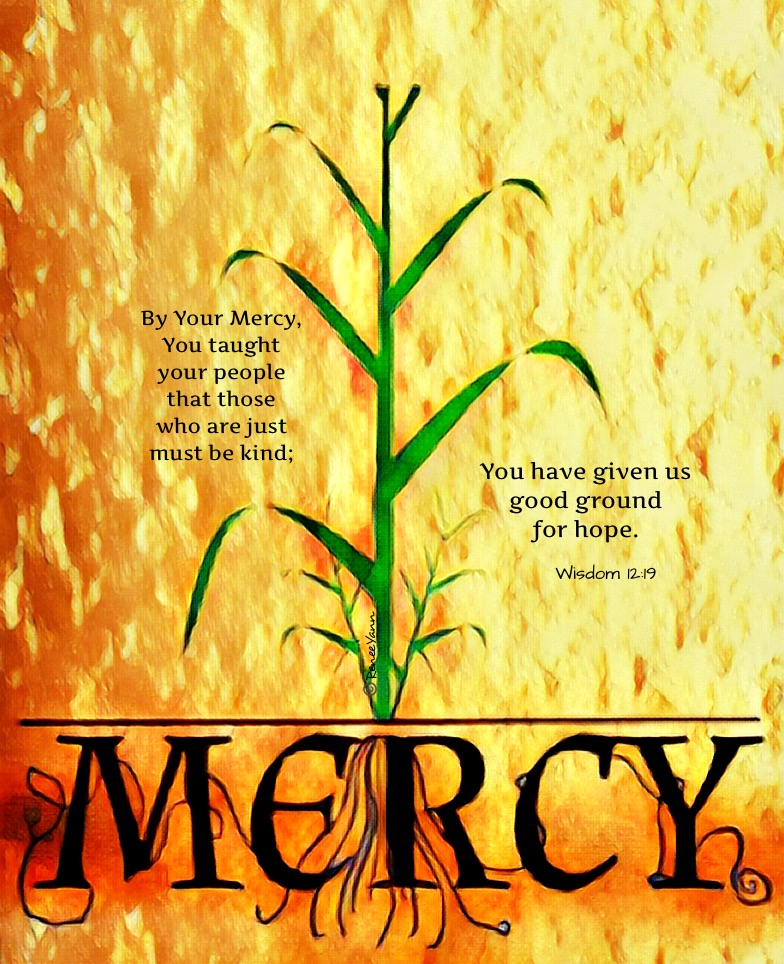
and you gave your children good ground for hope
that you would permit repentance for their sins.

Wisdom 12:18-19

Paul, in another passage from magnificent Romans 8, acknowledges that we can sustain hopeful hearts only by the power of the Holy Spirit who lifts us up and prays within us when we are too overwhelmed to do so ourselves.

The Spirit comes to the aid of our weakness;
for we do not know how to pray as we ought,
but the Spirit intercedes with inexpressible groanings. 
And the one who searches hearts
knows what is the intention of the Spirit,
because Spirit intercedes for the holy ones
according to God’s will.

Romans 8:26-27

Jesus gives us a great parable for understanding hope. How discouraged might that farmer have been when the enemy tried to ruin his crop! But instead, the farmer realized that his field, like life, can sustain both the wheat and the weeds. If we live hopefully and faithfully, the wheat can be gathered from the harvest, and the weeds ultimately cast aside.


How many times in our own lives have we nearly been overwhelmed by the weeds! There is no life which passes without its hurts, disappointments, confusions, and dashed wishes! Some experience a sparse scattering of these weeds, and some lives are thick with difficulty. How surprising that it is often in the latter circumstance that hope rises up and sustains hearts.


As our Responsorial Psalm reminds us, those who live simply and sincerely are most able to tap deeply into the mysterious power of hope.

Blessed are you, Father, Lord of heaven and earth;
you have revealed to little ones the mysteries of the kingdom.


Poetry: From “Odes” – George Santayana was a Spanish-American philosopher known more for his aphorisms than his poetry. He came up with lines like, ‘Those who cannot remember the past are doomed to repeat it”, and “Fanaticism consists in redoubling your effort when you have forgotten your aim.”

IV

Slowly the black earth gains upon the yellow,
And the caked hill-side is ribbed soft with furrows.
Turn now again, with voice and staff, my ploughman,
Guiding thy oxen.
Lift the great ploughshare, clear the stones and brambles,
Plant it the deeper, with thy foot upon it,
Uprooting all the flowering weeds that bring not
Food to thy children.
Patience is good for man and beast, and labour
Hardens to sorrow and the frost of winter.
Turn then again, in the brave hope of harvest,
Singing to heaven.

Music: Weed and Wheat – Silayio Kirisua is a Maasi woman who represented Kenya in the Voice of Holland singing competition. After winning the competition, she has become an international sensation.

Magdalene, Disciple of Christ

Feast of Saint Mary Magdalene
July 22, 2023

Today’s Readings:

https://bible.usccb.org/bible/readings/072223.cfm


(This is a “repeat post”, but I think it’s worth the repeat. I hope you agree.)

Today, in God’s Lavish Mercy, we pray with St. Mary Magdalene, disciple of Christ.

Massimo_Stanzione,_Mary-Magdalene_in_meditation
Magdalen in Meditation by Massimo Stanzione

Modern scripture scholarship recognizes Mary Magdalene as a disciple and companion of Jesus.  She is present in stories throughout all four Gospels, and most notably, as one who remained with Jesus at the foot of the Cross. Mary is the first witness to the Resurrection who then announces the Good News to the other disciples.

Over the centuries, Mary Magdalene has been confused with the many other Marys in the Gospel, as well as with the unnamed repentant woman who washes Jesus’ feet with her tears. These confusions have inclined us to think of Mary Magdalene as a reformed prostitute. This erroneous concept has supported a diminished understanding of the role of women in the ministry of Jesus and done a huge disservice to Mary’s vital role as beloved disciple.

The Gospel passage for the feast captures the powerful moment when the Resurrected Jesus is first revealed to the world. The scene also portrays the deep love, trust and friendship between Jesus and Mary Magdalene – a relationship which serves as a model for all of us who want to be Christ’s disciples. I imagined the scene like this in an earlier Easter reflection:

 Rabbouni

 The Upper Room on Holy Saturday evening: a place filled with sadness, silence and seeking. Jesus was dead. Jerusalem, scattered to their various houses to keep Shabbat, murmur their shocked questions under their shaky prayers.

 We have all been in rooms like this. They enclose a special kind of agony – one teetering between hope and doubt, between loss and restoration. It may have been a surgical waiting room or the hallway outside the courtroom. Sometimes, such a space is not bricks and mortar.  It is the space between a sealed envelope and the news inside. It is the hesitant pause between a heartfelt request and the critical response. In each of these places, we exist as if in a held breath, hoping against hope for life, freedom, and wholeness.

 It was from such a room that Mary Magdalene stole away in the wee hours. A woman unafraid of loneliness, she walked in tearful prayer along the path to Jesus’ tomb. Scent of jasmine rose up on the early morning mist. Hope rose with it that his vow to return might be true. Then she saw the gaping tomb, the alarm that thieves had stolen him to sabotage his promise. She ran to the emptiness seeking him. She was met by angels clothed in light and glory, but they were not enough to soothe her.

 Turning from them, she bumped against a gardener whom she begged for word of Jesus, just so she might tend to him again. A single word revealed his glory, “Mary”. He spoke her name in love.

 As we seek the assurance of God’s presence in our lives, we too may be unaware that God is already with us. The deep listening of our spirit, dulled with daily burdens, may not hear our name lovingly spoken in the circumstances of our lives. God is standing behind every moment. All we need do is turn to recognize him.

 Turn anger into understanding. Turn vengeance into forgiveness. Turn entitlement into gratitude. Turn indifference into love. All we need do is turn to recognize him.


For a comprehensive and enlightening lecture on the current theological and scriptural thinking on Mary Magdalen, follow this link to an Elizabeth Johnson, CSJ lecture at Fordham.

Click here for lecture


Music: I Know That My Redeemer Liveth

The Passover of the Lord

Friday of the Fifteenth Week in Ordinary Time
July 21, 2023

Today’s Readings:

https://bible.usccb.org/bible/readings/072123.cfm


Today, in God’s Lavish Mercy, we hear the familiar tones of the central Exodus story.

Waiting for Easter Vigil

As we prayerfully read this passage, we may be carried back to the many Holy Saturday liturgies we have attended in our lives. In our memories, it is early spring, the evenings are still dark, and chapel is barely lit. We know the momentous story we are about to hear and re-enact. We believe it is brought to fruition in the sacramental liturgy we are about to offer. And, within all the memories, all the rituals, and all the words, one phrase stands out:

It is the Passover of the Lord.

“This is how you are to eat the lamb:
with your loins girt, sandals on your feet

and your staff in hand,
you shall eat like those who are in flight.
It is the Passover of the LORD.


Walter Brueggemann says that, in the act of “passover”, the community chooses to move on from its prohibitive existence to a new way of being. It chooses an alternative that requires “departure”:

That alternative is not easy or obvious or automatic. It requires a departure, an intentional departure from that system that the Bible terms “exodus.” In that ancient narrative the Israelites did not want to go, and once they had gone they wished to resubmit to Pharaoh. The departure is a piece of demanding, sustained work. The capacity to think and imagine and act and live beyond that system requires imagination that has dimensions of the psychological, the economic, and the liturgical. Indeed, the core liturgy of Israel (Passover) and the derivative liturgies of the church are practiced departures that now and then take on reality in the world.

Walter Brueggemann: Journey to the Common Good

In our reading from Matthew, and continually throughout the Gospel, Jesus invites his community to a profound “departure” – to a new understanding of the Law as love not requirement.

When the Pharisees criticize the hungry disciples for plucking and eating grain heads on the Sabbath, Jesus confronts them:

I say to you, something greater than the temple is here.
If you knew what this meant, I desire mercy, not sacrifice,
you would not have condemned these innocent men.
For the Son of Man is Lord of the sabbath.”

Matthew 12:7-8

Something greater than the Temple?????? The Pharisees stare at Jesus in stunned amazement! Could such a thing be possible?

Our Gospel tells us that not only is it possible, it is reality. The “Temple” and the old Law had lost their heart to the belief that personal power and affluence trumped human need. Their “systems” for becoming holy had become vacuous.

Jesus teaches that gaining sanctity requires that we live in mercy toward ourselves and others. Rituals, Temples, Churches and codes of conduct are meaningless unless they direct us always to act in mercy. When these same institutions and practices contradict God’s Mercy, we must have the courage for “departure” and “passover”.

“Departure” though does not mean abandonment. It means ceasing the merciless practices condoned by institutionalization, and having the courageous perseverance to build new paths to meaning.


It is clear in the Jewish practice of Passover that the exodus memory became a paradigmatic narrative through which all social reality is described and re-experienced. That is, the narrative pertains to a one-time remembered social upheaval caused by God’s holiness; but the narrative looks beyond that one-time memory to see that the same transactions of oppression and emancipation continue everywhere to evoke holy power.

Walter Brueggemann, Journey to the Common Good

Every day of our lives, we are called to “passover” into greater spiritual awareness, merciful practice, and just living. We may hear the call in small personal interactions, or in the larger context of our fragmented world.

We are faced constantly with alternatives between (just to name a few):

  • selfishness or generosity
  • forgiveness or vengefulness
  • honesty or pretense
  • peacemaking or rabble-rousing
  • addiction or freedom
  • informed decision-making or arrogant ignorance
  • gossip or respect
  • action for the poor or indifferent comfort
  • political and economic elitism or social justice
  • respect fro Creation or utilitarian ignorance

The sacred bridge in each of these passovers is the Gospel of Jesus Christ. Choosing it wholeheartedly, we will arrive on the right side of God.


Poetry: Journey – by Mary Oliver

One day you finally knew
what you had to do, and began,
though the voices around you
kept shouting
their bad advice--
though the whole house
began to tremble
and you felt the old tug
at your ankles.
"Mend my life!"
each voice cried.
But you didn't stop.
You knew what you had to do,
though the wind pried
with its stiff fingers
at the very foundations,
though their melancholy
was terrible.
It was already late
enough, and a wild night,
and the road full of fallen
branches and stones.
But little by little,
as you left their voices behind,
the stars began to burn
through the sheets of clouds,
and there was a new voice
which you slowly
recognized as your own,
that kept you company
as you strode deeper and deeper
into the world,
determined to do
the only thing you could do--
determined to save
the only life you could save.

Music: Took Me Out of Egypt – David Baroni (lyrics below)

Lord I’m feel so empty seems like we’re so far apart
Even tho’ some may applaud me
You alone can see my heart
You don’t look at my achievements or my ability
All You really wants is all of me
And though it frightens me to give my control
There is only room for one King
In the throne room of my soul

Lord You took me out of Egypt
Now take Egypt out of me
You delivered me from Pharaoh
now set me free from me
Let my heart become a promised land
Where the desert used to be
Lord You took me out of Egypt
Now take Egypt out of me

Blessed are the pure in heart
For they shall see the Lord
But eyes that only look to earth
Will lose the rich reward
Of the fellowship eternal the blissful unity
Of the ones who live in Jesus
And no longer serve King Me

Lord You took me out of Egypt…….

Lord I love the gifts You’ve given me
But I love the Giver more
And to worship You more perfectly
That’s what those gifts are for

Lord You took me out of Egypt…….

Angels Hidden in the Bushes

Wednesday of the Fifteenth Week in Ordinary Time
July 19, 2023

Today’s readings:

https://bible.usccb.org/bible/readings/071923.cfm


Today, in God’s Lavish Mercy, our readings lead us to consider how God is present in our lives, calling us to deeper spiritual awareness and vitality.


In Exodus 3, Moses has fled Egypt and taken up a new, uneventful life, working for his father-in-law, napping by the sheepfold in Midian.

Meanwhile, Moses was tending the flock
of his father-in-law Jethro, the priest of Midian.


The text makes no notation that Moses is contemplating the gravity of his past experiences, nor seeking spiritual meaning from them. As a matter of fact, the first three chapters of Exodus make little reference to God, except for God’s faithfulness to the resistant midwives who saved Moses’ life.

Left up to Moses, no great theophanic event would be recorded in Exodus. It would simply be a story about a Midian shepherd too scared to go back to his old hometown. It was God Who made the magic happen in Exodus, and oh, what magic it was!


We first have notice that God is about to act in the final verses of Exodus 2:

A long time passed (after Moses fled), during which the king of Egypt died. The Israelites groaned under their bondage and cried out, and from their bondage their cry for help went up to God.
God heard their moaning and God was mindful of the covenant with Abraham, Isaac and Jacob.
God saw the Israelites, and God knew….

Exodus 2: 23-25

Because God knew – and always knows – our sufferings and joys, God cares and is present to us in our lives. We are not always aware of that Divine Accompaniment, as perhaps Moses was unaware in his Midian field.

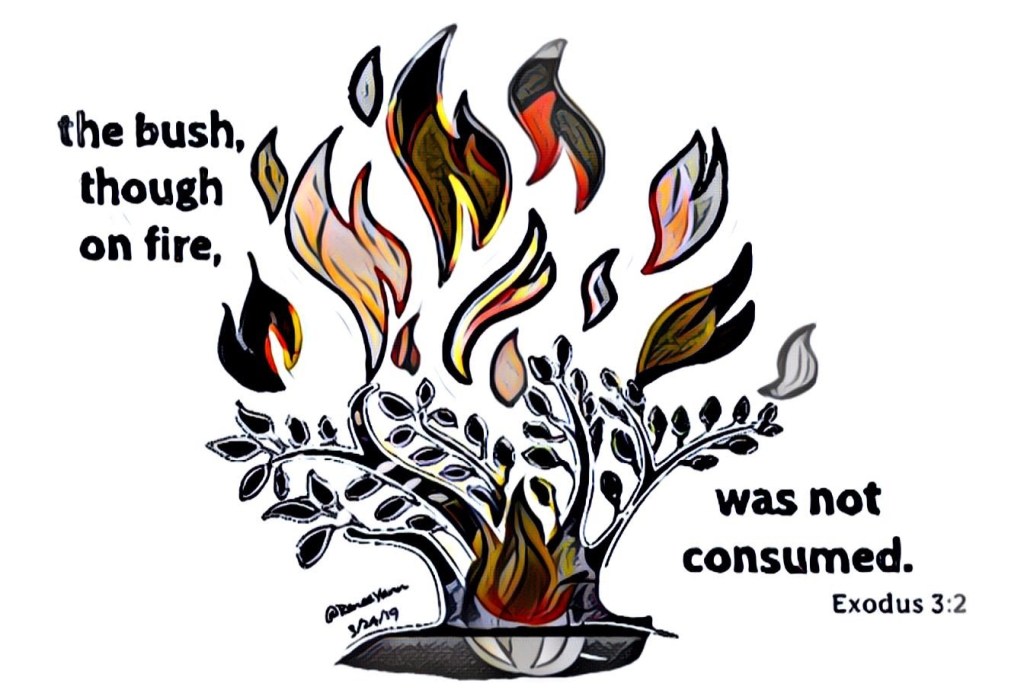
God woke Moses up with a burning bush. Then, by sharing his Name, God invited Moses to the deep spiritual intimacy which empowered him to act for God in the world.

God called out to him from the bush, “Moses! Moses!”
He answered, “Here I am.”
God said, “Come no nearer!
Remove the sandals from your feet,
for the place where you stand is holy ground.
I am the God of your father,” he continued,
“the God of Abraham, the God of Isaac, the God of Jacob.”


I think, for most of us, God is often hidden in our circumstances. I know I haven’t found too many buring bushes along life’s road. So what’s the secret to that deep spiritual awarnessthat allows us to live always in God’s Presence?

Jesus tells us in today’s Gospel that the secret is innocence.

At that time Jesus exclaimed:
“I give praise to you, Father, Lord of heaven and earth,
for although you have hidden these things
from the wise and the learned
you have revealed them to the childlike.


Spiritual innocence is not childish or uniformed. It is not faultless or naïve. The childlike quality Jesus describes is guileless, trusting, open, and wise. It waits in prayer and reflection for God’s time and movement. It believes despite doubt, and hopes despite setback.

Humble Moses – murderer, exile, and loafer on his in-law’s farm – had this kind of innocence. Like a wick awaiting kindling, Moses’s innocent heart caught fire with God. After that there was never an unnoticed “bush” in his life. After all, every one of them might contain angels!


Poetry: excerpt from Aurora Leigh by Elizabeth Barret Browning

But man, the two-fold creature, apprehends
The two-fold manner, in and outwardly,
And nothing in the world comes single to him.
A mere itself,–cup, column, or candlestick,
All patterns of what shall be in the Mount;
The whole temporal show related royally,
And build up to eterne significance
Through the open arms of God. 'There's nothing great
Nor small,' has said a poet of our day,
(Whose voice will ring beyond the curfew of eve
And not be thrown out by the matin's bell)
And truly, I reiterate, . . nothing's small!
No lily-muffled hum of a summer-bee,
But finds some coupling with the spinning stars;
No pebble at your foot, but proves a sphere;
No chaffinch, but implies the cherubim:
And,–glancing on my own thin, veined wrist,–
In such a little tremour of the blood
The whole strong clamour of a vehement soul
Doth utter itself distinct. Earth's crammed with heaven,
And every common bush afire with God:
But only he who sees, takes off his shoes,
The rest sit round it, and pluck blackberries,
And daub their natural faces unaware
More and more, from the first similitude.

Music: Burning Bush – Terrana and Manicardi

Burning bush You are, 
glowing and endless love. 
Living in Your midst, 
to live by You, 
to be alive in You. 

This Fire does not consume 
the essence of every person. 
You show Yourself in creation
in all of the beauty,  
that speaks and cries out Thee.

That You are Love 
in a flower, in the waves of the sea, 
in the dawn, in the song of a swan, 
in a kiss of a child to his mother 
in the farewell of a dying father. 

You are Love 
In a man who climbs the slope, 
In a woman who chooses life, 
In a star bursting with light, 
In the forgiveness that brings pain. 

You are earth, water, air and fire. 
Earth, water, air and fire. 

(Interlude)

Let’s take off our shoes 
in front of so much love. 
We need only to listen to 
the beautiful, the good, the true, 
That lies around us. 

For it’s Love
In a flower, in the waves of the sea,
in the dawn, in the song of a swan, 
in a kiss of a child to his mother
in the farewell of a dying father

It is Love
In a man who climbs the slope, 
In a woman who chooses life, 
In a star bursting with light,
In the forgiveness that costs pain

(Interlude)
repeat above
You are earth, water, air and fire
Earth, water, air and fire

The Promise Survives Deception

Saturday of the Thirteenth Week in Ordinary Time
July 8, 2023

Today’s Readings:

https://bible.usccb.org/bible/readings/070823.cfm

Today, in God’s Lavish Mercy, Genesis presents us with a story that may make us pick sides.

Jacob Deceives Isaac (Rebekah in back). James Jacques Joseph Tissot. c. 1896-1902.

(All I can say is that Esau must have been one hairy dude!)


Old, blind Isaac, sensing death on the horizon, dramatically prepares to hand over the promise to Esau. But his wife Rebekah has other ideas:

Rebekah then took the best clothes of her older son Esau
that she had in the house,
and gave them to her younger son Jacob to wear;
and with the skins of the kids she covered up his hands
and the hairless parts of his neck.
Then she handed her son Jacob the appetizing dish
and the bread she had prepared.

Genesis 27:15-17

It’s a fascinating and powerful narrative. I can see the movie trailer in my mind’s eye:

Watch as “The Promise” is passed to the wrong son
by means of his mother’s deception.


So is that what the story is about? Well, only on the surface.

The real story stars an Actor who is never mentioned in the script:

God, the Promise Keeper

This Bible passage teaches that God does not deviate from the Promise, no matter how the other players manipulate its unfolding. God performs the Promise despite human fiddling.


Friends, aren’t we just a little bit like Rebekah and Jacob? When our life’s dramas swirl around us, don’t we make every effort possible to salvage our own designs? It’s human nature, and it’s all good.

But all the same, God must smile at us and our sometimes frenzied efforts to control our lives. I think God smiled like that at Rebekah, covering her favorite son with smelly sheepskins so as to deceive her hungry husband.

Rebekah thought she had a better plan, but it was God’s plan all the time!

It takes some of us so long to realize that we can’t control much of our life. We can only engage our days, trusting that, as they unfold for us, they carry the promise and will of God for our hallowing.

By grace, we can learn to receive our lives as an infinite river of blessing, with all its natural turns. We can pray to trust that blessing when it is hidden in the curve of life’s shadows.


In our Gospel, the Baptist’s disciples are confused by Jesus’ behavior because it contradicts the old Law which offered them a controllable path to holiness.

Jesus tells them that the Law of Requirements is no longer sufficient. It is an old wineskin.
With the new wine of the Gospel, He is calling them to trust and enfold themselves in the Law of Love.

No one patches an old cloak with a piece of unshrunken cloth,
for its fullness pulls away from the cloak and the tear gets worse.
People do not put new wine into old wineskins.
Otherwise the skins burst, the wine spills out, and the skins are ruined.
Rather, they pour new wine into fresh wineskins, and both are preserved.

Matthew 9:16-17

Poetry: Late Ripeness – Czeslaw Milosz

Not soon, as late as the approach of my ninetieth year,
I felt a door opening in me and I entered
the clarity of early morning.
One after another my former lives were departing,
Like ships, together with their sorrow.
And the countries, cities, gardens, the bays of seas
assigned to my brush came closer,
ready now to be described better than they were before.
I was not separated from people,
grief and pity joined us.
We forget -- I kept saying -- that we are all children of
the King.
For where we come from there is no division
Into Yes and No, into is, was, and it will be.
We were miserable, we used no more than a hundredth part
of the gift we received for our long journey.
Moments from yesterday and from centuries ago --
a sword blow, the painting of eyelashes before a mirror
of polished metal, a lethal musket shot, a caravel
staving its hull against a reef -- they dwell in us,
waiting for a fulfillment.
I knew, always, that I would be a worker in the vineyard,
as are all men and women living at the same time,
whether they are aware of it or not.

Music: Piano and Flute Meditation – by Laura Sullivan