Come to Me

Solemnity of the Most Sacred Heart of Jesus
June 16, 2023

Today’s Readings:

https://bible.usccb.org/bible/readings/061623.cfm

Today, in God’s Lavish Mercy, we hear Moses tell the People:

You are a people sacred to the LORD, your God;
he has chosen you from all the nations on the face of the earth
to be a people peculiarly his own.

Deuteronomy 7:6

We modern readers may be a little put off by the use of the word “peculiar” which, since the 16th century, has taken on the connotation of “odd” or “uncommon”. But the original meaning of the word is “to belong exclusively to one person“, as in “Honey, I love you and you belong to me!” Moses is telling Israel that this is the way God loves them.


Below is a song many us will remember. Maybe as teenagers we even did the “Stroll” to its dulcet tones. The love described in this song is but a pale shadow of the love God has for us, and the longing sung about is but a weak imitation of God’s longing for us. Listen to it and let God sing to you – singing around the words and into the meaning behind them.

Thinking of God as we listen to a song like this can make God very human. And, of course, that is exactly who Jesus Christ is. Jesus loves us with a human heart and a divine love. He loves us with a Sacred Heart.


All love is refined and proven in sacrifice. Jesus testified to his infinite love for us in his Passion, Death and Resurrection. In that miracle of redemptive love, God embraces, strengthens and commissions us. We are to love as God loves – to have hearts themselves made sacred by imitation of Christ.

“Come to me, all you who labor and are burdened,
and I will give you rest.
Take my yoke upon you and learn from me,
for I am meek and humble of heart;
and you will find rest for yourselves.
For my yoke is easy, and my burden light.”

Matthew 11:28-30

Prose: In the late 17th, St. Margaret Mary Alacoque shared her vision of Christ’s Sacred Heart. In a book of her writings published after her death we read:

Christ showed me that it was His great desire
to be loved by human beings
and of withdrawing them from the path of ruin
that made Him form the design
of manifesting His Heart to us,
with all the treasures of love, of mercy, of grace,
of sanctification and salvation which it contains,
in order that those who desire
to render Him and procure Him
all the honor and love possible,
might themselves be abundantly enriched
with those divine treasures
of which His heart is the source.

Devotion to the Sacred Heart was fostered by the Jesuits and Franciscans, but it was not until the 1928 encyclical Miserentissimus Redemptor by Pope Pius XI that the Church validated the credibility of St. Margaret Mary’s visions of Jesus Christ in having “promised her that all those who rendered this honor to His Heart would be endowed with an abundance of heavenly graces.”

( see: https://sacredheartfla.org/sunday-mornings/seasonal/feast-days-solemnities/the-solemnity-of-the-most-sacred-heart-of-jesus/


Music: Empty Space – Jose Mari Chan

Jesus, the Eternal “Yes”

Memorial of Saint Anthony of Padua
June 13, 2023

Today’s Readings:

https://bible.usccb.org/bible/readings/061323.cfm


Today, in God’s Lavish Mercy, our readings are about Truth, Spiritual Vigor, Holy Light.

For the Son of God, Jesus Christ, whom we proclaimed to you
was not “yes” and “no,” but only “Yes”.
For however many are the promises of God,
their Yes is in Jesus Christ …

2 Corinthians 1:19-20

A good friend of mine has taught me a lot about “Yes”, the kind of “Yes” I think Paul is describing in this passage. Sometimes, as with all friends, we might need a favor from each other – picking up a quart of milk, typing out a letter, providing transportation to a doctor.

I usually begin such a request with the phrase, “Could you do ^ me a favor…?” Somewhere in between “do” and “me”, my friend always shouts, “YES!!!” even before she hears what the favor is. Her “Yes”, rooted in loving friendship, is complete, unqualified, and inexhaustible.


God’s “Yes” to us, incarnate in the Gift of Jesus Christ, is eternally complete, unqualified, and inexhaustible!

Wow! Just think about that! Believing it can release immense power in our relationship with God! It can drag our Light out from under the bushel basket and into the world which is aching in darkness!


Our Gospel today, which continues Jesus’ Sermon on the Mount, describes what a Christian looks like who is trying to live their own “yes” back to God.

Such a believer is like salt, like light, like an elevated city calling us higher.

  • Salt – which releases and accents the good already inherent in our nature
  • Light – which makes the sacred path discoverable even in life’s shadows
  • City on the hilltop – which not only assures us that the journey can be accomplished, but turns to beckon and encourage us in our climb

Poetry: love is a place – e.e.cummings

love is a place
& through this place of
love move
(with brightness of peace)
all places

yes is a world
& in this world of
yes live
(skillfully curled)
all worlds

Music: Salt and Light – Lauren Daigle

Blessed

Monday of the Tenth Week in Ordinary Time
June 12, 2023

Today’s Readings:

https://bible.usccb.org/bible/readings/monday-tenth-week-ordinary-time


Today, in God’s Lavish Mercy, we resume reading Matthew’s Gospel which will last all the way to the beginning of September. What a gift to spend the summer with Jesus as Matthew came to understand and proclaim him.

So who is the “Jesus of Matthew”? Matthew’s Jesus is the Messiah, the long-awaited fulfillment of God’s promise to Abraham, a promise woven throughout the Hebrew Scriptures. Matthew writes to an audience who believe in Christ but who are nevertheless steeped in the Jewish religion. Matthew is intent on showing Jesus as the fulfillment of all they have believed.

Matthew’s Jesus is very Jewish. He is the Promise realized, the Hope fulfilled, Salvation achieved.


But Matthew’s Jesus is also the Challenger, the Upsetter and the Revolutionary.

In his Gospel sermon today, Jesus asks his believers to invert their worldly thinking and to take on the new mind of God – a God who loves the losers more than the winners! In the Beatitudes, Jesus gives an astounding new meaning to the word ‘blessed”.

In the Sermon on the Mount, Jesus contradicted all human judgments and all nationalistic expectations of the kingdom of God. The kingdom is given to the poor, not the rich; the feeble, not the mighty; to little children humble enough to accept it, not to soldiers who boast that they can obtain it by their own prowess.

John R. W. Stott, The Message of the Sermon on the Mount

I’ve been reading the Beatitudes my whole life, and they still confound me. I can’t honestly say that I want to be poor, mourning, meek, hungry, or thirsty. The only way I have been able to comprehend the Beatitudes is when I have found them in someone else and they have been kind enough to teach me.

I found “Blessed are the poor in spirit” one morning where he lived on a steam vent in downtown Philadelphia. He taught me courage and honesty.

Blessed are those who mourn” was a brokenhearted young wife who taught me how to love by steadfastly caring for her dying husband during his hospice journey.

Blessed are the meek” was a Cuban exile physician who was barred from a U.S. medical license. He taught me by lovingly serving as an orderly in the E.R. where I worked.

Blessed are those who hunger for righteousness” was an old Franciscan sister who was arrested with me in the Nevada desert as we protested nuclear war. Authorities had to handcuff her to her walker so that she could remain standing in the holding cell in the wretched heat.

Blessed are the merciful” is the name of our sisters and nurses at our healthcare facility who teach me by their tireless tenderness toward those who suffer

Blessed are the pure of heart” has sat with me a thousand times to pray and discern God’s Spirit in our hearts

Blessed are the peacemakers” have walked beside me in protests, written letters, made phone calls, witnessed peace in their own lives

Blessed are the persecuted” are my Black, Latino, differently-abled, and LGBTQ friends who have both taught and forgiven me for my prejudices, stereotyping, and ignorance


Learning to really live the Beatitudes is key to the Christian life, and it is an ongoing education until the day we die. As we pray with today’s Gospel, may we receive abundant grace for our learning.


Poetry: The Beatitudes – Malcolm Guite

We bless you, who have spelt your blessings out,
And set this lovely lantern on a hill
Lightening darkness and dispelling doubt
By lifting for a little while the veil.
For longing is the veil of satisfaction
And grief the veil of future happiness
We glimpse beneath the veil of persecution
The coming kingdom’s overflowing bliss
Oh make us pure of heart and help us see
Amongst the shadows and amidst the mourning
The promised Comforter, alive and free,
The kingdom coming and the Son returning,
That even in this pre-dawn dark we might
At once reveal and revel in your light.

Music: The Beatitudes – John Michael Talbot

Blessed are the poor in spirit
Theirs is the kingdom of heaven
Blessed are those who mourn
They shall be comforted

Blessed are the lowly of heart
They shall inherit the earth
Blest are those who hunger for God
Nevermore shall they hunger or thirst

CHORUS:
Blessings upon the disciples of Jesus
Blessings upon al the multitudes
Blessings upon those who climb the mountain
With Jesus the Lord, with Jesus our Lord

Blessed are those who show mercy
They shall inherit the mercy of God
Blessed are the pure of heart
They shall see the face of God

Blest are those who strive for peace
They shall be the children of God
Blest are those who suffer for holiness
Theirs is the kingdom of God

Not Far

Thursday of the Ninth Week in Ordinary Time
June 8, 2023

Today’s Readings:

https://bible.usccb.org/bible/readings/060823.cfm

Today in God’s Lavish Mercy, our first reading invites us to a wedding and our Gospel shows us the way to heaven.

The marriage of Tobiah and Sarah is a nail-biter! Seven would-be husbands have already died in the honeymoon chamber! Sarah’s father is so convinced that Tobiah will be the eighth that, after the couple goes to bed, he digs a grave just in case. But Tobiah, like his father Tobit, is a good and just man. His heart is pure. Before they make love, Tobiah and Sarah pray and God hears their prayer, allowing Raphael to dispel the demon that has plagued Sarah’s earlier disastrous marriage attempts.


So what is happening here in terms of scriptural inspiration? Is this just a great beach book for the Jews scattered after the Assyrian captivity? Certainly not. The Book of Tobit offered spiritual stability to the uncertain world of the Jews in exile. In a clever story, the narrator outlines the essential guideposts for the believer to hold fast to their identity and faith – primarily with these concepts:

  • God is in charge and will remain faithful even if we do not. Imagine that!
  • Our faithfulness is demonstrated by religious fidelity, humility, prayer, patience and good works.
  • God’s faithfulness is demonstrated by bringing good even out of chaos and misfortune.

Our modern understandings are not that different from those of Tobit’s ancient author. In some sense, we all live “in exile”, at least from our final heavenly home. And God, of course, is still in charge. But we see God’s power in our lives not as preordained management but rather as a steadfast companionship in our own life’s unfolding drama.

Our life is not a book God has already written. In a mystery we cannot comprehend, our Omnipotent God chooses to live our lives with us, its direction unfolding as we continue to mature in God’s Love.


Our Gospel tells the story of a scribe deepening in that maturing process. He asks Jesus what is most important to live a good life. Jesus says what’s most important is love – love of God and love of neighbor. When the scribe responds in agreement, Jesus tells him that he is not far from the kingdom of God.

Perhaps our prayer today could be this: May deepening Love carry each of us all the way home to God’s heart.


Poetry: Heaven-Haven by Gerard Manley Hopkins

(A nun takes the veil)
I have desired to go
Where springs not fail,
To fields where flies no sharp and sided hail
And a few lilies blow.
And I have asked to be
Where no storms come,
Where the green swell is in the havens dumb,
And out of the swing of the sea.


Music: A Walk in Paradise – Darlene Koldenhaven

Sincerely

Tuesday of the Ninth Week in Ordinary Time
June 6, 2023

Today’s Readings:

https://bible.usccb.org/bible/readings/060623.cfm


Today, in God’s Lavish Mercy, our readings give us two examples of people talking to each other without communicating. Ever been there- just not quite on the same wavelength?

In the passage from Tobit, fiesty Anna brings home a bonus goat as a reward for her good work. Tobit, grumpy with the ill fortune of his blindness, accuses her of fencing stolen goods.

Anna said to me, “The goat was given to me as a bonus over and above my wages.”
Yet I would not believe her,
and told her to give it back to its owners.
I became very angry with her over this.
So she retorted: “Where are your charitable deeds now?
Where are your virtuous acts?
See! Your true character is finally showing itself!”

Tobit 2:14

Anna uses Tobit’s incalcitrance to make him take a good look at himself – his true character. She challenges another kind of blindness in Tobit beyond his physical challenges. He ultimately repents and prays for solace.


However, in our Gospel, a gang of antagonists intend to set a trap for Jesus. This is a whole different level of wavelength misalignment. Here, the questioners never had an intention to seek truth or come to mutual understanding.

Some Pharisees and Herodians were sent
to Jesus to ensnare him in his speech.
They came and said to him,
“Teacher, we know that you are a truthful man
and that you are not concerned with anyone’s opinion.
You do not regard a person’s status
but teach the way of God in accordance with the truth.

Mark 12:13-14

These two instances of fractious communication are differentiated by one key element: sincerity. Though out of alignment, both Anna and Tobit are sincere in their exchange. In our Gospel, only Jesus is sincere. His antagonizers use the reprehensible tool of gaslighting, attempting trap Jesus in his own words.


The Latin words “sine cera” mean ‘without wax”

“Sin-cere. Since the days of Michelangelo, sculptors had been hiding the flaws in their work by smearing hot wax into the cracks and then dabbing the wax with stone dust. The method was considered cheating, and therefore, any sculpture “without wax”—literally sine cera—was considered a “sincere” piece of art. The phrase stuck. To this day we still sign our letters “sincerely” as a promise that we have written “without wax” and that our words are true.”

Dan Brown, The Lost Symbol

How we communicate with one another affects how we build the kingdom of God together. The communication can be as ordinary as a couple’s banter, like Anna and Tobit. Or it can be as momentous as two cultures meeting in either resistance or transformation.

Our readings suggest that if we have not learned to practice sincerity even in small things, we will not have the awareness and spiritual freedom to practiice it in big things.


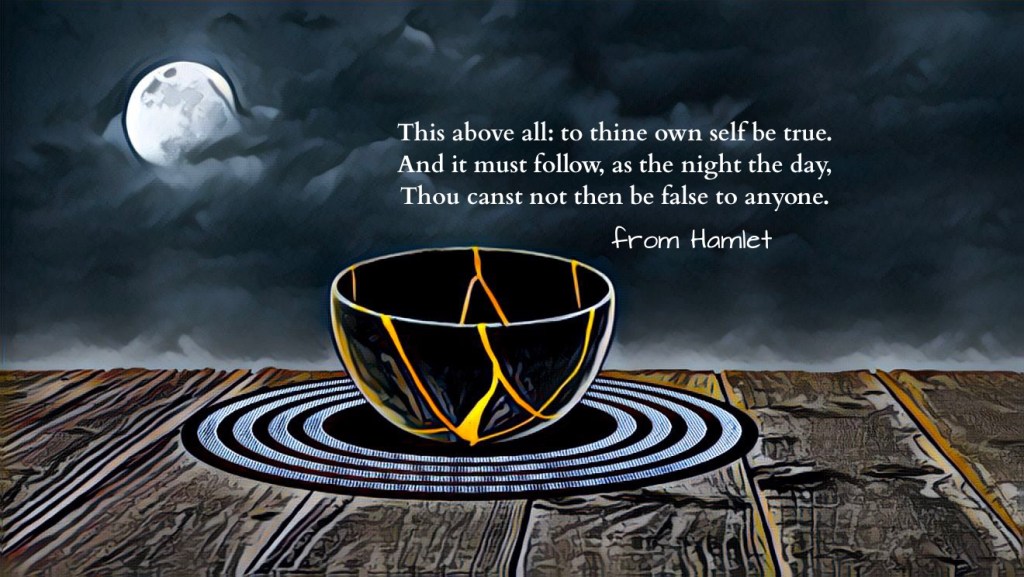
Poetry: “To thine own self be true” from Shakespeare’s Hamlet. Here, Polonius instructs his son, Laertes, as he leaves for college.

There, my blessing with thee.
And these few precepts in thy memory
Look thou character. Give thy thoughts no tongue,
Nor any unproportioned thought his act.
Be thou familiar but by no means vulgar.
Those friends thou hast, and their adoption tried,
Grapple them unto thy soul with hoops of steel,
But do not dull thy palm with entertainment
Of each new-hatched, unfledged comrade. Beware
Of entrance to a quarrel, but being in,
Bear ’t that th’ opposèd may beware of thee.
Give every man thy ear but few thy voice.
Take each man’s censure but reserve thy judgment.
Costly thy habit as thy purse can buy,
But not expressed in fancy—rich, not gaudy,
For the apparel oft proclaims the man,
And they in France of the best rank and station
Are of a most select and generous chief in that.
Neither a borrower nor a lender be,
For loan oft loses both itself and friend,
And borrowing dulls the edge of husbandry.
This above all: to thine own self be true,
And it must follow, as the night the day,
Thou canst not then be false to any man.
Farewell. My blessing season this in thee.

Music: To Thine Own Self Be True – Music by Brian Tate

And check out the just -for-fun extra song below.

Maybe you can imagine Anna singing this oldie but goodie to Tobit once they argued over the goat!

O My `Three’, My All

The Solemnity of the Most Holy Trinity
June 4, 2023

Today’s Readings:

https://bible.usccb.org/bible/readings/060423.cfm

Today, in God’s Lavish Mercy, we are wrapped in the loving mystery of the Holy Trinity. This mystery encompasses the Generative, Salvific, and Indwelling nature of the one true God.

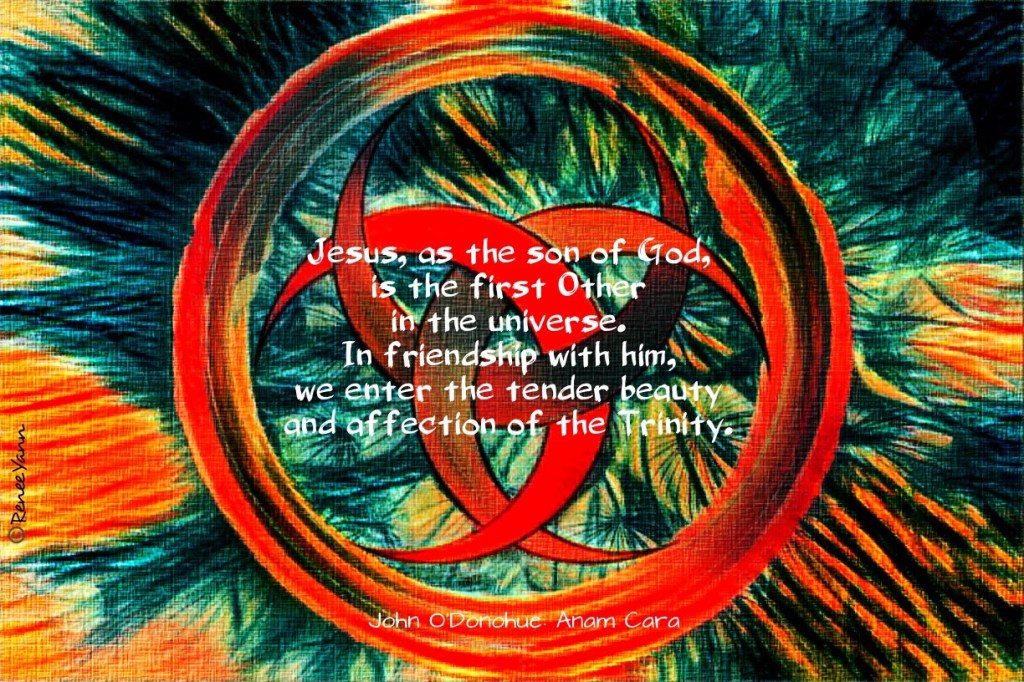
The Trinity is a mystery we approach with our hearts and souls, not with our minds. It is a Reality we fall in love with, and Which falls in love with us. John O’Donohue describes it like this:

The Christian concept of God as Trinity is the most sublime articulation of otherness and intimacy, an eternal interflow of friendship. This perspective discloses the beautiful fulfillment of our immortal longing in the words of Jesus, who said, Behold, I call you friends. Jesus, as the son of God, is the first Other in the universe. . . . In friendship with him, we enter the tender beauty and affection of the Trinity. In the embrace of this eternal friendship, we dare to be free.

from Anam Cara: A Book of Celtic Wisdom

In our first reading, Moses encounters the Creator, first Person of the Blessed Trinity and invites God into his company.

Having come down in a cloud, the LORD stood with Moses there
and proclaimed his name, “LORD.”
Thus the LORD passed before him and cried out,
“The LORD, the LORD, a merciful and gracious God,
slow to anger and rich in kindness and fidelity.”
Moses at once bowed down to the ground in worship.
Then he said, “If I find favor with you, O Lord,
do come along in our company.


In our second reading, Paul tells us how to invite God into our company:

Brothers and sisters, rejoice.
Mend your ways, encourage one another,
agree with one another, live in peace,
and the God of love and peace will be with you.


And in our Gospel, Jesus utters the iconic verse which is the foundation of our faith:

God so loved the world that he gave his only Son,
so that everyone who believes in him might not perish
but might have eternal life.


Each of our readings allows us to reflect on the wonder that we touch God in many different ways, just as God touches us.

  • Sometimes we invoke the Source of our life to guide and protect us.
  • At other times, we look to the Incarnate Word to teach us how to live.
  • Still there are other times when we reach deep into our hearts and pray without words in the Holy Spirit about things too deep to describe.

Prose: Prayer of St. Elizabeth of the Trinity – (excerpt from Drink of the Stream: Prayers of Carmelites compiled by Penny Hickey)

“O my God, Trinity whom I adore, let me entirely forget myself that I may abide in you, still and peaceful as if my soul were already in eternity; let nothing disturb my peace nor separate me from you, O my unchanging God, but that each moment may take me further into the depths of your mystery ! Pacify my soul! Make it your heaven, your beloved home and place of your repose; let me never leave you there alone, but may I be ever attentive, ever alert in my faith, ever adoring and all given up to your creative action.
O my beloved Christ, crucified for love, would that I might be for you a spouse of your heart! I would anoint you with glory, I would love you - even unto death! Yet I sense my frailty and ask you to adorn me with yourself; identify my soul with all the movements of your soul, submerge me, overwhelm me, substitute yourself in me that my life may become but a reflection of your life. Come into me as Adorer, Redeemer and Savior.
O Eternal Word, Word of my God, would that I might spend my life listening to you, would that I might be fully receptive to learn all from you; in all darkness, all loneliness, all weakness, may I ever keep my eyes fixed on you and abide under your great light; O my Beloved Star, fascinate me so that I may never be able to leave your radiance.
O Consuming Fire, Spirit of Love, descend into my soul and make all in me as an incarnation of the Word, that I may be to him a super-added humanity wherein he renews his mystery; and you O Father, bestow yourself and bend down to your little creature, seeing in her only your beloved Son in whom you are well pleased.
O my `Three', my All, my Beatitude, infinite Solitude, Immensity in whom I lose myself, I give myself to you as a prey to be consumed; enclose yourself in me that I may be absorbed in you so as to contemplate in your light the abyss of your Splendor!”

Music: Oh, Late Have I Loved You – Prayer of St. Augustine interpreted by Roc O’Conner, SJ

Don’t Miss Sirach!

Memorial of St. Justin, Martyr
June 1, 2023

Today’s Readings:

https://bible.usccb.org/bible/readings/060123.cfm

Today, in God’s Lavish Mercy, we pray with one of our last few readings from the Book of Sirach. On Saturday, we will finish this book and, on Monday, move on to the Book of Tobit.

Both Sirach and Tobit are considered deuterocanonical (or “second list”) books of the Bible. That’s a really big word that makes you sound smart but its meaning is simple. The term refers to a group of writings composed sometime in the 300 years before the birth of Christ. The Catholic Church considers them part of the Old Testament. Most Protestant denominations do not.

Therefore, my readers who are not Catholic may be unfamiliar with these books. The Protestant Bible is composed of the protocanonical (or “first list”) of books, the earlier texts which comprised the Hebrew scriptures. Catholic translations of the Bible include both proto and deutero books.


So who cares, you might be saying. Well, I think it’s helpful to realize that the formulation of what comprises the Bible was a fluid process. Jews, Catholics and Protestants mean different things when they say “my Bible”. We share many of the same readings, but may never have heard some others. Sirach and Tobit are good examples of those sometimes missed readings.


And what a shame it would be to miss the wise and lyrical Sirach who was a real poet writing around 200 years before Jesus was born. His work was preserved, popular and shared. Many references in the New Testament indicate that Jesus and the disciples were familiar with Sirach’s work. That’s cool, don’t you think? I like to think of Jesus listening to sacred stories or reading books like Sirach before he went to bed at night.


And maybe Jesus, as we might this morning, walked along the beach or sat by a dawn-lit window praying with these beautiful words:

Now will I recall God’s works;
what I have seen, I will describe.
At God’s word were his works brought into being;
they do his will as he has ordained for them.
As the rising sun is clear to all,
so the glory of the LORD fills all his works;
Yet even God’s holy ones must fail
in recounting the wonders of the LORD,
Though God has given these, his hosts, the strength
to stand firm before his glory.

Sirach 2:15-17

Our Gospel may lead us to pray with Bartimeus, begging for the kind of sight Sirach describes – an inner sight that comes from allowing God to plumb our hearts:

He plumbs the depths and penetrates the heart;
their innermost being he understands.
The Most High possesses all knowledge,
and sees from of old the things that are to come:
He makes known the past and the future,
and reveals the deepest secrets.

Sirach 42:18-19

Poetry: how about if we just enjoy more of Sirach’s elegant poetry

How beautiful are all God's works!
even to the spark and fleeting vision!
The universe lives and abides forever;
to meet each need, each creature is preserved.
All of them differ, one from another,
yet none of them has God made in vain,
For each in turn, as it comes, is good;
can one ever see enough of their splendor?

Music: Across the Universe – John Lennon and the Beatles

This song reminds me that God’s Universe is everlasting. Nothing will change God’s Presence to us. The phrase “Jai Guru Deva” is a Sanskrit phrase which can be translated “Glory to the Shining Remover of Darkness”, reminding us of Bartimeus’s experience of being healed from his blindness.

Do You Love Me?

Memorial of Saint Philip Neri, Priest
May 26, 2023

Today’s Readings:

https://bible.usccb.org/bible/readings/052623.cfm


Today, in God’s Lavish Mercy, we stand beside Peter as Jesus asks him the most important question of his life.

After Jesus had revealed himself to his disciples and eaten breakfast with them,
he said to Simon Peter,
“Simon, son of John, do you love me more than these?”

John 21:15

What was Jesus really getting at? Here they all are enjoying a nice breakfast on the beach. Their hearts are overjoyed to be in the presence of their Eastered Lord. Life must have felt good that sunny, post-Resurrection morning. And probably all that Peter really wanted out of life was another piece of fired fish or toasted bread, and for their seashore picnic to linger into an eternal evening.

Then here comes Jesus with his cosmic questions! What does he mean, “Do I love him”! Of course, I love him! Haven’t I hung around for three years trying to make this thing work, climbing out of my several missteps to try to be everything he wanted and needed? Oh my goodness, where is he going to call me now with this confusing question: Do you love me?


Yes, Jesus knows that Peter loves him in Peter’s way. He trusts Peter’s affection, devotion, and utter commitment to him. But Jesus’s question is pulling Peter way beyond the salted scents of that Tiberias beach. He wants Peter to love him in God’s way!

Jesus is calling Peter to a timeless answer and a transcendent love. What he is asking Peter is this:

  • Will you leave the man who was “Simon, son of John” to become “Peter, the Rock on which I build my Church”.
  • Will you love me to the point of giving yourself completely so that I may continue to love through you?

Today, as we settle into the sandy dunes with Jesus and his BFFs, Jesus might glance at us as he passes his smoked fish our way. His beautiful eyes might hold a question for us as well as for Peter. Through each of us, Jesus wants to continue to love the world into wholeness. Let’s ask his help in learning how to do that.


Maxim: from St. John of the Cross, a 16th century mystic, who understood Jesus’s eternal question and answered it in this way:

In the evening of our lives we will be judged on love.
Let us therefore learn to love God as God wishes to be loved.


Music: Fill the World with Love – from “Goodbye, Mr. Chips”, music and lyrics by Leslie Bricusse

In the morning of my life I shall look to the sunrise.
At a moment in my life when the world is new.
And the blessing I shall ask is that God will grant me,
To be brave and strong and true,
And to fill the world with love my whole life through.

And to fill the world with love
And to fill the world with love my whole life through.

In the noontime of my life I shall look to the sunshine,
At a moment in my life when the sky is blue.
And the blessing I shall ask shall remain unchanging.
To be brave and strong and true,
And to fill the world with love my whole life through.

And to fill the world with love
And to fill the world with love my whole life through.

In the evening of my life I shall look to the sunset,
At a moment in my life when the night is due.
And the question I shall ask only God can answer.
Was I brave and strong and true?
Did I fill the world with love my whole life through?

Did I fill the world with love?
Did I fill the world with love
My whole life through?

Amid Trumpet Blasts

The Ascension of the Lord
May 18, 2023

Today’s Readings:

https://bible.usccb.org/bible/readings/051823-Ascension.cfm

Today, in God’s Lavish Mercy, we pray with Psalm 47, one of seven enthronement psalms which celebrate a “coronation” of God.

All you peoples, clap your hands,
    shout to God with cries of gladness,
For the LORD, the Most High, the awesome,
    is the great king over all the earth.

Psalm 47: 1

Used for the feast of the Ascension, the point of the psalm is much more than an exercise of pageantry. It is an act of faith and reverence to God, the Loving Omnipotence who chose to redeem us by assuming our humanity.

It is a confirmation that we believers do see the Supreme Being in the human Jesus we have come to love. This is what Paul prays for the Ephesians in our second reading:

May the eyes of your hearts be enlightened,
that you may know what is the hope that belongs to his call,
what are the riches of glory
in his inheritance among the holy ones,
and what is the surpassing greatness of his power
for us who believe,
in accord with the exercise of his great might,
which he worked in Christ,
raising him from the dead
and seating him at his right hand in the heavens,
far above every principality, authority, power, and dominion,
and every name that is named
not only in this age but also in the one to come.

Ephesians 1:18-21

The Great Commission, found in today’s Gospel, is the true gift of the Ascension.

Go into the whole world
and proclaim the gospel to every creature.

Mark 16: 15

Jesus tells us that his time on earth is complete. The lesson of Incarnational Love has been taught. We now are given the power to continue the message for all time. 

Jesus promises that our faith will:


overcome evil
-create new possibilities to preach the Gospel
-show courage against antagonism
-resist suppression
-heal and strengthen others to believe

These signs will accompany those who believe:

-in my name they will drive out demons,
-they will speak new languages.
-They will pick up serpents with their hands,
-drink any deadly thing, it will not harm them.
lay hands on the sick, and they will recover.


If we believe and open our hearts to this message, indeed, it is a day for trumpet blasts! Here are a few from one of my favorite triumphal pieces! If the Apostles had only had trumpets, they might have played something like this for the Lord as He ascended 🙂


Poetry: Ascension Sonnet – Malcolm Guite

We saw his light break through the cloud of glory
Whilst we were rooted still in time and place
As earth became a part of Heaven’s story
And heaven opened to his human face.

We saw him go and yet we were not parted
He took us with him to the heart of things
The heart that broke for all the broken-hearted
Is whole and Heaven-centred now, and sings,

Sings in the strength that rises out of weakness,
Sings through the clouds that veil him from our sight,
Whilst we our selves become his clouds of witness
And sing the waning darkness into light,

His light in us, and ours in him concealed,
Which all creation waits to see revealed.

Music: Psalm 47 – Rory Cooney

Faith and Truth

Wednesday of the Sixth Week of Easter
May 17, 2023

Today’s Readings:

https://bible.usccb.org/bible/readings/051723.cfm

Today, in God’s Lavish Mercy, Paul is the headliner at the famed Areopagus in Athens.

The Areopagus is a prominent rock outcropping located northwest of the Acropolis in Athens, Greece. The name Areopagus also referred, in classical times, to the Athenian governing council, because they convened in this location. It was the ancient version of a stadium, but one provided by nature rather than human hands.

Paul’s address, from Acts today, has been perfectly crafted for his audience who are Gentile intellectuals and philosophers. We are familiar, up until now, with Paul’s speeches to Jews whom he wishes to convert. In those circumstances, he drew on the Hebrew scriptures with which they are familiar. But for the Athenians, Paul uses their art, poetry and philosophy to lead them to the topic of Jesus as the one true God.

And things go well for Paul in his long and finely detailed oration. The thoughtful Athenians are listening, that is until they hit a snag:

(Paul proclaimed) God demands that all people everywhere repent
because he has established a day on which he will ‘judge the world
with justice’ through a man he has appointed,
and he has provided confirmation for all
by raising him from the dead.”

When they heard about resurrection of the dead,
some began to scoff, but others said,
“We should like to hear you on this some other time.”
And so Paul left them.

Acts 17:30-33

Jesus Christ, Risen from the dead is the touchstone of our Christian faith. It is the Sacred Reality that surpasses and changes every other reality we encounter.

Resurrection faith is not something we can study, analyze, or comprehand with simply the powers of our minds. That’s what the Athenians tried to do, but their analytical inclinations blocked them.

Resurrection faith is a Divine gift, given through the Spirit, to a heart opened in trust and readiness to God. It defies logic and philosophy because it is greater than they are. For one who has this kind of faith, explanations are not only unnecessary, they are restrictive and superfluous.

Jesus understood that to live with such faith is challenging. He suggests that the disciples cannot bear the weight of it without the indwelling companionship of the Holy Spirit.

Jesus said to his disciples:
“I have much more to tell you, but you cannot bear it now.
But when the Spirit comes, the Spirit of truth,
you will be guided to all truth.

John 16:12-13

As people desiring to grow in faith, we can learn from the Athenians who walked away from the Grecian hillside. Is my capacity to believe limited by what my small human intellect can define? Or are my heart and mind given in trust to the infinite God Who loves me into the fullness of Truth.


Poetry: Tell All the Truth, but Tell It Slant – Emily Dickenson

Tell all the Truth but tell it slant –
Success in Circuit lies
Too bright for our infirm Delight
The Truth’s superb surprise
As Lightning to the Children eased
With explanation kind
The Truth must dazzle gradually
Or every man be blind –


Music: The Faith – Leonard Cohen

The sea so deep and blind
The sun, the wild regret
The club, the wheel, the mind,
O love, aren’t you tired yet?
The club, the wheel, the mind
O love, aren’t you tired yet?

The blood, the soil, the faith
These words you can’t forget
Your vow, your holy place
O love, aren’t you tired yet?
The blood, the soil, the faith
O love, aren’t you tired yet?

A cross on every hill
A star, a minaret
So many graves to fill
O love, aren’t you tired yet?
So many graves to fill
O love, aren’t you tired yet?

The sea so deep and blind
Where still the sun must set
And time itself unwind
O love, aren’t you tired yet?
And time itself unwind
O love, aren’t you tired yet?