Wake up, Beloved!

First Sunday of Advent
November 27, 2022

Today’s Readings:

https://bible.usccb.org/bible/readings/112722.cfm

Today, in God’s Lavish Mercy,we embark once again on an age-old journey — the path through Advent to Christmas. It is a spiritual journey about which we must be intentional because there are so many cultural distractions to waylay us from the path.

Beloved Isaiah, beautiful poet and prophet, stands along the sideline rallying us:

In days to come,
the mountain of the LORD’s house
shall be established as the highest mountain
and raised above the hills.
All nations shall stream toward it;
many peoples shall come and say:
“Come, let us climb the LORD’s mountain,
to the house of the God of Jacob,
that he may instruct us in his ways,
and we may walk in his paths.”
O house of Jacob, come,
let us walk in the light of the Lord!


Isaiah is telling us that it is time to get moving – moving deeper into our relationship with God. 

Like the “House of Jacob”, winding through a long journey, we may forget where we are really going in our lives. We are not going to material, social, or political success. We are not traveling life’s roads in order to end up at a cushy retirement.

Our lives are about moving deeper and deeper into the heart of God — that’s all. If we are not doing that by engaging the grace of our everyday lives, then we are missing the whole point!


Paul trusts that we understand this. He says, “You know the time … wake up!”

You know the time;
it is the hour now for you to awake from sleep.
For our salvation is nearer now than when we first believed;
the night is advanced, the day is at hand.
Let us then throw off the works of darkness
and put on the armor of light…


I have a sleepy friend who loves to linger in her blankets in the morning. When we need to be up and “at ‘em”, I can sound a lot like Paul. “Look at the time!”, “We don’t want to be late!”, “Throw off those blankets of night!”

Friends, the Church gives us the gift of Advent so that we will not be late for the ultimate “God-Party” which is our life’s glorious destination. The potential to reach this “destination” is offered us, not only in some future parousia, but in each moment of our existence by our choice for grace.


In our Gospel, Jesus reiterates the profound importance of our wakeful awareness of God’s Presence in our lives.

For you do not know on which day your Lord will come. 
Be sure of this: if the master of the house
had known the hour of night when the thief was coming,
he would have stayed awake
and not let his house be broken into.
So too, you also must be prepared,
for at an hour you do not expect, the Son of Man will come.


So, let the journey begin! Begin today to receive every moment as an invitation to God’s house — God’s heart. Whether the moment comes in darkness or light, joy or sorrow, God is in it – calling.

May this Advent bless each of us
with deeper understanding of
God’s Love incarnate in our lives.


Poetry: Advent Calendar – Rowan Williams

He will come like last leaf’s fall.
One night when the November wind
has flayed the trees to bone, and earth
wakes choking on the mould,
the soft shroud’s folding.
He will come like frost.
One morning when the shrinking earth
opens on mist, to find itself
arrested in the net
of alien, sword-set beauty.
He will come like dark.
One evening when the bursting red
December sun draws up the sheet
and penny-masks its eye to yield
the star-snowed fields of sky.
He will come, will come,
will come like crying in the night,
like blood, like breaking,
as the earth writhes to toss him free.
He will come like child.

Music: wake – TuneCore

Love’s Crown

The Solemnity of Our Lord Jesus Christ, King of the Universe
Sunday, November 20, 2022

Today’s Readings:

https://bible.usccb.org/bible/readings/112022.cfm

Today, in God’s Lavish Mercy, we celebrate the Solemnity of Christ the King. This feast was established in 1925 by Pope Pius XI by his encyclical Quas Primas. The Pope was acutely aware of the secularization of society and culture. He wanted this feast and devotion to bring people a deep awareness that Christ is the center of all Creation.

The images, language and metaphors surrounding the feast are ones that spoke to the people in the early 20th century. They may ring differently to us. Concepts of king”, “empire”, “dominion”, “subjection” tend to engender negative connotations for many of us. But our readings today can direct us to a deeper understanding of the characteristics Pius sought to highlight, ones that may speak more clearly to us in our time.


Our first reading from Samuel presents the anointing of David as King of Israel. Anointed by those who were “his own bone and flesh”, David prefigured the Incarnate Christ who, by the power of the Holy Spirit, took our flesh to redeem us.


Col1_15 image

The magnificent passage from Colossians offers exultant praise to the Creator for 

…delivering us from the power of darkness
and transferring us to the kingdom of the beloved Son,
in whom we have redemption …


And our Gospel gives us our precious Jesus on the Cross, teaching us the paradoxical truth of what his “Kingdom” really means – not oppressive dominion, but rather a sacrificial love that gives everything for the life of the beloved.

van eyck
Van Eyck’s painting of Christ King and his follower Petrus Christus’s Christ Suffering (15th C.)

Many cannot recognize such “kingship”. They cannot see the holy power within Christ’s sacrifice. They are, as Pius XI recognized for his time, blinded by a secularized culture and a dispirited life.

Let us pray today with the “justly condemned”, but spiritually enlightened, man in our Gospel who asked his Crucified King,

“Lord Jesus,
remember me
when you come into Kingdom!”


Poetry: As Kingfishers Catch Fire – Gerard Manley Hopkins

As kingfishers catch fire, dragonflies draw flame; 
As tumbled over rim in roundy wells 
Stones ring; like each tucked string tells, each hung bell's 
Bow swung finds tongue to fling out broad its name; 
Each mortal thing does one thing and the same: 
Deals out that being indoors each one dwells; 
Selves — goes itself; myself it speaks and spells, 
Crying Whát I dó is me: for that I came. 

I say móre: the just man justices; 
Keeps grace: thát keeps all his goings graces; 
Acts in God's eye what in God's eye he is — 
Chríst — for Christ plays in ten thousand places, 
Lovely in limbs, and lovely in eyes not his 
To the Father through the features of men's faces. 

Music: Jesus Remember Me

 Renee Yann, RSM

A Dance of Praise

Memorial of St. Elizabeth of Hungary
November 17, 2022

Today’s Readings:

https://bible.usccb.org/bible/readings/111722.cfm

Today, in God’s Lavish Mercy, we pray with Psalm 149 which calls the community to sing and dance because God has delivered them.

This happy, celebratory summons is set, contrastingly, between two readings that mention weeping.

Then I saw a mighty angel who proclaimed in a loud voice,
“Who is worthy to open the scroll and break its seals?”
But no one in heaven or on earth or under the earth
was able to open the scroll or to examine it.
I shed many tears because no one was found worthy
to open the scroll or to examine it.

Revelation 5: 2-4

As Jesus drew near Jerusalem,
he saw the city and wept over it, saying,
“If this day you only knew what makes for peace–
but now it is hidden from your eyes.

Luke 19: 41-42

The readings leave us with a sense that there is a secret to eternal life –
a secret to which only grace can open our eyes and hearts.


John writes that “the Lion of Judah” has the key:

One of the elders said to me, “Do not weep.
The lion of the tribe of Judah, the root of David, has triumphed,
enabling him to open the scroll with its seven seals.”

Revelation 5: 5-6

Jesus, Uncreated Grace, is the Lion of Judah. He has incarnated the sacred key in his Life, Death, and Resurrection. For those who receive him and share his life, the door is opened, the scroll unrolled.

So what is the path to such union with Jesus? 


Our psalm contains a brief line tucked at its center which foreshadows the entire message of the Gospel. 

Let them praise God’s name in the festive dance,
let them sing praise with timbrel and harp.
For the LORD loves us,
and adorns the lowly with victory.

We will find a dancing, singing joy when we give ourselves to these truths:

  • God loves us irrevocably
  • We can fully receive this great love to the degree that we become like Christ whose image we find among the poor, lowly, and suffering.

Poetry: Dance from Rumi

Come to me, and I shall dance with you
In the temples, on the beaches, through the crowded streets
Be you man or woman, plant or animal, slave or free
I shall show you the brilliant crystal fires, shining within
I shall show you the beauty deep within your soul
I shall show the path beyond Heaven.
Only dance, and your illusions will blow in the wind
Dance, and make joyous the love around you
Dance, and your veils which hide the Light
Shall swirl in a heap at your feet.

Music:  Psalm 149 – Antonín Dvořák

Our Splendid God

Wednesday of the Thirty-third Week in Ordinary Time
November 16, 2022

Today’s Readings:

https://bible.usccb.org/bible/readings/111622.cfm

Today, in God’s Lavish Mercy, we move deeper into the final weeks of Ordinary Time. Our readings continue to offer us images about what it will be like at the end of time.  

In our passage from Revelation, we are given an ornate and exuberant description of how the author envisions God’s “headquarters”, so to speak. With all its gems and thrones and crowns and flaming torches, the passage can be a little overwhelming. But what is the core message? I think it is this:

God is the Splendid Creator. Despite time’s destruction, Creation will be ultimately perfected by our Perfect God. Believing this, we are called to awe-filled worship and gratitude, as spoken in these two verses from the passage:

“Holy, holy, holy is the Lord God almighty,
who was, and who is, and who is to come.”

Revelation 4:8

“Worthy are you, Lord our God,
to receive glory and honor and power,
for you created all things;
because of your will they came to be and were created.”

Revelation 4:11

Today’s Gospel about the talents reminds us that we each have been given particular gifts with which to build up God’s Creation. Like the watchful Master, God expects – and needs – us to use these gifts, and to increase their value by sharing them with our sisters and brothers.

Sometimes we think we have no real gifts to give. But the witness of a simple, faithful, generous life is beyond price.

We may want to spend some prayer time reflecting on the many gifts we have been given – by God and by those who love us, and how we might offer these in worship to our Splendid Generous God.


Poetry: Advice to a ProphetRichard Wilbur (1921 – 2017) was an American poet and literary translator. One of the foremost poets of his generation, Wilbur’s work, composed primarily in traditional forms, was marked by its wit, charm, and gentlemanly elegance. He was appointed the second Poet Laureate Consultant in Poetry to the Library of Congress in 1987 and received the Pulitzer Prize for Poetry twice, in 1957 and 1989.

In Wilbur’s poem, we get a different vision of what the end of times might be like, and how we might respond to the prophet who describes such times.

When you come, as you soon must, to the streets of our city,
Mad-eyed from stating the obvious,
Not proclaiming our fall but begging us
In God's name to have self-pity,

Spare us all word of the weapons, their force and range,
The long numbers that rocket the mind;
Our slow, unreckoning hearts will be left behind,
Unable to fear what is too strange.

Nor shall you scare us with talk of the death of the race.
How should we dream of this place without us?—
The sun mere fire, the leaves untroubled about us,
A stone look on the stone's face?

Speak of the world's own change. Though we cannot conceive
Of an undreamt thing, we know to our cost
How the dreamt cloud crumbles, the vines are blackened by frost,
How the view alters.  We could believe,

If you told us so, that the white-tailed deer will slip
Into perfect shade, grown perfectly shy,
The lark avoid the reaches of our eye,
The jack-pine lose its knuckled grip

On the cold ledge, and every torrent burn
As Xanthus once, its gliding trout
Stunned in a twinkling.  What should we be without
The dolphin's arc, the dove's return, 

These things in which we have seen ourselves and spoken?
Ask us, prophet, how we shall call
Our natures forth when that live tongue is all
Dispelled, that glass obscured or broken

In which we have said the rose of our love and the clean
Horse of our courage, in which beheld
The singing locust of the soul unshelled,
And all we mean or wish to mean.

Ask us, ask us whether with the worldless rose
Our hearts shall fail us; come demanding
Whether there shall be lofty or long standing
When the bronze annals of the oak-tree close.

Music: We Have Gifts to Share – Susan Kay Wyatts – This is a childlike song, but the point is profound. For those with young children and Grands, you might like to share this song with them.

The Wish to Climb

Tuesday of the Thirty-third Week in Ordinary Time
November 15, 2022

Today’s Readings:

https://bible.usccb.org/bible/readings/111522.cfm

Today in God’s Lavish Mercy, the author of Revelation says some pretty tough stuff in the name of God!

To the Church at Sardis:
You have the reputation of being alive, but you are dead.

To the Church at Laodicea:
Because you are lukewarm, neither hot nor cold,
I will spit you out of my mouth.

As most of us know from experience, it’s never really easy to accept negative feedback.  But, couched in gentle, encouraging tones, it can be accepted and acted on. John of Patmos, author of Revelation, missed that lesson in coaching techniques! 

How effective his words were with the under-performing churches is a matter left to history. For us, they may perhaps inspire us to be more honest with ourselves regarding our vitality and ardor for the Gospel.


zaccheus

In our Gospel, Jesus takes a different approach to inspire repentance and commitment. His inclusive, forgiving words to Zaccheus proved very effective.  Jesus doesn’t even address any shortcomings (not to make a pun) in Zaccheus.

He simply says, “Come down from your tree.  I’m coming to your house for dinner.” In other words, I’m coming into your life — now what’s your response?

Zaccheus is radically changed by Jesus’s lavish mercy. He responds,

“Behold, half of my possessions, Lord, I shall give to the poor,
and if I have extorted anything from anyone
I shall repay it four times over.”

Today, we pray to have a simple, trusting faith. Sometimes, like Zaccheus, we get ourselves “up a tree”, all twisted and stretching to find God – or maybe to ignore God – in our lives. And all the time, God has been walking straight down the path of our heart, smiling at our efforts, planning to stay with us tonight, tomorrow and forever.


Poetry: AND HAVE YOU ALSO WISHED – Leonard Nathan (1924 – 2007) an American poet, critic, and professor emeritus of rhetoric at the University of California, Berkeley. Among other honors, he received the National Institute of Arts and Letters prize for poetry, a Guggenheim Fellowship, the Phelan Award for Narrative Poetry.

And have you also wished to leave the world
of unforgiving surface and hard time,
to enter mist and climb an autumn slope,
becoming all but invisible below
a gray and dripping baldachin of boughs
that lead to the little clearing in the woods
where much will be revealed, what love and dreams
had promised before you woke and had to leave?
And have you, even as you wished this all,
passionately wished it, nevertheless continued
in the old direction, stretching out
and out to dust, foregone and trampled flat,
because you were told to once or because—who knows—
you said you would, or something shallow as that?

Music: Zaccheus – Medical Mission Sisters:

The Divine Adventure

Monday of the Thirty-third Week in Ordinary Time
November 14, 2022

Today’s Readings:

https://bible.usccb.org/bible/readings/111422.cfm

Today, in God’s Lavish Mercy, we earnestly begin the Book of Revelation. These twelve days of passages will close out the liturgical year before Advent.

Rev 2_4 first love

The Book of Revelation, also commonly known as the Apocalypse, is one of the most controversial in the Bible. Scholars disagree as to its author, its meaning, its literary genre and even its place in the biblical canon.

Wherever we might fall in this spectrum of interpretations, the book still can inspire us to prayer and reflection.

In today’s passage, the author addresses the first of seven churches to whom he will write – the church at Ephesus. He praises them and says that God is pleased with their work, their endurance and their fidelity. That must have made them feel pretty good, right?

But then, the heart-breaking line:

Yet I hold this against you:
you have lost the love you had at first.

We might easily find ourselves in this passage. We’re trying hard to be faithful Christians. But, depending on where we are in our lives, have we lost that first fervor?

The continual grind of work, ministry, family and community responsibility can dim that first fire. Maybe the fresh flower has been choked in the daily weeds. Just the accumulation of years may obscure it. Just the unnoticed indifference within and around us can smother the love that once propelled us to choose God as our Everything.


Perhaps with the blind person in our Gospel, we might beg God to let us see where our faith has become dim or even blinded:

The people walking in front rebuked the blind man,
telling him to be silent,
but he kept calling out all the more,
“Son of David, have pity on me!”
Then Jesus stopped and ordered that he be brought to him;
and when he came near, Jesus asked him,
“What do you want me to do for you?”
He replied, “Lord, please let me see.”
Jesus told him, “Have sight; your faith has saved you.”

Luke 18:39-42

Today, let’s try to remember that first love which turned our hearts to God and to God’s work in the world. Let’s ask our generous God, Who longs for our love, to renew our passion and energy for the Divine Adventure.


Poetry: Consumed in Grace – Catherine of Siena

This poem is from a wonderful book which I highly recommend to you:

I first saw God when I was a child, six years of age.
The cheeks of the sun were pale before Him,
and the earth acted as a shy
girl, like me. 

Divine light entered my heart from His love
that did never fully wane, 

though indeed, dear, I can understand how a person’s
faith can at times flicker, 

for what is the mind to do
with something that becomes the mind’s ruin:
a God that consumes us
in His grace.

I have seen what you want;
it is there,
a Beloved of infinite
tenderness.

Music: Power of Your Love – Hillsongs

 Renee Yann, RSM  Disciples

The End Times

Thirty-third Sunday in Ordinary Time
November 13, 2022

Today’s Readings:

https://bible.usccb.org/bible/readings/111322.cfm

Today, in God’s Lavish Mercy, our readings carry the full flavor of the “end times” warnings, those repeated annually as we move closer to Advent (which is only two weeks away!) When I was a kid, these readings scared me. And now, even as an elder, I’m not particularly in love with them!

But, nevertheless, you gotta’ love Malachi! What a powerful poet! His message of impending judgement and necessary repentance definitely hits the mark.

Lo, the day is coming, blazing like an oven,
 when all the proud and all evildoers will be stubble…

Malachi 3:19

Wow! Really? Depending on where we stand in our moral life, our reaction to this announcement might range from:

Good! Go get ‘em, God!” 

to

Oh, dear God, I hope it’s not me!!!”.


Nobody wants to be “stubble” when the final fires blaze. So how can we avoid that? Paul resets us on the right track, from both “cheer” and “fear” to commitment. He instructs his readers to do their job, living and honest simple lives. He says something like this:

Listen! You must imitate your teachers in Christ.
Live with integrity, justice and generous mercy.
Navigate the world with these as your compass.
Then you will welcome the end times.


Lk21_19 perseverance

In Luke’s Gospel, Jesus offers an equally dire prediction of the end times. When we read the list of disasters and betrayals Jesus describes, we must admit that every one of them occurs somewhere in our world everyday. In essence, we already live in the “end times”, trying to welcome and foster Divine Grace in our piece of the universe.


Photo by Stas Knop on Pexels.com

Today’s readings are an alarm clock. They call us to recognize the geopolitical world we live in as the emerging Realm of God, and to do our part to bring that realm to full realization.

It is likely impossible to communicate God’s vision for the world in the language of politics.  Scripture offers us the transcendent gift of the eloquent prophets Malachi and Jesus describing not only their own times but ours as well.


Walter Brueggemann says this:

The prophet’s task is to imagine the world as though Yahweh, the God of Israel and the creator of heaven and earth, were a real character and a lively agent in the life of the world.  I believe that such a claim, then and now, has to be articulated poetically in order not to be co-opted by political absolutism or theological orthodoxy.

Our readings today give us this poetic vision and challenge. Read them with great longing to hear God’s voice for our times. The world so sorely needs the answer that will blossom by the perseverance of our lives.


Poetry: A Song on the End of the WorldCzeslaw Milosz

Czeslaw Milosz ranks among the most respected figures in 20th-century Polish literature, as well as one of the most respected contemporary poets in the world: he was awarded the Nobel Prize for Literature in 1980. 

On the day the world ends
A bee circles a clover,
A fisherman mends a glimmering net.
Happy porpoises jump in the sea,
By the rainspout young sparrows are playing
And the snake is gold-skinned as it should always be.

On the day the world ends
Women walk through the fields under their umbrellas,
A drunkard grows sleepy at the edge of a lawn,
Vegetable peddlers shout in the street
And a yellow-sailed boat comes nearer the island,
The voice of a violin lasts in the air
And leads into a starry night.

And those who expected lightning and thunder
Are disappointed.
And those who expected signs and archangels’ trumps
Do not believe it is happening now.
As long as the sun and the moon are above,
As long as the bumblebee visits a rose,
As long as rosy infants are born
No one believes it is happening now.

Only a white-haired old man, who would be a prophet
Yet is not a prophet, for he’s much too busy,
Repeats while he binds his tomatoes:
There will be no other end of the world,
There will be no other end of the world.

Warsaw, 1944


Music:  Let Justice Roll – video of the Salvation Army

Choosing Goodness

Monday of the Thirty-second Week in Ordinary Time
November 7, 2022

Today’s Readings:

https://bible.usccb.org/bible/readings/110722.cfm

Today, in God’s Lavish Mercy, our readings raise and answer some powerful questions. How does faith inspire moral responsibility? What is the relationship between moral commitment and leadership? How do we measure a person’s “communal righteousness”?

Paul asks these questions with respect to bishops and presbyters, and the standards are stringent – extending even to the leader’s family.

… appoint presbyters in every town, as I directed you,
on condition that a man be blameless,
married only once, with believing children
who are not accused of licentiousness or rebelliousness

In our Gospel, Jesus is direct and practical about how morally good a leader needs to be:

Jesus said to his disciples,
“Things that cause sin will inevitably occur,
but woe to the one through whom they occur.
It would be better for him if a millstone were put around his neck
and he be thrown into the sea
than for him to cause one of these little ones to sin.

Choosing leaders, trusting them, moving forward with them to a chosen future is something we do not only in our faith communities, but also in the civic arena. Even though we try mightily to separate religion and politics, these will inevitably touch because they so significantly affect the human person.

I find it interesting that these readings permeate my thoughts and prayers as many of us in the United States prepare to vote tomorrow. How might my faith direct me to choose those candidates who lead toward inclusivity, peace, mutual charity, and care for the vulnerable?

What I need as I ponder these questions is exactly what the disciples requested of Jesus. In our Gospel, Jesus instructs the disciples on sin, repentance and forgiveness — all of which we encounter within the struggling community of faith. Hearing him, the  disciples immediately realize what it is they most need to engage the challenges before them:

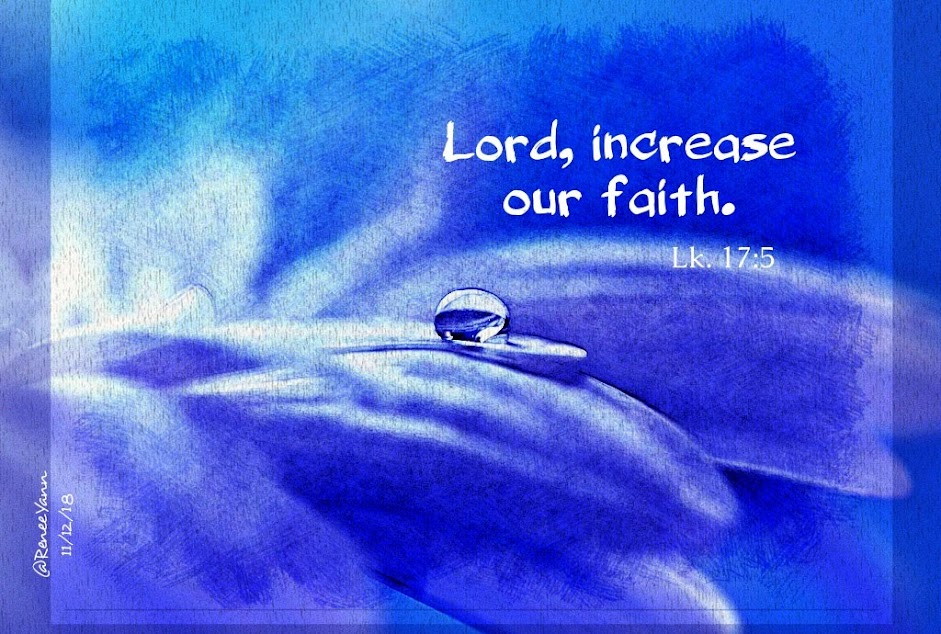
Lord, increase our faith!

Let us join their prayer today for unity and love in our faith and civic communities.


Thought: By voting, we help answer Pope France’s prayer:

I beg the Lord to grant us more politicians 
who are genuinely disturbed
by the state of society,
the people, the lives of the poor!

Joy of the Gospel (205)

 Renee Yann, RSM

Carry Us Home, Lord!

Thursday of the Thirty-first Week in Ordinary Time
November 3, 2022

Today’s Readings:

https://bible.usccb.org/bible/readings/110322.cfm

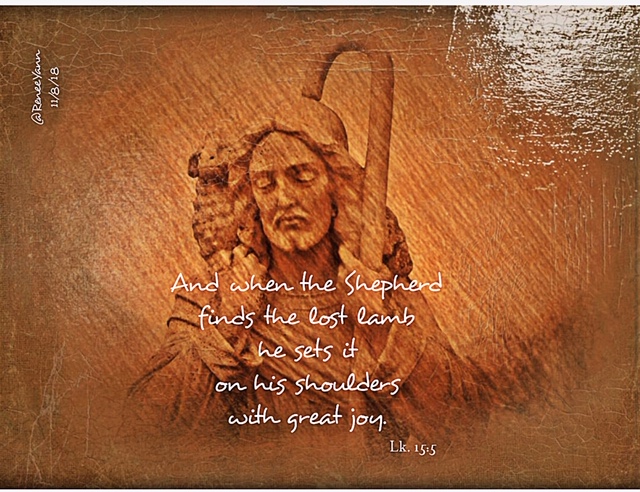
Lk15_5 lost lamb

Today, in God’s Lavish Mercy, we meet the Shepherd bringing the lost lamb home.  Haven’t we all, at sometime in our lives, been carried on those sacred shoulders?

Whether by our own prayers, or the prayers of those who love us, have we not been rescued from sorrow, foolishness, isolation or fear?

This beautiful Gospel assures us of the one thing we most deeply need – we are cherished, irrevocably, by God.

Today, if we need to ride those shoulders, let us trust ourselves to them in prayer. 

If, by grace, we are already home, let us pray for those feeling most lost or abandoned – those most beset by a hostile world. May our merciful action help lift them to peace and the sweet scent of God so close beside them.


Poetry: The Good Shepherd – Brian Yapko

I enjoyed this poem which imagines Jesus still as a youngster experiencing a night as a shepherd. Mary and Joseph think it might not be the right vocation for him after his traumatic overnight!

My count of sheep was off as twilight fell
And father’s friend, Ben Ezra’s lamb was gone!
I had to find her! Searching past the well
I climbed the rocks exhausted but pressed on.
Delay could mean her life! She’d failed to heed
My shepherd’s call and so risked being killed!
Some wild beast might capture her and feed.
I could not let her unstained blood be spilled!

Great danger filled that dark and craggy hill.
My fear was deep! And then my torch went dim!
Oh, why did I avoid my father’s will
To one day be a carpenter like him?
Because my father’s friend was gravely ill.
I loved his sheep, so father made a plan
For me to herd them just one year until
I’m old enough to be declared a man.

I found the frightened lamb inside a cave
Cornered by a wolf of knife-sharp claw.
The fiercest wolf I’ve seen! How could I save
This little sheep? I thrust my staff to draw
Away the beast. He snarled, bit my wrist
And mauled my side. In agony, I heard
The wolf’s attack, too wounded to resist.
But then, thank God, a miracle occurred!

I closed my eyes and with a trembling voice
Said “Help me, father!” And the fierce wolf froze!
He yelped, then fled as if he had no choice!
I clutched the lamb and wept till the sun rose.
Still shaking I then rose up on my feet.
I kissed the lamb and said don’t be afraid
For now you’re safe. She cried a grateful bleat.
She knew I’d saved her and the price I paid.

My parents say I may no longer herd
And must devote my life to nails and wood;
But angels fill my dreams and leave me stirred
To try to be a shepherd—one who’s good—
Who shields his sheep from wickedness and strife.
I love them all, the good ones and the lost;
I’ll fear no evil that might take my life,
For I think their salvation’s worth the cost.


Music: I Will Carry You – Sean Clive

I will carry you when you are weak.
I will carry you when you can’t speak.
I will carry you when you can’t pray.
I will carry you each night and day.

I will carry you when times are hard.
I will carry you both near & far.
I’ll be there with you whenever you fall.
I will carry you through it all.

My arms are wider than the sky,
softer than a little child,
stronger than the raging,
calming like a gentle breeze.
Trust in me to hold on tight because 

I will carry you when you can’t stand.
I’ll be there for you to hold your hand.
And I will show you that you’re never alone.
I will carry you and bring you back home.

Not pain, not fear, not death, no nothing at all
can separate you from my love.
My arms and hands will hold you close.
Just reach out and take them in your own.
Trust in me to hold on tight.
I will carry you.

Released from Hate

Monday of the Thirty-first Week in Ordinary Time
October 31, 2022

Today’s Readings:

https://bible.usccb.org/bible/readings/103122.cfm

Today, in God’s Lavish Mercy, what a beautiful prayer Paul spreads over his listeners. It is a prayer that calls all believers to live in love, peace, and reverence for one another:

Brothers and sisters:
If there is any encouragement in Christ,
any solace in love,
any participation in the Spirit,
any compassion and mercy,
complete my joy by being of the same mind, with the same love,
united in heart, thinking one thing.

Philippians 2:1-2

Reading this passage, I was immediately struck by the awareness of how much opposite messaging we receive in today’s world.

In the arenas of entertainment, politics, civic life, and – sad to say – even religion, we often hear a message contradictory to Paul’s. We hear civic and supposedly “religious” leaders tell their followers to attack, shun, fight, and even “hang” the other. Night after night on our TVs, we watch fictional characters act out the hate and crime that has become normalized in our culture. Our video games, music and movies are drowning in blood, hate and anger.

Sometimes, I am just astounded that we entertain ourselves with murder, war, rape and other outrages against human beings!

With the vicious attack on Paul Pelosi this week, as in so many other horrendous incidents of unbridled hate, we see a perpetrator sickened and abetted by the violent rhetoric our society has allowed. And perhaps even worse than the crime itself, we see political leaders not only minimizing the atrocity, but mocking the victim!


If St. Paul were here, what would he say?

  • where is the encouragement in Christ?
  • where is the solace in love?
  • where is the participation in the Spirit?
  • where is the compassion and mercy?

As a matter of fact, if St. Paul were here, I think he would wail in sadness!


In Luke’s Gospel, Jesus tells us what a society should look like when it respects God and God’s Creation. It should be impelled by the deepest respect and tenderness toward the self and the other:

When you hold a lunch or a dinner,
do not invite your friends or your brothers or sisters
or your relatives or your wealthy neighbors,
in case they may invite you back and you have repayment.
Rather, when you hold a banquet,
invite the poor, the crippled, the lame, the blind; 
blessed indeed will you be because of their inability to repay you.
For you will be repaid at the resurrection of the righteous.

Luke 14:12-14

Bottom line is this: a lot of people just don’t buy Paul’s or Jesus’s message. A lot of people would rather live for themselves to the expense of others.

But we’re not just “a lot of people”. We are Christ’s, and we must examine our speech, attitudes, choices and behaviors for anything that contradicts his message of love, mercy, inclusion, and mutual reverence.

The contradictions are subtle. Discovering and uprooting them takes honest and humble prayer. It requires a good look at how we entertain ourselves, how we confront those we disagree with, who we criticize and how we do it.


Several years ago, I was shocked when someone close to me announced, “I hate Obama!” I asked her why and she said, “I just do. I don’t need a reason!”

Where does all the hate in our culture come from? And, oh, how much more does it tell us about the haters than the ones hated! And of course, the essential question, “What can we do about it?”

Jesus made it simple. He told us to look around the “table” of our attitudes, behaviors and choices.

Who is welcome? Who is shunned? Who is embraced as a human being? Who is objectified and dispensed with as unimportant.

As in all solutions, we can begin with ourselves. Ridding ourselves of these contradictions requires that we listen to ourselves to see if, how, and why we ever use the word “hate”. Only then might we cleanse our hearts of its subtle poisons.


Prose: Two thoughts today

The enemy is fear.
We think it is hate,
but it is really fear.

Mahatma Gandhi

Who would I be,
and what power would be expressed in my life,
if I were not dominated by fear?

Paula D’Arcy

Music: At My Table – JJ Heller – a kinda fun video to watch!