Alleluia: Who’s Coming to the Party?

Twenty-first Sunday in Ordinary Time
August 21, 2022

Today’s Readings:

https://bible.usccb.org/bible/readings/082122.cfm

Alleluia, alleluia.
I am the way, the truth and the life, says the Lord;
no one comes to the Father, except through me.

Today, in God’s Lavish Mercy, we glimpse what the great gathering in heaven might be like.

The Kingdom of Heaven by Frank Bramley

Have you ever gotten an e-vite in your email? Perhaps an invitation to a gala event or a birthday party? All you need do to respond is to click a “Yes” or “ No” button. And then you can look to see who else has been invited and what response each has clicked. You can get a pretty clear picture of what the party will be like – chummy, snobby, noisy, elegant, boring, mind-blowing ….


Isaiah records a guest list for us of all who will be invited to God’s party. That “party” described in Isaiah 66 imagines a restored Jerusalem and a rebuilt Temple. It is an image of what Creation will look like when enveloped in God at the end times. It’s pretty cool!

They shall bring all your brothers and sisters from all the nations
as an offering to the LORD,
on horses and in chariots, in carts, upon mules and dromedaries,
to Jerusalem, my holy mountain, says the LORD…

Isaiah’s community really needed to hear that encouraging vision because the Temple-less Jerusalem they were living in had been devastated by the Babylonian invasions. For the Israelites, the Temple and the Holy City modeled the Kingdom to come. They had a long way to go before their environment was restored to Isaiah’s predicted dimensions. Isaiah helps them journey through present reality for the sake of future hope.


In our second reading, Paul gives a similar kind of encouragement to Hebrew converts who were finding difficulties in the pursuit of their new Christian faith. They too had to learn to suffer through in order to realize their hope.

At the time,
all discipline seems a cause not for joy but for pain,
yet later it brings the peaceful fruit of righteousness
to those who are trained by it.
So strengthen your drooping hands and your weak knees. 
Make straight paths for your feet,
that what is lame may not be disjointed but healed.


When questioned about heaven, Jesus says it’s not a piece of cake to get in. You have to “know somebody”, and that somebody is the God of your heart.

Jesus answered them,
“Strive to enter through the narrow gate,
for many, I tell you, will attempt to enter
but will not be strong enough. 

Jesus echoes Isaiah in describing the glorious mix of guests at the heavenly party:

And people will come from the east and the west
and from the north and the south
and will recline at table in the kingdom of God. 
For behold, some are last who will be first,
and some are first who will be last.

Christ Surrounded by Singing and Music – Hans Hemling

I know I want to be at that party. And we all want to see one another there, right?!

So let’s help each other:

  • get on our “horses, chariots, carts, mules, dromedaries” or any other assistance for our journey
  • strengthen our drooping hands to reach for righteousness
  • find the narrow gate and pass through it
  • finally recline at the table

Poetry: God – Khalil Gibran

In the ancient days, when the first quiver of speech came to my lips, I ascended the holy mountain and spoke unto God, saying, “Master, I am thy slave. Thy hidden will is my law and I shall obey thee for ever more.”

But God made no answer, and like a mighty tempest passed away.

And after a thousand years I ascended the holy mountain and again spoke unto God, saying, “Creator, I am thy creation. Out of clay hast thou fashioned me and to thee I owe mine all.”

And God made no answer, but like a thousand swift wings passed away.

And after a thousand years I climbed the holy mountain and spoke unto God again, saying, “Father, I am thy son. In pity and love thou hast given me birth, and through love and worship I shall inherit thy kingdom.”

And God made no answer, and like the mist that veils the distant hills he passed away.

And after a thousand years I climbed the sacred mountain and again spoke unto God, saying, “My God, my aim and my fulfilment; I am thy yesterday and thou are my tomorrow. I am thy root in the earth and thou art my flower in the sky, and together we grow before the face of the sun.”

Then God leaned over me, and in my ears whispered words of sweetness, and even as the sea that enfoldeth a brook that runneth down to her, he enfolded me.

And when I descended to the valleys and the plains God was there also.


Music: Paradise by Mehdi – a beautiful composition to put a little kick in your step on the way up the Mountain! 🙂

Alleluia: God is God; We Are Not

Tuesday of the Twentieth Week in Ordinary Time
August 16, 2022

Today’s Readings:

https://bible.usccb.org/bible/readings/081622.cfm

Alleluia, alleluia.
Jesus Christ became poor although he was rich
So that by his poverty you might become rich.

Today, in God’s Lavish Mercy, our readings confront us with a few spiritual cautions.

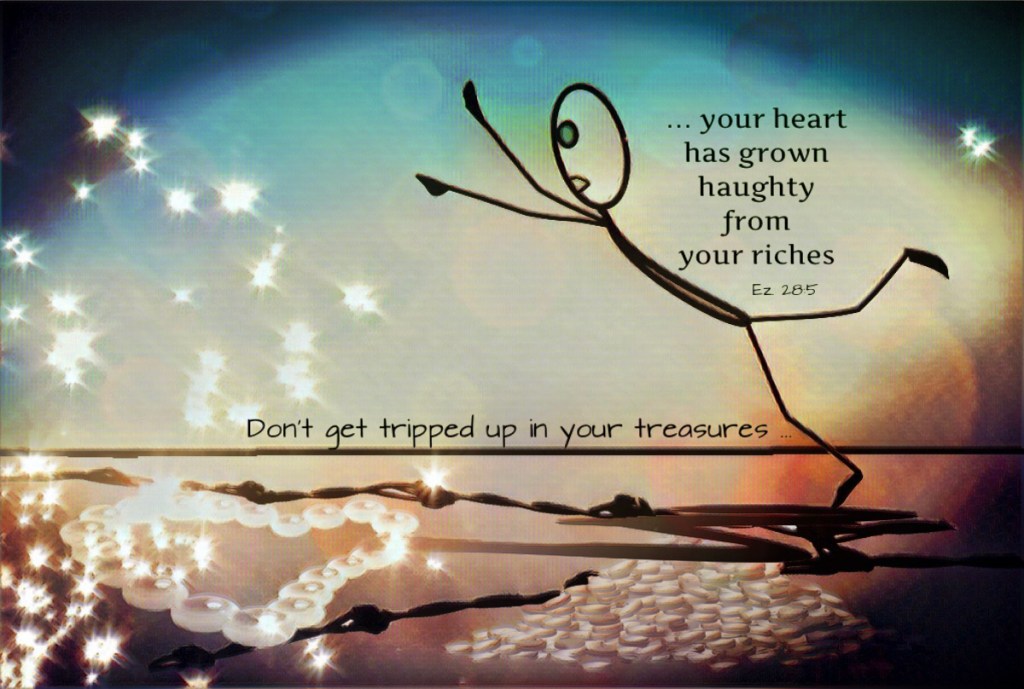
In our first reading, Ezekiel lets the Prince of Tyre know that he has really messed up his spiritual life:

Thus says the Lord GOD:

Because you are haughty of heart,
you say, “A god am I!
I occupy a godly throne
in the heart of the sea!”—
And yet you are a man, and not a god,
however you may think yourself like a god.

This Tyrian prince Ithobalus reigned over a wealthy and politically powerful nation – a nation which had become arrogant and domineering in its relationship to other peoples. The word Ezekiel uses describes the condition perfectly: haughty. The prince was so haughty that he considered himself equal to — and in no need of — God.

We, of course, can learn a lesson from vainglorious Ithobalus. No material possession or personal strength makes us equal to God or renders us independent of God’s governance and care. According to Ezekiel, old Itho was about to find that out the hard way!


In our Gospel, Jesus talks about how we can get caught up in ourselves similarly to Ithobaal.

Jesus said to his disciples:
“Amen, I say to you, it will be hard for one who is rich
to enter the Kingdom of heaven.
Again I say to you,
it is easier for a camel to pass through the eye of a needle
than for one who is rich to enter the Kingdom of God.”

When we read this passage, I think most of us picture material riches. And certainly the saying holds true in that case. But it also holds true for other types of “riches” – strengths or possessions that we use in arrogance and indifference toward others’ needs.


Prose: Pope Francis preached about such things in a homily on this passage from the prophet Amos:

Woe to the complacent in Zion, to those who feel secure … lying upon beds of ivory! . They eat, they drink, they sing, they play and they care nothing about other people’s troubles. (Am 6:1,4)

How does something like this happen? How do some people, perhaps ourselves included, end up becoming self-absorbed and finding security in material things which ultimately rob us of our face, our human face? This is what happens when we become complacent, when we no longer remember God. “Woe to the complacent in Zion”, says the prophet. If we don’t think about God, everything ends up flat, everything ends up being about “me” and my own comfort. Life, the world, other people, all of these become unreal, they no longer matter, everything boils down to one thing: having. When we no longer remember God, we too become unreal, we too become empty; like the rich man in the Gospel, we no longer have a face! Those who run after nothing become nothing – as another great prophet Jeremiah, observed (cf. Jer 2:5). We are made in God’s image and likeness, not the image and likeness of material objects, of idols!

Pope Francis – September 29, 2013

Music: Jesu, Joy of Our Desiring – J.S. Bach, interpreted by Daniel Kobialka

Alleluia: Green Grapes!

Saturday of the Nineteenth Week in Ordinary Time
August 13, 2022

Today’s Readings:

https://bible.usccb.org/bible/readings/081322.cfm

Today, in God’s Lavish Mercy, the core of our readings is about innocence and authenticity. But you have to dig a little to get to that. Maybe, like me, you finished  our first reading asking, “So what’s with the green grapes!?”

A common expression in ancient Israel suggested that people’s bad luck was a punishment for their parent’s sins. It was a handy way of avoiding responsibility for one’s own foolish actions, often the actual source of one’s misfortune.

Ezekiel uses the expression to teach a lesson about the nature of God’s love and forgiveness. God loves us completely – without prejudice, without vengeance. There is no record of faults to “set our teeth on edge”. There are no “green grapes” on God’s table. God only wants our wholeness.

Therefore I will judge you, house of Israel,
each one according to their own ways, says the Lord GOD.
Turn and be converted from all your crimes,
that they may be no cause of guilt for you.
Cast away from you all the crimes you have committed,
and make for yourselves a new heart and a new spirit.


God will not let us hide behind excuses like a bogus “Green Grapes Theory”. As in any loving relationship, we must be honest with God, own our faults, seek forgiveness, and love ardently.

Jesus uses the example of a little child to show us how to do this. Each one of us is born with a core of innocence and authenticity. These are the attributes of God’s life in us. Throughout our lives there are times when we hide these blessings under our sinfulness. Some people bury them so deep that they lose touch with their own sacred integrity.

Jesus calls us back out of our excuses and our excesses, just as the Lord called Ezekiel’s community. We are invited to an eternal covenant rooted in the gift of divine innocence and authenticity given to us at our creation.

Jesus said:
Let the children come to me,
and do not prevent them;
for the Kingdom of heaven
belongs to such as these.

Poetry: The Pursuit – Henry Vaughn

LORD ! what a busy, restless thing
Hast Thou made man !
Each day and hour he is on wing,
Rests not a span ;
Then having lost the sun and light,
By clouds surpris’d,
He keeps a commerce in the night
With air disguis’d.
Hadst Thou given to this active dust
A state untir’d,
The lost son had not left the husk,
Nor home desir’d.
That was Thy secret, and it is
Thy mercy too ;
For when all fails to bring to bliss,
Then this must do.
Ah, Lord ! and what a purchase will that be,
To take us sick, that sound would not take Thee !

Music: Tender Hearted – Jeanne Cotter

Alleluia: Called

Memorial of Saint Dominic, Priest
August 8, 2022

Today’s Readings:

https://bible.usccb.org/bible/readings/080822.cfm

Alleluia, alleluia.
God has called you through the Gospel
to possess the glory of our Lord Jesus Christ.


by Michelangelo on the ceiling of the Sistine Chapel in the Vatican between 1508 to 1512

Today, in God’s Lavish Mercy, we begin nearly two weeks of first readings from the prophet Ezekiel, and this first one is a real WOW!

As I looked, a stormwind came from the North,
a huge cloud with flashing fire enveloped in brightness,
from the midst of which (the midst of the fire)
something gleamed like electrum.
Within it were figures resembling four living creatures
that looked like this: their form was human.

Ezekiel 1:4-6

Walter Brueggemann calls Ezekiel “the prophet who had fantasies and hallucinations”. Nevertheless, Ezekiel is considered a prophet because like all prophets, Ezekiel “noticed what no one else noticed” — Ezekiel “saw death coming” to Israel.

Ezekiel did not blame the king, the government, the military or the war planners for this terrible death to come. He blamed the religious community, the clergy, the prophets: “My hands will be against the prophets who see delusive visions and give lying messages” (13:9). Ezekiel blamed the religious community because that community is responsible for truth-telling.

Truth-Telling and Peacemaking: A Reflection on Ezekiel
by Walter Brueggemann

I think it might be safe to say that most religious communities – and the people who comprise them – do not want to hear such things about themselves. Abraham Heschel, one of the greatest theologians and philosophers of the 20th century said this:

The prophets had disdain for those to whom God was comfort and security; to them God was a challenge, an incessant demand. He is compassion, but not a compromise; justice, but not inclemency. Tranquility is unknown to the soul of a prophet. The miseries of the world give him no rest. While others are callous, and even callous to their callousness and unaware of their insensitivity, the prophets remain examples of supreme impatience with evil, distracted by neither might nor applause, by neither success nor beauty. Their intense sensitivity to right and wrong is due to their intense sensitivity to God’s concern for right and wrong. They feel fiercely because they hear deeply.

from: What Are Prophets For?

By Abraham Joshua Heschel
MARCH 25, 2020

In today’s Gospel, Jesus informs his disciples that he too will endure a prophet’s suffering:

As Jesus and his disciples were gathering in Galilee,
Jesus said to them,
“The Son of Man is to be handed over to men,
and they will kill him, and he will be raised on the third day.”
And they were overwhelmed with grief.

Matthew 17:22-23

As we reflect on what these readings mean for us in our lives, our Alleluia Verse offers a key phrase:

Alleluia, alleluia.
God has called you through the Gospel
To possess the glory of our Lord Jesus Christ.

…through the Gospel

Unless we know and cherish the Gospel, we Christians cannot hear our call.


Poetry: The Call of a Christian – John Greenleaf Whittier

Not always as the whirlwind's rush 
On Horeb's mount of fear, 
Not always as the burning bush 
To Midian's shepherd seer, 
Nor as the awful voice which came 
To Israel's prophet bards, 
Nor as the tongues of cloven flame, 
Nor gift of fearful words,-- 
Not always thus, with outward sign 
Of fire or voice from Heaven,
The message of a truth divine, 
The call of Godis given! 
Awaking in the human heart 
Love for the true and right,-- 
Zeal for the Christian's better part, 
Strength for the Christian's fight. 
Nor unto manhood's heart alone
The holy influence steals 
Warm with a rapture not its own, 
The heart of woman feels! 
As she who by Samaria's wall
The Saviour's errand sought,-- 
As those who with the fervent Paul 
And meek Aquila wrought: 
Or those meek ones whose martyrdom 
Rome's gathered grandeur saw 
Or those who in their Alpine home
Braved the Crusader's war, 
When the green Vaudois, trembling, heard, 
Through all its vales of death, 
The martyr's song of triumph poured 
From woman's failing breath. 
And gently, by a thousand things 
Which o'er our spirits pass, 
Like breezes o'er the harp's fine strings, 
Or vapors o'er a glass, 
Leaving their token strange and new 
Of music or of shade, 
The summons to the right and true 
And merciful is made. 
Oh, then, if gleams of truth and light
Flash o'er thy waiting mind, 
Unfolding to thy mental sight 
The wants of human-kind; 
If, brooding over human grief,
The earnest wish is known 
To soothe and gladden with relief 
An anguish not thine own; 
Though heralded with naught of fear, 
Or outward sign or show; 
Though only to the inward ear 
It whispers soft and low; 
Though dropping, as the manna fell, 
Unseen, yet from above, 
Noiseless as dew-fall, heed it well,--- 
Thy Father's call of love!

Music: God is Calling through the Whisper

Alleluia: Nets and Clay

Thursday of the Seventeenth Week in Ordinary Time
July 28, 2022

Today’s Readings:

https://bible.usccb.org/bible/readings/072822.cfm

Today, in God’s Lavish Mercy, Jeremiah gives us the wonderful image of the potter and the clay. Through this image, Israel is called to repentance, faith and transformation.

Whenever the object of clay which the potter was making
turned out badly in his hand, 
he tried again,
making of the clay another object of whatever sort he pleased.
Then the word of the LORD came to me:
Can I not do to you, house of Israel,
as this potter has done? says the LORD.
Indeed, like clay in the hand of the potter,
so are you in my hand, house of Israel.

The passage carries the warning that some of potter’s attempts don’t quite cut it. They will be culled for the  spiritual “recycle bin”. Today’s Gospel offers a similar forewarning.

The Kingdom of heaven is like a net thrown into the sea,
which collects fish of every kind.
When it is full they haul it ashore
and sit down to put what is good into buckets.
What is bad they throw away.
Thus it will be at the end of the age.


Friends, we all want to make it into the heavenly bucket, right? So let’s sincerely pray the prayer of our Alleluia Verse:

Alleluia, alleluia.
Open our heart, O Lord,
to listen to the words of your Son.


Poetry: The Song of the Potter – Henry Wadsworth Longfellow 

Turn, turn, my wheel! Turn round and round,
Without a pause, without a sound:
So spins the flying world away!
This clay, well mixed with marl and sand,
Follows the motion of my hand;
For some must follow, and some command,
Though all are made of clay!

Turn, turn, my wheel! All things must change
To something new, to something strange;
Nothing that is can pause or stay;
The moon will wax, the moon will wane,
The mist and cloud will turn to rain,
The rain to mist and cloud again,
To-morrow be to-day.

Turn, turn, my wheel! All life is brief;
What now is bud will soon be leaf,
What now is leaf will soon decay;
The wind blows east, the wind blows west;
The blue eggs in the robin’s nest
Will soon have wings and beak and breast,
And flutter and fly away.

Turn, turn, my wheel! This earthen jar
A touch can make, a touch can mar;
And shall it to the Potter say,
What makest thou? Thou hast no hand?
As men who think to understand
A world by their Creator planned,
Who wiser is than they.

Turn, turn, my wheel! ‘Tis nature’s plan
The child should grow into the man,
The man grow wrinkled, old, and gray;
In youth the heart exults and sings,
The pulses leap, the feet have wings;
In age the cricket chirps, and brings
The harvest home of day.

Turn, turn, my wheel! The human race,
Of every tongue, of every place,
Caucasian, Coptic, or Malay,
All that inhabit this great earth,
Whatever be their rank or worth,
Are kindred and allied by birth,
And made of the same clay.

Turn, turn, my wheel! What is begun
At daybreak must at dark be done,
To-morrow will be another day;
To-morrow the hot furnace flame
Will search the heart and try the frame,
And stamp with honor or with shame
These vessels made of clay.

Stop, stop, my wheel! Too soon, too soon
The noon will be the afternoon,
Too soon to-day be yesterday;
Behind us in our path we cast
The broken potsherds of the past,
And all are ground to dust at last,
And trodden into clay.


Music: The Potter’s Hand- Helen  Baylor

I know for sure, all of my days are held in Your hands
Crafted into Your perfect plan
You gently call me, into Your presence
Guiding me by, Your Holy Spirit
Teach me dear Lord
To live all of my life through Your eyes
I’m captured by, Your Holy calling
Set me apart
I know You’re drawing me to Yourself
Lead me Lord I pray
Take me, and mold me
Use me, fill me
I give my life to the Potter’s hands
Hold me, You guide me
Lead me, walk beside me
I give my life to the Potter’s hand
You gently call me, into Your presence
Guiding me by, Your Holy Spirit
Teach me dear Lord
To live all of my life through Your eyes
I’m captured by, Your Holy calling
Set me apart
I know You’re drawing me to Yourself
Lead me Lord I pray
Take me, and mold me
Use me, fill me
I give my life to my Potter’s hands
Hold me, You guide me
Lead me, walk beside me
I give my life to my Potter’s hand
Take me, and mold me
Use me, fill me
I give my life to my Potter’s hands
Hold me, You guide me
Lead me, walk beside me
I give my life to my Potter’s hand
Give Him everything
Give Him everything
Right now, give Him everything
Everything
Give Him everything
Lord, I give it all
To You

Alleluia: God’s Own Children

Seventeenth Sunday in Ordinary Time
July 24, 2022

Today’s Readings:

https://bible.usccb.org/bible/readings/072422.cfm

Today, in God’s Lavish Mercy, a dominant theme connects all our readings: We are, and are loved as, God’s very own children.

Alleluia, alleluia.
You have received a Spirit of adoption,
through which we cry, Abba, Father.

God’s own children … hmmm.

In our reading from Genesis, some folks aren’t doing too well with that. Imagine being so bad that God would have to come down and check you out! Yikes! Not good! It’s like when you and your cousins were pillow-fighting in the basement and your Mom called down the stairs, “Don’t make me come down there!

Don’t Make Me Come Down There!!!!

You knew what to do, didn’t you? Just cut it out! Apparently, Moses isn’t quite so sure that his buddies will behave, but nevertheless does his level best to save the few good apples in the barrel.

This highly anthropomorphic story still carries a very solid truth:

God loves us without reservation
and wants us to return that love
by growing in God’s likeness.

Paul tells the Colossians that God has forgiven, redeemed and raised them with Christ

You were buried with him in baptism,
in which you were also raised with him
through faith in the power of God,
who raised him from the dead.

In our Alleluia Verse from Romans,
Paul describes our new status
as one of “adoption”,
allowing us to call God “Abba”.

Jesus shows us how to be God’s children by sharing with us the intimacies of his talks with his Father.

Father, hallowed be your name,
your kingdom come.
Give us each day our daily bread
and forgive us our sins
for we ourselves forgive everyone in debt to us,
and do not subject us to the final test.

Jesus indicates that we can put this prayer in action by being forgiving and selfless people.

If you then, who are inclined toward selfishness,
know how to give good gifts to your children,
how much more will the Father in heaven
give the Holy Spirit to those who ask him?”


Poetry: O Magne Pater – Hildegard of Bingen

O magne Pater,
in magna necessitate sumus.
Nunc igitur obsecramus, obsecramus te
per Verbum tuum
per quod nos constituisti
plenos quibus indigemus.
Nunc placeat tibi, Pater,
quia te decet, ut aspicias in nos
per adiutorium tuum,
ut non deficiamus, et
ne nomen tuum in nobis obscuretur,
et per ipsum nomen tuum
dignare nos adiuvare.
O Father great,
in great necessity we are.
Thus we now beg, we beg of you
according to your Word,
through whom you once established us
full of all that we now lack.
Now may it please you, Father,
as it behooves you—look upon us
with your kindly aid,
lest we should fail again
and, lost, forget your name.
By that your name we pray—
please kindly help and bring us aid!
thanks to hildegard-society.org

Music: O Magne Pater – Hildegard of Bingen

Alleluia: My Redeemer Lives

Feast of St. Mary Magdalen
July 22, 2022

Today’s Readings:

https://bible.usccb.org/bible/readings/072222.cfm

Edited in Prisma app with Huawei HiAI

Alleluia, alleluia.
Tell us Mary, what did you see on the way?
I saw the glory of the risen Christ,
I saw his empty tomb.

Modern scripture scholarship recognizes Mary Magdalen as a disciple and companion of Jesus.  She is present in stories throughout all four Gospels, and most notably, as one who remained with Jesus at the foot of the Cross. Mary is the first witness to the Resurrection who then announces the Good News to the other disciples.

Over the centuries, Mary Magdalen has been confused with the many other Marys in the Gospel, as well as with the unnamed repentant woman who washes Jesus’ feet with her tears. These confusions have inclined us to think of Mary Magdalen as a reformed prostitute. This erroneous concept has supported a diminished understanding of the role of women in the ministry of Jesus and done a huge disservice to Mary’s vital role as beloved disciple.

The Gospel passage for the feast captures the powerful moment when the Resurrected Jesus is first revealed to the world. The scene also portrays the deep love, trust and friendship between Jesus and Mary Magdalen – a relationship which serves as a model for all of us who want to be Christ’s disciples. I imagined the scene like this in an past reflection:


 Rabbouni

 The Upper Room on Holy Saturday evening: a place filled with sadness, silence and seeking. Jesus was dead. Believers around Jerusalem, scattered to their various houses to keep Shabbat, murmur their shocked questions under their shaky prayers.

 We have all been in rooms like this. They enclose a special kind of agony – one teetering between hope and doubt, between loss and restoration. It may have been a surgical waiting room or the hallway outside the courtroom. Sometimes, such a space is not bricks and mortar.  It can be the space between a sealed envelope and the news inside. It is the hesitant pause between a heartfelt request and the critical response. In each of these places, we exist as if in a held breath, hoping against hope for life, freedom, and wholeness.

 It was from such a room that Mary Magdalen stole away in the wee hours. A woman unafraid of loneliness, she walked in tearful prayer along the path to Jesus’ tomb. Scent of jasmine rose up on the early morning mist. Hope rose with it that his vow to return might be true. Then she saw the gaping tomb, the alarm that thieves had stolen him to sabotage his promise. She ran to the emptiness seeking him. She was met by angels clothed in light and glory, but they were not enough to soothe her.

Turning from them, she bumped against a gardener whom she begged for word of Jesus, just so she might tend to him again. A single word revealed his glory, “Mary”. He spoke her name in love.

As we seek the assurance of God’s presence in our lives, we too may be unaware that God is already with us. The deep listening of our spirit, dulled with daily burdens, may not hear our name lovingly spoken in the circumstances of our lives. God is standing behind every moment. All we need do is turn to recognize him.

 Turn anger into understanding. Turn vengeance into forgiveness. Turn entitlement into gratitude. Turn indifference into love. All we need do is turn to recognize him.


For a comprehensive and enlightening lecture on the current theological and scriptural thinking on Mary Magdalen, follow this link to an Elizabeth Johnson, CSJ lecture at Fordham.
There is a long intro, but you can slide to the 14 minute mark for Elizabeth’s start.

https://www.library.fordham.edu/digital/collection/VIDEO/id/824


Music: I Know That My Redeemer Liveth

Alleluia: Seedlings

Wednesday of the Sixteenth Week in Ordinary Time
July 20, 2022

Today’s Readings:

https://bible.usccb.org/bible/readings/072022.cfm

Alleluia, alleluia.
The seed is the word of God,
Christ is the sower;
all who come to him will live for ever.

Before I formed you in the womb, I knew you.

Today, in God’s Lavish Mercy, our first reading recounts Jeremiah’s call. Oh, and it has a sovereign ring to it, doesn’t it! You can almost hear trumpets accompanying the words:

The word of the LORD came to me thus:
Before I formed you in the womb I knew you,
before you were born I dedicated you,
a prophet to the nations I appointed you.

Jeremiah 1: 2-3

Long before Jeremiah knew, the Word had been instilled in him. At the appointed time, God called for that Word to bear fruit.


At our creation, God breathed the Divine Word into our hearts too. Jesus says it was like a farmer planting seed. And our humble, patient Creator waits to see if we turn out to be rich soil.

A sower went out to sow.
… some seed fell on the path,
and birds came and ate it up.

Some fell on rocky ground, 
…. the sun rose it was scorched,

Some seed fell among thorns
which choked it.

But some seed fell on rich soil, 
and produced fruit,
a hundred or sixty or thirtyfold.
Whoever has ears ought to hear.
(from Matthew 13: 1-9)

When Jeremiah heard about the Word in his heart, he didn’t immediately have “ears to hear”. At first, he resisted:

“Ah, Lord GOD!” I said,
“I know not how to speak;
I am too young.”

Jeremiah

Every day, God continues to call forth the fruitful Word from us. Sometimes we resist. Our lives can be a little rocky, thorny, or we might just be off the path a bit.

We also might make excuses to ignore the call of grace:

  • too young
  • too old
  • too tired
  • too busy
  • too afraid
  • too weak

We might just too … too… too ourselves into spiritual quicksand!


Our beautiful psalm tells what to say instead of our “too”s:

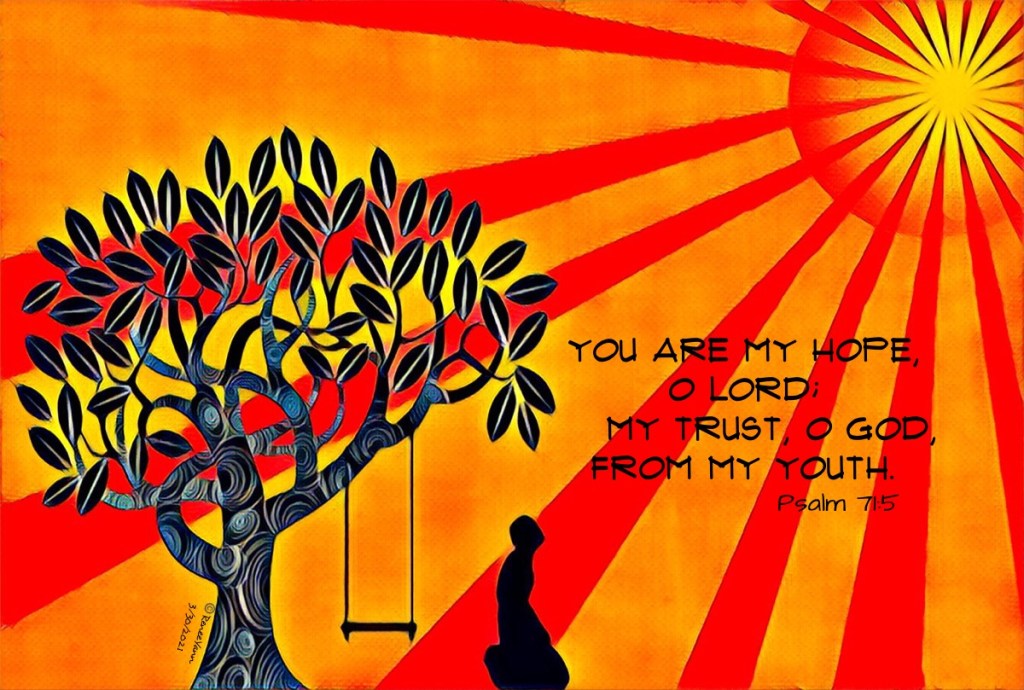
For you are my hope, O Lord;
my trust, O God, from my youth.
On you I depend from birth;
from my mother’s womb you are my strength.

My mouth shall declare your justice,
day by day your salvation.
O God, you have taught me from my youth,
and till the present I proclaim your wondrous deeds.

Psalm 71: 5-6; 15,17

Poetry: Two poems today – one from Wendell Berry and one from me. His is way better. 🙂

The Wild Geese – Wendell Berry

Horseback on Sunday morning,
harvest over, we taste persimmon
and wild grape, sharp sweet
of summer's end.  In time's maze
over the fall fields, we name names
that went west from here, names
that rest on graves.  We open
a persimmon seed to find the tree
that stands in promise,
pale, in the seed's marrow.

Geese appear high over us,
pass, and the sky closes.  Abandon,
as in love or sleep, holds
them to their way, clear,
in the ancient faith: what we need
is here.  And we pray, not
for new earth or heaven, but to be
quiet in heart, and in eye
clear.  What we need is here.

If You Are Mother – Renee Yann, RSM

If you are Mother, God
don’t let us hurt ourselves;
keep freedom in us
as freedom,
not as willfulness,
so that we grow
even if we must grow down
like a dark, hidden root.

Remember,
if life dies in us,
You change.  We are not
isolated seedlings
you left somewhere
in lonely hope one spring.
You are the ground, and the
growth, and the growth’s nourishment.
When we green, it is You
who thrive.

Music: Listen and blossom, dears❤️

Alleluia: Imperative Mood

Monday of the Sixteenth Week in Ordinary Time
July 18, 2022

Today’s Readings

https://bible.usccb.org/bible/readings/071822.cfm

Alleluia, alleluia.
If today you hear God’s voice,
soften your hearts.

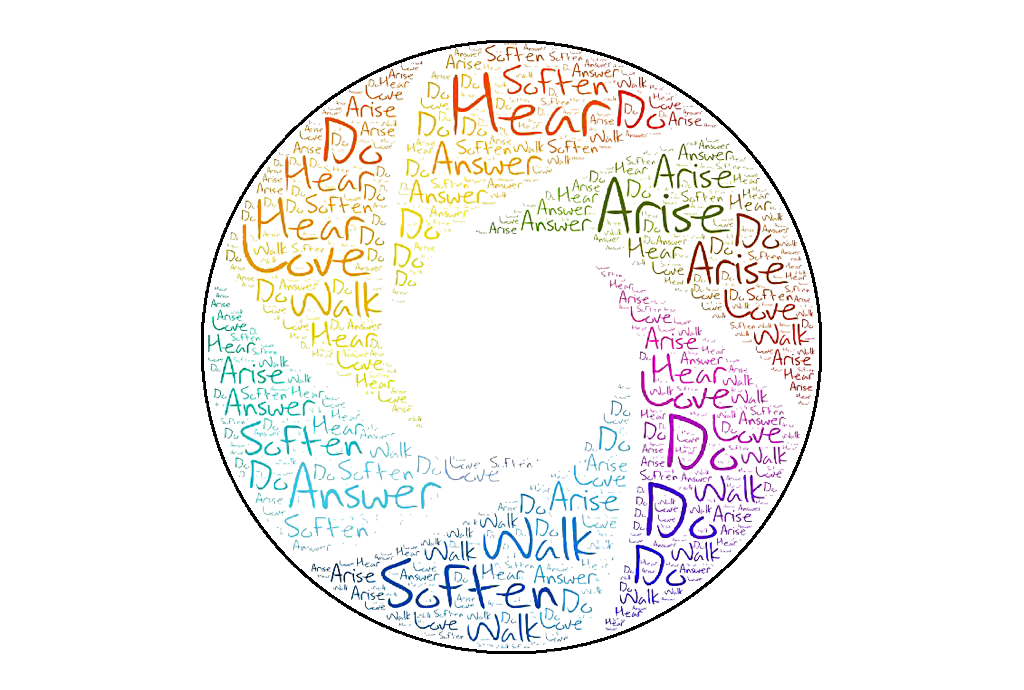
Today, in God’s Lavish Mercy, the readings heighten the familiar imperative of our Alleluia Verse with several more injunctions:

  • Hear
  • Soften
  • Arise
  • Answer 
  • Do
  • Love
  • Walk

God is not shy in telling us what to do in order to grow in holiness – in mutual relationship with God.

We have to DO something, to be responsive in order to unite with God. We can’t be just passive lumps of inactive devotion.

Don’t Be a Spiritual Couch Potato

Each instruction has its own vitality which is meant, in turn, to vitalize our spirits and to make us agents of the Holy One in the world.


Our first reading carries this message clearly to the people of Micah’s time. It’s not about contrived sacrifice. It’s about love and compassion.

With what shall I come before the LORD,
and bow before God most high?
Shall I come before him with burnt offerings,
with calves a year old?
Will the LORD be pleased with thousands of rams,
with myriad streams of oil?
Shall I give my first-born for my crime,
the fruit of my body for the sin of my soul?
You have been told, O Creature, what is good,
and what the LORD requires of you:
Only to do the right and to love goodness,
and to walk humbly with your God.

Micah 6: 6-8

The scribes and Pharisees of Jesus’s time demand a sign before they will listen. Jesus says the only sign they will get is to remember that the Ninevites listened when Jonah delivered God’s message. 

At the judgment, the men of Nineveh will arise with this generation
and condemn it, because they repented at the preaching of Jonah;
and there is something greater than Jonah here.

Matthew 12:42

We don’t have a Micah or a Jonah coaching us to holiness. What we have is the Word present to us in the Gospel and in the community of faith. That Word reveals itself in the circumstances of our lives to which we must respond by:

Hearing God’s invitation 
Softening our hearts from judgments 
Arising from our self-absorption 
Answering the call to holiness
Doing good
Loving compassionately 
Walking humbly with our God


Poetry: from Rumi

Discard yourself 
and thereby regain yourself. 
Spread the trap of humility 
and ensnare Love.

Music: Act Justly – Pat Barrett

Alleluia: Blessed Mary

Saturday of the Fifteenth Week in Ordinary Time
July 16, 2022

Today’s Readings:

https://bible.usccb.org/bible/readings/0716-memorial-our-lady-mount-carmel.cfm

Today, in God’s Lavish Mercy, we have the option of celebrating the Memorial of Our Lady of Mount Carmel in place of the 15th Saturday in Ordinary Time. And since it is Saturday, traditionally Mary’s day, I have chosen to pray with those readings.

Our Alleluia Verse captures in a short sentence exactly why Mary is the perfect model for a Christian life: she heard and acted on God’s word.

Alleluia, alleluia.
Blessed are those
who hear the word of God
and observe it.


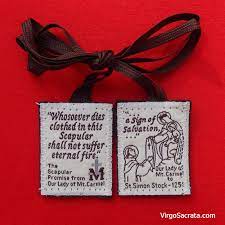
Many of you will have been introduced to Our Lady of Mt Carmel as young children. Perhaps you, as I did, received a brown scapular when you made your First Communion. My second grade teacher convinced me that, by wearing that scapular, I had become a very dedicated Christian and friend of Jesus and the Blessed Mother.

According to the Vatican’s Congregation for Divine Worship, the Brown Scapular is “an external sign of the filial relationship established between the Blessed Virgin Mary, Mother and Queen of Mount Carmel, and the faithful who entrust themselves totally to her protection, who have recourse to her maternal intercession, who are mindful of the primacy of the spiritual life and the need for prayer.

Wikipedia

My little brown scapular is long gone, set aside perhaps when my maturing fashions were inhibited by it in seventh of eighth grade. But the devotion to Mary which it initiated has never left me. It has grown, changed and deepened over these seventy years, but its roots are still entwined with that sepia necklace Sister Grace Loretta once placed in my little hand.

When I entered the Sisters of Mercy in the early 60s, I was so delighted that Our Lady of Mt. Carmel was honored as one of our patron saints. We did it up big back then by wearing our church cloaks and special habit sleeves to Mass on her feastday.


As I pray the Magnificat in today’s Responsorial Psalm, I reflect that Mary has become not only a trusted friend and model for my spiritual life. Her profound faith and poverty of spirit challenge and inspire my deeper understanding of the Gospel in today’s world.

The Mary I love today is a very different woman from the one I idealized in my youth. This change in perception has come about through reflection on the works of modern theologians such as those referred to below. Some of these books are out of print and/or expensive but reviews and excerpts are available online and can be helpful to one’s prayerful study.

For today’s prayer, let us open our hearts to the deep inspiration of Mary of Nazareth. I have referred readers to this excellent article by Elizabeth Johnson — and I do so again — as a great place to start:

https://www.americamagazine.org/faith/2000/06/17/mary-nazareth-friend-god-and-prophet


Elizabeth Johnson: Truly Our Sister


Rosemary Radford Reuther: Mary, The Feminine Face of the Church


Ivone Gebara and Maria Clara Bingemer: Mary, Mother of God, Mother of the Poor


Leonard Boff: The Maternal Face of God

Music: Tota Pulchra Es, Maria –