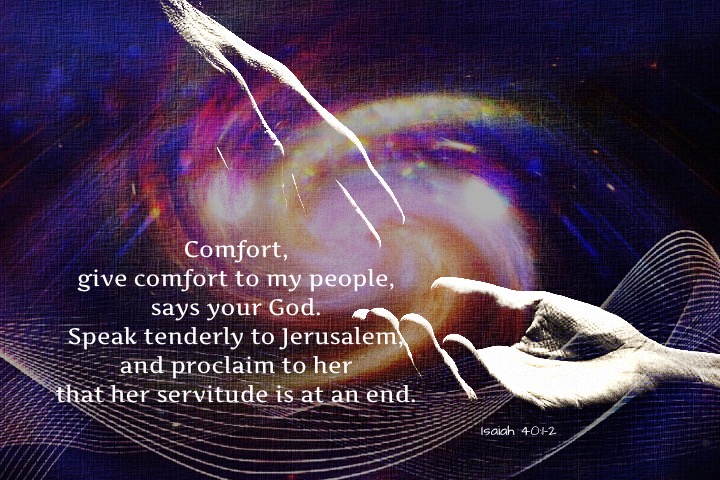
Today, in God’s Lavish Mercy, we once again hear that powerful passage from Isaiah, “Comfort Ye, My People”.
In these words from ancient Isaiah, also suggest echos of the Baptist’s voice, yet to be born, but fashioned from the same hope:
A voice cries out: In the desert prepare the way of the LORD! Make straight in the wasteland a highway for our God! Every valley shall be filled in, every mountain and hill shall be made low; The rugged land shall be made a plain, the rough country, a broad valley. Then the glory of the LORD shall be revealed, and all people shall see it together; for the mouth of the LORD has spoken.
Isaiah 40:1-2
Our Gospel gives us the gentle parable of the Good Shepherd who finds and comforts the lost sheep. This Divine Shepherd rejoices in the chance to seek out the hurt sheep and to comfort them, just as God rejoices in comforting and healing us.
And finding the sheep, amen, I say to you, the shepherd rejoices more over it than over the ninety-nine that did not stray. In just the same way, it is not the will of your heavenly Father that one of these little ones be lost.”
As we listen to today’s magnificent music, let us slowly name in our prayer those who most need God’s comfort – the “little ones” – not so much in stature – but in hope, freedom, justice, and the blessings of this world.
We may pray for ourselves, for someone we love, for those we know by name, or for those dear to God though nameless to us – all who suffer throughout the world.
Poetry: Shepherd – William Blake
How sweet is the Shepherd's sweet lot,
From the morn to the evening he strays:
He shall follow his sheep all the day
And his tongue shall be filled with praise.

For he hears the lambs innocent call,
And he hears the ewes tender reply,
He is watchful while they are in peace,
For they know when their Shepherd is nigh
Music: Comfort Ye from Handel’s Messiah, sung by Jerry Hadley
Today, in God’s Lavish Mercy, Isaiah describes a beautiful hike through a desert turned verdant and lush. Usually that’s not the way we picture a desert, but the phenomenon is real.
A desert bloom is a climatic phenomenon that occurs in various deserts around the world. The phenomenon consists of the blossoming of a wide variety of flowers during early-mid spring in years when rainfall is unusually high. The blossoming occurs when the unusual level of rainfall reaches seeds and bulbs that have been in a latent or dormant state, and causes them to germinate and flower in early spring. It is accompanied by the proliferation of insects, birds and small species of lizards. (Wikipedia)
Bloom in Chilean Desert – photo by Javier Rubilar
Isaiah preached during tough times — real “desert” times for Israel. He uses the image of the luxuriant desert bloom to encourage his listeners that, despite their dire circumstances (the Assyrian occupation followed by the Babylonian captivity), there is hope.
But it is hard to hope and believe when you haven’t yet seen the flowers, right? Some of Isaiah’s audience may have seemed a little “weak kneed” about launching out on the journey when the horizon still looked pretty dry and lifeless.
Strengthen the hands that are feeble, make firm the knees that are weak, Say to those whose hearts are frightened: Be strong, fear not! Here is your God, Who comes with vindication; With divine recompense God comes to save you.
Isaiah 35:3-4
I know I’ve felt weak-kneed at times, both literally and figuratively — those times when we are afraid to walk, to step forward or back, to move around or toward what we should. I’ll bet some of you have felt that way too.
At those times, we’re a little bit like the paralyzed man in today’s Gospel. We need courage, the help of good friends, and faith in God in order to stand up and walk on our own. Jesus wants to help us just like he helped this young man.
That you may know that the Son of Man has authority on earth to forgive sins”– Jesus said to the one who was paralyzed, “I say to you, rise, pick up your stretcher, and go home.”
He stood up immediately before them, picked up what he had been lying on, and went home, glorifying God.
Luke 5:24-25
Advent invites us to journey into deep faith and spiritual freedom, to trust the desert for its flowers, to believe that God lovingly wills our vigor and wholeness.
The LORD himself will give his benefits; our land shall yield its increase. Justice shall walk before him, and salvation, along the way of his steps.
Today’s Psalm 85: 13-14
Poetry: I Walked in a Desert – Stephen Crane
I walked in a desert.
And I cried,
“Ah, God, take me from this place!”
A voice said, “It is no desert.”
I cried, “Well, But —
The sand, the heat, the vacant horizon.”
A voice said, “It is no desert.”
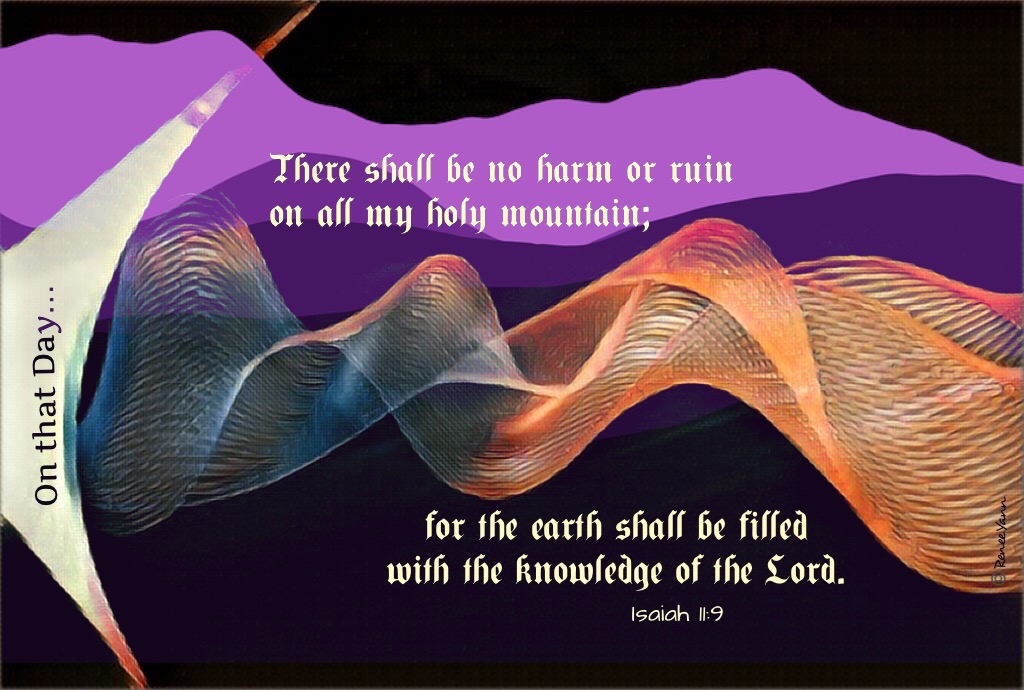
Today, in God’s Lavish Mercy, Isaiah paints the vision of Shalom.
“Shalom” is a Hebrew word commonly translated to English as “peace”.
In Hebrew, words are built on “roots”, generally of three consonants. When the root consonants appear with various vowels and additional letters, a variety of words, often with some relation in meaning, can be formed from a single root. Thus from the root sh-l-m come the words shalom (“peace, well-being”), hishtalem (“it was worth it”), shulam (“was paid for”), meshulam (“paid for in advance”), mushlam (“perfect”), and shalem (“whole”).
Our passage from Isaiah indicates an even deeper concept of shalom – one in which there is such right-balance among all creatures that:
When I first get up each morning, I glance through the news on my iPad while my tea is steeping. It’s a bad habit that I have trouble resisting because I want to make sure the world is all in one piece before I really start my day.
And, you know what? It never is. It’s a mess – with people shot, carjacked and bombed; with puppies abandoned, idiots in government, and tornadoes all over the place. There is little or no peace typed across the top of CNN.
The morning news is never going to blast the headline: A shoot has sprung from the Jesse’s root! God’s spirit rests on him!
See, here’s the thing. This “Jesse news” is what we are meant to set our mornings by, to set our lives by – because we are people of faith, and we have been taught the true meaning of “shalom”. Shalom is something that will never be found in our “apparent” world. Shalom is only to be found within each of us who live the promise of Isaiah fulfilled in Jesus.
Advent is about pondering how to live “shalom” in an often corrupt world. It is a time to ask ourselves if we really believe the Promise to which Advent points:
On that day, a shoot shall sprout from the stump of Jesse, and from his roots a bud shall blossom. The spirit of the LORD shall rest upon him: a spirit of wisdom and of understanding, a spirit of counsel and of strength, a spirit of knowledge and of fear of the LORD, and his delight shall be the fear of the LORD. Not by appearance shall he judge, nor by hearsay shall he decide, but he shall judge the poor with justice, and decide aright for the land’s afflicted.
Isaiah 11:1-4
While acknowledging the often leaden toxicity of our culture, our redeemed hearts will not be caught in it. We will live by and in the Promised Light because we understand that Isaiah’s “Day” started this morning when we decided to pray. We will live in the beautiful world that both has felt and yet awaits the touch of an Incarnate God.
Poetry: A World of Light – Elizabeth Jennings
Yes when the dark withdrew I suffered light
And saw the candles heave beneath the wax,
I watched the shadow of my old self dwindle
As softly on my recollection stole
A mood the senses could not touch or damage,
A sense of peace beyond the breathing word.
Day dawdled at my elbow. It was night
Within. I saw my hands, their soft dark backs
Keeping me from the noise outside. The candle
Seemed snuffed into a deep and silent pool:
It drew no shadow round my constant image
For in a dazzling dark my spirit stirred.
But still I questioned it. My inward sight
Still knew the senses and the senses' tracks,
I felt my flesh and clothes, a rubbing sandal,
And distant voices wishing to console.
My mind was keen to understand and rummage
To find assurance in the sounds I heard.
Then senses ceased and thoughts were driven quite
Away(no act of mine). I could relax
And feel a fire no earnest prayer can kindle;
Old parts of peace dissolved into a whole
And like a bright thing proud in its new plumage
My mind was keen as an attentive bird.
Yes fire, light, air, birds, wax, the sun's own height
I draw from now, but every image breaks.
Only a child's simplicity can handle
Such moments when the hottest fire feels cool,
And every breath is like a sudden homage
To peace that penetrates and is not feared.
Today, in God’s Lavish Mercy, we pray with Psalm 147 coming after the consoling passage from Isaiah:
O my people, no more will you weep; I will be gracious to you when you cry out, as soon as I hear you, I will answer.
Isaiah 30:19
Our readings today assure us that God sees and cares about our suffering. Like a mother who sings to a crying child, God wants to comfort us.
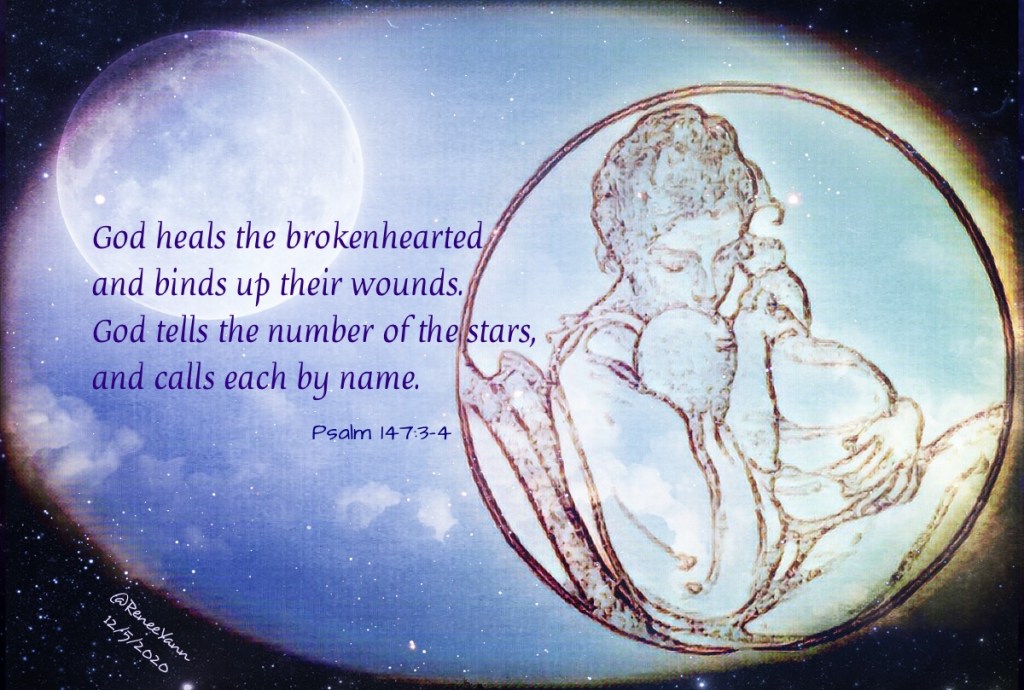
God heals the brokenhearted and binds up their wounds. God tells the number of the stars; calling each by name.
Psalm 147:3-4
God’s lullaby is Jesus Christ. In Jesus, our Creator sings over us the melody of Infinite Love and Mercy. All we need do is calm ourselves and listen.
Jesus is the Divine Song. He sings God’s Mercy over all who suffer.
At the sight of the crowds, Jesus’s heart was moved with pity for them because they were troubled and abandoned.
Matthew 9:36
All of us, at some time in our lives, stand amidst the troubled crowd. Our friends and family members too stand there at times.
Today, as we pray Psalm 147, let us place all our troubles, and theirs, — all of the world’s troubles — into the loving embrace of God who sings the lullaby of Jesus over us. Let us beg for all who are hurting to be cradled in infinite grace, resilient hope, holy courage and lavish mercy.
Poetry: from Rumi
Every midwife knows
that not until a mother's womb
softens from the pain of labour
will a way unfold
and the infant find that opening to be born.

Oh friend!
There is treasure in your heart,
it is heavy with child.

Listen.

All the awakened ones,
like trusted midwives are saying,
'welcome this pain.'
It opens the dark passage of Grace.
Today, in God’s Lavish Mercy, Isaiah teaches us how to imagine with the power of faith.
We’ve probably all done this, at least in small ways. It’s a mechanism for getting through some of the tougher spots in our lives. For example, when I have an unpleasant dental procedure, I calm myself by imagining the pizza I will pick up on the way home. I even envision a specific time when the procedure will be over and I’ll be in line at the pizzeria.
Isaiah is coaching us in the same coping mechanisms, but on a much grander scale.
On that day, The branch of the LORD will be luster and glory, and the fruit of the earth will be honor and splendor for the survivors of Israel. He who remains in Zion and he who is left in Jerusalem Will be called holy: every one marked down for life in Jerusalem.
During his lifetime, Isaiah lived in a war torn land where the poor and the vulnerable were particularly threatened. These daily anxieties challenged their faith and eroded their confidence in God. Their intent to build and participate in a faithful community suffered because they could not see beyond their pain.
Isaiah tells them that a better day is coming. He invites Israel to stretch their faith, to trust in God’s promise, and to believe that God abides with them and will deliver them to glory.
Then will the LORD create, over the whole site of Mount Zion and over her place of assembly, A smoking cloud by day and a light of flaming fire by night. For over all, the LORD’s glory will be shelter and protection: shade from the parching heat of day, refuge and cover from storm and rain.
Isaiah is asking a lot of these bereft people. It is really hard to live in the Light when there is nothing around you but darkness. But it is possible to do so by the power of faith.
In our Gospel, Jesus meets a man who has that kind of powerful faith. When Jesus offers to come cure the man’s paralyzed servant, the man says there is no need to come. He already trusts that God is with that servant and will bring him to wholeness.
Hearing the man, Jesus was amazed and said to those following him, “Amen, I say to you, in no one in Israel have I found such faith. I say to you, many will come from the east and the west, and will recline with Abraham, Isaac, and Jacob at the banquet in the Kingdom of heaven.”
Wow! Wouldn’t it be great to amaze Jesus with our faith!
Indeed, as we pray today, Isaiah and Jesus may be asking us for the same kind of faith. There is a lot of pain and darkness in the larger world we share, and in many of our individual worlds. As we make our Advent journey, God asks us to live in a way that does not ignore the gloom, but still sees through it to trust the Light – a faith that proclaims God is already with us, bringing us to wholeness.
Come and save us, LORD our God; let your face shine upon us, that we may be saved. R. Alleluia, alleluia.
Poetry: To Imagination – Emily Brontë
When weary with the long day's care,
And earthly change from pain to pain,
And lost and ready to despair,
Thy kind voice calls me back again:
Oh, my true friend! I am not lone,
While thou canst speak with such a tone!

So hopeless is the world without;
The world within I doubly prize;
Thy world, where guile, and hate, and doubt,
And cold suspicion never rise;
Where thou, and I, and Liberty,
Have undisputed sovereignty.

What matters it, that, all around,
Danger, and guilt, and darkness lie,
If but within our bosom's bound
We hold a bright, untroubled sky,
Warm with ten thousand mingled rays
Of suns that know no winter days?

Reason, indeed, may oft complain
For Nature's sad reality,
And tell the suffering heart, how vain
Its cherished dreams must always be;
And Truth may rudely trample down
The flowers of Fancy, newly-blown:

But, thou art ever there, to bring
The hovering vision back, and breathe
New glories o'er the blighted spring,
And call a lovelier Life from Death,
And whisper, with a voice divine,
Of real worlds, as bright as thine.

I trust not to thy phantom bliss,
Yet, still, in evening's quiet hour,
With never-failing thankfulness,
I welcome thee, Benignant Power;
Sure solacer of human cares,
And sweeter hope, when hope despairs!
Today, in God’s Lavish Mercy, our readings are challenging.
Revelation, a very complex book of the Bible, uses symbols, prophecies and allegorical references to make its point. There are huge bodies of scholarship written in the attempt to interpret these passages.
Our Gospel has Jesus describing what it will be like in heaven – when our human perceptions will be erased and we will finally be absorbed into God’s understanding.
These are BIG thoughts and my mind, at least, needs some more manageable inspirations for my morning prayer. So here’s how I prayed with these readings today.
What both passages share are continual references to time – past, present and future. They reference then-time, now-time, and to-be-time. These passages, and others in Scripture like them, talk about time like this:
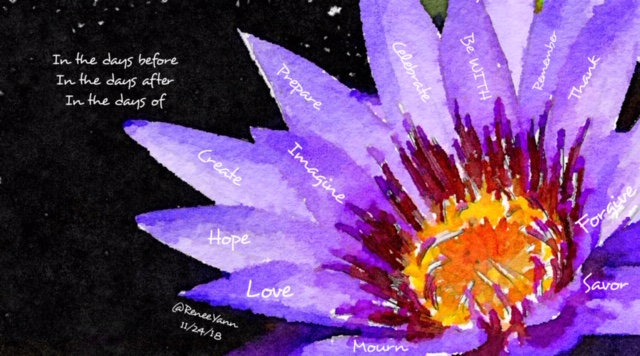
“in the days before” (then time)
“in the days after” (to -be time)
“in the day of” (now time)
So what is this day, November 19th, for me? How is God revealing Love to me in this, my time?
Today is among “the days after” the last memorable thing that happened in my life – maybe a good thing, maybe not so much. In “the days after”, we spend time with a completed event – learning, savoring, or perhaps regretting and recovering. The “days after” are a time to pray for grace and blessing over what cannot be changed.
Today is also among “the days before” the next big events of my life. So my prayer includes a petition for new and continued courage, hope and enthusiasm for life.
And, most importantly, today is “a day of”. I ask God to help me see and receive the graces of this present moment – not to miss them because I am looking only back or forward. Let me look God square in the eye on this day, which is the only place that I can really find the God Who is always Now.
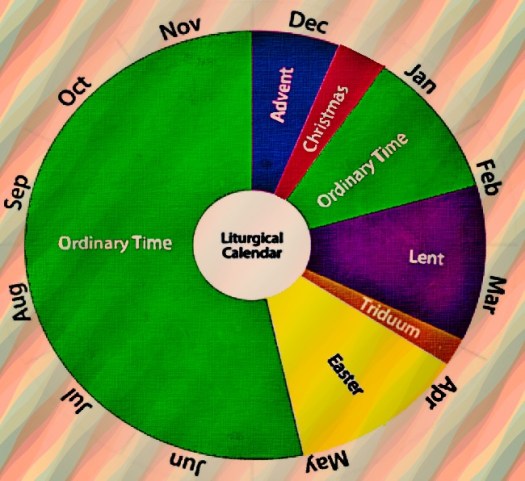
The entire liturgical year is built on this understanding of time.
Advent and Lent are “the days before”, the days of preparation, anticipation, imagining, creating, hoping.
The feasts like Christmas, Easter and Pentecost are “the days of”, days of celebrating, loving, being with.
The various Octaves are “the days after”, days of remembering, thanking, appreciating, understanding, mourning, forgiving and savoring
Where are you today in the times of your life? It may be in a very different place from what is printed on the calendar. The events of our lives create their own personal liturgies.
No matter where that happens to be, let us meet God there with full and open hearts.
Poetry: from Burnt Norton by T.S. Eliot
Time present and time past Are both perhaps present in time future, And time future contained in time past. If all time is eternally present All time is unredeemable. What might have been is an abstraction Remaining a perpetual possibility Only in a world of speculation. What might have been and what has been Point to one end, which is always present. Footfalls echo in the memory Down the passage which we did not take Towards the door we never opened Into the rose-garden. My words echo Thus, in your mind. But to what purpose Disturbing the dust on a bowl of rose-leaves I do not know. Other echoes Inhabit the garden. Shall we follow?
Today, in God’s Lavish Mercy, we read about time, that elusive framework that binds our days. We are so conscious of time, still it defies all our efforts to define or control it. It lumbers when we want it to skip. It flies when we long for it to tarry. Once it has passed, we wonder where it went. We find the long, vibrant years compressed to a distant, gossamer memory.
Time can create in us a sense of urgency, a deadline for us to make a mark on its surface. But Ecclesiastes counsels us to be patient, telling us there is a time for everything – a segment in our life story for us to plumb each emotion.
As we read through this antiphonal list of life’s realities, we are conscious of the ones we would rather eliminate – the downside of experience. But the scribe suggests that even life’s shadowed side serves to hone us for eternity.
Faith allows us to stand in balanced trust on the crossbeam of our shifting lives. Hope causes us to expect light out of every darkness. Love convinces us that our timeless God abides with us beyond time’s testing.
In our Gospel, Jesus is conscious that he is coming to the end of his time. As many of us do when we are feeling unsure of ourselves, Jesus asks his disciples what people are saying about him. They respond in glowing accolades – Elijah, the Baptist returned from the dead, the Christ, Son of God. But Jesus knows it is not a time for accolades. He rebukes them with a somber forecast of darkening times.
Even Jesus, Son of the Eternal God, experienced time’s shifting waves. Praying the Gospel daily, living with Jesus through his highs and lows, is the steady fulcrum in our own uneven seas.
Poetry: from Burnt Norton – T.S. Eliot
These are the opening lines from Eliot’s long poem. I love Eliot but he definitely challenges his reader. If you are up to the challenge, here is a link to the whole poem. ( I find it best to read his poems in small doses, reflecting slowly on the depth of his suggestions.) http://www.coldbacon.com/poems/fq.html
Time present and time past
Are both perhaps present in time future
And time future contained in time past.
If all time is eternally present
All time is unredeemable.
What might have been is an abstraction
Remaining a perpetual possibility
Only in a world of speculation.
What might have been and what has been
Point to one end, which is always present.
Footfalls echo in the memory
Down the passage which we did not take
Towards the door we never opened
Into the rose-garden. My words echo
Thus, in your mind.
                                   But to what purpose
Disturbing the dust on a bowl of rose-leaves
I do not know.
Today, in God’s Lavish Mercy, we are taught about the nature of faith and hope.
Alleluia, alleluia. Stay awake and be ready! For you do not know on what day your Lord will come.
Our readings today are long, complex, and rich. Trying to pray with them this morning brought an image to mind.
Like many Dads, mine both loved and hated putting the lights on the Christmas tree. No matter how carefully he had stored them the previous year, those endless wires and tiny bulbs managed to morph into a ball of frustration when he opened the box.
But Dad persevered because he knew what the end result would be. After a few hours, when he finally leaned over to plug in his work, the whole family all held our breath both in anticipation and trepidation. That was because, most of time, nothing happened… no lights. Zilch.
Dad would then exclaim a litany over the fragile mess – one that I was prohibited from repeating. This chant signaled that we all immediately join in testing every single bulb to find the culprit which had caused the blackout. Ah! Family Christmas rituals!
Well, I think today’s readings are like those labyrinthine lights. Each passage contains a string of bulbs that must be twisted and turned over in our prayer to help us discover their illumination.
The central current for me is this: faith is a relationship, long and unbreakable. Even if a bulb goes out every now and again, keep searching for the energy and light, just as our foremothers and fathers did.
Our faith and hope are rooted in that sacred heritage:
In the ancient faith of Moses:
The night of the passover was known beforehand to our ancestors, that, with sure knowledge of the oaths in which they put their faith, they might have courage.
In the trusting songs of David
Our soul waits for the LORD, who is our help and our shield. May your kindness, O LORD, be upon us who have put our hope in you.
In the grounding insights of Paul
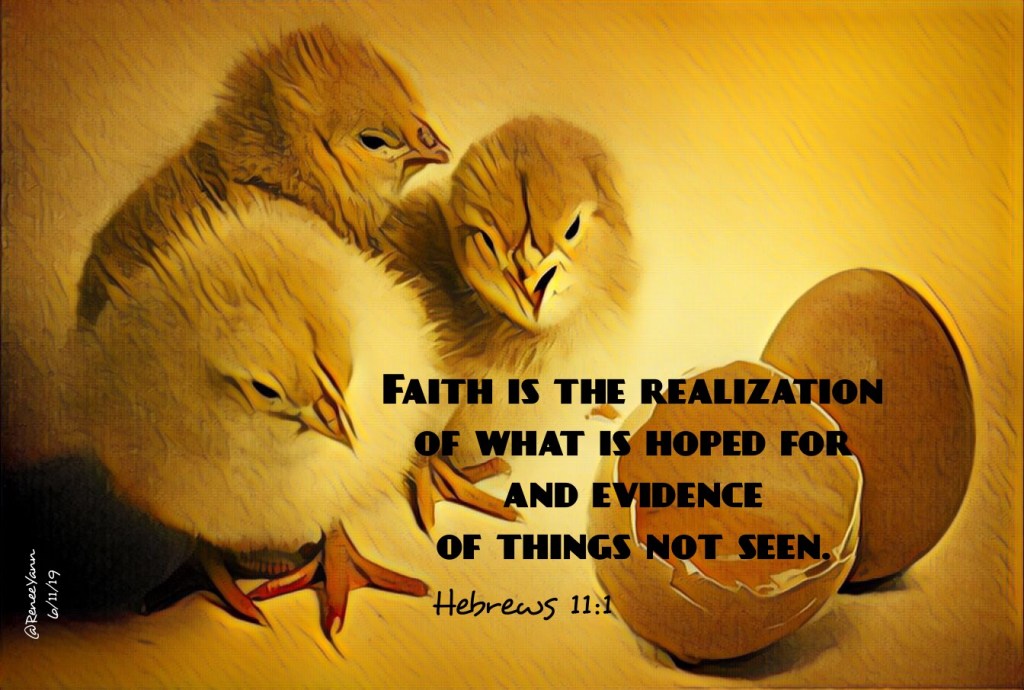
Faith is the realization of what is hoped for and evidence of things not seen.
And in the promise of Jesus to those who remain faithful
Jesus said to his disciples: “Do not be afraid any longer, little flock, for your Father is pleased to give you the kingdom.”
Our readings assure us that, for those who hope and believe, there is no doubt what the end result will be. Our faith will be blessed by the glorious light of God.
Alleluia, alleluia. A great prophet has arisen in our midst and God has visited the people.
Today, in God’s Lavish Mercy, our readings carry the themes of Hope and Restoration.
Jeremiah tells the people that, even after all they’ve been through, God has an age-old love for them and therefore will not abandon them.
Jeremiah continues with a description of the future coming of the Savior, promising that Israel will be restored:
Yes, a day will come when the watchmen will call out on Mount Ephraim: “Rise up, let us go to Zion, to the LORD, our God.” For thus says the LORD: Shout with joy for Jacob, exult at the head of the nations; proclaim your praise and say: The LORD has delivered the people, the remnant of Israel.
Our Alleluia Verse announces that this expected Savior has arrived in Jesus Christ, the Divine Shepherd, Lord, Guardian and Redeemer whom Jeremiah describes in our Responsorial Psalm.
Alleluia, alleluia. A great prophet has arisen in our midst and God has visited the people.
Matthew’s Gospel today, which can seem a little contentious in tone, actually demonstrates the surprising truth that Jesus came not only for the sake of Israel, but for all people — for us.
We are all beneficiaries of God’s age-old love for us.
Poetry: You are the future, the great sunrise red – Rainer Maria Rilke
You are the future, the great sunrise red above the broad plains of eternity. You are the cock-crow when time’s night has fled, You are the dew, the matins, and the maid, the stranger and the mother, you are death.
You are the changeful shape that out of Fate rears up in everlasting solitude, the unlamented and the unacclaimed, beyond describing as some savage wood.
You are the deep epitome of things that keeps its being’s secret with locked lip, and shows itself to others otherwise: to the ship, a haven — to the land, a ship.
Music: I Have Loved You – Michael Joncas
I have loved you with an everlasting love, I have called you and you are mine;
I have loved you with an everlasting love, I have called you and you are mine.
Seek the face of the Lord and long for him: He will bring you his light and his peace.
I have loved you with an everlasting love, I have called you and you are mine;
I have loved you with an everlasting love, I have called you and you are mine.
Seek the face of the Lord and long for him: He will bring you his joy and his hope.
I have loved you with an everlasting love, I have called you and you are mine;
I have loved you with an everlasting love, I have called you and you are mine.
Seek the face of the Lord and long for him: He will bring you his care and his love.
I have loved you with an everlasting love, I have called you and you are mine;
I have loved you with an everlasting love, I have called you and you are mine.
Today, in God’s Lavish Mercy, our Alleluia Verse makes an amazing promise.
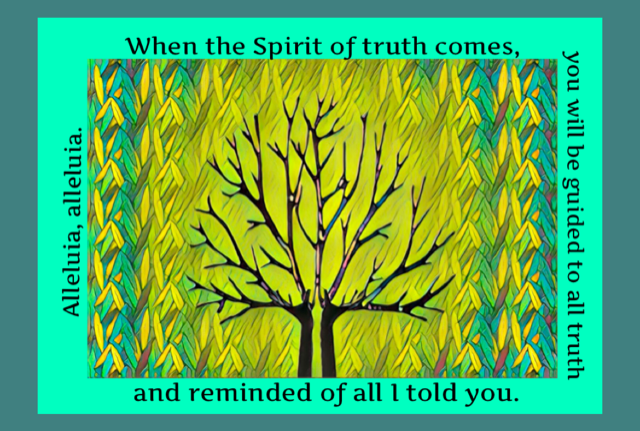
Alleluia, alleluia. When the Spirit of truth comes, you will be guided to all truth and reminded of all I told you.
John 16:13-14
We will be guided and re-minded by the Spirit of God! We will have a refreshed mind and sense of sacred purpose!
Perhaps like Hosea’s community, we have been exhausted, “collapsed” from a lack of grace and spiritual vitality. The lack may be within or around us, from our own negligence or from a world too heavy with evil. But Hosea proclaims that, if we turn to God with our “words” – our prayer – God will respond:
I will be like the dew for my beloved: who shall blossom like the lily; who shall strike root like the Lebanon cedar, and put forth abundant shoots. My dear one’s splendor shall be like the olive tree with a fragrance like the Lebanon cedar.
Hosea 14: 6-7
Jesus continues and fulfills that promise in his own time and in ours. We live in a world still plagued by the sinfulness Jesus describes for his disciples in today’s Gospel. It is an overwhelming darkness at times and we can become heavy with it. We may feel we have no strength to stand against it, nor words to speak for change.
Jesus assures us that the refreshing “dew” of Hosea is abundantly available to us through our life in the Holy Spirit.
Do not worry about how you are to speak or what you are to say. You will be given at that moment what you are to say. For it will not be you who speak but the Spirit of your God speaking through you.
Matthew 10:19-20
Let’s not take that amazing gift and promise for granted. Let’s not fail to believe that the Spirit of Truth is with us to guide and remind us of our immense power for good.
Poetry: The World Is Too Much With Us – William Wordsworth
The world is too much with us; late and soon,
Getting and spending, we lay waste our powers;—
Little we see in Nature that is ours;
We have given our hearts away, a sordid boon!
This Sea that bares her bosom to the moon;
The winds that will be howling at all hours,
And are up-gathered now like sleeping flowers;
For this, for everything, we are out of tune;
It moves us not. Great God! I’d rather be
A Pagan suckled in a creed outworn;
So might I, standing on this pleasant lea,
Have glimpses that would make me less forlorn;
Have sight of Proteus rising from the sea;
Or hear old Triton blow his wreathèd horn.













 Lavish Mercy