Today, in God’s Lavish Mercy, Isaiah offers us polar opposites for our prayer: some charmless metaphors and some beautiful lyricism.
In a graphic attempt to alert us to our spiritual weakness, Isaiah suggests that we are worms and maggots whom God still loves. It’s a comparison I get, but I choose not to linger on in my prayer.
Still, I don’t want to miss the point. No matter how unimportant we may feel in human estimation, we are ardently cared for by God who does not want us to be afraid. God wants us to turn from our worrisome self-estimation toward the hope that God’s Love promises:
The afflicted and the needy seek water in vain, their tongues are parched with thirst. I, the LORD, will answer them; I, the God of Israel, will not forsake them. I will open up rivers on the bare heights, and fountains in the broad valleys; I will turn the desert into a marshland, and the dry ground into springs of water. I will plant in the desert the cedar, acacia, myrtle, and olive; I will set in the wasteland the cypress, together with the plane tree and the pine, That all may see and know, observe and understand, That the hand of the LORD has done this, the Holy One of Israel has created it.
Isaiah 41:17-20
In our Gospel, Jesus praises John the Baptist, a preacher who could get a little wormy too at times. But John’s core message bursts with hope as does Isaiah’s. Their messages sound like this in my spirit:
Your soul is a window into eternity! Stop looking in your unlit mirror! Repent! Turn your heart toward God! Believe in the New Dawn rising in Jesus Christ!
Imagery:
As our Alleluia Verse charges us:
R. Alleluia, alleluia. Let the clouds rain down the Just One, and the earth bring forth a Savior. R. Alleluia, alleluia.
Today, in God’s Lavish Mercy, our readings ask us, for an Advent moment, to disentangle ourselves from time and space, and to see the world as God sees it.
Isaiah, hearing God’s insistence in his prophet’s heart, assures us of God’s mercy and of our deliverance from the world’s confusions:
Handel: Messiah / Part 1 – “Comfort ye, My people… Ev’ry Valley shall be exalted” Conducted by Sir Neville Mariner
Comfort, give comfort to my people, says your God. Speak tenderly to Jerusalem, and proclaim to her that her service is at an end, her guilt is expiated; indeed, she has received from the hand of the LORD double for all her sins.
Isaiah 40: 1-2
Isaiah analogizes these confusions in rich terrestrial metaphors: a desert, a wasteland, a depressed valley, a rough road. Probably most of us have been in one or two of these spots in the past year. Am I right?
A voice cries out: In the desert prepare the way of the LORD! Make straight in the wasteland a highway for our God! Every valley shall be filled in, every mountain and hill shall be made low; the rugged land shall be made a plain, the rough country, a broad valley. Then the glory of the LORD shall be revealed, and all people shall see it together; for the mouth of the LORD has spoken.
Isaiah 40:3-5
But just how is our deliverance from these dead-end places to be accomplished? Peter offers an answer – it is accomplished through repentance.
Do not ignore this one fact, beloved, that with the Lord one day is like a thousand years and a thousand years like one day. The Lord does not delay his promise, as some regard “delay,” but he is patient with you, not wishing that any should perish but that all should come to repentance.
2 Peter 3:8-9
If we were lost in a desert or trapped in an unscalable valley, all we would want is to get out. We might not pause to ask ourselves, “How did I get here?”, or “How can I avoid a return?”. The same thing might be true of our spiritual deserts and valleys.
Isaiah, Peter, and Jesus tell us that it is our resistance to God’s vision, our sinfulness, that captures us in our desolations – and that “repentance” is the antidote.
Since everything is to be dissolved in this way, what sort of persons ought you to be, conducting yourselves in holiness and devotion, waiting for and hastening the coming of the day of God, because of which the heavens will be dissolved in flames and the elements melted by fire. But according to his promise we await new heavens and a new earth in which righteousness dwells. Therefore, beloved, since you await these things, be eager to be found without spot or blemish before him, at peace.
2 Peter 3:11-14
In our Gospel, John the Baptist also tells us to repent. And, honestly, when I first read his Advent proclamation every year, I find myself telling God something like this:
You know, dear God, I’m not really that bad off that I need to — well, you know…. like actually REPENT!!!! I’ve been doing the best I can. I’m one of the “Goodies” in this bad, bad world! You see that, don’t You?
Then Isaiah’s gentle Shepherd comes along, lifts me into those comforting arms, and convinces me that the world can be transformed if I will let myself see it as God sees it. All the normalized uncharities of my life — the judgments, the ungenerous hesitations, the excused prejudices, the unforgiven mistakes, the selfish expectations. Yes, all those deserts and valleys that we dismiss unresolved will just accumulate and stagnate in our listless spirits! It is from these crooked ways that God offers to deliver us once again in this year’s Advent reimagining.
So, what a wonderful invitation we receive in today’s readings! It is time to begin again – fresh, reinvigorated, and amazed at the power of grace in our lives!
Go up on to a high mountain, Zion, herald of glad tidings; cry out at the top of your voice, Jerusalem, herald of good news! Fear not to cry out and say to the cities of Judah: Here is your God! Here comes with power the Lord GOD, who rules by his strong arm; here is his reward with him, his recompense before him. Like a shepherd he feeds his flock; in his arms he gathers the lambs, carrying them in his bosom, and leading the ewes with care.
Isaiah 40:9-11
On this Advent’s Second Sunday, let’s rest with that comforting but convincing Shepherd to learn where graceful change will free us for rebirth.
Poetry: Reminder – Mark Jarman
For God is in heaven, and you upon earth. —Ecclesiastes 5:2
Don’t take your eyes off the road. Accept nothing as given. Watch where you put your hands. You’re here and God’s in heaven.
Be careful where you step. The drop-off’s somewhere near. The fog won’t lift tonight. God’s in heaven. You’re here.
That word you wish to say, That score you’d like to even— Don’t hurry either while You’re here and God’s in heaven.
The earth says, “Take the wheel. But no matter how you steer, I’ll still go round in circles. God’s in heaven. You’re here.”
Today, in God’s Lavish Mercy, we finally stand at the edge of the diving board before our plunge into the sublime days of Advent!
Daniel, at the end of a daunting passage, closes with this conviction that foreshadows the Messiah’s reign:
Then the kingship and dominion and majesty of all the kingdoms under the heavens shall be given to the holy people of the Most High, Whose Kingdom shall be everlasting: all dominions shall serve and obey him.
Daniel 7:27
In our Gospel, Jesus uses a tone similar to Daniel to encourage our vigilance:
Jesus said to his disciples: “Beware that your hearts do not become drowsy from carousing and drunkenness and the anxieties of daily life, and that day catch you by surprise like a trap. For that day will assault everyone who lives on the face of the earth. Be vigilant at all times and pray that you have the strength to escape the tribulations that are imminent and to stand before the Son of Man.”
Luke 21:34-36
I take these words as an imperative to engage the days of Advent for what they are supposed to be – a time of thoughtful, prayerful preparation to receive the gift and mystery of Christ in all its splendor.
The Gospel seems to suggest that we might become too tired for such prayer during all our frenetic Christmas preparations, or that we might break out the spiked egg nog a little too early. We are admonished to be alert, sober, and unanxious. We are advised to “Be vigilant” – that is, to light the heart’s candle and to wait patiently for God.
Poetry: Tug and Sigh – May Sarton, from “The Silence Now”
Like the datura’s yellow trumpets
I am waiting for the breath of angels
to perfume the twilight
of this ordinary day
and play the vigil hymn
reminding me
that heaven and earth
wed long ago.

I too am married
to the unseen
sigh and scent,
filling and returning,
thus never full –
always longing,
often failing,
yet ever blessed
with heaven’s pull.
Today, in God’s Lavish Mercy, we celebrate the Feast of St. Andrew, the brother of Peter, also a fisherman, a beloved Apostle and friend of Jesus.
Our Gospel tells the story of Andrew’s call.
As Jesus was walking by the Sea of Galilee, he saw two brothers, Simon who is called Peter, and his brother Andrew, casting a net into the sea; they were fishermen. He said to them, “Come after me, and I will make you fishers of men.” At once they left their nets and followed him.
Matthew 4;18-20
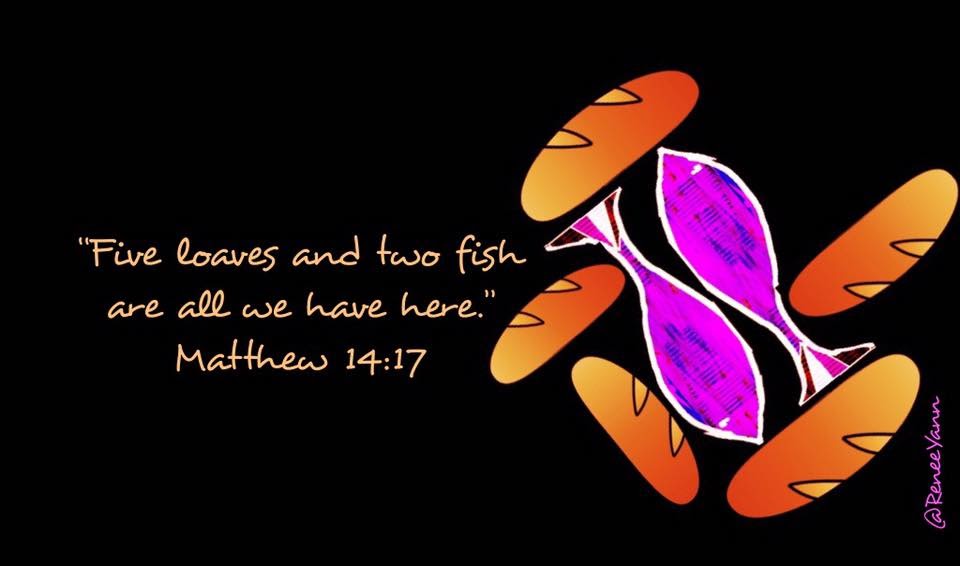
Another favorite passage about Andrew is when he points out to Jesus that, in the hungry crowd, there is a young boy with five loaves and two fish.
One of the disciples—it was Andrew, brother to Simon Peter—said, “There’s a little boy here who has five barley loaves and two fish. But that’s a drop in the bucket for a crowd like this.” Jesus said, “Make the people sit down.” There was a nice carpet of green grass in this place. They sat down, about five thousand of them. Then Jesus took the bread and, having given thanks, gave it to those who were seated. He did the same with the fish. All ate as much as they wanted.
John 6:8-11
How simple and complete was Andrew’s faith! Those seven little groceries must have seemed so minute among 5000. Can you picture Andrew looking into Jesus’s eyes as if to say, “I know it’s not much but you can do anything!” Maybe it was that one devoted look that prompted Jesus to perform this amazing miracle!
We trust that our deep devotion and faith can move God’s heart too – or, more accurately, can move our hearts to embrace God’s Presence. On this feast of St. Andrew, many people begin a prayer which carries them through to Christmas. Praying it, we ask for particular favors from God.
I love this prayer because it was taught to me by my mother, a woman blessed with simple faith like Andrew’s. As I recite it, I ask to be gifted with the same kind of faith.
( Another reason I love it is this: how often in life do you get a chance to say a word like “vouchsafe“! )
St. Andrew Christmas Novena Hail and blessed be the hour and moment in which the Son of God was born of the most pure Virgin Mary, at midnight, in Bethlehem, in the piercing cold. In that hour vouchsafe, I beseech Thee, O my God, to hear my prayer and grant my desires through the merits of Our Savior Jesus Christ, and of His blessed Mother. Amen.
As we draw near to the Season of great blessings, we see our world filled with conflict and violence. Let’s fold our Advent prayers around its many wounds.
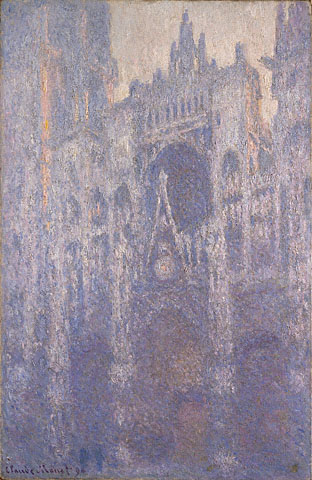
Poetry: Monet Refuses the Operation – Lisel Mueller
How wonderful to allow ourselves to see the world differently – to see it charged with heavenly illuminations and latent miracles!
Rouen Cathedral: Morning Light (1894) – Claude Monet
Doctor, you say there are no haloes
around the streetlights in Paris
and what I see is an aberration
caused by old age, an affliction.
I tell you it has taken me all my life
to arrive at the vision of gas lamps as angels,
to soften and blur and finally banish
the edges you regret I don’t see,
to learn that the line I called the horizon
does not exist and sky and water,
so long apart, are the same state of being.
Fifty-four years before I could see
Rouen cathedral is built
of parallel shafts of sun,
and now you want to restore
my youthful errors: fixed
notions of top and bottom,
the illusion of three-dimensional space,
wisteria separate
from the bridge it covers.
What can I say to convince you
the Houses of Parliament dissolve
night after night to become
the fluid dream of the Thames?
I will not return to a universe
of objects that don’t know each other,
as if islands were not the lost children
of one great continent. The world
is flux, and light becomes what it touches,
becomes water, lilies on water,
above and below water,
becomes lilac and mauve and yellow
and white and cerulean lamps,
small fists passing sunlight
so quickly to one another
that it would take long, streaming hair
inside my brush to catch it.
To paint the speed of light!
Our weighted shapes, these verticals,
burn to mix with air
and change our bones, skin, clothes
to gases. Doctor,
if only you could see
how heaven pulls earth into its arms
and how infinitely the heart expands
to claim this world, blue vapor without end.
Music: Hear my prayer, O Lordis an eight-part choral anthem by the English composer Henry Purcell (1659–1695). The anthem is a setting of the first verse of Psalm 102 in the version of the Book of Common Prayer. Purcell composed it c. 1682 at the beginning of his tenure as Organist and Master of the Choristers for Westminster Abbey.
Today, in God’s Lavish Mercy, Daniel interprets a dream in which a statue spontaneously breaks apart, and Jesus warns that the beloved Temple will someday do the same thing. Our scriptures beg the question: how does one find strength to rebuild again?
We don’t like things to break apart that we hadn’t expected to break apart – even stupid things. I had a favorite old plastic mug that I loved to pack with ice and B.O.C. (beverage of choice) as I headed to the beach on a hot summer day. It was about a thousand years old but part of its famed origin was still visible on the faded side:
For some inexplicable reason, one morning I decided to pour my hot tea into that irreplaceable mug. It basically melted into itself like the wicked witch in the Wizard of Oz. It wasn’t a tragedy tantamount to Daniel’s dream or the Temple collapsing, but I’ll tell you, I have NEVER since had a matching drink on the beach!
My treasured mug disintegrated because I used it for the wrong purpose. And that is also the point of both our readings. Daniel describes how the ensuing generations, who misuse their power, will disappear one after the other until God establishes the permanent reign of justice:
… the kingdom shall be partly strong and partly fragile. The iron mixed with clay tile means that they shall seal their alliances by intermarriage, but they shall not stay united, any more than iron mixes with clay. In the lifetime of those kings the God of heaven will set up a kingdom that shall never be destroyed or delivered up to another people; rather, it shall break in pieces all these kingdoms and put an end to them, and it shall stand forever.
Daniel 2:42-44
Jesus describes the same dynamic in relationship to the Temple because its use has been diverted into material show and adornment rather than worship and the works of justice:
While some people were speaking about how the temple was adorned with costly stones and votive offerings, Jesus said, “All that you see here– the days will come when there will not be left a stone upon another stone that will not be thrown down.”
Luke 21:5
But, here’s the thing about God’s action to break up in our lives that which is no longer life-giving — the breakup will always yield new life if we can open our hearts to its grace.
As we look back over 2023, we may see a lot of disassembled pieces scattered across the landscape. Maybe some of the plans we had never flew, or maybe the string broke on some of the kites we’d been flying for years! There may have been small losses that seemed monumental at the time, or truly monumental losses whose significance has only deepened.
Wherever we stand amid our dreams and our temples, we can be sure of this as 2024 approaches: grace is always with us, renewing us in the ever clearer image of God.
This final week before Advent is a great time to take inventory of our spiritual lives. What needs to go and what needs to be strengthened? Most likely, we already know the answers. Now let’s gather the courage and focus to do what grace suggests.
Poem: Beginners – Denise Levertov
Levertov writes about hope, courage, justice, and mercy. The poem begins with a stanza from The Garden of Proserpine by Algernon Charles Swinburne, introduced by a dedication to activists Karen Silkwood and Eliot Gralia.
“From too much love of living, Hope and desire set free, Even the weariest river Winds somewhere to the sea—“ – – – – – – –
But we have only begun
To love the earth.

We have only begun
To imagine the fullness of life.

How could we tire of hope?
— so much is in bud.

How can desire fail?
— we have only begun

to imagine justice and mercy,
only begun to envision

how it might be
to live as siblings with beast and flower,
not as oppressors.

Surely our river
cannot already be hastening
into the sea of nonbeing?

Surely it cannot
drag, in the silt,
all that is innocent?

Not yet, not yet—
there is too much broken
that must be mended,

too much hurt we have done to each other
that cannot yet be forgiven.

We have only begun to know
the power that is in us if we would join
our solitudes in the communion of struggle.

So much is unfolding that must
complete its gesture,

so much is in bud.
Music: Sacred River – Gandalf As you experience this beautiful video, allow your spirit to remember the challenges and blessings of this past year that have brought you to this place with God, ready for a new beginning and a deeper love.
Today, in God’s Lavish Mercy, on this feast of Christ the King, we might expect our readings to be filled with triumphal metaphors for God – conquerer, ruler, omnipotent and, yes, distant from us.
Instead, today’s passages offer us images of God as a devoted, simple, and caring shepherd – the tenderest of roles in our natural world.
Thus says the Lord GOD: I myself will look after and tend my sheep. As a shepherd tends his flock when he finds himself among his scattered sheep, so will I tend my sheep. I will rescue them from every place where they were scattered when it was cloudy and dark.
What an unexpected “King” this is! Rather than groveling before his majesty, we are lifted shivering to his warm shoulders. We are rescued from our cloudy shadows and raised into his light.
In Corinthians, Paul instructs us that Christ is King for one reason: he has conquered death. Death is the darkest of shadows from which we long to be rescued – both the small deaths of loss, bereavement, failure, addiction, illness, depression – and the inevitable ending of the life we cherish in ourselves and others. Christ, the kingly shepherd, finds us even when we are lost and confused in fears such as these.
In our Gospel, Jesus says that he will easily find us in our shadows because we are already marked by a certain light – our acts of mercy toward his least ones:
‘Lord, when did we see you hungry and feed you, or thirsty and give you drink? When did we see you a stranger and welcome you, or naked and clothe you? When did we see you ill or in prison, and visit you?’ And the king will say to them in reply, ‘Amen, I say to you, whatever you did for one of the least brothers of mine, you did for me.’
For our prayer today, we might just ask the kingly shepherd to lift us close to the Divine Heart, to hum Mercy over us in a healing lullaby, so that we might return it freely to our wounded world.
Prayer: Our beautiful Responsorial Psalm will be our poetry for today.
The LORD is my shepherd; I shall not want.
In verdant pastures I rest.
Beside restful waters God leads me;
refreshing my soul.
guiding me in right paths
in the safety of God's Name.
You spread the table before me
in the sight of my foes;
you anoint my head with oil;
my cup overflows.
Only goodness and kindness follow me
all the days of my life;
and I shall dwell in the house of the LORD
for years to come.
Today, in God’s Lavish Mercy, our readings are about living in the big picture of God’s vision for us.
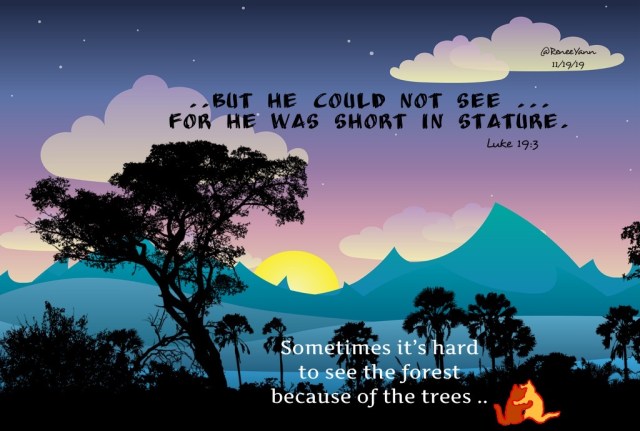
Once again, we meet Zacchaeus who, due to his short stature, was unable to get a glimpse of Jesus walking nearby. He wasn’t getting the whole picture but he wanted to!
Zacchaeus ran ahead and climbed a sycamore tree in order to see Jesus, who was about to pass that way. When he reached the place, Jesus looked up and said, “Zacchaeus, come down quickly, for today I must stay at your house.” And he came down quickly and received him with joy.
Luke 19:4-5
Sometimes we miss Christ in our midst, don’t we? It may be because we’re “short” on time, patience, faith, attention, courage, peace, desire … you name it.
Zacchaeus may have been physically short, but he was tall in will and intention to see Jesus. The trees became his tools, not his obstacles.
In our first reading, Eleazar was a giant in the virtues necessary to “see beyond the trees” of his current circumstances. A more spiritually short-sighted person might have succumbed to the temptation to save himself at the cost of his faith and witness.
But Eleazar’s faith was long, both in years and in depth. He kept the eyes of his heart focused on that faith and was delivered beyond any short-sighted choices.
Eleazar made up his mind in a noble manner, worthy of his years, the dignity of his advanced age, the merited distinction of his gray hair, and of the admirable life he had lived from childhood; and so he declared that above all he would be loyal to the holy laws given by God.
2 Maccabees 6:23
It’s hard sometimes to see the forest beyond the trees – to direct our choices, attitudes, and actions by a vision we glimpse only in the stretch of faith and prayer.
Perhaps these two God-seekers can inspire us today by their courage, steadfastness and faith to always live within God’s long eternal vision for us.
Zaccheus – by Richard Medrington
I hope you enjoy this clever poem as much as I did.
Here’s a man we all despise,
Damn his hide and damn his eyes.
Pray that God will some day free us,
From that loathsome leech Zacchaeus.
See him sitting at his table,
Takes as much tax as he’s able,
Stashes some away for later,
Dirty, double-dealing traitor.
Lord of liars, chief of crooks,
Look at how he cooks the books!
Renders what is ours to Caesar,
Cheating, money-grubbing geezer.
He’s the man we love to hate,
Vulgar, vapid reprobate,
Lounging in his lavish house,
Cringing toady, thieving louse.
Wonder how he got so rich?
Greedy, filching, little snitch.
We would lynch the poison gnome,
Were he not employed by Rome.
Then when Jesus comes to town,
See his smile turn to a frown!
Though he’s arrogant and proud,
He cannot see above the crowd.
How we laugh to see him squirm,
Nasty, creeping, crawling worm,
But here’s a thing not seen before:
A sell-out in a sycamore!
Now he’s shouting from the tree,
“Jesus, Jesus look at me!”
Hope he falls, the tiresome tyke,
Falls and lands upon a spike.
Careful Jesus. Don’t be conned,
Just ignore him, don’t respond.
Move on quickly, if you linger
He will twist you round his finger.
Then a voice rings loud and clear,
“Zack mate, get yourself down here!
I spy you in that sycamore,
And you’re the man I’m looking for.”
Now he’s off to have his dinner
With a man who is a sinner
And a traitor to our nation!
He’s gone down in our estimation.
Fraternising with our foe,
Of all the places he could go!
Who would think a man like that
Would take his meals with such a rat?
I beg your pardon, did you say
Zach’s giving half his wealth away?
Dispensing money to the poor?
This too has not been seen before.
And if he’s asked for too much tax
He’s giving fourfold rebates back?
Well, that’s amazing! If it’s true,
There’s going to be a massive queue.
I’m not that easy to deceive.
When I see it, I’ll believe.
He’ll fleece us when the Master’s gone,
It’s just another taxman’s con.
But Jesus says, “It is no scam,
He is a son of Abraham.
Salvation landed here today,
I seek for those who’ve gone astray,
And even though you think it strange,
Occasionally people change,
So do not look at him askance
But give the man a second chance.”
Of course at first this all seemed grand,
The thought of all that cash in hand!
But very soon we came to see
That nothing in this world is free.
In righteous wrath we had estranged him,
Then someone came along and changed him!
Thank you, Jesus. Smashing! Great!
Now there’s no one left to hate!
Since Zach is generous and kind
We’ve nothing left to hide behind.
He radiates with joy and thus
His kindly light exposes us.
His very presence seems to say,
“My life has changed from night to day.
Now tell me what is stopping you
From changing things in your life too?”
So here’s the source of our complaints:
Zacchaeus made us feel like saints,
But now we must admit it’s true
That we are rotten sinners too.
We pray that God will soon restore
Zacchaeus as he was before,
Or Jericho shall rue the day
That Jesus chose to pass this way.
Music: Zacchaeus – An oldie but goodie from Sister Miriam Therese Winter and the Medical Mission Sisters
Today, in God’s Lavish Mercy, we have reached the next-to-last Sunday of Liturgical Year 2023. It’s a time when the Church asks us to step back from our lives and take a good look at them – much in the way we would look at a painting or building project we have almost finished.
When a couple of us moved into a new apartment over thirty years ago, I was still pretty nimble and handy with home improvement projects. I decided to fit out an old closet space with new shelving. The project went really well until near the end when I stepped back and realized that the top shelf was too high for anybody to reach but six-foot me. The “aha moment” called for a lot of reassessment and redesign.
With today’s readings, we are encouraged to step back and take a look at our lives from the perspective of the end times. Have we done our best to make the pieces of our lives fit with God’s design? Are there elements we need to remove or re-order to come into alignment with God’s hope for us?
Kudos to the “worthy wife” from Proverbs! She seems to have gotten it right. Her “worthiness” is rooted in these virtues: goodness, hard work, care for those who are poor, natural sincerity, and reverence for God.
Charm is deceptive and beauty fleeting; the woman who fears the LORD is to be praised. Give her a reward for her labors, and let her works praise her at the city gates.
Proverbs 31:30-31
Paul’s Thessalonian community seems in good shape too. Paul says that they already are awake and well aware of the coming end times:
But you, brothers and sisters, are not in darkness, for that day to overtake you like a thief. For all of you are children of the light and children of the day. We are not of the night or of darkness. Therefore, let us not sleep as the rest do, but let us stay alert and sober.
1 Thessalonians 5:4-6
Jesus tells the story of a few stewards, some who used their talents well and some who didn’t. He’s alerting us that we too have been given immeasurable gifts against which we will be measured at the end of our earthly lives.
This next-to-last Sunday poses some questions for us:
Did we bury our talents in selfishness looking to advantage only ourselves?
Or did we “reach out” like the worthy wife?
Did we live in light like the Thessalonians?
Like the good servant, did we double our graces by using them generously among our sisters and brothers?
Prose: from C.S. Lewis – The Weight of Glory – I will leave the bulk of your time today to this wonderful passage from Lewis, taken from a sermon preached originally in the Church of St. Mary the Virgin, Oxford, on June 8, 1942.
When I began to look into this matter I was shocked to find such different Christians as Milton, Johnson and Thomas Aquinas taking heavenly glory quite frankly in the sense of fame or good report. But not fame conferred by our fellow creatures—fame with God, approval or (I might say) “appreciation’ by God. And then, when I had thought it over, I saw that this view was scriptural; nothing can eliminate from the parable the divine accolade, “Well done, thou good and faithful servant.”

With that, a good deal of what I had been thinking all my life fell down like a house of cards. I suddenly remembered that no one can enter heaven except as a child; and nothing is so obvious in a child—not in a conceited child, but in a good child—as its great and undisguised pleasure in being praised. Not only in a child, either, but even in a dog or a horse.

Apparently what I had mistaken for humility had, all these years. prevented me from understanding what is in fact the humblest, the most childlike, the most creaturely of pleasures— nay, the specific pleasure of the inferior: the pleasure a beast before men, a child before its father, a pupil before his teacher, a creature before its Creator.

I am not forgetting how horribly this most innocent desire is parodied in our human ambitions, or how very quickly, in my own experience, the lawful pleasure of praise from those whom it was my duty to please turns into the deadly poison of self-admiration. But I thought I could detect a moment—a very, very short moment—before this happened, during which the satisfaction of having pleased those whom I rightly loved and rightly feared was pure.

And that is enough to raise our thoughts to what may happen when the redeemed soul, beyond all hope and nearly beyond belief, learns at last that she has pleased Him whom she was created to please. There will be no room for vanity then. She will be free from the miserable illusion that it is her doing. With no taint of what we should now call self-approval she will most innocently rejoice in the thing that God has made her to be, and the moment which heals her old inferiority complex for ever will also drown her pride deeper than Prospero’s book. Perfect humility dispenses with modesty. If God is satisfied with the work, the work may be satisfied with itself; “it is not for her to bandy compliments with her Sovereign.”

I can imagine someone saying that he dislikes my idea of heaven as a place where we are patted on the back. But proud misunderstanding is behind that dislike. In the end that Face which is the delight or the terror of the universe must be turned upon each of us either with one expression or with the other, either conferring glory inexpressible or inflicting shame that can never be cured or disguised.
Today, in God’s Lavish Mercy, our two readings remind us that the journey into God is an ever-deepening passage to which we must continually open our hearts.
The Wisdom writer addresses those who sincerely seek God, but who cannot see beyond God’s handiwork. So they are satisfied to make gods of these created wonders:
All persons were by nature foolish who were in ignorance of God, and who from the good things seen did not succeed in knowing him who is, and from studying the works did not discern the artisan; But either fire, or wind, or the swift air, or the circuit of the stars, or the mighty water, or the luminaries of heaven, the governors of the world, they considered gods. Now if out of joy in their beauty they thought them gods, let them know how far more excellent is the Lord than these; for the original source of beauty fashioned them.
Wisdom 13:1-3
The writer seems astounded that these seekers get lost on their way to full knowledge of God:
For they search busily among his works, but are distracted by what they see, because the things seen are fair. But again, not even these are pardonable. For if they so far succeeded in knowledge that they could speculate about the world, how did they not more quickly find its Lord?
Wisdom 13: 7-9
I don’t find it so astounding. The invisible God we love and worship can be elusive, and the world through which we seek that God can be deeply distracting. I think it’s pretty easy to get stuck worshipping signs of God (which we can see) rather than God (Whom we cannot see). I think that’s what Jesus might have meant when he said, “Blessed are the pure of heart, for they shall see God.”
Our Gospel reading gives us a hint about truly seeking God. It’s a reading I have always found a little bit scary. As a child, I envisioned myself, or the dear person next to me, getting swooped up in some unexpected divine tornado. It wasn’t a comfortable image.
I tell you, on that night there will be two people in one bed; one will be taken, the other left. And there will be two women grinding meal together; one will be taken, the other left.” They said to him in reply, “Where, Lord?” He said to them, “Where the body is, there also the vultures will gather.”
Luke 17: 34-37
I mean, really, this is nobody’s favorite scripture passage! But what can it teach us? Maybe this: just like the unfulfilled worshippers in our Wisdom passage, the folks Jesus describes were distracted by the necessities and frivolities of life. In their spiritual journeys, they had not fully opened their hearts to the holy expectation of God. When God comes in a swoop of Infinite Grace, they’re just not ready for the swooping!
In our readings today, both the Wisdom writer and Jesus are encouraging us to meet every life experience as an opportunity to move deeper into the mystery of God.
The Wise One tells us to look beyond the beautiful distractions of our lives into the One Who ordains them:
Now if out of joy in their beauty they thought them gods, let them know how far more excellent is the Lord than these; for the original source of beauty fashioned them.
Wisdom 13:3
And Jesus very bluntly tells us that our visible experiences hold a deeper meaning that we will never know unless we yield our life fully to God’s transforming grace:
Whoever seeks to preserve their life will lose it, but whoever loses it will save it.
Luke 17:33
Poetry: If only there were stillness, full, complete – Rainer Maria Rilke
If only there were stillness, full, complete.
If all the random and approximate
were muted, with neighbors’ laughter, for your sake,
and if the clamor that my senses make
did not confound the vigil I would keep —
Then in a thousandfold thought I could think
you out, even to your utmost brink,
and (while a smile endures) possess you, giving
you away, as though I were but giving thanks,
to all the living.
Music: Jessye Norman – Sanctus from Messe solennelle de Sainte Cécile in G major, by Charles Gounod
I never hear this piece without being awestruck by Ms. Norman’s magnificent voice. I had the great joy of meeting her and working with her briefly on a project over thirty years ago. She was majestic in every way. May she rest in Peace.
Today, in God’s Lavish Mercy, we have two beautiful readings. Like rich fruit from a fructuous tree, each word and phrase can be savored long and separately.
Our first reading offers the consummate description of Wisdom, the Spirit Who is of and with God. If you can, take time to mentally finger the words in the first reading, the way you would your rosary beads. Let the power of each syllable sink into your heart as you imagine the Unimaginable Beauty who is God:
In Wisdom is a spirit:
And then listen to Jesus as he speaks to the Pharisees (and to us) in our Gospel.
Asked by the Pharisees when the Kingdom of God would come, Jesus said in reply, “The coming of the Kingdom of God cannot be observed, and no one will announce, ‘Look, here it is,’ or, ‘There it is.’ For behold, the Kingdom of God is among you.”
Luke 17:20-21
Jesus tells us that this Incomprehensible Divinity, this Reign of Wisdom, is already among us in the Person of Jesus Christ made flesh among us. We are to look clearly and deeply into our lives to find the Face of God.
Prose: from Evolutionary Faith by Diarmuid O’Murchu
“It is time to outgrow . . .
our rational anthropocentric need to impose order, structure, and closure on every sphere of experience. Our fear of wild eroticism, of creative chaos, and of the radically new possibilities often condemns us to the imprisonment of our fretful imaginations, which then drive us to impulsive action and an irrational desire to dominate and control.
“It is time to embrace . . .
horizons that stretch our minds and hearts to their very limits, trusting that the creative Spirit, who breaks down all rigid boundaries and barriers, will spearhead a new relationality in which we and every other organism will rediscover its true cosmic and planetary identity.”













 Lavish Mercy