Today, in God’s Lavish Mercy, our first reading describes the penetrating, all-seeing, all-discerning Word of God.
Reading this, some of us may find it startling to think how well God knows us! The truth is God knows us fully, much better than we know ourselves. And God loves us fully, again even better than we love ourselves.
The word of God is living and effective, sharper than any two-edged sword, penetrating even between soul and spirit, joints and marrow, and able to discern reflections and thoughts of the heart. No creature is concealed from him, but everything is naked and exposed to the eyes of him to whom we must render an account.
Hebrews 4:12-14
God already knows and understands the secrets we are slow to share, the hurts we have buried, the angers we try to shackle. God knows the fears we will not face, the regrets we cannot abandon, the sadness we cannot forget, the hopes we hesitate to speak.
God knows and loves it all.
Being present to the Word of God can help us learn to love and accept ourselves as God does.
This Word can come to us in reading and listening. It can come in images, nature and silence. God’s Word is not bound by print or sound. It speaks to us in every circumstance of our lives.
Today, we pray to have a deep love of God’s Word given to us in Scripture, spiritual reading, music, poetry, the beauty of Creation, and the wonder of life. The Holy Word sees and loves us completely. In that complete Love, may we come to know ourselves and to be fully ourselves in God’s Presence.
Poetry: The Word of God – George MacDonald In this rather cryptic poem, I believe MacDonald’s point is this: where the Word of God has not inspired the heart, there is no real life and vigor – either in action (bud) or written word(letter).
Where the bud has never blown Who for scent is debtor? Where the spirit rests unknown Fatal is the letter.
In thee, Jesus, Godhead-stored, All things we inherit, For thou art the very Word And the very Spirit!
Today, in God’s Lavish Mercy, Mark’s Gospel allows us to spend a day with Jesus during his early ministry.
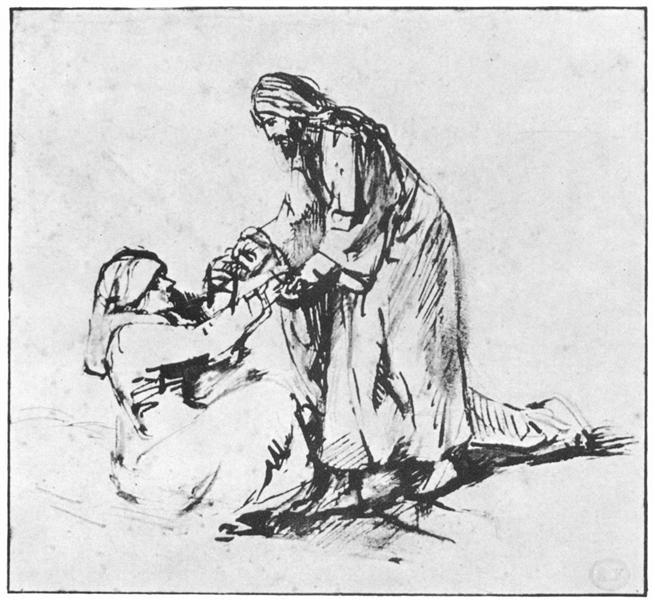
After “church”, so to speak, Jesus and his buddies go to Simon’s house for a meal. Where Simon’s wife was we’re not told, but his mother-in-law seems to have been chief cook and bottle washer. Unfortunately, on that day, she’s not feeling well. However, with but a touch from Jesus, she’s restored and begins waiting on the guys.
The Healing of Peter’s Mother-in-Law by Rembrandt
On leaving the synagogue Jesus entered the house of Simon and Andrew with James and John. Simon’s mother-in-law lay sick with a fever. They immediately told him about her. He approached, grasped her hand, and helped her up. Then the fever left her and she waited on them.
Mark 1:29-31
It seems like Jesus and his friends hung out through the heat of the day. As evening cool descends, neighbors begin arriving with their sicknesses and troubled spirits. Jesus cures many of those gathered. Can you just imagine the scene!
The next morning, even before dawn, Jesus goes off to a quiet place to pray. No doubt he wants to discern, with his Father and the Holy Spirit, the things that are happening in his life. Again can you imagine that conversation!
We know that, when asked, Jesus gave us the human words of the “Our Father” to teach us to pray. But how did Jesus himself pray in the solitude of his heart?
Three Persons of the Blessed Trinity focused in relationship to one another and yielding a Love too immense for description!
In our own humble prayer today, may we lean against the heart of Jesus as he immersed himself in the Presence of the Creator and Spirit. May we pray in Christ’s pregnant silence.
Poetry: Solitude – Thomas Merton
When no one listens
To the quiet trees
When no one notices
The sun in the pool.
Where no one feels
The first drop of rain
Or sees the last star
Or hails the first morning
Of a giant world
Where peace begins
And rages end:
One bird sits still
Watching the work of God:
One turning leaf,
Two falling blossoms,
Ten circles upon the pond.
One cloud upon the hillside,
Two shadows in the valley
And the light strikes home.
Now dawn commands the capture
Of the tallest fortune,
The surrender
Of no less marvelous prize!
Closer and clearer
Than any wordy master,
Thou inward Stranger
Whom I have never seen,
Deeper and cleaner
Than the clamorous ocean,
Seize up my silence
Hold me in Thy Hand!
Now act is waste
And suffering undone
Laws become prodigals
Limits are torn down
For envy has no property
And passion is none.
Look, the vast Light stands still
Our cleanest Light is One!
Music: Intermezzo in B minor – Maureen McCarthy Draper
Today, in God’s Lavish Mercy, Jesus makes a remarkable debut!
Picture the scene. It is a beautiful morning in the Judean Valley where the Jordan Riven runs fresh and sparkling. Most scholars place the Baptism of Jesus sometime in January, which means the weather would have been relatively cool. But perhaps, like our own weather, an unusually warm day may have snuck in.
Rustic, fiery preacher John is baptizing in the Jordan River. Crowds have come to hear what he has to say. Some are convinced and dive into the cool water under his hand.
Others rim the hillside, not so sure John isn’t one of the many who have glorious visions but few facts.
Then, out from the pines on the far side of the river, comes Jesus, flanked by some of the Twelve. While his companions chat away to Jesus, his eyes are focused on John. In an instant, Jesus realizes that this is the moment for his revelation. In that same instant, all Creation realizes the same thing.
As Jesus walks slowly toward John, the birds and little animals speak to him, “My Lord and my God…”. Wind whistling through the trees becomes an Oratorio praising him. All the surrounding colors deepen, breaking forth in unimaginable light.
John is stunned by the cosmic change he senses but cannot describe. Heart trembling, he looks into Jesus’s eyes and catches a glimpse of heaven. “I need to be baptized by you”, John says,”and yet you are coming to me?”
Jesus smiles at his cousin, replying,
“Let it be so now; it is proper for us to do this to fulfill all righteousness.”
Then John consented.
Perhaps those in the crowd, schooled in the ancient scriptures, heard Isaiah’s voice in the charged atmosphere:
Here is my servant whom I uphold, my chosen one with whom I am pleased, upon whom I have put my spirit; he shall bring forth justice to the nations, not crying out, not shouting, not making his voice heard in the street. a bruised reed he shall not break, and a smoldering wick he shall not quench, until he establishes justice on the earth; the coastlands will wait for his teaching.
Matthew tells us:
As soon as Jesus was baptized, he went up out of the water.
Can you see him light-heartedly splashing John as he shakes his dark curls free of the chilly water? Can you see his transfigured face as he hears his Father speak Love over him?
At that moment heaven was opened, and he saw the Spirit of God descending like a dove and alighting on him. And a voice from heaven said, “This is my Son, whom I love; with him I am well pleased.”
What a beautiful moment in time! Don’t we wish we might have been there in the blessed and awe-struck crowd? We can. Let your prayer of imagination take you there. What happens in your heart when the newly baptized Jesus catches your eyes?
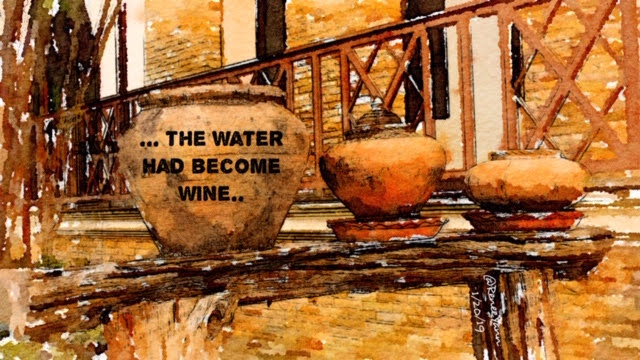
Today, in God’s Lavish Mercy, we have the belovedly familiar story of the Miracle at Cana.
There was a wedding at Cana in Galilee, and the mother of Jesus was there. Jesus and his disciples were also invited to the wedding. When the wine ran short, the mother of Jesus said to him, “They have no wine.”
John 2: 1-3
Like all good stories, this one is engaging on so many levels:
We see Mary and Jesus enjoying a social event in the same way we would.
We see Mary extending her solicitude and influence for the sake of the hosting family.
We see Jesus needing a swift nudge from his mother to do the right thing!
We see the Apostolic tipsters slowly waking up to the fact that Jesus is not just the guy next door!
We can pray with this Gospel passage by entering it from any one of these, or other, perspectives. We can easily sit right down at one of the wedding tables and watch the slow, human revelation of God in the world. But I think our first reading makes a strong case for us to pray the Cana story as a perfect example of how we should make our prayers of petition.
If you’re like me, you ask God for a lot of things every single day. Some of them are big deal things like “Please move hearts to stop the war on Ukraine.” And some of them are little deals like, “Please don’t let it rain on my picnic!”
In our first reading, John tells us how to pray our needs to God – with the utter confidence that, within God’s Will, we are heard.
Beloved: We have this confidence in God, that if we ask anything according to God’s will, we are heard. And if we know that God hears us in regard to whatever we ask, we know that what we have asked for is ours.
1 John 5: 14-15
This is the way Mary offers her petition in our Gospel story. She knows that Jesus will hear her and do the right thing. She doesn’t niggle him to death to get it done. She knows that by her “prayer”, she is now present to God’s infinite awareness of our needs.
His mother said to the servers, “Do whatever he tells you.”
John 2:5
In this case, that “right thing” was to turn huge vats of water into delicious wine. A very satisfying outcome! But what about when our prayer doesn’t result in a deluge of wine? What about when it seems like God paid no attention to our request? Can we still have the unyielding confidence which John encourages and Mary exemplifies?
Our faith calls us to believe that God is present with us in all things. Our prayer opens us to seek that Presence and to respond in faith to our circumstances knowing that even when the vessels seem empty, God abides. Ours is a life in God not limited to one petition, or one prayer. It is an incremental immersion into an Eternal Truth which transcends any particular circumstance. God is always with us and that alone is the source of our confident prayer.
We also know that the Son of God has come and has given us discernment to know the one who is true. And we are in the one who is true, in God’s Son Jesus Christ. He is the true God and eternal life.
1 John 5:20
Poetry: Cana Wine – Irene Zimmerman, OSF
“The weather’s so hot
and no more wine’s to be bought
in all of Cana!
It’s just what I feared—
just why I begged my husband
to keep the wedding small.”
“Does he know?” Mary asked.
“Not yet. Oh, the shame!
Look at my son and his beautiful bride!
They’ll never be able
to raise their heads again,
not in this small town.”
“Then don’t tell him yet.”
Mary greeted the guests
as she made her way
through crowded reception rooms.
“I must talk to you, Son,”
she said unobtrusively.
Moments later he moved
toward the back serving rooms.
They hadn’t seen each other
since the morning he’d left her—
before the baptism
and the desert time.
There was so much to tell her,
so much to ask.
But this was not the time!
They could talk tomorrow
on the way to Capernaum.
She spoke urgently, her words
both request and command to him:
“They have no wine.”
But he hadn’t been called yet!
He hadn’t felt it yet.
Would she send him so soon
to the hounds and jackals?
For wine?
Was wine so important then?
“Woman, what concern is that
to you and me?
My hour has not yet come.”
Her unflinching eyes reflected to him
his twelve-year-old self
telling her with no contrition:
“Why were you searching for me?
Did you not know I must be
in my Father’s house?”
She left him standing there—
vine from her stock,
ready for fruit bearing—
and went to the servants.
“Do whatever he tells you,” she said.
From across the room
she watched them fill water jars,
watched the chief steward
drink from the dripping cup,
saw his eyes open in wide surprise.
She watched her grown son
toast the young couple,
watched the groom’s parents
and the guests raise their cups.
She saw it all clearly:
saw the Best Wine
pouring out for them all.
Today, in God’s Lavish Mercy, our prayer is turned to the Holy Family, that unique configuration of love which nurtured the developing life of Jesus. Can you imagine how tenderly the Creator shaped this Triad, this nesting place of love for God’s own Word? Our passage from Sirach gives us an idea of the honor given to the concept of “family” down through the ages leading to Christ:
God sets a father in honor over his children; a mother’s authority he confirms over her sons. Whoever honors his father atones for sins, and preserves himself from them. When he prays, he is heard; he stores up riches who reveres his mother. Whoever honors his father is gladdened by children, and, when he prays, is heard. Whoever reveres his father will live a long life; he who obeys his father brings comfort to his mother.
Sirach 3: 2-6
The Flight into Egypt – Rembrandt
Matthew’s Gospel today describes a fierce devotion in Joseph and Mary to protect the precious life of Jesus. It is a natural instinct, fed by God, and made holy by its selflessness. We do not have to look far to see such devotion today … we see it wherever refugees struggle to foster their own and their beloveds’ lives. Today’s feast calls us to consider our efforts, by prayer or activism, to create a world where all may be reverenced and may live in safety.
We also look to the Holy Family so that we might be strengthened in the virtues that will help us build our own families: sacrificial love, reverence, courage, unfailing support, committed presence, shared faith, gentle honesty, unconditional acceptance.
“Family” is the primordial place where we learn who we are. The lessons it teaches us about ourselves – for better or worse — remain with us forever.
Not everyone is blessed by their family. Family can ground us in confidence or undermine us with self-doubt. It can free us from fear or cripple us with reservation. It can release either possibility or perpetual hesitation within us.
Some families are so dysfunctional that we spend the rest of our lives trying to recover from them. But some, like the Holy Family, allow God’s dream to be nurtured in us and to spread to new families, both of blood and spirit.
The challenge today is to thank God for whatever type of family bore us. Lessons can be learned from both lights and shadows. Let us spend time this morning looking at our own families with love, gratitude, forgiveness, understanding. Where there are wounds to be healed, let us face them. Where there are belated thanks to be offered, let us give them. Where there are negligence and oversights to confess, let us use them as bridges to a new devotion.
For some, it may seem too late to heal or bless our family. Time may have swallowed some of our possibilities. But it is never too late to deepen relationships through prayer, both for and to our ancestors.
May this feast strengthen us for the families who need us today.
Music: God Bless My Family ~ Anne Hampton Calloway (Lyrics below)
GOD BLESS MY FAMILY Words and music – By Ann Hampton Callaway
It’s Christmas time Outside the snow is falling Like a million stars Like a million dreams All dressed up in white I’m writing Christmas cards A joy that’s tinged with sadness As I think of friends Some are here and some are gone But our love goes on and on Like the snow tonight
CHORUS And oh, what a familyMy life has given me From the corners of the earth To the reaches of the sky We touch eternally And though my heart aches ev’ry day This Christmas I will find a way To let each face I’ve ever loved Shine out in me God bless my family
As years go by The carols we sang as children Gather memories What was just a song Now feels like a pray’r Welcoming us home To fathers, mothers Sisters, brothers ev’rywhere Some we’ve lost and some we’ve found As love circles us around In the songs we share
CHORUS
So fly, angels of my heart We’ll never be apart Tonight I say a pray’r For loved ones ev’rywhere
CHORUS/CODA
You’re a part of my family That life has given me From the corners of the earth To the reaches of the sky We touch eternally And though my heart aches ev’ryday This Christmas I will find a way To let each face I’ve ever loved Shine out in me God bless my family You’ll always live in me God bless my family
Something a little different for this special day:
The Light of the World is Loving You
It was Christmas Eve, 1947. I was almost three years old – the perfect age for waiting for Santa. There had been a bitter cold and, like all winters when we were young :-), the snow was deeper than it ever seems now!
I had been told I must be asleep before Santa would come to our house. I shut my eyes so tight that the lids nearly curled. I surely didn’t want him to pass us by. Around nine o’clock, while I was somewhere between pretense and dreamland, my mother came into my room and said, “He just left. If we go to the window, you may see him leaving in his sleigh!”
In my mind’s eye, I can still see that white window frame, filled with the navy velvet of a deep December night. I tiptoed up to it and stretched my little chin to the sill. There was an almost full moon that night, and somewhere out of my imagination, the silhouette of Santa appeared across that brilliant moon. It was a magic moment born of my childlike belief, my mother’s love and the culture of hope we all want to give our children.
I never saw that Santa again. I became too wise and sophisticated to retain that wondrous vision. But the faith, love and hope of that night have remained – eternal gifts just waiting for me to walk to the window of grace to see them.
These are the real gifts of this Holy Season. After all the shopping, all the wrapping, all the hassle and all the bustle – walk to the window of your spirit. The Light of the World is looking in at you – loving you, believing in the power of your life, hoping for your wholeness and peace.
A Blessed and Merry Christmas to all of you, dear readers!
Dark, dark, the winter cold night. Lu-lee-lay. Hope is hard to come by. Lu-lee-lay. Hard, hard, the journey tonight. Lu—lee-lay. Star, guide, hope, hide our poor, winter cold night.
And on earth, peace, good will among men. Lean, lean, the livin′ tonight. Lu-lee-lay. Star seems darker sometimes. Lu-lee-lay.
Unto you is born this day a Savior.
Pain, yes, in the bornin’ tonight. Lu lee—lay. Star, guide, hope, hide our poor, winter cold night.
Thursday of the Fourth Week of Advent December 22, 2022
Today, in God’s Lavish Mercy, our O Antiphon beseeches God, Who is King of All Nations, Who unites Gentile and Jew, to deliver us.
But from what?
The answer lies in the closing phrase of the antiphon: “we whom you formed from the dust of the earth”.
Deliver us from the artificial barriers we have created to separate from and dominate over one another – by nationality, ethnicity, color, gender, social or economic class. We each began as dust and will end that way. May we be humble, mutual and compassionate in the time between.
Consider the holy humility of Hannah in our first reading today, and of Mary in our Gospel. They are power figures in Salvation History. But their power comes from their utter dependence on and honor to God, their only true King.
I prayed for this child, and the LORD granted my request. Now I, in turn, give him to the LORD; as long as he lives, he shall be dedicated to the LORD.”
1 Samuel 1: 27-28
My soul proclaims the greatness of the Lord; my spirit rejoices in God my savior. for he has looked upon his lowly servant. From this day all generations will call me blessed: the Almighty has done great things for me, and holy is his Name.
Luke 1: 46-49
There was no fragmentation in the commitment of their entire lives to God. They understood all Creation to belong to the Divine.
King of Kings, deliver us from any such fragmentation. Make us all whole in You.
O King of all nations and keystone of the Church: come and save us, whom you formed from the dust! R. Alleluia, alleluia.
Poetry: A King Dressed as a Servant – Rumi
You may interpret Rumi, of course, as you wish. He is deeply mystical and his thoughts don’t always correspond to a logical path. But that’s the real beauty of his poetry. We can put ourselves in his poem and shape it to fit our experience of God. In this poem, Rumi says that we must wait, and be ready, for God’s Love to come to us. And when it does, it will be far beyond anything we expected.
A sweet voice calls out,"The caravan from Egypt is here!"A hundred camels with what amazing treasure!Midnight, a candle and someone quietlywaking me, "Your friend has come."I spring out of my body, put a ladderto the roof, and climb up to see ifit's true.Suddenly, there is a world within this world!An ocean inside the water jar!A king sitting with me wearingthe uniform of a servant!A garden in the chest of the gardener!I see how love has "thoughts,"and that these thoughts are circulatingin conversation with majesty.Let me keep opening this momentlike a dead body reviving.My teacher saw the Placeless Oneand from That, made a place.
Music: O Rex Gentium – Gregorian Chant ( this is a Latin rendering of the italicized prayer above.)
Today, in God’s Lavish Mercy, as the anticipation of Christmas builds to a crescendo, we have the tender and sublime images of the Song of Songs.
Hark! my lover–here he comes springing across the mountains, leaping across the hills. My lover is like a gazelle or a young stag. Here he stands behind our wall, gazing through the windows, peering through the lattices.
Song of Songs 2:8-9
This book of the Bible is unique in that “it shows no interest in Law or Covenant or the God of Israel, nor does it teach or explore wisdom like Proverbs or Ecclesiastes. Jewish tradition reads it as an allegory of the relationship between God and Israel; Christianity, as an allegory of Christ and his bride, the Church.” (Wikipedia)
Like all enduring poetry, the Song of Songs invites us to match its images with our own understanding of God. Of course, God is more than any image we can humanly create, but our relationship with God has the characteristics of a human relationship because WE are human.
As we read this passage, we might pray with thoughts like these:
God loves me – and all Creation – passionately.
God wants and waits for me to notice the loving Divine Presence in my life
God’s love is energetic and attentive. God is at the center and edge of all my existence.
Added to all that, God wants us to live in the world as people who already see the Spring of Eternal Life. Living with that kind of faith and hope allows us not only to find God, but to reflect God’s Presence to all around us.
For see, the winter is past, the rains are over and gone. The flowers appear on the earth, the time of pruning the vines has come, and the song of the dove is heard in our land. The fig tree puts forth its figs, and the vines, in bloom, give forth fragrance. Arise, my beloved, my beautiful one, and come!
Songs of Songs 8: 11-13
On this day of Winter Solstice, when – depending on our hemisphere – we are ultimately close or far from our Sunstar, this particular passage is so comforting. In our everyday life we will still experience a rollercoaster of seasons – sadness and joy and everything in between. But beyond all the seasons, the Verdant Eastertide has already redeemed our lives. With deep faith and hope, we can always live with the Spring’s abundance.
The Visitation by Raphael
In our Gospel, we are given a beautiful picture of Mary and Elizabeth, with in-vitro Jesus and John – dancing in the graces of this holy Springtime. Join them as we sing of O Antiphon for today:
R. Alleluia, alleluia. O Emmanuel, our King and Giver of Law: come to save us, Lord our God! R. Alleluia, alleluia.
Poetry: May is Mary’s Month – Gerard Manley Hopkins
May is Mary’s month, and I
Muse at that and wonder why:
Her feasts follow reason,
Dated due to season—
Candlemas, Lady Day;
But the Lady Month, May,
Why fasten that upon her,
With a feasting in her honour?
Is it only its being brighter
Than the most are must delight her?
Is it opportunest
And flowers finds soonest?
Ask of her, the mighty mother:
Her reply puts this other
Question: What is Spring?—
Growth in every thing—
Flesh and fleece, fur and feather,
Grass and greenworld all together;
Star-eyed strawberry-breasted
Throstle above her nested
Cluster of bugle* blue eggs thin
Forms and warms the life within;
And bird and blossom swell
In sod or sheath or shell.
All things rising, all things sizing
Mary sees, sympathising
With that world of good,
Nature’s motherhood.
Their magnifying of each its kind
With delight calls to mind
How she did in her stored
Magnify the Lord.
Well but there was more than this:
Spring’s universal bliss
Much, had much to say
To offering Mary May.
When drop-of-blood-and-foam-dapple
Bloom lights the orchard-apple
And thicket and thorp† are merry
With silver-surfèd cherry
And azuring-over greybell makes
Wood banks and brakes‡ wash wet like lakes
And magic cuckoocall
Caps, clears, and clinches all—
This ecstasy all through mothering earth
Tells Mary her mirth till Christ’s birth
To remember and exultation
In God who was her salvation.
Today, in God’s Lavish Mercy, we pray, “O Root of Jesse’s Stem”, addressing, in this short prayer, the whole historic ancestry of Jesus.
The phrase, taken from Isaiah 11, recognizes Jesus as the sign of deliverance for both Jews and Gentiles.
This Antiphon is unique in that it not only beseeches the Savior to come. It says, “Tarry not!”
Do you ever ask God to hurry up and answer your prayers? What is most urgent for you to place before God today?
Let us pray this prayer together today, dear friends, for our urgent needs and those of our needy world:
R. Alleluia, alleluia. O Root of Jesse’s stem, sign of God’s love for all his people: come to save us without delay! R. Alleluia, alleluia.
In our readings today, we meet two great prophets of the Hebrew Scriptures, both born miraculously; both fully dedicated to revealing God’s Presence in the world.
Praying with them today, we prepare ourselves to encounter the greatest of all miraculous nativities, the birth of Jesus Christ – the ultimate revelation of God’s own Self.
Poetry: Song of Zechariah – Irene Zimmerman, OSF
(LUKE 1:59–79) At the circumcision of his son, relatives and neighbors came to speak for Zechariah of the tied tongue. The child, they concurred, would bear his worthy father’s name. But during her husband’s silence, old Elizabeth had found her voice. “His name will be John,” she said.
Why this strange, unprecedented choice, the relatives and neighbors wondered. Armed with writing instrument, back they went to poor, dumb Zechariah. But during the long confinement, as young Mary and Elizabeth spoke about the missions of their sons, he had listened and grown wise.
Straightaway, he wrote: “His name is John.” He caught Elizabeth’s smiling eyes, felt his old tongue loosen, found his voice, sang of God’s tender mercy, sang of the breaking dawn, sang of the prophet, their son, who would make straight the way for the long awaited One.
Today, in God’s Lavish Mercy, our scripture readings roll out before our prayer the long line of salvation history. It is a line that we can walk in wonder, winding from Isaiah’s prophecy, through the House of David, down to Joseph dreaming in the Nazarene night, and Mary fully waking to God in the Nazarene morning.
It is a story filled with words we love because, ever since our childhood, they have carried to us the fragrant scent of Christmas. These readings are the thrilling stuff of prophecies and dreams, all the more wonderful because we know them now fulfilled.
Therefore the Lord himself will give you this sign: the virgin shall conceive, and bear a son, and shall name him Emmanuel.
Isaiah 7:14
Joseph, son of David, do not be afraid to take Mary your wife into your home. For it is through the Holy Spirit that this child has been conceived in her. She will bear a son and you are to name him Jesus, because he will save his people from their sins.
Matthew 1:20
This long wick of Promise, burning slowly through the biblical years, bursts into light with the birth of Jesus Christ, the Fire of God.
Through our faith, that Divine Light kindles us – we who now, through our Baptism, carry the sacred DNA of Jesus into our times.
On this final Sunday of Advent, when the world’s “crazy Xmas” tries to hijack our souls, let us be very intentional about the true meaning of these days. Let us take the time to “go into our heart cave” and prepare for Jesus.
Poetry: And in Her Morning – Jessica Powers
The Virgin Mary cannot enter into
my soul for an indwelling. God alone
has sealed this land as secretly His own;
but being mother and implored, she comes
to stand along my eastern sky and be
a drift of sunrise over God and me.
God is a light and genitor of light.
Yet for our weakness and our punishment
He hides Himself in midnights that prevent
all save the least awarenesses of Him.
We strain with dimmed eyes inward and perceive
no stir of what we clamored to believe.
Yet I say: God (if one may jest with God),
Your hiding has not reckoned with Our Lady
who holds my east horizon and whose glow
lights up my inner landscape, high and low.
All my soul’s acres shine and shine with her!
You are discovered, God; awake, rise
out of the dark of Your Divine surprise!
Your own reflection has revealed Your place,
for she is utter light by Your own grace.
And in her light I find You hid within me,
and in her morning I can see Your Face.
Music: Emmanuel – Tim Manion (Lyrics below)
Baby born in a stall. Long ago now and hard to recall Cold wind, darkness and sin, your welcoming from us all.
How can it be true? A world grown so old now, how can it be new? Sorrow’s end, God send, born now for me and you
Emanuel, Emanuel What are we that You have loved us so well? A song on high, a Savior’s high, angel hosts rejoice Thy glory to tell
Lord, lead us to know. You lay like a beggar, so humble, so low; no place for Your head and straw for a bed, the glory of God to show.
Babe on mother’s knee, child so soon to be nailed to a tree; all praise, till the end of our days; O Lord, You have set us free