Today, in God’s Lavish Mercy, we begin the recitation of the O Antiphons.
No doubt many of you, like me, love these beautiful verses for any number of reasons:
First off, they alert us that we are very close to the astounding miracle of Christmas!
They capture, in a very simple way, the riches of the Hebrew Scriptures which foretold and longed for the Messiah.
The dramatic “O” introducing each one conveys the depth of our own longing and “O”penness to God’s grace.
The O Antiphons are Magnificat antiphonies used at Vespers of the last seven days of Advent. They are also used as the Alleluia Verse during the daily Mass.
Each antiphon is a name of Christ, one of his attributes mentioned in Scripture. They are:
We begin today with a heartfelt plea to God to fill our world with a Wisdom that orders all things and teaches us prudence.
O, how our world needs this prayer to be answered. How we need to return to a Wisdom rooted in truth, justice and mutual love!
Let us pray this prayer together today, dear friends, by opening our hearts like the wide space of an “O”. Let our hearts be ready to receive, on behalf of the world, the transforming gift of Jesus – given on Christmas, and on every day of our lives.
O Wisdom of our God Most High, guiding creation with power and love: come to teach us the path of knowledge! R. Alleluia, alleluia.
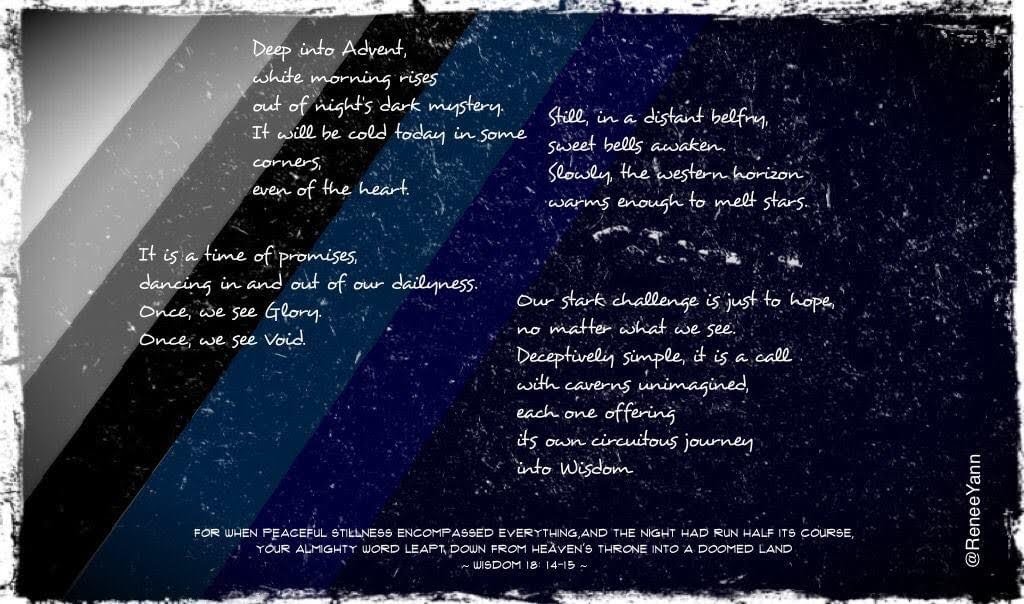
Poetry: Journey into Wisdom – Renee Yann, RSM
Music: Michael G. Hegeman, 1997 Performed by: The Lauda! Chamber Singers
Today, in God’s Lavish Mercy, Isaiah uses powerful, passionate images to describe the relationship between God and Israel.
The Lord calls you back, like a wife forsaken and grieved in spirit, A wife married in youth and then cast off, says your God. For a brief moment I abandoned you, but with great tenderness I will take you back. In an outburst of wrath, for a moment I hid my face from you; But with enduring love I take pity on you, says the Lord, your redeemer.
Isaiah 54:6-7
This relationship is best conceptualized as COVENANT. The great prophets use human covenants as images to help describe an otherwise indescribable God. For example, there are biblical passages which imagine God as Father, Mother, Friend, King, Shepherd, Lover, and Spouse.
Of course, God is infinitely more than any one of these relationships, but that “more” is beyond our human capacity to comprehend. So these human images give us some starting point to open ourselves in prayer as to how God wants to be with us at particular times in our lives.
In today’s passage, Isaiah speaks to a people devastated by captivity in Babylon. Jerusalem is occupied, their Temple is destroyed, and their reality is particularly bleak. They feel abandoned by the God who once companioned them to the Promised Land. And they feel like they brought the abandonment on themselves by their faithlessness to the Covenant.
What does the passage say to me?
Have I ever felt forgotten by God? Or at least invisible and unimportant?
Do I regret a bit of “faithlessness” in my own life?
Do I wonder if some of the difficulties in my life are merited because my faith is weak?
Well, if so, then Isaiah 54 was written for me, because the God who is in covenant with me is ever-faithful, loving and forgiving. God is always with me and for me. Despite my worries, ideations, or scruples, God is eternally committed to me:
Though the mountains leave their place and the hills be shaken, My love shall never leave you nor my covenant of peace be shaken, says the Lord, who has mercy on you.
Isaiah 54:10
Jesus Christ is the infinitely gracious fulfillment of this Covenant. Advent invites us to draw ever closer to such Wondrous Faithful Love.
Poetry: Where Is God? – Mark Nepo is a poet and spiritual adviser who has taught in the fields of poetry and spirituality for over 40 years. Nepo is best known for his New York Times #1 bestseller,The Book of Awakening. A cancer survivor, Nepo writes and teaches about the journey of inner transformation and the life of relationship.
It’s as if what is unbreakable— the very pulse of life—waits for everything else to be torn away, and then in the bareness that only silence and suffering and great love can expose, it dares to speak through us and to us.
It seems to say, if you want to last,
hold on to nothing. If you want
to know love, let in everything.
If you want to feel the presence
of everything, stop counting the
things that break along the way.
Today, in God’s Lavish Mercy, through the lyricism of Isaiah, God proclaims his majesty and omnipotence. But as awesome as that Power is, it descends over us in the gentlest form – justice and salvation like morning dew and springtime blossoms:
Let justice descend, O heavens, like dew from above, like gentle rain let the skies drop it down. Let the earth open and salvation bud forth; let justice also spring up! I, the LORD, have created this.
Isaiah 45:8
Our God invites us all into that gentle embrace, asking us to deepen our hearts in faith and worship:
Turn to me and be safe, all you ends of the earth, for I am God; there is no other! By myself I swear, uttering my just decree and my unalterable word: To me every knee shall bend; by me every tongue shall swear, Saying, “Only in the LORD are just deeds and power.
Isaiah 45:22-24
Our Gospel is a repeat of this past Sunday’s, only this time told by Luke instead of Matthew. It again reminds us of what this just and gentle reign of God will look like:
“Go and tell John what you have seen and heard: the blind regain their sight, the lame walk, lepers are cleansed, the deaf hear, the dead are raised, the poor have the good news proclaimed to them. And blessed is the one who takes no offense at me.”
Luke 7:22-23
Praying in these twilight days of Advent, let’s ask to be drenched in gentle Justice and life-giving Mercy so that we may be living signs of the One Who is to come on Christmas.
Poetry: Annunciation – Scott Cairns – a wonderful poet. Read about him here:
Deep within the clay, and O my people very deep within the wholly earthen compound of our kind arrives of one clear, star-illumined evening a spark igniting once again the tinder of our lately banked noetic fire. She burns but she is not consumed. The dew lights gently, suffusing the pure fleece. The wall comes down. And—do you feel the pulse?—we all become the kindled kindred of a King whose birth thereafter bears to all a bright nativity.
Today, in God’s Lavish Mercy, we feel the Church moving ever closer to the miracle of Christmas. The prophet Zephaniah, not quite as lyrically as Isaiah, paints a picture of who is ready for that miracle – because it is a fact: some will be able to receive it, and some will not.
Thus says the LORD: Woe to the city, rebellious and polluted, to the tyrannical city! She hears no voice, accepts no correction; In the LORD she has not trusted, to her God she has not drawn near.
Zephaniah 3:1-2
But the prophet also makes clear that there will be a “remnant people” in whose hearts the miracle will take life:
I will leave as a remnant in your midst a people humble and lowly, Who shall take refuge in the name of the LORD: the remnant of Israel. They shall do no wrong and speak no lies; Nor shall there be found in their mouths a deceitful tongue; They shall pasture and couch their flocks with none to disturb them..
Zephaniah 3:12-13
As Jesus told the chief priests and elders in our Gospel:
“Amen, I say to you, tax collectors and prostitutes are entering the Kingdom of God before you. When John came to you in the way of righteousness, you did not believe him; but tax collectors and prostitutes did. Yet even when you saw that, you did not later change your minds and believe him.”
Matthew 21: 31-32
Our readings today reiterate a truth that threads through all of scripture: the “Kingdom” is composed of the least likely in the world’s eyes. Wealth, power, influence, or appearances don’t cut it. Faith and dependence on God define the “remnant” who are God’s people.
I don’t think there are a lot of tax collectors among my readers, and probably not too many prostitutes either. 🙂 So who are we when we take a good look at ourselves? Are we our power, money or upper hand in the world? Or are we faithful souls who try to keep our hearts open to the Divine call to love God and our neighbor?
The more we try to be the latter, the more we will comprehend the Miracle we celebrate just twelve days from now.
Prose: Advent Credo – Allan Boesak (from Walking Among Thorns)
It is not true that creation and the human family are doomed to destruction and loss— This is true: For God so loved the world that He gave his only begotten Son, that whoever believes in Him shall not perish but have everlasting life;
It is not true that we must accept inhumanity and discrimination, hunger and poverty, death and destruction— This is true: I have come that they may have life, and that abundantly.
It is not true that violence and hatred should have the last word, and that war and destruction rule forever— This is true: Unto us a child is born, unto us a Son is given, and the government shall be upon his shoulder, his name shall be called wonderful councilor, mighty God, the Everlasting, the Prince of peace.
It is not true that we are simply victims of the powers of evil who seek to rule the world— This is true: To me is given authority in heaven and on earth, and lo I am with you, even until the end of the world.
It is not true that we have to wait for those who are specially gifted, who are the prophets of the Church before we can be peacemakers— This is true: I will pour out my spirit on all flesh and your sons and daughters shall prophesy, your young men shall see visions and your old men shall have dreams.
It is not true that our hopes for liberation of humankind, of justice, of human dignity of peace are not meant for this earth and for this history— This is true: The hour comes, and it is now, that the true worshipers shall worship God in spirit and in truth.
So let us enter Advent in hope, even hope against hope.
Let us see visions of love and peace and justice.
Let us affirm with humility, with joy, with faith, with courage:
Jesus Christ—the life of the world.
Music: Just after today’s passage from Zephaniah, the prophet preaches in a more reassuring tone in verse 17. I thought you might like to pray with it.
Today, in God’s Lavish Mercy, Isaiah gives us the best news anyone could ever want to hear:
Here is your God… Who comes to save you!
The news inspires great joy in the waiting heart. Our first reading is full of exultant words pulling us from the shadows of waiting into the hope-filled Light.
What Isaiah proclaims for all generations is that we never need remain in darkness and confusion; that the Lord of Light wills a sunrise for us; that something wondrous and holy is not only possible but inevitable if we but have faith.
This is a powerful revelation and call. If we receive and accept it with open hearts, we are bound to live in joy.
In our second reading, James tells us the secret to living with this kind of joy – PATIENCE.
Be patient, brothers and sisters, until the coming of the Lord. See how the farmer waits for the precious fruit of the earth, being patient with it until it receives the early and the late rains. You too must be patient. Make your hearts firm, because the coming of the Lord is at hand.
James 5: 7-8
We too must welcome into our lives both “the early and the late rain”. We must not only believe; we must ponder our faith within the circumstances of our life and the world around us. This pondering deepens us and allows the power of God to visit the world through our lives.
In our Gospel, Jesus explains what the world looks like when we let the Mercy of God shine through us:
“Go and tell John what you hear and see: the blind regain their sight, the lame walk, lepers are cleansed, the deaf hear, the dead are raised, and the poor have the good news proclaimed to them. And blessed is the one who takes no offense at me.”
Matthew 11: 4-6
On this beautiful Gaudete Sunday, as we come closer to the Gift of Christmas, let us choose to be agents of God’s joy, love and mercy in our world.
Poetry: Gaudete – Brad Reynolds, SJ
Because Christmas is almost here Because dancing fits so well with music Because inside baby clothes are miracles. Gaudete Because some people love you Because of chocolate Because pain does not last forever Because Santa Claus is coming. Gaudete Because of laughter Because there really are angels Because your fingers fit your hands Because forgiveness is yours for the asking Because of children Because of parents. Gaudete Because the blind see. And the lame walk. Gaudete Because lepers are clean And the deaf hear. Gaudete Because the dead will live again And there is good news for the poor. Gaudete Because of Christmas Because of Jesus You rejoice.
Music: The Medieval Carol “Gaudete” sung by the Choir of Clare College with the London Cello Orchestra (lyrics and translation below)
Rejoice, rejoice Christ is born Gaudete, gaudete Christos est natus
From the virgin Mary, rejoice. Ex Maria virginae, gaudete.
Rejoice, rejoice Christ is born Gaudete, gaudete Christos est natus
From the virgin Mary, rejoice. Ex Maria virginae, gaudete.
It is time to thank you for what we have hoped for. Tempus ad est gratiae hoc quod optabamus,
We devoutly sing songs of joy. Carmina laetitiae devote redamus.
Rejoice, rejoice Christ is born Gaudete, gaudete Christos est natus
From the virgin Mary, rejoice. Ex Maria virginae, gaudete.
Rejoice, rejoice Christ is born Gaudete, gaudete Christos est natus
From the virgin Mary, rejoice. Ex Maria virginae, gaudete.
God became man, being nature, Deus homo factus est naturam erante,
The world has been renewed by the reigning Christ. Mundus renovatus est a Christo regnante.
Rejoice, rejoice Christ is born Gaudete, gaudete Christos est natus
From the virgin Mary, rejoice. Ex Maria virginae, gaudete.
Rejoice, rejoice Christ is born Gaudete, gaudete Christos est natus
From the virgin Mary, rejoice. Ex Maria virginae, gaudete.
Ezekiel’s gate was closed by the passerby Ezecheelis porta clausa per transitor
Whence the light arose, the finder of pebbles. Unde lux est orta sallus invenitor.
Rejoice, rejoice Christ is born Gaudete, gaudete Christos est natus
From the virgin Mary, rejoice. Ex Maria virginae, gaudete.
Rejoice, rejoice Christ is born Gaudete, gaudete Christos est natus
From the virgin Mary, rejoice. Ex Maria virginae, gaudete.
Therefore, our congregation sings already in the twilight, Ergo nostra contio psallat jam in lustro,
Bless the lord of the saddles for our king. Benedicat domino sallas regi nostro.
Rejoice, rejoice Christ is born Gaudete, gaudete Christos est natus
From the virgin Mary, rejoice. Ex Maria virginae, gaudete.
Rejoice, rejoice Christ is born Gaudete, gaudete Christos est natus
From the virgin Mary, rejoice. Ex Maria virginae, gaudete.
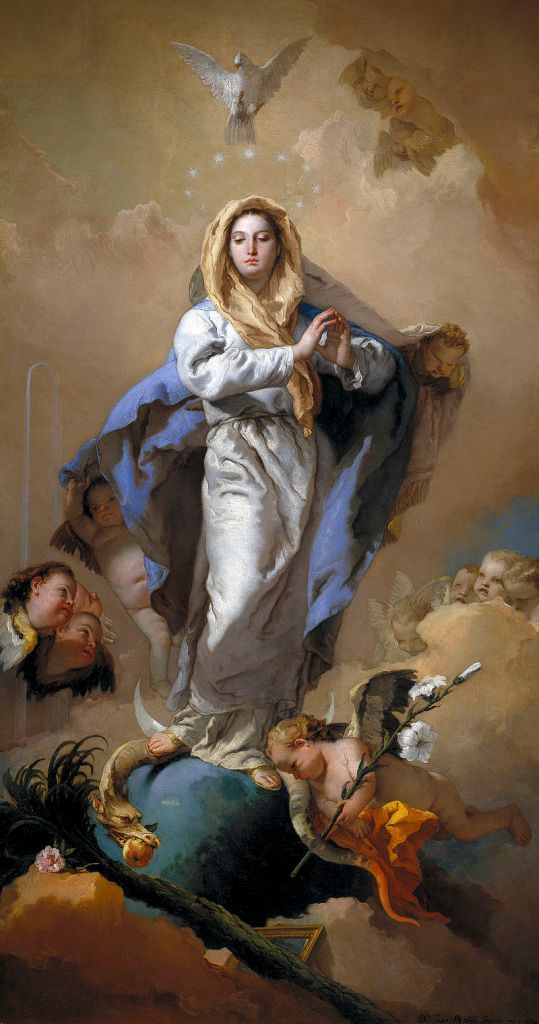
Today, in God’s Lavish Mercy, we celebrate the feast of the Immaculate Conception, the belief that Mary was conceived without the mark of Original Sin.
Beyond the intricate theology underlying the feast, what we treasure is that Mary made a holy place for Christ to dwell as he became incarnate, grew, lived and redeemed the world in loving mercy.
Mary chose to be God’s partner in our salvation!
Our Gospel story today invites us to pray with the most important word Mary ever said, “Yes. Fiat.” Think about it. Mary was not TOLD to become the mother of Jesus. She was asked. She could have said, “No” … for any number of logical reasons.
I’m too young.
I’ve got other plans.
Joseph won’t like this!
I don’t trust angels.
I’m afraid.
I’m sure all of us can think of a few more very rational excuses to tell our “angels” that we’re not ready for transforming grace. I know I have quite a few of them tucked away from over the years. But Mary calls us to something more – she calls us to an “irrational season” of love which responds to the irrational love God has for us!
Mary chose to say “Yes.” She may not have had to work too hard to find the courage for it within her heart. She was already “full of grace”, having lived her short young life with a faithfulness that made her ready to bear Christ to the world.
We pray that, with Mary’s love and guidance, we too may find the courage to make choices that sanctify our hearts, readying them to receive God.
God will come to us today – not on angel’s word – but in the human form of someone poor, sick, desperate, heart-broken, lonely, or just plain tired. May our faith allow us to respond as Mary did, with a grace-fullness that invites God into the situation.
Today, in God’s Lavish Mercy, we pray with Psalm 103 which bursts with music even as we silently read it!
Bless the LORD, O my soul; and all my being, bless God’s holy name. Bless the LORD, O my soul, and forget not all God’s benefits.
Psalm 103:1–2
Our psalm rests today between two Advent readings that pick up its melody of grace and mercy.
In our first reading, Isaiah has just finished praising the Creator in the magnificence of nature. Today’s verses continue that praise and awed wonderment. As we read, we can picture God, robed in glory, marching out the sun, moon, stars …
Lift up your eyes on high and see who has created these things: He leads out their army and numbers them, calling them all by name. By his great might and the strength of his power not one of them is missing!
Isaiah 40:26
When we take the time to appreciate a sunrise or sunset, or to trace the constellations across the dark December sky, we are doing what Isaiah encourages his listeners to do – trusting our all-powerful God. If our Creator can hold the heaven’s together in eternal beauty, we can expect the same to be done for us who are the most cherished of God’s creatures.
Do you not know or have you not heard? The LORD is the eternal God, creator of the ends of the earth. He does not faint nor grow weary, and his knowledge is beyond scrutiny. He gives strength to the fainting; for the weak he makes vigor abound.
Isaiah 40:28-29
In our Gospel, Jesus puts God’s abiding promise into a comforting invitation:
Jesus said to the crowds: “Come to me, all you who labor and are burdened, and I will give you rest. Take my yoke upon you and learn from me, for I am meek and humble of heart; and you will find rest for yourselves. For my yoke is easy, and my burden light.
Matthew 11:28-30
As we continue our Advent journey with Isaiah and Jesus, maybe we might like to catch a sunset or sunrise … or go out and look up at the winter stars. Doing so, let’s give ourselves fully in faith to our Creator’s promise to be with us in every rising and setting of our lives. Let us act as people who fully hope and believe:
They that hope in the LORD will renew their strength, they will soar as with eagles’ wings; They will run and not grow weary, walk and not grow faint.
Isaiah 40:31
Poetry: Come – Christina Rossetti
‘Come,’ Thou dost say to Angels, To blessed Spirits, ‘Come’: ‘Come,’ to the lambs of Thine own flock, Thy little ones, ‘Come home.’
‘Come,’ from the many-mansioned house The gracious word is sent; ‘Come,’ from the ivory palaces Unto the Penitent.
O Lord, restore us deaf and blind, Unclose our lips though dumb: Then say to us, ‘I will come with speed,’ And we will answer, ‘Come.’
Today, in God’s Lavish Mercy, Isaiah describes a beautiful hike through a desert turned verdant and lush. Usually that’s not the way we picture a desert, but the phenomenon is real.
A desert bloom is a climatic phenomenon that occurs in various deserts around the world. The phenomenon consists of the blossoming of a wide variety of flowers during early-mid spring in years when rainfall is unusually high. The blossoming occurs when the unusual level of rainfall reaches seeds and bulbs that have been in a latent or dormant state, and causes them to germinate and flower in early spring. It is accompanied by the proliferation of insects, birds and small species of lizards. (Wikipedia)
Bloom in Chilean Desert – photo by Javier Rubilar
Isaiah preached during tough times — real “desert” times for Israel. He uses the image of the luxuriant desert bloom to encourage his listeners that, despite their dire circumstances (the Assyrian occupation followed by the Babylonian captivity), there is hope.
But it is hard to hope and believe when you haven’t yet seen the flowers, right? Some of Isaiah’s audience may have seemed a little “weak kneed” about launching out on the journey when the horizon still looked pretty dry and lifeless.
Strengthen the hands that are feeble, make firm the knees that are weak, Say to those whose hearts are frightened: Be strong, fear not! Here is your God, Who comes with vindication; With divine recompense God comes to save you.
Isaiah 35:3-4
I know I’ve felt weak-kneed at times, both literally and figuratively — those times when we are afraid to walk, to step forward or back, to move around or toward what we should. I’ll bet some of you have felt that way too.
At those times, we’re a little bit like the paralyzed man in today’s Gospel. We need courage, the help of good friends, and faith in God in order to stand up and walk on our own. Jesus wants to help us just like he helped this young man.
That you may know that the Son of Man has authority on earth to forgive sins”– Jesus said to the one who was paralyzed, “I say to you, rise, pick up your stretcher, and go home.”
He stood up immediately before them, picked up what he had been lying on, and went home, glorifying God.
Luke 5:24-25
Advent invites us to journey into deep faith and spiritual freedom, to trust the desert for its flowers, to believe that God lovingly wills our vigor and wholeness.
The LORD himself will give his benefits; our land shall yield its increase. Justice shall walk before him, and salvation, along the way of his steps.
Today’s Psalm 85: 13-14
Poetry: I Walked in a Desert – Stephen Crane
I walked in a desert. And I cried, “Ah, God, take me from this place!” A voice said, “It is no desert.” I cried, “Well, But — The sand, the heat, the vacant horizon.” A voice said, “It is no desert.”
Today, in God’s Lavish Mercy, we pray with Psalm 147 coming after the consoling passage from Isaiah:
O my people, no more will you weep; I will be gracious to you when you cry out, as soon as I hear you, I will answer.
Isaiah 30:19
Our readings today assure us that God sees and cares about our suffering. Like a mother who sings to a crying child, God wants to comfort us.
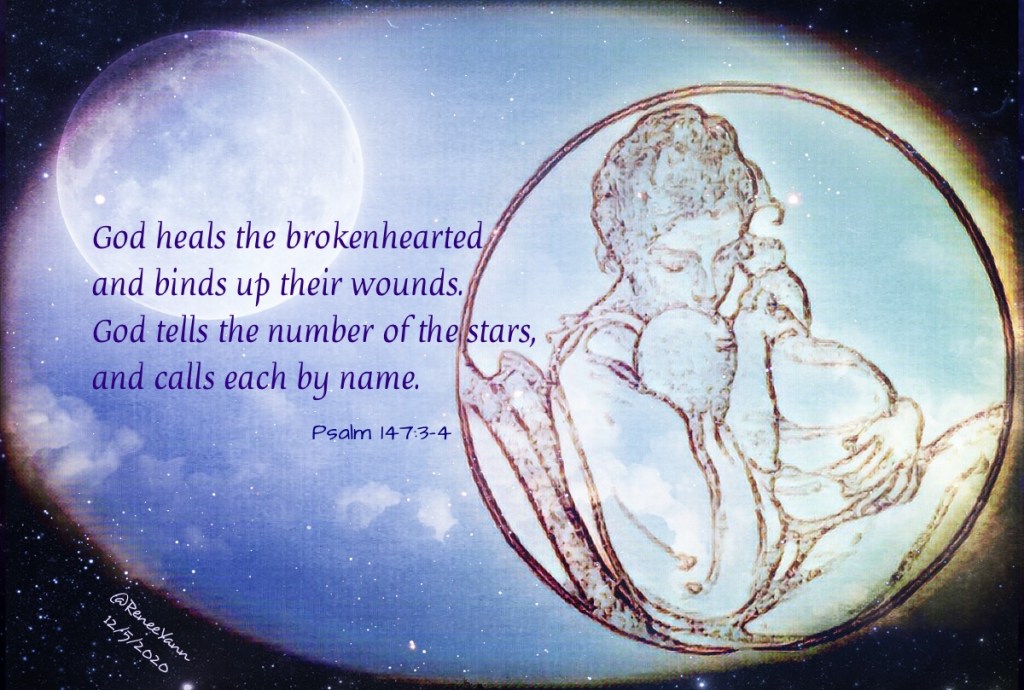
God heals the brokenhearted and binds up their wounds. God tells the number of the stars; calling each by name.
Psalm 147:3-4
God’s lullaby is Jesus Christ. In Jesus, our Creator sings over us the melody of Infinite Love and Mercy. All we need do is calm ourselves and listen.
Jesus is the Divine Song. He sings God’s Mercy over all who suffer.
At the sight of the crowds, Jesus’s heart was moved with pity for them because they were troubled and abandoned.
Matthew 9:36
All of us, at some time in our lives, stand amidst the troubled crowd. Our friends and family members too stand there at times.
Today, as we pray Psalm 147, let us place all our troubles, and theirs, — all of the world’s troubles — into the loving embrace of God who sings the lullaby of Jesus over us. Let us beg for all who are hurting to be cradled in infinite grace, resilient hope, holy courage and lavish mercy.
Poetry: from Rumi
Every midwife knows
that not until a mother's womb
softens from the pain of labour
will a way unfold
and the infant find that opening to be born.
Oh friend!
There is treasure in your heart,
it is heavy with child.
Listen.
All the awakened ones,
like trusted midwives are saying,
'welcome this pain.'
It opens the dark passage of Grace.
Today, in God’s Lavish Mercy, Isaiah tells us that – “on that Day“, God’s People will sing a new song:
On that day they will sing this song in the land of Judah: “A strong city have we; God sets up walls and ramparts to protect us. Open up the gates to let in a nation that is just, one that keeps faith.
Isaiah 26:1-2
It is the song of a People who have recognized God’s abiding, protective Presence in their lives. That realization impels them to respond in faith and to open their lives ever more radically to God’s constant graces.
And so it is with us. As we deepen in our trust that God is with us in every circumstance, and as we choose to live out of that trust, our hearts too open to ever deeper relationship with the Holy.
In our Gospel, Jesus says that this kind of faith is more than words. It is action, choice, presence, witness — all of which declare, “I choose to anchor my life in God and to invite God’s Mercy to live through me.”
Jesus said to his disciples: “Not everyone who says to me, ‘Lord, Lord,’ will enter the Kingdom of heaven, but only the one who does the will of my Father in heaven.
“Everyone who listens to these words of mine and acts on them will be like a wise person who built their house on rock. The rain fell, the floods came, and the winds blew and buffeted the house.”
Matthew 7: 21;24-25
Just what are “these words” of Jesus to which we must listen and respond?
Today’s Gospel passage comes from the first of the Five Discourses in Matthew’s Gospel by which Jesus teaches the New Law of Love. This first discourse holds treasures like the Sermon on the Mount and the Golden Rule.
These are the “words” Jesus is talking about in today’s Gospel passage — words we must hear and act on in order that God will recognize us “on that Day“. Maybe, if you have a little time, you might like to read through Matthew, chapters 5-7, to savor this First Discourse.
Poetry: Let’s use today’s Responsorial Psalm as our poem-prayer. In it, God’s People celebrate God’s Mercy which has brought them to the “gate” of a new relationship of gratitude and trust with the Holy One.
Give thanks to the LORD, Who is good, Whose mercy endures forever. It is better to take refuge in the LORD than to trust in human appearances. It is better to take refuge in the LORD than to trust in human power.
Open to me the gates of justice and mercy; I will enter them and give thanks to the LORD. This gate is the LORD’s; the just shall enter it. I will give thanks to you, for you have answered me and have been my savior.
O LORD, grant salvation! O LORD, grant prosperity! Blessed is the one who comes in the name of the LORD; we bless you from the house of the LORD. The LORD is God, and has given us Light.
Psalm 118:1 and 8-9, 19-21, 25-27a
Music: The Breath at Dawn – Gary Schmidt – some lovely music to start your “new day”.