Alleluia: Unmuted!

Tuesday of the Fourteenth Week in Ordinary Time
July 5, 2022

Today’s Readings:

https://bible.usccb.org/bible/readings/070522.cfm

Today, in God’s Lavish Mercy, a double-sided theme runs through our readings

Our first reading references idols of silver and gold, “the work of artisans, no god at all”. 

The Responsorial Psalm describes in detail how the power of God’s creative Word  contrasts to these mute and powerless idols.

Our God is in heaven;
whatever God wills, God does.
Their idols are silver and gold,
the handiwork of men.
R. Alleluia.

They have mouths but speak not;
they have eyes but see not;
They have ears but hear not;
they have noses but smell not.
R. Alleluia.

They have hands but feel not;
they have feet but walk not.
Their makers shall be like them,
everyone that trusts in them.
R. Alleluia

In today’s Gospel, we see the power of the Living Word, Jesus, to release the mute man from his demons. As we pray with this Gospel, we can think of the word “mute” in many ways.

Wherever truth, integrity, kindness and respect are stifled – whether in us or in others – God’s desire to speak to and through us is muted. 

Sometimes we mute ourselves by burying our true voice under a blanket of pretenses, frivolities, excuses, or useless ambitions. We can mute others by our prejudices, judgements and indifference. And we can do it all so easily, like flipping a button on the TV remote!

Let’s pray to be amazed today, as were the Gospel crowds, at the power of Jesus to free the Word in us!


Poetry: In Silence by Thomas Merton

Be still.
Listen to the stones of the wall.
Be silent, they try
to speak your

name.
Listen
to the living walls.

Who are you?
Who
are you? Whose
silence are you?

Who (be quiet)
are you (as these stones
are quiet). Do not
think of what you are
still less of
what you may one day be.

Rather
be what you are (but who?)
be the unthinkable one
you do not know.

O be still, while
you are still alive,
and all things live around you

speaking (I do not hear)
to your own being,
speaking by the unknown
that is in you and in themselves.

“I will try, like them
to be my own silence:
and this is difficult. The whole
world is secretly on fire. The stones
burn, even the stones they burn me.
How can a man be still or
listen to all things burning?
How can he dare to sit with them
when all their silence is on fire?”

Music: Echo of Our Souls – Kerani

Some lovely instrumental music to unmute the Word as we pray.
Alleluia: Arise

Monday of the Fourteenth Week in Ordinary Time
July 4, 2022

Today’s Readings 

https://bible.usccb.org/bible/readings/070422.cfm

Today, in God’s Lavish Mercy, the power of eternal life flows in an Almighty Current through our readings.

Hosea imagines an amorous God who allures the beloved to full and faithful relationship.


Beautiful Psalm 145 might be read as the grateful response of that redeemed beloved … of us as we are continually gathered back into God’s heart.

The Alleluia Verse assures us that the ultimate “gathering back” has occurred through the Resurrection of Jesus Christ. We are forever allured, redeemed, arisen in Christ!

Alleluia, alleluia.
Our Savior Jesus Christ has destroyed death
and brought life to light through the Gospel.


Today’s Gospel, tells the miraculous stories of two women – one young, one old – touched to new life by Jesus. Each of us could linger in these stories at the thousand places where our own lives might mirror the needs of that breathless little girl or that exhausted woman. We pause with one or the other of them today, have a little talk in our prayer, see how the power of Jesus covered them.

In our scriptures today, all kinds of death are destroyed through the infinite gift of God’s love and mercy. What deathly threats might we bring to God’s touch as we pray today?


Poetry: WOMAN UN-BENT (LUKE 13:10–17) – Irene Zimmerman, OSF

That Sabbath day as always
she went to the synagogue
and took the place assigned her
right behind the grill where,
the elders had concurred,
she would block no one’s view,
she could lean her heavy head,
and (though this was not said)
she’d give a good example to
the ones who stood behind her. 

That day, intent as always
on the Word (for eighteen years
she’d listened thus), she heard
Authority when Jesus spoke. 

Though long stripped
of forwardness,
she came forward, nonetheless,
when Jesus summoned her.
“Woman, you are free
of your infirmity,” he said. 

The leader of the synagogue
worked himself into a sweat
as he tried to bend the Sabbath
and the woman back in place. 

But she stood up straight and let
God’s glory touch her face.

Music: He Touched Me – Gaithersburg Brothers 

This extremely popular American Gospel song was written by Bill Gaithers in 1963. It has been recorded and released over 10 times by artists such as Jimmy Durante, Tennessee Ernie Ford, Lawrence Welk and Elvis Presley.

Alleluia: Peace and Abundance

Fourteenth Sunday in Ordinary Time
July 3, 2022

Today’s Readings 

https://bible.usccb.org/bible/readings/070322.cfm

Today, in God’s Lavish Mercy, our Alleluia Verse encapsulates the message of the readings: Christ is the Source of our peace and our abundance.

Alleluia, alleluia.
Let the peace of Christ control your hearts;
let the word of Christ dwell in you richly.

Colossians 3:15-16


Isaiah describes that peace and abundance like this:

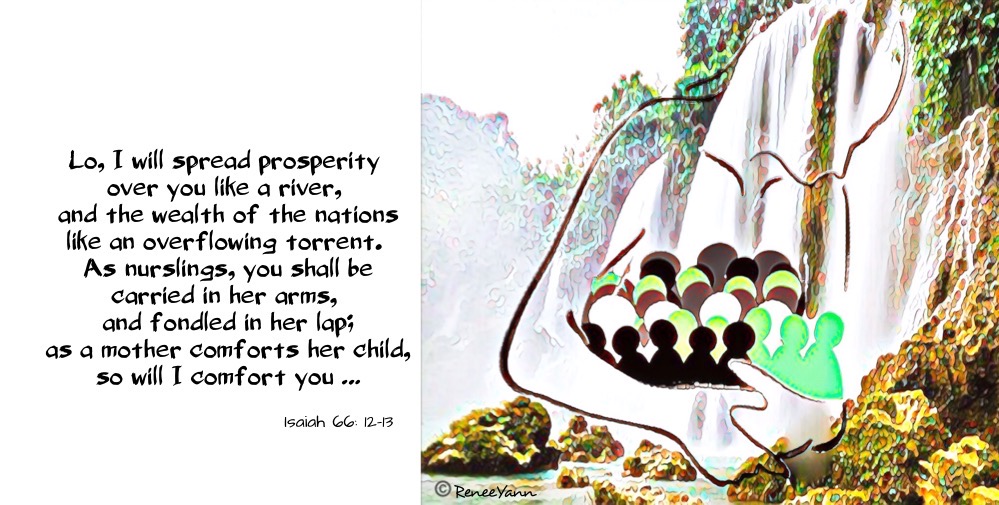
For thus says the LORD:
Lo, I will spread prosperity over Jerusalem like a river,
and the wealth of the nations like an overflowing torrent.
As nurslings, you shall be carried in her arms,
and fondled in her lap;
as a mother comforts her child,
so will I comfort you;
in Jerusalem you shall find your comfort.

Isaiah 66: 12-13


In Galatians, we meet a community that has been arguing over a few things, but especially whether circumcision should continue to be a mark of faith. Paul sounds a little frustrated with the argument.

He claims his “peace and abundance” from the marks of his long ministry and what he has suffered for Christ:

From now on, let no one make troubles for me;
for I bear the marks of Jesus on my body.

Galatians 6:17


In Luke, Jesus indicates that “peace and abundance” will be spread in the New Creation through the sometimes difficult ministry of his disciples:

Go on your way;
behold, I am sending you like lambs among wolves.
Carry no money bag, no sack, no sandals;
and greet no one along the way.
Into whatever house you enter, first say,
‘Peace to this household.’
If a peaceful person lives there,
your peace will rest on him;
but if not, it will return to you.

Luke 10: 3-9

The Gospel message meant to bring peace will, no doubt, bring fear and judgement to those hostile to it:

The kingdom of God is at hand for you.

If we sincerely open our hearts to this message, how might it affect our daily lives? Peace and abundance? A frantic need for repentance? Or maybe just an angry, indifferent, or deaf ear?

Alleluia, alleluia.
Let the peace of Christ control your hearts;
let the word of Christ dwell in you richly.


Poem: one of my favorite poems, The Heart Cave by Geoffrey Brown

The Heart Cave

I must remember
To go down to the heart cave
& sweep it clean; make it warm
with a fire on the hearth,
& candles in their niches,
the pictures on the walls
       glowing with a quiet light.
       I must remember
To go down to the heart cave
       & make the bed
with the quilt from home,
strew
the rushes on the floor
hang
lavender and sage
         from the corners.
         I must go down
                                           To the heart cave & be there
                                           when You come.

Music: Dwelling Place – John Foley, SJ

Alleluia: Come to Me

Friday of the Thirteenth Week in Ordinary Time
July 1, 2022

Today’s Readings: 

https://bible.usccb.org/bible/readings/070122.cfm

Today, in God’s Lavish Mercy, our readings revolve around a theme of taxes, measures, weights, scales – those instruments that may be misused to unduly burden others.

We will diminish the containers for measuring,
add to the weights,
and fix our scales for cheating!

Amos 8:5

Our Gospel illustrates the mental instruments we use to measure, and sometimes condemn others – judgement, prejudice, stereotyping.

The Pharisees said to Jesus’s disciples,
“Why does your teacher eat with tax collectors and sinners?”

Matthew 9:11

There are all kinds of ways we can lay heavy burdens on ourselves and others. Our Alleluia Verse invites us to freedom from such burdens:

Alleluia, alleluia.
Come to me, all you who labor and are burdened,
and I will give you rest, says the Lord.

Does this mean that God will remove such burdens from our lives? No. We know better than that don’t we. 🙂

Trusting our lives to God does not change our burdens. It changes us. 

That change – that unburdening grace – allows us spiritual freedom even in the midst of challenges and trials.

Our hope, confidence, freedom and peace rests in God. Nothing can shake that foundation.


Poetry: Edwina Gateley – Let Your God Love You

Be silent.
Be still.
Alone.
Empty
Before your God.
Say nothing.
Ask nothing.
Be silent.
Be still.
Let your God look upon you.
That is all.
God knows.
God understands.
God loves you
With an enormous love,
And only wants
To look upon you
With that love.
Quiet.
Still.
Be.

Let your God—
Love you.


Music: Come to Me – Gregory Norbet

Lyrics

Come to me, all who labor and are heavy burdened
And I shall give you rest
Take up my yoke and learn from me
For I am meek and humble of heart
And you'll find rest for your souls
Yes, my yoke is easy and my burden is light.

You, God, are my shepherd, I shall never be in need
Fresh and green are the meadows where you give me rest

Come to me, all who labor and are heavy burdened
And I shall give you rest
Take up my yoke and learn from me
For I am meek and humble of heart
And you'll find rest for your souls
Yes, my yoke is easy and my burden is light

Pursue me, o God, with your fathomless love
In your tent let me dwell all the days of my life

Come to me, all who labor and are heavy burdened
And I shall give you rest
Take up my yoke and learn from me
For I am meek and humble of heart
And you'll find rest for your souls
Yes, my yoke is easy and my burden is light

Alleluia: Grafted to God

Thursday of the Thirteenth Week in Ordinary Time
June 30, 2022

Today’s readings:

https://bible.usccb.org/bible/readings/063022.cfm

Today, in God’s Lavish Mercy, we move from Amos’s angry God to the gentle Jesus of our Gospel who gently lifts a broken man out of both his paralysis and sin.

These readings offer quite a leap as we try to image our invisible God! And, once again, our Alleluia Verse is the bridge that helps us do so.

The verse assures us that, in all circumstances, God in restoring us to a share in Divine Life.

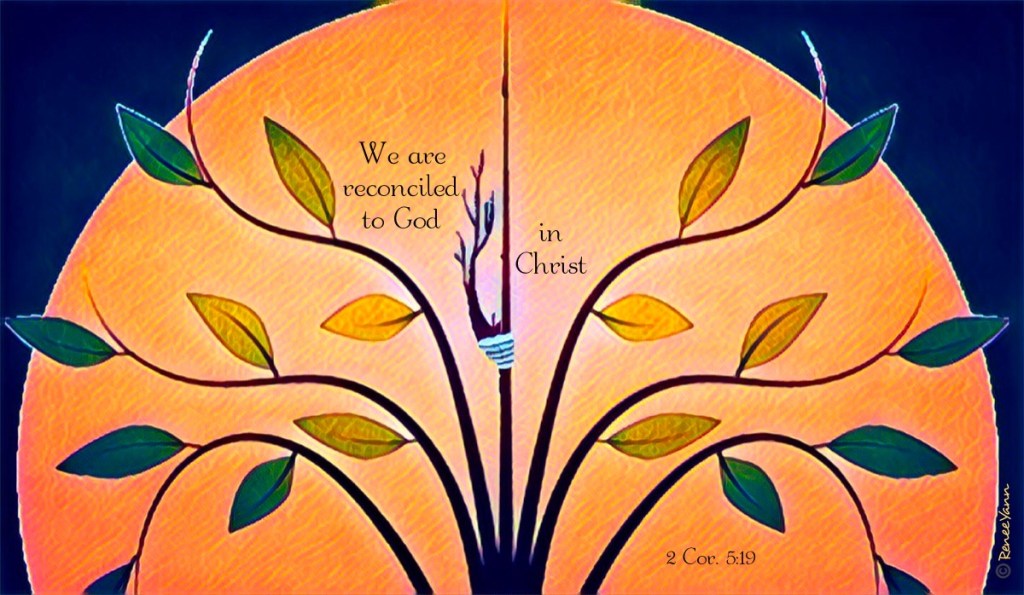
Alleluia, alleluia.
God was reconciling the world to himself in Christ
and entrusting to us the message of reconciliation.

2 Corinthians 5:19


The image that comes to my mind is that of an expert gardener grafting a broken shoot on to a vibrant tree.

That “grafting” occurs within the context of our life stories. In Amos’s time, it was a story fraught with political struggles crippling the community’s moral life. The crowd gathered around Jesus are challenged by the crippling effects of their lack of faith. His cure of the paralytic demonstrates how God wishes to restore their spiritual freedom.

God continues to reconcile the world in Christ
even in our own time.
How am I a recipient
and how am I an agent
of that merciful, conciliatory grace? 

Praying with the elements of Responsorial Psalm 19 today suggests a guide for us. When our lives are reconciled with God, we should experience these gifts:

  • truth
  • justice
  • wholeness
  • refreshment
  • trustworthiness
  • wisdom
  • simplicity
  • right balance
  • joy
  • clarity
  • enlightenment
  • purity
  • steadfastness
  • and spiritual sweetness

Poetry: from Rumi

Find the sweetness 
in your own heart, 
then you may find the sweetness 
in every heart.

Music: Sweet Will of God – by Lelia Naylor Morris (1862 – 1929) an American Methodist hymn writer. In the 1890s, she began to write hymns and gospel songs; it has been said that she wrote more than 1,000 songs and tunes, and that she did so while doing her housework. In 1913, her eyesight began to fail; her son thereupon constructed for her a blackboard 28 feet (8.5 m) long with oversized staff lines, so that she could continue to compose.

In 1900, she published Sweet Will of God, about  the true “sweetness” of a deep spiritual life.

Two versions today. The first is the entire hymn sung by Amy Grant. The second is just the interlude so beautifully sung by Junior W. Smith that I had to share it. (Lyrics below)


Amy Grant

Junior W. Smith

My stubborn will at last hath yielded;
I would be Thine, and Thine alone;
And this the prayer my lips are bringing,
“Lord, let in me Thy will be done.”

Sweet will of God, still fold me closer;
Till I am wholly lost in Thee;
Sweet will of God, still fold me closer,
Till I am wholly lost in Thee.

Thy precious will, O conquering Saviour,
Doth now embrace and compass me;
All discords hushed, my peace a river,
My soul, a prisoned bird, set free.

Shut in with Thee, O Lord, forever,
My wayward feet no more to roam;
What power from Thee my soul can sever?
The centre of God’s will my home.

Alleluia: Speak, Lord!

Thirteenth Sunday in Ordinary Time
June 26, 2022

Today’s Readings

https://bible.usccb.org/bible/readings/062622.cfm

Today, in God’s Lavish Mercy, our Alleluia Verse suggests an amazing consideration- that the Almighty God responds to our human invitation!

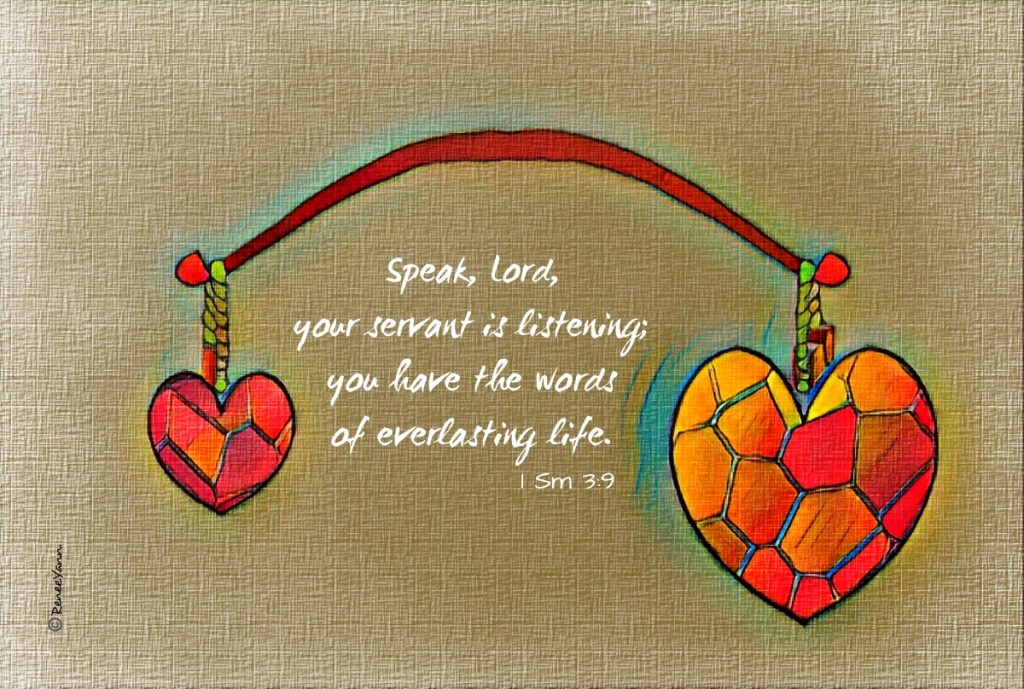
Alleluia, alleluia.
Speak, Lord, your servant is listening;
you have the words of everlasting life.

1 Sm 3:9; Jn 6:68


This humble, hopeful prayer encapsulates themes from each of today’s readings which all use the symbol of a yoke to illustrate their message.

Elisha, and the listeners to both Paul and Jesus understand what a yoke does. It ties the beast of burden to its task. It also ties the one who holds the reins and plow handle.

Although the symbols of ploughing and yoke may be less familiar to us, our readings instruct us that to truly hear God’s voice in our lives we must have a deep freedom from anything that burdens our spirits. How do we do that while living normal human lives with responsibilities, worries and frustrations?

Our verse today might offer us an answer. It all depends on how we perceive our daily lives. 

Speak, Lord, your servant is listening;
you have the words of everlasting life.

Do we see our life only for itself with all the burdens it might put on us? Or do we see it as the sacred unfolding of an infinitely deeper life – everlasting life?

  • Elisha’s life was so much more than the field he had to plow that day!
  • The Galatians lives were so much more than the “biting” arguments that plagued them that day!
  • Jesus’s invitation to follow him is to so much more than the surface concerns of our lives.

Our life in Christ is a call to live in the deep stream of grace – to live “everlasting life” even within the limits of time’s circumstances.

Doing so changes us. It breaks the yoke that constricts our vision, our hope, our capacity for mercy. It allows us to invite God to speak and to hear God’s voice in our ordinary day. It strengthens us to live with extraordinary love and “everlasting “ grace.

Poetry: from T.S.Eliot’s Ash Wednesday 

I have taken a few lines from this long poem of Eliot’s. He wrote it in his later years. He expresses his continuing struggle with living a deep faith. After the excerpt, there is a link to the entire poem. I find Eliot not to be an easy poet, but oh is he ever worth the effort!

If the lost word is lost, if the spent word is spent

If the unheard, unspoken

Word is unspoken, unheard;

Still is the unspoken word, the Word unheard,

The Word without a word, the Word within

The world and for the world;

And the light shone in darkness and

Against the Word the unstilled world still whirled

About the centre of the silent Word.

O my people, what have I done unto thee.

Where shall the word be found, where will the word

Resound? Not here, there is not enough silence

Not on the sea or on the islands, not

On the mainland, in the desert or the rain land,

For those who walk in darkness

Both in the day time and in the night time

The right time and the right place are not here

No place of grace for those who avoid the face

No time to rejoice for those who walk among noise and deny

the voice

Will the veiled sister pray for

Those who walk in darkness, who chose thee and oppose thee,

Those who are torn on the horn between season and season,

time and time, between

Hour and hour, word and word, power and power, those who wait

In darkness? Will the veiled sister pray

For children at the gate

Who will not go away and cannot pray:

Pray for those who chose and oppose

O my people, what have I done unto thee.

Will the veiled sister between the slender

Yew trees pray for those who offend her

And are terrified and cannot surrender

And affirm before the world and deny between the rocks

In the last desert before the last blue rocks

The desert in the garden the garden in the desert

Of drouth, spitting from the mouth the withered apple-seed.

O my people.

http://famouspoetsandpoems.com/poets/t__s__eliot/poems/15133


Music – I Can Hear Your Voice – Jean Watson, Michael W. Smith

Alleluia: Full of Grace

Memorial of the Immaculate Heart of the Blessed Virgin Mary
June 25, 2022

Today’s Readings:

https://bible.usccb.org/bible/readings/062522.cfm

Today, in God’s Lavish Mercy, we pray with Mary, blessed mother of Jesus, and thus of us all who have been born anew in him.

Alleluia, alleluia.
Blessed is the Virgin Mary
who kept the word of God
and pondered it in her heart.

What can this beautiful mother teach us, she who kept and pondered the very Word of God?

In order to grow fully in to God’s heart and will, this holy woman held the Word – the way the dough holds yeast to allow its own transformation.

So that she might blossom into the fullness of her own beauty, she caressed faith’s slow-forming bud in the dark protection of her prayer.


Like all of us, Mary was not divine. She was not supernatural. She was an ordinary, good woman who loved God with extraordinary passion.

She spent her days clearing her heart-space of any clutter that would keep her from God. And slowly, that Divine Presence ripened and revealed itself in the flash of an angel wing and the soundless message that would transform all time.


We too, in our particular ways, are asked to allow God the space to imagine Divinity into flesh through our human experience.

Mary believed that God could and would do such a miracle for love of us. She let the Truth of Jesus live, not only in Him, but in her own mother’s life.

This generous mother then became the first disciple, keeping company with Jesus through his Passion, Death and Resurrection

Indeed, we have much to learn from her.


Poetry: Annunciation – Denise Levertov

We know the scene: the room, variously furnished,

almost always a lectern, a book; always
the tall lily.
Arrived on solemn grandeur of great wings,
the angelic ambassador, standing or hovering,
whom she acknowledges, a guest.

But we are told of meek obedience. No one mentions
courage.
The engendering Spirit
did not enter her without consent.
God waited.

She was free
to accept or to refuse, choice
integral to humanness.

____________________________

Aren’t there annunciations
of one sort or another
in most lives?
Some unwillingly
undertake great destinies,
enact them in sullen pride,
uncomprehending.
More often
those moments
when roads of light and storm
open from darkness in a man or woman,
are turned away from
in dread, in a wave of weakness, in despair
and with relief.
Ordinary lives continue.
God does not smite them.
But the gates close, the pathway vanishes.

______________________________

She had been a child who played, ate, slept
like any other child – but unlike others,
wept only for pity, laughed
in joy not triumph.
Compassion and intelligence
fused in her, indivisible.

Called to a destiny more momentous
than any in all of Time,
she did not quail,
only asked
a simple, ‘How can this be?’
and gravely, courteously,
took to heart the angel’s reply,
perceiving instantly
the astounding ministry she was offered:

to bear in her womb
Infinite weight and lightness; to carry
in hidden, finite inwardness,
nine months of Eternity; to contain
in slender vase of being,
the sum of power –
in narrow flesh,
the sum of light.
Then bring to birth,
push out into air, a Man-child
needing, like any other,
milk and love –

but who was God.

This was the moment no one speaks of,
when she could still refuse.

A breath unbreathed,
                                Spirit,
                                          suspended,
                                                            waiting.

______________________________

She did not cry, ‘I cannot. I am not worthy,’
Nor, ‘I have not the strength.’
She did not submit with gritted teeth,
                                                       raging, coerced.
Bravest of all humans,
                                  consent illumined her.
The room filled with its light,
the lily glowed in it,
                               and the iridescent wings.
Consent,
              courage unparalleled,
opened her utterly.


Music: Two versions of the magnificent “Ave Maria”.

Ave Maria – Franz Schubert – sung by Ms. Jessye Norman, in German as written by Schubert.

( I had the immense privilege and pleasure of meeting and working with the great Jessye Norman when I chaired a UNCF event in Philadelphia many years ago. She, in her own way, was a bit “divine”!)

Ave Maria – Charles Gounod – sung by Ms. Jessye Norman in Latin, as written

Alleluia: God’s Heart for Us

Solemnity of Most Sacred Heart of Jesus
June 24, 2022

Today’s Readings:

https://bible.usccb.org/bible/readings/062422.cfm

Alleluia, alleluia.
Take my yoke upon you, says the Lord,
and learn from me, for I am meek and humble of heart.

Today, in God’s Lavish Mercy, we offer our loving adoration to the Sacred Heart of Jesus Who teaches us the boundless humility of God.

Although not today’s reading, this passage from Philippians captures for me the perfect description of God’s humility in Jesus:

Though Jesus was in the form of God,
he did not count equality with God
a thing to be grasped,
but emptied himself, taking the form of a servant,
being born in human likeness.
And being found in human form
he humbled himself
and became obedient unto death,
even death on a cross.
Therefore God has highly exalted him
and bestowed on him the name
which is above every name,
that at the name of Jesus every knee should bend,
in heaven and on earth and under the earth,
and every tongue confess that Jesus Christ is Lord,
to the glory of God the Creator.

Philippians 2: 6-11

In order to meet our invisible God in prayer, we must imagine God in the ways that most speak to our spirits. For St. Margaret Mary Alacoque that image came in the form of the Sacred Heart, an image which combines both the sacred infinity and the full human heart of Jesus.

Margaret Mary Alacoque (1647 – 1690) was a French Roman Catholic Visitation nun and mystic, who promoted devotion to the Sacred Heart of Jesus in its modern form.

We must never be discouraged or give way to anxiety. . . but ever have recourse to the adorable Heart of Jesus.

Margaret Mary Alacoque

As we pray on this holy feast, may we lean closer and more confidently into the loving heart of Jesus. God loves us enough to do for us what is described in our passage from Philippians. May we fully trust that love and give our own hearts to it.


Poetry: from Rumi in The Masnavi, an extensive poem written in Persian. The Masnavi is one of the most influential works of Sufism, commonly called “the Quran in Persian”. It has been viewed by many commentators as the greatest mystical poem in world literature. The Masnavi is a series of six books of poetry that together amount to around 25,000 verses or 50,000 lines. It is a spiritual text that teaches Sufis how to reach their goal of being truly in love with God.

Open the Window

There’s a street where the Beautiful One
is known to take a stroll.

When a certain radiance is noticed
through the latticed windows
of that neighborhood,

people whisper, The Beloved
must be near.

Listen: open a window to God
and breathe. Delight yourself
with what comes through that opening.

The work of love is to create
a window in the heart,

for the breast is illumined
by the beauty of the Beloved.

Gaze incessantly on that Face!
Listen, this is in your power, my friend!

Find a way to your innermost secret.
Let no other perception distract you.

You, yourself, possess the elixir,
so rub it into your skin,

and by this alchemy
your inner enemies will become friends.

And as you are made beautiful,
the Beautiful One will become your own,
the intimate of your once lonely spirit.


Music: This Ancient Love – Carolyn McDade

Alleluia: Living Bread

The Solemnity of the Most Holy Body and Blood of Christ
June 19, 2022

Today’s Readings:

https://bible.usccb.org/bible/readings/061922.cfm

Today, in God’s Lavish Mercy, we celebrate the most intimate and sacred feast of “Corpus Christi”, as we called it in our Latinized “old days”. In those days, we tried very hard to celebrate the feast in the best way we knew how — processions, hymns, exposition of the Blessed Sacrament. Yet nothing did, nor ever will, come close to capturing the mystery we honor on this holy day.

Alleluia, alleluia.
I am the living bread that came down from heaven,
says the Lord;
whoever eats this bread will live forever.


The items of faith contained in this short verse are earth-shattering. We are asked to believe that Jesus

  • came down from heaven
  • is the visible Presence of the infinite Love of God
  • lives on with in the Eucharist and in the community of the Church
  • grants us a share in eternal life
  • and is present to us beyond time, space, and appearances

The mystery of the Body of Christ/Living Bread is infinite and profound. Great minds such as Pierre Teilhard deChardin spent entire lives plumbing its depths.

When one understands how physical and immediate is the omni-influence of Christ, the vigor assumed by every detail of the Christian life is quite astonishing; it gains an emphasis never dreamt of by those who are frightened of the realistic view of the mystery of the Incarnation.

Take charity, for example, that complete change of attitude so insistently taught by Christ. It has nothing in common with our colorless philanthropy, but represents the essential affinity which brings human beings closer together, not in the superficial sphere of sensible affections or earthly interests, but in building up the pleroma (the fullness of God in Creation.).

The possibility, and even the obligation of doing everything for God are no longer based solely on the virtue of obedience, or solely on the moral value of intention; they can be explained, in short, only by the marvelous grace, instilled into every human effort, no matter how material, of effectively cooperating, through its physical result, in the fulfillment of the body of Christ.

Pierre Teilhard de Chardin in Christianity and Evolution

As I pray this rather heady passage from de Chardin, I reflect on these thoughts:

  • All Creation generates from God and returns to God in the fullness of Love.
  • Jesus Christ is the visible gift of that Love born into our human story.
  • By our faith in Jesus, and our choice to participate in his life, we become part of the ongoing perfection of Creation.
  • The Body of Christ, once present in the flesh in time, now sanctifies Creation through our lives, united in the Bread of Life.


No poetry today. Slowly read and re-read the passage from de Chardin. Find it’s message for you … perhaps just a word or a phrase:

  • the omni-influence of Christ
  • charity, …. that complete change of attitude so insistently taught by Christ
  • nothing in common with our colorless philanthropy
  • building up the fullness of God in Creation
  • the marvelous grace… of effectively cooperating … in the fulfillment of the Body of Christ

Music: Benedictus – Karl Jenkins

Alleluia: Love’s Silent Unity

Wednesday of the Eleventh Week in Ordinary Time
June 15, 2022

Today’s Readings:

https://bible.usccb.org/bible/readings/061522.cfm

Today, in God’s Lavish Mercy, we listen to Jesus’s instruction and promise about how to live at one with God.

Alleluia, alleluia.
If you love me and will keep my word,
and my Father will love you
and we will come to you.

What wonderful assurance! We don’t have to labor to find God, or worry about searching for God. 

God will come to us – will blossom in our hearts like a sacred flower, – if we love Jesus and keep his Word.


In the opening sentence of her book “Too Deep for Words”, Thelma Hall, r.c. says this:

There is an inner dynamic in the evolution of all true love that leads to a communication too deep for words.  There the lover becomes inarticulate, falls silent, and the beloved receives the silence as eloquence.

Our verse today carries
that same, exquisite mystery,
the silent and complete unity
that comes from mutual love. 

Our Gospel elaborates on the invitation. 

But when you pray, go to your inner room, close the door,
and pray to your Father in secret.
And your Father who sees in secret will repay you.

Matthew 6:6

Let us savor these promises in our prayer today.


Poetry: in the silence – Rumi

In the silence 
between your heartbeat 
bides a summons
from Love.
Do you hear it? 
Name it if you must, 
or leave it forever nameless, 
but why pretend it is not there?

Music: The God of Silence – Bukas Palau