God’s blessings to all of you, my readers, in this beautiful month of May! These days bring the full blossoming of Spring in the Northern Hemisphere, the grape harvest in Australia, and the close of the rainy season in Peru. May all these gifts, and the special love of Mary, brighten these days.
Please enjoy this beautiful and elegant music, reminiscent of May:
Sacrifice and offering you did not desire, but a body you prepared for me; in holocausts and sin offerings you took no delight. Then I said, ‘As is written of me in the scroll, behold, I come to do your will, O God.
Hebrews 10:5-7; cf: Psalm 40:7-9
On this Feast of the Annunciation, we remember Mary’s choice to love the world according to the manner of God. It was not a choice she made for the first time during the angel’s visit. Mary had always lived her young life patterned on grace and fidelity. Therefore, she was ready when the angel offered her the choice that changed the world.
Today, in God’s Lavish Mercy:
As human beings, we may be inclined to think of “God’s Will” as a pre-ordained pattern for our lives – rather like a document that, if we could get hold of it, we could follow exactly to achieve salvation. We may even mistakenly think that it is God’s Will that we, or our sisters and brothers, suffer.
We might ask ourselves instead, “What is God’s Will, really?”. The life of Christ, reflected in the Gospel, tells us this: God’s Will is Love. So when Psalm 40 interprets Mary’s Fiat as ” … behold, I come to do Your Will…”, what we might understand is this:
Your Will, O God, is Love. I open my heart to be your Love in the world, in whatever pattern your grace may come to me, whether it be through the joys or the sorrows of the human condition.
Poetry: Fiat – Robert Morneau
On her bed of doubt,
in wrinkled night garment,
she sat, glancing with fear
at a golden shaft of streaming light,
pondering perhaps, "Was this
but a sequel to a dream?"
The light too brief for disbelief,
yet its silence eased not her trembling.
Somehow she murmured a "yes"
and with that the light's love and life
pierced her heart
and lodged in her womb.
The room remained the same
- rug still need smoothing
- jug and paten awaiting using.
Now all was different
in a maiden's soft but firm fiat.
Music: O Santissima – interpreted by Andrea Montepaone
O sanctissima, o piissima, dulcis Virgo Maria! Mater amata, intemerata, ora, ora pro nobis.
Tu solatium et refugium, Virgo Mater Maria. Quidquid optamus, per te speramus; ora, ora pro nobis.
Ecce debiles, perquam flebiles; salva nos, o Maria! Tolle languores, sana dolores; ora, ora pro nobis.
Virgo, respice, Mater, aspice; audi nos, o Maria! Tu medicinam portas divinam; ora, ora pro nobis.
O most holy, o most loving, sweet Virgin Mary! Beloved Mother, undefiled, pray, pray for us.
You are solace and refuge, Virgin Mother Mary. Whatever we wish, we hope it through you; pray, pray for us.
Look, we are weak and deeply deplorable; save us, o Mary! Take away our lassitude, heal our pains; pray, pray for us.
Virgin, look at us, Mother, care for us; hear us, o Mary! You bring divine medicine; pray, pray for us.
Today, in God’s Lavish Mercy, on this Christmas Eve and Fourth Sunday of Advent, we are blessed with the iconic reading from Luke:
The moment of Annunciation …. where history pivots on a woman’s willingness for God
The angel Gabriel was sent from God to a town of Galilee called Nazareth, to a virgin betrothed to a man named Joseph, of the house of David, and the virgin’s name was Mary. And coming to her, he said, “Hail, full of grace! The Lord is with you.” But she was greatly troubled at what was said and pondered what sort of greeting this might be. Then the angel said to her, “Do not be afraid, Mary, for you have found favor with God.
“Behold, you will conceive in your womb and bear a son, and you shall name him Jesus. He will be great and will be called Son of the Most High, and the Lord God will give him the throne of David his father, and he will rule over the house of Jacob forever, and of his kingdom there will be no end.” But Mary said to the angel, “How can this be, since I have no relations with a man?” And the angel said to her in reply, “The Holy Spirit will come upon you, and the power of the Most High will overshadow you. Therefore the child to be born will be called holy, the Son of God. And behold, Elizabeth, your relative, has also conceived a son in her old age, and this is the sixth month for her who was called barren; for nothing will be impossible for God.” Mary said, “Behold, I am the handmaid of the Lord. May it be done to me according to your word.” Then the angel departed from her.
Luke 1:26-38
Poetry: The Blessed Virgin Compared to the Air We Breathe – Gerard Manley Hopkins
Wild air, world-mothering air,
Nestling me everywhere,…
Minds me in many ways
Of her who not only
Gave God’s infinity
Dwindled to infancy
Welcome in womb and breast,
Birth, milk, and all the rest
But mothers each new grace
That does now reach our race…
And makes, O marvellous!
New Nazareth in us,
Where she shall yet conceive
Him, morning, noon, and eve;
New Bethlems, and he born
There, evening, noon, and morn…
Be thou then, O thou dear
Mother, my atmosphere;
My happier world, wherein
To wend and meet no sin…
Stir in my ears, speak there
Of God’s love, O live air,
Of patience, penance, prayer:
World-mothering air, air wild,
Wound with thee, in thee isled,
Fold home, fast fold thy child.
Today, in God’s Lavish Mercy, we pray a heartfelt antiphon beseeching God to transform our world.
Our readings strengthen our prayer because they vibrate with luminous faith deepened by a palpable humanness like our own. We pray with these spiritually powerful women:
Mary and Hannah courageous mothers shining believers agents of worship prophets in common disguise.
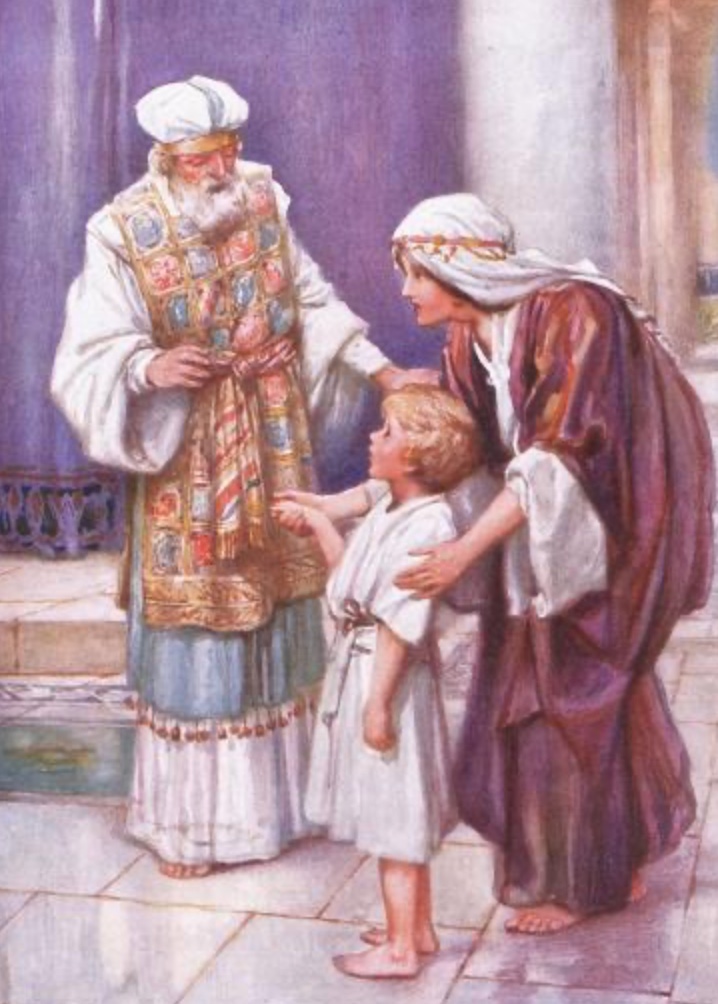
Our first reading once again foreshadows Christ’s life. Hannah, a mother like Mary, gives her only son fully to God’s work. Notice that Hannah, not her husband, brings Samuel to the Temple and initiates the ritual of his dedication. It is Hannah who, claiming her womanhood, utters the simple canon that dedicates Samuel’s life.
Hannah brought Samuel with her, along with a three-year-old bull, an ephah of flour, and a skin of wine, and presented him at the temple of the LORD in Shiloh……
I am the woman who stood near you here, praying to the LORD. I prayed for this child, and the LORD granted my request. Now I, in turn, give him to the LORD; as long as he lives, he shall be dedicated to the LORD.” She left Samuel there.
1 Samuel 1:24-28
Hannah Leaves Samson at the Temple
But how poignantly the reading ends! Do not miss the human emptiness that filled her heart as she returned to her childless home.
She left Samuel there.
1 Samuel 1:28
In our Gospel, Mary offers us her Liturgy of the Word as she proclaims the liberated dimensions of a redeemed world.
My soul proclaims your greatness, O God!
My heart rejoices in you, my Savior,
because you have showered your servant with blessing!
From now to the end of time,
all generations will know the great things you have done for me.
Mighty One! Your name is holy!
In every age, your compassion flows to those who reverence you!
But all who seek to exalt themselves in arrogance
will be leveled by your power.
You have deposed the mighty from their seats of power,
and have raised the lowly to high places.
Those who suffer hunger, you have filled with good things.
Those who are privileged, you have turned away empty-handed.
You have come to the aid of your people,
in fulfillment of the promise you made to our ancestors
when you spoke blessing to Sarah and Hagar
and all their descendants, to the utmost generation!
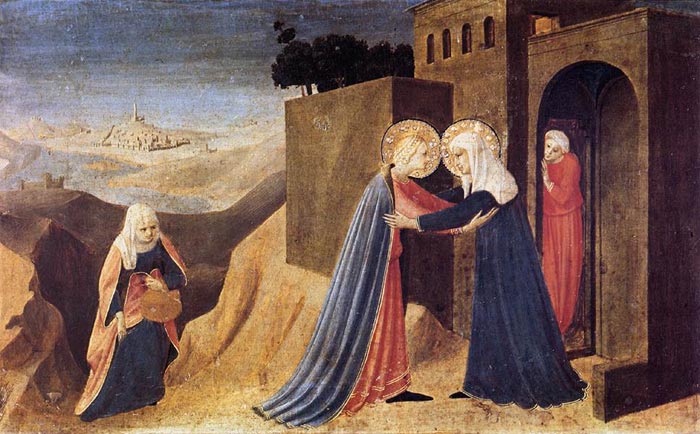
from the Cortona Altarpiece by Fra Angelico
After her courageous declaration, Mary spends three months with Elizabeth in a mutually-directed matriarchal retreat. She then goes back, alone but not alone, to the life she has yet to shape for the coming God. Once again, the striking solitude of this young mother as she travels home:
Mary remained with Elizabeth about three months and then returned to her home.
Luke 1:56
What can we learn from these women today as we make a place for God in our hearts and in our world? Like Hannah, to what liturgies of giving am I called? Like Mary, does my life proclaim my faith in God’s transformative intention for Creation?
Poetry: The Eternal Feminine by Pierre de Chardin
When the world was born, I came into being.
Before the centuries were made, I issued from the hand of God. . .
God instilled me into the initial multiple
as a force of condensation and concentration.
In me is seen that side of beings by which they are joined as one,
in me the fragrance that makes them hasten together and leads them,
freely and passionately, along their road to unity.

Through me, all things have their movement and are made to work as one.
I am the beauty running through the world,
to make it associate in ordered groups;
the ideal held up before the world to make it ascend.
I am the Eternal Feminine.
I was the bond that held together the foundations of the universe. . .
I extend my being into the soul of the world. . .
I am the magnetic force of the universal presence
and the ceaseless ripple of its smile.
I open the door to the whole heart of creation:
I, the Gateway of the Earth, the Initiation. . .

In me, the soul is at work to sublimate the body —
Grace to divinize the soul.
Those who wish to continue to possess me
must change as I change. . .
It is God who awaits you in me!. . .
If, God, then, was able to emerge from himself,
he had first to lay a pathway of desire before his feet,
he had to spread before him a sweet savor of beauty.
It was then that he caused me to rise up,
a luminous mist hanging over the abyss—
between the earth and himself—
that, in me, he might dwell among you. . .

Lying between God and the earth,
as a zone of mutual attraction,
I draw them both together in a passionate union.
. . . I am the Eternal Feminine.
Music – Magnificat – Carl Philipp Emmanuel Bach
Carl Philipp Emanuel Bach (8 March 1714 – 14 December 1788), commonly abbreviated C. P. E. Bach, was a German Classical period composer and musician, the fifth child and second surviving son of Johann Sebastian Bach and Maria Barbara Bach. Throughout his lifetime, Bach worked on the Magnificat in D, Wq. 215. J. S. Bach was alive to hear it in 1749, and C. P. E. continued to revise and perform it as late as 1786. The work clearly shows the influence of J.S. Bach’s own Magnificat, including the striking resemblance of the Deposuit movements in both works.
This is the track list for the album Magnificat, taking the various phrases of the Latin prayer and expressing them in melody. If you don’t have time to listen to the whole thing, you might like to take a portion or two at a time.
Tracklist: 00:00:00 Symphony in G Major, Wq 173: I. Allegro assai 00:02:59 Symphony in G Major, Wq 173: II. Andante 00:05:34 Symphony in G Major, Wq 173: III. Allegretto
00:08:38 Symphony in G Major, Wq 180: I. Allegro di molto 00:12:50 Symphony in G Major, Wq 180: II. Largo 00:17:12 Symphony in G Major, Wq 180: III. Allegro assai
00:20:26 Magnificat in D Major, Wq 215: I. Magnificat (Chorus) 00:23:18 Magnificat in D Major, Wq 215: II. Aria. Quia respexit (Soprano) 00:29:35 Magnificat in D Major, Wq 215: III. Aria. Quia fecit (Tenor) 00:33:40 Magnificat in D Major, Wq 215: IV. Et misericordia eius (Chorus) 00:41:28 Magnificat in D Major, Wq 215: V. Aria. Fecit potentiam (Bass) 00:45:14 Magnificat in D Major, Wq 215: VI. Duet. Deposuit potentes (Contralto, Tenor) 00:51:00 Magnificat in D Major, Wq 215: VII. Aria. Suscepit Israel (Contralto) 00:56:31 Magnificat in D Major, Wq 215: VIII. Gloria (Chorus) 00:58:17 Magnificat in D Major, Wq 215: IX. Sicut erat (Chorus)
Today, in God’s Lavish Mercy, the Church sings out to God the warm, familiar Advent invitation:
Our first reading from the Song of Songs vibrates with anticipation of God’s arrival:
Hark! my lover–here he comes springing across the mountains, leaping across the hills. My lover is like a gazelle or a young stag. Here he stands behind our wall, gazing through the windows, peering through the lattices.
Song of Songs 2: 8-9
When the Divine Lover arrives, the one who waits must be awakened from frost, flood, or barrenness that has drowsed them.
“Arise, my beloved, my dove, my beautiful one, and come! “For see, the winter is past, the rains are over and gone. The flowers appear on the earth, the time of pruning the vines has come, and the song of the dove is heard in our land. The fig tree puts forth its figs, and the vines, in bloom, give forth fragrance. Arise, my beloved, my beautiful one, and come!
Song of Songs 2: 10-12
As we pray with the Song of Songs, we are reminded that relationship with God exceeds our comprehension and expression. We have only our human descriptions to help us explore the infinite dimensions of Grace and Mercy. We image the Holy One as Father, Mother, Sister, Brother, Child, Light, Wisdom, Love, Lover, or Beloved – each aspect offering a necessarily limited metaphor for the Incomprehensible One.
As we consider places in our world, and in our own hearts, which are frozen, flooded, or barren of life, let us invite the Passion of God to rescue and reinvigorate us.
As we reflect on today’s Gospel, we can imagine both Mary and Elizabeth filled with that Holy Vigor which changes and restores everything to God’s original hope for Creation. It was into such ready openness that God’s Word leapt in one moment 2000 years ago. May it leap again into our hearts.
Poetry: Love Gaze – Renee Yann, RSM
Caught in the ferocious wind
of my own inadequacies,
I cling by finest web
to the energy You are,
fixing my soul on yours
in that precarious holding.

You are the magnet, gathering
all my emptiness beyond itself.
As if my fears were only stones
to tread upon, You come into the marshes
of my life as stillness, paused
and vibrating like a deer
among the reeds in dusklight.

I cannot word what it is
to swim in the deep pool of your Eyes.
All the universe, and all my understanding
turn reverently aside to offer privacy
for such profound combining.
Music: Veni, Dilecte Mi – Orlande de Lassus (1532-1594), one of the leading composers of the later Renaissance
Latin: Prima pars 7:11 Veni dilecte mi, egrediamur in agrum, commoremur in villis, 7:12 Mane surgamus ad vineas. Videamus si floruit vinea, si flores fructus parturiunt, si floruerunt mala punica. Ibi dabo tibi ubera mea.
Secunda pars 4:11a Favus distillans labia tua, [dilecte mi], mel et lac sub lingua tua. 8:6a Pone me ut signaculum super cor tuum, quia fortis est ut mors dilectio, dura sicut infernus aemulatio.
English: Prima pars 7:11 Come, my beloved, let us go forth into the field, let us abide in the villages. 7:12 Let us get up early to the vineyards, let us see if the vineyard flourish, if the flowers be ready to bring forth fruits, if the pomegranates flourish: there will I give thee my breasts.
Secunda pars 4:11a Thy lips, my spouse, are as a dropping honeycomb, [my beloved] honey and milk are under thy tongue; 8:6a Put me as a seal upon thy heart, as a seal upon thy arm, for love is strong as death, jealousy as hard as hell. (Douai-Rheims)
Today, in God’s Lavish Mercy, what glorious readings we have, capturing our exuberant hope. In our Responsorial Psalm, Mary proclaims the profound re-ordering of the world in justice and mercy.
Walter Brueggemann says “the song of Mary (the Magnificat; Luke 1:46–55) is about the unthinkable turn in human destinies when all seemed impossible: “For with God nothing will be impossible” (v. 37).
Our God has filled the hungry with good things, and sent the rich away empty;. has come to the help of our people and remembered the promise of mercy…
Luke 1:63-64
With Isaiah, the whole earth sings out: “GAUDETE’ – REJOICE”, because the Divine Light breaks on the horizon. Isaiah imagines the self-proclamation of this glorious Messiah Who rises out of history’s darkness:
The spirit of the Lord GOD is upon me, because the LORD has anointed me; he has sent me to bring glad tidings to the poor, to heal the brokenhearted, to proclaim liberty to the captives and release to the prisoners, to announce a year of favor from the LORD and a day of vindication by our God.
I rejoice heartily in the LORD, in my God is the joy of my soul; for he has clothed me with a robe of salvation and wrapped me in a mantle of justice, like a bridegroom adorned with a diadem, like a bride bedecked with her jewels. As the earth brings forth its plants, and a garden makes its growth spring up, so will the Lord GOD make justice and praise spring up before all the nations.
Isaiah 61: 1-2A;10-12
Finally, in our Gospel, John the Baptist instructs his questioning followers about finding “the One Who is to come”. His words give us a precious insight into how we will find this emergent Savior in our own lives:
John answered them, “I baptize with water; but there is one among you whom you do not recognize, the one who is coming after me, whose sandal strap I am not worthy to untie.” This happened in Bethany across the Jordan, where John was baptizing.
John 1:20-28
The jubilant grace of Gaudete Sunday may be this:
the spiritual energy to find God, as John did, in the shrouded complexities of our lives and times
to believe, as Mary did, that God will enact an incredible restoration of Creation
to rejoice heartily with Isaiah in the One who is the “joy of my soul”
Prose: Willa Cather in Death Comes for the Archbishop
The miracles of the church seem to me to rest not so much upon faces or voices or healing power coming suddenly near to us from afar off, but upon our perceptions being made finer, so that for a moment our eyes can see and our ears can hear what is there about us always.
Today, in God’s Lavish Mercy, we pray in praise of Mary, with a passage from the Book of Judith as our Responsorial Psalm:
Blessed are you, daughter, by the Most High God, above all the women on earth; and blessed be the LORD God, the creator of heaven and earth.JUDITH 13:18
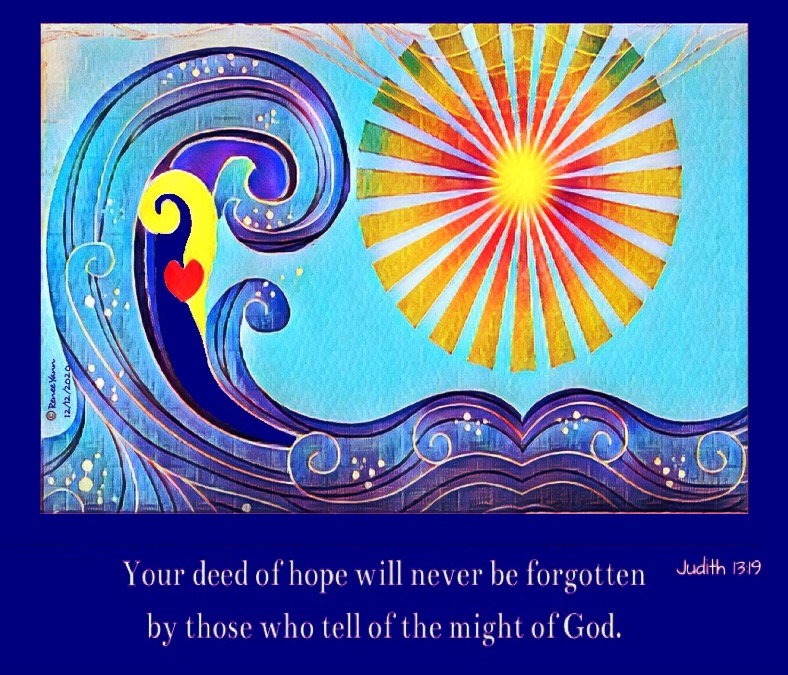
Judith rescues her people’s future by an act of heroism against the enemy. That “deed of hope” saves the whole community from deadly oppression.
You are the highest honor of our human race. Your deed of hope will never be forgotten by those who tell of the might of God.JUDITH 13:19
Judith’s deeds foreshadow Mary’s sublime obedience to the power of God. Her dynamic faith and trust free Mary to respond to God’s outrageous willingness to become flesh for our salvation.
Mary said, “Behold, I am the handmaid of the Lord. May it be done to me according to your word.”LUKE 1:38
Down through history, Mary continues to inspire that kind of faith in God’s People. Today, we remember two such inspired individuals:
Saint Juan Diego who, in receiving graces from Our Lady of Guadalupe, offered a “deed of hope” for the Mexican people.
Venerable Catherine McAuley, our beloved founder who , on this date in 1831, released the “deed of hope” ever afterward known as “the Sisters of Mercy”.
What “deed of hope” wants firing in your heart today? Let’s look to Mary, and the saints she has inspired, to encourage us!
Poetry: from Hafiz
Light Will someday split you open Even if your life is now a cage,
For a divine seed, the crown of destiny, Is hidden and sown in an ancient fertile plain You hold the title to.
Love will surely burst you wide open Into an unfettered, blooming new galaxy… A life–giving radiance will come, The Beloved’s gratuity will come…..
Music: Sub Tuum Praesidium- “Beneath Thy Protection” – is the oldest preserved extant hymn to the Blessed Virgin Mary. (mid-3rd century). The Latin version has been set to music in the West many times, notably by Marc-Antoine Charpentier, Jan Dismas Zelenka, Antonio Salieri, Wolfgang Amadeus Mozart, and Ludwig van Beethoven.
Sub tuum praesidium confugimus, Sancta Dei Genetrix. Nostras deprecationes ne despicias in necessitatibus nostris, sed a periculis cunctis libera nos semper, Virgo gloriosa et benedicta.
We fly to Thy protection, O Holy Mother of God; Do not despise our petitions in our necessities, but deliver us always from all dangers, O Glorious and Blessed Virgin.
Today, in God’s Lavish Mercy, our Gospel offers us the luminous account of Gabriel’s Annunciation to young Mary. In my prayer, I think I would just like to sit beside Mary and wait for the graces God wishes to give me – to wait confidently as she did, and to do so with her guidance.
Annunciation – Edward Burns-Jones
I will use the powerful poem by Scott Cairns to focus my heart. You may want to use it as well.
Deep within the clay, and O my people
very deep within the wholly earthen
compound of our kind arrives of one clear,
star-illumined evening a spark igniting
once again the tinder of our lately
banked noetic fire. She burns but she
is not consumed. The dew lights gently,
suffusing the pure fleece. The wall comes down.
And—do you feel the pulse?—we all become
the kindled kindred of a King whose birth
thereafter bears to all a bright nativity.
Music: Monteverdi – Vespro della Beata Vergine led by John Eliot Gardiner
Claudio Giovanni Antonio Monteverdi (1567 – 1643) was an Italian composer, choirmaster and string player. A composer of both secular and sacred music, and a pioneer in the development of opera, he is considered a crucial transitional figure between the Renaissance and Baroque periods of music history.
The Vespro della Beata Vergine consists of 14 components: an introductory versicle and response, five psalms interspersed with five “sacred concertos”, a hymn, and two Magnificat settings. Collectively these pieces fulfil the requirements for a Vespers service on any feast day of the Virgin.
In March 1964, as a student at King’s College, Cambridge, John Eliot Gardiner led a performance of Monteverdi’s Vespers that not only launched his conducting career, but also his world-renowned Monteverdi Choir.
Today, in God’s Lavish Mercy, as we pray with Our Mother of Sorrows, we follow the liturgical cycle and return to Paul’s letter to Timothy for our first reading. However, we break from the cycle to honor Mary, Mother of Sorrows for our Gospel and Sequence.
What a solemn title this is for Mary! It is so much more comforting to think of her as the young, lively mother of Jesus, or the exuberant girl who happily visited her cousin Elizabeth.
But today, the Church remembers Mary’s suffering by which she intimately shared in Jesus’s redemption of the world.
At the cross her station keeping,
Stood the mournful Mother weeping,
Close to Jesus to the last.
Through her heart, his sorrow sharing,
All his bitter anguish bearing,
Now at length the sword had passed.
Mary’s life was full of both mind-blowing and heart-wrenching experiences!
Just imagine what it felt like to find an angel in one’s living room with an invitation to star in salvation history.
Imagine Mary’s pride, and perhaps frightened astonishment, at Cana when she tasted that “wine-formerly-known-as-water.”
Imagine how she fought the urge to slow Jesus down, to call him back to the comfort, safety and anonymity of their Nazareth home.
Imagine the utter bereavement of mind, heart, and spirit Mary suffered at the foot of the Cross.
Mary’s life was so full of joys and sorrows that there could be little in our lives she would not fully understand. Let’s be with her in prayer today, turning over our own blessings and difficulties with her – and those of our world – asking for her counsel and care.
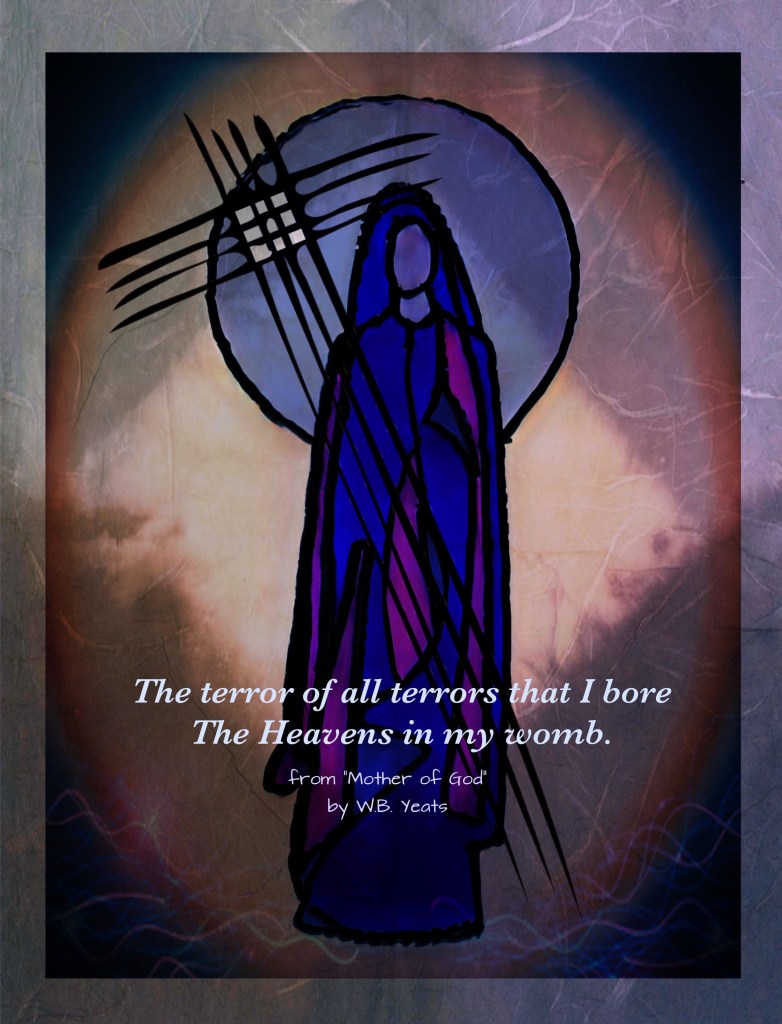
Poetry: Mother of God – W. B. Yeats
The threefold terror of love; a fallen flare
Through the hollow of an ear;
Wings beating about the room;
The terror of all terrors that I bore
The Heavens in my womb.
Had I not found content among the shows
Every common woman knows,
Chimney corner, garden walk,
Or rocky cistern where we tread the clothes
And gather all the talk?
What is this flesh I purchased with my pains,
This fallen star my milk sustains,
This love that makes my heart’s blood stop
Or strikes a Sudden chill into my bones
And bids my hair stand up?
Music: Mary’s Heart – Danielle Rose
Oh Mary Mother of Jesus Give me your heart That I might receive Jesus Give me your heart So beautiful, so pure So immaculate, so full Of love and humanity
Oh Mary Mother of Jesus Give me your heart That I might receive Jesus Give me your heart To love him as you loved him And serve him as you served him In the distressing disguise of the poorest of the poor
Oh Mary Mother of Jesus Give me your heart That I might receive Jesus In the bread of life In the poorest of the poor In distressing disguise In Christ our Lord In the bread of life In the poorest of the poor In distressing disguise In Christ our Lord
Oh Mary Mother of Jesus Give me your heart That I might receive Jesus Jesus
Today, in God’s Lavish Mercy, we have an option in our readings. Therefore, I chose the readings for the Queenship of Mary for our reflection today.
The beautiful first reading from Isaiah will no doubt evoke sentiments of Advent as we hear its familiar dulcet tones. (Click the tiny white arrowhead in the grey bar below to hear a lovely interpretation.)
The people who walked in darkness have seen a great light; Upon those who dwelt in the land of gloom a light has shone.
With today’s feast, we acknowledge that we were delivered from darkness by the brave and humble “Yes” of a young Nazarene woman, Mary, Mother of Jesus.
“Yes” is an infinitely powerful word when spoken in response to God’s Will. Mary’s “Yes” initiated the unfurling of God’s Dominion through the new law of Love:
For a child is born to us, a son is given us; upon his shoulder dominion rests. They name him Wonder-Counselor, God-Hero, Father-Forever, Prince of Peace. His dominion is vast and forever peaceful, From David’s throne, and over his kingdom, which he confirms and sustains By judgment and justice, both now and forever. The zeal of the LORD of hosts will do this!
As the “initiatrix” of that Reign, Mary has been designated by the Church as “Queen”. In this life, Mary’s role was that of a humble, faithful woman who gave all that she had to foster the ministry of Jesus. No doubt, she never felt herself to be a “queen”. And it is from the witness of that obedient fidelity that we draw the inspiration for our own ordinary lives.
Nevertheless, it is fitting to honor Mary under this regal title. Through it, we recognize and appeal to Mary’s unique and intimate partnership in the continuous unfolding of God’s Reign in our times.
For our own prayer, we might ask Mary to help us assess the vitality of our “Yes” to God as it unfolds for us in each day’s circumstances.
Annunciationby Henry Ossawa Tanner
Poetry: Fiat by Robert Morneau
On seeing Tanner’s Annunciation….
On her bed of doubt, in wrinkled night garment, she sat, glancing with fear at a golden shaft of streaming light, pondering perhaps, “Was this but a sequel to a dream?” The light too brief for disbelief, yet its silence eased not her trembling. Somehow she murmured a “yes” and with that the light’s love and life pierced her heart and lodged in her womb. The room remained the same -rug still needed smoothing -jug and paten awaiting using. Now all was different in a maiden’s soft but firm fiat.








 Lavish Mercy