Isaiah the Poet

Wednesday of the Twenty-ninth Week in Ordinary Time

October 21, 2020


Today, in God’s Lavish Mercy, we pray with Isaiah for our Responsorial Psalm.

God indeed is my savior;
I am confident and unafraid.
My strength and my courage is the LORD,
Who has been my savior.

Isaiah 12: 2-3

But how do we get to the degree of steadfast faith described here by Isaiah, a faith that is confident, unafraid, strong and courageous? Isaiah says it is like satisfying a deep thirst at a flowing fountain.


We all know how unpleasant it is to be thirsty, but what about really thirsty?

I’m a pretty big fan of old cowboy movies. A standard scene in many of these is the forlorn rider traversing a parched plain, longing for water.

by Stanley L. Wood

Now that’s “thirsty”! And that is the degree of longing Paul describes in today’s passage from Ephesians, a longing for that “water” that had been hidden through the ages:

To me, the very least of all the holy ones, this grace was given,
to preach to the Gentiles the inscrutable riches of Christ,
and to bring to light for all what is the plan of the mystery
hidden from ages past in God who created all things,
so that the manifold wisdom of God
might now be made known …


… the inscrutable riches of Christ…

This is the Fountain to which we are invited as we open ourselves through the Word of God in scripture, sacrament, and sacred circumstance of our lives.


Sing praise to the LORD for his glorious achievement;
let this be known throughout all the earth.
Shout with exultation, O city of Zion,
for great in your midst
is the Holy One of Israel!

Isaiah 12: 5-6

The “glorious achievement” proclaimed by Isaiah is the same “manifold wisdom” to which Paul says we all have access by faith:

… the manifold wisdom of God …
… accomplished in Christ Jesus our Lord,
in whom we have boldness of speech
and confidence of access through faith in him.

Ephesians 3: 10-12

In our Gospel, Jesus tells that this gift, this Fountain, once opened to us, demands our faithful response:

Much will be required of the person entrusted with much,
and still more will be demanded of the person entrusted with more.

So as we drink deeply of this Fountain, let us pray for a grateful, responsive fidelity for the gift we have been given.


Poem: excerpt from “Water Sign Woman” by Lucille Clifton

Photo by Kevin Bidwell on Pexels.com
the woman who feels everything
sits in her new house
waiting for someone to come
who knows how to carry water
without spilling, who knows
why the desert is sprinkled
with salt, why tomorrow
is such a long and ominous word.

they say to the feel things woman
that little she dreams is possible,
that there is only so much
joy to go around, only so much
water. there are no questions
for this, no arguments. she has
to forget to remember the edge
of the sea, they say, to forget
how to swim to the edge, she has

to forget how to feel. the woman
who feels everything sits in her
new house retaining the secret
the desert knew when it walked
up from the ocean, the desert,

so beautiful in her eyes;
water will come again
if you can wait for it.
she feels what the desert feels.
she waits.

Music: Come Thou Fount of Every Blessing written by Robert Robinson (1758) sung here by Fernando Ortega


Psalm 100: Sing Out Loud

Memorial of Saints John de Brébeuf and Isaac Jogues, Priests, and Companions, Martyrs

October 19, 2020

Today, in God’s Lavish Mercy, we pray with Psalm 100, the Jubilate Deo – a psalm that tells us to SING! You know, like this: (Go ahead, click. It’s fun.)


Psalm 100 was that kind of invitation for ancient Israel. And it is for us too.

It is a well-known and beloved psalm. Wikipedia tells us:

People who have translated the psalm range from Martin Luther to Katherine Parr, (last wife of Henry VIII), and translations have ranged from Parr’s elaborate English that doubled many words, through metrical hymn forms, to attempts to render the meaning of the Hebrew as idiomatically as possible in a modern language (of the time).

Sing joyfully to the LORD all you lands;
serve the LORD with gladness.

Psalm 100:1-2

In our first reading, Paul clearly states a perfect reason for such singing:

But God, who is rich in mercy,
because of the great love God had for us,
even when we were dead in our transgressions,
brought us to life with Christ (by grace you have been saved),
raised us up with him,
and seated us with him in the heavens in Christ Jesus,
that in the ages to come
he might show the immeasurable riches of his grace
in his kindness to us in Christ Jesus.

Ephesians 2:4-7

This is such a powerful passage from Ephesians!
If we really internalize it, there is no limit to the power of our faith.


(That’s me before I dyed my hair grey 🙂

Using an inclusive translation of Psalm 100, I sat quietly with its individual phrases today and my spirit was deeply fed. Sometimes, I put my reasoning mind to the side, and just let the dynamic beauty of the words rest in my heart.

Psalm 100 – Jubilate Deo

Be joyful in the Lord, all you lands;
serve the Lord with gladness
and come into the divine presence with a song.
Know this: the Lord, the Lord, is God;
the One made us and to whom we belong;
we are God’s people, the sheep of God’s pasture.
Enter the gates of the Lord with thanksgiving; 
go into these courts with praise;
give thanks to God and call upon the name of the Lord. 
For the Lord is good, whose steadfast love is everlasting;
and whose faithfulness endures from age to age.

Inclusive Language Psalter: Anglican Church of Canada

Music: Jubilate Deo  – Dan Forrest

I have included two separate links to this magnificent music which offers Psalm 100, the Jubilate, in eight languages!

First Movement: Latin

Complete concert:

Psalm 8: Hymn of the Universe

Memorial of Saint Ignatius of Antioch, Bishop and Martyr

October 17, 2020


Today, in God’s Lavish Mercy, we pray with Psalm 8.

O LORD, our LORD,
how glorious is your Name over all the earth!
You have exalted your majesty above the heavens.
Out of the mouths of babes and sucklings
you have fashioned praise ….

Psalm 8:2-3

Just yesterday, I got an email from the amazingly organized Sister who manages our grounds. She wanted to alert us that there would be a small “star-gazing” event this weekend, sponsored by our school, in case we might wonder about unusual nighttime visitors.


The note took me back to my own star-gazing days, residues of which percolate from time to time, especially during meteor showers. These days I do most of my “gazing” out our kitchen window, but when I studied for my certification in Earth Sciences, I had several opportunities for “instructed” star-gazing with excellent West Chester University astronomers. In a subsequent reflection, I described one such experience like this:

There are a few places where nature offers an experience of darkness so absolute it can be terrifying.  Assateague Island lies along the barrier coast of Virginia.  On a winter night, darkness there feels complete, enveloping.  As evening lengthens, night pulls its velvet canopy from the black ocean, covering the beach in silence. The whisper of rustling sea oats along invisible dunes is the only link to a land left behind.  But slowly, like sparks rolling through dry tinder, stars burn one by one through heaven’s blanket.  By midnight, their incomparable brilliance convinces the soul that it has never been and can never be alone.


Three thousand years ago, our psalmist felt the same way:

When I behold your heavens, the work of your fingers,
the moon and the stars which you set in place—
What are we  that you should be mindful of us,
we human beings that you should care for us?

Psalm 8:4-5

Charles Spurgeon, revered Baptist preacher, calls this psalm “the song of the Astronomer“, as gazing at the heavens inspires the psalmist to meditate on God’s creation and humanity’s place in it.

You have made us little less than the angels,
and crowned us with glory and honor.
You have given us rule over the works of your hands,
putting all things under our feet.

Psalm 8:6-7

Pope John Paul II said this:

 …. for those who have attentive ears and open eyes, creation is like a first revelation that has its own eloquent language: it is almost another sacred book whose letters are represented by the multitude of created things present in the universe. St. John Chrysostom says: “The silence of the heavens is a voice that resounds louder than a trumpet blast: this voice cries out to our eyes and not to our ears, the greatness of Him who made them.

General Audience – January 30, 2002

And our dear Pope Francis reiterates this thought so beautifully in his epic encyclical:

At the end, we will find ourselves face to face with the infinite beauty of God, and be able to read with admiration and happiness the mystery of the universe, which with us, will share in unending plenitude.

Laudato Si’

Let’s rest in all this beauty as we pray today with Psalm 8


Music: Beautiful Universe – Tim Janis

Psalm 33: God’s Peace

Friday of the Twenty-eighth Week in Ordinary Time

October 16, 2020


Today, in God’s Lavish Mercy, we pray with Psalm 33 which has been described as “a song of praise” and a call to worship. But as I pray with it this morning, I think of the psalm as much more. Within it is a profound call to social justice grounded in faith.

Maybe my attitude is the result of a commercial I keep thinking about. You may have seen it – the one for an organization called Wounded Warriors. Every time I see it, my soul splits. There is deep compassion, admiration and respect for the veterans depicted. But there is also the raging question “WHY!”.

How can we still allow, tout, and support the systemic atrocity of war in any form? How can we see these young men and women, bodies maimed and lives fractured, and not be outraged that war even exists!


I think that, thousands of years ago, the writer of Psalm 33 may have entertained similar questions. The psalmist realizes that it is not by the superiority of the nation state that a people gains righteousness and mercy.

The LORD foils the plan of nations,
frustrates the designs of peoples.
But the plan of the LORD stands forever,
the designs of his heart through all generations.
Blessed is the nation whose God is the LORD,
the people chosen as his inheritance.

Psalm 33:10-12

It is instead by acknowledging God’s care for all peoples that a nation achieves the humility, understanding, and courage to help build universal peace.

From heaven the LORD looks down
and observes all the children of Adam,
From his dwelling place he surveys
all who dwell on earth.
The One who fashioned together their hearts
is the One who knows all their works.

Psalm 33:13-15

The challenge of global peace-making is daunting. We “children of Adam” have permitted ourselves to not only normalize, but to exalt war. Reversing the systems that depend on and lead to war will be a long, complex, and arduous pursuit.

But for God’s sake, and our own, we must do it!
Our soul waits for the LORD,
he is our help and shield.
For in him our hearts rejoice;
in his holy name we trust.
May your mercy, LORD, be upon us;
as we put our hope in you.

Psalm 33: 20-21

Reading: from
In Truth, Peace
MESSAGE OF HIS HOLINESS POPE BENEDICT XVI
FOR THE CELEBRATION OF THE WORLD DAY OF PEACE
1 JANUARY 2006

The theme chosen for this year’s reflection—In truth, peace — expresses the conviction that wherever and whenever men and women are enlightened by the splendour of truth, they naturally set out on the path of peace. The Pastoral Constitution Gaudium et Spes, promulgated forty years ago at the conclusion of the Second Vatican Council, stated that humankind will not succeed in ”building a truly more human world for everyone, everywhere on earth, unless all people are renewed in spirit and converted to the truth of peace”. 

But what do those words, ”the truth of peace”, really mean? To respond adequately to this question, we must realize that peace cannot be reduced to the simple absence of armed conflict, but needs to be understood as ”the fruit of an order which has been planted in human society by its divine Founder”, an order ”which must be brought about by humanity in its thirst for ever more perfect justice”. As the result of an order planned and willed by the love of God, peace has an intrinsic and invincible truth of its own, and corresponds ”to an irrepressible yearning and hope dwelling within us”.


Music: Let There Be Peace on Earth sung by the magnificent Wintley Phipps

Psalm 98: The Lord Remembers

Memorial of Saint Teresa of Jesus, Virgin and Doctor of the Church

October 15, 2020

Today, in God’s Lavish Mercy, on this feast of the great St. Teresa of Avila, we pray with Psalm 98.

Our psalm is the exultant song of a joyful and triumphant people – a people grateful and blessed by the Lord’s Presence among them.

Sing to the LORD a new song,
Who has done wondrous deeds;
Whose right hand has won for us
the victory of peace.

Psalm 98:1-2

We have all experienced these types of moments when we feel “delivered”.

  • We might have been praying for someone’s health, or our own.
  • We might have been caught in a difficult decision.
  • We might have been waiting for an acceptance letter or call.
  • We might have been hoping our apology would be accepted, or that one would be given.
  • We might have been aching for an inspiration, a thread of hope, or a new understanding.

And then —- Light!

We know what it feels like when the Light comes. But often, it is not the light we had expected. True “deliverance” comes not from shedding a worrisome circumstance. Instead, it comes from being incorporated into an unshakable faith and trust, as St. Teresa of Ávila describes it:

May today there be peace within. 
May you trust God that you are exactly where you are meant to be. 
May you not forget the infinite possibilities that are born of faith. 
May you use those gifts that you have received, and pass on the love that has been given to you. 
May you be content knowing you are a child of God. 
Let this presence settle into your bones, and allow your soul the freedom to sing, dance, praise and love. 
It is there for each and every one of us.


Poem: Nada Te Turbe – Teresa of Ávila

Let nothing disturb you,
Let nothing frighten you,
All things are passing:
God alone is changeless.
Patience
obtains all things.
Whoever has God
lacks nothing;
God alone suffices.

Nada te turbe,
Nada te espante.
Todo se pasa.
Dios no se muda.
La paciencia 
Todo lo alcanza.
Quien a Dios tiene,
Nada le falta.
Solo Dios basta.


Music: Voice in My Heart – Iris Koh


A beautiful reflection in Spanish from the Discalced Carmelite Sisters

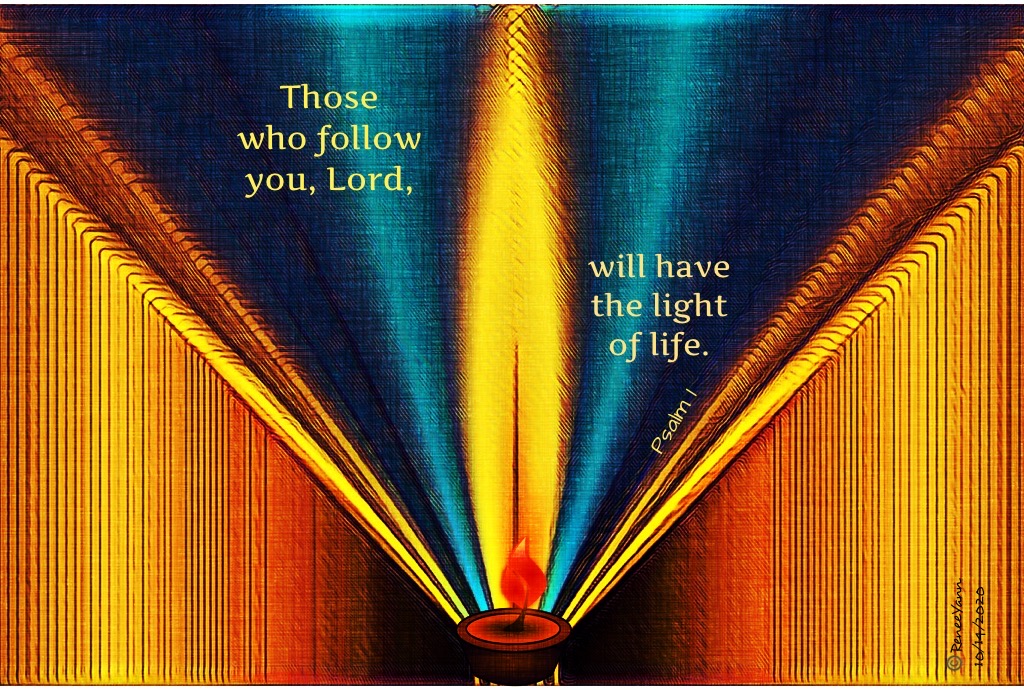
Psalm 1: The First Word

Wednesday of the Twenty-eighth Week in Ordinary Time

October 14, 2020


Today, in God’s Lavish Mercy, we pray with Psalm 1.

Patrick D. Miller, Hebrew Scriptures scholar, suggests that Psalm 1 “sets the agenda for the Psalter through its identification of the way of the righteous and the way of the wicked as well as their respective fates” along with “its emphasis on the Torah, the joy of studying it and its positive benefits for those who do“.

Blessed the one who follows not
the counsel of the wicked
Nor walks in the way of sinners,
nor sits in the company of the insolent,
But delights in the law of the LORD
and meditates on God’s law day and night.

Psalm 1:1-2

What does it really mean to “meditate on God’s law day and night”? Become a monk? Read the Bible all day? Never sleep?

Of course not. I think it means to live in the firm belief that God is in everything, and to train our hearts to see and respond to that Omnipresent Love.

We all know people who, no matter the circumstances, are focused on good and radiate a joyful confidence. There is a light within them and a peace around them. The living of their ordinary lives is a meditation on God’s order in all things.

Such a person …

… is like a tree
planted near running water,
That yields its fruit in due season,
and whose leaves never fade.
Whatever that faithful one does, prospers.

Psalm 1:3

It doesn’t mean there aren’t challenges … even protests, righteous anger, sadness and pain. Think of Jesus as he overturned the Temple tables!

It means rather that the focus is never lost because …
Creation’s sacred order is our Light;
and God’s law has taught ours hearts 
to find our joy in its Beauty.

my transliteration of Psalm 1:2

Let’s be that tree near
the running water of Grace!🙏


Poem: On Beauty by Khalil Gibran

And a poet said, Speak to us of Beauty.
     And he answered:
     Where shall you seek beauty, and how
shall you find her unless she herself be your
way and your guide?
     And how shall you speak of her except
she be the weaver of your speech?
    
The aggrieved and the injured say,
“Beauty is kind and gentle.
     Like a young mother half-shy of her
own glory she walks among us.”
     And the passionate say, “Nay, beauty is
a thing of might and dread.
     Like the tempest she shakes the earth
beneath us and the sky above us.”
    
The tired and the weary say, “Beauty is
of soft whisperings. She speaks in our spirit.
     Her voice yields to our silences like a faint
light that quivers in fear of the shadow.”
     But the restless say, “We have heard her
shouting among the mountains,
     And with her cries came the sound of
hoofs, and the beating of wings and
the roaring of lions.”
    
At night the watchmen of the city say,
“Beauty shall rise with the dawn from the
east.”
     And at noontide the toilers and 
the wayfarers say, 
“We have seen her leaning over
the earth from the windows of the sunset.”
    
In winter say the snow-bound, “She shall
come with the spring leaping upon the hills.”
     And in the summer heat the reapers say,
“We have seen her dancing with the autumn
leaves, and we saw a drift of snow in her hair.”
     All these things have you said of beauty,
     Yet in truth you spoke not of her but of
needs unsatisfied,
     And beauty is not a need but an ecstasy.
     It is not a mouth thirsting nor an empty
hand stretched forth,
     But rather a heart enflamed and a soul enchanted.
     It is not the image you would see nor the
song you would hear,
     But rather an image you see though you
close your eyes and a song you hear though
you shut your ears.
     It is not the sap within the furrowed bark,
nor a wing attached to a claw,
     But rather a garden for ever in bloom and
a flock of angels for ever in flight.
    
People of Orphalese, beauty is life when
life unveils her holy face.
     But you are life and you are the veil.
     Beauty is eternity gazing at itself in a mirror.
But you are eternity and you are the mirror.


Music: I Delight in You, Lord – David Baroni

Psalm 119: Come, Sweet Mercy!

Tuesday of the Twenty-eighth Week in Ordinary Time

October 13, 2020


Today, in God’s Lavish Mercy, we pray with Psalm 119 whose refrain is beautiful to the ears of those who love Mercy.


We can invite Mercy in many ways.

One way is to ask Mercy to heal the fractured circumstances of our lives – the outside of the cup, if we would borrow an image from today’s Gospel:

  • to strengthen us against any pain or fear in our own lives
  • to deliver us and those we love from all that overwhelms
  • to forgive our inexcusable retreats into selfishness
  • to repair that which seems irrevocably broken 

But another, deeper way is to invite Mercy to the inside of our “cup”:

  • to indwell our hearts
  • to transform, within us, the place where we encounter life
  • to inspire us to respond always with the heart of Jesus
  • to flow from us in continual witness to God’s Mercy

Today, in our prayer, let’s spend some time with Mercy, the most beautiful Face of God.


Poem:  Blest are the undefiled in heart (Psalm 119)
by Isaac Watts (1674 – 1748) was an English Christian minister (Congregational), hymn writer, theologian, and logician. He was a prolific and popular hymn writer and is credited with some 750 hymns. He is recognized as the “Godfather of English Hymnody”; many of his hymns remain in use today and have been translated into numerous languages.

Blest are the undefiled in heart,
whose ways are right and clean;
who never from your law depart,
but flee from every sin.

Blest are the ones that keep your word,
and serve you with their hands;
with their whole heart they seek you, Lord,
obeying your commands.

Great is their peace who love your law;
how firm their souls abide!
Nor can a bold temptation draw
their steady feet aside.

Then shall my heart have inward joy!
I’ll keep my steps from shame;
your statutes help me to obey,
and glorify your name.

Music- Sanctuary by Secret Garden

Psalm 113: Over All the Earth

Monday of the Twenty-eighth Week in Ordinary Time

October 12, 2020


Today, in God’s Lavish Mercy, we pray with Psalm 113, a prayer of praise and thanksgiving, focusing our praise on the Name of the Lord.

Praise, you servants of the LORD,
praise the name of the LORD.
Blessed be the name of the LORD
both now and forever.

Psalm 113:1-2

A particularly beautiful dynamic emerges in the following verse:

From the rising to the setting of the sun
is the Name of the LORD to be praised.
High above all nations is the LORD;
above the heavens is his glory.

Psalm 113:3-4

Praying this verse, we might picture the sun slowly lighting and darkening the contrapuntal curves of the earth.

Within that inverse yet complementary rhythm, the morning and evening prayers of believers encircle the globe. The whole Church, the Communion of Saints, each takes up its part in the prayerful caress of our world.

As I go to sleep at night, I know someone is waking on the other side of the world with the Holy Name on her lips. When I rise in the morning, I lift that song from the semi-darkness to offer my part to the Great Embrace.

Each morning and evening, I pray for my blog followers, thinking of their moment in this universal prayer. I imagine that prayer dawning near St. Barbara Catholic School in Guam, then drifting westward to Australia, Uzbekistan, Rome, and the little village of Hampstead Norreys, England.

I see it reach the shores of the Americas, deepening as it resounds in various languages through Rio de Janeiro, Haiti, Guyana, and Chulucanas, Peru.

I feel the warm healing of God’s Name prayed over my own country from Silver Spring, MD to McAllen, TX; from Dubuque, IA to Sacramento, then on again over the Pacific.

As each of us joins this global song of praise, let us be aware of the Infinite Power Who holds us all within the Divine Song – beyond time, beyond borders, beyond space, beyond any comprehension but Love.

Praise the Lord,
the Unnamable, the All-Perfect, the Inconceivable, 
who, higher than the highest heavens, 
stoops to the lowest of the low, 
who raises the poor from the dunghill 
and lifts the wretched from the dust, 
who grants them an infinite abundance 
and showers them with all good things.

from A Book of Psalm Selections Adapted from the Hebrew by Stephen Mitchell

Music:  Praise the Lord, Psalm 113 – Blanca Vega and Roby Duke

Psalm 105: God at the Center

Saturday of the Twenty-seventh Week in Ordinary Time

October 10, 2020


Today, in God’s Lavish Mercy, we pray with Psalm 105, a recounting of the marvelous works God has done from the Abrahamic covenant to the Exodus.

Sing to God, sing praise,
proclaim all God’s wondrous deeds.
Glory in the Holy Name;
rejoice, O hearts that seek the LORD!

Psalm 105: 2-3

Our psalm today enjoins us to remember God’s faithful mercy to us and to praise God as we remember.

Such sacred “remembering” is an act of radical faith which, first, recognizes God as the Center of our life, and second, acts from that radical awareness.


The word “obedience”, so commonly misconstrued as subservience, is another way of describing this radical faith which hears, listens, acknowledges, responds and centers itself on the voice of God. The word “obedience” comes from the same root as the word “listen”.

This freely-given and continually deepened obedience allows us to hear and discern the loving truth God weaves through our lives.

The counter-world of the Psalms contradicts our closely held world of amnesia and mediates to us a world of lively remembering….
… In Psalm 105, a long recital of the great deeds climaxes, “in order that they might keep his statutes and observe his laws” (v. 45). The purpose of remembering is thus to evoke a contemporary practice of obedience in the wake of the memory. The implied negative is that when the inventory of miracles is forgotten, there will be no contemporary obedience .

Walter Brueggemann, From Whom No Secrets Are Hid

In the encyclical Fratelli Tutti, Pope Francis points out how this obedience, (this holy remembering, listening and acting), is tied to the course of human affairs. Francis quotes JPII here:

In this regard, I wish to cite the following memorable statement: “If there is no transcendent truth, in obedience to which the human person achieves full identity, then there is no sure principle for guaranteeing just relations between people. Their self-interest as a class, group or nation would inevitably set them in opposition to one another. If one does not acknowledge transcendent truth, then the force of power takes over, and each person tends to make full use of the means at their disposal in order to impose personal interests or opinion, with no regard for the rights of others… The root of modern totalitarianism is to be found in the denial of the transcendent dignity of the human person who, as the visible image of the invisible God, is therefore by very nature the subject of rights that no one may violate – no individual, group, class, nation or state.

St. John Paul II, Encyclical Letter Centesimus Annus (1 May 1991)

Rootedness in this “remembering obedience” begins with each person’s own sincere prayer. With the psalmist, let us remember God’s loving fidelity to us and, in grateful response, live that Love faithfully into our conflicted world:

Look to the LORD’s strength;
seek to serve the Lord constantly.
Recall the wondrous deeds that God has wrought,
the signs, and the graces God has spoken in your life.

Psalm 105: 4-5

Poem: Called to Become – Edwina Gateley

You are called to become
A perfect creation.
No one else is called to become
Who you are called to be.
It does not matter
How short or tall
Or thick-set or slow
You may be.
It does not matter
Whether you sparkle with life
Or are as silent as a still pool.
Whether you sing your song aloud
Or weep alone in darkness.
It does not matter
Whether you feel loved and admired
Or unloved and alone
For you are called to become
A perfect creation.
No one's shadow
Should cloud your becoming.
No one's light
Should dispel your spark.
For the Lord delights in you.
Jealously looks upon you
And encourages with gentle joy
Every movement of the Spirit
Within you.
Unique and loved you stand.
Beautiful or stunted in your growth
But never without hope and life.
For you are called to become
A perfect creation.
This becoming may be
Gentle or harsh.
Subtle or violent.
But it never ceases.
Never pauses or hesitates.
Only is—
Creative force—
Calling you
Calling you to become
A perfect creation.

Music: Psalm 105 – Give Thanks – Sean Dayton

Psalm 111: Make It Personal

Friday of the Twenty-seventh Week in Ordinary Time

October 9, 2020

Today, in God’s Lavish Mercy, we pray with Psalm 111, an elegant and simple hymn of praise to God.

Wikipedia says that the psalm praises God for a few specific things:

  • God’s great works v.2
  • God’s enduring Righteousness v.3
  • God’s grace and compassion v.4
  • God’d provision v.5
  • Truth and Justice v.7
  • Redemption for God’s people v.9
  • Granting of wisdom to those who revere God v.10

As I pray this psalm this morning, I will thank and praise God for these things. But I also want to be more personal in my gratitude, to thank God for the elegant Divine Presence in my life and in our world.

  • How blessed are we even to have been born, let alone loved, sanctified, and redeemed by God!
  • How blessed are we to know God and to seek the depths of God in our lives!
  • How blessed are we to share our moment in time with other beloveds of God who enrich and challenge us!
  • How blessed are we to be enlivened with the exquisite grace of God’s own life, and to know that our eternity will be the fulfillment of that grace!

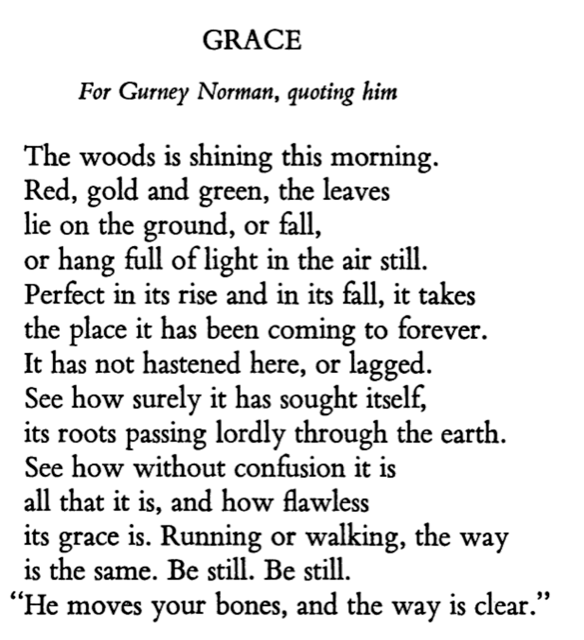
Poem: Grace by Wendell Berry

Music: Arioso, Cantata 156 – Johann Sebastian Bach played by Susanne Beer