Don’t Sleepwalk Your Life!

Monday of the Thirty-fourth Week in Ordinary Time

November 25, 2019

Click here for readings

Today, in Mercy, we begin a series of readings from the Book of Daniel. It is the only time throughout the Liturgical Year that we get a good dose of Daniel. And it is well placed, coming in this final week before Advent.

Daniel is apocalyptic literature, a genre which conveys the author’s perception of the end times through dreams, visions and prophecies. Like many of our readings of the past weeks, Daniel focuses us on God’s Final Coming into time by interpreting current circumstances in a spiritual light.

Today’s Gospel does the same thing, but in a little different way. 

Jesus tells the story of the poor widow who gave everything she had for the sake of the poor. This widow, in a sense, already lives in the “end times”, a time when our only “possessions” will be the good we have done in our lives.

Both these readings set us up to reflect on our lives and times as we approach Advent. This sacred season is the annual reenactment of Christ’s First Coming in order to prepare us for:

  • Christ’s daily revelation in our lives
  • Christ’s Final Coming at the end of time

Mt24_awake

All of Daniel’s complex visions and prophecies can feel a little confusing, but we can focus on this:

  • God is continually revealing Godself in the ordinary circumstances of time.
  • We can open ourselves to this revelation by our humble prayer and good works.
  • Staying awake like this in our hearts and souls will allow us to pass seamlessly into God’s Presence when the end times come.

Music: Be Thou My Vision

Marking the Hours

Friday of the Seventeenth Week in Ordinary Time

August 2, 2019

Click here for readings

Today, in Mercy, we begin a few days of reading Leviticus. The reading today provides a long list of when and how the community should gather to worship. It is a lexicon on how to honor the sacred presence in their lives. Such honoring includes aspects of celebration, decoration, sharing, remembering and hoping together.

Lv23_37 hoursJPG

While the particular enjoinments detailed in Leviticus might not pertain to us, their spirit does. It is a spirit that encourages us to cherish the gift of time – moments, days, years – as precious opportunities to encounter God.

Down through the ages, people seeking holiness have used various, ritualized practices to remember and honor God’s omnipresence in their lives. They include morning and nighttime prayers, Grace before Meals, the Blessing of the Hour, the Angelus at noontime, the great liturgical practices of Advent and Lent, and the Divine Office. Each of these spiritual practices helps us to be more intentional about the true meaning and purpose of our daily life. 

Macrina Wiederkehr, a Benedictan monastic, has published a beautiful book to help people mark the hours of their day. She says this in Seven Sacred Pauses:


When I speak of “the hours” I am referring to those times of the day that the earth’s turning offers us: midnight, dawn, midmorning, noon, midafternoon, evening, and night. Although every hour is sacred, these special times have been hallowed by centuries of devotion and prayer…..

The daily and nightly dance of the hours is a universal way of honoring the earth’s turning as well as the sacred mysteries that flow out of our Christian heritage.


I think this is exactly what our Leviticus passage is doing as well. Our time is so precious and it flows so quickly! What a tragedy if we fail to stop and realize that it is the holy river on which we are meant to float to God!

robson-hatsukami-morgan-454S_xB0ReA-unsplash
Photo by Robson Hatsukami Morgan on Unsplash

Music: Teach Us to Number Our Days – Marty Goetz

Hmmm. The Other Cheek?

Monday of the Eleventh Week in Ordinary Time

June 17, 2019

Click here for readings

Today, in Mercy, our reading from Matthew again shows us how revolutionary Jesus really was!

Yield

For the Jews who listened to Jesus, and for us still listening, today’s instructions might be some of the hardest to swallow! These readings encompass a phrase classically known as the lex talionis or the law of talion.

We may not be familiar with the phrase but we probably are quite familiar with the practice. Most of us begin it very early in life, at least in my young neighborhood we did. It went like this: Harry bites you, you bite him back. Janey pushes you, you push her harder. Margie takes your pickle, you take her peach. Right? Isn’t that the way it should be?

Well, Jesus says not, although his listeners had lived by variations of this law from the time of:

Exodus 21:23-25
But if there is harm, then you shall pay life for life, eye for eye, tooth for tooth, hand for hand, foot for foot, burn for burn, wound for wound, stripe for stripe.

and Leviticus 24:19-21
Anyone who injures their neighbor is to be injured in the same manner: fracture for fracture, eye for eye, tooth for tooth. The one who has inflicted the injury must suffer the same injury.

Believe it or not, these harsh injunctions were actually intended to placate situations by preventing a backlash disproportionate to the original crime.

But Jesus says that is not enough. He says not to resist the evildoer. Scholars have considered for centuries exactly what this means. 

Does it mean to ignore evil, not calling it out for what it is? Obviously not, because Jesus Himself was quick to name the evils of his times.

Does it mean to be a doormat for evil-hearted people to walk all over? Definitely not. Jesus stood up to his persecutors and clearly named their wrong-doing.

What it means is not to return evil for evil, not to respond in-kind, as Paul writes in 1 Thessalonians 5:15

See that no one repays another with evil for evil,
but always seek after that which is good
for one another and for all people.

One of the key Critical Concerns of the Sisters of Mercy is non-violence. I find it one of the most challenging.

Mercy

This article, written by Rosemarie Tresp, RSM proved very helpful to me. You might find it so as well.

Click here for article

Music: Make Me a Channel of Your Peace – written by Sebastian Temple, sung by Susan Boyle

We Are A New Creation

Saturday of the Tenth Week in Ordinary Time

June 15, 2019

Click here for readings

Today, in Mercy,  we are reminded of two fundamentals of our spiritual life.

  1. In Christ, we are a New Creation. (2 Cor.5:17)
  2. We are called to live in the fullness of that Truth  (Mt.5:37)

If we could only believe and act from that power how our lives might be transformed!

2Cor5_7 new

Often, we let the relentless passing of time convince us each day that, rather than “new”, we are an older creation. Some of us tend to meet the cycles of life as challenges rather than opportunities. We use old, comfortable solutions that don’t quite meet the test. We get stuck, because life can be hard work!

But what if we realized that, every morning, God is imagining us into new possibility? That together with God, we have another day to become a sign of the Spirit in the world?

What if we consciously chose to meet any dispiriting situation with the attitude Jesus might take toward it? What if we lived life as an unfolding, glorious mystery rather than a problem?

What if we lived fully in the Truth that we are God’s beloved and, with God, capable of eternal life?

Today’s scriptures invite us to consider these questions with openness and faith.

Music: I Am a New Creation- The Worship Collection

Glory following Glory

Memorial of Saint Anthony of Padua, Priest and Doctor of the Church

June 13, 2019

Click here for readings

Today, in Mercy, we celebrate the feast of St. Anthony. Many of us are close friends with him, as we mislay our keys, glasses, phones and wallets on a regular basis. But we might want to consider St. Anthony’s more universal contribution to the Church. A Franciscan friar, Anthony was noted by his contemporaries for his powerful preaching, expert knowledge of scripture, and undying love and devotion to the poor and the sick – virtues we are called to imitate by his canonization.

On another note, today’s readings for Ordinary Time focus on seeing past the letter of the Law to its Spirit.


In today’s Gospel, Jesus, preaching charity over ritual, says:

Therefore, if you bring your gift to the altar,
and there recall that your brother
has anything against you,
leave your gift there at the altar,
go first and be reconciled with your brother,
and then come and offer your gift.

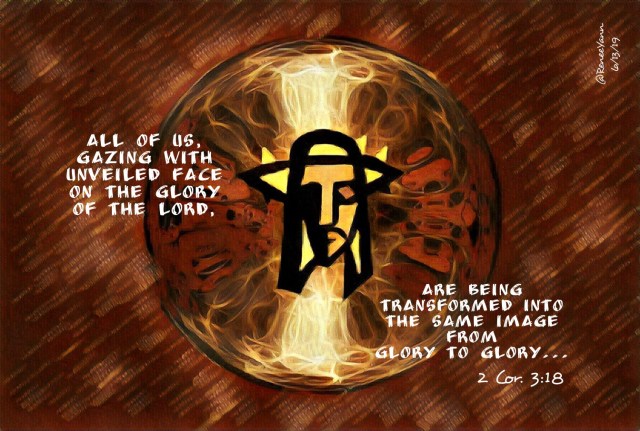
In the magnificent passage from 2 Corinthians, Paul, describing the Old Law of requirements as a veil over our eyes, writes:

2Cor3_18

Now the Lord is the Spirit and where the Spirit of the Lord is,
there is freedom.

All of us, gazing with unveiled face on the glory of the Lord,
are being transformed into the same image from glory to glory,
as from the Lord who is the Spirit.

glory

May our lives, blessed by the freedom of the Holy Spirit, move gratefully, humbly, and joyously “from glory to glory” – growing ever more deeply into the merciful Heart of God.

Music:  Dwelling Place – John Foley, SJ

No Ordinary Time

Wednesday of the Tenth Week in Ordinary Time

June 12, 2019

Click here for readings

2Cor3_7JPG

Today, in Mercy, ah — here we are, back in Ordinary Time. Our journey through Lent and Eastertide has been completed and we now return to the “dailyness” of our spiritual lives and Liturgical Year. Really?

For the next two weeks, we will learn from 2 Corinthians. And from now, throughout the summer (or winter, depending on your hemisphere), we will listen to Matthew’s account of the life Christ. ( Some of you may want to pick up a good commentary on Matthew’s Gospel. My longtime favorite was The Gospel of Matthew by Daniel J. Harrington, SJ. It is out of print now but some good passages are available for free from Google books by clicking here.)

What we find in 2 Corinthians is Paul – when the rubber meets the road. Some of the first enthusiasm after the Resurrection has worn thin. The hard work of preaching the Gospel has spun strains of exhaustion in Paul. The very important Corinthian community proves difficult and resistant. Paul has already tried to deal with this dissonance in 1 Corinthians. But now, he has to raise some issues again.

In 2 Corinthians, we see a community hanging on to old definitions of godliness. Paul does not condemn the old, rather he challenges his people to fully put on the New Christ – the Christ of Mercy, Forgiveness, Calvary and Resurrected Hope. It’s a lofty challenge, particularly when one’s feet are stuck in the mud of “ordinary time” and old comforts.

In our Gospel, Jesus preaches the same message. He tells his followers that he has not come to abolish the Law, but to perfect it in the Spirit.

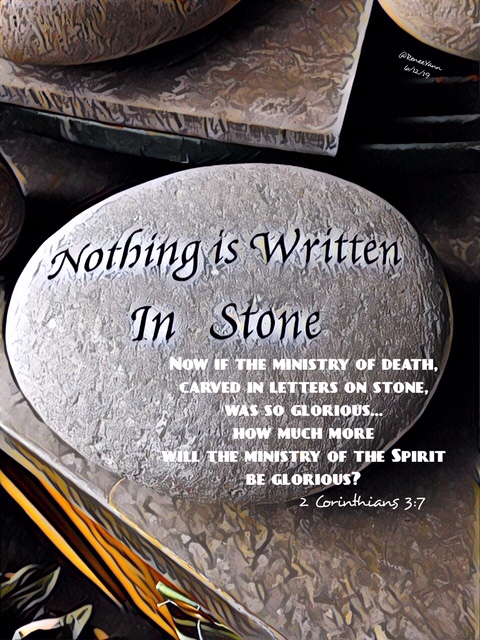
For some of us, it is a lot more comforting to hang on to the tried and the true, the words “written in stone”. But the Spirit of God will never be confined to stone.

The Spirit is always free, astonishing and alive. In the inspiration of these passages, let us ask God what new Pentecostal courage and hope God asks of us. It may be as small as a personal act of forgiveness, or as large as a Church welcoming previously alienated individuals and communities.

How can we announce God’s merciful heart for all people by the gracious exercise of our “ordinary” time?

Music: perhaps, if Paul were preaching today, this is the way he would speak to the Corinthians (Apologies to English teachers🧐)

Kelontae Gavin: No Ordinary Worship