Today, in God’s Lavish Mercy Mercy, vigorous, grace-filled David dances with abandon before the Lord. It is a beautiful moment to imagine!
David went to bring up the ark of God from the house of Obed-edom into the City of David amid festivities. As soon as the bearers of the ark of the LORD had advanced six steps, he sacrificed an ox and a fatling. Then David, girt with a linen apron, came dancing before the LORD with abandon, as he and all the house of Israel were bringing up the ark of the LORD with shouts of joy and to the sound of the horn.
2 Samuel 6: 12-15
David dances with unselfconscious joy because he has brought the Presence of God home to the heart of the community. The joy comes from recognizing that God wants to be with the People. This joy, inexpressible in words, takes the form of a dance with the Spirit of God.
Let’s pause today with that dancing image, to consider all the ways God longs to dance with us throughout our lives, and we with God — dances of both:
joy and sorrow, faith and questioning, hope and shadow
… dances in which we must abandon ourselves to the moment’s sacred music and respond to God’s mysterious, leading step.
Whatever the emotion we bring to prayer, what matters is only that we carry it close to God’s heart, listening to our circumstances for the Divine Heartbeat. We may not be the “Fred Astaire” or “Ginger Rodgers” of prayer, but each one of us has a holy dance somewhere in their heart.
I think our children can teach us something about this kind of uninhibited prayer – one filled with trust, hope, joy, and innocence.
Poetry: T. S. Eliot
At the still point of the turning world. Neither flesh nor fleshless; Neither from nor towards; at the still point, there the dance is, But neither arrest nor movement. And do not call it fixity, Where past and future are gathered. Neither movement from nor towards, Neither ascent nor decline. Except for the point, the still point, There would be no dance, ~ T.S. Eliot
A second lovely poem, even though it is not Easter 🙂
Easter Exultet
Shake out your qualms. Shake up your dreams. Deepen your roots. Extend your branches.
Trust deep water and head for the open, even if your vision shipwrecks you.
Quit your addiction to sneer and complain. Open a lookout. Dance on a brink.
Run with your wildfire. You are closer to glory leaping an abyss than upholstering a rut.
Not dawdling. Not doubting. Intrepid all the way Walk toward clarity.
At every crossroad Be prepared to bump into wonder. Only love prevails.
Enroute to disaster insist on canticles. Lift your ineffable out of the mundane.
Nothing perishes; nothing survives; everything transforms! Honeymoon with Big Joy! ~ James Broughton
December greetings to all of you, dear readers. May you be blessed by this beautiful month that, depending on our latitude, brings us the golden or white glory of summer or winter. I hope you enjoy this short poem by Longfellow.
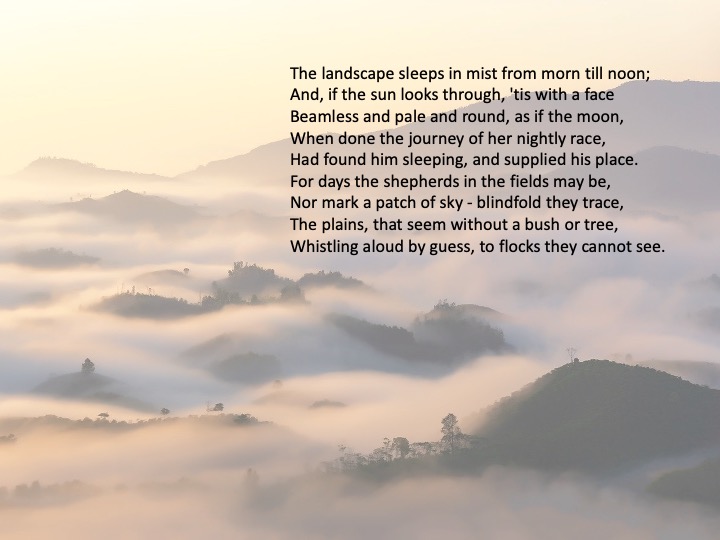
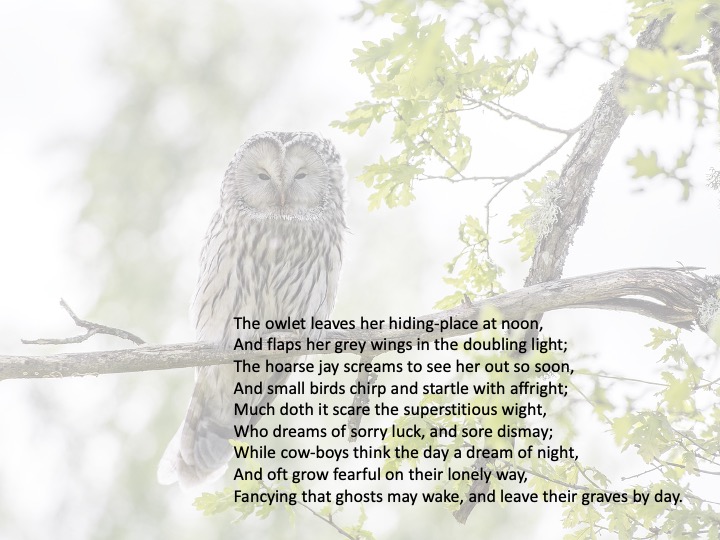
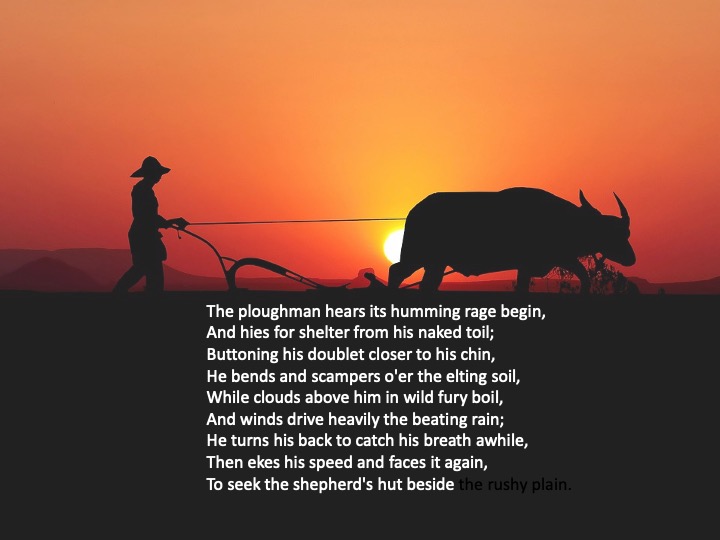
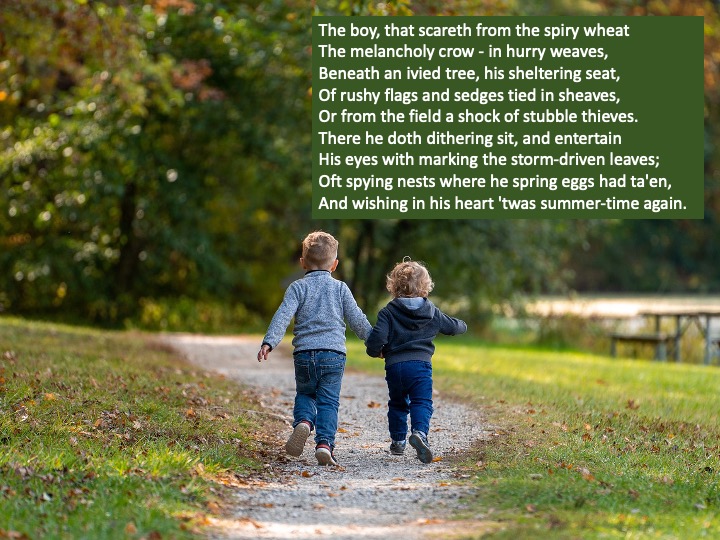
I love this beautiful poem, The Shepherd’s Calendar by John Clare. Placing myself in its lovely artistic images, I have a grateful and deep appreciation of Earth and of her changing seasons. I like to pray with the poem in the spirit of Laudato Si, praising God for the beauty of Creation.
It’s a bit long, so you might just want to come back to it several times throughout the month, taking just one small stanza that seems to fit you day or mood.
Click the little white arrow in the bar below for accompanying music as you pray. You can re-click any number of times you wish. To see each of the ten slides at your own pace, click the very small arrowhead > to the right of the slide.
Today, in God’s Lavish Mercy, we have a Gospel passage which is both scary and beautiful!
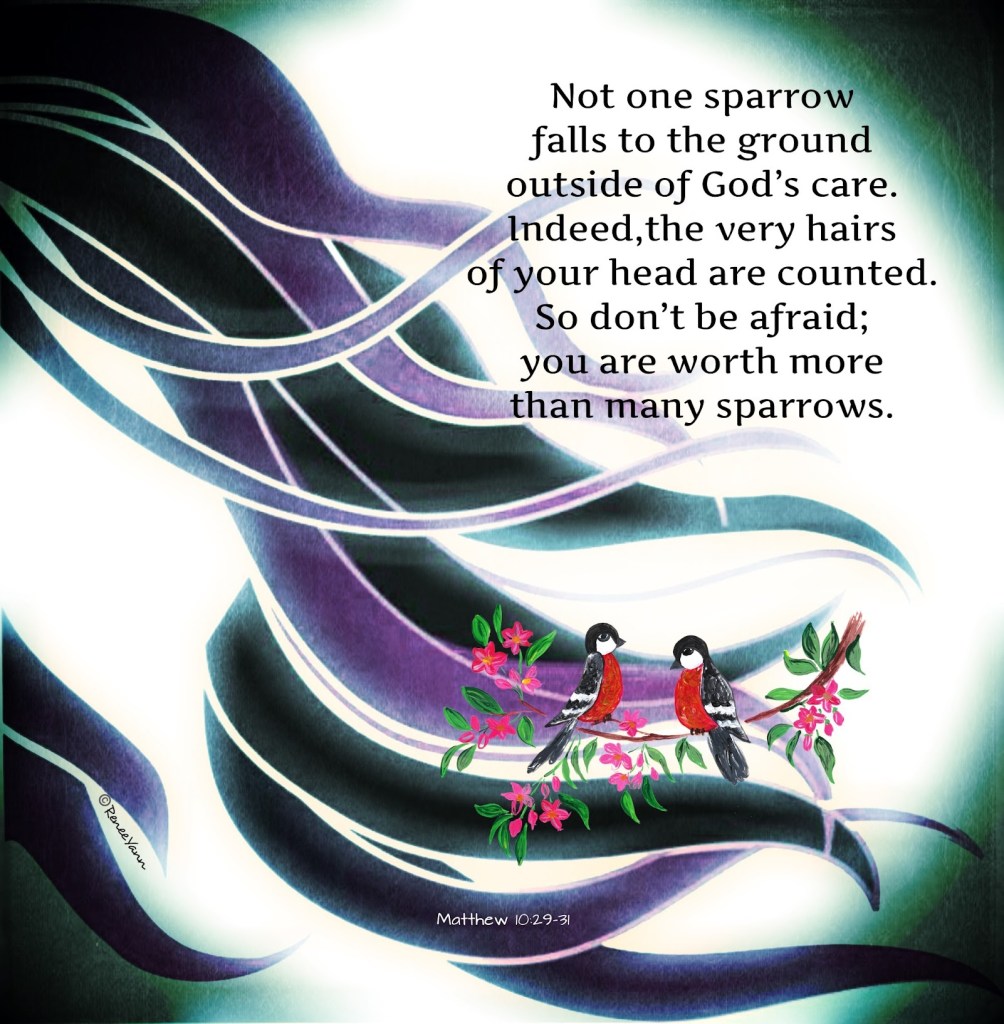
I tell you, my friends, do not be afraid of those who kill the body but after that can do no more. I shall show you whom to fear. Be afraid of the one who after killing has the power to cast into Gehenna; yes, I tell you, be afraid of that one. Are not five sparrows sold for two small coins? Yet not one of them has escaped the notice of God. Even the hairs of your head have all been counted. Do not be afraid. You are worth more than many sparrows.
Luke 12:4-7
Jesus, with radical clarity, tells us that God is both a relentless judge and a tender parent. Who God is toward us depends on our choices in life, because our choices either open or close us to know God.
Jesus says that we will be condemned if we choose to live a hypocritical life like the Pharisees.
There are many images of “Gehenna”, both within and outside of the Gospel. For some of us, that condemnation is represented in hellfire, brimstone, devils, and pitchforks.
But today’s Gospel might incline us to consider that the condemnation is more a personal choice for spiritual alienation from God – in other words, sin. By that choice, we isolate ourselves from God’s tenderness choosing instead selfishness, prevarication, and hard-heartedness. We become less than we were created to be, and that in itself is a tragic self-condemnation.
Jesus says that when that kind of choosing becomes a habitual part of our lives, it is like leaven that permeates our very personhood. It changes us from God’s child to our own biggest fan. Like the Pharisees, we live a lie of who we pretend to be. And, especially from a position of power, we can infect others with our deception. They become “leavenized”: they “drink the kool-aid”.
Ironically, at the end of this tirade, Jesus gives us two of the tenderest images of God: God the Hairdresser and God the Bird Lover. Praying with these images, I remember my mother tenderly fingering my hair as I sat beside her in the evening. I picture my father spreading birdseed on the frozen patio when the winter juncos struggled to find food.
In our prayer today, Jesus invites us to encounter God with this kind of tender familiarity.
Poetry: The Creation of the Birds – Renee Yann, RSM
O, the wonderful mood that seized You
God, as you created birds;
you dancing there, twirling in light,
flinging your crystal arms to infinite music,
flicking your hands like magic fountains,
feathers and colors splashing out from your fingertips,
chattering, rainbowed profusions
of your Boundless Life.
Your depthless, joy-filled soul laughing out
the soaring beings into the still universe,
peals of you infusing them each
to their measure with notes of your inner song.
O, I see your Holy Eyes flash color to them
as they fly, strobing their feathers
with shards of your prismed white light.
This morning, seeing only one,
free and jubilant in a thin sycamore,
I consume it as
part of your Delightful Essence,
this day’s communion with you, grey
and orange wafer filling me with mysteries
of the primal dance from which
we both began.
Today, in God’s Lavish Mercy, our readings suggest a slight tone of “the after-Ascension” blues.
It’s a bit like how we might feel on the day after Christmas. The big celebration has come and gone. The company has all gone home. Maybe we’re exhausted from the preparations and clean-ups. Maybe we had been so busy that we didn’t take enough time to think about the meaning of the Feast. Maybe we feel like we’ve been spun around in time’s tumbler and can’t believe it’s now the end of the year. It’s a “what do we do next?” time when we come out of a flurry and need to get our bearings.
Click the arrow to get the spun-around feeling!
And for the disciples, it’s a morning they wake up and realize that Jesus has really gone home. In an otherwise chilly room, they might linger in their cozy cots reflecting on his parting words:
Amen, amen, I say to you, you will weep and mourn, while the world rejoices; you will grieve, but your grief will become joy. When a woman is in labor, she is in anguish because her hour has arrived; but when she has given birth to a child, she no longer remembers the pain because of her joy that a child has been born into the world. So you also are now in anguish. But I will see you again, and your hearts will rejoice, and no one will take your joy away from you.
These very special days between the Ascension and Pentecost offer the perfect time to quiet our spirits and get our spiritual bearings. Unlike the video of the deer above, it is a time to stop the spin, to clear the inner space, to ready ourselves for the promised and longed-for Spirit.
It’s a time not to be afraid of the silence or the echoing space deep in our hearts which longs for the presence of God.
Even if we are still in the midst of our busy lives, we can make a choice to be on “inner retreat” – to limit useless noise, directionless activity, and mumifying distractions.
If we have forgotten how to sit quietly enough to hear the wind and the distant meadowlark, let’s try to remember. Let’s try to make an inner chamber for the whisper of God Who hums through these ten days until bursting forth in Pentecost.
This decade of hours is a very special time to pray.
Poetry: excerpt from Sara Teasdale’s poem “Silence” (I love her archaic British term “anhungered“)
We are anhungered after solitude,
Deep stillness pure of any speech or sound,
Soft quiet hovering over pools profound,
The silences that on the desert brood,
Above a windless hush of empty seas,
The broad unfurling banners of the dawn,
A faery forest where there sleeps a Faun;
Our souls are fain of solitudes like these.
and a second brief but powerful verse from Emily Dickinson:
Silence is all we dread.
There’s Ransom in a Voice –
But Silence is Infinity.
Himself have not a face.
Music: Achtsamkeit (German for “Mindfulness”) this is an hour’s worth of beautiful music. You can tap into various parts of the video to hear different pieces.
Today, in God’s Lavish Mercy, we celebrate the feast of St. Athanasius, and since our readings repeat themes we have prayed with for a few days, I thought we might focus our prayer today on Athanasius.
During his lifetime, the Church struggled with the heresy of Arianism which questioned whether Jesus was really God. Athanasius was named a Doctor of the Church for his steadfast defense of the doctrine of the divinity of Christ. Some of Athanasius’s writings are suggestive of the theology of our great modern theologians, and so necessary for our spirituality today.
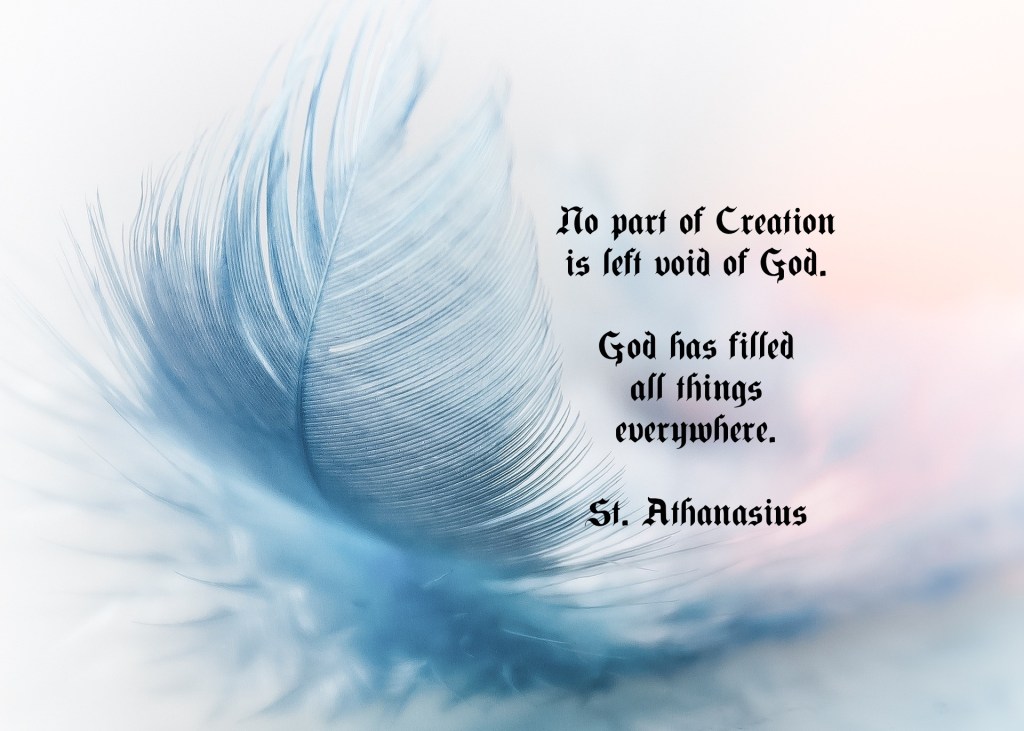
The Self-revealing of the Word is in every dimension – above, in creation; below, in the Incarnation; in the depth, in Hades; in the breadth, throughout the world. All things have been filled with the knowledge of God.
St. Athanasius
Pierre Teilhard de Chardin, the revered Jesuit theologian of the early 20th century, writes in a tone suggestive of Athanasius:
If we live at a distance from God, the universe remains neutral or hostile to us. But if believe in God, immediately all around us the elements, even the irksome, organize themselves into a friendly whole, ordered to the ultimate success of life.
Pierre de Chardin, SJ in Christianity and Evolution
More recently, beloved Pope Francis teaches with the same sacred appreciation of the “mystical” depths of Creation:
The universe unfolds in God, who fills it completely. Hence, there is a mystical meaning to be found in a leaf, in a mountain trail, in a dewdrop, in a poor person’s face. The ideal is not only to pass from the exterior to the interior to discover the action of God in the soul, but also to discover God in all things.
Pope Francis in Laudato Sí, 84)
As we pray in these early days of May, still drenched in the glory of Easter, may we hear God speaking to us in the infinitely new and ever-evolving power and beauty of all Creation.
The occurrence of chance in the world in its own finite way reflects the infinite creativity of the living God, endless source of fresh possibilities. The indwelling Creator Spirit grounds not only life’s regularities but also the novel occurrences that open up the status quo, igniting what is unexpected, interruptive, genuinely uncontrolled, and unimaginably possible. As boundless love at work in the universe, the Spirit embraces the chanciness of random mutations, being the source not only of order but also of the unexpected breaks in order that ensure freshness. Divine creativity is much more closely allied to the outbreak of novelty than our older order-oriented theology ever imagined
Elizabeth Johnson, CSJ – Distinguished Professor of Theology at Fordham University in her book, Ask the Beasts: Darwin and the God of Love
Poetry: Spring – Mary Oliver
Somewhere
a black bear
has just risen from sleep
and is staring
down the mountain.
All night
in the brisk and shallow restlessness
of early spring
I think of her,
her four black fists
flicking the gravel,
her tongue
like a red fire
touching the grass,
the cold water.
There is only one question:
how to love this world.
I think of her
rising
like a black and leafy ledge
to sharpen her claws against
the silence
of the trees.
Whatever else
my life is
with its poems
and its music
and its glass cities,
it is also this dazzling darkness
coming
down the mountain,
breathing and tasting;
all day I think of her -—
her white teeth,
her wordlessness,
her perfect love.
Music: Spring from The Four Seasons – Antonio Vivaldi
Today, in God’s Lavish Mercy, Mark’s Gospel allows us to spend a day with Jesus during his early ministry.
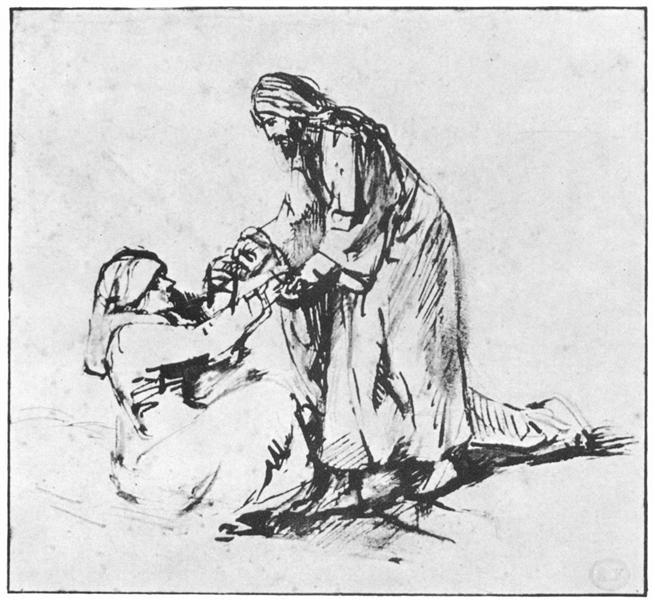
After “church”, so to speak, Jesus and his buddies go to Simon’s house for a meal. Where Simon’s wife was we’re not told, but his mother-in-law seems to have been chief cook and bottle washer. Unfortunately, on that day, she’s not feeling well. However, with but a touch from Jesus, she’s restored and begins waiting on the guys.
The Healing of Peter’s Mother-in-Law by Rembrandt
On leaving the synagogue Jesus entered the house of Simon and Andrew with James and John. Simon’s mother-in-law lay sick with a fever. They immediately told him about her. He approached, grasped her hand, and helped her up. Then the fever left her and she waited on them.
Mark 1:29-31
It seems like Jesus and his friends hung out through the heat of the day. As evening cool descends, neighbors begin arriving with their sicknesses and troubled spirits. Jesus cures many of those gathered. Can you just imagine the scene!
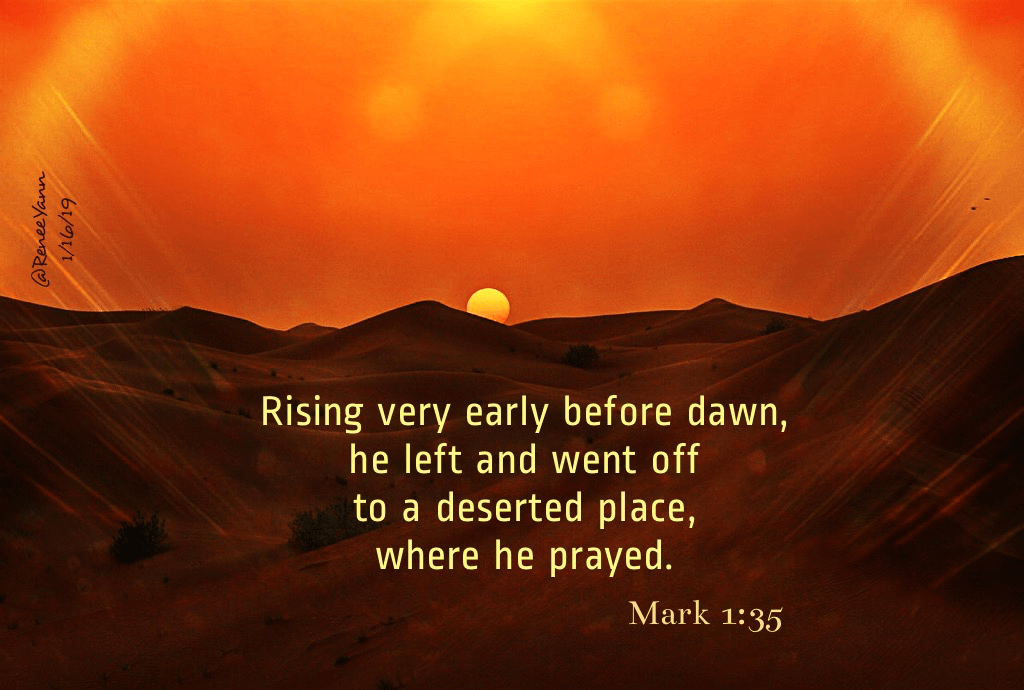
The next morning, even before dawn, Jesus goes off to a quiet place to pray. No doubt he wants to discern, with his Father and the Holy Spirit, the things that are happening in his life. Again can you imagine that conversation!
We know that, when asked, Jesus gave us the human words of the “Our Father” to teach us to pray. But how did Jesus himself pray in the solitude of his heart?
Three Persons of the Blessed Trinity focused in relationship to one another and yielding a Love too immense for description!
In our own humble prayer today, may we lean against the heart of Jesus as he immersed himself in the Presence of the Creator and Spirit. May we pray in Christ’s pregnant silence.
Poetry: Solitude – Thomas Merton
When no one listens
To the quiet trees
When no one notices
The sun in the pool.

Where no one feels
The first drop of rain
Or sees the last star

Or hails the first morning
Of a giant world
Where peace begins
And rages end:

One bird sits still
Watching the work of God:
One turning leaf,
Two falling blossoms,
Ten circles upon the pond.

One cloud upon the hillside,
Two shadows in the valley
And the light strikes home.
Now dawn commands the capture
Of the tallest fortune,
The surrender
Of no less marvelous prize!

Closer and clearer
Than any wordy master,
Thou inward Stranger
Whom I have never seen,

Deeper and cleaner
Than the clamorous ocean,
Seize up my silence
Hold me in Thy Hand!

Now act is waste
And suffering undone
Laws become prodigals
Limits are torn down
For envy has no property
And passion is none.

Look, the vast Light stands still
Our cleanest Light is One!
Music: Intermezzo in B minor – Maureen McCarthy Draper
Today, in God’s Lavish Mercy, we have the belovedly familiar story of the Miracle at Cana.
There was a wedding at Cana in Galilee, and the mother of Jesus was there. Jesus and his disciples were also invited to the wedding. When the wine ran short, the mother of Jesus said to him, “They have no wine.”
John 2: 1-3
Like all good stories, this one is engaging on so many levels:
We see Mary and Jesus enjoying a social event in the same way we would.
We see Mary extending her solicitude and influence for the sake of the hosting family.
We see Jesus needing a swift nudge from his mother to do the right thing!
We see the Apostolic tipsters slowly waking up to the fact that Jesus is not just the guy next door!
We can pray with this Gospel passage by entering it from any one of these, or other, perspectives. We can easily sit right down at one of the wedding tables and watch the slow, human revelation of God in the world. But I think our first reading makes a strong case for us to pray the Cana story as a perfect example of how we should make our prayers of petition.
If you’re like me, you ask God for a lot of things every single day. Some of them are big deal things like “Please move hearts to stop the war on Ukraine.” And some of them are little deals like, “Please don’t let it rain on my picnic!”
In our first reading, John tells us how to pray our needs to God – with the utter confidence that, within God’s Will, we are heard.
Beloved: We have this confidence in God, that if we ask anything according to God’s will, we are heard. And if we know that God hears us in regard to whatever we ask, we know that what we have asked for is ours.
1 John 5: 14-15
This is the way Mary offers her petition in our Gospel story. She knows that Jesus will hear her and do the right thing. She doesn’t niggle him to death to get it done. She knows that by her “prayer”, she is now present to God’s infinite awareness of our needs.
His mother said to the servers, “Do whatever he tells you.”
John 2:5
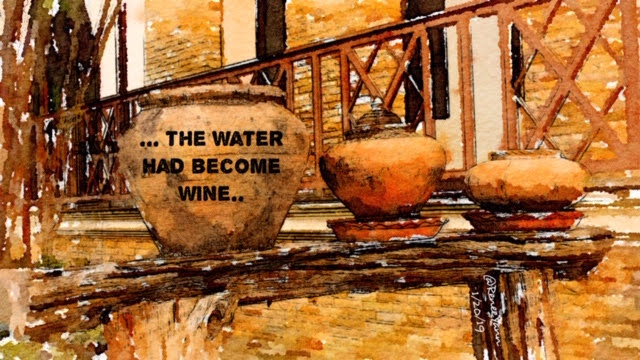
In this case, that “right thing” was to turn huge vats of water into delicious wine. A very satisfying outcome! But what about when our prayer doesn’t result in a deluge of wine? What about when it seems like God paid no attention to our request? Can we still have the unyielding confidence which John encourages and Mary exemplifies?
Our faith calls us to believe that God is present with us in all things. Our prayer opens us to seek that Presence and to respond in faith to our circumstances knowing that even when the vessels seem empty, God abides. Ours is a life in God not limited to one petition, or one prayer. It is an incremental immersion into an Eternal Truth which transcends any particular circumstance. God is always with us and that alone is the source of our confident prayer.
We also know that the Son of God has come and has given us discernment to know the one who is true. And we are in the one who is true, in God’s Son Jesus Christ. He is the true God and eternal life.
1 John 5:20
Poetry: Cana Wine – Irene Zimmerman, OSF
“The weather’s so hot
and no more wine’s to be bought
in all of Cana!
It’s just what I feared—
just why I begged my husband
to keep the wedding small.”

“Does he know?” Mary asked.

“Not yet. Oh, the shame!
Look at my son and his beautiful bride!
They’ll never be able
to raise their heads again,
not in this small town.”
“Then don’t tell him yet.”
Mary greeted the guests
as she made her way
through crowded reception rooms.
“I must talk to you, Son,”
she said unobtrusively.

Moments later he moved
toward the back serving rooms.
They hadn’t seen each other
since the morning he’d left her—
before the baptism
and the desert time.

There was so much to tell her,
so much to ask.
But this was not the time!
They could talk tomorrow
on the way to Capernaum.
She spoke urgently, her words
both request and command to him:
“They have no wine.”
But he hadn’t been called yet!
He hadn’t felt it yet.
Would she send him so soon
to the hounds and jackals?
For wine?

Was wine so important then?

“Woman, what concern is that
to you and me?
My hour has not yet come.”

Her unflinching eyes reflected to him
his twelve-year-old self
telling her with no contrition:
“Why were you searching for me?
Did you not know I must be
in my Father’s house?”

She left him standing there—
vine from her stock,
ready for fruit bearing—
and went to the servants.
“Do whatever he tells you,” she said.

From across the room
she watched them fill water jars,
watched the chief steward
drink from the dripping cup,
saw his eyes open in wide surprise.

She watched her grown son
toast the young couple,
watched the groom’s parents
and the guests raise their cups.

She saw it all clearly:
saw the Best Wine
pouring out for them all.
Today, in God’s Lavish Mercy, as I begin to create today’s reflection, Pope Francis has asked the world to pray for Pope Emeritus Benedict XVI who is mortally ill. Perhaps by the time you red this, God will already have taken Benedict home. If so, may he rest in peace.
Today’s readings fit so well for this moment for Benedict and for the Church. Our first reading offers us John’s perfect honesty and simplicity:
Whoever says, “I know him,” but does not keep his commandments is a liar, and the truth is not in him. But whoever keeps his word, the love of God is truly perfected in him. This is the way we may know that we are in union with him: whoever claims to abide in him ought to walk just as he walked.
1 John 2:5-6
Yes, it’s that simple and that hard!
It is so fitting that as we pray Pope Benedict home to heaven, we meet Simeon in our Gospel. He speaks with the holy confidence of a long and well-lived life. His lifelong dream was that he might not die before seeing the Messiah. That dream now fulfilled, Simeon intones one of the most beautiful prayers in Scripture:
Lord, now let your servant go in peace; your word has been fulfilled: my own eyes have seen the salvation which you prepared in the sight of every people, a light to reveal you to the nations and the glory of your people Israel.
Luke 2: 29-32
If we live by the Light, we too will see the Messiah within our own life’s experiences. We too will come to our final days confident and blessed by that enduring recognition.
For as John also assures us:
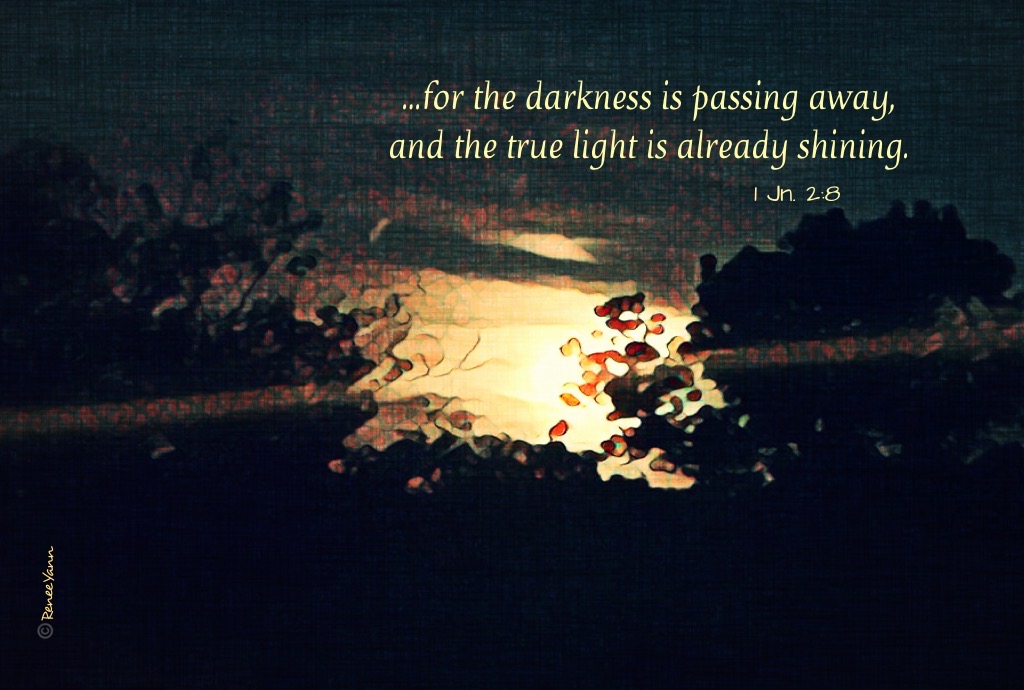
Whoever says they are in the light, yet hates their brother or sister is still in the darkness. But whoever loves their brother and sister remains in the light …
1 John 2:9-10
Let’s pray today for those all who are dying, that they may know this kind of peace, especially for Pope Emeritus Benedict XVI.
Let us pray for ourselves, that when our time comes, we too may experience this confidence.
Poetry: Nunc Dimittis – Joseph Brodsky (from Joseph Brodsky, A Part of Speech by George L. Kline (NY: Noonday, 1996) The poem is long but exceptionally beautiful. I hope you can take the time to enjoy it.
‘Nunc Dimittis’
When Mary first came to present the Christ Childto God in His temple, she found—of those fewwho fasted and prayed there, departing not from it—devout Simeon and the prophetess Anna.The holy man took the Babe up in his arms.The three of them, lost in the grayness of dawn,now stood like a small shifting frame that surroundedthe Child in the palpable dark of the temple.The temple enclosed them in forests of stone.Its lofty vaults stooped as though trying to cloakthe prophetess Anna, and Simeon, and Mary—to hide them from men and to hide them from Heaven.And only a chance ray of light struck the hairof that sleeping Infant, who stirred but as yetwas conscious of nothing and blew drowsy bubbles;old Simeon's arms held him like a stout cradle.It had been revealed to this upright old manthat he would not die until his eyes had seenthe Son of the Lord. And it thus came to pass. Andhe said: ‘Now, O Lord, lettest thou thy poor servant,according to thy holy word, leave in peace,for mine eyes have witnessed thine offspring: he isthy continuation and also the source ofthy Light for idolatrous tribes, and the gloryof Israel as well.' The old Simeon paused.The silence, regaining the temple's clear spaceoozed from all its corners and almost engulfed them,and only his echoing words grazed the rafters,to spin for a moment, with faint rustling sounds,high over their heads in the tall temple's vaults,akin to a bird that can soar, yet that cannotreturn to the earth, even if it should want to.A strangeness engulfed them. The silence now seemedas strange as the words of old Simeon's speech.And Mary, confused and bewildered, said nothing—so strange had his words been. He added, while turningdirectly to Mary: ‘Behold, in this Child,now close to thy breast, is concealed the great fallof many, the great elevation of others,a subject of strife and a source of dissension,and that very steel which will torture his fleshshall pierce through thine own soul as well. And that woundwill show to thee, Mary, as in a new visionwhat lies hidden, deep in the hearts of all people.’He ended and moved toward the temple's great door.Old Anna, bent down with the weight of her years,and Mary, now stooping gazed after him, silent.He moved and grew smaller, in size and in meaning,to these two frail women who stood in the gloom.As though driven on by the force of their looks,he strode through the cold empty space of the templeand moved toward the whitening blur of the doorway.The stride of his old legs was steady and firm.When Anna's voice sounded behind him, he slowedhis step for a moment. But she was not callingto him; she had started to bless God and praise Him.The door came still closer. The wind stirred his robeand fanned at his forehead; the roar of the street,exploding in life by the door of the temple,beat stubbornly into old Simeon's hearing.He went forth to die. It was not the loud dinof streets that he faced when he flung the door wide,but rather the deaf-and-dumb fields of death's kingdom.He strode through a space that was no longer solid.The rustle of time ebbed away in his ears.And Simeon's soul held the form of the Child—its feathery crown now enveloped in glory—aloft, like a torch, pressing back the black shadows,to light up the path that leads into death's realm,where never before until this present hourhad any man managed to lighten his pathway.The old man's torch glowed and the pathway grew wider.
Music: Nyne Otpushchayeshi ~Sergei Rachmaninoff (translated Nunc Dimittis, Now Let Your Servant Go). This was sung at Rachmaninoff’s funeral, at his prior request.










 Lavish Mercy