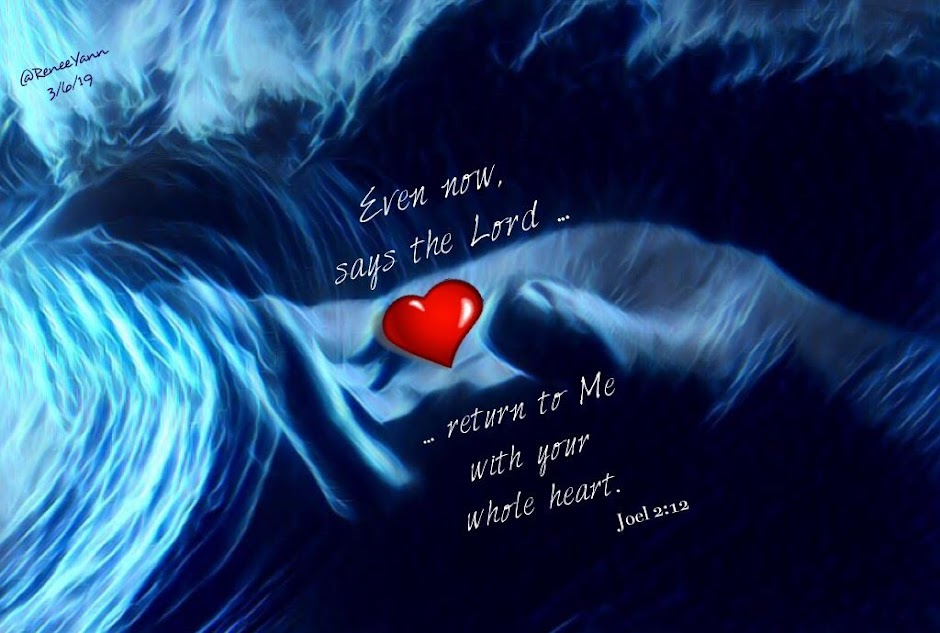
Today in God’s Lavish Mercy, Jeremiah begins our readings by describing the evil heart:
… they obeyed not, nor did they pay heed. They walked in the hardness of their evil hearts and turned their backs, not their faces, to Me.
Jeremiah :24
It is a terrible thing to encounter a truly evil-hearted person – someone who exudes a twisted energy which is the polar opposite of God’s Love.
I believe we are seeing such a individual now in the person of Vladimir Putin. His actions leave us astounded at their arrogance and cruelty. How can such a person face himself, and certainly, how can he face God?
But our Psalm and Gospel Verse, lead me to ask myself the question:
What if we prayed FOR Vladimir Putin?
Come, let us bow down in worship; let us kneel before the LORD who made us. For he is our God, and we are the people he shepherds, the flock he guides. R. If today you hear his voice, harden not your hearts.
What if we took pity on the wretched soul he has become and asked God to heal his mind and give him a new heart? He has become sick with evil, and that is a tragic thing to see in a leader responsible for millions of lives!
All of us feel tremendous sorrow and compassion toward the Ukrainian people. But in the end, no matter what, they will triumph through their sincerity, courage and faithfulness.
Putin, on the other hand, is otherwise lost for all eternity.
Will you consider praying today for Putin and those who share his evil culpabilities that they may yet hear the voice of goodness, justice, peace, and reverence for human life?
As we witness the power of God revealed in our Gospel story, let us ask that the evil of war be driven out of the hearts of all those responsible for the outrageous suffering and inhumanity being perpetrated again the people of Ukraine and in all war-infested parts of our world.
Music: Shchedryk by Mykola Leontovich
One of the world’s most famous Christmas songs – The Carol of the Bells – was based on the Ukrainian song Shchedryk, written in 1916 by composer Mykola Leontovich, which was in turn based on the melody and lyrics of a pre-Christian folk song.
This is Gimnazija Kranj Symphony Orchestra and Choir’s dedication to brave Ukrainian people who suffer under the brutal Russian invasion. Our musicians performed this beautiful love song a couple of years ago. Tine Bec did an amazing arrangement. It was composed by Mykola Leontovych: Shchedryk (Carol the Bells) with a splendid arrangement, made by composer Slovenian Tine Bec.
This arrangement is magical. It starts like deep sad mourning and continues to strengthen, unitarian voice, which is stronger than any steel, any armoury and any Russian bullet, rocket or trank grande. Music is a winner. It gives hope, unites us in a way, that no aggression will ever win.
Arrangement: Tine Bec Piano: Monika Podlogar; Cello: Katarina Minatti
Today, in Mercy, our readings could be so reassuring about the power of our prayer, except …..
How often have you prayed for something that you didn’t get?
In our reading from the Book of Esther, Esther certainly puts everything she has into her prayer for deliverance:
Queen Esther – By Jean-François Portaels
She lay prostrate upon the ground, together with her handmaids, from morning until evening, and said: “God of Abraham, God of Isaac, and God of Jacob, blessed are you. Help me, who am alone and have no help but you, for I am taking my life in my hand.
The passage, in isolation from the rest of the Book, might lead us to conclude that Esther’s prayer is simply about her asking for, and receiving, what she wants from God. It’s about much more.
Esther, like Christ, is in a position to save her people. She must risk her life to do so. She is praying for the courage to do God’s will, to look past her own comfort and become an agent of grace in her circumstances.
Now that’s some kind of prayer!
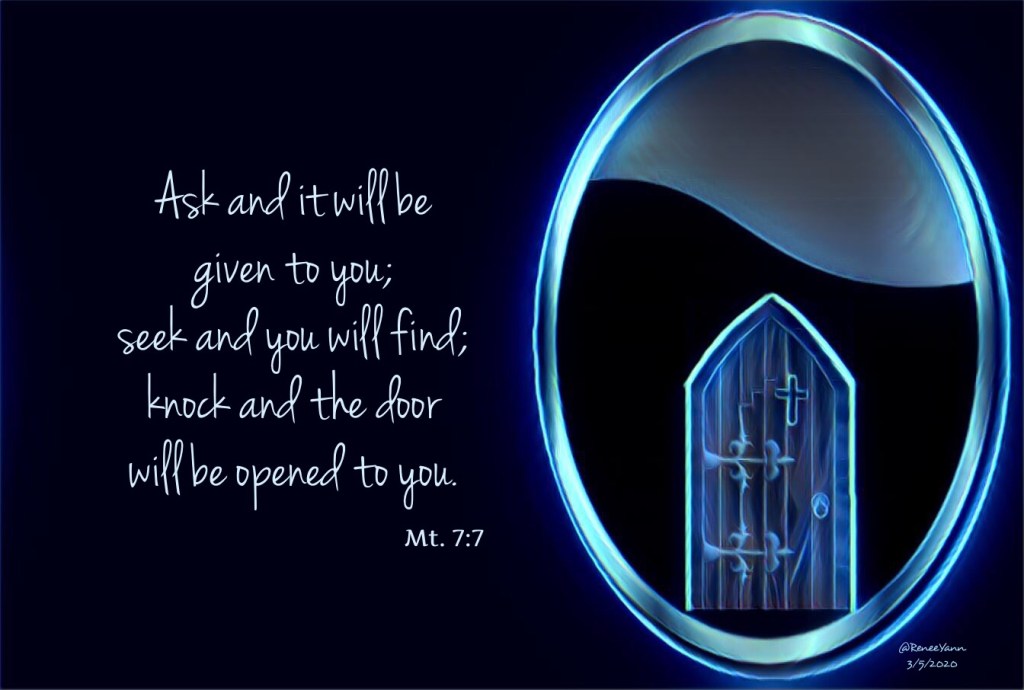
Prayer can be like looking in a mirror. All we see reflected back is our own need and desire. We don’t pray honestly and openly enough to let God open a door in the mirror – a door into God’s own will and hope for us.
That’s the door Jesus is talking about in today’s Gospel.
What we ASK is not just for something we want, but rather to know God’s heart.
What we SEEK is not our own satisfaction, but the grace to embrace God’s mysterious energy in our lives no matter how it comes to us.
What we KNOCK for and desire to be opened to us is deeper love and fuller relationship with our loving God.
Sometimes, the problem with prayer is that we think it’s like asking our rich uncle for a permanent loan. It’s only when we comprehend that prayer is a relationship that the RECEIVE, FIND, and OPENED parts become real for us.
I walk the earth, soft from yesterday’s long rain. Mists ascend like incense under my indulgent footfalls. Birdsongs thin themselves between the early light; chanting, contrapuntal, in the well-laved trees.
Nothing grey is left now in the wide sky. Rinsed in light it spreads to dry in sere, blue wind.
Momentarily, earth is wholly God’s; deep, true colors fall to it, rich, unshadowed. Your Word, Creator, WaterGod, has penetrated. It returns to You in crystal images from a finally uncomplicated world.
As if within a lucent globe I hold You still, in perfect, silent love, clear, inexplicable like sunlit rain.
Music: two offerings today. One is old-time revival. The other is classic beauty. Enjoy.
Prayer Is the Key to Heaven – Alan Brewster
Music: Overture from Esther – George Frideric Handel
Today, in God’s Lavish Mercy, one line from our readings hit me like a lightening bolt:
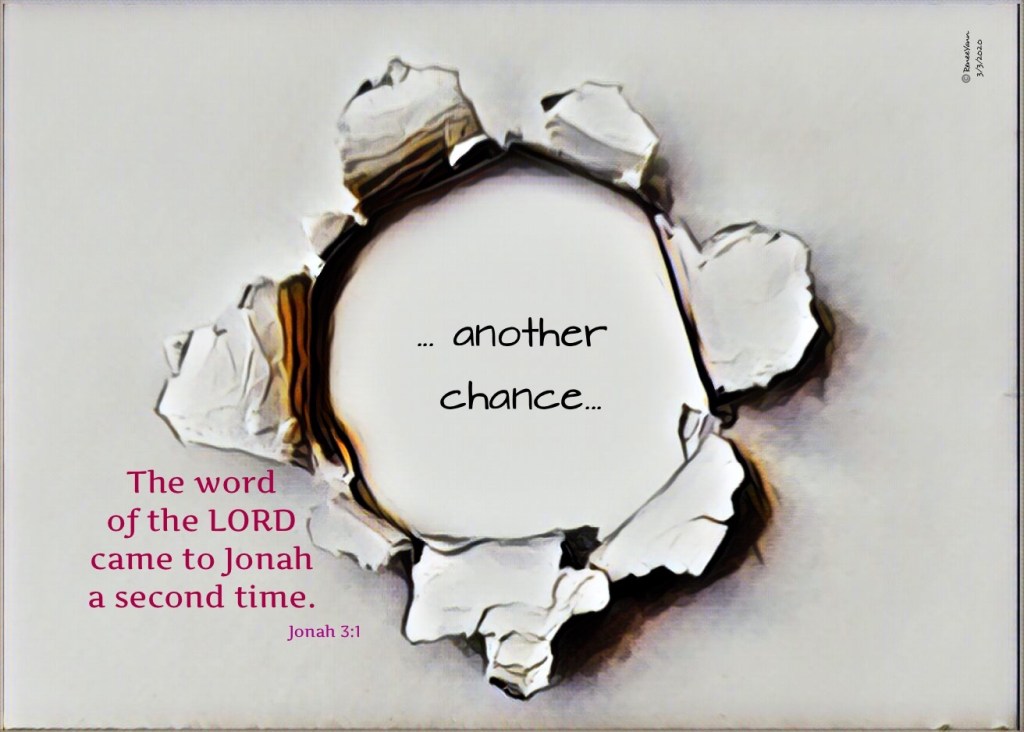
The word of the LORD came to Jonah a second time.
Jonah 3:1
Yes, it’s the truth! God will keep coming back again and again to encourage us to hear the true message for our lives.
Our Gospel gives us a hint about how resistant we sometimes are to do this deep listening:
This generation is an evil generation; it seeks a sign, but no sign will be given it, except the sign of Jonah.
Luke 11:29
What is the sign of Jonah anyway?
To put it simply, it is the witness of the Resurrection – that overarching event that changed everything for believers. For just as Jonah was able to return from certain death in the whale’s belly, so Christ conquered death and rose to new life, promising us the same power.
This is the central, life-changing belief for Christians. It should make a difference in how we live.
By our Lenten repentance, we can be like Jonah, grasping the second chance God always gives us to respond to our life circumstances with faith, hope, and love.
I would bet there is something in your life right now that is calling you to such a response. Someplace in your life, you may be caught in a bit of a “whale’s belly 🐳” about some issue, am I right?
God makes us ask ourselves questions most often when He intends to resolve them. He gives us needs that He alone can satisfy, and awakens capacities that He means to fulfill. Any perplexity is liable to be a spiritual gestation, leading to a new birth and a mystical regeneration.
Thomas Merton, The Sign of Jonas
Today’s readings remind us that we already have the glorious sign of the Resurrection to inspire us to leap from that dark “belly” into God’s hope for us!
Poetry: WE ARE JONAH – Rabbi Rachel Barenblat
In Rabbi Eliezer’s vision Jonah entered the whale’s mouth as we enter a synagogue. Light streamed in through its eyes. Jonah approached the bimah, the whale’s head. Show me wonders, he said, as though his own life weren’t a miracle.
The whale obliged, swimming down to the foundation stone, the navel of creation fixed deep beneath the land. Tsk tsk, chided the fish: you’re beneath God’s temple — you should pray.
Prayer requires stillness. Running away had always been so easy. Sitting silent in self-judgement — forget it! But waves only churn the surface. In the deep beneath the deep Jonah was wholly present.
We all flee from uncomfortable conversations the drip of a hospital IV the truths we don’t want to own the work we don’t want to do. Now we’re in the belly of the whale, someplace deep and strange.
God calls us to awareness: to stand our ground in the place where we are, to do the work which needs doing. To bring kindness and mercy even to those who are unlike us. Are we listening?
Music: a fun song “In the Belly of Whale” – The Newsboys
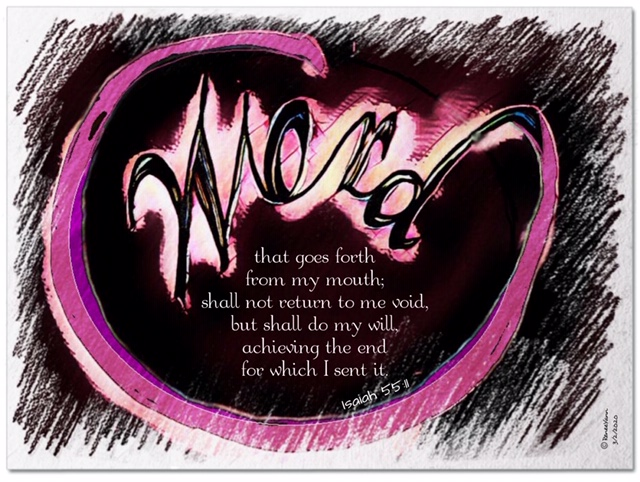
So shall my word be that goes forth from my mouth; It shall not return to me void, but shall do my will, achieving the end for which I sent it.
Isaiah 55:11
Today, in God’s Lavish Mercy, as I pray with today’s readings, I ask myself two questions:
“What has God’s Word accomplished in me?” “What does God’s Word yet want to accomplish in me?”
If you’re like me, you’re always thinking about what you haven’t done, still must do, wish you had done.
Let’s just STOP that and, instead, praise our gracious God for the good accomplished through our lives. I know every one of you reading this blog is an amazingly good person. God has already done beautiful things in you and through you. Thank God. Give God the glory.
Let’s consciously pray for one another today as today’s Gospel encourages us:
Our Father who art in heaven, hallowed be thy name, thy Kingdom come, thy will be done, on earth as it is in heaven. Give us this day our daily bread; and forgive us our trespasses, as we forgive those who trespass against us; and lead us not into temptation, but deliver us from evil.
Poetry: My Psalm – Renee Yann, RSM
May my life be its own psalm of praise to You.
Within its melody, my whole being
bows to you in gratitude.
You chose to breathe your soul into me,
to warm my name in your cupped hands,
to wind your Divine Heart into the notes of my life.
Thank You.
My years have unfolded like flowers,
slowly warming to your grace.
The petals of my years have each been kissed by You.
Whether in joy or sorrow,
silence or song, seen or unseen,
You have been with me.
Thank You.
You loved the child I once was and You played within me.
You loved the young girl who walked toward your call
along the precious, winding path of mercy.
You loved the woman I became, over and over,
as I learned to find You hiding in the world.
Thank You.
Now, as years deepen and with them,
our comfort in each other's love,
let my trust also deepen.
Let my faith reflect You,
like the face of a well-polished rock,
fully turned to your steadfast Light,
fully afire in your Abiding.
Thank You.
Music: My Tribute ( To God Be the Glory)
How can I say thanks For the things You have done for me? Things so undeserved, Yet You gave to prove Your love for me; The voices of a million angels Could not express my gratitude. All that I am and ever hope to be, I owe it all to Thee.
To God be the glory, To God be the glory, To God be the glory For the things He has done.
With His blood He has saved me, With His power He has raised me; To God be the glory For the things He has done.
Just let me live my life, Let it pleasing, Lord to Thee, And if I gain any praise, Let it go to Calvary.
Today, in God’s Lavish Mercy, our reading from Romans tells us:
The word is near you, in your mouth and in your heart.
How is the Word of God near us, with us?
Certainly, our sincere study and prayer with scripture is one way. Sitting quietly with scriptural passages, letting them speak to us, and inviting them to inform our lives is a life-giving discipline.
Sometimes, we might choose just one word or phrase from a beloved reading, turning it over and over, gently in our prayer. How has this precious word informed our lives, inspired us, called us, comforted us? How is it speaking to us in this moment?
As we move more deeply into the “words” of scripture, we move closer to theWord – the Incarnate God. John writes:
In the beginning was the Word, and the Word was with God, and the Word was God. He was with God in the beginning. Through him all things were made; without him nothing was made that has been made.
John 1:1
Today in our prayer, we might recommit ourselves to a deepening love of scripture, of the Word given to us there.
In his book, “The Bible Makes Sense”, Walter Bruggemann says this:
The Bible is not an “object” for us to study but a partner with whom we may dialogue. It is usual in our modern world to regard any “thing” as an object that will yield its secrets to us if we are diligent and discerning. And certainly this is true of a book that is finished, printed, bound, and that we can buy, sell, shelve, and carry in a briefcase or place on a coffee table…[But] reading the Bible requires that we abandon the subject-object way of perceiving things… [If we do,] the text will continue to contain surprises for us, and conversely we discover that not only do we interpret the text but we in turn are interpreted by the text… We may analyze, but we must also listen and expect to be addressed.
Poetry: God – by Khalil Gibran
In the ancient days, when the first quiver of speech came to my lips, I ascended the holy mountain and spoke unto God, saying, 'Master, I am thy slave. Thy hidden will is my law and I shall obey thee for ever more.'
But God made no answer, and like a mighty tempest passed away.
And after a thousand years I ascended the holy mountain and again spoke unto God, saying, 'Creator, I am thy creation. Out of clay hast thou fashioned me and to thee I owe mine all.'
And God made no answer, but like a thousand swift wings passed away.
And after a thousand years I climbed the holy mountain and spoke unto God again, saying, 'Father, I am thy son. In pity and love thou hast given me birth, and through love and worship I shall inherit thy kingdom.'
And God made no answer, and like the mist that veils the distant hills he passed away.
And after a thousand years I climbed the sacred mountain and again spoke unto God, saying, 'My God, my aim and my fulfilment; I am thy yesterday and thou art my tomorrow. I am thy root in the earth and thou art my flower in the sky, and together we grow before the face of the sun.'
Then God leaned over me, and in my ears whispered words of sweetness, and even as the sea that enfoldeth a brook that runneth down to her, he enfolded me.
And when I descended to the valleys and the plains, God was there also.
Today, in God’s Lavish Mercy, Isaiah cuts his listeners no slack — and, remember, we too are his listeners.
In this powerful passage, the prophet shatters the pretenses of those who make a show of religion. Speaking with God’s voice, Isaiah lambastes those who fast and pray but practice no works of justice and mercy.
Lo, on your fast day you carry out your own pursuits, and drive all your laborers. Yes, your fast ends in quarreling and fighting, striking with wicked claw.
These “fake fasters” are left wondering why God doesn’t answer their prayers. The prophet tells them that God isn’t fooled by their pretenses:
Is this the manner of fasting I wish, of keeping a day of penance: That a man bow his head like a reed and lie in sackcloth and ashes?
Isaiah says that God’s not into sackcloth and ashes. God’s into good works of mercy and justice. These are the actions that change our hearts, opening us to deeper relationship with God.
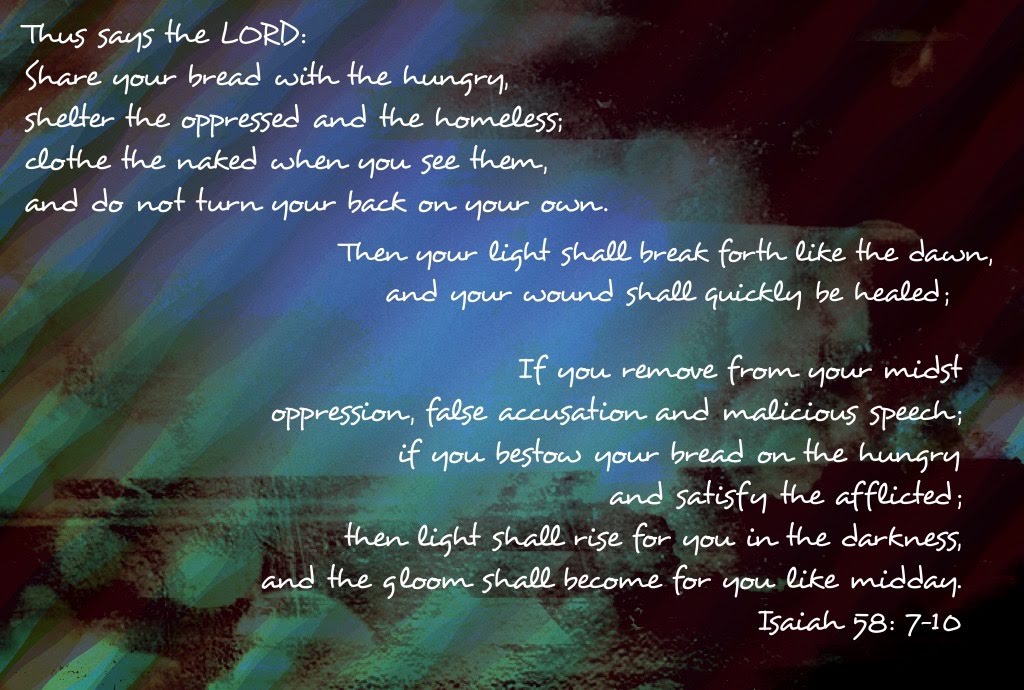
This, rather, is the fasting that I wish: releasing those bound unjustly, untying the thongs of the yoke; Setting free the oppressed, breaking every yoke; Sharing your bread with the hungry, sheltering the oppressed and the homeless; Clothing the naked when you see them, and not turning your back on your own.
Listen, dear friends. It can’t be clearer than that.
In a world full of “prosperity gospels”, false piety and pretend religion – used to justify all kinds of injustice – we may get mixed up sometimes about what pleases God.
Let’s really open our hearts to Isaiah’s message and try to rid our own lives of any pretense about these things.
Let’s confront such hypocrisy when we see it used to subtly oppress rather than to lift up others.
Then your light shall break forth like the dawn, and your wound shall quickly be healed.
Perhaps we might spend sometime today thinking about that “wound” we need healed. Might there be some harbored prejudice, indifference, fear, or ignorance that distances us from others who are different, vulnerable, or in need?
Isaiah cautions that until that wound is healed, we will never hear God’s true answer to our prayers.
Poetry: from Gitanjali by Rabindranath Tagore
Then said a rich man, “Speak to us of Giving”.
And he answered: “You give but little when you give of your possessions. It is when you give of yourself that you truly give. For what are your possessions but things you keep and guard for fear you may need them tomorrow? And tomorrow, what shall tomorrow bring to the overprudent dog burying bones in the trackless sand as he follows the pilgrims to the holy city?
And what is fear of need but need itself? Is not dread of thirst when your well is full, thirst that is unquenchable?
There are those who give little of the much which they have
and they give it for recognition and their hidden desire makes their gifts unwholesome. And there are those who have little and give it all. These are the believers in life and the bounty of life, and their coffer is never empty.
There are those who give with joy, and that joy is their reward. And there are those who give with pain, and that pain is their baptism. And there are those who give and know not pain in giving, nor do they seek joy, nor give with mindfulness of virtue; They give as in yonder valley the myrtle breathes its fragrance into space. Through the hands of such as these God speaks, and from behind their eyes He smiles upon the earth.
It is well to give when asked, but it is better to give unasked, through understanding; And to the open-handed the search for one who shall receive is joy greater than giving.
And is there aught you would withhold? All you have shall some day be given; Therefore give now, that the season of giving may be yours and not your inheritors’.
You often say, “I would give, but only to the deserving.” The trees in your orchard say not so, nor the flocks in your pasture. They give that they may live, for to withhold is to perish.
Surely he who is worthy to receive his days and his nights is worthy of all else from you. And he who has deserved to drink from the ocean of life deserves to fill his cup from your little stream. And what desert greater shall there be than that which lies in the courage and the confidence, nay the charity, of receiving?
And who are you that men should rend their bosom and unveil their pride, that you may see their worth naked and their pride unabashed? See first that you yourself deserve to be a giver, and an instrument of giving. For in truth it is life that gives unto life – while you, who deem yourself a giver, are but a witness.
And you receivers – and you are all receivers – assume no weight of gratitude, lest you lay a yoke upon yourself and upon him who gives. Rather rise together with the giver on his gifts as on wings; For to be overmindful of your debt, is to doubt his generosity who has the free-hearted earth for mother, and God for father.
Music: Respond – Collin Campbell (Lyrics below)
Oh how long will you cry out And never truly seek my face You come to me with heavy hearts But you ignore what makes mine break
I see your thoughts, I hear your words And I have watched you as you’ve prayed I’ve told you my desires But you don’t follow all the way
Children, I’m crying out Break the chains Let the oppressed go free Empty yourselves to those in need Be my hands Be my feet What you do unto them You do unto Me
Every day you lift your voice And await my swift response But I see only what’s inside And it’s (what i see on the inside) an offering I don’t want
Children, I’m crying out Break the chains Let the oppressed go free Empty yourselves to those in need Be my hands Be my feet What you do unto them You do unto Me
Then your Salvation will come like the dawn And my glory will be your shield When you call on My name I will not turn away I am Your God And I am here And your light it will shine from the dark You will be like a free flowing stream And when you call on My name I will not turn away I am your God And I am here
Today, in God’s Lavish Mercy, each of our readings encourages us to live a life of prayer – with fervor, perseverance, and childlike simplicity
The fervent prayer of a righteous person is very powerful.
James 5:16
O LORD, to you I call; hasten to me; hearken to my voice when I call upon you. Let my prayer come like incense before you; the lifting up of my hands, like the evening sacrifice.
Psalm 141:1-2
Let the children come to me; do not prevent them, for the Kingdom of God belongs to such as these.
Mark 10:14
Rather than make any theological comment on prayer, I thought I might simply offer some of my own poetry-prayers today, if you would care to pray with them.
Awaking
Sunrise paints
the hedge's morning side
rosy gold.
But I choose
the western side.
There, midnight's purple leaves
awake in lazy grey,
then stripes
of green and silver.
There, the awesome
grace of living
rises slowly in the heart,
a liquor savored,
a prayer lingering
In genuflected silence
Photo credit: Mary Pat Garvin, RSM
Prayer
Still ourselves,
we are more one
than separate now,
Heart over heart,
heart within Heart,
like a word's meaning
held within its sound.
I drink from that union
like the verdant earth drinks
from its deep reserve of water.
It is Your color
that flushes
every blossom
sprung from me.
But that water, once tasted
precludes satiety
by any other water.
There is
no return for me now
to a season
not fed by You.
What I have given You, then
is the whole seed of my life.
Today, in God’s Lavish Mercy, I pause in my scriptural reflections to ask all of you to join in prayer for peace in Ukraine. As I typed today’s date, it hit me that we can’t just watch the evolution of this crisis on the news, as if it were a movie that isn’t really happening. We have a responsibility to be active peacemakers in our volatile world, and to foster a resolution that honors all human life.
I’ll tell you why Saturday’s date struck my heart so forcibly.
February 19, 1945
I was not even alive yet. I was kicking around inside my Mom and waiting to be born exactly two months later. There was joyful expectation in my family that afternoon, as you can imagine. What they did not expect was that at that very moment, my mother’s nineteen year old brother had bled to death on the shores of Iwo Jima.
When the word finally reached my family, Jimmy had already been buried at sea. The coordinates are noted in the WWII War Logs: 21°N latitude; 111° E longitude. That’s where he is buried, somewhere in the middle of the Philippine Sea. It feels so very lonely when you look at it on a map.
His death, his slaughter, wounded my mother so deeply that it reached into my incipient spirit. I never knew him, but have never forgotten, my Uncle Jim. Some of you will understand how that can be.
No young man or woman should be left alone forever at the bottom of the sea, or in an mountain gorge, or under the flaming sand. No human being should suffer and die because of war, because of the bloated egos and stunted imaginations of undraftable world leaders who pretend it is the means to peace.
It may seem that we can do little to prevent these travesties, but that’s not true. We can vote; we can lobby; we can advocate for international justice and equity that ameliorate the catalysts to war: poverty, hunger, and political and economic domination.
And we can pray.
We have the power through prayer and political action to fuel the demand for peaceful and diplomatic relationships in our world. These powerful interventions can confront our unexamined militarism and transform it.
Pope Francis has said:
“The news coming out of Ukraine is very worrying. I entrust to the intercession of the Virgin Mary, and to the conscience of political leaders, every effort on behalf of peace. Let us pray in silence.”
Mother of Sorrows – Batolome Murillo
But the responsibility belongs to us as well. Will you join me on this Saturday of the Blessed Virgin Mary to ask her powerful intercession in this outrageous situation in Ukraine?
The following prayer was very meaningful to me and you may want to pray with it:
Today, in God’s Lavish Mercy, our readings stand in stark contrast to each other.
In our first reading, we meet the two adversarial kings of the now split kingdom of Israel – so cooly named King Rehoboam and King Jeroboam. They were grasping, grabbing and trying to hold on to power over each other’s terrain. Using idols, Jeroboam tried to lure the people away from their covenanted practice of going up to Jerusalem to worship.
Our Gospel demonstrates that Jesus is a very different kind of king. His concern is for the wholeness of his people, not for the increase of his own power and standing.
Jesus summoned the disciples and said, “My heart is moved with pity for the crowd, because they have been with me now for three days and have nothing to eat. If I send them away hungry to their homes, they will collapse on the way, and some of them have come a great distance.”
Matthew 8:1-4
This morning I can’t help thinking that many of us have come a long way with Jesus too. But still we find ourselves in spells of hunger — hungers of all kinds. Jesus sees our true needs, has compassion for, and presence with us in the pangs of any human experience.
He ordered the crowd to sit down on the ground. Then, taking the seven loaves he gave thanks, broke them, and gave them to his disciples to distribute, and they distributed them to the crowd.
Matthew 8: 6
Let’s just sit down with Jesus today as we pray, laying out before him our deepest hungers, worries, regrets, doubts and hopes. Let’s wait for the gift of God’s beautiful and miraculous Bread – broken for each one of us.
Poetry: Gratitude – Henry Van Dyke
“Do you give thanks for this? — or that?” No, God be thanked I am not grateful In that cold, calculating way, with blessing ranked As one, two, three, and four, — that would be hateful.
I only know that every day brings good above” My poor deserving; I only feel that, in the road of Life, true Love Is leading me along and never swerving.
Whatever gifts and mercies in my lot may fall, I would not measure As worth a certain price in praise, or great or small; But take and use them all with simple pleasure.
For when we gladly eat our daily bread, we bless The Hand that feeds us; And when we tread the road of Life in cheerfulness, Our very heart-beats praise the Love that leads us.
Music: Bread of Life – rory Cooney
I myself and the bread of life. You and I are the bread life, Taken and blessed, Broken and shared by Christ that the world might live.
This bread is spirit, gift of the maker’s love, And we who share it know we can be one: A living of God in Christ.
I myself and the bread of life. You and I are the bread life, Taken and blessed, Broken and shared by Christ that the world might live.
Here is God’s kingdom given to us as food. This is our body, this is our blood: A living sign of God in Christ.
I myself and the bread of life. You and I are the bread life, Taken and blessed, Broken and shared by Christ that the world might live.
Lives broken open, stories shared aloud, Become a banquet, a shelter for the world: A living sign of God in Christ.
I myself am the bread of life. I myself am the bread of life
Today, in God’s Lavish Mercy, our readings leave me wondering about what makes God tick.
In our first reading, God exacts justice for Solomon’s unfaithfulness, but God does it sort of like a prosecutor in a plea bargain.
I will deprive you of the kingdom … but not during your lifetime It is your son whom I will deprive … but I won’t take away the whole kingdom.
1 Kings 11:11-13
What’s going on with God in this reading? Well, it’s more like “What’s going on with the writer as s/he tries, retrospectively, to interpret God’s role in Israel’s history?”
The passage is much more than a report on exchanges between God and Solomon.
It is a testament to Israel’s unwavering faith that God is intimately involved in their lives. In every circumstance, the believing community returns to the fact that experience leads to God and not away from Him.
So “Solomon … had TURNED his heart to strange gods” BUT God had not turned from Solomon. Nor would God EVER turn because God has CHOSEN Israel.
In our Gospel, the Syrophoenician woman tries to get the favor of Jesus to turn toward her. And actually, Jesus sounds pretty mean and stingy about it.
Again the writer Mark is portraying, retrospectively, a significant time in Christ’s ministry. Jesus has really gone into hiding in a remote place. Apparently, he wants space to figure some things out. The story indicates that one of those things might be whether or not his ministry should embrace the Gentiles.
The persistence of this woman’s faith is a turning point for Jesus Who evolved, as we all do, in his understanding of his sacred role and meaning in the world.
These passages encourage us to constantly turn toward God Who lives our life with us. Day to day, our lives change and challenge us. But throughout, we must stay centered on our God who does not change. This sacred relationship is essential to our spiritual growth. As we become bigger in heart and soul, so does our concept of God and what God’s hope is for us.
Poetry: All this “turning” brought to mind some favorites lines from T.S. Eliot
At the still point of the turning world. Neither flesh nor fleshless; Neither from nor towards; at the still point, there the dance is, But neither arrest nor movement. And do not call it fixity, Where past and future are gathered. Neither movement from nor towards, Neither ascent nor decline. Except for the point, the still point, There would be no dance, and there is only the dance.










 Lavish Mercy