Regret

Tuesday of the Fourth Week in Ordinary Time

February 4, 2020

Click here for readings

Today, in Mercy, we read one of the saddest lines in Scripture.

2Sam18_32

You have followed the story in these daily passages. Absalom rebels, designing to usurp his father’s throne. A massive battle rises between them. David, as commander-in-chief, remains behind, but gives instructions to his generals to spare Absalom’s life. Joab ignores the command, killing Absalom in a moment of vulnerability.

David is devastated.

david mourns
David Mourning Absalom’s Death – Jean Colombe

I think there is no more wrenching human emotion than regret. When I ministered for nearly a decade as hospice chaplain, and later in the emergency room, I saw so much regret.

People who had waited too long to say “I’m sorry”, “I forgive you”, “Let’s start over”, “Thank you for all you did for me”, “I love you”…..

Instead, these people stood at lifeless bedsides saying things like, “I should have”, “I wish…”, “If only…”


Life is complex and sometimes difficult. We get hurt, and we hurt others — sometimes so hurt that we walk away from relationship, or stay but wall ourselves off.

We might think that what is missing in such times is love. But I think it is more likely truth. In times of painful conflict, if we can hear and speak our truth to ourselves and one another, we open the path to healing.


If you want the truth, I’ll tell you the truth.
Listen to the secret sound,
the real sound, which is inside you.
~ Kabir


That healing may demand adjustments, agreements, even a willingness to step apart in mutual respect. But if the changes emerge from shared truth, restoration and wholeness are possible.

David and Absalom never found that path because they were so absorbed in their own self-interests. Theirs was the perfect formula for regret – that fruitless stump that perpetually sticks in the heart.

I remember a trauma surgeon leaving the hospital late one night after an unsuccessful effort to save a young boy who had been shot. The doctor carried the loss so heavily as he walked into the night saying to me, “I’m just going to go home and hug my kids.”

As we pray over David and Absalom today, let us examine our lives for the fractures that are still healable and act on them. Let us “hug” the life we have. Regret is a useless substitute.

When David Heard – Eric Whitaker ( The piece builds. Be patient. Lyrics below)

When David heard that Absalom was slain,
he went up into his chamber over the gate and wept,
and thus he said;

My son, my son,
O Absalom my son,
would God I had died for thee!

When David heard that Absalom was slain,
he went up into his chamber over the gate and wept,
and thus he said;

My son, my son.
It’s All About the Temple

Feast of the Presentation of the Lord

February 2, 2020

Click here for readings

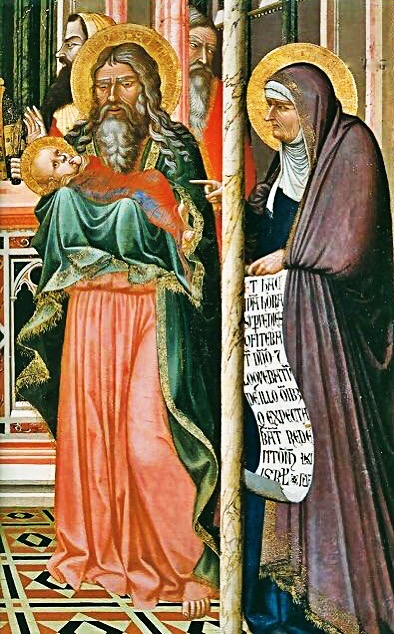
Today, in Mercy, we begin with a reading from the prophet Malachi, a hurler of fire and brimstone in the 4th-5th century before Christ. It’s an interesting choice and begs the question of how it relates to this Feast when a little baby comes to be blessed in the Temple.

Presentation of Our Lord
Presentation of Our Lord – Ambrogio Lorenzetti (Wikipedia.org_ not for commercial use)

Ah, perhaps that’s the hinge – the Temple, both actual and symbolic.

Malachi writes at a time when the second Temple has been restored. In other words, God is about giving the people a second chance to behave according to the Covenant. But they’re not doing such a good job — especially those in charge, the priests:

A son honors his father,
and a servant fears his master;
If, then, I am a father,
where is the honor due to me?
And if I am a master,
where is the fear due to me?
So says the LORD of hosts to you, O priests,
who disdain my name.
Malachi 1:6

A Little Extra Music: Handel – But Who May Abide (You know you have time to listen just before the Super Bowl!)

Through a series of prophetic oracles, Malachi admonishes the people to repent before it is too late because no unrepentant soul will withstand the judgement.

Yes, he is coming, says the LORD of hosts.
But who will endure the day of his coming?
And who can stand when he appears?
For he is like the refiner’s fire,
or like the fuller’s lye.


In the passage from Hebrews, Paul presents the perfect priest, Jesus Christ. In taking flesh, Christ’s Body becomes the new Temple of our redemption. We stand before judgement already saved by his Passion, Death, and Resurrection.


In our Gospel, two aged and venerable prophets wait in the Temple for the Promised One. Their long years of prayer have already proven them faithful. Now, Simeon’s and Anna’s long and complete fidelity is rewarded by seeing their Savior. They know Him because they have already created a place for him in the Temple of their hearts. Now, they will meet their judgement in total peace. As Simeon’s prays:

“Now, Master, you may let your servant go
in peace, according to your word,
for my eyes have seen your salvation,
which you prepared in the sight of all the peoples:
a light for revelation to the Gentiles,
and glory for your people Israel.”

It’s a beautiful, total-hearted prayer!  Don’t we all hope to be able to offer it one day?

( I wrote an earlier reflection about dear Anna.  You might like to see it again here:

Music: Nunc Dimittis – Taizé (Latin and English text below)

Nunc dimittis servum tuum,
Now dismiss your servant
Domine, Domine,
Lord, Lord,
Secundum verbum tuum in pace.
according to your word in peace
Domine.
Lord.

God loves …. always!

Saturday of the Third Week in Ordinary Time

February 1, 2020

Click here for readings

Today, in Mercy, David gets his comeuppance after his sinful forays.

david weeps
David Weeps – wikipedia.org – not for commercial use

The passage is hard to deal with. It suggests that God is vengeful, and gets us back for going against him. That’s not the God Who loves me.

Like much of the Old Testament, the writer is interpreting the circumstances of life in order to teach a lesson. The lesson here is not that God is a payback God. The core lesson is that our choices have repercussions, and should always be made in the light of God’s hope for us.

Sometimes in our own lives, we think of God as reacting in a human way to us – getting angry, forgetting us, paying us back, testing us, punishing us. Like the disciples in today’s storm-tossed boat, our faith is weak and maybe misdirected.

God is Love, and Love only. God is NEVER “I’ll getcha’ “. Deep faith directs us to find God’s love – God’s continuing call to intimacy – in every circumstance of our lives. 

God didn’t kill David’s illegitimate son. It just happened, the way so much of life happens. We can blame God if we want to, but we’re missing the point. 

The point is that God is with us in the inevitable joys and sorrows of our lives saying, as he did to his distraught shipmates:

“Why are you terrified?
Do you not yet have faith?”

Ps51

Our Gospel assures us that God is with us, “sleeping” even in our rocky boat. By faith and prayer, we “wake God”, as we actually wake ourselves to the truth of God’s immutable, loving Presence in our lives.

Music:  You Raise Me Up – Selah

Who’s Boss?

Thursday of the Third Week in Ordinary Time

January 30, 2020

Click here for readings

Today, in Mercy, David has received a wake up call from God, delivered by the prophet Nathan:

Go and tell David my servant, Thus says the LORD:
Is it you who would build me a house to dwell in?
 
2 Samuel 7:5

As a follow up to David’s big idea of building a house for God, God says,”Wait a minute! I don’t think so!” Gently, but ever so clearly, God reminds David of a phrase very popular on social media today:

boss

It seems David has gotten a little full of himself. He likes being King. He decides to use his power and position to do something nice for God. But God uses the occasion to remind David that all that David has comes from God. David is not God’s King, he is God’s servant. David can’t do anything for God except to offer thanks, praise and worship.

Ps119 lamp

This huge spiritual insight turns David’s heart to see himself truly as God sees him. His subsequent prayer is full of humility and gratitude as David asks God for continued blessing on David’s House.

The lesson for me today is this: God is God. I am nothing without God. Everything I have and am comes from the Divine Goodness.

Meister Eckhart echoes here:

If the only prayer we say
in our entire lives is

“Thank You”,
it is enough.

Music: Thank You, God – mantra video composed by Michelle Sherliza

God Gets Tough

Feast of the Conversion of Saint Paul, Apostle

January 25, 2020

Click here for today’s readings

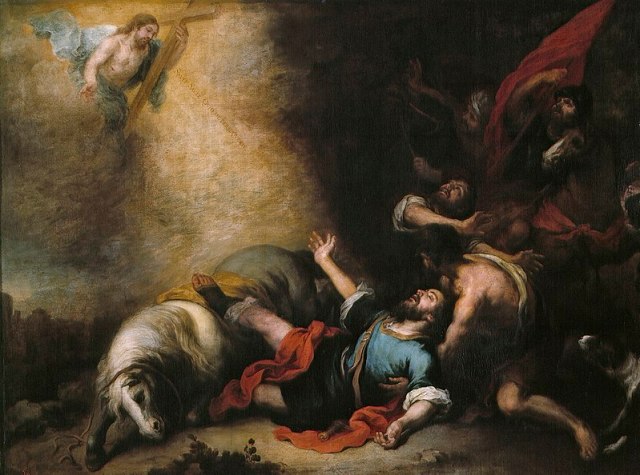
Today, in Mercy, we ride with Paul on the road to Damascus, there to be struck with him by a Godly Light.

800px-La_conversión_de_san_Pablo_(Murillo)
The Conversion of St. Paul — Bartolomé Esteban Murillo

Have you ever been knocked off your “high horse” by the sudden realization of something to which you had been totally blind? It’s shocking, isn’t it? 

We might react by castigating ourselves with remarks like:

  • How could I have missed that?
  • Wow, I was really stupid, or foolish, or naïve, or prejudiced, or misled, or … or what?

God, in a kind of ironic twist, strikes Paul blind in order to cure him of his real blindness: the right he claimed to persecute others for a faith he didn’t understand.

Sometimes God has to be pretty tough with us to wake us up to the truth of our souls. John Donne, the pre-eminent English metaphysical poet, prayed for that kind of Divine Toughness in his poem Batter my heart, three-personed God.

png-divider-lines--1400

Since I have blogged twice previously about this feast,


Links available here:

Click here for 1/24/2019 Reflection

Click here for 4/19/2018 Reflection


I thought my readers might like to pray with Donne’s poem, read by Tom O’Bedlam

Holy Sonnets: Batter my heart, three-person’d God
Batter my heart, three-person’d God, for you
As yet but knock, breathe, shine, and seek to mend;
That I may rise and stand, o’erthrow me, and bend
Your force to break, blow, burn, and make me new.
I, like an usurp’d town to another due,
Labor to admit you, but oh, to no end;
Reason, your viceroy in me, me should defend,
But is captiv’d, and proves weak or untrue.
Yet dearly I love you, and would be lov’d fain,
But am betroth’d unto your enemy;
Divorce me, untie or break that knot again,
Take me to you, imprison me, for I,
Except you enthrall me, never shall be free,
Nor ever chaste, except you ravish me.

Here also is a musical interpretation of the poem.
The University of South Florida Chamber Singers perform Richard Nance’s “Batter my heart” under the direction of Dr. James Bass 

Rachel Still Weeps

Feast of the Holy Innocents, martyrs

December 28, 2019

Click here for readings

Today, in Mercy, John tells us a hard truth:

If we say, “We are without sin,”
we deceive ourselves, and the truth is not in us.

Rachel

As I read the Gospel account of the slaughter of the Holy Innocents, John’s words pummel me, as do the images we view routinely on the evening news:

  • toddlers caged on the US-Mexico border
  • infants lying dead on Syrian and Kurdish hillsides
  • kindergarteners bulleted by AK47s
  • youngsters trafficked to the rich and powerful
  • children of color victimized by prejudice
  • acolytes defiled by their priests
  • students lunch-shamed for their poverty
  • kids bullied for their differences
  • hungry babies cut from assistance to fund military excess

In today’s world, so bereft of social justice and moral policy, we don’t have to read the Gospel to find the Holy Innocents. They are staring us, teary-eyed, right in our faces!

This morning’s is an uncomfortable prayer! What can I do to be sinless in the face of such injustice? What is morally required of me to shed complicity in these outrages?

Like many of you, I feel helpless and overwhelmed at times, just as Herod’s populace must have felt.

But then I remember that I do not live under a “Herod”, unless I passively allow myself to. I can advocate, protest, contribute and most of all VOTE. I can do everything in my power to assure that a moral and rational leadership holds the right to stand for me and for my responsibilities to my sisters and brothers.

Yes, today in our prayer, we may weep like Rachel. But then, let us finish weeping. Let us seek the ways that we can repent any complicit sinfulness. Let us acknowledge and repudiate the normalized culture of war and domination which we have accepted. Let us inform ourselves and act clearly and consistently for merciful justice – for innocent life in all its stages!

Music: Save the Children – Marvin Gaye

Who Will Stand in the End?

Thirty-third Sunday in Ordinary Time

November 17, 2019

Click he for readings

Today, in Mercy, our readings carry the full flavor of the “end times” warnings, those repeated annually as we move closer to Advent ( which is only two weeks away!)

Malachi is very direct:

Lo, the day is coming, blazing like an oven,
 when all the proud and all evildoers will be stubble…

Wow! Really? Our reaction might range from “Good! Go get ‘em, God!” to “Oh, dear God, I hope it’s not me!!!”.

But Paul resets us on the right track. He says something like this:

Listen! You must imitate your teachers in Christ.
Live with integrity, justice and generous mercy.
Navigate the world with these as your compass.
Then you will welcome the end times.


Lk21_19 perseverance

In our world, we see the opposing forces of good and evil clearly pulling against one another. In our decisions and attitudes, we are confronted with the choice between sin and selflessness.

The “elephant in the room” this week for many of us is the impeachment hearings. How do we view this event as people of Gospel faith? How do we respond?

elephant

While some of us believe strongly in separation of Church and State, still we acknowledge that our FAITH is exercised in a political world. We pursue our full conversion in Christ through “polity“:  our just and compassionate interactions with all Creation.

Right in front of us this week, we have seen  amazing displays of courage and morality standing against venal self-interests. How does what we see align with our own living of justice and mercy?

Political scientist Harold Lasswell defined politics as “who gets what, when, and how“. If this isn’t the same challenge tackled in the Gospel, I don’t know what is! Jesus said that the poor and disenfranchised should be the first to “get” – through peace, love and mercy. Making that happen is our Christian call.

However, it is likely impossible to communicate God’s vision for the world in the language of politics.  Walter Brueggemann says this:

The prophet’s task is to imagine the world as though Yahweh, the God of Israel and the creator of heaven and earth, were a real character and a lively agent in the life of the world.  I believe that such a claim, then and now, has to be articulated poetically in order not to be co-opted by political absolutism or theological orthodoxy.
~Walter Brueggemann 

Our readings today give us this poetic vision and challenge. Read them with great longing to hear God’s voice for our times. The world so sorely needs the answer that will grow in our souls.

Music:  Let Justice Roll

Climb the Tree! Ignore the Haters!

Thirty-first Sunday in Ordinary Time

November 3, 2019

Click here for readings

Today, in Mercy, our readings are all rooted in Mercy. The beautifully literate Book of Wisdom delights us with its poetry and heartfelt understanding of God’s “imperishable “ love for us. Think about it! The passage, written very near the time of Christ, is intended to assure us that God’s mercy will save and embrace us.

In our second reading, Paul assures the Thessalonians that this mercy has indeed been given to them in the person of Jesus Christ. Through Christ they are, as we are, called to be Mercy in the world in Christ’s name.

But Paul adds a little warning. Apparently there are some conspiracy theorists floating around trying to scare people about the final coming. (Oh, Lord — ever present!) They are even forging Paul’s name to spread their crazy havoc.

Religion will always have distorters who pull out and exaggerate certain threads of doctrine, often opposed to the core message of Mercy. They do this to gain control over others and to advance themselves. Every sacred religion, from Catholicism to Islam, has been manhandled by opportunists who use it to advance their own agendas.

But Paul says to cling to the truth: our ever-merciful God loves us, no matter our deficiencies, and welcomes our repentance.

Zaccheus, whom we meet in today’s Gospel, did not succumb to the distorters who branded him an irredeemable sinner. He opened his heart to Jesus in sincerity and enthusiasm. He changed his life because he believed in the full truth of the Gospel: Christ came for us sinners.

zccheusJPG
Notice how Zaccheus in hidden in the tree. Are there ways in which we re hiding form the full truth and love of Christ?

Like Zaccheus, a man “deficient” in height, maybe we need to “climb a tree” of prayer and repentance today to take a full-hearted look at the power of God passing through our lives. May we never let the opportunity for Mercy – either to receive or to give it – pass us by.

Music:  Zaccheus – Medical Mission Sisters (Oldie but goodie — love the dedicated nuns! How much good they have done in a suffering world!)

Zap Time?

Saturday of the Twenty-ninth Week in Ordinary Time

October 26, 2019

Click here for readings

Today, in Mercy, our Gospel takes on some difficult themes.

lightening

Jesus gives a parable which, at first, appears to say, “Get your act together fast, or God might zap you.” From Jesus’s words, we can assume that some public disasters have recently occurred. The gathered crowd are unnerved by these events.

Jesus uses that nervousness to talk about repentance. He tells the people that tragedy can make us wake up to the fact that life is fragile and fleeting. That awareness should make us want to use our time on earth well, to give glory to God.

The repentance Jesus encourages is not just a contrition, or turning from sin. It is an opening of the soul’s eyes to see our lives and circumstances as God sees them.

Is God going to zap us if we don’t have that kind of repentance? No.

With the parable of the fruitless fig tree, Jesus assures us that God is with us, giving us every grace and opportunity to bear spiritual fruit. God is patient and nurturing. But, in every human life, there is a limit to the time we have to respond.

Music: Calm the Soul – Poor Clares Galway

Sinners Anonymous

Friday of the Twenty-ninth Week in Ordinary Time

October 25, 2019

Click here for readings

Today, in Mercy, Paul sounds a lot like someone approaching the microphone at “Sinners Anonymous“:

I know that good does not dwell in me, that is, in my flesh.
The willing is ready at hand, but doing the good is not.
For I do not do the good I want,
but I do the evil I do not want.

Paul basically attests to the fact that for human beings, even him, will and actions often don’t synch up. Sure, we want to be good people, but as Nike says, do we:

Do itJPG

Paul’s says no. The only way we do the good we will to do is by the grace of Jesus Christ.

In our Gospel, Jesus affirms the slowness of the human spirit to act on the realities around us. In some translations, Jesus uses a phrase which caught on with the architects of Vatican II: the signs of the times.

In our Gospel, Jesus is telling his listeners and us that we need to be alert to the circumstances of our world. It both weeps and rejoices. Where it weeps, we must be a source of mercy and healing. Where it rejoices, we must foster and celebrate the Presence of the Spirit.

In the Vatican II document Gaudium et Spes (The Church in the Modern World), we read:

In every age, the church carries the responsibility of reading the signs of the times and of interpreting them in the light of the Gospel, if it is to carry out its task. In language intelligible to every generation, it should be able to answer the ever recurring questions which people ask about the meaning of this present life and of the life to come, and how one is related to the other. We must be aware of and understand the aspirations, the yearnings, and the often dramatic features of the world in which we live.

Although written in the 1960s, these powerful words hold true today. We are the Church of which the document speaks. We are the ones whom Jesus calls to respond with authentic justice and mercy to the signs of the times. Read the newspaper in that light today. Watch the news in that light. Meet your brothers and sisters in that light today.

Music: The Times They Are A’changin’ – Bob Dylan whose songs in the 50s and 60sbecame anthems for the Civil Rights and anti-war movements. His lyrics during this period incorporated a wide range of political, social, philosophical, and literary influences, defied popular music conventions and appealed to the burgeoning counterculture. (Wikipedia) (Ah, it was a good time to be young!)

The Swedish Academy awarded Dylan the 2016 Nobel Prize in Literature “for having created new poetic expressions within the great American song tradition.