Today, in God’s Lavish Mercy, our readings assure us that God cares about our hungry spirits and will satisfy them.
Both the prophet Elisha and Jesus respond to the needs of the hungry crowds by the power of their faith. In each story, there is only a small amount of food to meet the overwhelming need of the people. But those small amounts, given selflessly and gratefully, renew themselves until all are satisfied.
Our spiritual hungers are deep, and much harder to fill than our physical ones. Sometimes, we don’t even know what we are longing for. Thus we may end up filling our emptiness with distractions and junk.
Today’s readings encourage us to turn our soul’s needs toward God. St. Augustine said this:
You have made us for yourself, O Lord, and our hearts are restless (hungry) until they rest in You.
Notice that in Jesus’s miracle of the loaves and fishes, there is one key action before the multiplication occurs.
Then Jesus took the loaves, gave thanks, and distributed them to those who were reclining, and also as much of the fish as they wanted.
Let’s sift through both the large and the small sustenances of our life for the things that we are grateful for. When we lift these up in thanksgiving, glimpsing the loving face of God, other graces will begin unexpectedly to multiply around and within us.
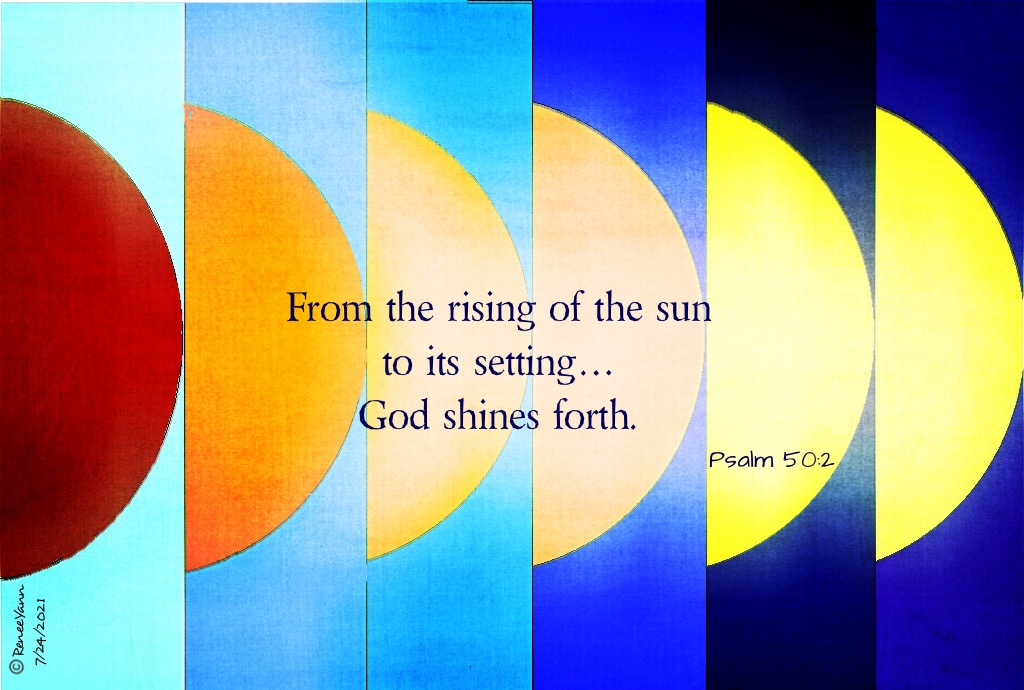
Today, in God’s Lavish Mercy, we pray with Psalm 50 which enjoins us – from sunrise to sunset – to offer God a sacrifice of praise.
A sacrifice of praise! It’s a phrase and concept that pops up in scripture several times. And it intrigues me. What might that repeated phrase mean for my life with God?
In our first reading, the Israelites took detailed steps to offer sacrifice to the Lord. Their efforts are summarized in this verse:
We will do everything that the LORD has told us.
But what is the difference between a “sacrifice of praise” and the ritualized blood sacrifice described in Exodus?
I think of a “sacrifice of praise” as that moment in our spiritual lives when our focus shifts
from “what we do to honor God” to “how God lives in us”
from practiced ritual to the awe of Sacred Presence
from my efforts to God’s fidelity
in other words…..
from me to God
At that moment, the “sacrifice” is of our natural self-absorption and self-involvement in order to free God’s presence and action through us.
It is a moment of recognition like that of John the Baptist who, busy as he had been establishing his ministry, on seeing Jesus said, “He must increase and I must decrease.”
Our psalm tells us that God is faithfully responsive to such total awareness and commitment:
Offer to God praise as your sacrifice and fulfill your vows to the Most High; Then call upon me in time of distress; I will rescue you, and you shall glorify me.
Our psalm moves me to this prayer:
My intention, hope, and prayer, dear God, is
to praise You with my life
to act for You in all things
to be Mercy in the world as You would be
May these become a sacrifice of praise to You.
Poetry: St. John’s Eve – Malcolm Guite
Midsummer night, and bonfires on the hill
Burn for the man who makes way for the Light:
‘He must increase and I diminish still,
Until his sun illuminates my night.’
So John the Baptist pioneers our path,
Unfolds the essence of the life of prayer,
Unlatches the last doorway into faith,And makes one inner space an everywhere.
Least of the new and greatest of the old,
Orpheus on the threshold with his lyre,
He sets himself aside, and cries “Behold
The One who stands amongst you comes with fire!”
So keep his fires burning through this night,
Beacons and gateways for the child of light.
Today, in God’s Lavish Mercy, we pray with Psalm 19, a testament to God’s Word as living and real in our lives. This psalm foreshadows the beautiful words from John’s Gospel.
Our first reading recounts God’s presentation of the Ten Commandments on Sinai. This code was the basic framework for the community’s response to God’s gift of relationship. God was saying, “Here’s what I need from you to make this thing work.”
Psalm 19 shows us that even though this “Law” was “carved in stone”, it was lived in the hearts of the faithful. It was dynamic, required nuance and interpretation, needed human engagement to fully come to life.
In other words, the “Law” had to live, come off the stone, and into hearts.
When this happens, we grow in the essence of “law”, which is love, reverence, mutuality, and generosity. We experience God’s Word as gift and delight. We long to learn more perfectly what, in our choices and actions, can bring us closer to God.
Then the law becomes, as Psalm 19 tells us:
perfect, refreshing the soul
trustworthy, giving wisdom to the simple
right, rejoicing the heart
clear, enlightening the eye.
pure, enduring forever;
true,
just
more precious than gold
sweeter also than syrup
or honey from the comb.
We all know people who claim to live by a static, lifeless but recite-able law. They can readily quote some out-of-context scripture to judge, reprimand, or condemn. It’s sad because the Word has died in them.
The Law of Love grows in the rich soil of today’s Gospel. It meets life with an honest, open, and loving spirit to find the unique adventure of grace God wants for each of us.
Pope Francis, when speaking of the Law, said this:
Our God is the God of nearness, a God who is near, who walks with his people. That image in the desert, in Exodus: the cloud and the pillar of fire to protect the people: He walks with his people. He is not a God who leaves the written prescriptions and says, “Go ahead.” He makes the prescriptions, writes them with his own hands on the stone, gives them to Moses, hands them to Moses, but does not leave the prescriptions and leaves: He walks, He is close. “Which nation has such a close God?” It’s the nearness. Ours is a God of nearness.
Poetry: What is the Root? – Hafiz
What Is the Root of all these Words?
One thing: love. But a love so deep and sweet It needed to express itself With scents, sounds, colors That never before Existed.
Today, in God’s Lavish Mercy, we pray with Psalm 63, a prayer of both longing and fulfillment.
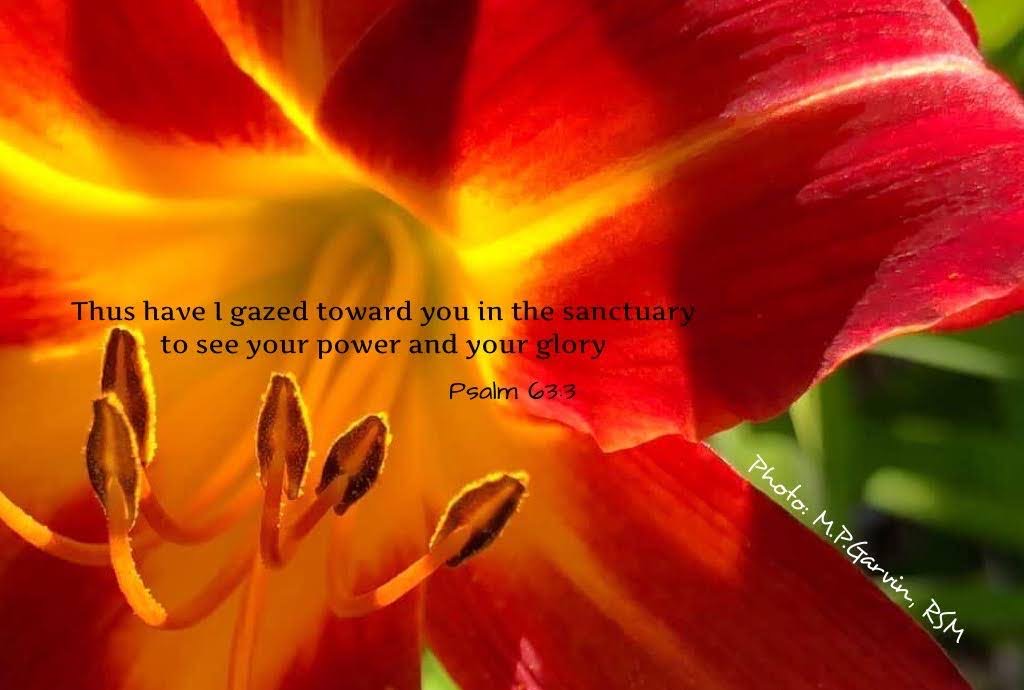
O God, you are my God whom I seek; for you my flesh pines and my soul thirsts like the earth, parched, lifeless and without water.
Thus have I gazed toward you in the sanctuary to see your power and your glory, For your kindness is a greater good than life; my lips shall glorify you.
Psalm 63: 2-4
And isn’t our spiritual life exactly like that? We feel our lives caressed by God, and yet we long for greater oneness with Infinite Love.
Mary Magdalen is the embodiment of that longing and embrace. And so the Church applies to her the powerful intimacy of our first reading:
The Bride says: On my bed at night I sought him whom my heart loves– I sought him but I did not find him. I will rise then and go about the city; in the streets and crossings I will seek Him whom my heart loves. I sought him but I did not find him. The watchmen came upon me, as they made their rounds of the city: Have you seen him whom my heart loves? I had hardly left them when I found him whom my heart loves.
Song of Songs 3:1-4
Within each one of us is a sacred mystic who longs for and seeks God’s embrace. Perhaps that mystic hibernates like a little bear hidden under all the distractions of our lives. But if we give ourselves to silence and holy waiting, the sleeping hermit will awake! 😴
We might pray with beautiful Mary Magdalen today to let that seeker in us reach for God Who is also waiting.
Poem: Song of the Soul That Is Glad to Know God by Faith – St. John of the Cross
English version by Antonio T. de Nicolas Original Language Spanish
Well I know the fountain that runs and flows, though it is night!
This eternal fountain is hidden deep. Well I know where it has its spring, Though it is night!
In this life’s dark night, Faith has taught where this cold fountain lies, Though it is night!
Its origin I cannot know, it has none, And I know all origins come from it, Though it is night!
And I know there can be nothing more fair, The heavens and earth drink there, Though it is night!
And I know it has no bed, And I know no one can cross its depths, Though it is night!
Its clarity is never clouded, And I know all light shines from it, Though it is night!
I know her streams swell so abundantly, They water people, heaven and even hell, Though it is night!
The current born of this fountain I know to be wide and mighty, Though it is night!
And from these two another stream flows, And I know neither comes before, Though it is night!
I know Three in only one water live, And each the other feeds, Though it is night!
This eternal fountain is hiding from sight Within this living bread to give us life, Though it is night!
He calls all creatures to this light, And of this water they drink, though in the dark, Though it is night!
This living fountain I desire, I see it here within this living bread, Though it is night!
Music: I Found My Beloved – John Michael Talbot
So I found my beloved in the mountains On the lonely and far distant isles O’er resounding waters I heard the whispering of love’s breezes To heal my broken heart Oh tranquil evening, silent music And the sounding solitude of the rising dawn It is there that I hear You There that I taste of You In love’s banquet to fill my heart Chorus: And I found Your footprints In the sands by the sea And like Your maiden I ran along the way to a secret chamber And there you gave to me There you taught me, O so well And I drank of your sweet spiced wine The wine of God And there I gave to You Keeping nothing for myself And I promised You forever To be your bride (Repeat Chorus) So I have abandoned All I ever sought to be And in dying My spirit has been released
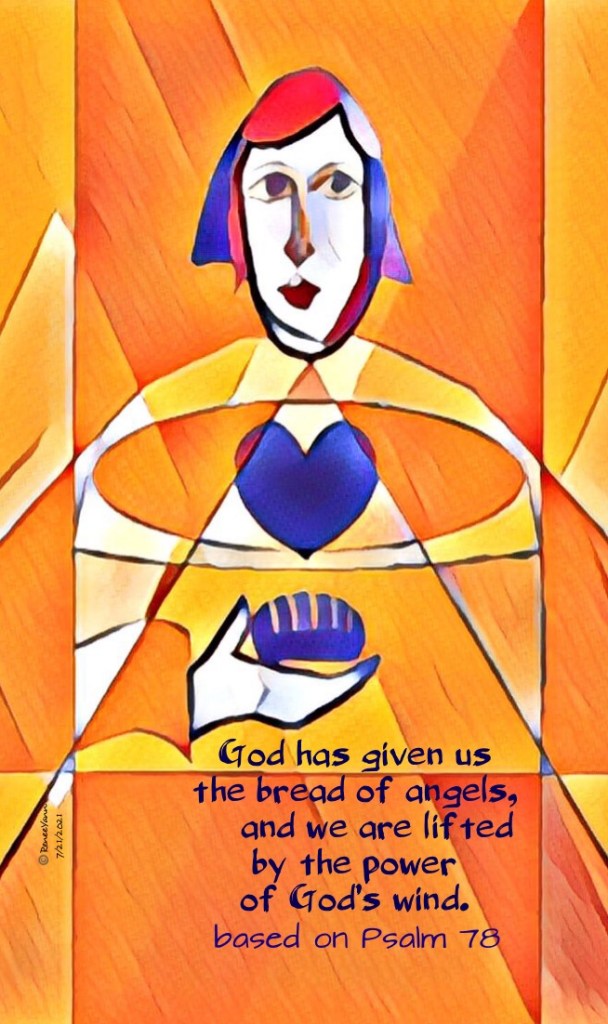
Today, in God’s Lavish Mercy, we pray with Psalm 78 which calls on the community to remember God’s constant gifts to us. Those gifts are symbolized in bread, manna from Heaven.
Thinking about the symbol of bread, this wonderful poem by Mary Oliver captured my prayer today. I leave it with you without additional comment to find your own place within it.
As I prayed with the poem, I began drawing a mandala … but it turned into an icon! (Who knew!😀) Each segment holds a memory or awareness of a particular gift God has given me.
Icons, like poems, allow the receiver a certain amount of interpretation. For example, is the figure here God, an Angel, me – or someone else? It’s up to you … enjoy the sacred play.
I hope this poem will offer you a doorway to your prayer as well.
Eat bread and understand comfort. Drink water, and understand delight. Visit the garden where the scarlet trumpets are opening their bodies for the hummingbirds who are drinking the sweetness, who are thrillingly gluttonous.
For one thing leads to another. Soon you will notice how stones shine underfoot. Eventually tides will be the only calendar you believe in.
And you will hear the air itself, like a beloved, whisper Oh let me, for a while longer, enter the two Beautiful bodies of your lungs…
The witchery of living is my whole conversation with you, my darlings. All I can tell you is what I know.
Look, and look again. This world is not just a little thrill for your eyes.
It’s more than bones. It’s more than the delicate wrist with its personal pulse. It’s more than the beating of a single heart. It’s praising. It’s giving until the giving feels like receiving. You have a life–just imagine that! You have this day, and maybe another, and maybe still another…
We do one thing or another; we stay the same, or we change. Congratulations, if you have changed.
Let me ask you this. Do you also think that beauty exists for some fabulous reason? And, if you have not been enchanted by this adventure– your life– what would do for you?
What I loved in the beginning, I think, was mostly myself. Never mind that I had to, since somebody had to. That was many years ago. Since then I have gone out from my confinements, though with difficulty. I mean the ones that thought to rule my heart. I cast them out; I put them on the mush pile. They will be nourishment somehow (everything is nourishment somehow or another).
And I have become the child of the clouds, and of hope. I have become the friend of the enemy, whoever that is. I have become older and, cherishing what I have learned, I have become younger.
And what do I risk to tell you this, which is all I know? Love yourself. Then forget it. Then, love the world.
Music: Break Thou the Bread of Life by Mary A. Lathbury (1877), and sung beautifully here by Acapeldridge
Today, in God’s Lavish Mercy, we read that triumphant Exodus passage in which the Israelites pass through the walled-up waters of the Red Sea. The images and exultations abound!
Just as the newborn is carried through the birth canal on the waters of life, so too God’s neonate people finally begin the fullness of life promised to Abraham. God accomplishes this great “delivery” by a masterful intertwining of omnipotence, human choices, and natural phenomena. The result is breathtaking!
Just as it is in our lives!
Like any great Bible story, this one invites us to find ourselves somewhere within it. At the least, we are all making a sometimes treacherous passage through life. And at particular times, maybe even now, the threats may be intense.
At times, we stand at the edge of intimidating seas, wondering how we will make it to the other side. But if we reflect on our history, we must acknowledge that – with prayer and patience – the parting wind does come. Those “chariots” at our heels become mired in our resilience, hope and trust in God.
Even through the dark night of faith, the Bright Mystery speaks to us.
In moments of astounding though quiet grace, we catch the glance of God. And we sing in thanksgiving.
The glory of this magnificent reading is captured in the Exultet, sung at the Easter Vigil.
Exult, let them exult, the hosts of heaven,
exult, let Angel ministers of God exult,
let the trumpet of salvation
sound aloud our mighty King's triumph!

Be glad, let earth be glad, as glory floods her,
ablaze with light from her eternal King,
let all corners of the earth be glad,
knowing an end to gloom and darkness.

Rejoice, let Mother Church also rejoice,
arrayed with the lightning of his glory,
let this holy building shake with joy,
filled with the mighty voices of the peoples.

(Therefore, dearest friends,
standing in the awesome glory of this holy light,
invoke with me, I ask you,
the mercy of God almighty,
that he, who has been pleased to number me,
though unworthy, among the Levites,
may pour into me his light unshadowed,
that I may sing this candle's perfect praises.)

(V. The Lord be with you.
R. And with your spirit.)
V. Lift up your hearts.
R. We lift them up to the Lord.
V. Let us give thanks to the Lord our God.
R. It is right and just.


It is truly right and just, with ardent love of mind and heart
and with devoted service of our voice,
to acclaim our God invisible, the almighty Father,
and Jesus Christ, our Lord, his Son, his Only Begotten.

Who for our sake paid Adam's debt to the eternal Father,
and, pouring out his own dear Blood,
wiped clean the record of our ancient sinfulness.

These, then, are the feasts of Passover,
in which is slain the Lamb, the one true Lamb,
whose Blood anoints the doorposts of believers.

This is the night,
when once you led our forebears, Israel's children,
from slavery in Egypt
and made them pass dry-shod through the Red Sea.

This is the night
that with a pillar of fire
banished the darkness of sin.

This is the night
that even now, throughout the world,
sets Christian believers apart from worldly vices
and from the gloom of sin,
leading them to grace
and joining them to his holy ones.

This is the night,
when Christ broke the prison-bars of death
and rose victorious from the underworld.

Our birth would have been no gain,
had we not been redeemed.

O wonder of your humble care for us!
O love, O charity beyond all telling,
to ransom a slave you gave away your Son!
O truly necessary sin of Adam,
destroyed completely by the Death of Christ!
O happy fault
that earned so great, so glorious a Redeemer!

O truly blessed night,
worthy alone to know the time and hour
when Christ rose from the underworld!

This is the night
of which it is written:
The night shall be as bright as day,
dazzling is the night for me,
and full of gladness.

The sanctifying power of this night
dispels wickedness, washes faults away,
restores innocence to the fallen, and joy to mourners,
drives out hatred, fosters concord, and brings down the mighty.
On this, your night of grace, O holy Father,
accept this candle, a solemn offering,
the work of bees and of your servants’ hands,
an evening sacrifice of praise,
this gift from your most holy Church.

But now we know the praises of this pillar,
which glowing fire ignites for God's honor,
a fire into many flames divided,
yet never dimmed by sharing of its light,
for it is fed by melting wax,
drawn out by mother bees
to build a torch so precious.

O truly blessed night,
when things of heaven are wed to those of earth,
and divine to the human.

Therefore, O Lord,
we pray you that this candle,
hallowed to the honor of your name,
may persevere undimmed,
to overcome the darkness of this night.

Receive it as a pleasing fragrance,
and let it mingle with the lights of heaven.

May this flame be found still burning
by the Morning Star:
the one Morning Star who never sets,
Christ your Son,
who, coming back from death's domain,
has shed his peaceful light on humanity,
and lives and reigns for ever and ever.

R. Amen.
Today, in God’s Lavish Mercy, we pray with a selection from Exodus which you will probably recognize from the Easter Vigil on Holy Saturday night. It describes one of the most astounding displays of power in the Hebrew Scriptures.
by Frederick Arthur Bridgman
Stand with the author on the other side of the Red Sea and feel the pounding exultation:
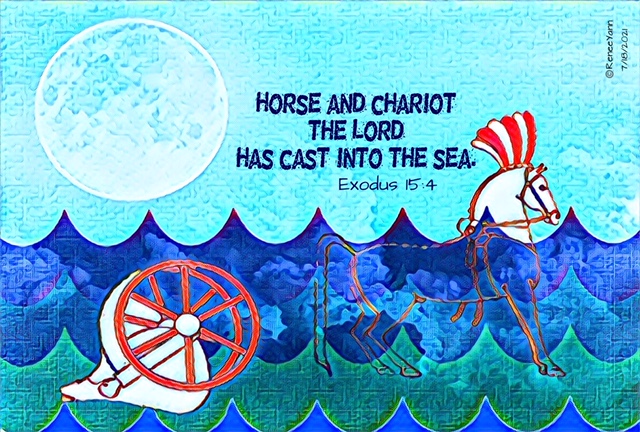
I will sing to the LORD who is gloriously triumphant; horse and chariot casting into the sea. My strength and my courage is the LORD, who has been my savior. my God, whom I praise; the God of my father, whom I extol.
It is a beautifully cadenced victory chant, and I have always loved hearing it at the vigil as we celebrate our deliverance from death through Christ’s Resurrection.
Imagine those “chariots and charioteers”, ancient symbols of power and oppression!
So Pharaoh made his chariots ready and mustered his soldiers six hundred first-class chariots and all the other chariots of Egypt, with warriors on them all.
Exodus 14: 6-7
What chance did the unarmed, rag tag horde of fleeing Israelites hold against such power?
The power they held was this – faith in God’s promise and obedience to its unfolding in their lives.
It wasn’t easy for them! Moses had to bolster them in their fear and hesitation.
But Moses answered the people, “Fear not! Stand your ground, and you will see the victory the LORD will win for you today. For these Egyptians whom you see today you will never see again. The LORD will fight for you; you have only to keep still.”
Exodus 14: 13-14
Within these readings, the parallels to our own lives are abundant. If not now, at least at some time, we will have overwhelming forces pursue us. We will be afraid. Our faith will be tested. We will doubt.
If we can “be still”, bolstering our trust in prayer, God will reveal our particular deliverance. It may not look like what we imagined, nor exactly fit what we might have prayed for.
But in trusting prayer, the flood waters of grace release and resurrect us from all that threatens our souls.
The flood waters covered them, they sank into the depths like a stone. Your right hand, O LORD, magnificent in power, your right hand, O LORD, has shattered the enemy.
Exodus 15: 5-6
Poetry: I think the psalm is its own poem today.😉
Music: Horse and Chariot – let these kids wake up our faith today!
Today, in God’s Lavish Mercy, we pray with Psalm 23, the familiar hymn of confidence, gratitude, and hope.
You, Lord, are my shepherd;
I shall not be in want.
You make me lie down in green pastures
and lead me beside still waters.
You revive my soul
and guide me along right pathways for your name’s sake.

Though I walk through the valley of the shadow of death,
I shall fear no evil;
for you are with me;
your rod and your staff, they comfort me.

You spread a table before me
in the presence of those who trouble me;
you have anointed my head with oil,
and my cup is running over.

Surely goodness and mercy shall follow me
all the days of my life,
and I will dwell in the house of the Lord forever.
Praying this psalm, we are enfolded into the arms of a loving God.
This beautiful image, which is beloved to us even in our highly urbanized society, certainly held even greater meaning to the early Christians. They understood, from experience, the utter self-donation of a shepherd to his flock. The shepherd needs the sheep in order to live, just as they need the shepherd. Their lives were critically interdependent.
In a sense, the shepherd became one with the sheep. From sunrise to sunset, and even through the night, he led them to food, water, and rest. He protected them as they slept, by laying his own body across the sheep gate.
In our own time, a more familiar image might be that of a horse-whisperer, someone who through natural sensitivity and studious training, is able to understand and communicate with animals. Rather than “breaking” a horse, as seen in old westerns, the horse-whisperer leads them to trust by listening and responding to them through body-language.
As we pray with the image of the Good Shepherd today, we might imagine Jesus as our “Soul-Whisperer”. Jesus stands beside us in the vast, open loneliness of life, which sometimes tries to “break” us. But we are never alone. He is listening. As he opens our life before us, let us trust and follow him. He has made our welfare his own by becoming one of us.
Poetry: I Am the Door of the Sheepfold – Malcolm Guite
Not one that’s gently hinged or deftly hung,
Not like the ones you planed at Joseph’s place,
Not like the well-oiled openings that swung
So easily for Pilate’s practiced pace,

Not like the ones that closed in Mary’s face
From house to house in brimming Bethlehem,
Not like the one that no man may assail,
The dreadful curtain, The forbidding veil
That waits your breaking in Jerusalem.

Not one you made but one you have become:
Load-bearing, balancing, a weighted beam
To bridge the gap, to bring us within reach
Of your high pasture. Calling us by name,
You lay your body down across the breach,
Yourself the door that opens into home.
Today, in God’s Lavish Mercy, we pray with Psalm 136 in which the psalmist remembers in detail Israel’s long experience of God’s enduring fidelity.
The cadence of the psalm creates an underlying drumbeat to our prayer, a chant of gratitude and confidence. Reading it, I was reminded of two things.
The first is a scene from the movie “Glory” where the troops pray the night before battle. They pray in the classic style of the Black spiritual call-and-response song.
You may have seen it:
The prayer of these men, like the prayer of ancient Israel, is not just a walk down memory lane. No. Each proclamation is an act of of faith – and of gratitude for the past, courage for the present, and hope for the future.
Secondly, I was reminded of the simple and methodical cadence of a childhood ditty – S/he loves me S/he loves me not. Didn’t many of us try that magic practice at least once, maybe at our first young crush?
Well, God does love us – daisy or not. The proof is not in the petals, but in the story of our lives.
Today might be a good day to “chant” gratefully through our own catalogue with God – remembering, thanking, believing,and hoping.
Poetry: I thank you, God – e.e.cummings
i thank You God for most this amazing
day:for the leaping greenly spirits of trees
and a blue true dream of sky;and for everything
which is natural which is infinite which is yes
(i who have died am alive again today,
and this is the sun’s birthday;this is the birth
day of life and of love and wings:and of the gay
great happening illimitably earth)
how should tasting touching hearing seeing
breathing any—lifted from the no
of all nothing—human merely being
doubt unimaginable You?
(now the ears of my ears awake and
now the eyes of my eyes are opened)
Music: Swing Low, Sweet Chariot – Etta James sings a classical example of the call-and-response spiritual
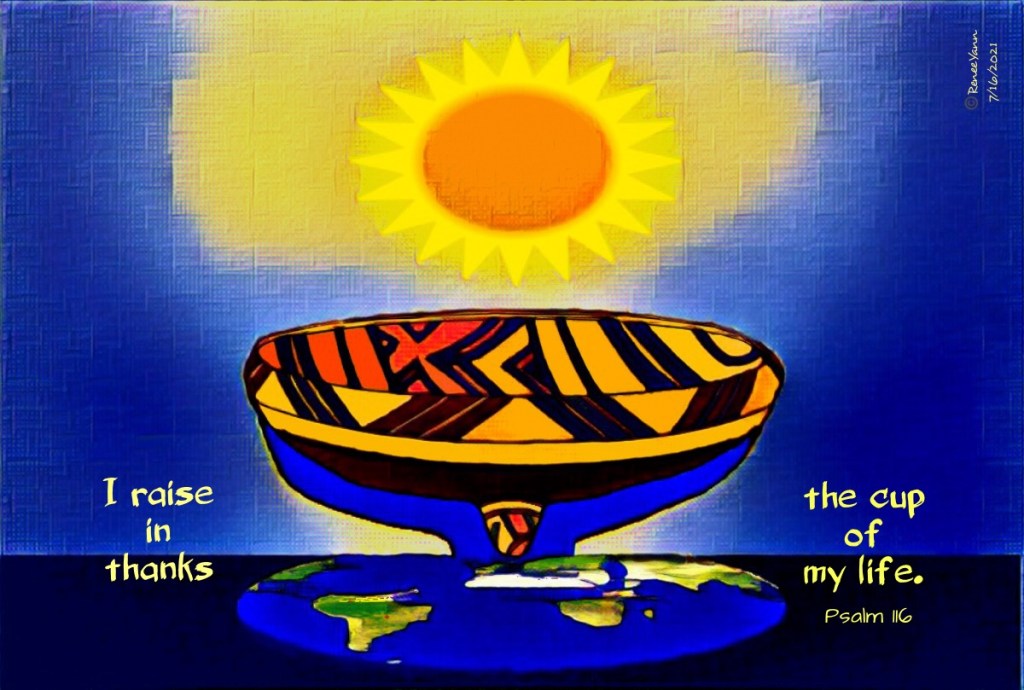
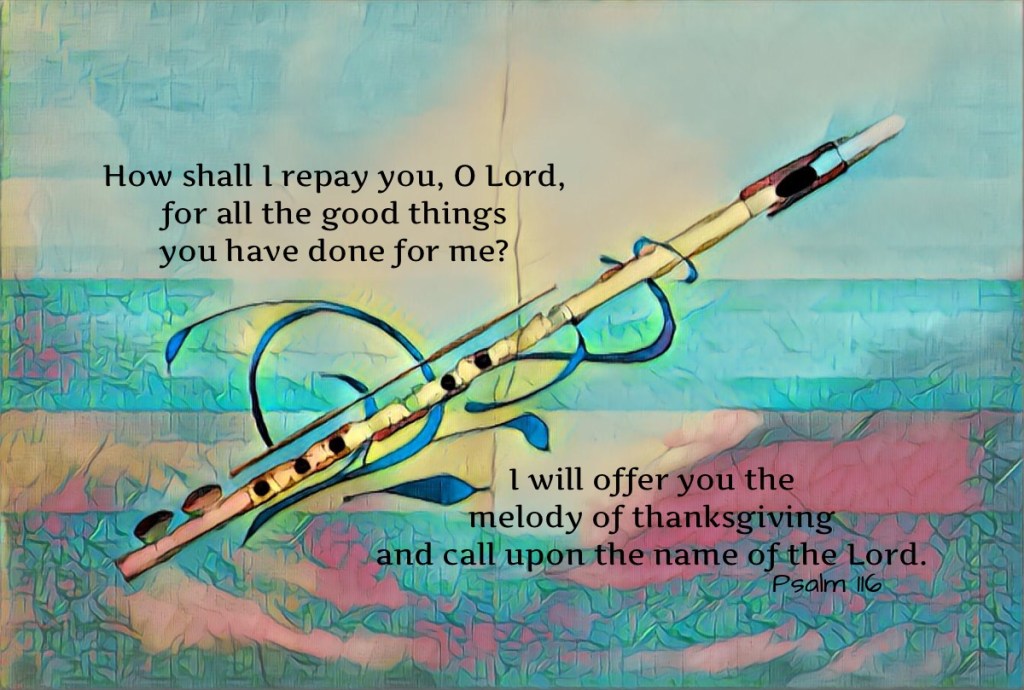
Today, in God’s Lavish Mercy, we pray with Psalm 116, a lyrical interweaving of thanksgiving and praise.
I love this beautiful psalm which expresses the heart’s overwhelming gratitude for the whole mystery of one’s life.
How shall I make a return to the LORD for all the good God has done for me? The cup of salvation I will take up, and I will call upon the name of the LORD.
Psalm 116:12-13
The gratitude is so profound that we must call on the Holy Spirit to understand our awed silence and to pray within us.
This prayer always comes to my mind when one of our Sisters dies. The witness of her life, remembered in our funeral rituals, always stirs me to deeper faith and gratitude.
Precious in your eyes, O LORD is the death of your faithful one, your servant, who has freely and lovingly served you. To you she has offered the sacrifice of thanksgiving, and called upon your name, O LORD. Her vows to the LORD she has paid in the presence of all your people.
Psalm 116: 15-18
It is with perfect timing that this sacred psalm comes up in Friday’s liturgy. At the Motherhouse in Plainfield,NJ, a wonderful Sister of Mercy is laid to rest today – Sister Diane Szubrowski. Her vows to the Lord she has paid – with faith and mercy. May she rest in Glory!
Poetry: Grateful – Thomas Merton
To be grateful
is to recognize
the love of God
in everything.
Music: My Vows to the Lord – John Michael Talbot (lyrics below








 Lavish Mercy