Blessings of St. Paddy’s Day

Sláinte means “health” in Irish and Scottish Gaelic

Our dear St. Patrick, on this glorious feast, gives us the perfect prayer to strengthen and direct our hearts. We pray in gratitude for all our ancestors on whose shoulders we stand.

I arise today
Through the strength of heaven;
Light of the sun,
Splendor of fire,
Speed of lightning,
Swiftness of the wind,
Depth of the sea,
Stability of the earth,
Firmness of the rock.
I arise today
Through God’s strength to pilot me;
God’s might to uphold me,
God’s wisdom to guide me,
God’s eye to look before me,
God’s ear to hear me,
God’s word to speak for me,
God’s hand to guard me,
God’s way to lie before me,
God’s shield to protect me,
God’s hosts to save me
Afar and anear,
Alone or in a mulitude.
Christ shield me today
Against wounding
Christ with me, Christ before me, Christ behind me,
Christ in me, Christ beneath me, Christ above me,
Christ on my right, Christ on my left,
Christ when I lie down, Christ when I sit down,
Christ in the heart of everyone who thinks of me,
Christ in the mouth of everyone who speaks of me,
Christ in the eye that sees me,
Christ in the ear that hears me.
I arise today
Through the mighty strength
Of the Lord of creation

There were people of all ages
Gathered round the gable wall
Poor and humble men and women
Little children that you would call
We are gathered here before you
And our hearts are just the same
Filled with joy at such a vision
As we praise your name

Golden Rose, Queen of Ireland
All my cares and troubles cease
As I kneel with love before you
Lady of Knock, my Queen of Peace

Oh, your message is unspoken
But the truth in silence lies
So I gaze upon your vision
And the truth I try to find
Here I stand, with John the teacher
And with Joseph at your side
And I see the lamb of God
On the altar glorified

Golden Rose, Queen of Ireland
All my cares and troubles cease
As we kneel with love before you
Lady of Knock, my Queen of Peace

And the lamb will conquer
And the woman clothed in the sun
Will shine her light on everyone
And the lamb will conquer
And the woman clothed in the sun
Will shine her light on everyone

Golden Rose, Queen of Ireland
All our cares and troubles cease
As we kneel with love before you
Lady of Knock, my Queen of Peace

Inscribe

Fifth Sunday of Lent
March 17, 2024

Today’s Readings:

https://bible.usccb.org/bible/readings/031724-YearB.cfm


I will place my law within them and write it upon their hearts;
I will be their God, and they shall be my people.
No longer will they have need to teach their friends and relatives
how to know the LORD.
All, from least to greatest, shall know me, says the LORD,
for I will forgive their evildoing and remember their sin no more.

Jeremiah 31: 33-34

My Uncle Joe was full of life – a little wildness, a little wisdom, and a lot of love. Only seventeen years older than I, he was more like my older brother. His mother, my grandmother, died when I was almost three and he was twenty. One night months later, after partying with his buddies, he came home with a big tattoo on his upper arm something like this:

There is a whole psychology around why people get tattoos, but I think it boils down to expressing something that’s otherwise inexpressible. The tattoo was Joe’s way of holding on to someone who had anchored his life.

Today, in God’s Lavish Mercy:

In our first reading, Jeremiah kind of tells us that if God had tattoos, our name would be one of them. We are inscribed on God’s heart in an inexpressible covenant of love. Let’s live so that, if our hearts became visible, God’s Name would be clearly etched there as well.


Poetry: I carry your heart – e.e.cummings

i carry your heart with me (I carry it in
my heart) i am never without it (anywhere
i go you go, my dear ;and whatever is done
by only me is your doing, my darling)
i fear
no fate (for you are my fate, my sweet) I want
no world (for beautiful you are my world, my true)
and it’s you are whatever a moon has always meant
and whatever a sun will always sing is you
here is the deepest secret nobody knows
(here is the root of the root and the bud of the bud
and the sky of the sky of a tree called life; which grows
higher than soul can hope or mind can hide)
and this is the wonder that’s keeping the stars apart
i carry your heart (i carry it in my heart)

Music: Still by Stephen Peppos

Plot

Saturday of the Fourth Week of Lent
March 16, 2024

Today’s Readings:

https://bible.usccb.org/bible/readings/031624.cfm


Yet I, like a trusting lamb led to slaughter,
had not realized that they were hatching plots against me:
“Let us destroy the tree in its vigor;
let us cut him off from the land of the living,
so that his name will be spoken no more.”

Jeremiah 11:19

“Plot” can be an ugly word – a sinister trap woven in the darkness of fear and ignorance. Such plotters are befuddled by innocence, freedom, honesty, and goodness. Without these virtues themselves, they have no tools to meet challenges with sincerity and trust..

In our readings, we see darkened souls interweaving their fears to trap both Jeremiah and Jesus. It’s a picture of “conspiracy theories” in Biblical times!

In our current culture, we see people design elaborate arguments to justify war, rioting, oppression, weaponry, economic excess, and all the many “isms” that trap others in their vulnerability.

Lent is not just a remembrance of things past. It is a living participation in the Paschal Mystery as Christ experiences it in our times. We must ask ourselves if we ever stand with, or even silently near, the “plotters”.


Poem: The Second Crucifixion – Richard Le Gallienne (1866 – 1947)

LOUD mockers in the roaring street   
  Say Christ is crucified again:   
Twice pierced His gospel-bearing feet,   
  Twice broken His great heart in vain.   
  
I hear, and to myself I smile,          
For Christ talks with me all the while.   
  
No angel now to roll the stone   
  From off His unawaking sleep,   
In vain shall Mary watch alone,   
  In vain the soldiers vigil keep.   
  
Yet while they deem my Lord is dead   
My eyes are on His shining head.   
  
Ah! never more shall Mary hear   
  That voice exceeding sweet and low   
Within the garden calling clear:   
  Her Lord is gone, and she must go.   
  
Yet all the while my Lord I meet   
In every London lane and street.   
  
Poor Lazarus shall wait in vain,   
  And Bartimæus still go blind;   
The healing hem shall ne'er again   
  Be touch'd by suffering humankind.   
  
Yet all the while I see them rest,   
The poor and outcast, on His breast.   
  
No more unto the stubborn heart   
  With gentle knocking shall He plead,   
No more the mystic pity start,   
  For Christ twice dead is dead indeed.   
  
So in the street I hear men say,   
Yet Christ is with me all the day.

Music: Agnus Dei – Michael Hoppé

Recompense

Friday of the Fourth Week of Lent
March 15, 2024

Today’s readings:

https://bible.usccb.org/bible/readings/031524.cfm


The wicked said among themselves…
“Let us condemn him to a shameful death;
for according to his own words, God will take care of him.”
These were their thoughts, but they erred;
for their wickedness blinded them,
and they knew not the hidden counsels of God;
neither did they count on a recompense of holiness
nor discern the innocent souls’ reward.

Wisdom 2: 20-22

In our readings, the Holy One meets the opposition of those who plot against him. They rationalize their persecutions, proclaiming them as acts of justice. They expect their victim to crumble under the pressure of their judgments. What they do not expect is a return of goodness, gentleness, and forgiveness – a recompense of holiness. They do not expect the great contradiction of the Cross, and they are incapable of comprehending it.

Today, in God’s Lavish Mercy:

As Lent deepens, and we come closer to the shadows of Calvary, we are summoned into the sufferings of Jesus to test our own understanding of this Great Contradiction.

What does Christ teach us about payback, unforgiveness, revenge, violence, and war – the popular “recompenses” of our culture to any resistance or injury we encounter?

What might a “recompense of holiness” look like in my life when I meet gracelessness in another person or situation?

How might it transform our belligerent culture if we modeled our behaviors on the holiness of Jesus?


Poetry: Peace-making Is Hard …. – Daniel Berrigan, SJ

hard almost as war. 
the difference being 
one we can stake life upon 
and limb and thought and love.
I stake this poem out 
dead man to a dead stick 
to tempt an Easter chance— 
if faith may be 
truth, our evil chance 
penultimate at last, 
not last. We are not lost. 
When these lines gathered 
of no resource at all 
serenity and strength, 
it dawned on me 
a man stood on his nails, 
an ash like dew, a sweat 
smelling of death and life. 
Our evil Friday fled, 
the blind face gently turned 
another way. Toward Life. 
A man walks in his shroud. 

Music: He Trusted in God – from Handel’s Messiah

Calf

Thursday of the Fourth Week of Lent
March 14, 2024

Today’s Readings:

https://bible.usccb.org/bible/readings/031424.cfm


The LORD said to Moses,
“Go down at once to your people
whom you brought out of the land of Egypt,
for they have become depraved.
They have soon turned aside from the way I pointed out to them,
making for themselves a molten calf and worshiping it,
sacrificing to it and crying out,
‘This is your God, O Israel,
who brought you out of the land of Egypt!’

Exodus 32: 7-8

Today’s readings give us Moses and John the Baptist, each serving as a bridge over the chasm between a faithful God and a faithless people. Both met blockades in their attempts to lead the people to their God, just as Jesus meets opposition in today’s Gospel.

For Moses, the blockade was the golden calf, symbol of all the fragile pretensions we substitute for a true and committed faith. Real faith is dangerous. It asks us to risk ourselves on realities we cannot see. Glittering gold, even in the form of a beast, feels so much more secure!

Today, in God’s Lavish Mercy:

Let’s have the courage to look for the golden calves in our lives

  • a greed for control, power which limits others’ freedom
  • any form of disrespect or indifference toward another’s dignity
  • the lust for, or abuse of money or goods
  • willfulness that limits my own spiritual growth, or the spiritual joy of others

Poetry: The Golden Calf – John Newton (1725-1807), also author of “Amazing Grace”.

When Israel heard the fiery law,
From Sinai's top proclaimed;
Their hearts seemed full of holy awe,
Their stubborn spirits tamed.
Yet, as forgetting all they knew,
Ere forty days were past;
With blazing Sinai still in view,
A molten calf they cast.
Yea, Aaron, God's anointed priest,
Who on the mount had been
He durst prepare the idol-beast,
And lead them on to sin.
Lord, what is man! and what are we,
To recompense thee thus!
In their offence our own we see,
Their story points at us.
From Sinai we have heard thee speak,
And from mount Calv'ry too;
And yet to idols oft we seek,
While thou art in our view.
Some golden calf, or golden dream,
Some fancied creature-good,
Presumes to share the heart with him,
Who bought the whole with blood.
Lord, save us from our golden calves,
Our sin with grief we own;
We would no more be thine by halves,
But live to thee alone.

Music: Song of the Golden Calf from the opera Faust by Charles Gounod

Mother

Wednesday of the Fourth Week of Lent
March 13, 2024

Today’s Readings:

https://bible.usccb.org/bible/readings/031324.cfm


But Zion said, “The LORD has forsaken me;
my Lord has forgotten me.”
Can a mother forget her infant,
be without tenderness for the child of her womb?
Even should she forget,
I will never forget you.

Isaiah 49: 14-15

In our Gospel, Jesus tells his questioners that he and the Creator are One. Jesus uses the imagery of “Father” to connote his oneness with the Creator. Isaiah uses the imagery of a “Mother” to convey the depth of loving relationship we are given in God.

Throughout Scripture and through the long spiritual legacy of the Church, many images of God have been offered to deepen our prayer.

  • Scripture gives us God as King, Suffering Servant, Rock, Fortress, Shepherd …
  • John of the Cross imaged God as Lover, Francis of Assisi and Hadewijch of Brabant found God in Creation. Therese of Lisieux knew herself as a child of God.
  • The poet Francis Thompson sees God as the Hound of Heaven, William Blake as a Lamb.

Today, in God’s Lavish Mercy:

Depending on our human relationships and experiences, some of these images help us with our prayer and some do not.

Today we might consider how we relate to our Invisible God. Our prayer can open our understanding to allow God’s Love to come nearer to us. This is something Isaiah understood when he imaged God as Mother, and that Jesus understood when he called God “Father”.


Poetry: The Divine Feminine – by Hildegard of Bingen who is only the fourth woman in history to be declared a Doctor of the Church, joining the names of Catherine of Sienna, Teresa of Avila, and Therese of Lisieux.

I heard a voice speaking to me: 
‘The young woman whom you see is Love.
She has her tent in eternity…
It was love that was the source of this creation
in the beginning when God said: ‘Let it be!’
And it was.

As though in the blinking of an eye,
the whole creation was formed through love.
The young woman is radiant
in such a clear, lightning-like brilliance of countenance
that you can’t fully look at her…
She holds the sun and moon in her right hand
and embraces them tenderly…

The whole of creation calls this maiden ‘Lady.’
For it was from her that all of creation proceeded,
since Love was the first. She made everything…
Love was in eternity and brought forth,
in the beginning of all holiness,
all creatures without any admixture of evil.
Adam and Eve, as well were produced by love
from the pure nature of the Earth.”

Music: 1,000 Names – Phil Wickham

Water

Tuesday of the Fourth Week of Lent
March 12, 2024

https://bible.usccb.org/bible/readings/031224.cfm


There is a stream whose runlets gladden the city of God,
the holy dwelling of the Most High.
God is in its midst; it shall not be disturbed;
God will help it at the break of dawn.

Psalm 46:5-6

Our Psalm today connects two readings centered around life-giving water.

Ezekiel’s watery vision offers a symbolic interpretation of the life-force flowing from God’s heart (symbolized by the Temple) to all Creation.

In our Gospel, a man waits for decades beside the waters of an inaccessible pool until Jesus cures him – until Jesus himself becomes the “Water of Life”.


Today, in God’s Lavish Mercy:

Imagine yourself being blessed by life-giving water – maybe a cool swim on a blistering day, or a warm bath on a frosty one.

Imagine walking in a gentle summer rain, no umbrella, no puddle prohibitions.

If you love the ocean, imagine diving under soft waves at flood tide, belly-riding them back, again and again, to a warm, quiet beach.

Now imagine that all that water is God’s Love for you, because it is. And let your heart pray with a joy similar to today’s psalmist!


Poetry: The Waterfall – Henry Vaughan (1621-1695)

With what deep murmurs through time’s silent stealth
Doth thy transparent, cool, and wat’ry wealth
Here flowing fall,
And chide, and call,
As if his liquid, loose retinue stay’d
Ling’ring, and were of this steep place afraid;
The common pass
Where, clear as glass,
All must descend
Not to an end,
But quicken’d by this deep and rocky grave,
Rise to a longer course more bright and brave.

Dear stream! dear bank, where often I
Have sate and pleas’d my pensive eye,
Why, since each drop of thy quick store
Runs thither whence it flow’d before,
Should poor souls fear a shade or night,
Who came, sure, from a sea of light?
Or since those drops are all sent back
So sure to thee, that none doth lack,
Why should frail flesh doubt any more
That what God takes, he’ll not restore?

O useful element and clear!
My sacred wash and cleanser here,
My first consigner unto those
Fountains of life where the Lamb goes!
What sublime truths and wholesome themes
Lodge in thy mystical deep streams!
Such as dull man can never find
Unless that Spirit lead his mind
Which first upon thy face did move,
And hatch’d all with his quick’ning love.
As this loud brook’s incessant fall
In streaming rings restagnates all,
Which reach by course the bank, and then
Are no more seen, just so pass men.
O my invisible estate,
My glorious liberty, still late!
Thou art the channel my soul seeks,
Not this with cataracts and creeks.

Music: How Deep Is the Ocean
As you listen to the smooth jazz of Diana Krall, let yourself be in love with God who raises you from beside whatever pool where you’ve been lingering.

Create

Monday of the Fourth Week of Lent
March 11, 2024

Today’s Readings:

https://bible.usccb.org/bible/readings/031124.cfm


Thus says the LORD:
Lo, I am about to create new heavens
and a new earth;
The things of the past shall not be remembered
or come to mind.
Instead, there shall always be rejoicing and happiness
in what I create;
For I create Jerusalem to be a joy
and its people to be a delight;
I will rejoice in Jerusalem
and exult in my people.

Isaiah 65: 17-19a

To create – not just “to make”, the way we make a cake, or a snowball, or a campfire which always depends on our ideation for existence.

But rather to generate something new, fully enlivened and freed by our faith, hope, and love – to be no longer what was made, but to become itself.

This is how God dreamed Creation to Life, around us and in us. This is how we and all Creation are re-created in the Paschal Mystery and in the Eucharist.


Today, in God’s Lavish Mercy, let’s pray with this powerful act of praise over a New Creation:

from The Mass on the World – Pierre Teilhard De Chardin

“Since once again, Lord - though this time not in the forests of the Aisne but in the steppes of Asia - I have neither bread, nor wine, nor altar, I will raise myself beyond these symbols, up to the pure majesty of the Real itself; I, your priest, will make the whole earth my altar and on it will offer you all the labours and sufferings of the world.
Over there, on the horizon, the sun has just touched with light the outermost fringe of the eastern sky. Once again, beneath this moving sheet of fire, the living surface of the earth wakes and trembles, and once again begins its fearful travail. I will place on my paten, O God, the harvest to be won by this renewal of labour. Into my chalice I shall pour all the sap which is to be pressed out this day from the earth’s fruits.

My paten and my chalice are the depths of a soul laid widely open to all the forces which in a moment will rise up from every corner of the earth and converge upon the Spirit. Grant me the remembrance and the mystic presence of all those whom the light is now awakening to the new day . . .

Over every living thing which is to spring up, to grow, to flower, to ripen during this day say again the words: ‘This is my Body’. And over every death-force which waits in readiness to corrode, to wither, to cut down, speak again your commanding words which express the supreme mystery of faith: ‘This is my Blood’.”

Music: Essence – Peter Kater

Loved

Fourth Sunday of Lent 
March 10, 2024

Today’s Readings:

https://bible.usccb.org/bible/readings/031024-YearB.cfm


For God so loved the world that he gave his only Son,
so that everyone who believes in him might not perish
but might have eternal life.
For God did not send his Son into the world to condemn the world,
but that the world might be saved through him.

John 3:16-17

For some of us, it’s hard to believe in a God we do not see. This passage from John suggests that God understands how hard it is. So that believers might not “perish” in their natural doubts, God made Divinity visible in Jesus Christ. The reason? Infinite Love for and desire to be one with us.

Today, in God’s Lavish Mercy:

Let’s rest in the confidence and gratitude this passage ignites in our hearts. God loves us — loves you — enough to become like you so that you might become like God.


Poetry: Infinite Love – Julian of Norwich, who was an English anchoress of the Middle Ages. Her writings, now known as Revelations of Divine Love, are the earliest surviving English language works by a woman. They are also the only surviving English language works by an anchoress. ( An anchoress is someone who, for religious reasons, withdraws from secular society to be able to lead an intensely prayer-orientated, ascetic, or Eucharist-focused life.)

Infinite Love

Because of the great,
infinite love which God has for all humankind,
he makes no distinction in love
between the blessed soul of Christ
and the lowliest of the souls that are to be saved . . . .
We should highly rejoice that God dwells in our soul
and still more highly should we rejoice
that our soul dwells in God.
Our soul is made to be God’s dwelling place,
and the dwelling place of our soul
is God who was never made.

Music: God So Loved the World – Mormon Tabernacle Choir

Piety

Saturday of the Third Week of Lent
March 9, 2024

Today’s Readings:

https://bible.usccb.org/bible/readings/030924.cfm


Your piety is like a morning cloud,
like the dew that early passes away.

Hosea 6:4

_______

… the tax collector stood off at a distance
and would not even raise his eyes to heaven
but beat his breast and prayed,
‘O God, be merciful to me a sinner.’
I tell you, the latter went home justified, not the former;
for everyone who exalts himself will be humbled,
and the one who humbles himself will be exalted.”

Luke 18: 13-14

I think the word “Piety” has taken on a rather saccharine connotation because we mistake it for an overly sentimental, and sometimes insincere, devotion. However, the word piety comes from the Latin word pietas, the noun form of the adjective pius (which means “devout” or “dutiful”).

Today, in God’s Lavish Mercy:

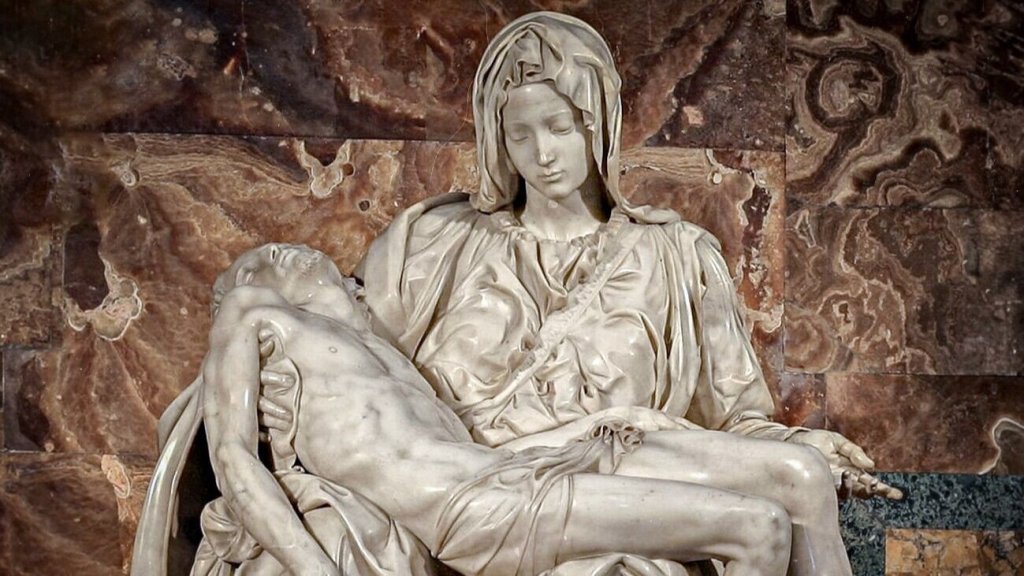
Picture Michelangelo’s Pieta. Let yourself feel the emotion captured in the heart of that sculpture. That is pietas/piety – a deep, penetrating presence and love that cannot fully be put into words. A humble, sincere prayer like that of the tax collector is the fruit of such piety.

Most of us are not great sinners. We just make some mean – and perhaps continual – choices that can block the flow of grace into our hearts. God stands beside us as we make such choices, ready to hear us when we turn and ask for the Mercy that will free and deepen us.


Prose: from Point Counterpoint by Aldous Huxley

Aldous Huxley (1894 – 1963) was an English writer and philosopher. His bibliography spans nearly 50 books, including novels and non-fiction works, essays, narratives, and poems.
By the end of his life, Huxley was widely acknowledged as one of the foremost intellectuals of his time. He was nominated for the Nobel Prize in Literature nine times.

From the quote below, Huxley obviously had strong opinions about religion but especially about false piety. Although Jesus would never have put it this way, the sentiments echo those in today’s readings.


“In the abstract you know that music exists and is beautiful. But don’t therefore pretend, when you hear Mozart, to go into raptures which you don’t feel. If you do, you become one of those idiotic music-snobs … unable to distinguish Bach from Wagner, but mooing with ecstasy as soon as the fiddles strike up. 

It’s exactly the same with God. The world’s full of ridiculous God-snobs. People who aren’t really alive, who’ve never done any vital act, who aren’t in any living relation with anything; people who haven’t the slightest personal or practical knowledge of what God is. But they moo away in churches, they coo over their prayers, they pervert and destroy their whole dismal existences by acting in accordance with the will of an arbitrarily imagined abstraction which they choose to call God.

Just a pack of God-snobs. They’re as grotesque and contemptible as the music-snobs … but nobody has the sense to say so. The God-snobs are admired for being so good and pious and Christian. When they’re merely dead and ought to be having their bottoms kicked and their noses tweaked to make them sit up and come to life.”