Incredible Things

Monday of the Second Week of Advent
December 11, 2023

Today’s Readings:

https://bible.usccb.org/bible/readings/121123.cfm


Today, in God’s Lavish Mercy, Isaiah speaks to a weary and forlorn people, a people captive in the desolate land of their conquers. He tells them that the brown dust of their lives will blossom like a magical garden. He tells the wobbly, weakened masses that they will be rejuvenated beyond their wildest dreams:

Strengthen the hands that are feeble,
make firm the knees that are weak,
Say to those whose hearts are frightened:
Be strong, fear not!
Here is your God,
he comes with vindication;
With divine recompense
he comes to save you.
Then will the eyes of the blind be opened,
the ears of the deaf be cleared;
Then will the lame leap like a stag,
then the tongue of the mute will sing.

Isaiah 35:3-6

In our Gospel, Jesus tells the crowd the same thing.

In that crowd, there is a dynamic mix of believers and unbelievers. On the one hand, we have the spiritually stodgy Pharisees who like rules better than miracles. On the other hand, we have these outrageously hopeful young men who are willing to blow the roof off to place their friend under Jesus’s miraculous gaze.

Then the scribes and Pharisees began to ask themselves,
“Who is this who speaks blasphemies?
Who but God alone can forgive sins?”
Jesus knew their thoughts and said to them in reply,
“What are you thinking in your hearts?
Which is easier, to say, ‘Your sins are forgiven,’
or to say, ‘Rise and walk’?
But that you may know
that the Son of Man has authority on earth to forgive sins”–
he said to the one who was paralyzed,
“I say to you, rise, pick up your stretcher, and go home.”

He stood up immediately before them,
picked up what he had been lying on,
and went home, glorifying God.

Luke 5:21-25

Wouldn’t you just love to have been a fly on the wall when that paralyzed kid got up and skipped home! The stunned expressions on the pharisaical faces! The grateful oohs and aahs of those who wanted to believe! The profound awe of his disciples as they realize more deeply who it is that they have come to love!


Throughout the centuries, those with a deep and sincere desire to believe have seen incredible things. The eyes of faith have allowed them to see beyond the dusty surface of appearances.. For those who refuse to believe, even the miracles right in front of them are invisible.


I think that seeing the miracles in our lives is a little bit like seeing a meteor shower. First of all, we have to go outside. We have to look UP! We have to keep our eyes open. And we have to wait.

All moments, maybe especially the dark ones, hold a heavenly cascade of grace. During this holy time, as we await the Infinite Miracle of Love, let’s focus our hearts on watching, waiting, and celebrating these incredible yet daily graces:

  • that we have been given the gift of life
  • that our minds and hearts have the insight to seek God in prayer
  • that we are capable of giving and receiving love
  • that we can hope and heal
  • that we have been touched and changed by Mercy
  • that we are infinitely loved by God

Each one of our lists goes on and on. Pray yours today with the scriptural encouragement of Jesus and Isaiah!


Poetry: The Lord Will Come and not be Slow – John Milton

The Lord will come and not be slow,
his footsteps cannot err;
before him righteousness shall go,
his royal harbinger.
Truth from the earth, like to a flower,
shall bud and blossom then;
and justice, from her heavenly bower,
look down on mortal men.
Surely to such as do him fear
salvation is at hand!
And glory shall ere long appear
to dwell within our land.
Rise, God, judge thou the earth in might,
this wicked earth redress;
for thou art he who shalt by right
the nations all possess.
The nations all whom thou hast made
shall come, and all shall frame
to bow them low before thee, Lord,
and glorify thy Name.
For great thou art, and wonders great
by thy strong hand are done:
thou in thy everlasting seat
remainest God alone.

Music: Miracles – Kari Jobe

Renewal Offer

Second Sunday of Advent
December 10, 2023

Today’s Readings:

https://bible.usccb.org/bible/readings/121023.cfm


Today, in God’s Lavish Mercy, our readings ask us, for an Advent moment, to disentangle ourselves from time and space, and to see the world as God sees it.


Isaiah, hearing God’s insistence in his prophet’s heart, assures us of God’s mercy and of our deliverance from the world’s confusions:

Handel: Messiah / Part 1 – “Comfort ye, My people… Ev’ry Valley shall be exalted”
Conducted by Sir Neville Mariner

Comfort, give comfort to my people,
says your God.
Speak tenderly to Jerusalem, and proclaim to her
that her service is at an end,
her guilt is expiated;
indeed, she has received from the hand of the LORD
double for all her sins.

Isaiah 40: 1-2

Isaiah analogizes these confusions in rich terrestrial metaphors: a desert, a wasteland, a depressed valley, a rough road. Probably most of us have been in one or two of these spots in the past year. Am I right?

A voice cries out:
In the desert prepare the way of the LORD!
Make straight in the wasteland a highway for our God!
Every valley shall be filled in,
every mountain and hill shall be made low;
the rugged land shall be made a plain,
the rough country, a broad valley.
Then the glory of the LORD shall be revealed,
and all people shall see it together;
for the mouth of the LORD has spoken.

Isaiah 40:3-5

But just how is our deliverance from these dead-end places to be accomplished? Peter offers an answer – it is accomplished through repentance.

Do not ignore this one fact, beloved,
that with the Lord one day is like a thousand years
and a thousand years like one day.
The Lord does not delay his promise, as some regard “delay,”
but he is patient with you,
not wishing that any should perish
but that all should come to repentance.

2 Peter 3:8-9

If we were lost in a desert or trapped in an unscalable valley, all we would want is to get out. We might not pause to ask ourselves, “How did I get here?”, or “How can I avoid a return?”. The same thing might be true of our spiritual deserts and valleys.

Isaiah, Peter, and Jesus tell us that it is our resistance to God’s vision, our sinfulness, that captures us in our desolations – and that “repentance” is the antidote.

Since everything is to be dissolved in this way,
what sort of persons ought you to be,
conducting yourselves in holiness and devotion,
waiting for and hastening the coming of the day of God,
because of which the heavens will be dissolved in flames
and the elements melted by fire.
But according to his promise
we await new heavens and a new earth
in which righteousness dwells.
Therefore, beloved, since you await these things,
be eager to be found without spot or blemish before him, at peace.

2 Peter 3:11-14

In our Gospel, John the Baptist also tells us to repent. And, honestly, when I first read his Advent proclamation every year, I find myself telling God something like this:

You know, dear God, I’m not really that bad off that I need to — well, you know…. like actually REPENT!!!! I’ve been doing the best I can. I’m one of the “Goodies” in this bad, bad world! You see that, don’t You?

Then Isaiah’s gentle Shepherd comes along, lifts me into those comforting arms, and convinces me that the world can be transformed if I will let myself see it as God sees it. All the normalized uncharities of my life — the judgments, the ungenerous hesitations, the excused prejudices, the unforgiven mistakes, the selfish expectations. Yes, all those deserts and valleys that we dismiss unresolved will just accumulate and stagnate in our listless spirits! It is from these crooked ways that God offers to deliver us once again in this year’s Advent reimagining.


So, what a wonderful invitation we receive in today’s readings! It is time to begin again – fresh, reinvigorated, and amazed at the power of grace in our lives!

Go up on to a high mountain,
Zion, herald of glad tidings;
cry out at the top of your voice,
Jerusalem, herald of good news!
Fear not to cry out
and say to the cities of Judah:
Here is your God!
Here comes with power
the Lord GOD,
who rules by his strong arm;
here is his reward with him,
his recompense before him.
Like a shepherd he feeds his flock;
in his arms he gathers the lambs,
carrying them in his bosom,
and leading the ewes with care.

Isaiah 40:9-11

On this Advent’s Second Sunday, let’s rest with that comforting but convincing Shepherd to learn where graceful change will free us for rebirth.


Poetry: Reminder – Mark Jarman

For God is in heaven, and you upon earth.
—Ecclesiastes 5:2

Don’t take your eyes off the road.
Accept nothing as given.
Watch where you put your hands.
You’re here and God’s in heaven.

Be careful where you step.
The drop-off’s somewhere near.
The fog won’t lift tonight.
God’s in heaven. You’re here.

That word you wish to say,
That score you’d like to even—
Don’t hurry either while
You’re here and God’s in heaven.

The earth says, “Take the wheel.
But no matter how you steer,
I’ll still go round in circles.
God’s in heaven. You’re here.”


Music: Like A Shepherd – John Foley, SJ

Without Cost

Saturday of the First Week of Advent
December 9, 2023

Today’s Readings:

https://bible.usccb.org/bible/readings/120923.cfm


Today, in God’s Lavish Mercy, our readings invite us to consider the state of our world and to imagine its transformation. And more significantly, our Gospel invites us to imagine ourselves as participants in that transformation.


This image is taken from Cassell’s Illustrated Universal History
illustrated by Edmund Ollier (1827)
This amazing book is preserved and can be accessed here:

https://archive.org/details/cassellsillustr02olligoog/page/192/mode/1up


Isaiah prophesied in a time of desperation for Israel. Crushed by the Assyrian Empire, the Jewish people languished in foreign captivity. As all prophets do, Isaiah interprets Israel’s experience in terms of its spiritual meaning – how do one’s present circumstances reveal the evolution of one’s eternal relationship with God.

The entire Book of Isaiah swings back and forth between two poles: the sin of a faithless people counterbalanced by the merciful generosity of a faithful God. Isaiah’s job is to call the people to awareness, repentance, and hope.


Today’s passage is a call to hope. In it, Isaiah describes the glorious peace that will occur when humankind truly repents from sin and turns to God for healing. The prophet assumes God’s voice in an invitation to healing and the restoration of fidelity:

Thus says the Lord GOD,
the Holy One of Israel:
O people of Zion, who dwell in Jerusalem,
no more will you weep;
He will be gracious to you when you cry out,
as soon as he hears he will answer you.
The Lord will give you the bread you need
and the water for which you thirst.
No longer will your Teacher hide himself,
but with your own eyes you shall see your Teacher,
While from behind, a voice shall sound in your ears:
“This is the way; walk in it,”
when you would turn to the right or to the left.

Isaiah 30:19-21

Scripture speaks to us as well as to the audience for whom it was originally written. And surely Isaiah’s world, distanced on a timeline, is amazingly comparable to our own.

Imagine if you can, living in a world that calls good evil and evil good. Imagine a place where the powerful store up money and treasures while the poor and vulnerable go hungry. Imagine a cultural system that applauds immorality and whose icons lead undiscerning masses to open graves of unrestrained greed, lust, and hatred. Obviously, none of us has to work too hard to imagine such a place.
These are not new problems. The book of Isaiah presents a world strangely familiar to our own. Two powerful images emerge. On one hand, is the picture of sin’s ravaging ways; the aftermath is devastating. But filtering through this awful picture is the more powerful vision of deliverance and salvation. Isaiah invites the reader to see this bright vision through eyes of faith.

Robarts, Charme (2003) “By Faith We Can See It Afar: Believing Isaiah’s Word,” Leaven: Vol. 11: Iss. 2, Article 4

In our Gospel, Jesus – like Isaiah and like us – is in the midst of such a wounded world:

Jesus went around to all the towns and villages,
teaching in their synagogues,
proclaiming the Gospel of the Kingdom,
and curing every disease and illness. 
At the sight of the crowds, his heart was moved with pity for them
because they were troubled and abandoned,
like sheep without a shepherd.

Matthew 9:35-36

Jesus tells his disciples – and us – that by selfless generosity, rooted in grace, we become God’s healing agents for our times and communities.

Then he summoned his Twelve disciples
and gave them authority over unclean spirits to drive them out
and to cure every disease and every illness.

Jesus sent out these Twelve after instructing them thus,
“Go to the lost sheep of the house of Israel.
As you go, make this proclamation: ‘The Kingdom of heaven is at hand.’
Cure the sick, raise the dead,
cleanse lepers, drive out demons.
Without cost you have received; without cost you are to give.”

Matthew 9:6-8

Prose: from “Kindness” – The First Gift by John O’Donohue

Despite all the darkness, human hope is based on the instinct that at the deepest level of reality some intimate kindness holds sway. This is the heart of blessing. To believe in blessing is to believe that our being here, our very presence in the world, is itself the first gift, the primal blessing...

... To be born is to be chosen. To be created and come to birth is to be blessed. Some primal kindness chose us and brought us through the forest of dreaming until we could emerge into the clearance of individuality, with a path of life opening before us through the world.

Music: Kindness – Steven Curtis Chapman

She burns …

Solemnity of the Immaculate Conception of the Blessed Virgin Mary
December 8, 2023

Today’s Readings:

https://bible.usccb.org/bible/readings/120823.cfm


Today, in God’s Lavish Mercy, our Gospel offers us the luminous account of Gabriel’s Annunciation to young Mary. In my prayer, I think I would just like to sit beside Mary and wait for the graces God wishes to give me – to wait confidently as she did, and to do so with her guidance.

Annunciation – Edward Burns-Jones


I will use the powerful poem by Scott Cairns to focus my heart. You may want to use it as well.

Deep within the clay, and O my people
very deep within the wholly earthen
compound of our kind arrives of one clear,
star-illumined evening a spark igniting
once again the tinder of our lately
banked noetic fire. She burns but she
is not consumed. The dew lights gently,
suffusing the pure fleece. The wall comes down.
And—do you feel the pulse?—we all become
the kindled kindred of a King whose birth
thereafter bears to all a bright nativity.

Music: Monteverdi – Vespro della Beata Vergine led by John Eliot Gardiner

Claudio Giovanni Antonio Monteverdi (1567 – 1643) was an Italian composer, choirmaster and string player. A composer of both secular and sacred music, and a pioneer in the development of opera, he is considered a crucial transitional figure between the Renaissance and Baroque periods of music history.

The Vespro della Beata Vergine consists of 14 components: an introductory versicle and response, five psalms interspersed with five “sacred concertos”, a hymn, and two Magnificat settings. Collectively these pieces fulfil the requirements for a Vespers service on any feast day of the Virgin.

In March 1964, as a student at King’s College, Cambridge, John Eliot Gardiner led a performance of Monteverdi’s Vespers that not only launched his conducting career, but also his world-renowned Monteverdi Choir.

An Obstinate Faith

Thursday of the First Week of Advent
Memorial of Saint Ambrose, Bishop and Doctor of the Church
December 7, 2023

Today’s Readings:

https://bible.usccb.org/bible/readings/120723.cfm


Today, in God’s Lavish Mercy, Isaiah describes the upside-down nature of God’s Reign:

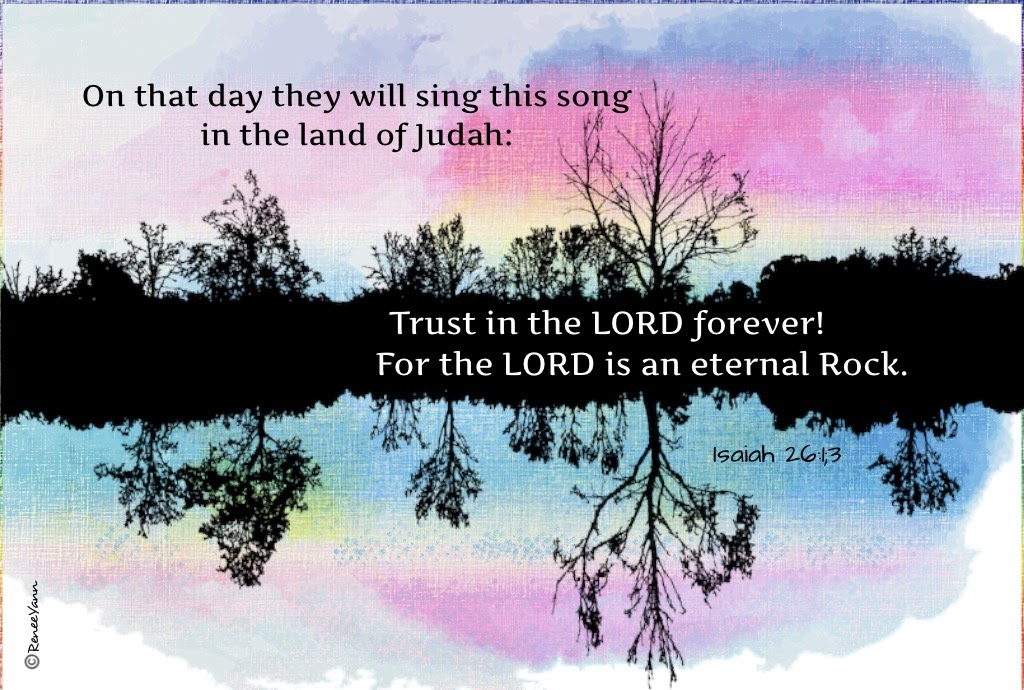
Trust in the LORD forever!
For the LORD is an eternal Rock,
who humbles those in high places,
and the lofty city he brings down;
He tumbles it to the ground,
levels it with the dust.
It is trampled underfoot by the needy,
by the footsteps of the poor.

Isaiah 26:4-6

God humbles the haughty, dwindles the lofty, tramples the elite with the “footsteps of the poor”. Wow! God turns our messy world on its head to right it!

This eloquent prophecy was intended to bolster the hopes of Isaiah’s careworn exiled community. It imagines the embodiment of the hope for which they have no evidence. Isaiah tells a geographically imprisoned people that they will be the ultimate conquerors. He assures a shackled community that their trust will earn them jubilant liberation. He enjoins them to believe!


It is really hard to have that kind of faith and trust when we have no evidence of delivery from whatever imprisons or assails us. Sometimes we wait a lifetime for a prayer to be answered but it seems that it never is. Are we fools to keep believing under such circumstances? Or are we wise enough to trust that the answers have come in ways we could not yet discern?


Our Gospel summons us to the same type of wildly hopeful trust. Jesus says that we cannot foresee nor control what kind of weather will assail us in life. Therefore, we must have a firm and sure foundation in faith so that we may survive any storm.

Jesus tells us to hear the sacred word with integrity and to measure ourselves according to it, because simply murmuring “Lord, Lord” doesn’t merit a pass to eternal life.

Everyone who listens to these words of mine and acts on them
will be like a wise one who built the house on rock. 
The rain fell, the floods came,
and the winds blew and buffeted the house. 
But it did not collapse; it had been set solidly on rock. 
And everyone who listens to these words of mine
but does not act on them
will be like a fool who built the house on sand. 
The rain fell, the floods came,
and the winds blew and buffeted the house. 
And it collapsed and was completely ruined.

Matthew 7:24-27

In this Advent time, let’s pray for a simple, wise and strong faith for ourselves and for those we love.


Prose: from On Obstinacy in Belief by C.S. Lewis

… a little bit long from Lewis but so worth it! If you like the excerpt, here’s a link to the entire essay:

https://thesewaneereview.com/articles/on-obstinacy-and-belief


Christians seem to praise an adherence to the original belief which holds out against any evidence whatever. I must now try to show why such praise is in fact a logical conclusion from the original belief itself.

This can be done best by thinking for a moment of situations in which the thing is reversed. In Christianity such faith is demanded of us; but there are situations in which we demand it of others. There are times when we can do all that a fellow creature needs if only he will trust us.

In getting a dog out of a trap, in extracting a thorn from a child’s finger, in teaching a boy to swim or rescuing one who can’t, in getting a frightened beginner over a nasty place on a mountain, the one fatal obstacle may be their distrust.

We are asking them to trust us in the teeth of their senses, their imagination, and their intelligence. We ask them to believe that what is painful will relieve their pain and that what looks dangerous is their only safety. We ask them to accept apparent impossibilities: that moving the paw further back into the trap is the way to get it out; that hurting the finger very much more will stop the finger hurting; that water which is obviously permeable will resist and support the body; that holding onto the only support within reach is not the way to avoid sinking; that to go higher and onto a more exposed ledge is the way not to fall.

To support all these incredibilia we can rely only on the other party’s confidence in us—a confidence certainly not based on demonstration, admittedly shot through with emotion, and perhaps, if we are strangers, resting on nothing but such assurance as the look of our face and the tone of our voice can supply, or even, for the dog, on our smell. Sometimes, because of their unbelief, we can do no mighty works.

But if we succeed, we do so because they have maintained their faith in us against apparently contrary evidence. No one blames us for demanding such faith. No one blames them for giving it. No one says afterward what an unintelligent dog or child or boy that must have been to trust us. If the young mountaineer were a scientist it would not be held against him, when he came up for a fellowship, that he had once departed from Clifford’s rule of evidence by entertaining a belief with strength greater than the evidence logically obliged him to.

Now to accept the Christian propositions is ipso facto to believe that we are to God, always, as that dog or child or bather or mountain climber was to us, only very much more so.

Music: Sheep May Safely Graze – J. S. Bach from from Cantata No. 208, “Was mir behagt” (Hunt Cantata), BWV 208, arr. by Egon Petri, (Oliver Schnyder – Piano)

Eyes Unveiled

Wednesday of the First Week of Advent
December 6, 2023

Today’s Readings:

https://bible.usccb.org/bible/readings/120623.cfm


Today, in God’s Lavish Mercy, Isaiah tantalizes us with his vision of the sumptuous heavenly banquet:

On this mountain the LORD of hosts
will provide for all peoples
A feast of rich food and choice wines,
juicy, rich food and pure, choice wines.

Isaiah 25:6-7

I can picture myself at that table munching on a savory turkey leg washed down by a bottomless pilsner. But if I stop there in my meditation I will have missed the whole point! The menu is not even the tip of the treasures to be had when we gather on Isaiah’s “Parousia Mountain”.

On that mountain, the veil will be lifted from our perception. The tangly web of our stresses and confusions will be wiped away. We will see ourselves and all Creation with God’s clear and loving eyes. Death – the lurking intruder threatening every earthly table – will have been eradicated, dissolved into Eternal Being.

On this mountain God will destroy
the veil that veils all peoples,
The web that is woven over all nations;
God will destroy death forever.

Isaiah 25:7-8

In our first reading, Isaiah paints the picture of a mountain lifted from time and transformed with heaven. In our Gospel, Jesus too is on a mountain when he pulls heaven down to heal and feed the yearning crowd.

Jesus walked by the Sea of Galilee,
went up on the mountain, and sat down there. 
Great crowds came to him,
having with them the lame, the blind, the deformed, the mute,
and many others. 
They placed them at his feet, and he cured them. 

Matthew 15:29-30

No doubt the gathered people, cured of their nagging maladies, were stunned into an instant faith. But Jesus knows that they can not stay on this heaven-charged mountain forever. They have their life’s journey ahead of them, and the energy of nascent faith may wane on the long road. So he reinforces the healing miracles with the comfort and sustenance of common food:

My heart is moved with pity for the crowd,
for they have been with me now for three days
and have nothing to eat. 
I do not want to send them away hungry,
for fear they may collapse on the way.

Matthew 15:32

In this incident, which is another version of the miracle in Matthew 14, the simple common folk have with them only the merest provisions. It is these that Jesus uses to fuel an enduring faith in these earth-bound believers:

Jesus said to them, “How many loaves do you have?” 
“Seven,” they replied, “and a few fish.” 
He ordered the crowd to sit down on the ground. 
Then he took the seven loaves and the fish,
gave thanks, broke the loaves,
and gave them to the disciples, who in turn gave them to the crowds. 
They all ate and were satisfied. 
They picked up the fragments left over–seven baskets full.

Matthew 15:34-37

God uses our merest provisions too to charge our daily life with faith’s energy. But we must take the holy time to let any misleading webs and obstructive veils fall from our perceptions. Our godless culture layers the world with so many distractions and fallacies that we are hard-pressed to see what’s really essential to true life.

Especially at Christmas time, God is nearly buried in tinsel, hype, and commercialism. A good Advent, spent in the awe-filled silence of scriptural reflection, is the antidote to this malady. Let’s be committed to it.


Poetry: Adult Advent Announcement – by David A. Redding, (from If I Could Pray Again – 1965)

O Lord,
Let Advent begin again
In us,
Not merely in commercials;
For that first Christmas was not
Simply for children,
But for the
Wise and the strong.
It was
Crowded around that cradle,
With kings kneeling.
Speak to us
Who seek an adult seat this year.
Help us to realize,
As we fill stockings,
Christmas is mainly
For the old folks —
Bent backs
And tired eyes
Need relief and light
A little more.
No wonder
It was grown-ups
Who were the first
To notice
Such a star.

Music: When I Can Read My Title Clear – arranged by Tim Sharpe
This is an acapella version of the hymn text by Isaac Watts (1674 – 1748) interpreting Isaiah 25:8.It is set to the tune PISGAH, an American Folk Melody by the 19th-century composer Joseph C. Lowry

A Budding Promise

Tuesday of the First Week of Advent
December 5, 2023

Today’s Readings:

https://bible.usccb.org/bible/readings/120523.cfm


Today, in God’s Lavish Mercy, Isaiah challenges us with his outrageously hopeful poetry.

After describing, in lyrical magnificence, the Messianic Ruler, Isaiah tells us this:

Then the wolf shall be a guest of the lamb,
and the leopard shall lie down with the kid;
The calf and the young lion shall browse together,
with a little child to guide them.
The cow and the bear shall be neighbors,
together their young shall rest;
the lion shall eat hay like the ox.
The baby shall play by the cobra’s den,
and the child lay his hand on the adder’s lair.
There shall be no harm or ruin on all my holy mountain;
for the earth shall be filled with knowledge of the LORD,
as water covers the sea.

Isaiah 11:6-10

We love this lilting Advent balladry, don’t we? Its movement is laced with hidden bells and waft of pine. It makes us remember Handel’s Messiah and resolve to find and play the CD we put away last January.

But as much as we might love the passage, do we believe it? Is the era of messianic peace possible, and will it be realized through the mystery of Divine Love incarnate in Jesus Christ?


Well, here are the facts:

Isaiah lived and prophesied a redeemed kingdom about 700 years before Christ. When Christ was born, the world was in pretty much the same sad shape as it was when Isaiah wrote.

Jesus lived 2000 years ago, speaking and modeling specific instructions for the world’s transformation. But the world is in pretty much the same sad shape today as it was when Jesus lived.

So where is all this “peaceable kingdom” stuff happening? Is it non-existent or just invisible? Is it just the rather lunatic imagining of ancient prophets?


Today’s Gospel offers us an understanding of God’s Reign too deep for the world’s logic. By the gift of faith and the grace of Baptism, we have been given a new set of eyes, charged with the same outrageous yet real hope evident in Isaiah and enfleshed in Christ.

I give you praise, Father, Lord of heaven and earth,
for although you have hidden these things
from the wise and the learned
you have revealed them to the childlike…

… Turning to the disciples in private he said,
“Blessed are the eyes that see what you see.
For I say to you,
many prophets and kings desired to see what you see,
but did not see it,
and to hear what you hear, but did not hear it.

Luke 10:21-24

If we can give ourselves to the vulnerable simplicity Jesus describes, faith can transform us. The “Kingdom” can live in us and because of us!

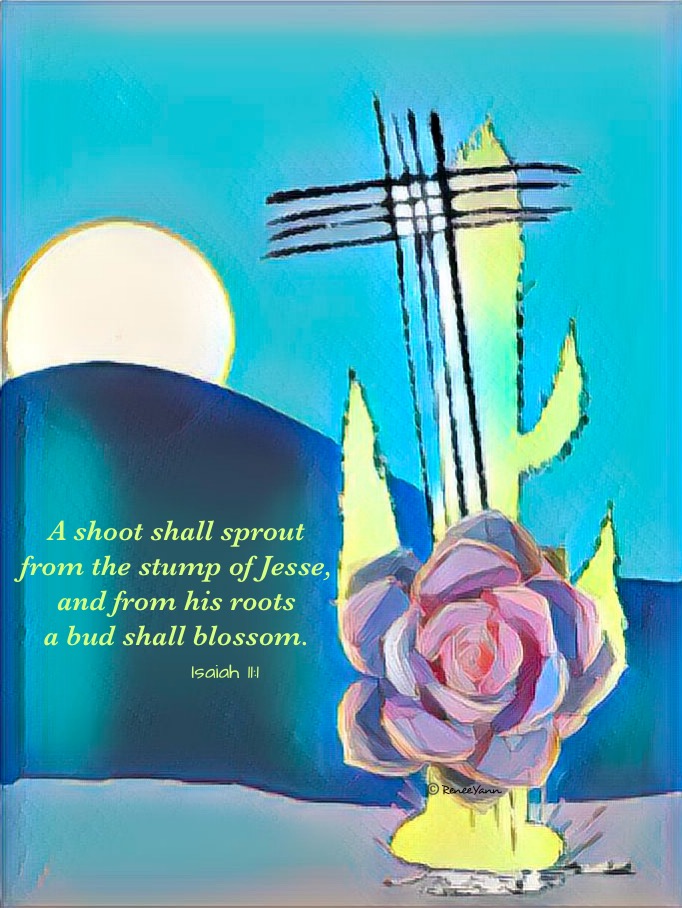
We too will see the bud beyond the stump. New life will arise from what appears lifeless. The worldly fears and inhospitalities that prey on us will be tamed by a holy confidence. In life’s sinuous circumstances, we will see the Holy Mystery unfolding.

The Kingdom, so indiscernible in our fractious world, will “advent” in us. This is what we long for in our Advent prayer.


Poetry: Advent Credo – Allan Boesak, a South African pastor in the Dutch Reformed Church, politician, anti-apartheid activist, and author of fifteen books. This poem is taken from his book Walking on Thorns (Eerdmans, 1984), and is often but wrongly attributed to Daniel Berrigan.


It is not true that creation and the human family are doomed to destruction and loss—
This is true: For God so loved the world that He gave his only begotten Son, that whoever believes in Him shall not perish but have everlasting life;
It is not true that we must accept inhumanity and discrimination, hunger and poverty, death and destruction—
This is true: I have come that they may have life, and that abundantly.
It is not true that violence and hatred should have the last word, and that war and destruction rule forever—
This is true: Unto us a child is born, unto us a Son is given, and the government shall be upon his shoulder, his name shall be called wonderful councilor, mighty God, the Everlasting, the Prince of peace.
It is not true that we are simply victims of the powers of evil who seek to rule the world—
This is true: To me is given authority in heaven and on earth, and lo I am with you, even until the end of the world.
It is not true that we have to wait for those who are specially gifted, who are the prophets of the Church before we can be peacemakers—
This is true: I will pour out my spirit on all flesh and your sons and daughters shall prophesy, your young men shall see visions and your old men shall have dreams.

It is not true that our hopes for liberation of humankind, of justice, of human dignity of peace are not meant for this earth and for this history—
This is true: The hour comes, and it is now, that the true worshipers shall worship God in spirit and in truth.

So let us enter Advent in hope, even hope against hope. Let us see visions of love and peace and justice. Let us affirm with humility, with joy, with faith, with courage: Jesus Christ—the life of the world.

Music: Lo, How a Rose E’er Blooming – pre-17th century anonymous hymn

From Wikipedia: The hymn was originally written with two verses that describe the fulfillment of the prophecy of Isaiah foretelling the birth of Jesus. It emphasizes the royal genealogy of Jesus and Christian messianic prophecies. The hymn describes a rose sprouting from the stem of the Tree of Jesse, a symbolic device that depicts the descent of Jesus from Jesse of Bethlehem, the father of King David. The image was especially popular in medieval times, and it features in many works of religious art from the period. It has its origin in the Book of Isaiah:

And there shall come forth a rod out of the stem of Jesse, and a Branch shall grow out of his roots.— Isaiah 11:1

All Nations …

Monday of the First Week of Advent
December 4, 2023

Today’s Readings:

https://bible.usccb.org/bible/readings/120423.cfm


Today, in God’s Lavish Mercy, Isaiah opens our prayer with this amazingly inclusive passage, both a vision and an invitation:

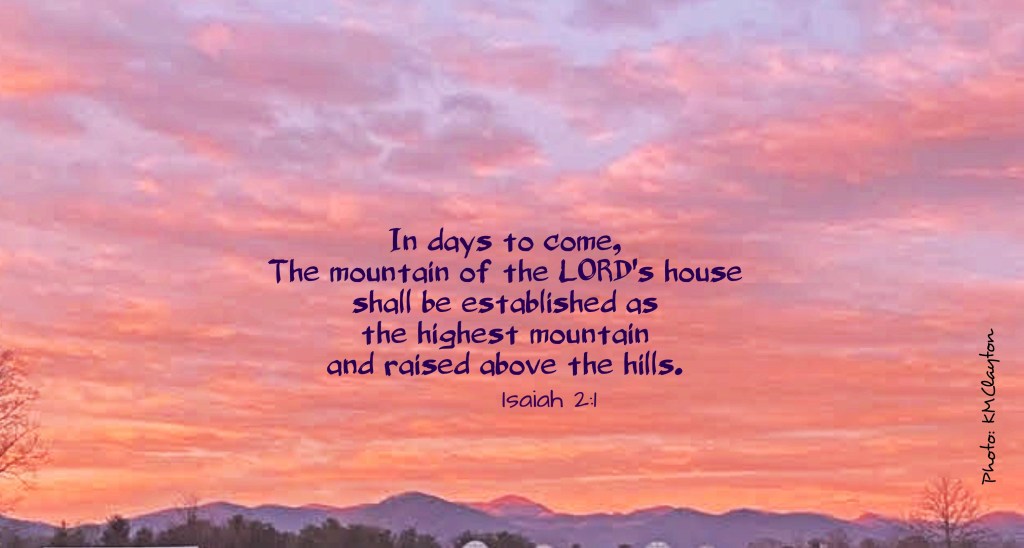
In days to come,
The mountain of the LORD’s house
shall be established as the highest mountain
and raised above the hills.
All nations shall stream toward it;
many peoples shall come and say:
“Come, let us climb the LORD’s mountain,
to the house of the God of Jacob,
That he may instruct us in his ways,
and we may walk in his paths.”

Isaiah 2:2-3

These first chapters of Isaiah were written about 8oo years before Christ, near the time of the Babylonian Captivity. The faith, vision, and hope of Israel were being sorely tested. Isaiah’s core message to these beleaguered people is that even when we do not see God, God abides. This abiding God will lead them to a new reality … to the “highest mountain” as opposed to their current valley of tears.

Isaiah is clear that this abiding promise is extended not only to Israel, but to all nations! What a surprising statement to find in the precious literature of Israel’s exceptionalism!


Jesus Heals a Centurion’s Servant – William Brassey Hole

To confirm this open invitation to “all nations”, our Gospel relates a complementary story. One of the first figures presented to us early in this Advent journey is the Gospel centurion, a Gentile with imperceptible religion but striking faith. His humble response to Jesus acknowledges that he, with all Creation, is subject to an infinitely loving Authority:

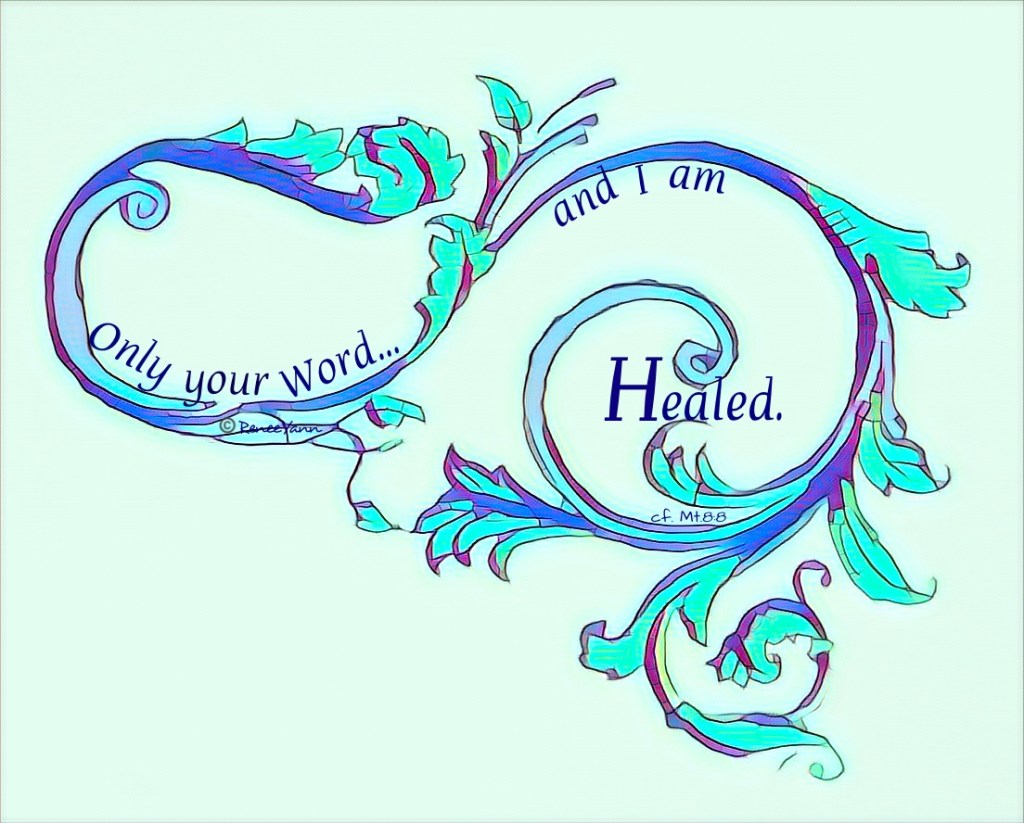
Lord, I am not worthy to have you enter under my roof;
only say the word and my servant will be healed.
For I too am a man subject to authority,
with soldiers subject to me.
And I say to one, ‘Go,’ and he goes;
and to another, ‘Come here,’ and he comes;
and to my slave, ‘Do this,’ and he does it.” 

Matthew 8:6-9

Our Advent lesson? Maybe this. To bring, as the centurion did, our beloved hopes and needs before God. To place them lovingly, confidently in the Divine Heart. To trust and receive God’s answers with all the faith we can gather. And to look, not past the moment, but through it to the holy mountain in the distance – a distance which is shortened by our faithful Advent prayer.


Poetry: I couldn’t come up with a written poem today, so I drew one:


Music: Healing – Peter Kater

Watch!

First Sunday of Advent
December 3, 2023

Today’s Readings:

https://bible.usccb.org/bible/readings/120323.cfm


Today, in God’s Lavish Mercy, we begin the Advent Watch, that annual time of acute spiritual awareness and hope-filled expectation.

We’ve all kept watch at various times in our lives, perhaps without even realizing it. It may have been as simple as waiting for a delayed but highly anticipated letter, or as worrisome as the anxious vigil over a feverish child. It may be as unnoticeable as waiting for an elevator, a green light, or a “transaction complete” at the ATM, or as marvelous as the nine-month expectancy of new life.

We should be good at waiting because we do it all the time, but maybe we’re not so good at it after all.


Good waiting requires our consciousness. We may idly consider the “waiting space” a neutral zone that we can fill with anything we choose – impatience, daydreaming, or distraction. But pivotal waiting can offer us an invaluable invitation – to meet God in a new way as we anticipate what we cannot yet see or comprehend. But sometimes we don’t pay enough attention to hear the invitation.

This kind of “keeping watch” can be a sacramental experience. It is a time when we are stilled before a reality or mystery we cannot control. We can only wait, hope, release any fear, and cleanse our demanding prayer of its useless stipulations. It is a time of confident abandonment into God’s loving will for our good. Advent is such a blessed time.


Praying with our Advent scriptures provides us with a curriculum for good waiting. Our teachers will be the divinely lyrical Isaiah, the Psalms, Matthew and Luke, and the glorious O Antiphons.

We begin today with this heartfelt entreaty to God:

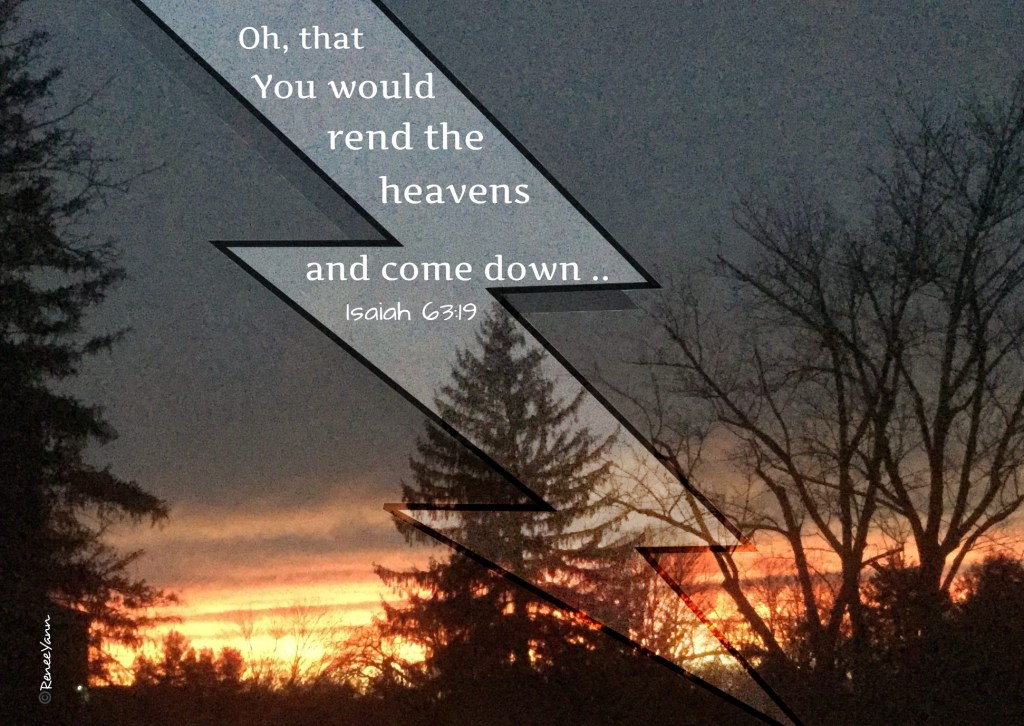
Oh, that you would rend the heavens and come down,
with the mountains quaking before you,
while you wrought awesome deeds we could not hope for,
such as they had not heard of from of old.
No ear has ever heard, no eye ever seen, any God but you
doing such deeds for those who wait for him.
Would that you might meet us doing right,
that we were mindful of you in our ways!


Each one of us can look into our own hearts today, into our own perception of the world, to see where God is most sorely needed. As we pray Isaiah’s plea, we can do so assured by Paul’s blessing that God desires to answer us:

I give thanks to my God always on your account
for the grace of God bestowed on you in Christ Jesus,
that in him you were enriched in every way,
with all discourse and all knowledge,
as the testimony to Christ was confirmed among you,
so that you are not lacking in any spiritual gift
as you wait for the revelation of our Lord Jesus Christ.
He will keep you firm to the end,
irreproachable on the day of our Lord Jesus Christ.
God is faithful,
and by him you were called to fellowship with his Son,
Jesus Christ our Lord.


Poetry: Advent (On a theme by Dietrich Bonhoeffer) – by Pamela Cranston

Look how long
the tired world waited,
locked in its lonely cell,
guilty as a prisoner.
As you can imagine,
it sang and whistled in the dark.
It hoped. It paced and puttered about,
tidying its little piles of inconsequence.
It wept from the weight of ennui
draped like shackles on its wrists.
It raged and wailed against the walls
of its own plight.
But there was nothing
the world could do
to find its freedom.
The door was shut tight.
It could only be opened
from the outside.
Who could believe the latch
would be turned by the flower
of a newborn hand?

Music: Wachet auf! ruft uns die Stimme – J.S. Bach

Wachet auf, ruft uns die Stimme
Wake up, the voice calls us
Der Wächter sehr hoch auf der Zinne,
of the watchmen high up on the battlements,
Wach auf, du Stadt Jerusalem!
wake up, you city of Jerusalem!
Mitternacht heißt diese Stunde;
This hour is called midnight;
Sie rufen uns mit hellem Munde:
they call us with a clear voice:
Wo seid ihr klugen Jungfrauen?
where are you, wise virgins ?
Wohl auf, der Bräutgam kömmt;
Get up, the bridegroom comes;
Steht auf, die Lampen nehmt! Alleluja!
Stand up, take your lamps! Hallelujah!
Macht euch bereit
Make yourselves ready
Zu der Hochzeit,
for the wedding,
Ihr müsset ihm entgegen gehn!
you must go to meet him!

On the Edge

Saturday of the Thirty-fourth Week in Ordinary Time
December 2, 2023

Today’s Readings:

https://bible.usccb.org/bible/readings/120223.cfm


Today, in God’s Lavish Mercy, we finally stand at the edge of the diving board before our plunge into the sublime days of Advent!


Daniel, at the end of a daunting passage, closes with this conviction that foreshadows the Messiah’s reign:

Then the kingship and dominion and majesty
of all the kingdoms under the heavens
shall be given to the holy people of the Most High,
Whose Kingdom shall be everlasting:
all dominions shall serve and obey him.

Daniel 7:27

In our Gospel, Jesus uses a tone similar to Daniel to encourage our vigilance:

Jesus said to his disciples:
“Beware that your hearts do not become drowsy
from carousing and drunkenness
and the anxieties of daily life,
and that day catch you by surprise like a trap.
For that day will assault everyone
who lives on the face of the earth.
Be vigilant at all times
and pray that you have the strength
to escape the tribulations that are imminent
and to stand before the Son of Man.”

Luke 21:34-36

I take these words as an imperative to engage the days of Advent for what they are supposed to be – a time of thoughtful, prayerful preparation to receive the gift and mystery of Christ in all its splendor.

The Gospel seems to suggest that we might become too tired for such prayer during all our frenetic Christmas preparations, or that we might break out the spiked egg nog a little too early. We are admonished to be alert, sober, and unanxious. We are advised to “Be vigilant” – that is, to light the heart’s candle and to wait patiently for God.


Poetry: Tug and Sigh – May Sarton, from “The Silence Now”

Like the datura’s yellow trumpets
I am waiting for the breath of angels
to perfume the twilight
of this ordinary day
and play the vigil hymn
reminding me
that heaven and earth
wed long ago.

I too am married
to the unseen
sigh and scent,
filling and returning,
thus never full –
always longing,
often failing,
yet ever blessed
with heaven’s pull.

Music: Silent Vigil – Tony O’Connor