Not Far

Thursday of the Ninth Week in Ordinary Time
June 8, 2023

Today’s Readings:

https://bible.usccb.org/bible/readings/060823.cfm

Today in God’s Lavish Mercy, our first reading invites us to a wedding and our Gospel shows us the way to heaven.

The marriage of Tobiah and Sarah is a nail-biter! Seven would-be husbands have already died in the honeymoon chamber! Sarah’s father is so convinced that Tobiah will be the eighth that, after the couple goes to bed, he digs a grave just in case. But Tobiah, like his father Tobit, is a good and just man. His heart is pure. Before they make love, Tobiah and Sarah pray and God hears their prayer, allowing Raphael to dispel the demon that has plagued Sarah’s earlier disastrous marriage attempts.


So what is happening here in terms of scriptural inspiration? Is this just a great beach book for the Jews scattered after the Assyrian captivity? Certainly not. The Book of Tobit offered spiritual stability to the uncertain world of the Jews in exile. In a clever story, the narrator outlines the essential guideposts for the believer to hold fast to their identity and faith – primarily with these concepts:

  • God is in charge and will remain faithful even if we do not. Imagine that!
  • Our faithfulness is demonstrated by religious fidelity, humility, prayer, patience and good works.
  • God’s faithfulness is demonstrated by bringing good even out of chaos and misfortune.

Our modern understandings are not that different from those of Tobit’s ancient author. In some sense, we all live “in exile”, at least from our final heavenly home. And God, of course, is still in charge. But we see God’s power in our lives not as preordained management but rather as a steadfast companionship in our own life’s unfolding drama.

Our life is not a book God has already written. In a mystery we cannot comprehend, our Omnipotent God chooses to live our lives with us, its direction unfolding as we continue to mature in God’s Love.


Our Gospel tells the story of a scribe deepening in that maturing process. He asks Jesus what is most important to live a good life. Jesus says what’s most important is love – love of God and love of neighbor. When the scribe responds in agreement, Jesus tells him that he is not far from the kingdom of God.

Perhaps our prayer today could be this: May deepening Love carry each of us all the way home to God’s heart.


Poetry: Heaven-Haven by Gerard Manley Hopkins

(A nun takes the veil)
I have desired to go
Where springs not fail,
To fields where flies no sharp and sided hail
And a few lilies blow.
And I have asked to be
Where no storms come,
Where the green swell is in the havens dumb,
And out of the swing of the sea.


Music: A Walk in Paradise – Darlene Koldenhaven

What Will Heaven Be Like?

Wednesday of the Ninth Week in Ordinary Time
June 7, 2023

Today’s Readings:

https://bible.usccb.org/bible/readings/060723.cfm

Today, in God’s Lavish Mercy, both Tobit and Sarah stand on the edge of a psychological cliff:

  • Tobit – because he has lost his ability to see, both physically and spiritually
  • Sarah – because she is ridiculed and accused of killing seven husbands

The beautiful thing about both of them is that in their desperation they turn to God. Ultimately, God hears them and gives healing.


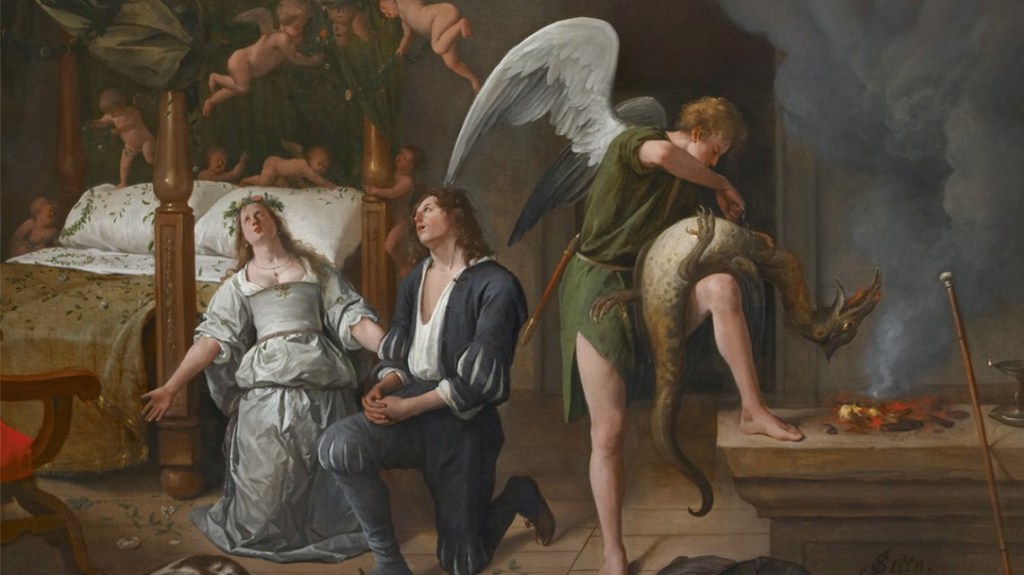
Sarah’s Marriage to Tobiah after Raphael Kills Demon- Jan Steen


In our Gospel, the Sadducees present Jesus with a puzzle reminiscent of Sarah’s situation.

Now there were seven brothers.
The first married a woman and died, leaving no descendants.
So the second brother married her and died, leaving no descendants,
and the third likewise.
And the seven left no descendants.
Last of all the woman also died.
At the resurrection when they arise whose wife will she be?

Mark 12:20-23

The Sadducees could not have been more insincere in their question. They didn’t even believe in life after death, so why were they posing the question? The Sadducees accepted only the first five books of the Bible as scripture. They rejected the inspirations of the prophets and wisdom writers where the first Biblical ideas of an afterlife arise.

Given their rejection of the developing insights into God and God’s dealings with his people over the intervening centuries, and expressed so beautifully in the prophets and much of the wisdom literature, they did not accept any possibility of life after death. Persons lived on through descendants. The centrality of descendants was the reason also for their obsession with property rights and inheritance. The consequences of human behavior did not echo into eternity. Their horizons were firmly limited to the here and now.

Father John McKinnon – revered Australian priest and teacher

Jesus clearly saw the intention of the Sadducees’s question. Feeling their elite status to be threatened by his teaching, they wished to trap Jesus in an indefensible position. If they could undermine his authority and influence, their own would be bolstered.

Jesus unperturbedly but directly tells them that they are not only wrong in their calculations, but are clueless regarding God and the scriptures:

Jesus said to them, “Are you not misled
because you do not know the Scriptures or the power of God?
When they rise from the dead,
they neither marry nor are given in marriage,
but they are like the angels in heaven.

Mark 12:24-25

Haven’t you wondered what heaven will be like? Jesus’ answer gives us a little insight. I really like how Father McKinnon describes Jesus’s perception:

Jesus’ view of resurrection was of unbelievable qualitative difference, beyond the capacity of people to imagine or understand. It would be the power of God at work: pure gift. 

Father John McKinnon

We may want to spend some prayer time imagining that “unbelievable qualitative difference”, an imagining which ultimately saved Tobit and Sarah from their desperation.


Poetry: The World is not Conclusion – Emily Dickinson

This World is not Conclusion.
A Species stands beyond -
Invisible, as Music -
But positive, as Sound -
It beckons, and it baffles -
Philosophy, dont know -
And through a Riddle, at the last -
Sagacity, must go -
To guess it, puzzles scholars -
To gain it, Men have borne
Contempt of Generations
And Crucifixion, shown -
Faith slips - and laughs, and rallies -
Blushes, if any see -
Plucks at a twig of Evidence -
And asks a Vane, the way -
Much Gesture, from the Pulpit -
Strong Hallelujahs roll -
Narcotics cannot still the Tooth
That nibbles at the soul -

Music: Can Only Imagine – MercyMe

Sincerely

Tuesday of the Ninth Week in Ordinary Time
June 6, 2023

Today’s Readings:

https://bible.usccb.org/bible/readings/060623.cfm


Today, in God’s Lavish Mercy, our readings give us two examples of people talking to each other without communicating. Ever been there- just not quite on the same wavelength?

In the passage from Tobit, fiesty Anna brings home a bonus goat as a reward for her good work. Tobit, grumpy with the ill fortune of his blindness, accuses her of fencing stolen goods.

Anna said to me, “The goat was given to me as a bonus over and above my wages.”
Yet I would not believe her,
and told her to give it back to its owners.
I became very angry with her over this.
So she retorted: “Where are your charitable deeds now?
Where are your virtuous acts?
See! Your true character is finally showing itself!”

Tobit 2:14

Anna uses Tobit’s incalcitrance to make him take a good look at himself – his true character. She challenges another kind of blindness in Tobit beyond his physical challenges. He ultimately repents and prays for solace.


However, in our Gospel, a gang of antagonists intend to set a trap for Jesus. This is a whole different level of wavelength misalignment. Here, the questioners never had an intention to seek truth or come to mutual understanding.

Some Pharisees and Herodians were sent
to Jesus to ensnare him in his speech.
They came and said to him,
“Teacher, we know that you are a truthful man
and that you are not concerned with anyone’s opinion.
You do not regard a person’s status
but teach the way of God in accordance with the truth.

Mark 12:13-14

These two instances of fractious communication are differentiated by one key element: sincerity. Though out of alignment, both Anna and Tobit are sincere in their exchange. In our Gospel, only Jesus is sincere. His antagonizers use the reprehensible tool of gaslighting, attempting trap Jesus in his own words.


The Latin words “sine cera” mean ‘without wax”

“Sin-cere. Since the days of Michelangelo, sculptors had been hiding the flaws in their work by smearing hot wax into the cracks and then dabbing the wax with stone dust. The method was considered cheating, and therefore, any sculpture “without wax”—literally sine cera—was considered a “sincere” piece of art. The phrase stuck. To this day we still sign our letters “sincerely” as a promise that we have written “without wax” and that our words are true.”

Dan Brown, The Lost Symbol

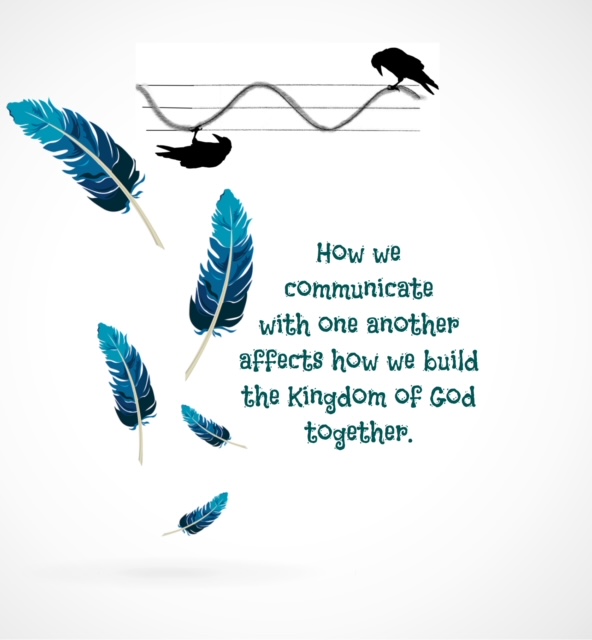
How we communicate with one another affects how we build the kingdom of God together. The communication can be as ordinary as a couple’s banter, like Anna and Tobit. Or it can be as momentous as two cultures meeting in either resistance or transformation.

Our readings suggest that if we have not learned to practice sincerity even in small things, we will not have the awareness and spiritual freedom to practiice it in big things.


Poetry: “To thine own self be true” from Shakespeare’s Hamlet. Here, Polonius instructs his son, Laertes, as he leaves for college.

There, my blessing with thee.
And these few precepts in thy memory
Look thou character. Give thy thoughts no tongue,
Nor any unproportioned thought his act.
Be thou familiar but by no means vulgar.
Those friends thou hast, and their adoption tried,
Grapple them unto thy soul with hoops of steel,
But do not dull thy palm with entertainment
Of each new-hatched, unfledged comrade. Beware
Of entrance to a quarrel, but being in,
Bear ’t that th’ opposèd may beware of thee.
Give every man thy ear but few thy voice.
Take each man’s censure but reserve thy judgment.
Costly thy habit as thy purse can buy,
But not expressed in fancy—rich, not gaudy,
For the apparel oft proclaims the man,
And they in France of the best rank and station
Are of a most select and generous chief in that.
Neither a borrower nor a lender be,
For loan oft loses both itself and friend,
And borrowing dulls the edge of husbandry.
This above all: to thine own self be true,
And it must follow, as the night the day,
Thou canst not then be false to any man.
Farewell. My blessing season this in thee.

Music: To Thine Own Self Be True – Music by Brian Tate

And check out the just -for-fun extra song below.

Maybe you can imagine Anna singing this oldie but goodie to Tobit once they argued over the goat!

Fidelity in Exile

Memorial of Saint Boniface, Bishop and Martyr
June 5, 2023

Today’s Readings:

https://bible.usccb.org/bible/readings/060523.cfm

Today, in God’s Lavish Mercy, we begin a series of readings from the Book of Tobit. This fascinating scripture is actually a biblical novel written by an unknown author about 200 years before Jesus was born. It tells the story of a character who lived 800 years before that. It is not an autobiography or history. It is a combination of fiction, poetry, allegory and wisdom. Probably a “best seller” in its own time, it is actually really fun to read – and it gives us a good dose of spiritual wisdom!


In a nutshell, the book of Tobit relates how two suicidal characters, one blind
(Tobit) and one haunted by a husband-killing demon (Sarah) are healed with
medicinal fish organs by Tobit’s son Tobiah with the guidance of the angel
Raphael. Tobiah marries Sarah and acquires wealth and property into the
bargain. In addition to being entertaining, the book of Tobit
maintains that one can withstand temporary misfortune
and ultimately enjoy a happy life if one performs righteous deeds.

Delicious Prose: Reading the Tale of Tobit with Food and Drink, by Naomi S.S. Jacobs

In today’s passage, Tobit introduces himself as a good man who wants to share his blessings with someone less fortunate. He sends his son Tobiah on the noble errand to find such a person. On his way, Tobiah discovers a murdered kinsman left unburied where he died. Upon hearing of it, Tobit “springs” into action, doing the right thing for this unfortunate victim. As a result of his righteous response, Tobit incurs the wrath not only of the Assyrian overlords, but also of his wimpy Israelite neighbors who are too afraid (or lazy) to keep the Mosaic Law while in exile.

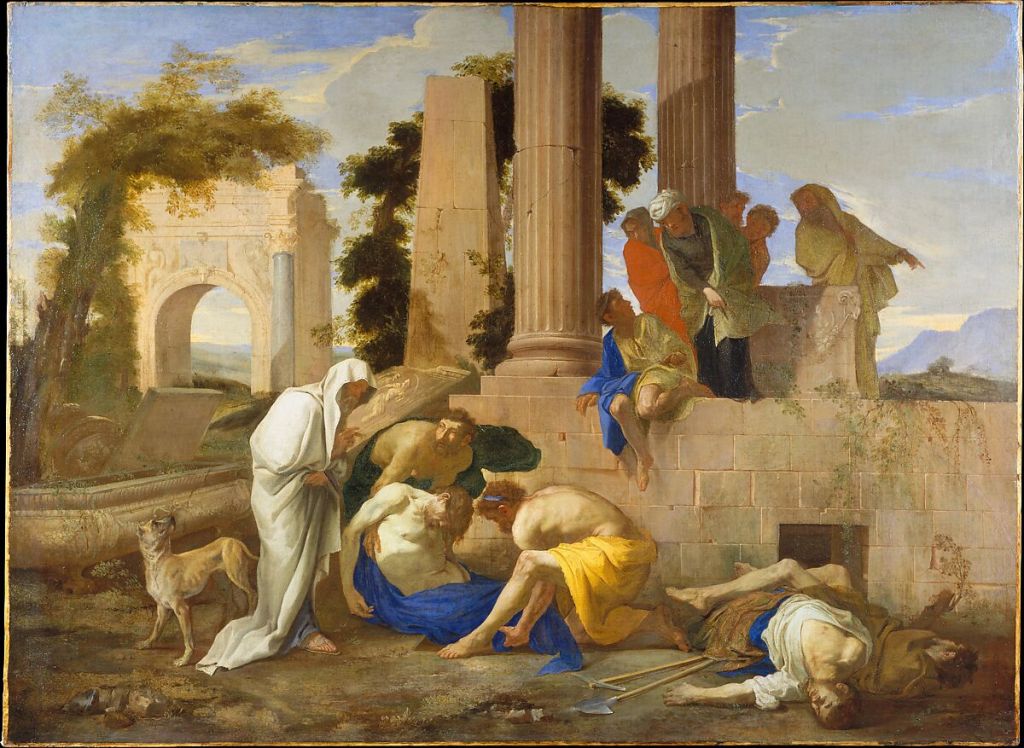
Tobit Burying the Dead – Andrea DiLeone


Big lessons from this reading? Remember, the author of Tobit was writing for a community that had been ripped from their spiritual and material home. They knew the waning hope of one in exile. They needed to be reminded of and supported by stories of covenantal fidelity – both God’s and humanity’s.

By the rivers of Babylon we sat and wept when we remembered Zion.(Ps.137)


But even if our lives are not quite so dramatic as theirs, the reading holds quite a few lessons for us as well.

  • Circumstances may cause one to feel “exiled” from the comfort of their faith, but it is essential to retain a stabilizing religious devotion and practice.
  • It is important to invite and include others, especially the young, in the faithful practice of charity and justice.
  • It is normal and healthy to grieve the spiritual losses or emptiness we may experience. Such recognition is a first step to healing, and can give us the release to move on to what we need to do:

Returning to my own quarters, I washed myself
and ate my food in sorrow.
I was reminded of the oracle
pronounced by the prophet Amos against Bethel:
All your festivals shall be turned into mourning,
and all your songs into lamentation.

And I wept.
Then at sunset I went out, dug a grave, and buried him.

Tobit 2:5-7

Prose: How to Be Hopeful by Barbara Kingsolver, from her commencement address at Duke University, May 11, 2008

HOPE: AN OWNER’S MANUAL
Look, you might as well know, this thing
is going to take endless repair: rubber bands, crazy glue, tapioca, the square of the hypotenuse. Nineteenth century novels. Heartstrings, sunrise: all of these are useful. Also, feathers.

To keep it humming, sometimes you have to stand on an incline, where everything looks possible;
on the line you drew yourself. Or in
the grocery line, making faces at a toddler secretly, over his mother's shoulder.

You might have to pop the clutch and run
past all the evidence. Past everyone who is laughing or praying for you. Definitely you don't want to go directly to jail, but still, here you go, passing time, passing strange. Don't pass this up.

In the worst of times, you will have to pass it off.
Park it and fly by the seat of your pants. With nothing in the bank, you'll still want to take the express.
Tiptoe past the dogs of the apocalypse that are sleeping in the shade of your future. Pay at the window.
Pass your hope like a bad check.
You might still have just enough time. To make a deposit. 

Music: Take Courage – Kristine DiMarco

O My `Three’, My All

The Solemnity of the Most Holy Trinity
June 4, 2023

Today’s Readings:

https://bible.usccb.org/bible/readings/060423.cfm

Today, in God’s Lavish Mercy, we are wrapped in the loving mystery of the Holy Trinity. This mystery encompasses the Generative, Salvific, and Indwelling nature of the one true God.

The Trinity is a mystery we approach with our hearts and souls, not with our minds. It is a Reality we fall in love with, and Which falls in love with us. John O’Donohue describes it like this:

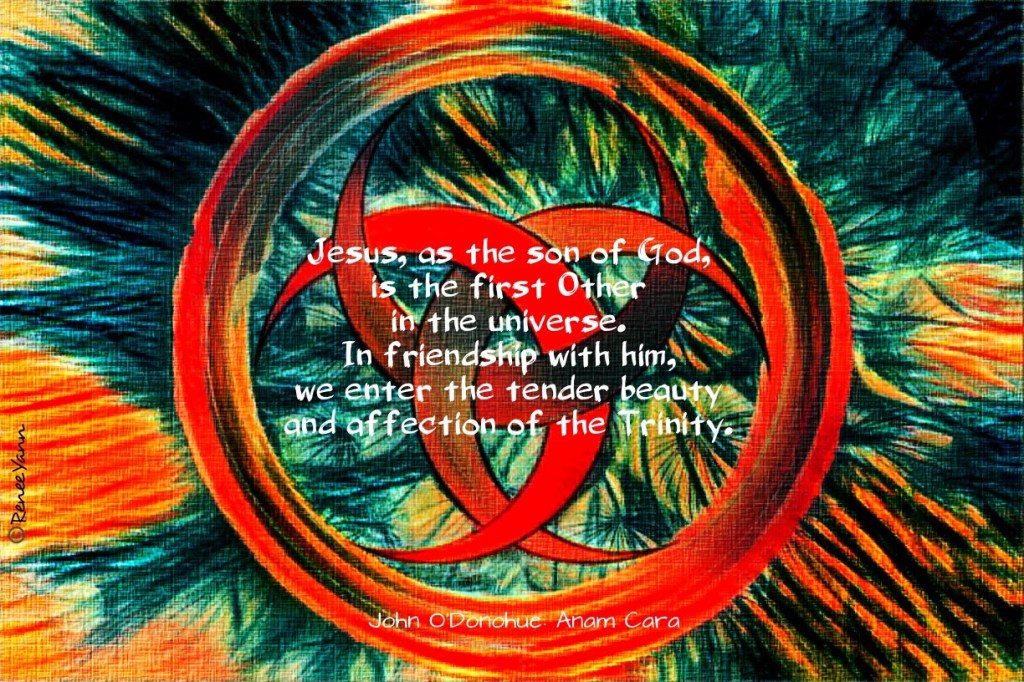
The Christian concept of God as Trinity is the most sublime articulation of otherness and intimacy, an eternal interflow of friendship. This perspective discloses the beautiful fulfillment of our immortal longing in the words of Jesus, who said, Behold, I call you friends. Jesus, as the son of God, is the first Other in the universe. . . . In friendship with him, we enter the tender beauty and affection of the Trinity. In the embrace of this eternal friendship, we dare to be free.

from Anam Cara: A Book of Celtic Wisdom

In our first reading, Moses encounters the Creator, first Person of the Blessed Trinity and invites God into his company.

Having come down in a cloud, the LORD stood with Moses there
and proclaimed his name, “LORD.”
Thus the LORD passed before him and cried out,
“The LORD, the LORD, a merciful and gracious God,
slow to anger and rich in kindness and fidelity.”
Moses at once bowed down to the ground in worship.
Then he said, “If I find favor with you, O Lord,
do come along in our company.


In our second reading, Paul tells us how to invite God into our company:

Brothers and sisters, rejoice.
Mend your ways, encourage one another,
agree with one another, live in peace,
and the God of love and peace will be with you.


And in our Gospel, Jesus utters the iconic verse which is the foundation of our faith:

God so loved the world that he gave his only Son,
so that everyone who believes in him might not perish
but might have eternal life.


Each of our readings allows us to reflect on the wonder that we touch God in many different ways, just as God touches us.

  • Sometimes we invoke the Source of our life to guide and protect us.
  • At other times, we look to the Incarnate Word to teach us how to live.
  • Still there are other times when we reach deep into our hearts and pray without words in the Holy Spirit about things too deep to describe.

Prose: Prayer of St. Elizabeth of the Trinity – (excerpt from Drink of the Stream: Prayers of Carmelites compiled by Penny Hickey)

“O my God, Trinity whom I adore, let me entirely forget myself that I may abide in you, still and peaceful as if my soul were already in eternity; let nothing disturb my peace nor separate me from you, O my unchanging God, but that each moment may take me further into the depths of your mystery ! Pacify my soul! Make it your heaven, your beloved home and place of your repose; let me never leave you there alone, but may I be ever attentive, ever alert in my faith, ever adoring and all given up to your creative action.
O my beloved Christ, crucified for love, would that I might be for you a spouse of your heart! I would anoint you with glory, I would love you - even unto death! Yet I sense my frailty and ask you to adorn me with yourself; identify my soul with all the movements of your soul, submerge me, overwhelm me, substitute yourself in me that my life may become but a reflection of your life. Come into me as Adorer, Redeemer and Savior.
O Eternal Word, Word of my God, would that I might spend my life listening to you, would that I might be fully receptive to learn all from you; in all darkness, all loneliness, all weakness, may I ever keep my eyes fixed on you and abide under your great light; O my Beloved Star, fascinate me so that I may never be able to leave your radiance.
O Consuming Fire, Spirit of Love, descend into my soul and make all in me as an incarnation of the Word, that I may be to him a super-added humanity wherein he renews his mystery; and you O Father, bestow yourself and bend down to your little creature, seeing in her only your beloved Son in whom you are well pleased.
O my `Three', my All, my Beatitude, infinite Solitude, Immensity in whom I lose myself, I give myself to you as a prey to be consumed; enclose yourself in me that I may be absorbed in you so as to contemplate in your light the abyss of your Splendor!”

Music: Oh, Late Have I Loved You – Prayer of St. Augustine interpreted by Roc O’Conner, SJ

A Grape Soon Ripe

Saint Charles Lwanga and Companions, Martyrs
June 3, 2023

Today’s Readings:

https://bible.usccb.org/bible/readings/060323.cfm

Today, in God’s Lavish Mercy, we pray with our final passage from the Book of Sirach. We will read Sirach only five or six times again scattered throughout the liturgical year.

In today’s reading, Sirach offers a grateful reflection on the early blessing of wisdom and pursuit of holiness in his life.

I thank the LORD and I praise him;
I bless the name of the LORD.
When I was young and innocent,
I sought wisdom openly in my prayer
I prayed for her before the temple…

Sirach 51:13-14

Sirach’s prayer will resonate with many of us whose earliest days were blessed with faithful parents and grandparents. These wisdom figures taught us to love and seek God in our lives. As we pray today, we think of them with gratitude, as well as of the many teachers who guided our young spirits into God’s Light.

Even if we have moved far from the parish church of our youth, we may recall the graces we received within her walls. We might prayerfully recollect our beloved grade school and high school where we were guided in the pursuit of a meaningful and reverent life.


Hopefully, our prayer brings us to realize how blessed we have been from the beginning of our lives. This is the kind of prayer Sirach prays in today’s reading. He is filled with gratitude and praise because he understands that it is all a gratuitous and undeserved blessing:

My heart delighted in Wisdom,
My feet kept to the level path
because from earliest youth I was familiar with her.
In the short time I paid heed,
I met with great instruction.
Since in this way I have profited,
I will give my teacher grateful praise.

Sirach 51:15-17

Sirach’s prayer brings him to that still and holy place deep in his heart — that place where he touches the Wisdom of God. He describes it like this:

I sought Wisdom openly in my prayer
I prayed for her before the temple,
and I will seek her until the end,
and she flourished as a grape soon ripe.

Sirach 51:13-15

Many of us are so busy and intent on living our lives forward – trying to make it through this day to the next. We may not take the time to consider and appreciate the “ripe grape” our life has already become.

I look around me in our convent chapel and realize that I am living with holy people. Of course, like me, they have their personal twists and trademarks. Still each one of them has walked through their roundabout years into the heart of God. Every day they live into a deeper goodness – aging like fine wine, unaware that the grape has already ripened and is blessing the world around them.

The Great Vintner accomplishes this holy transformation in us by a slow accumulation of blessings which saturate our hearts in God. Pausing, like Sirach, to recognize and give thanks fills us with generous gratitude and a confident courage for the days to come.


Take time to look at the holy people in your own life today, the ones through whom God’s Wisdom has poured into your life. They are the ones who love you into a better person by their goodness, honesty, humility, and generosity. You meet them in your family, friends and workplace. Or you may have met them only in a book, poem, song or story.

I met with great instruction.
Since in this way I have profited,
I will give my teacher grateful praise.

Sirach 51:16-17

Poetry: Our Responsorial Psalm 19 today beautifully complements Sirach’s prayer and can serve as a perfect poetic refletion for us.


The law of the LORD is perfect,
refreshing the soul.
The decree of the LORD is trustworthy,
giving wisdom to the simple.

The precepts of the LORD are right,
rejoicing the heart.
The command of the LORD is clear,
enlightening the eye.

Awe of the LORD is pure,
enduring forever;
The ordinances of the LORD are true,
all of them just.

They are more precious than gold,
than a heap of purest gold;
Sweeter also than syrup
or honey from the comb.


Music: Psalm 19 – Jess Ray

A Godly Person

Friday of the Eighth Week in Ordinary Time
June 2, 2023

Today’s Readings:

https://bible.usccb.org/bible/readings/060223.cfm

The Family Tree


Today, in God’s Lavish Mercy, Sirach sounds like he has been using Ancestry.com! As he comes close to the conclusion of his long meditation on God, the Universe, and Nature, he closes now with a reflection on humanity.

Now will I praise those godly men and women,
our ancestors, each in their own time.


In my childhood home, there was a fascinating table whose secrets I learned only when I got to about fifth or sixth grade. I had thought it was just a spot to place a pretty vase, but it was really a classic games table whose top swiveled to store the cards or games inside.

I lived with that table for years, and by the time I was ten or eleven years old, I had never seen that top swiveled nor the inside displayed. Reading Sirach today makes me remember why.

Stored in the table since the time of my grandmother’s death were all the tender remembrances of my deceased family members. Dried funeral flowers wrapped in faded wax paper. The war office telegram saying Uncle Jim had died on Iwo Jima. Black rimmed death announcements from another era – aunts, uncles and great-grands. There were cards from neighbors extolling my grandmother’s courage and goodness.

One day, my mother opened the table and we sat togather as she recounted the stories of the ancestors I never knew. I think it made her both happy and sad to finally share the stories with me. Reliving the losses made her sad. But placing the memories in me made her happy for the very reasons Sirach elaborates in today’s reading.

… these also were godly people
whose virtues have not been forgotten;
Their wealth remains in their families,
their heritage with their descendants;
Through God’s covenant with them their family endures,
their posterity, for their sake.


Our Gospel includes a description of Jesus’s encounter with the poor fig tree. Failing to bear fruit, the tree was cursed by Jesus. It seems like an uncharacteristically mean thing for Jesus to do until we realize that the fig tree is a symbol of the “ungodly” people Jesus has met in the Temple area.

He overturned the tables of the money changers
and the seats of those who were selling doves.
He did not permit anyone to carry anything through the temple area.
Then he taught them saying, “Is it not written:

My house shall be called a house of prayer for all peoples?
But you have made it a den of thieves.”


So our readings today give us two contrasting readings. Sirach tells us what makes a person “godly”, rememberable, and worthy of eternal life. Jesus shows us the fruitlessness and faithlessness that eternally nullifies and condemns a life.

Jesus tells us what faithfulness consists of and how we are to become a godly person – a person worth remembering. Praying with these scriptures, I remember my faith-filled ancestors who rest, not only in a hidden drawer, but in me and in how I live my life because of their legacy.

Jesus said to them in reply, “Have faith in God.
Amen, I say to you, whoever says to this mountain,
‘Be lifted up and thrown into the sea,’
and does not doubt in his heart
but believes that what he says will happen,
it shall be done for him.
Therefore I tell you, all that you ask for in prayer,
believe that you will receive it and it shall be yours.
When you stand to pray,
forgive anyone against whom you have a grievance,
so that your heavenly Father may in turn
forgive you your transgressions.”


Poetry: The Other Kingdoms – Mary Oliver

Consider the other kingdoms. The
trees, for example, with their mellow-sounding
titles: oak, aspen, willow.
Or the snow, for which the peoples of the north
have dozens of words to describe its
different arrivals. Or the creatures, with their
thick fur, their shy and wordless gaze. Their
infallible sense of what their lives
are meant to be. Thus the world
grows rich, grows wild, and you too,
grow rich, grow sweetly wild, as you too
were born to be.

Music: Memories of Blue – Vangelis

Don’t Miss Sirach!

Memorial of St. Justin, Martyr
June 1, 2023

Today’s Readings:

https://bible.usccb.org/bible/readings/060123.cfm

Today, in God’s Lavish Mercy, we pray with one of our last few readings from the Book of Sirach. On Saturday, we will finish this book and, on Monday, move on to the Book of Tobit.

Both Sirach and Tobit are considered deuterocanonical (or “second list”) books of the Bible. That’s a really big word that makes you sound smart but its meaning is simple. The term refers to a group of writings composed sometime in the 300 years before the birth of Christ. The Catholic Church considers them part of the Old Testament. Most Protestant denominations do not.

Therefore, my readers who are not Catholic may be unfamiliar with these books. The Protestant Bible is composed of the protocanonical (or “first list”) of books, the earlier texts which comprised the Hebrew scriptures. Catholic translations of the Bible include both proto and deutero books.


So who cares, you might be saying. Well, I think it’s helpful to realize that the formulation of what comprises the Bible was a fluid process. Jews, Catholics and Protestants mean different things when they say “my Bible”. We share many of the same readings, but may never have heard some others. Sirach and Tobit are good examples of those sometimes missed readings.


And what a shame it would be to miss the wise and lyrical Sirach who was a real poet writing around 200 years before Jesus was born. His work was preserved, popular and shared. Many references in the New Testament indicate that Jesus and the disciples were familiar with Sirach’s work. That’s cool, don’t you think? I like to think of Jesus listening to sacred stories or reading books like Sirach before he went to bed at night.


And maybe Jesus, as we might this morning, walked along the beach or sat by a dawn-lit window praying with these beautiful words:

Now will I recall God’s works;
what I have seen, I will describe.
At God’s word were his works brought into being;
they do his will as he has ordained for them.
As the rising sun is clear to all,
so the glory of the LORD fills all his works;
Yet even God’s holy ones must fail
in recounting the wonders of the LORD,
Though God has given these, his hosts, the strength
to stand firm before his glory.

Sirach 2:15-17

Our Gospel may lead us to pray with Bartimeus, begging for the kind of sight Sirach describes – an inner sight that comes from allowing God to plumb our hearts:

He plumbs the depths and penetrates the heart;
their innermost being he understands.
The Most High possesses all knowledge,
and sees from of old the things that are to come:
He makes known the past and the future,
and reveals the deepest secrets.

Sirach 42:18-19

Poetry: how about if we just enjoy more of Sirach’s elegant poetry

How beautiful are all God's works!
even to the spark and fleeting vision!
The universe lives and abides forever;
to meet each need, each creature is preserved.
All of them differ, one from another,
yet none of them has God made in vain,
For each in turn, as it comes, is good;
can one ever see enough of their splendor?

Music: Across the Universe – John Lennon and the Beatles

This song reminds me that God’s Universe is everlasting. Nothing will change God’s Presence to us. The phrase “Jai Guru Deva” is a Sanskrit phrase which can be translated “Glory to the Shining Remover of Darkness”, reminding us of Bartimeus’s experience of being healed from his blindness.

A Feast Women Treasure

Feast of the Visitation of the Blessed Virgin Mary
May 31, 2023

Today’s Readings:

https://bible.usccb.org/bible/readings/053123.cfm

Today, in God’s Lavish Mercy, we celebrate the Feast of the Visitation, when a newly-pregnant Mary travels to be with her shockingly pregnant older cousin, Elizabeth. Although a universal feast, it is certainly a feast for women to plumb and to treasure.

The Carmignano Visitation, a unique masterpiece by one of sixteenth-century Italy’s greatest painters,
Jacopo da Pontormo (1494-1557)

The Gospel is replete with the quiet but powerful understandings women share with one another:

  • the haste to support one another
  • the blessing and bolstering of each other’s faith
  • the shared joy to cause a baby’s leap in the womb
  • the desire for mercy and justice for the suffering
  • the “staying with” until need’s end

Of course, men too experience many of these holy sensibilities, but today most certainly invites women to celebrate the gifts of God within their bodies, minds and spirits.

Perhaps we might pray on these things while watching this movie clip of the imagined scene:


Poetry: Two poems to honor the two blessed women of this scene

The Visitation by Joyce Kilmer
(For Louise Imogen Guiney)

There is a wall of flesh before the eyes
Of John, who yet perceives and hails his King.
It is Our Lady’s painful bliss to bring
Before mankind the Glory of the skies.
Her cousin feels her womb’s sweet burden rise
And leap with joy, and she comes forth to sing,
With trembling mouth, her words of welcoming.
She knows her hidden God, and prophesies.
Saint John, pray for us, weary souls that tarry
Where life is withered by sin’s deadly breath.
Pray for us, whom the dogs of Satan harry,
Saint John, Saint Anne, and Saint Elizabeth.
And, Mother Mary, give us Christ to carry
Within our hearts, that we may conquer death.


Visitation Villanelle by Sarah O’Brien

She came to me, the mother of my Lord,
and grinned with amazement at the sight.
All creation with me seemed to roar.

Grey haired, belly swollen like a gourd,
I stood to kiss her in the morning light.
She came to me, the mother of my Lord.

Her voice, as she crossed the threshold of my door,
rang through my womb –  from a great height,
all creation with me seemed to roar.

The baby leapt – tethered only by the cord.
The joy coursing through us! I shouted outright.
She came to me, the mother of my Lord.

Already she faced her share of the sword
She who believed all God said would be, might –
All creation with me seemed to roar.

Blessed one! With your yes you moved us toward
the home we long for, and all things made right.
She came to me, the mother of my Lord.
All creation with me seemed to roar.


Music: Also two selections for this wonderful Feastday:

Ave Maria (Schubert) sung in German, as Schubert wrote it, by the incomparable Marian Anderson


Magnificat (Bach) 
Imagine composing this powerful first movement based on only a single word: “Magnificat