Today, in God’s Lavish Mercy, we have a choice in readings between the 24th Monday or the Holy Name of Mary. I’m going with Mary, especially since the passage from Corinthians is about people overeating and drinking (and stealing parking spots?) at their church meetings. Can you imagine! Well, yes, maybe we’ll save that for another day. 😉
When the fullness of time had come,
God sent his Son, born of a woman..
Galatians 4:4
It’s such a brief and simple phrase from Galatians, isn’t it? But it carries the whole possibility of our redemption, and the infinite hope of our eternal life.
We owe it all, of course to God’s Mercy, but in a very real way, we owe it to this “woman” who is not even named in Galatians!
Today, let’s simply say her holy name in prayer, asking to be strengthened in faith, courage, hope, fidelity, and love – the hallmarks of her life.
Praying her name slowly – Mary……… Mary…… Mary …. let each breath deepen our love for her. Let each quiet thought ask for the grace to learn from her.
Almost all of us over 25 or 30 years old remember where we were this day twenty-one years ago. We remember the horrifying scenes, the crushing sadness, the swelling anger, the hardening resolve.
Over these years, we have remembered again and again the innocent lives lost and hearts shattered.
We have remembered, with a never-to-be-reclaimed nostalgia, a world of unguarded and comfortable safety.
Understandably, the memories have left many of us smaller, harder and meaner.
A question for our reflection today might be this. How do we remember inflicted pain in a way that makes us:
determined not vengeful
wise not judgmental
resilient not fearful
united not isolated
We must do this because to do otherwise is to be consumed by the hatred that our enemy has heaped on us. And that would allow evil its victory.
So, on this solemn day, let us never forget.
But let us remember with reverence, hope, faith, and love – and the unquenchable strength these engender. Let us remember with a grace that ennobles our loss, letting it empower rather than weaken us.
Music: In a Peaceful Valley (The Dance of Innocents) ~ Peter Kater & Nawang Khechog
Pray with this beautiful music and allow it to bless, heal, and release the sacred power of your memories for the healing of our world.
Today, in God’s Lavish Mercy, Exodis tells a story of Moses’ intervention to save the people from God’s wrath. It is a story of God’s relenting … a theme which repeats itself endlessly in the Hebrew Scriptures.
This is the way we sometimes characterize the astonishment of Grace – God’s overwhelming passion to love and forgive us over and over. We just can’t imagine such mercy, such infinite generative love!
And so we imagine instead that Moses made God do it! Yeah, I don’t think so. 😉
We imagine that God cannot tolerate our sinful pursuits because we cannot tolerate them in ourselves or in others. But God is mercy, forgiveness, reconciliation, wholeness, love. God can’t help loving us!
Of course, we shouldn’t be stupid and take advantage of the divine largesse… not because it would hurt God, but because it so damages us and limits our capacity for wholeness. But nevertheless, whether we’re stupid or not, God will always welcome us home.
Today’s readings are example of a word we’ve used few times in Lavish Mercy
splancha
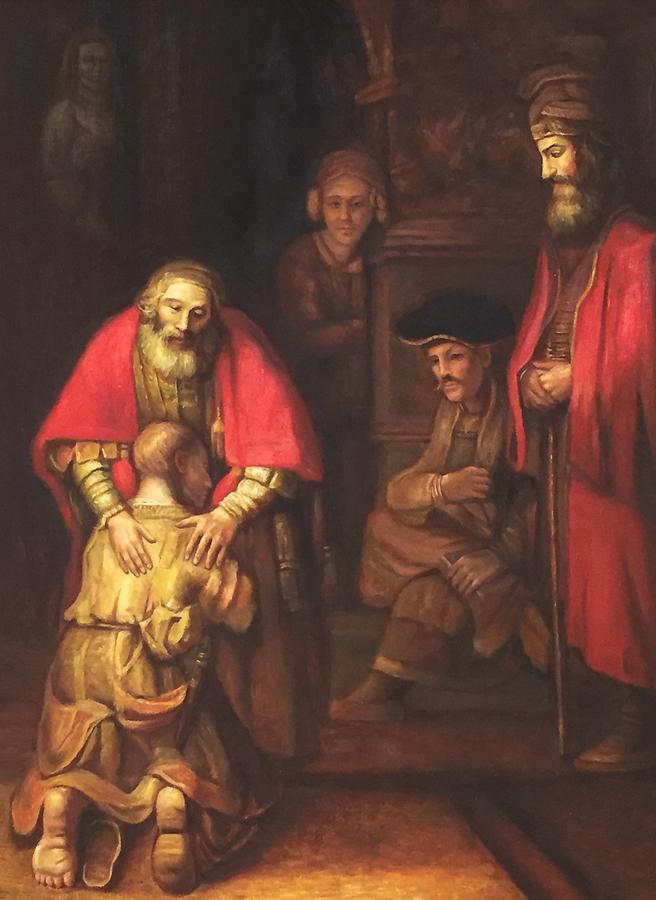
– that “gut love” that so describes God’s prodigal passion for us. We find the word again today in the heart-wrenching parable of the Prodigal Son.
You know the story. Near the end, as the devastated son returns seeking mercy…
While he was still a long way off, his father caught sight of him, and was filled with compassion — withsplancha – esplanchnisthē Luke 15:20
Our God is a Love that is filled, overflowing – with no room for retribution or condemnation.
Indeed, our God, like the Prodigal Father, is soft-hearted, an easy mark, a pushover for our sincere repentance, trust, and hope. Our God would bleed for us — just as Jesus did!
This short but powerful scene from George Balanchine’s ballet, Prodigal Son, may inspire our prayer today. The father is steadfast, a monolith of strength and love. The son is broken, naked in his desperation. Let their magnetic reunion take you to God’s heart. Let God wrap you too in the mantle of Love for any hurt or emptiness that is within you.
George Balanchine “Prodigal Son” – Final Scene (Son- Barishnikov)
Claude Debussy also wrote a beautiful piece on this parable. If you have a contemplative space sometime this week, you may want to listen to Debussy’s moving opera (with my all-time fav Ms. Jessye Norman.)
Today, in God’s Lavish Mercy, both Paul and Jesus caution their listeners to be single-hearted and resolute in their faith and practice.
Paul tells these early Corinthian Christians not to participate in dinners served at pagan temples. The meat at these meals had been sacrificed to idols so that to participate in the dinner appeared to give approbation to the idolatrous practice.
My beloved ones, avoid idolatry. I am speaking as to sensible people; judge for yourselves what I am saying.
….
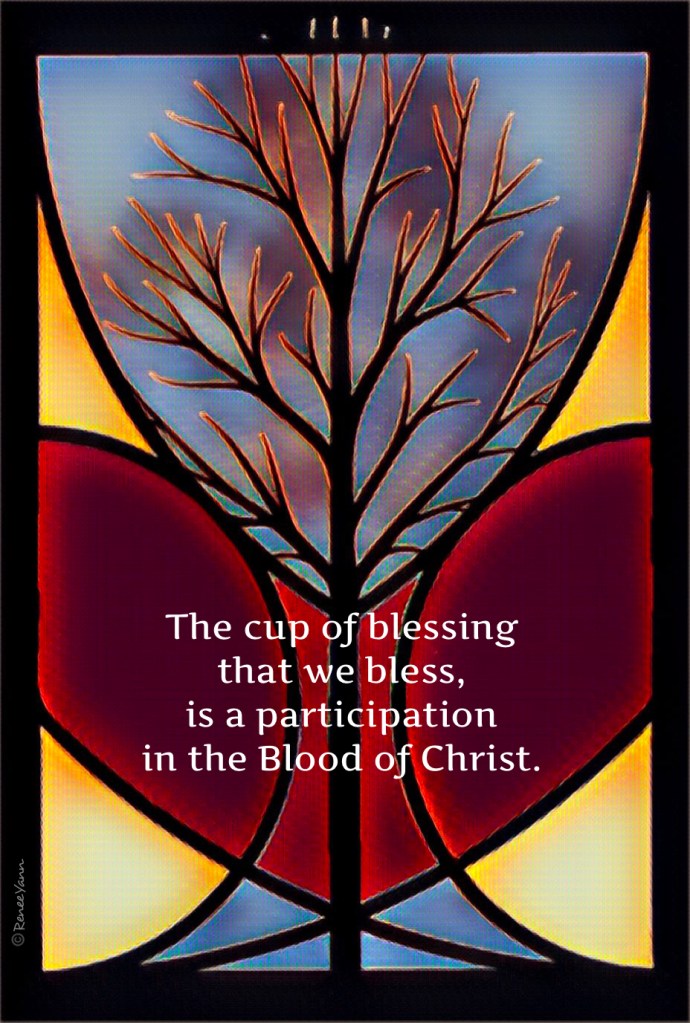
You cannot drink the cup of the Lord and also the cup of demons. You cannot partake of the table of the Lord and of the table of demons.
Paul’s key message is that now this baptized community belongs to a new faith which worships one God through Jesus Christ. Their lives must witness this gift and commitment.
My beloved ones, avoid idolatry. I am speaking as to sensible people; judge for yourselves what I am saying. The cup of blessing that we bless, is it not a participation in the Blood of Christ? The bread that we break, is it not a participation in the Body of Christ? Because the loaf of bread is one, we, though many, are one Body, for we all partake of the one loaf.
In our Gospel, Jesus describes that steadfast witness in terms of a tree. When we are truly knit into the love of God in Jesus Christ, we flourish with God’s own life.
A good tree does not bear rotten fruit, nor does a rotten tree bear good fruit. For every tree is known by its own fruit. For people do not pick figs from thornbushes, nor do they gather grapes from brambles. A good person out of the store of goodness in his heart produces good, but an evil person out of a store of evil produces evil; for from the fullness of the heart the mouth speaks.
Each day, each moment, gives us the opportunity to root our lives deeply in our faith. We ask God for that sacred entwining – like a tree which reaches deep into the ground for life, or like a well-founded house whose bedrock is deep and stable.
I will show you what someone is like who comes to me, listens to my words, and acts on them. That one is like someone building a house, who dug deeply and laid the foundation on rock; when the flood came, the river burst against that house but could not shake it because it had been well built.
Poetry: Love and Harmony – William Blake
This poem is often interpreted to describe the picture of a perfect marriage where love and harmony allow otherwise separate entities to “entwine”. However, Blake was, beyond a poet, a mystic. His poems almost always contain a central analogy of the human relationship with the Divine. I think this poem does as well and can be read as a type of prayer to be fully entwined with God, in love and harmony.
Love and harmony combine,
And round our souls entwine
While thy branches mix with mine,
And our roots together join.
Joys upon our branches sit,
Chirping loud and singing sweet;
Like gentle streams beneath our feet
Innocence and virtue meet.
Thou the golden fruit dost bear,
I am clad in flowers fair;
Thy sweet boughs perfume the air,
And the turtle buildeth there.
There she sits and feeds her young,
Sweet I hear her mournful song;
And thy lovely leaves among,
There is love, I hear his tongue.
There his charming nest doth lay,
There he sleeps the night away;
There he sports along the day,
And doth among our branches play.
Today, in God’s Lavish Mercy, there is a powerful urgency in Paul’s preaching.
Do you not know that the runners in the stadium all run in the race, but only one wins the prize? Run so as to win. Every athlete exercises discipline in every way. They do it to win a perishable crown, but we an imperishable one. Thus I do not run aimlessly; I do not fight as if I were shadowboxing. No, I drive my body and train it, for fear that, after having preached to others, I myself should be disqualified.
1 Corinthians 9:24-27
Let’s face it: Paul must have been a seriously intense guy. I mean look at his life! Early on, he took it on himself to personally go around “murderously” persecuting Christians. He got knocked off his high horse in a bolt from heaven, was struck blind, cured, and converted. This man did not live a laid-back life!
Conversion of Paul – Caravaggio
In today’s scripture, Paul tells the Corinthians to have an equal passion in living out their Christian faith. He describes his own complete dedication and chosen sacrifices to live and preach Christ’s message, saying:
All this I do for the sake of the Gospel, so that I too may have a share in it.
In our Gospel, Jesus says that to live the faith sincerely, we must be rid of anything that blinds us. Paul got his corrected vision in a lightning induced horse-fall. Maybe we need similar drama to achieve ours. Or maybe we just need to consistently place our judgements, beliefs, passions, and convictions before God humbly asking for the grace of discernment.
Why do you notice the splinter in your brother’s eye, but do not perceive the wooden beam in your own? How can you say to your brother, “Brother, let me remove that splinter in your eye,’” when you do not even notice the wooden beam in your own eye? You hypocrite! Remove the wooden beam from your eye first; then you will see clearly to remove the splinter in your brother’s eye.”
Poetry: The Racer – John Masefield
And as he landed I beheld his soul
Kindle, because, in front, he saw the Straight
With all its thousands roaring at the goal,
He laughed, he took the moment for his mate.
I saw the racer coming to the jump,
Staring with fiery eyeballs as he rusht,
I heard the blood within his body thump,
I saw him launch, I heard the toppings crusht.
Would that the passionate moods on which we ride
Might kindle thus to oneness with the will;
Would we might see the end to which we stride,
And feel, not strain, in struggle, only thrill.
And laugh like him and know in all our nerves
Beauty, the spirit, scattering dust and turves.
Music: Chariots of Fire – Vangelis
God bless Queen Elizabeth II who has faithfully run the race. May she rest in peace.
September is a time of new beginnings, powerful hope, and contagious enthusiasm. This is a special day for me and those women with whom I entered Mercy on September 8th, fifty-nine years ago. As I pray today, I think of each of them, and also of the teachers and children starting a new school year. I pray too for all of you Lavish Mercy followers and offer this extra reflection for your encouragement and a small personal celebration.
Being a long-ago teacher, I have always loved September. It is the sense of new beginning which accompanies these crisp, blue and golden days.
Remember the fresh batch of school supplies you got every year:
that marble copybook which invited you to a heightened level of neatness (perhaps never achieved !)?
that perfectly compact and complete pencil box with the little sharpener on the end, promising you clear and accurate answers?
that un-smudged and malleable soap eraser which would redeem you from any mistake?
and that wonderful box of fresh crayons, each standing at attention, ready to translate your genius into a rainbow of creativity ?
What a gift it is in life to be given the opportunity for a new beginning. Every one of us has grown richer in our hearts by both giving and receiving these opportunities. Every act of inclusion, forgiveness, encouragement, mentoring and graciousness we have given or received has brought a new dawn to our spirits.
We see so much violence, hatred and meanness in our world. We all mourn its ugly reappearance unrelentingly in the evening news, especially the lives lost of those who hungered for peace. But we must never allow ourselves to be poisoned or diminished by evil. Good will always overcome evil.
How wise it was of the Universal Spirit to give us both day and night. Their dance of light and dark is a daily reminder to us that with the evening comes refreshment and with the morning renewed joy. Every day, the Great Hand of Mercy reaches down into our darkness and lifts us up into the drenching light of hope. Do we ever take a moment to let ourselves be awed by that gift?
Every day is a new box of crayons! Every day, we can give and receive the chance to start fresh! How do I want to color my world differently today? What do I want to outline more clearly in my life? What gaps in my life are longing to be filled in with the rainbow of my creativity, courage and love? How will I blend the shades of peace into the world around me?
A beautiful verse from the Hebrew Scriptures puts it this way:
God’s mercies are renewed each morning, so great is God’s faithfulness.
Let yourself bask in that promise, especially in this golden September. It will renew your hope and strength.
Poetry: September – Helen Hunt Jackson
The golden-rod is yellow;
The corn is turning brown
The trees in apple orchards
With fruit are bending down.

The gentian’s bluest fringes
Are curling in the sun;
In dusty pods the milkweed
Its hidden silk has spun.

The sedges flaunt their harvest,
In every meadow nook;
And asters by the brook-side
Make asters in the brook.

From dewy lanes at morning
the grapes’ sweet odors rise;
At noon the roads all flutter
With yellow butterflies.

By all these lovely tokens
September days are here,
With summer’s best of weather,
And autumn’s best of cheer.

But none of all this beauty
Which floods the earth and air
Is unto me the secret
Which makes September fair.

‘T is a thing which I remember;
To name it thrills me yet:
One day of one September
I never can forget.
Today, in God’s Lavish Mercy, on our Blessed Mother’s birthday, we pray with the beautiful final verses of Psalm 13.
These verses embody an immense shift in form from the psalm’s early lines. Early on, the psalmist cries out four times, “How long, O Lord?”.
How long:
Will you forget me?
Will you hide your face from me?
Must I carry sorrow in my soul?
Will my enemy triumph over me?
Referring to these early verses reminds us that Mary’s life was full of sorrow as well as joy. On a feast like today, we think of Mary in her heavenly glory. But in her lifetime, Mary suffered many sorrows. She was an unwed mother, a refugee, and a widow. She was the mother of an executed “criminal” and a leader of his persecuted band.
The Julian of Norwich, “Her Showing of Love”
What was it that allowed Mary to transcend sorrow and claim joy? Our psalm verses today help us to understand. They show the psalmist turning to heartfelt prayer., trusting God’s abiding protection.
Look upon me, answer me, LORD, my God! Give light to my eyes lest I sleep in death, Lest my enemy say, “I have prevailed,” lest my foes rejoice at my downfall.
That deep trust ultimately yields not only peace, but joy. Mary, singer of the Magnificat, is the quintessence of that holy joy.
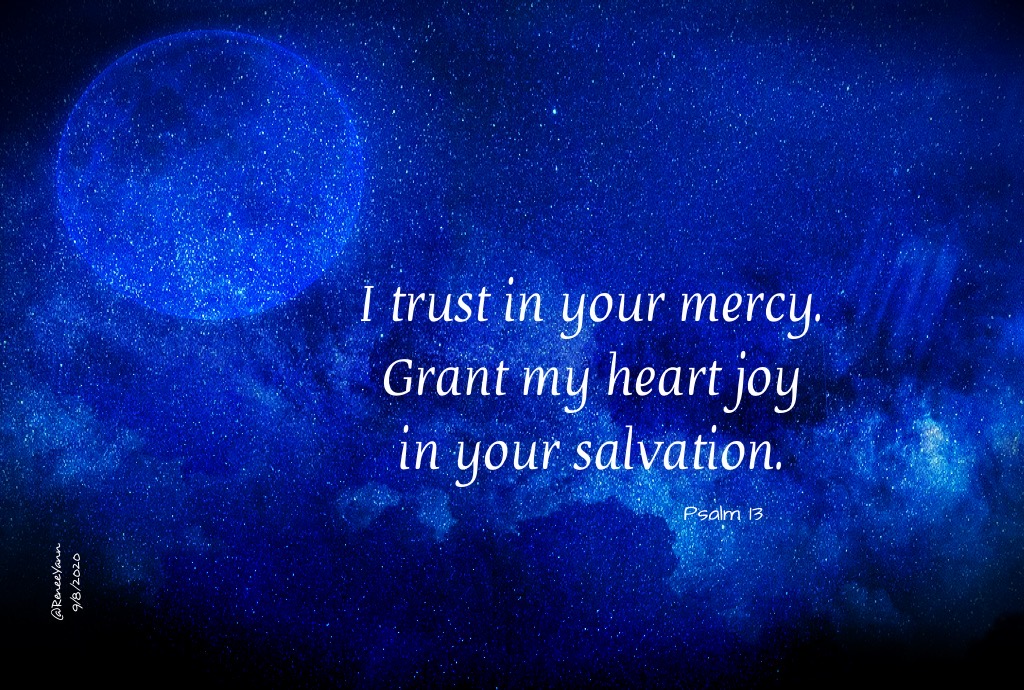
But I trust in your mercy. Grant my heart joy in your salvation, I will sing to the LORD, Who has dealt bountifully with me!
Today, in our prayer, we ask Mary to love and guide us through the challenges of our lives.
Poetry: Three Days – Madeleine L’Engle
Friday:
When you agree to be the mother of God
you make no conditions, no stipulations.
You flinch before neither cruel thorn nor rod.
You accept the tears; you endure the tribulations.
But, my God, I didn't know it would be like this.
I didn't ask for a child so different from others.
I wanted only the ordinary bliss,
to be the most mundane of mothers.

Saturday:
When I first saw the mystery of the Word
made flesh I never thought that in his side
I'd see the callous wound of Roman sword
piercing my heart on the hill where he died.
How can the Word be silenced? Where has it gone?
Where are the angel voices that sang at his birth?
My frail heart falters. I need the light of the Son.
What is this darkness over the face of the earth?
Sunday:
Dear God, He has come, the Word has come again.
There is no terror left in silence, in clouds, in gloom.
He has conquered the hate; he has overcome the pain.
Where, days ago, was death lies only an empty tomb.
The secret should have come to me with his birth,
when glory shone through darkness, peace through strife.
For every birth follows a kind of death, and only after pain comes life.
Today, in God’s Lavish Mercy, Paul gives a little “life guidance” to the neophyte Christian community in Corinth. One might get the picture of him sitting, grandfather-like, in a lounge chair by the Korinthos Bay, thinking his instructions out loud.
You know, if you’re a virgin, that’s good. – on the other hand -if you’re not, well that can work too. And if you’re not married, great. But – on the other had – if you are married, hmm, you’re gonna suffer, but you can still find a way.
Renee’s Translation of the passage below 🙂
In regard to virgins, I have no commandment from the Lord, but I give my opinion as one who by the Lord’s mercy is trustworthy. So this is what I think best because of the present distress: that it is a good thing for a person to remain as he is. Are you bound to a wife? Do not seek a separation. Are you free of a wife? Then do not look for a wife. If you marry, however, you do not sin, nor does an unmarried woman sin if she marries; but such people will experience affliction in their earthly life, and I would like to spare you that.
1 Corinthians :25-28
I can picture myself sitting in that crowd, turning to a companion to say, “WHAT the heck is he talking about!?”. And hopefully that companion would be tuned in enough to say, “He’s talking about life and how hard it is to truly appreciate what life is all about before it’s too late.”
I think that is the key and precious tidbit in this reading:
Life in Christ is the inverse of worldly definitions. It is a heartbeat humming under appearances, between the layers of our experience, which renders them infinitely more grace-filled than we might perceive.
I tell you the time is running out. From now on, let those having wives act as not having them, those weeping as not weeping, those rejoicing as not rejoicing, those buying as not owning, those using the world as not using it fully. For the world in its present form is passing away.
1 Corinthians 7: 29-21
We need deeper vision, a blessed listening to perceive this Sacred Heartbeat.
We need a peaceful courage and holy insight to enter it, to sing with it. Paul, in this reading and Jesus, in our Gospel, invite us to step into the spiritual counterpoint of God’s song.
Counterpoint is a compositional technique in which two or more melodic lines complement one another but act independently. The term comes from the Latin punctus contra punctum, which means “point against point.” Composers use counterpoint to create beautiful, complementary polyphonic music.
Paul’s lesson isn’t about being a virgin or not, being married or not. It’s about finding that sweet spot in your life, between the layers, where you can best hear God breathing within you and open your life, in counterpoint, to that Eternal Song.
Jesus says we will have found that sweet spot when we understand and live the “inverse richness” – the “counterpoint” of the Beatitudes which are offered in a perhaps less familiar form today by Luke:
Blessed are you who are poor, for the Kingdom of God is yours. Blessed are you who are now hungry, for you will be satisfied. Blessed are you who are now weeping, for you will laugh. Blessed are you when people hate you, and when they exclude and insult you, and denounce your name as evil on account of the Son of Man. Rejoice and leap for joy on that day! Behold, your reward will be great in heaven.
Poetry: The Layers – Stanley Kunitz
I have walked through many lives, some of them my own,
and I am not who I was,
though some principle of being
abides, from which I struggle
not to stray.
When I look behind,
as I am compelled to look
before I can gather strength
to proceed on my journey,
I see the milestones dwindling
toward the horizon
and the slow fires trailing
from the abandoned camp-sites,
over which scavenger angels
wheel on heavy wings.
Oh, I have made myself a tribe
out of my true affections,
and my tribe is scattered!
How shall the heart be reconciled
to its feast of losses?
In a rising wind
the manic dust of my friends,
those who fell along the way,
bitterly stings my face.
Yet I turn, I turn,
exulting somewhat,
with my will intact to go
wherever I need to go,
and every stone on the road
precious to me.
In my darkest night,
when the moon was covered
and I roamed through wreckage,
a nimbus-clouded voice
directed me:
“Live in the layers,
not on the litter.”
Though I lack the art
to decipher it,
no doubt the next chapter
in my book of transformations
is already written.
I am not done with my changes.
Music: Inside This River – Gary Schmidt ( more great counterpoint)
Today, in God’s Lavish Mercy, Corinthians might leave us thinking, “Wow, maybe I’m a sinner but I’m sure not as bad as those guys!”
Their Names Have Been Changed to Protect the Innocent 🙂
Paul generates quite a list of reprobates, doesn’t he!
Do not be deceived; neither fornicators nor idolaters nor adulterers nor boy prostitutes nor sodomites nor thieves nor the greedy nor drunkards nor slanderers nor robbers will inherit the Kingdom of God.
The list is so compelling that we might be blinded by it and miss the message that the reading has for us. And I think the message is this – what do Paul’s miscreants have in common?
They have violated and scorned the sanctity of RELATIONSHIP which demands commitment, trust, reverence and integrity.
When, in our prayer, we examine our conscience and honestly place before God the best we have done with our day, how does it look in terms of right-relationship?
How committed, honest, respectful and caring have we been toward those God has given us in the circle of our lives?
Paul’s catalogue of sinners use others for their own selfish purposes. There is no mutuality, responsibility or investment in one another’s good. And while our wrongdoings may not make Paul’s Most Wanted List, they will be characterized by the same failings.
The question Paul offers us is this: how reverent, honest, respectful, merciful and loving am I in each of my relationships – with God, myself, Creation, my immediate and larger world? Or whom might I instead “write off” as fodder for my contempt, gossip, judgements, disregard, indifference or exclusion?
NAMASTE
Maybe we don’t mean to do these things, but I think we might be surprised if we really took a good look at ourselves — myself included.
In calling the Corinthians to get it together, Paul is also calling me.
Poetry: When I Am Among the Trees – Mary Oliver
When I am among the trees,
especially the willows and the honey locust,
equally the beech, the oaks and the pines,
they give off such hints of gladness.
I would almost say that they save me, and daily.
I am so distant from the hope of myself,
in which I have goodness, and discernment,
and never hurry through the world
but walk slowly, and bow often.
Around me the trees stir in their leaves
and call out, “Stay awhile.”
The light flows from their branches.
And they call again, “It's simple,” they say,
“and you too have come
into the world to do this, to go easy, to be filled
with light, and to shine.”
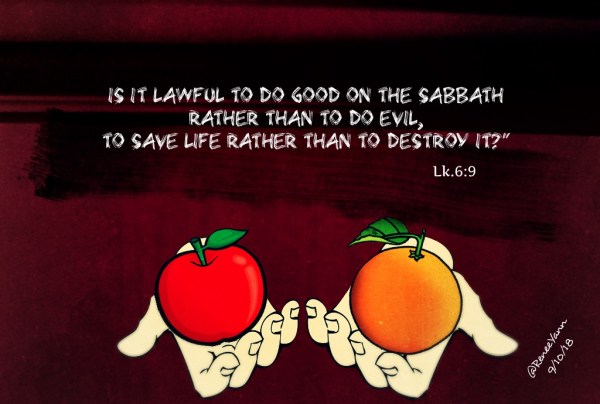
Today, in God’s Lavish Mercy, our Gospel finds the Pharisees once again confronting Jesus with a dilemma. It is the Sabbath, a day when any kind of “work” is prohibited. Yet, a man with a withered hand approaches Jesus needing to be cured. Should Jesus do this work?
It is the classic, Pharisaical confrontation: appearing to weigh two equal responses which in reality are incomparable – like apples and oranges. They are similar only on the surface. Their essences are quite distinct.
Jesus’ continuing debate with the Pharisees always swirls around the balance between law and spirit. The Pharisees have idolized the Law, allowing it to swallow the Spirit. Under their intransigent interpretation, the poor crippled man in today’s Gospel would have lost the chance for healing.
We call quandaries like this being “between a rock and a hard place”. The ancient Greeks called it “between Scylla and Charybdis” – an adjacent huge rock and whirlpool which threatened to swallow their ships passing through. The image powerfully captures the angst accompanying these dilemmas.
We navigate such hazards throughout our lives, facing choices which are often unclear and confusing. Our alternatives sail the wide range between “law” and “spirit”, between what seems advantageous and what seems right, between what is comfortable and what is spiritually challenging, between what is “legal” and what is just and merciful.
How do we choose according to the pattern of Christ? How do we choose forgiveness, mercy, inclusive love, peace and charity in a world that screams “Choose selfishly. You deserve it!”
Through prayer, scriptural reflection, and merciful service, our spirits absorb that Sacred Pattern of Christ. It is in the shape of the Cross. It will guide us between our Scylla and Charybdis.
Poetry: Scylla and Charybdis – from The Aeneid by Virgil
                    BUT when near the coasts
Of Sicily, Pelorus’ narrow straits
Open to view, then take the land to the left,
And the left sea, with a wide circuit round,
And shun the shore and sea upon the right.         5

Those lands, ’t is said, by vast convulsions once
Were torn asunder (such the changes wrought
By time), when both united stood as one.
Between them rushed the sea, and with its waves
Cut off the Italian side from Sicily,         10

And now between their fields and cities flows
With narrow tide. There Scylla guards the right,
Charybdis the implacable the left;
And thrice its whirlpool sucks the vast waves down
Into the lowest depths of its abyss,         15

And spouts them forth into the air again,
Lashing the stars with waves. But Scylla lurks
Within the blind recesses of a cave,
Stretching her open jaws, and dragging down
The ships upon the rocks. Foremost, a face,         20

Human, with comely virgin’s breast, she seems,
E’en to the middle; but her lower parts
A hideous monster of the sea, the tails
Of dolphins mingling with the womb of wolves.
Better to voyage, though delaying long,         25

Around Pachyna’s cape, with circuit wide,
Than once the shapeless Scylla to behold
Under her caverns vast, and hear those rocks
Resounding with her dark blue ocean hounds.
Today’s song is simple, almost childlike – but that simplicity is often just what we need in the face of a dilemma. Music: I Choose You – Libby Allen Songs














 Lavish Mercy