Alleluia, alleluia. The word of God is living and effective, able to discern the reflections and thoughts of the heart.
Today, in God’s Lavish Mercy, Ezekiel gets another tough assignment from God:
The word of the Lord came to me: Son of man, prophesy against the shepherds of Israel, in these words prophesy to them to the shepherds: Thus says the Lord GOD: Woe to the shepherds of Israel who have been pasturing themselves! Should not shepherds, rather, pasture sheep?
Ezekiel 34: 1-2
With prophetic insight, Ezekiel understands that Israel’s corrupt leaders will cause its downfall. He takes on the unhappy responsibility of summoning them – and the people – to repentance and conversion of heart.
By comparing Israel’s kings and princes to shepherds, Ezekiel points out how their leadership is a perversion of the ministry to which they have been called. He tells them that God won’t put up with their malfeasance because God has a tenderness for the “sheep” – particularly the struggling ones.
Thus says the Lord GOD: I swear I am coming against these shepherds. I will claim my sheep from them and put a stop to their shepherding my sheep so that they may no longer pasture themselves. I will save my sheep, that they may no longer be food for their mouths.
For thus says the Lord GOD: I myself will look after and tend my sheep.
Ezekiel 34: 10-11
The parallels to our present world are so stark that it’s difficult not to launch into political opining here! But I choose not to because the call within these readings goes much deeper than even current global circumstances.
And it is the call embodied in our Alleluia Verse:
Alleluia, alleluia. The word of God is living and effective, able to discern the reflections and thoughts of the heart.
Each one of us is created to live in the sincere light of God’s Word; to discern our relationships within Creation through the ‘living and effective” lens offered to us through our Baptism.
Whether we are leader or follower, these relationships must be built on reverence, honesty, justice, peace and mercy. Only then can we forestall the corporate corruptions that fester in the absence of grace.
The promissory nature of Ezekiel’s oracles articulates what good leadership looks like…in government, in corporations, all through the private sector. That rule consists in: – Seeking the lost – Bringing back the strayed – Binding up the injured – Strengthening the weak – Feeding the hungry In a word, good leadership consists in the restoration of the common good so that all members of the community, strong and weak, rich and poor, may live together in a common shalom of shared resources.
Walter Brueggemann, On Ezekiel 34
In our Gospel, the landowner refuses to be bound by corporate definitions regarding how he treats his laborers. He chooses to be generous, no doubt realizing the laborers’ underlying need for a decent day’s pay. Doing so, the landowner mirrors God whose generosity has granted the landowner life and livelihood.
As we pray today, let’s consider where we serve a leaders, and who depends on our sincere and generous heart for their subsistence. Some of these relationships might be obvious to us – such as the children in our lives, and others whom we support by our presence, care and love.
But others may not be so obvious. There may be others who need us to recognize that they’re waiting to be noticed and invited just like the late laborers of today’s Gospel. Is our world, and our generosity, big enough to include them?
Poetry: Shepherd – Rumi
Be a lamp, or a lifeboat, or a ladder. Help someone’s soul heal.
Alleluia, alleluia. Jesus Christ became poor although he was rich So that by his poverty you might become rich.
Today, in God’s Lavish Mercy, our readings confront us with a few spiritual cautions.
In our first reading, Ezekiel lets the Prince of Tyre know that he has really messed up his spiritual life:
Thus says the Lord GOD:
Because you are haughty of heart, you say, “A god am I! I occupy a godly throne in the heart of the sea!”— And yet you are a man, and not a god, however you may think yourself like a god.
This Tyrian prince Ithobalus reigned over a wealthy and politically powerful nation – a nation which had become arrogant and domineering in its relationship to other peoples. The word Ezekiel uses describes the condition perfectly: haughty. The prince was so haughty that he considered himself equal to — and in no need of — God.
We, of course, can learn a lesson from vainglorious Ithobalus. No material possession or personal strength makes us equal to God or renders us independent of God’s governance and care. According to Ezekiel, old Itho was about to find that out the hard way!
In our Gospel, Jesus talks about how we can get caught up in ourselves similarly to Ithobaal.
Jesus said to his disciples: “Amen, I say to you, it will be hard for one who is rich to enter the Kingdom of heaven. Again I say to you, it is easier for a camel to pass through the eye of a needle than for one who is rich to enter the Kingdom of God.”
When we read this passage, I think most of us picture material riches. And certainly the saying holds true in that case. But it also holds true for other types of “riches” – strengths or possessions that we use in arrogance and indifference toward others’ needs.
Prose: Pope Francis preached about such things in a homily on this passage from the prophet Amos:
Woe to the complacent in Zion, to those who feel secure … lying upon beds of ivory! . They eat, they drink, they sing, they play and they care nothing about other people’s troubles. (Am 6:1,4)
How does something like this happen? How do some people, perhaps ourselves included, end up becoming self-absorbed and finding security in material things which ultimately rob us of our face, our human face? This is what happens when we become complacent, when we no longer remember God. “Woe to the complacent in Zion”, says the prophet. If we don’t think about God, everything ends up flat, everything ends up being about “me” and my own comfort. Life, the world, other people, all of these become unreal, they no longer matter, everything boils down to one thing: having. When we no longer remember God, we too become unreal, we too become empty; like the rich man in the Gospel, we no longer have a face! Those who run after nothing become nothing – as another great prophet Jeremiah, observed (cf. Jer 2:5). We are made in God’s image and likeness, not the image and likeness of material objects, of idols!
Pope Francis – September 29, 2013
Music: Jesu, Joy of Our Desiring – J.S. Bach, interpreted by Daniel Kobialka
Alleluia, alleluia. Mary is taken up to heaven; a chorus of angels exults.
Today, in God’s Lavish Mercy, we honor Mary on the Feast which celebrates her assumption, “that the Immaculate Mother of God, the ever Virgin Mary, having completed the course of her earthly life, was assumed body and soul into heavenly glory.”
The Catholic Church’s teaching on the Assumption of Mary was promulgated in 1950 by Pope Pius XII in an Apostolic Constitution entitled “MUNIFICENTISSIMUS DEUS (the Most Bountiful God). Having experienced the horrors of a world war, and aware of the ensuing evils of the Cold War, Pope Pius XII looked to Mary for healing for himself and the whole world:
We, who have placed our pontificate under the special patronage of the most holy Virgin, to whom we have had recourse so often in times of grave trouble, we who have consecrated the entire human race to her Immaculate Heart in public ceremonies, and who have time and time again experienced her powerful protection, are confident that this solemn proclamation and definition of the Assumption will contribute in no small way to the advantage of human society, since it redounds to the glory of the Most Blessed Trinity, to which the Blessed Mother of God is bound by such singular bonds. It is to be hoped that all the faithful will be stirred up to a stronger piety toward their heavenly Mother, and that the souls of all those who glory in the Christian name may be moved by the desire of sharing in the unity of Jesus Christ’s Mystical Body and of increasing their love for her who shows her motherly heart to all the members of this august body. And so we may hope that those who meditate upon the glorious example Mary offers us may be more and more convinced of the value of a human life entirely devoted to carrying out the heavenly Father’s will and to bringing good to others. Thus, while the illusory teachings of materialism and the corruption of morals that follows from these teachings threaten to extinguish the light of virtue and to ruin the lives of men by exciting discord among them, in this magnificent way all may see clearly to what a lofty goal our bodies and souls are destined. Finally it is our hope that belief in Mary’s bodily Assumption into heaven will make our belief in our own resurrection stronger and render it more effective.
MUNIFICENTISSIMUS DEUS (42)
Maybe, like me, the fact of the Assumption doesn’t matter a whole lot to you. I love Mary whether she was “assumed” or not. But in its time, the declaration of this dogma was important in order to turn the world’s focus toward Mary, a figure of goodness, courage, love, mercy and justice – virtues desperately necessary for healing in the aftermath of war.
Our own world could surely benefit from a prayerful, loving contemplation of Mary.
Mary was a woman so open to God that she enfleshed God’s Spirit in the person of Jesus. She was a vessel of love – for God and for all Creation. By living her ordinary life with extraordinary love and holy courage, she became blessed.
Mary, the Blessed Mother of all of us, can teach us to love, reverence, strengthen and support one another when we pray with her as we meet her in the Gospel.
Elizabeth said:
“Blessed are you who believed that what was spoken to you by the Lord would be fulfilled.”
And Mary said: “My soul proclaims the greatness of the Lord; my spirit rejoices in God my Savior for God has looked on my simplicity with favor . From this day all generations will call me blessed: the Almighty has done great things for me and holy is God’s Name. In every generation, God has mercy on those with holy reverence and awe.
Poetry: The Blessed Virgin compared to the air we breathe… by Gerard Manley Hopkins, SJ
( I know this is a really long poem, and Hopkins can seem a little convoluted. But the images in this poem are spectacular … even if you just read a bit at a time. It’s so worth it.)
Wild air, world-mothering air, Nestling me everywhere, That each eyelash or hair Girdles; goes home betwixt The fleeciest, frailest-flixed Snowflake; that’s fairly mixed With, riddles, and is rife In every least thing’s life; This needful, never spent, And nursing element; My more than meat and drink, My meal at every wink; This air, which, by life’s law, My lung must draw and draw Now but to breathe its praise, Minds me in many ways Of her who not only Gave God’s infinity Dwindled to infancy Welcome in womb and breast, Birth, milk, and all the rest But mothers each new grace That does now reach our race— Mary Immaculate, Merely a woman, yet Whose presence, power is Great as no goddess’s Was deemèd, dreamèd; who This one work has to do— Let all God’s glory through, God’s glory which would go Through her and from her flow Off, and no way but so.
I say that we are wound With mercy round and round As if with air: the same Is Mary, more by name. She, wild web, wondrous robe, Mantles the guilty globe, Since God has let dispense Her prayers his providence: Nay, more than almoner, The sweet alms’ self is her And men are meant to share Her life as life does air. If I have understood, She holds high motherhood Towards all our ghostly good And plays in grace her part About man’s beating heart, Laying, like air’s fine flood, The deathdance in his blood; Yet no part but what will Be Christ our Saviour still. Of her flesh he took flesh: He does take fresh and fresh, Though much the mystery how, Not flesh but spirit now And makes, O marvellous! New Nazareths in us, Where she shall yet conceive Him, morning, noon, and eve; New Bethlems, and he born There, evening, noon, and morn Bethlem or Nazareth, Men here may draw like breath More Christ and baffle death; Who, born so, comes to be New self and nobler me In each one and each one More makes, when all is done, Both God’s and Mary’s Son. Again, look overhead How air is azurèd; O how! nay do but stand Where you can lift your hand Skywards: rich, rich it laps Round the four fingergaps. Yet such a sapphire-shot, Charged, steepèd sky will not Stain light. Yea, mark you this: It does no prejudice. The glass-blue days are those When every colour glows, Each shape and shadow shows. Blue be it: this blue heaven The seven or seven times seven Hued sunbeam will transmit Perfect, not alter it. Or if there does some soft, On things aloof, aloft, Bloom breathe, that one breath more Earth is the fairer for. Whereas did air not make This bath of blue and slake His fire, the sun would shake, A blear and blinding ball With blackness bound, and all The thick stars round him roll Flashing like flecks of coal, Quartz-fret, or sparks of salt, In grimy vasty vault. So God was god of old: A mother came to mould Those limbs like ours which are What must make our daystar Much dearer to mankind; Whose glory bare would blind Or less would win man’s mind. Through her we may see him Made sweeter, not made dim, And her hand leaves his light Sifted to suit our sight. Be thou then, thou dear Mother, my atmosphere; To wend and meet no sin; Above me, round me lie Fronting my froward eye With sweet and scarless sky; Stir in my ears, speak there Of God’s love, O live air, Of patience, penance, prayer: World-mothering air, air wild, Wound with thee, in thee isled, Fold home, fast fold thy child.
Music: Magnificat – Mina
Magnificat anima mea Magnificat Dominum et exsultavit spiritus meus In Deo salutari meo Magnificat, Magnificat Quia respexit humilitatem ancillae suae Ecce enim ex hoc beatam me dicent omnes generationes Magnificat anima mea Magnificat Dominum et exsultavit spiritus meus In Deo salutari meo Magnificat, Magnificat Quia fecit mihi magna qui potens est Et sanctum nomen ejus Magnificat, Magnificat Dominum et exsultavit spiritus meus In Deo Magnificat, Magnificat
Lyrics translation
My soul magnifies the The lord and my spirit rejoices In God my saviour Magnificat, Magnificat For he has looked on his servant in her lowliness Behold this blessed shall call me blessed all generations The Magnificat my soul Magnifies the The lord and my spirit rejoices In God my saviour Magnificat, Magnificat Because I made a big who is able And holy is his name Magnificat, Magnificat The lord and my spirit rejoices In God Magnificat, Magnificat
Today, in God’s Lavish Mercy, our readings encourage us, despite all obstacles, to deepen our spiritual life.
But sometimes it’s hard. Sometimes we get stuck in habits, illusions, fears, doubts and all kinds of things that paralyze us. And it’s not for lack of trying, but we just can’t seem to break free of what immobilizes us.
On a beautiful summer day years ago, I went clamming with some friends. I had backed the car to the bay’s edge to unload our equipment. I didn’t notice as the tide came in that it was softening the sand around my rear wheels. Later, when I tried to pull out, the wheels just spun. The more I revved, the more they sank. Fortunately, my hearty friends were able to push the car enough to coax it out. But we all learned a lifelong lesson.
Luckily, Jeremiah also had some friends who freed him from the mud. He may have prayed his thanksgiving with the Responsorial Psalm we are given today:
I waited patiently for the Lord;
who turned to me and heard my cry.
The Lord lifted me out of the slimy pit,
out of the mud and mire;
set my feet on a rock
and gave me a firm place to stand.
God put a new song in my mouth,
a hymn of praise to our God.
Many will see and fear the Lord
and put their trust in God.
In a similar way, Paul evokes the “great cloud of witnesses” surrounding us – friends, both living and dead who model courageous faith for us. Jesus, in particular, “seeing the joy that lay before him” offered such witness by his Life, Death and Resurrection.
In our Gospel, Jesus reaffirms how hard such witnessing can be:
Do you think that I have come to establish peace on the earth?
I have come to set the earth on fire,
and how I wish it were already blazing!
St. Catherine of Siena heard this challenge of Jesus and restated it like this:
Be who God meant you to be and you will set the world on fire.
That’s what today’s scripture readings are encouraging us to do. Blessings on our will and effort.
Today, in God’s Lavish Mercy, the core of our readings is about innocence and authenticity. But you have to dig a little to get to that. Maybe, like me, you finished our first reading asking, “So what’s with the green grapes!?”
A common expression in ancient Israel suggested that people’s bad luck was a punishment for their parent’s sins. It was a handy way of avoiding responsibility for one’s own foolish actions, often the actual source of one’s misfortune.
Ezekiel uses the expression to teach a lesson about the nature of God’s love and forgiveness. God loves us completely – without prejudice, without vengeance. There is no record of faults to “set our teeth on edge”. There are no “green grapes” on God’s table. God only wants our wholeness.
Therefore I will judge you, house of Israel, each one according to their own ways, says the Lord GOD. Turn and be converted from all your crimes, that they may be no cause of guilt for you. Cast away from you all the crimes you have committed, and make for yourselves a new heart and a new spirit.
God will not let us hide behind excuses like a bogus “Green Grapes Theory”. As in any loving relationship, we must be honest with God, own our faults, seek forgiveness, and love ardently.
Jesus uses the example of a little child to show us how to do this. Each one of us is born with a core of innocence and authenticity. These are the attributes of God’s life in us. Throughout our lives there are times when we hide these blessings under our sinfulness. Some people bury them so deep that they lose touch with their own sacred integrity.
Jesus calls us back out of our excuses and our excesses, just as the Lord called Ezekiel’s community. We are invited to an eternal covenant rooted in the gift of divine innocence and authenticity given to us at our creation.
Jesus said: Let the children come to me, and do not prevent them; for the Kingdom of heaven belongs to such as these.
Poetry: The Pursuit – Henry Vaughn
LORD ! what a busy, restless thing
Hast Thou made man !
Each day and hour he is on wing,
Rests not a span ;
Then having lost the sun and light,
By clouds surpris’d,
He keeps a commerce in the night
With air disguis’d.
Hadst Thou given to this active dust
A state untir’d,
The lost son had not left the husk,
Nor home desir’d.
That was Thy secret, and it is
Thy mercy too ;
For when all fails to bring to bliss,
Then this must do.
Ah, Lord ! and what a purchase will that be,
To take us sick, that sound would not take Thee !
Alleluia, alleluia. Receive the word of God, not as a human word but, as it truly is, the word of God.
Today, in God’s Lavish Mercy, our readings are hard-edged with images that can scrape the heart rather than warm it.
Ezekiel, with typical passion, describes God’s ardent love for Israel in a drama of abandonment, rescue, desire, tenderness, rejection, forgiveness, and reconciliation. It’s like a biblical soap opera filled with lines fit for the silver screen.
As for your birth, the day you were born your navel cord was not cut; you were neither washed with water nor anointed, nor were you rubbed with salt, nor swathed in swaddling clothes. No one looked on you with pity or compassion to do any of these things for you. Rather, you were thrown out on the ground as something loathsome, the day you were born.
Ezekiel 16:4-6
Guess what. Our lives are like soap operas too. But the script is usually not squeezed into one biblical passage or TV half hour, so we might underestimate the intensity of our own relationship story with God and with God’s Creation drawn out over the length of our years.
Both our readings today incline us to consider the nature of relationship in our lives – how do we meet, encounter or objectify the “other” – even the “Other” who is God.
I read many years ago that once we are in relationship with a person or thing, that relationship can never end. It may change. It may even be denied. But as long as we have memory, the relationship exists.
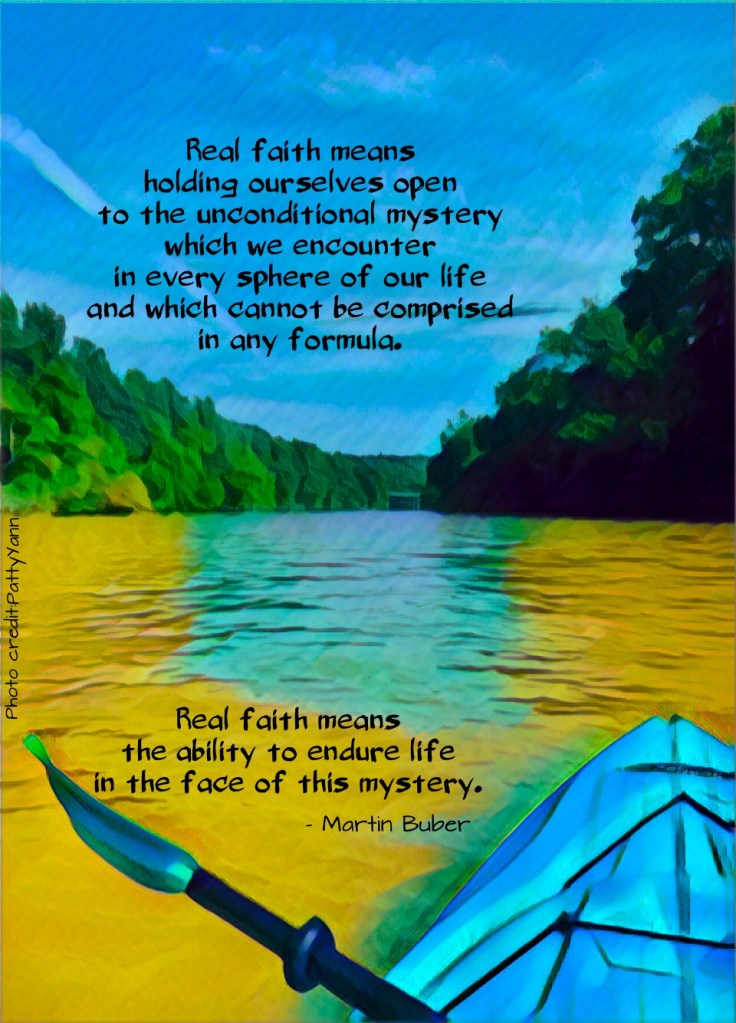
I can’t recall exactly where I read this, but I believe the concept came from Martin Buber, venerable teacher and author of the masterpiece “I and Thou”.
Buber describes an I-Thou relationship as a mutual, holistic encounter between two beings. It is characterized by openness, authenticity and reverence toward the other.
An I-it relationship, on the other hand, does not include “encounter”. Instead, the individual treats other beings as objects to be understood only within one’s own mental framework.
This may sound like a lot of philosophical jargon, but we see the two concepts concretized in today’s readings.
The Gospel Pharisees see marriage as an “I-It” relationship that must fit into their own mental framework and definition. Jesus calls them out for their hard-heartedness and reminds them that God created human beings for encounter not objectification. Buber said it this way:
Marriage, for instance, will never be given new life except by that out of which true marriage always arises, the revealing by two people of the Thou to one another. Out of this a marriage is built up by the Thou that is neither of the I’s. This is the metaphysical and metapsychical factor of love to which feelings of love are mere accompaniments.”
Martin Buber – I and Thou
In our first reading, Ezekiel describes God’s “I-Thou” relationship with us, giving and responding to us in immutable loving encounter. The relationship changes under various circumstances but it never dissolves. Buber saw it this way:
That you need God more than anything, you know at all times in your heart. But don’t you know also that God needs you—in the fullness of God’s eternity, you? How would the human person exist if God did not need her and how would you exist? You need God in order to be, and God needs you—for that which is the meaning of your life.”
Martin Buber – I and Thou
Poetry: A Long Faith – Renee Yann, RSM
This is the way of love, perhaps
near the late summer,
when the fruit is full
and the air is still and warm,
when the passion of lovers
no longer rests against
the easy trigger
of adolescent spring,
but lumbers in the drowsy silence
where the bees hum --
where it is enough
to reach across the grass
and touch each other's hand.
Music: This beautiful song captures the insoluble nature of true relationship. Ezekiel understood it. Buber understood it. Certainly, Jesus understood it. And I think wonderful Dolly Parton, in her own inimitable way, understands it. Anyway, you all deserve a pretty song after reading all that philosophy! 🙂
Alleluia, alleluia. Blessed are the poor in spirit; the Kingdom of heaven is theirs!
Today, in God’s Lavish Mercy, we’ll pray with the readings for St. Clare of Assisi. Clare, like Francis, was a luminous prophet of the Christian era.
Clare of Assisi (born Chiara Offreduccio, 16 July 1194 – 11 August 1253) was an Italian saint and one of the first followers of Francis of Assisi. She founded the Order of Poor Ladies, a monastic religious order for women in the Franciscan tradition, and wrote their Rule of Life, the first set of monastic guidelines known to have been written by a woman.
Wikipedia
By the life Clare lived, she gave testimony to a sacred reality which continues to enrich the life of the Church.
As I learned about Clare, I discovered a woman who was original and innovative in her own right. She was profoundly mystical and charismatic, unyielding and radical in her commitment to poverty; a model of servant leadership; determined despite years of ailing health; courageous in the face of danger. In short, she was a saint…with or without Francis.
Bret Thoman, O.F.S., – an American Catholic lay writer, secular third order Franciscan. His latest book is St. Clare of Assisi: Light from the Cloister.
Today before I wrote this reflection, our own Mercy Sister Clare was buried. As our sisters are carried to the cemetery, the death knell slowly tolls out over the whole surrounding neighborhood. Some may hear it as a solemn reminder as did the poet John Donne:
No man is an island,
Entire of itself.
Each is a piece of the continent,
A part of the main.
If a clod be washed away by the sea,
Europe is the less.
As well as if a promontory were.
As well as if a manor of thine own
Or of thine friend's were.
Each man's death diminishes me,
For I am involved in mankind.
Therefore, send not to know
For whom the bell tolls,
It tolls for thee.
Instead, I choose to hear the hallowed sound as a salute to one who understood and chose what is most important in life:
Happy the soul to whom it is given to attain this life with Christ,
to cleave with all one’s heart to him
whose beauty all the heavenly hosts behold forever,
whose love inflames our love,
the contemplation of whom is our refreshment,
whose graciousness is our delight,
whose gentleness fills us to overflowing,
whose remembrance makes us glow with happiness,
whose fragrance revives the dead,
the glorious vision of whom will be the happiness
of all the citizens of the heavenly Jerusalem.
For he is the brightness of eternal glory,
the splendor of eternal light,
the mirror without spot.
Clare of Assisi
Our Gospel today reinforces the lesson that a life given fully to Christ and the Gospel, as was both these precious Clare’s, is returned to the giver a hundredfold:
Peter said to Jesus, “We have given up everything and followed you. What will there be for us?” Jesus said to them, “Amen, I say to you that you who have followed me, in the new age, when the Son of Man is seated on his throne of glory, will yourselves sit on twelve thrones, judging the twelve tribes of Israel. And everyone who has given up houses or brothers or sisters or father or mother or children or lands for the sake of my name will receive a hundred times more, and will inherit eternal life.”
Music: Let the Love That Dwells in Your Hearts
Let the love that dwells in your hearts shine forth in your deeds. (St. Clare)
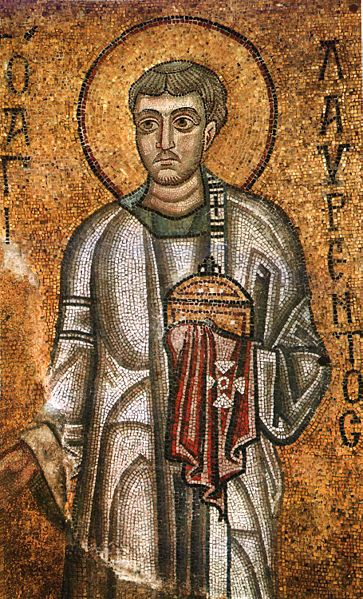
Saint Lawrence. Mosaic from the Saint Sophia Cathedral in Kiev.
Today, in God’s Lavish Mercy, we celebrate the feast of St. Lawrence who is noted for his love for those who were poor. Legend has it that Lawrence was demanded, before his martyrdom, to turn over the Church’s riches to the emperor Valerian. Instead, he distributed all the resources among the poor. Lawrence then gathered all these people, presenting them before Valerian with these words:
Behold in these poor persons the treasures which I promised to show you – these are the true treasures of the Church.
Lawrence was likely inspired by readings like today’s. In Corinthians, Paul encourages us to be cheerful givers. He says this delights God, the Giver of Divine Abundance, whom we are imitating.
In our reading from John, Jesus says that only in dying to ourselves do we live – the ultimate generosity. He says that only by doing this can we truly follow him.
While these readings are clear and simple, they are so profound that we can hardly take in their message. What they ask of us is daunting! The encouragement Jesus gives us to respond to his challenge is this:
The Father will honor whoever serves me.
St. Lawrence believed and lived this promise. What about us?
Poetry: St. Laurence – Joyce Kilmer
Within the broken Vatican
The murdered Pope is lying dead.
The soldiers of Valerian
Their evil hands are wet and red.
Unarmed, unmoved, St. Laurence waits,
His cassock is his only mail.
The troops of Hell have burst the gates,
But Christ is Lord, He shall prevail.
They have encompassed him with steel,
They spit upon his gentle face,
He smiles and bleeds, nor will reveal
The Church's hidden treasure-place.
Ah, faithful steward, worthy knight,
Well hast thou done. Behold thy fee!
Since thou hast fought the goodly fight
A martyr's death is fixed for thee.
St. Laurence, pray for us to bear
The faith which glorifies thy name.
St. Laurence, pray for us to share
The wounds of Love's consuming flame.
Music: Before the Bread – Elizabeth Alexander
We all want our lives to be full and complete – to be “bread”. But there are many steps before the grain of wheat becomes bread, as captured in this elegant acapella canon.
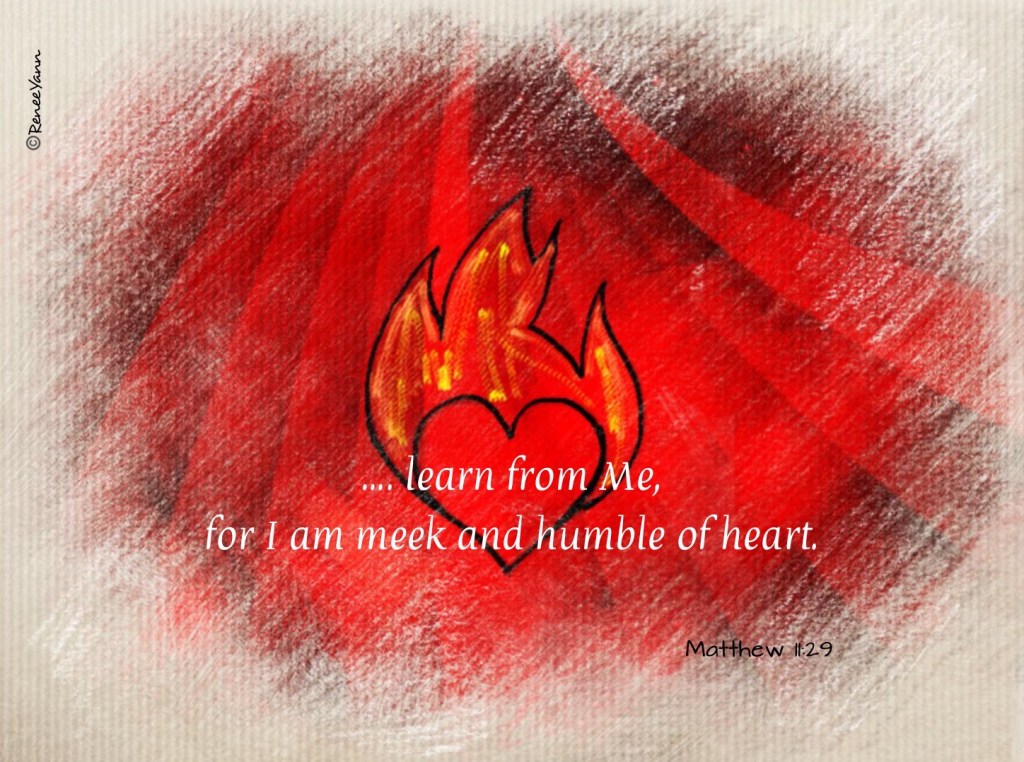
Alleluia, alleluia. Take my yoke upon you and learn from me, for I am meek and humble of heart.
Today, in God’s Lavish Mercy, our readings offer us key lessons about truth, simplicity and sacred obedience.
Let’s start with Ezekiel. In one of his technicolor visions, God tells him to eat a scroll inscribed with the scary words, “Lamentation and wailing and woe!” A little nightmarish, isn’t it. One might be tempted to tell God, “Thanks anyway, but I’ve already eaten!”
Source: gallica.bnf.fr Bibliothèque nationale de France, Département des manuscrits, Latin 16744, fol. 81r.
But Ezekiel listens and obeys, only to be surprised by the sweetness of the Word once consumed.
The Lord said to me: Creature of Earth, eat what is before you; eat this scroll, then go, speak to the house of Israel. So I opened my mouth and was given the scroll to eat. Creator of Earth, the Lord then said to me, feed your belly and fill your stomach with this scroll I am giving you. I ate it, and it was as sweet as honey in my mouth. The Lord said: Go now to the house of Israel, and speak my words to them.
Ezekiel 3:1-4
Our Responsorial Psalm expatiates on that sweetness. The psalmist too sees that the Word, once embraced, brings unexpected delight.
In our Gospel, Jesus centers his teaching on the innocence and simplicity of a child. A child’s openness, trust, and readiness to love show us how we should respond to God’s Word.
As we “grow up”, and our lives become complicated with the world’s expectations, the Word can be hard to swallow. It demands honesty in a culture that often manipulates with lies. It asks for selflessness in a world full of “me first”. It asks us to listen, in sacred obedience, for the whisper of grace in a cacophony of violence.
The truth of God’s Word is demanding. It doesn’t bend to worldly expectations. And, certainly, this can bring a certain “lamentation and wailing and woe” to the practitioner of God’s just and merciful message.
Jesus tells us to take up that challenge, to trust the Word, to consume the it and be consumed by it, just as little children are consumed by mystery, hope, and delight.
Amen, I say to you, unless you turn and become like children, you will not enter the Kingdom of heaven. Whoever becomes humble like this child is the greatest in the Kingdom of heaven.
Matthew 18:3-4
Poetry: Where Is God? – Mark Nepo
It’s as if what is unbreakable— the very pulse of life—waits for everything else to be torn away, and then in the bareness that only silence and suffering and great love can expose, it dares to speak through us and to us. It seems to say, if you want to last, hold on to nothing. If you want to know love, let in everything. If you want to feel the presence of everything, stop counting the things that break along the way.
Music: Word of God – Bernadette Farrell
Word of God, renew your people, make us now your living sign. Recreate us for your purpose in this place and in this time.
Word of hope and word of healing… Word of peace and word of justice … With your cross of love upon us … God alone the power we trust in … By our name you call us onward Cross of Jesus freely chosen Cross of Jesus, all-embracing … By your Cross, restored, forgiven… Through the Cross of Christ our Savior … To the waters lead your people … Risen Savior with us always … Holy Spirit, raise your people >>>
Alleluia, alleluia. God has called you through the Gospel to possess the glory of our Lord Jesus Christ.
by Michelangelo on the ceiling of the Sistine Chapel in the Vatican between 1508 to 1512
Today, in God’s Lavish Mercy, we begin nearly two weeks of first readings from the prophet Ezekiel, and this first one is a real WOW!
As I looked, a stormwind came from the North, a huge cloud with flashing fire enveloped in brightness, from the midst of which (the midst of the fire) something gleamed like electrum. Within it were figures resembling four living creatures that looked like this: their form was human.
Ezekiel 1:4-6
Walter Brueggemann calls Ezekiel “the prophet who had fantasies and hallucinations”. Nevertheless, Ezekiel is considered a prophet because like all prophets, Ezekiel “noticed what no one else noticed” — Ezekiel “saw death coming” to Israel.
Ezekiel did not blame the king, the government, the military or the war planners for this terrible death to come. He blamed the religious community, the clergy, the prophets: “My hands will be against the prophets who see delusive visions and give lying messages” (13:9). Ezekiel blamed the religious community because that community is responsible for truth-telling.
Truth-Telling and Peacemaking: A Reflection on Ezekiel by Walter Brueggemann
I think it might be safe to say that most religious communities – and the people who comprise them – do not want to hear such things about themselves. Abraham Heschel, one of the greatest theologians and philosophers of the 20th century said this:
The prophets had disdain for those to whom God was comfort and security; to them God was a challenge, an incessant demand. He is compassion, but not a compromise; justice, but not inclemency. Tranquility is unknown to the soul of a prophet. The miseries of the world give him no rest. While others are callous, and even callous to their callousness and unaware of their insensitivity, the prophets remain examples of supreme impatience with evil, distracted by neither might nor applause, by neither success nor beauty. Their intense sensitivity to right and wrong is due to their intense sensitivity to God’s concern for right and wrong. They feel fiercely because they hear deeply.
In today’s Gospel, Jesus informs his disciples that he too will endure a prophet’s suffering:
As Jesus and his disciples were gathering in Galilee, Jesus said to them, “The Son of Man is to be handed over to men, and they will kill him, and he will be raised on the third day.” And they were overwhelmed with grief.
Matthew 17:22-23
As we reflect on what these readings mean for us in our lives, our Alleluia Verse offers a key phrase:
Alleluia, alleluia. God has called you through the Gospel To possess the glory of our Lord Jesus Christ.
…through the Gospel
Unless we know and cherish the Gospel, we Christians cannot hear our call.
Poetry: The Call of a Christian – John Greenleaf Whittier
Not always as the whirlwind's rush
On Horeb's mount of fear,
Not always as the burning bush
To Midian's shepherd seer,
Nor as the awful voice which came
To Israel's prophet bards,
Nor as the tongues of cloven flame,
Nor gift of fearful words,--
Not always thus, with outward sign
Of fire or voice from Heaven,
The message of a truth divine,
The call of Godis given!
Awaking in the human heart
Love for the true and right,--
Zeal for the Christian's better part,
Strength for the Christian's fight.
Nor unto manhood's heart alone
The holy influence steals
Warm with a rapture not its own,
The heart of woman feels!
As she who by Samaria's wall
The Saviour's errand sought,--
As those who with the fervent Paul
And meek Aquila wrought:
Or those meek ones whose martyrdom
Rome's gathered grandeur saw
Or those who in their Alpine home
Braved the Crusader's war,
When the green Vaudois, trembling, heard,
Through all its vales of death,
The martyr's song of triumph poured
From woman's failing breath.
And gently, by a thousand things
Which o'er our spirits pass,
Like breezes o'er the harp's fine strings,
Or vapors o'er a glass,
Leaving their token strange and new
Of music or of shade,
The summons to the right and true
And merciful is made.
Oh, then, if gleams of truth and light
Flash o'er thy waiting mind,
Unfolding to thy mental sight
The wants of human-kind;
If, brooding over human grief,
The earnest wish is known
To soothe and gladden with relief
An anguish not thine own;
Though heralded with naught of fear,
Or outward sign or show;
Though only to the inward ear
It whispers soft and low;
Though dropping, as the manna fell,
Unseen, yet from above,
Noiseless as dew-fall, heed it well,---
Thy Father's call of love!













 Lavish Mercy