Alleluia: Imperative Mood

Monday of the Sixteenth Week in Ordinary Time
July 18, 2022

Today’s Readings

https://bible.usccb.org/bible/readings/071822.cfm

Alleluia, alleluia.
If today you hear God’s voice,
soften your hearts.

Today, in God’s Lavish Mercy, the readings heighten the familiar imperative of our Alleluia Verse with several more injunctions:
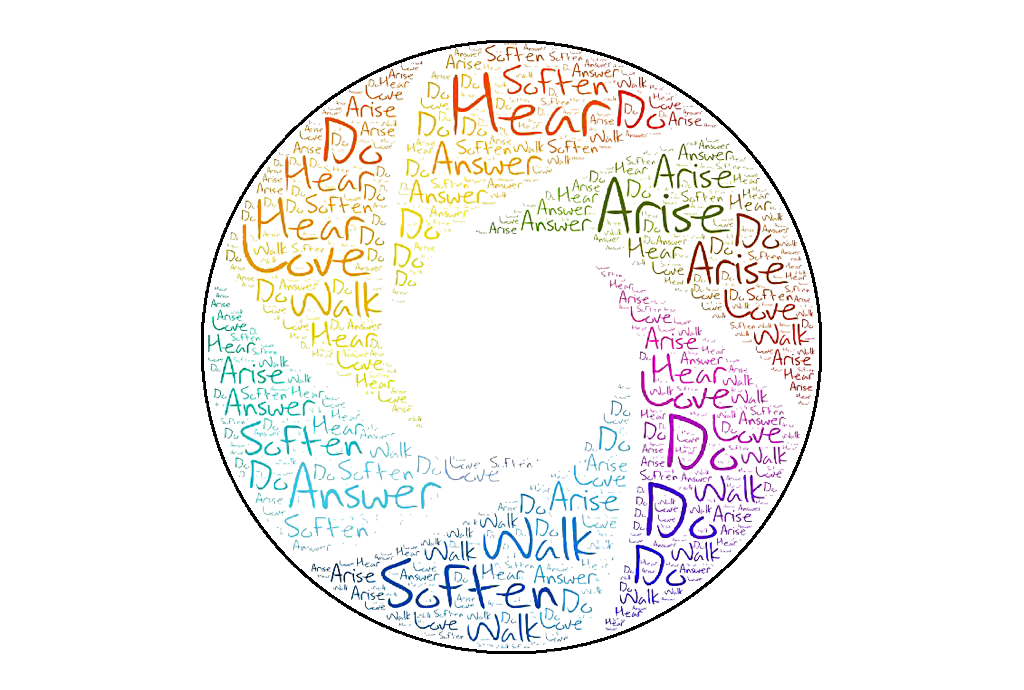
  • Hear
  • Soften
  • Arise
  • Answer 
  • Do
  • Love
  • Walk

God is not shy in telling us what to do in order to grow in holiness – in mutual relationship with God.

We have to DO something, to be responsive in order to unite with God. We can’t be just passive lumps of inactive devotion.

Don’t Be a Spiritual Couch Potato

Each instruction has its own vitality which is meant, in turn, to vitalize our spirits and to make us agents of the Holy One in the world.


Our first reading carries this message clearly to the people of Micah’s time. It’s not about contrived sacrifice. It’s about love and compassion.

With what shall I come before the LORD,
and bow before God most high?
Shall I come before him with burnt offerings,
with calves a year old?
Will the LORD be pleased with thousands of rams,
with myriad streams of oil?
Shall I give my first-born for my crime,
the fruit of my body for the sin of my soul?
You have been told, O Creature, what is good,
and what the LORD requires of you:
Only to do the right and to love goodness,
and to walk humbly with your God.

Micah 6: 6-8

The scribes and Pharisees of Jesus’s time demand a sign before they will listen. Jesus says the only sign they will get is to remember that the Ninevites listened when Jonah delivered God’s message. 

At the judgment, the men of Nineveh will arise with this generation
and condemn it, because they repented at the preaching of Jonah;
and there is something greater than Jonah here.

Matthew 12:42

We don’t have a Micah or a Jonah coaching us to holiness. What we have is the Word present to us in the Gospel and in the community of faith. That Word reveals itself in the circumstances of our lives to which we must respond by:

Hearing God’s invitation 
Softening our hearts from judgments 
Arising from our self-absorption 
Answering the call to holiness
Doing good
Loving compassionately 
Walking humbly with our God


Poetry: from Rumi

Discard yourself 
and thereby regain yourself. 
Spread the trap of humility 
and ensnare Love.

Music: Act Justly – Pat Barrett
Alleluia: The Promise

Sixteenth Sunday in Ordinary Time
July 17, 2022

Today, in God’s Lavish Mercy, our readings are all about making and keeping promises.

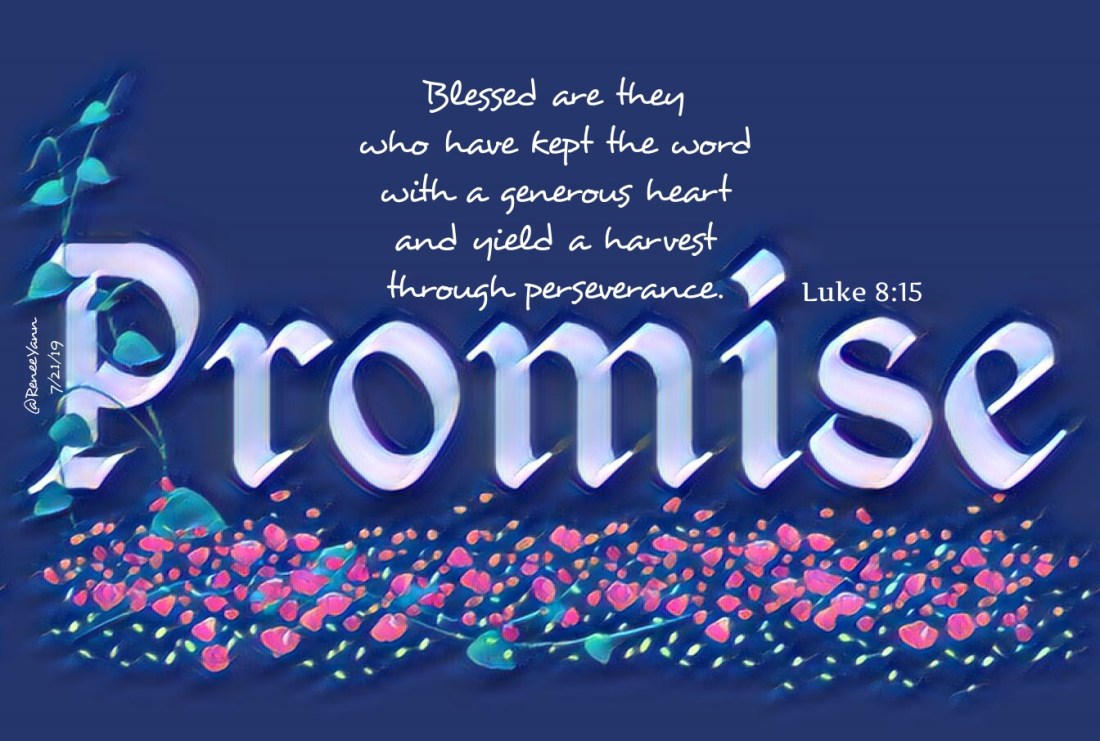
Luke8_15 promise

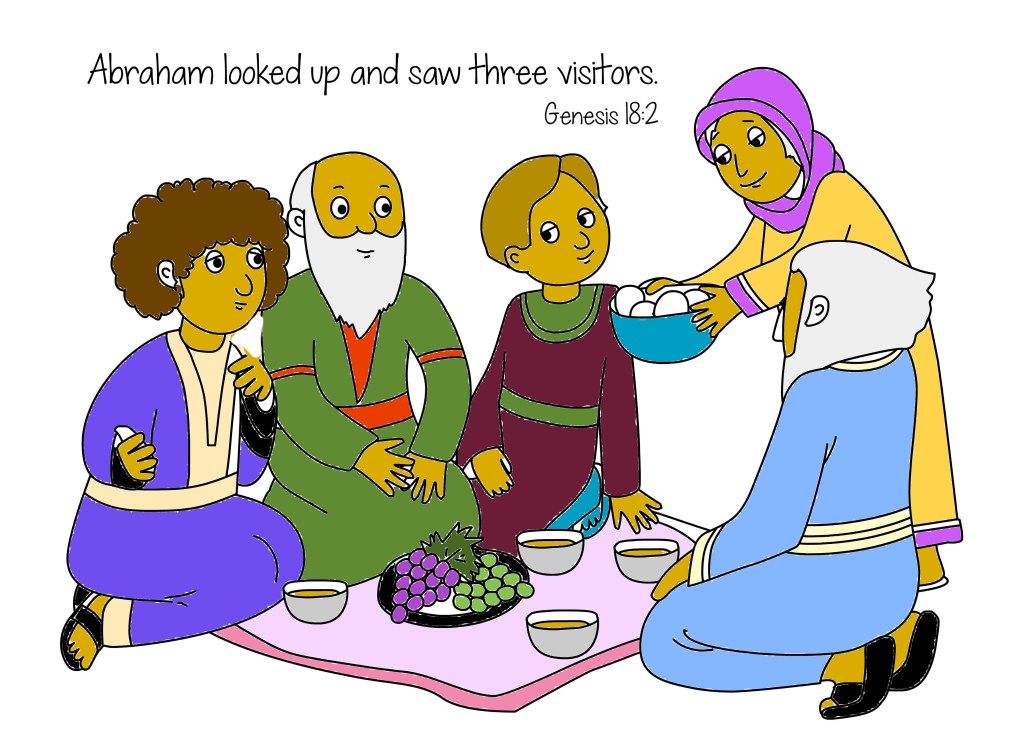
Our first reading refers to Genesis and God’s promise to Abraham of land and posterity. Through his hospitality to three disguised angels, Abraham secures God’s promise to bless Sara and him with a child.


In today’s second reading from Colossians, Paul assures us that God has brought that promise to its full completion in the gift of Jesus Christ living in us.

…the mystery hidden from ages and from generations past
has now been manifested to his holy ones,
to whom God chose to make known the riches of the glory
of this mystery among the Gentiles;
it is Christ in you, the hope for glory. 

In our Gospel, Jesus encourages Martha to give her attention to the presence of this promise revealed in her life. Mary sees the promise fulfilled in Jesus, the living presence of God. She gives her full heart to it. Martha, maybe like us sometimes, is preoccupied by other distractions.


Our readings invite us to rejoice in God’s promise to us
of “land” and “posterity”. 

In Jesus, we are brought home to God. 
In Jesus, the fruitfulness of our life is eternally secured.


We make promises to God too.

vows

When our Sisters die, our vows rest near us for our wakes – a profound symbol of promises given and promises fulfilled.
Today, as we pray about God’s faithful promises to us, we might want to reflect on and deepen the commitments of our Baptism, our religious profession, our marriage, our covenants to communities of faith and service.

Like Martha, we might hear Jesus encourage us to give our fullest heart to that which is most important.


Poetry: BETHANY DECISIONS (LUKE 10:38–42) – Irene Zimmerman

As Jesus taught the gathered brothers
and Martha boiled and baked their dinner,
Mary eavesdropped in the anteroom
between the great hall and the kitchen.
Her dying mother’s warning words
clanged clearly in her memory—
“Obey your sister. She has learned
the ways and duties of a woman.”

She’d learned her sister’s lessons well
and knew a woman’s place was not
to sit and listen and be taught.
But when she heard the voice of Jesus
call to her above the din
of Martha’s boiling pots and pans,
she made her choice decisively—
took off her apron and traditions,
and walked in.


Music: timeless Motion – Daniel Kobialka

Alleluia: Blessed Mary

Saturday of the Fifteenth Week in Ordinary Time
July 16, 2022

Today’s Readings:

https://bible.usccb.org/bible/readings/0716-memorial-our-lady-mount-carmel.cfm

Today, in God’s Lavish Mercy, we have the option of celebrating the Memorial of Our Lady of Mount Carmel in place of the 15th Saturday in Ordinary Time. And since it is Saturday, traditionally Mary’s day, I have chosen to pray with those readings.

Our Alleluia Verse captures in a short sentence exactly why Mary is the perfect model for a Christian life: she heard and acted on God’s word.

Alleluia, alleluia.
Blessed are those
who hear the word of God
and observe it.


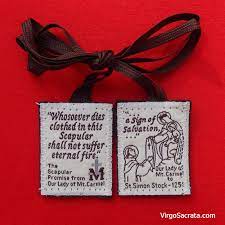
Many of you will have been introduced to Our Lady of Mt Carmel as young children. Perhaps you, as I did, received a brown scapular when you made your First Communion. My second grade teacher convinced me that, by wearing that scapular, I had become a very dedicated Christian and friend of Jesus and the Blessed Mother.

According to the Vatican’s Congregation for Divine Worship, the Brown Scapular is “an external sign of the filial relationship established between the Blessed Virgin Mary, Mother and Queen of Mount Carmel, and the faithful who entrust themselves totally to her protection, who have recourse to her maternal intercession, who are mindful of the primacy of the spiritual life and the need for prayer.

Wikipedia

My little brown scapular is long gone, set aside perhaps when my maturing fashions were inhibited by it in seventh of eighth grade. But the devotion to Mary which it initiated has never left me. It has grown, changed and deepened over these seventy years, but its roots are still entwined with that sepia necklace Sister Grace Loretta once placed in my little hand.

When I entered the Sisters of Mercy in the early 60s, I was so delighted that Our Lady of Mt. Carmel was honored as one of our patron saints. We did it up big back then by wearing our church cloaks and special habit sleeves to Mass on her feastday.


As I pray the Magnificat in today’s Responsorial Psalm, I reflect that Mary has become not only a trusted friend and model for my spiritual life. Her profound faith and poverty of spirit challenge and inspire my deeper understanding of the Gospel in today’s world.

The Mary I love today is a very different woman from the one I idealized in my youth. This change in perception has come about through reflection on the works of modern theologians such as those referred to below. Some of these books are out of print and/or expensive but reviews and excerpts are available online and can be helpful to one’s prayerful study.

For today’s prayer, let us open our hearts to the deep inspiration of Mary of Nazareth. I have referred readers to this excellent article by Elizabeth Johnson — and I do so again — as a great place to start:

https://www.americamagazine.org/faith/2000/06/17/mary-nazareth-friend-god-and-prophet


Elizabeth Johnson: Truly Our Sister


Rosemary Radford Reuther: Mary, The Feminine Face of the Church


Ivone Gebara and Maria Clara Bingemer: Mary, Mother of God, Mother of the Poor


Leonard Boff: The Maternal Face of God

Music: Tota Pulchra Es, Maria –

Alleluia: Shadows

Memorial of Saint Bonaventure, Bishop and Doctor of the Church
July 15, 2022

Today’s Readings:

https://bible.usccb.org/bible/readings/071522.cfm

Alleluia, alleluia.
My sheep hear my voice, says the Lord;
I know them, and they follow me.

Today, in God’s Lavish Mercy, our readings are woven through with themes of life and death, time and eternity. These are fundamental realities at the core of our lives. Yet they are so huge in scope that they elude our comprehension.

Photo by Rui Dias on Pexels.com
  • How often do we ask ourselves, “Where did the time, the day, the years go”?
  • Despite all our acts of faith, aren’t we still undone by death and bereavement in our lives?
  • When we try to imagine heaven, doesn’t the image slip through our efforts like a wet sunfish lost back to the sea?

In our first reading, Hezekiah faces the same kind of bewilderment. Informed that he is about to die, he laments:

“O LORD, remember how faithfully and wholeheartedly
I conducted myself in your presence,
doing what was pleasing to you!”
And Hezekiah wept bitterly.

Hezekiah’s pleading gains him another fifteen years. (Would that our prayers could so prevail!) His bonus is delivered accompanied by a sign:

This will be the sign for you from the LORD
that he will do what he has promised:
See, I will make the shadow cast by the sun
on the stairway to the terrace of Ahaz
go back the ten steps it has advanced.


In our Gospel, Jesus doesn’t need bonuses or signs. Jesus himself is the embodiment of Life over death, Eternity over time. In today’s passage, the Pharisees try to judge and limit Jesus’s spiritual freedom by invoking the old law against him:

Jesus was going through a field of grain on the sabbath.
His disciples were hungry
and began to pick the heads of grain and eat them.
When the Pharisees saw this, they said to him,
“See, your disciples are doing what is unlawful to do on the sabbath.”


Jesus tells them clearly that he is the new law of mercy and love. He is beyond time, death, and the judgments of human law:

I say to you, something greater than the temple is here. 
If you knew what this meant, I desire mercy, not sacrifice,
you would not have condemned these innocent men.
For the Son of Man is Lord of the sabbath.

Let’s pray today with our God Who is greater than time, death or human judgments. Let us trust that God has power over any shadow that might darken our lives.


Poetry: The Shadow of Thy Wing – Susan Dickinson (Emily’s sister-in-law)

Weary of life's great mart, its dust and din,
Faint with its toiling, suffering with its sin,
In childlike faith my heart to Thee I bring.
For refuge in "the shadow of thy wing."

Like a worn bird of passage, left behind
Wounded, and sinking, by its faithless kind,
With flight unsteady, seeking needed rest,
I come for shelter to Thy faithful breast.

Like a proud ship, dismantled by the gale,
Her banners lost and rifted every sail,
In the deep waters to Thy love I cling,
And hasten to the refuge of Thy wing.

O Thou, thy people's comforter alway,
Their light in darkness, and their guide by day,
Their anchor 'mid the storm, their hope in calm,
Their joy in pain, their fortress in alarm!

We are all weak, Thy strength we humbly crave;
We are all lost, and Thou alone canst save;
A weary world, to Thy dear arm we cling,
And hope for all a refuge "'neath Thy wing."

- "Original Poetry." Springfield Daily Republican, March 1, 1862

Music: Cavatina’s “The Shadows” played by 2Cellos

Alleluia: Refreshed

Memorial of Saint Kateri Tekakwitha, Virgin
July 14, 2022

Today’s Readings 

https://bible.usccb.org/bible/readings/071422.cfm

Today, in God’s Lavish Mercy, our Alleluia Verse offers us a loving, comforting invitation:

Alleluia, alleluia.
Come to me,
all you who labor and are burdened,
and I will give you rest.


Each of today’s readings offers beautiful lines that can be caressed in prayer to deepen our relationship with our Merciful God.

Isaiah’s heartfelt longing for God keeps him alert day and night to God’s Presence:

My soul yearns for you in the night,
yes, my spirit within me keeps vigil for you…

Isaiah 26:9

And even though times are tough for Isaiah’s community, he expresses a hope born of faith – like morning dew filled with first daylight:

Salvation we have not achieved for the earth,
the inhabitants of the world cannot bring it forth.
But your dead shall live, their corpses shall rise;
awake and sing, you who lie in the dust.
For your dew is a dew of light,
and the land of shades gives birth.

Isaiah 26: 18-19

Our Responsorial Psalm picks up the theme and gives it as a promise to future generations:

Let this be written for the generation to come,
and let God’s future creatures praise the LORD:
“The LORD looked down from his holy height,
from heaven and beheld the earth,
To hear the groaning of the prisoners,
to release those doomed to die.

Psalm 102: 19-21

And in our beautiful Gospel, Jesus embodies the promise in his merciful invitation:

Come to me, all you who labor and are burdened,
and I will give you rest.
Take my yoke upon you and learn from me,
for I am meek and humble of heart;
and you will find rest for yourselves.
For my yoke is easy, and my burden light.

Matthew 11: 28-30

Poetry: Dew Drop – Rabindranath Tagore

Through many years,
At great expense,
Journeying through many countries,
I went to see high mountains,
I went to the oceans.

Only I had not seen at my very doorstep,
The dew drop glistening
On the ear of the corn.


Music: Zuni Sunrise – Wil Numkena

The Zuni People are Native Americans of New Mexico, USA

A morning prayer to greet the sunrise. Let the sound pray in you without words.

Alleluia: Simplicity

Wednesday of the Fifteenth Week in Ordinary Time
July 13, 2022

Today’s Readings

https://bible.usccb.org/bible/readings/071322.cfm

Today, in God’s Lavish Mercy, our Alleluia Verse evokes the tender image of Jesus with innocent little children.

Alleluia, alleluia.
Blessed are you, Father,
Lord of heaven and earth,
you have revealed to little ones
the mysteries of the Kingdom.

The verse is so gentle that it may seem out of place following a ferocious first reading. Without exegeting that passage from Isaiah, let’s just say it is all about PRIDE and ARROGANCE toward God’s Will. These two vices are the downfall of the spiritual life.


Their corrective is diagnosed into today’s Gospel. It is to have the simplicity and trust that makes us spiritually childlike – not “childish” – childlike.

  • This means to recognize that our life is a gift which belongs to our Creator. 
  • It means to trust in that Gift Giver to care for us the way a parent cherishes their child.
  • It means to be faithful even when we don’t understand and to seek to deepen in our understanding through prayer.
  • It means to mature to a deep relationship of mutual love with God.

I give praise to you, Father, Lord of heaven and earth,
for although you have hidden these things
from the wise and the learned
you have revealed them to the childlike.

Matthew 11: 25-26

We may wish to pray today considering the simple beauty of the children in our lives. Here are my “grand” inspirations:

Love, Love, Love and Love!

Quote: Leonardo Da Vinci

Simplicity is the greatest sophistication.

Music: ‘Tis a Gift to Be Simple

Alleluia: Just Listen!

Tuesday of the Fifteenth Week in Ordinary Time
July 12, 2022

Today’s Readings:

https://bible.usccb.org/bible/readings/071222.cfm

Today, in God’s Lavish Mercy, we are once again enjoined:

Alleluia, alleluia.
If today you hear his voice,
harden not your hearts.

In other words, just listen!

This verse is repeated so often because it’s so important! And the rest of our readings illustrate that fact.

In our first reading King Ahaz is in a mess with a lot of cleverly named guys trying to take over Jerusalem. Apparently Ahaz is a nervous wreck about the situation when God says, “Just listen – it’s going to be OK!”


And don’t you just love the way God encourages Isaiah to support Ahaz. God tells Isaiah to stay calm and calls the bad guys “two stumps of smoldering brands”:

Take care you remain tranquil and do not fear;
let not your courage fail
before these two stumps of smoldering brands
the blazing anger of Rezin and the Arameans,
and of the son Remaliah,


In our Gospel, Jesus warns his Capernaum neighbors about what can happen when we ignore God’s voice. Jesus loves this little village and has settled there in his early ministry. But he is upset with them:

And as for you, Capernaum:

Will you be exalted to heaven?
You will go down to the nether world.

For if the mighty deeds done in your midst had been done in Sodom,
it would have remained until this day.
But I tell you, it will be more tolerable
for the land of Sodom on the day of judgment than for you.”

Matthew 11: 22-24

So, even though today’s readings are pretty heavy, the message is simple:

  • Soften your heart in silence and reflection
  • Just listen to God speaking in your life
  • Act on the loving Word given to you

Prose: from Frederick Buechner, Now and Then: A Memoir of Vocation

Listen to your life.
See it for the fathomless mystery it is.
In the boredom and pain of it,
no less than in the excitement and gladness:
touch, taste, smell your way
to the holy and hidden heart of it,
because in the last analysis
all moments are key moments,
and life itself is grace.


Music: Ave Generose – Maureen McCarthy Draper

Alleluia: Righteousness

Memorial of Saint Benedict, Abbot
July 11, 2022

Today’s Readings

https://bible.usccb.org/bible/readings/071122.cfm

Today, in God’s Lavish Mercy, our Alleluia Verse repeats one of the treasured yet challenging Beatitudes:

Alleluia, alleluia.
Blessed are they who are persecuted
for the sake of righteousness,
for theirs is the Kingdom of heaven.


Sometimes, the word “righteous” can fall harshly on the mind. Over the years, it has acquired a tinge of Bible-banging fundamentalism. Even in secular culture, a “self-righteous” person is repellent.

But the “righteousness” which is our heritage from both the Hebrew and Christian scriptures is a caring and dynamic discernment born of Wisdom and Mercy. It is a virtue the disciple seeks in imitation of the Beloved.


From Walter Brueggemann’s Theology of the Old Testament:

Israel’s characteristic grammar in speaking of Yahweh, governed by active verbs, regularly insisted that Yahweh is a major player in Israel’s life and in the life of the world. Yahweh’s characteristic presentation in Israel’s rhetoric is that Yahweh acts powerfully, decisively, and transformatively. Yahweh is morally serious and demanding, so that Yahweh is endlessly attentive to distinctions of good and evil, justice and injustice. Indeed, it is palpable power and moral seriousness that distinguish Yahweh from all rival gods, who have no power to act decisively and no capacity for moral distinctions.


In our first reading, we meet this righteous God who is fed up with the people’s dissembling.

When you come in to visit me,
who asks these things of you?
Trample my courts no more!
Bring no more worthless offerings;
your incense is loathsome to me.

Isaiah 1: 12-13

Instead, Isaiah’s God states clearly what makes one righteous:

Put away your misdeeds from before my eyes;
cease doing evil; learn to do good.
Make justice your aim: redress the wronged,
hear the orphan’s plea, defend the widow.

Isaiah 1: 16-17

Jesus tells us that it’s not easy to be such a person. You’re going to suffer for your acts of justice and mercy because we live in a world that honors vengeance and oppression instead. You’re going to be insulted, mocked and ostracized for your righteousness – for your desire to “right-balance” life for all human beings.

Brueggemann tells us that, nevertheless, this is our call:

The purpose of human life, a life of vocation, fellowship, and witness is to attest the truth of God’s solidarity with is, that is in justice, righteousness, compassion, steadfast love, and faithfulness.

Poetry: A Psalm of Life – Henry Wadsworth Longfellow

Anyone with a little interest in English poetry, must have had this poem etched into memory; hence no guesses about Longfellow’s best poem. Such is its evocative eloquence, such is its superior effect on every person regardless of class, religion and nationality that it transcends the boundaries of a mere song, and in the right sense, transforms into a psalm – a path to be followed for glorified and righteous life. Recited at Senate meetings, public gatherings and even at churches, this poem is sometimes speculated to have inspired Longfellow after he had come across a board in a German graveyard. Certainly his greatest, ‘Psalm of Life’ seems to have varied ideas where each quatrain is a guideline in itself. (from classical poets.org)

A Psalm of Life – (1839)
What the Heart of the Young Man Said to the Psalmist

Tell me not, in mournful numbers,
Life is but an empty dream!
For the soul is dead that slumbers,
And things are not what they seem.

Life is real! Life is earnest!
And the grave is not its goal;
Dust thou art, to dust returnest,
Was not spoken of the soul.

Not enjoyment, and not sorrow,
Is our destined end or way;
But to act, that each to-morrow
Find us farther than to-day.

Art is long, and Time is fleeting,
And our hearts, though stout and brave,
Still, like muffled drums, are beating
Funeral marches to the grave.

In the world’s broad field of battle,
In the bivouac of Life,
Be not like dumb, driven cattle!
Be a hero in the strife!

Trust no Future, howe’er pleasant!
Let the dead Past bury its dead!
Act,—act in the living Present!
Heart within, and God o’erhead!

Lives of great men all remind us
We can make our lives sublime,
And, departing, leave behind us
Footprints on the sands of time;

Footprints, that perhaps another,
Sailing o’er life’s solemn main,
A forlorn and shipwrecked brother,
Seeing, shall take heart again.

Let us, then, be up and doing,
With a heart for any fate;
Still achieving, still pursuing,
Learn to labor and to wait.


Music: I just had to offer a beautiful song from the Righteous Brothers on this “righteous” day. 🙂

I believe for every drop of rain that falls
A flower grows
I believe that somewhere in the darkest night
A candle glows
I believe for everyone who goes astray
Someone will come
To show the way
I believe, I believe

I believe above a storm the smallest prayer
Can still be heard
I believe that someone in the great somewhere
Hears every word

Every time I hear a new born baby cry
Or touch a leaf or see the sky
Then I know why, I believe

Alleluia: Be Mercy

Fifteenth Sunday in Ordinary Time
July 10, 2022

Today’s Readings

https://bible.usccb.org/bible/readings/071022.cfm

Today, in God’s Lavish Mercy, our readings take us on a centuries-long journey from Sinai nearly to the foot of Calvary. 

Our guideline for the pilgrimage is the Word:

  • given first to Moses
  • cherished in Psalms
  • and finally revealed in the full glory of the Incarnated Christ.

Throughout the ages, each of us receives the same direction to holiness as that given by Moses thousands of years ago:

If only you would
heed the voice of the LORD, your God…


The young man in today’s Gospel requests such direction straight from the mouth of Jesus. And he receives it in the form of an iconic story which holds in simplicity all the ponderous theology of the ages:

Which of these three, in your opinion,
was neighbor to the robbers’ victim?”
He answered, “The one who treated him with mercy.”
Jesus said to him, “Go and do likewise.”


With this story, Jesus translates into action that age-old Biblical Word:

  • Hear Mercy
  • Love Mercy
  • Do Mercy
  • Become Mercy

Poetry: Ramadan –  Erik K. Taylor

It was the month of Ramadan, 
the month when Muslims fast. 
From the day’s first light, 
when they could tell a white thread from a black one, 
until evening hid the difference again, 
they did not eat, did not drink, and 
– here in rural Liberia – 
did not even swallow their own spit.

We were three thousand miles from home 
when the telegram came. 
My mother’s father had died. 

From Gbapa, three miles away, 
five dark-skinned Mandingo men 
came walking to our house. 
Students from her English class, 
a class in a building with mud-brick walls 
and a tin roof that pinged in the rain. 
She drove to them several nights each week, 
teaching them to write “hut” and “mat” and “cat,” 
drawing little pictures beside the words. 

But this day, they came to her, 
walking over dusty, rust-colored roads, 
under the African sun. 
They came to sit with her, 
to offer what comfort they could.

We could not offer them water or coke or tea. 
For a few hours they sat, talking in soft voices, 
stepping out occasionally to spit. 
Then home again… 
waiting for black and white to merge back into one.

Someone once asked Jesus 
what it meant to love our neighbor. 
He said it was to be those men.

Music: Kyrie ( Lord, have Mercy) – Robert Gass

Alleluia: Insulted Yet Blessed

Saturday of the Fourteenth Week in Ordinary Time
July 9, 2022

Today’s Readings

https://bible.usccb.org/bible/readings/070922.cfm

Today, in God’s Lavish Mercy, our Alleluia Verse captures the mixed and even contradictory conditions awaiting a dedicated disciple of Christ:

Alleluia, alleluia.
If you are insulted for the name of Christ,
blessed are you,
for the Spirit of God rests upon you.


This brief verse immediately brought to my mind the image of Tevye from Fiddler on the Roof. He had wonderful, faith-filled dialogues with God about his seemingly contradictory “blessings”.

So here’s a snapshot of how I prayed with our verse today:

God: You’re going to be insulted for your faith, but consider it a blessing. 
Me: What! Wait a minute! Maybe I’d prefer some more obvious blessings!
God: No, you’re going to be insulted for your faith, but it’s a sign that my Spirit rests upon you.
Me: ….. Crickets


I have been insulted and harassed for my faith, but not too often. Usually that occasional insult has come from a sad or dysfunctional source who caused more harm to themselves than to me.


The greatest insult to my faith has come from within the Church itself. The clerical sex abuse scandals and cover-ups of recent years deeply shook the investment I had made in service of the Church. The revelations mocked the innocent trust I had unquestioningly placed in the institutional Church. They invited public insult toward me and toward all of us associated with that now exposed institution.

Although my pain cannot be compared to the trauma of survivors of abuse, it has been a seismic insult and has forced me to a deeper discernment of my faith. While profoundly painful, this “insult” has, indeed, been a blessing which has helped me to separate my true Catholic faith from any misplaced institutional devotion.


The closing verses of today’s Gospel are both a warning and a pledge for those who commit themselves to Christ:

And do not be afraid of those who kill the body but cannot kill the soul;
rather, be afraid of the one who can destroy
both soul and body in Gehenna.
Are not two sparrows sold for a small coin?
Yet not one of them falls to the ground without your Father’s knowledge.
Even all the hairs of your head are counted.
So do not be afraid; you are worth more than many sparrows.
Everyone who acknowledges me before others
I will acknowledge before my heavenly Father.
But whoever denies me before others,
I will deny before my heavenly Father.


Poetry: The Break of Faith – Renee Yann, RSM

My father walked with me each day in Lent
past neighbors’ homes with names
and histories like mine,
to church, where laborers in solid faith,
received a Host before the Mass began
and left to be at work on time.

Some days, my father left but I remained
secure among the faithful whose
religion was a sure as rock.
I trusted and believed their saying
salvation was reserved for those
within the Church, praying
at ten or twelve to be like
the elite who held the ancient definitions
of the God I longed to know.  
Those devoted people were 
the heroes of my youth.
I beat my breast with secret joy and knelt
beside them in the unexamined truth.

Some were robed in black and wafted
scents of incense and of candle wax
that were to me like fine, intoxicant perfume.
Through them, I chose the worship of a God
who was the slim abstraction of my mind
the mute extension of my whim.

But my mind is not the tender thing it was.
The years have passed and I have hardened 
to them, like a lone, maturing tree.
The deeply venerated guides I loved
have journeyed with my father to the pale,
expanded universe of memory.

That I stand questioning them now is jeopardy
against the very pegs that ground my life.
I am outside the Church they held for me
because it seems a box remote from God,
who, with the years, assumed Creation’s face,
became a fire in my heart, consuming
those securities I designated once as faith.

The theologian says we walk in footsteps of a God
who comes to us from futures we cannot define.
That God of paradox is breaking in my mind
like lava breaks from stolid earth 
to recreate the world. But,
with an utterly profound regret,
I leave the heroes and the saints of youth behind.

Music: Renouncement – Michael Hoppé