Come Away Awhile

Memorial of Saint Alphonsus Liguori, Bishop and Doctor of the Church
Tuesday of the Seventeenth Week in Ordinary Time
August 1, 2023

Today’s Readings:

https://bible.usccb.org/bible/readings/080123.cfm


Today, in God’s Lavish Mercy, Moses goes on a rigorous forty day retreat:

So Moses stayed there with the LORD for forty days and forty nights,
without eating any food or drinking any water,
and he wrote on the tablets the words of the covenant,
the ten commandments.

Exodus 33:28

The purpose of this intense retreat was for Moses to codify God’s law in his own heart. He is to be a witness and leader for God among the people. It was a law of relationship, written in stone for the people, but written in fire for Moses. If God’s intentions are not embedded in Moses’s own heart, his ministry will fail.

In our Gospel, the disciples go on a kind of retreat too. The crowds have been dismissed, and Jesus’s close friends sit down with him for an in-depth instruction in the meaning of his parables. They want to understand the mind and heart of Christ so that they can pattern their own on his Word.


A good retreat is like a spiritual spa experience. It can provide us with rest, clarity, nourishment, and stabilization. And good retreat direction, either through a spiritual guide or through the discipline of solitude, is invaluable to such a pursuit.

But while we can’t be on a formal retreat every day of our lives, we still need a daily “coming away” with God to center our spirits and to keep alive the holy fire within them.


Today might be a good day to evaluate those processes in our lives. Are they working for us? Or might our prayer and reflection time have become so routine as to lose its snap. Have we let life’s concerns slip into our solitude to the point of no longer hearing God’s whisperings? Or have we even truncated that time to meet those ever-expanding concerns?

We may feel so overwhelmed by life that we think we don’t have time for deep prayer. That’s like saying we don’t have time to breathe! If we don’t make the time for both of them, we will die. It’s that simple.


Sixty years ago, my Novice Director gave me a wonderful book. I return to it frequently to consider the spiritual discipline of my life. Here are two excerpts which seem to have bearing on today’s reflection and might inspire your considerations today:

When silence takes possession of you; when far from the racket of the human highway the sacred fire flames up in the stillness; when peace, which is the tranquillity of order, puts order in your thoughts, feelings, and investigations, you are in the supreme disposition for learning; you can bring your materials together; you can create; you are definitely at your working point; it is not the moment to dwell on wretched trifles, to half live while time runs by, and to sell heaven for nothings.


Retirement (retreat) is the laboratory of the spirit; interior solitude and silence are its two wings. All great works were prepared in the desert, including the redemption of the world

A.D. Sertillanges, The Intellectual Life: Its Spirit, Conditions, Methods

Poetry: The Stolen Child – William Butler Yeats
Using his love for Celtic lore and fantasy, Yeats imagines a return to innocence at the hands of magical creatures, the faeries. With imagery rich in natural wonder, the reader is invited to “come away” from a world impossible to understand, and to be restored in spiritual truth. Sounds like a retreat to me!

Where dips the rocky highland
Of Sleuth Wood in the lake,
There lies a leafy island
Where flapping herons wake
The drowsy water rats;
There we've hid our faery vats,
Full of berrys
And of reddest stolen cherries.
Come away, O human child!
To the waters and the wild
With a faery, hand in hand,
For the world's more full of weeping than you can understand.
Where the wave of moonlight glosses
The dim gray sands with light,
Far off by furthest Rosses
We foot it all the night,
Weaving olden dances
Mingling hands and mingling glances
Till the moon has taken flight;
To and fro we leap
And chase the frothy bubbles,
While the world is full of troubles
And anxious in its sleep.
Come away, O human child!
To the waters and the wild
With a faery, hand in hand,
For the world's more full of weeping than you can understand.
Where the wandering water gushes
From the hills above Glen-Car,
In pools among the rushes
That scarce could bathe a star,
We seek for slumbering trout
And whispering in their ears
Give them unquiet dreams;
Leaning softly out
From ferns that drop their tears
Over the young streams.
Come away, O human child!
To the waters and the wild
With a faery, hand in hand,
For the world's more full of weeping than you can understand.
Away with us he's going,
The solemn-eyed:
He'll hear no more the lowing
Of the calves on the warm hillside
Or the kettle on the hob
Sing peace into his breast,
Or see the brown mice bob
Round and round the oatmeal chest.
For he comes, the human child,
To the waters and the wild
With a faery, hand in hand,
For the world's more full of weeping 
than he can understand.

Music: Inner Peace – Hennie Bekker

Sincerely

Tuesday of the Ninth Week in Ordinary Time
June 6, 2023

Today’s Readings:

https://bible.usccb.org/bible/readings/060623.cfm


Today, in God’s Lavish Mercy, our readings give us two examples of people talking to each other without communicating. Ever been there- just not quite on the same wavelength?

In the passage from Tobit, fiesty Anna brings home a bonus goat as a reward for her good work. Tobit, grumpy with the ill fortune of his blindness, accuses her of fencing stolen goods.

Anna said to me, “The goat was given to me as a bonus over and above my wages.”
Yet I would not believe her,
and told her to give it back to its owners.
I became very angry with her over this.
So she retorted: “Where are your charitable deeds now?
Where are your virtuous acts?
See! Your true character is finally showing itself!”

Tobit 2:14

Anna uses Tobit’s incalcitrance to make him take a good look at himself – his true character. She challenges another kind of blindness in Tobit beyond his physical challenges. He ultimately repents and prays for solace.


However, in our Gospel, a gang of antagonists intend to set a trap for Jesus. This is a whole different level of wavelength misalignment. Here, the questioners never had an intention to seek truth or come to mutual understanding.

Some Pharisees and Herodians were sent
to Jesus to ensnare him in his speech.
They came and said to him,
“Teacher, we know that you are a truthful man
and that you are not concerned with anyone’s opinion.
You do not regard a person’s status
but teach the way of God in accordance with the truth.

Mark 12:13-14

These two instances of fractious communication are differentiated by one key element: sincerity. Though out of alignment, both Anna and Tobit are sincere in their exchange. In our Gospel, only Jesus is sincere. His antagonizers use the reprehensible tool of gaslighting, attempting trap Jesus in his own words.


The Latin words “sine cera” mean ‘without wax”

“Sin-cere. Since the days of Michelangelo, sculptors had been hiding the flaws in their work by smearing hot wax into the cracks and then dabbing the wax with stone dust. The method was considered cheating, and therefore, any sculpture “without wax”—literally sine cera—was considered a “sincere” piece of art. The phrase stuck. To this day we still sign our letters “sincerely” as a promise that we have written “without wax” and that our words are true.”

Dan Brown, The Lost Symbol

How we communicate with one another affects how we build the kingdom of God together. The communication can be as ordinary as a couple’s banter, like Anna and Tobit. Or it can be as momentous as two cultures meeting in either resistance or transformation.

Our readings suggest that if we have not learned to practice sincerity even in small things, we will not have the awareness and spiritual freedom to practiice it in big things.


Poetry: “To thine own self be true” from Shakespeare’s Hamlet. Here, Polonius instructs his son, Laertes, as he leaves for college.

There, my blessing with thee.
And these few precepts in thy memory
Look thou character. Give thy thoughts no tongue,
Nor any unproportioned thought his act.
Be thou familiar but by no means vulgar.
Those friends thou hast, and their adoption tried,
Grapple them unto thy soul with hoops of steel,
But do not dull thy palm with entertainment
Of each new-hatched, unfledged comrade. Beware
Of entrance to a quarrel, but being in,
Bear ’t that th’ opposèd may beware of thee.
Give every man thy ear but few thy voice.
Take each man’s censure but reserve thy judgment.
Costly thy habit as thy purse can buy,
But not expressed in fancy—rich, not gaudy,
For the apparel oft proclaims the man,
And they in France of the best rank and station
Are of a most select and generous chief in that.
Neither a borrower nor a lender be,
For loan oft loses both itself and friend,
And borrowing dulls the edge of husbandry.
This above all: to thine own self be true,
And it must follow, as the night the day,
Thou canst not then be false to any man.
Farewell. My blessing season this in thee.

Music: To Thine Own Self Be True – Music by Brian Tate

And check out the just -for-fun extra song below.

Maybe you can imagine Anna singing this oldie but goodie to Tobit once they argued over the goat!

… that you believe…

Monday of the Third Week of Easter
April 24, 2023

Today’s Readings:

https://bible.usccb.org/bible/readings/042423.cfm

Today, in God’s Lavish Mercy, our readings remind us that being a Christian is simple, but not easy.

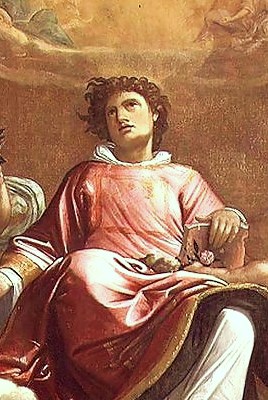
Stephen, presented to us in our reading from Acts, must have been a beautiful, simple person — almost angelic according to Acts’ description:

Stephen, filled with grace and power,
was working great wonders and signs among the people.

Acts 6:8

All those who sat in the Sanhedrin looked intently at him
and saw that his face was like the face of an angel.

Acts 6:15

St. Stephen – Giacomo Cavedone – c. 1601


Despite his goodness, Stephen became an object of hate and persecution by many:

Certain members of the so-called Synagogue of Freedmen,
Cyreneans, and Alexandrians,
and people from Cilicia and Asia,
came forward and debated with Stephen,
but they could not withstand the wisdom and the Spirit with which he spoke.
Then they instigated some men to say,
“We have heard him speaking blasphemous words
against Moses and God.”

Acts 6:9-11

This is such a revealing passage! Stephen’s persecutors cannot challenge his preaching themselves, so they create a web of poisonous lies and entangle some other men in its venom. They instigate these men to spread false allegations against Stephen which will eventually lead to his martyrdom.


There is a vital lesson here for us. Truth matters. Lies matter. They are the engines that drive not only our relationships and actions, but our very culture. And a hard look at our modern culture suggests that we are becoming a culture of lies.

I don’t need to give examples here. We know just from glancing at the newspaper, or perhaps – unfortunately – from reflecting on our own experiences.

We know the people who pretend they are what they are not.

We know who pretends that they are not what they actually are.


Jesus is a Truth Teller. In our Gospel, he gently confronts a bunch of people who are “pretending” their faith. Jesus tells them they’re not so much interested in the Truth he preaches as in the food he provided just yesterday. After all, everybody loves a good picnic!

Jesus answered them and said,
“Amen, amen, I say to you, you are looking for me
not because you saw signs
but because you ate the loaves and were filled.
Do not work for food that perishes
but for the food that endures for eternal life,
which the Son of Man will give you. 
For on him the Father, God, has set his seal.” 

John 6: 26-27

These bread seekers in our Gospel hear Jesus’s challenge so they ask him

“What can we do to accomplish the works of God?”
Jesus answered and said to them,

“This is the work of God,
that you believe in the one he sent.”

Just believe. Doing so will lead us to Truth and to a holy simplicity like that which radiated from Stephen. It’s that simple …. and that hard.


Poetry: A Christmas Hymn – by Richard Wilbur

Although the following poem is out of season, and does not mention Stephen, its refrain references his method of martyrdom: “every stone shall cry”. The poem is also a succinct and lyrical summary of the life of Christ and its meaning for us — a good thing to consider during this Eastertide.

A stable lamp is lighted
whose glow shall wake the sky;
the stars shall bend their voices,
and every stone shall cry.
And every stone shall cry,
and straw like gold shall shine;
a barn shall harbour heaven,
a stall become a shrine.
This child through David’s city
shall ride in triumph by;
the palm shall strew its branches,
and every stone shall cry.
And every stone shall cry,
though heavy, dull and dumb,
and lie within the roadway
to pave his kingdom come.
Yet he shall be forsaken,
and yielded up to die;
the sky shall groan and darken,
and every stone shall cry.
And every stone shall cry
for gifts of love abused;
God’s blood upon the spearhead,
God’s blood again refused.
But now, as at the ending,
the low is lifted high;
the stars shall bend their voices,
and every stone shall cry.
And every stone shall cry
in praises of the child
by whose descent among us
the worlds are reconciled.

Music: Every Stone Shall Cry – Steve Bell musically interprets Wilbur’s poem.

God of Abundance

Friday of the Second Week of Easter
April 21, 2023

Today’s Readings:

https://bible.usccb.org/bible/readings/042123.cfm

Today, in God’s Lavish Mercy, our readings offer us two very human, accessible stories.

The first, from Acts, is about the Pharisee named Gamaliel. Gamaliel was a big deal. An esteemed authority in the powerful Sanhedrin, he was the son and grandson of highly respected Jewish teachers. He was wise, prudent, honest and practical. Gamaliel was the “real deal” himself, and he recognized it in others.

Gamaliel and Nicodemus Mourn the Death of Stephen – Carlo Saracini -1615 AD

In today’s reading, Gamaliel intervenes in the Sanhedrin’s relentless pursuit of the early disciples. He basically tells his colleagues, “Hey, wait a minute. If these guys are “the real deal”, there is nothing we can do to undermine them. If they are not, they will undermine themselves. So just cool it for a while.”

While there is scant verifiable evidence to the fact, tradition holds that Gamaliel converted to Christianity. He is venerated as a saint in both the Roman Catholic and the Orthodox traditions.


Our Gospel tells us the familiar yet still amazing account of the miracle of the loaves and fishes.

It’s a wonderful story. I mean just put yourself in this noisy, curious, hungry crowd of 5000 people! Picture Jesus going up the mountainside so they could – maybe – hear what he might say.

Imagine that you’re Philip when Jesus turns to him and asks,
“Where will we get enough food for this crowd?”

Do you see the unspoken answers written all over Philip’s face,
“How should I know? Why are you asking ME!!!!”

The passage says that Jesus was testing Philip, but it was more like a tease when I picture it. Can’t you see the mischievous little smile on Jesus’s face? Jesus knew what he was going to do about the crowd’s hunger. He wanted to be sure his disciples paid strict attention to what was about to happen. So he got them involved with his testing questions.


God wants us to pay attention, too, to what happens when we bring our hungers before God’s merciful goodness. Like the few fish and loaves, God takes the smallest parts of us and builds them up with the gift of grace. God finds the willing fragments of faith, hope and love in us and multiplies them with God’s own power.


With this miracle, Jesus shows his followers and all of us, that there is a sacred reality and Truth beyond the thin scarcities we at first perceive. Deep faith allows us to plumb that reality and to live in its expansive promise. Walter Brueggemann puts it this way:

The feeding of the multitudes … is an example of the new world coming into being through God. When the disciples, charged with feeding the hungry crowd, found a child with five loaves and two fishes, Jesus took, blessed ,broke and gave the bread. These are the four decisive verbs of our sacramental existence. Jesus conducted a Eucharist, a gratitude. He demonstrated that the world is filled with abundance and freighted with generosity. If bread is broken and shared, there is enough for all. Jesus is engaged in the sacramental, subversive reordering of public reality.

Walter Brueggemann, The Liturgy of Abundance, The Myth of Scarcity

Gamaliel opened his heart to this Truth,
as did the first disciples.
It’s our turn now.

(Insert your name), where will we get the food
to feed these hungers in our world?


Poetry: Miracles – Walt Whitman

Why, who makes much of a miracle?
As to me I know of nothing else but miracles,
Whether I walk the streets of Manhattan,
Or dart my sight over the roofs of houses toward the sky,
Or wade with naked feet along the beach just in the edge of the water,
Or stand under trees in the woods,
Or talk by day with any one I love, or sleep in the bed at night with any one I love,
Or sit at table at dinner with the rest,
Or look at strangers opposite me riding in the car,
Or watch honey-bees busy around the hive of a summer forenoon,
Or animals feeding in the fields,
Or birds, or the wonderfulness of insects in the air,
Or the wonderfulness of the sundown, or of stars shining so quiet and bright,
Or the exquisite delicate thin curve of the new moon in spring;
These with the rest, one and all, are to me miracles,
The whole referring, yet each distinct and in its place.
To me every hour of the light and dark is a miracle,
Every cubic inch of space is a miracle,
Every square yard of the surface of the earth is spread with the same,
Every foot of the interior swarms with the same.

To me the sea is a continual miracle,
The fishes that swim—the rocks—the motion of the waves—the
ships with men in them,
What stranger miracles are there?


Music: God of Abundance – Kat Mills

Alleluia: The Fig Tree

Feast of Saint Bartholomew, Apostle
August 24, 2022

Today’s Readings:

https://bible.usccb.org/bible/readings/082422.cfm

Jn 1_48 fig

Today, in God’s Lavish Mercy, we celebrate the Feast of the Apostle Bartholomew, also known as Nathaniel. As with many of the Apostles, little is known of Bartholomew’s life outside of a few Gospel stories. John’s Gospel tells the wonderful story of Nathaniel’s call by Christ.

The encounter is a very personal one. Jesus and Nathaniel share a conversation that must have impressed the other listeners because it was remembered and recounted word for word in the Gospel.

One exchange, in particular, carries deep significance for Nathaniel. Jesus says that there is no duplicity, or pretense, in Nathaniel. There is a transparency in him shared even with God. Nathaniel wonders out loud , “How do you know me?” Jesus answers, “Before Philip called you, I saw you under the fig tree.”

Saint Bartholomew – El Greco

What was going on with Nathaniel under that fig tree? A moment of intense prayer, questioning, decision, doubt, hope? Whatever it was, Jesus had shared it, even at a distance. When Nathaniel realizes this, his faith in Jesus and vocation to follow Him are confirmed. Nathaniel professes, “Rabbi, you are the Son of God; you are the King of Israel.”


Where are the fig trees in your life story — those moments when, looking back, you realize that God was with you even though seeming distant?

What have been the turning points in your faith, when you came out from under the shadow of a challenging experience, to the grateful amazement that God had accompanied you through it?

What are those pivotal, intimate moments when it was just you and God – those transparent moments that changed your life?

If you can’t recall any such moments, perhaps you are not giving yourself the time and space to let God reach you.

It might be time to seek out a “fig tree” – a place of spiritual solitude where you may speak honestly and directly to God about the most important things in your life. Open your heart, like Nathaniel, to hear what God already knows about you.

Poetry: The Banyan Tree – Rabindranath Tagore

O you shaggy-headed banyan tree
standing on the bank of the pond,
have you forgotten the little child,
like the birds that have
nested in your branches and left you?

Do you not remember
how he sat at the window
and wondered at
the tangle of your roots
plunged underground?

The women would come
to fill their jars in the pond,
and your huge black shadow
would wriggle on the water
like sleep struggling to wake up.

Sunlight danced on the ripples
like restless tiny shuttles
weaving golden tapestry
Two ducks swam by the weedy margin
above their shadows, and
the child would sit still and think.

He longed to be the wind
and blow through your resting branches,
to be your shadow and
lengthen with the day on the water,
to be a bird and perch
on your topmost twig, and to float like
those ducks among the weeds and shadows.


Forest Lake with Boy Fishing – Alfred Wahlberg

Music: The Memory of Trees – Enya (Some lyrical New Age music to listen to under your fig tree!)

Alleluia: Discerning Word

Tuesday of the Twenty-first Week in Ordinary Time
August 23, 2022

Today’s Readings:

https://bible.usccb.org/bible/readings/082322.cfm

Alleluia, alleluia.
The word of God is living and effective,
able to discern reflections and thoughts of the heart.

Today, in God’s Lavish Mercy, Jesus and Paul both get downright serious about true spiritual discernment — in other words,

“Stop the bull(ony)!

The passage from Thessalonians indicates that “conspiracy theories” are not just a sick modern phenomenon. Apparently some religious charlatans were trying to delude the neophyte Christian community with threats about the end of the world. Paul is adamant in his advice:

Do not to be shaken out of your minds suddenly,
or to be alarmed either by a “spirit,”
or by an oral statement,
or by a letter allegedly from us
to the effect that the day of the Lord is at hand.
Let no one deceive you in any way.

2 Thessolians 2:2

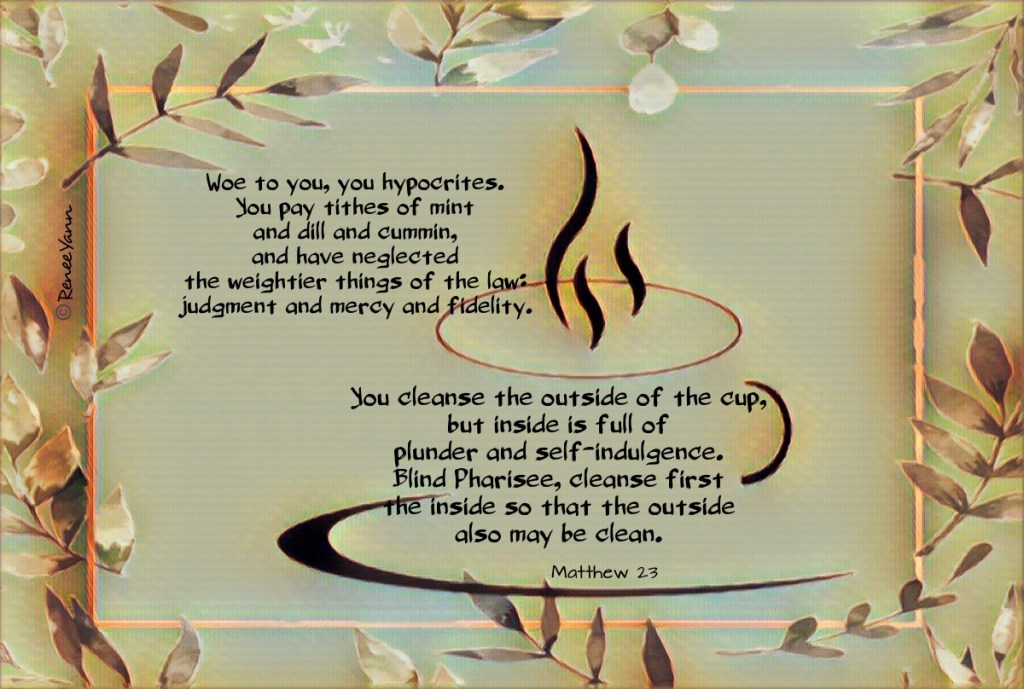
Jesus “woes” the Pharisees once again for a similar type of deluding behavior. For their own advancement, they impose minute religious entanglements which block the true purpose of the law:

Woe to you, scribes and Pharisees, you hypocrites.
You pay tithes of mint and dill and cummin,
and have neglected the weightier things of the law:
judgment and mercy and fidelity.
But these you should have done, without neglecting the others.

Matthew 23:23

Jesus employs a great image to correct such delusions:

You cleanse the outside of cup and dish,
but inside they are full of plunder and self-indulgence.
Blind Pharisee, cleanse first the inside of the cup,
so that the outside also may be clean.

Matthew 23:25

In matters of faith, always look inside the cup for “justice, mercy and fidelity”. If instead you find “plunder and self-indulgences”, you can be sure it is not the word of God.

Alleluia, alleluia.
The word of God is living and effective,
able to discern reflections and thoughts of the heart.


Poetry: A Cup Story – Author Unknown

You are holding a cup of coffee when 
someone comes along and accidentally bumps you 
and shakes your arm, 
making you spill coffee everywhere.
Why did you spill the coffee?
Because someone bumped into you, right?
Wrong answer.
You spilled the coffee because coffee was in the cup.
If tea had been in it, you would have spilled tea.
Whatever is inside the cup is what will come out.
Therefore, when life comes along and shakes you,
whatever is inside of you will come out. 
So each of us has to ask ourselves..... what's in my cup?
When life gets bumpy, what spills over?
Joy, gratefulness, peace, and humility?
Or anger, bitterness, harsh words, and reactions?
We choose what's in our cup!

Music: Inside of the Cup – Ernst Samuel

Alleluia: God of the Storm

Tuesday of the Eighteenth Week in Ordinary Time
August 2, 2022

Alleluia, alleluia.
Rabbi, you are the Son of God;
you are the King of Israel.

Today’s Readings:

https://bible.usccb.org/bible/readings/080222.cfm

Today, in God’s Lavish Mercy, we begin with a puzzling passage from Jeremiah. Verses 12-15 describe an Israel which, spiritually, is terminally ill.

For thus says the LORD:
Incurable is your wound,
grievous your injury;

There is none to plead your case,
no remedy for your running sore,
no healing for you.

Jeremiah 30: 12-14

The puzzling part comes with the dramatic shift at verses 16-17 when God seems to step out of Israel’s storm to cure her:

Yet all who devour you shall be devoured,
all your enemies shall go into exile.
All who plunder you shall become plunder,
all who pillage you I will hand over to be pillaged.l

For I will restore your health;
I will heal your injuries—oracle of the LORD.
“The outcast” they have called you,
“whom no one looks for.”

Jeremiah 30: 16-17

So what’s the point of the whole Jeremiah passage for us? Perhaps for today we can find that meaning in Matthew’s story of the stormy sea.

… the boat, already a few miles offshore,
was being tossed about by the waves, for the wind was against it.
During the fourth watch of the night,
he came toward them, walking on the sea.
When the disciples saw him walking on the sea they were terrified.
“It is a ghost,” they said, and they cried out in fear.

It’s rather easy to find God on a clear, pleasant day. It’s not so easy when God walks toward us out of life’s storms. Jeremiah was challenging Israel to find God in a storm. Jesus is challenging Peter to trust and do the same.

God doesn’t send storms to test us. Life is just stormy some times — that’s just the way it is. Faith asks us to trust that God is with us at such times and can use even chaotic circumstances to bring us closer to God’s heart. Hananiah was afraid to believe that so he made up a lie. Peter was half-brave enough to try to believe, and Jesus helped him the rest of the way.

At once Jesus spoke to them, “Take courage, it is I; do not be afraid.”
Peter said to him in reply, “Lord, if it is you, command me to come to you on the water.”
He said, “Come.”

Oh boy, that first step into nothing but waves is a doozy, isn’t it! But with God’s help, we can pass through the storm holding God’s hand into even deeper faith and trust for the rest of life’s voyage.

But when Peter saw how strong the wind was he became frightened;
and, beginning to sink, he cried out, “Lord, save me!”
Immediately Jesus stretched out his hand and caught him,
and said to him, “O you of little faith, why did you doubt?”
After they got into the boat, the wind died down.
Those who were in the boat did him homage, saying,
“Truly, you are the Son of God.”

Poetry: Catastrophe Is Next to Godliness – Franny Choi

Lord, I confess I want the clarity of catastrophe but not the catastrophe.
Like everyone else, I want a storm I can dance in.
I want an excuse to change my life.
The day A. died, the sun was brighter than any sun.
I answered the phone, and a channel opened
between my stupid head and heaven, or what was left of it. The blankness
stared back; and I made sound after sound with my blood-wet gullet.
O unsayable—O tender and divine unsayable, I knew you then:
you line straight to the planet’s calamitous core; you moment moment moment;
you intimate abyss I called sister for a good reason.
When the Bad Thing happened, I saw every blade.
And every year I find out what they’ve done to us, I shed another skin.
I get closer to open air; true north.
Lord, if I say Bless the cold water you throw on my face,
does that make me a costume party. Am I greedy for comfort
if I ask you not to kill my friends; if I beg you to press
your heel against my throat—not enough to ruin me,
but just so—just so I can almost see your face—

Music: God of the Storm – The Freemans

Lent: Discerning the Golden Calves

March 31, 2022
Thursday of the Fourth Week of Lent

Today, in God’s Lavish Mercy, we are challenged to assess our true and deepest values.

Our first reading describes a moment when God and Moses are having a nice chat. Suddenly, God makes Moses aware of the fact that his people have gone haywire:

The LORD said to Moses,
“Go down at once to your people
whom you brought out of the land of Egypt,
for they have become depraved.
They have soon turned aside from the way I pointed out to them,
making for themselves a molten calf and worshiping it,
sacrificing to it and crying out,
‘This is your God, O Israel,
who brought you out of the land of Egypt!’

Exodus 32: 7-8

It might seem crazy to us that people would worship a metal statue. But let’s take a look at what that golden calf represents. The idol is a symbol of the Israelite community’s “economy”, what they really deem most important, what they really worship when they think God isn’t looking. When they look upon the idol’s golden reflection, they see themselves mirrored back the way they want to be – rich, powerful, and dominant.

In our society, those desires may not reside in a golden calf – but maybe in a shiny car, a flashy gemstone, a corner office, an elite club membership, an ivy league degree, etc. Does this mean that such things are necessarily wrong! Not really. It means that when these things become our gods, captivating our attention and worship, then we have really lost our soul.

When we begin to believe that such idols make us who we are,
we disconnect from God Who actually makes us who we are.

Further, we disconnect from the human community
which is meant to mirror God’s face to us.

As our Psalm reminds us:
Our fathers made a calf in Horeb
            and adored a molten image;
They exchanged their glory
            for the image of a grass-eating bullock.
They forgot the God who had saved them,
            who had done great deeds in Egypt,
Wondrous deeds in the land of Ham,
            terrible things at the Red Sea.

Psalm 106:19-22

In our Gospel today, Jesus confronts a group of Pharisees and others who have their own sort of “golden calf”. They have turned their religion into a tool to gain power and dominate others. They are no longer open to God and to the message Jesus offers them. They see their fellow humans as “things” to be used for their own advancement:

But you have never heard his voice nor seen his form,
and you do not have his word remaining in you,
because you do not believe in the one whom he has sent.
You search the Scriptures,
because you think you have eternal life through them;
even they testify on my behalf.
But you do not want to come to me to have life.

John 5:37-40

There are serious warnings in our readings today. Perhaps some of them might speak to us personally. And for certain, they speak to us as a society. May we hear God’s voice in whatever way we need to.


Poetry: The Golden Calf – by John Newton

When Israel heard the fiery law,
From Sinai's top proclaimed;
Their hearts seemed full of holy awe,
Their stubborn spirits tamed. 

Yet, as forgetting all they knew,
Ere forty days were past;
With blazing Sinai still in view,
A molten calf they cast. 

Yea, Aaron, God's anointed priest,
Who on the mount had been
He durst prepare the idol-beast,
And lead them on to sin. 

Lord, what is man! and what are we,
To recompense thee thus!
In their offence our own we see,
Their story points at us. 

From Sinai we have heard thee speak,
And from mount Calv'ry too;
And yet to idols oft we seek,
While thou art in our view. 

Some golden calf, or golden dream,
Some fancied creature-good,
Presumes to share the heart with him,
Who bought the whole with blood. 

Lord, save us from our golden calves,
Our sin with grief we own;
We would no more be thine by halves,
But live to thee alone.

Music: Song of the Golden Calf from the opera Faust by Gounod.

The aria is delivered by Mephistopheles who is associated with the Faust legend of an ambitious scholar, based on the historical Johann Georg Faust. In the legend, Faust makes a deal with the Devil at the price of his soul, Mephistopheles acting as the Devil’s agent.

The calf of gold is still standing!
One adulates his power,
From one end of the world to the other end!
To celebrate the infamous idol,
Kings and the people mixed together,
To the somber sound of golden coins,
They dance a wild round
Around his pedestal
Around his pedestal
And Satan leads the dance, etc, etc.

The calf of gold is the victor over the gods!
In its derisory (absurd) glory,
The abject monster insults heaven!
It contemplates, oh weird frenzy!
At his feet the human race,
Hurling itself about, iron in hand,
In blood and in the mire,
Where gleams the burning metal,
And Satan leads the dance,etc.

Live in Truth

February 25, 2022
Friday of the Seventh Week in Ordinary Time

Today, in God’s Lavish Mercy, our readings instruct us on one of life’s most important realities: truthful relationship – with God, nature, other people, and ourselves.

James reminds us that the prophets spoke the truth at great personal cost.

Take as an example of hardship and patience, brothers and sisters,
the prophets who spoke in the name of the Lord.
Indeed we call blessed those who have persevered.

James 5:10

Culture sometimes characterizes a “prophet” as one who can foresee the future, one who has a greater capacity than the normal person. And indeed there are great leaders who fit that understanding. They see things rightly and help us to realign our vision.


But, in an everyday sense, a prophet is simply someone who sees the truth and is unafraid to speak it. A prophet doesn’t pretend, deflect, lie, ignore, hide, distort or abuse Truth. The call to this kind of prophecy is one that we all share.

Such a call requires that we are honest, first and foremost, with God and with ourselves. It asks that we live a discerning and courageous life, reverently telling our truth as best we understand before God:

… let your “Yes” mean “Yes” and your “No” mean “No,”
that you may not incur condemnation.

James 5:12

In our Gospel, we find the Pharisees trying trip up Jesus with their pretend concern for the Law. Instead, what they are really concerned about is that they could lose their hold on power if the people turn to Jesus and his teaching.


Jesus calls them “hard of heart” because they are not open to the Spirit. They hide in a labyrinth of minutiae rather than the clarity of Love and Truth.

Living in the Truth of God’s grace and mercy, we grow in our ability to be prophetic. It means that people know they will get the truth from us — not opinion or advice; not bluntness or unnecessary critique — but a discernment offered in love, reverence, and mutual hope.

Like the biblical prophets, and like Jesus himself, we will meet people who don’t want that kind of truth. They haven’t been able to espouse it in themselves, so they don’t want to hear it from us. We see this played out daily in a sham political world that continually creates its own version of reality to suit its selfish ends.

In such situations, James would offer us this encouragement:

You have heard of the perseverance of Job,
and you have seen the purpose of the Lord,
because the Lord is compassionate and merciful.

And our Alleluia Verse offers us a prayer for such times:

Your word, O Lord, is truth;
consecrate us in the truth.


So persevere.
Seek your truth in prayer.
Give it to the world generously
with compassion and mercy.

Poetry: A Legend of Truth – Rudyard Kipling
“A Friend of the Family”
From “Debits and Credits” (1919-1923)

Once on a time, the ancient legends tell,
Truth, rising from the bottom of her well,
Looked on the world, but, hearing how it lied,
Returned to her seclusion horrified.
There she abode, so conscious of her worth,
Not even Pilate’s Question called her forth,
Nor Galileo, kneeling to deny
The Laws that hold our Planet ‘neath the sky.
Meantime, her kindlier sister, whom men call
Fiction, did all her work and more than all,
With so much zeal, devotion, tact, and care,
That no one noticed Truth was otherwhere.

Then came a War when, bombed and gassed and mined,
Truth rose once more, perforce, to meet mankind,
And through the dust and glare and wreck of things,
Beheld a phantom on unbalanced wings,
Reeling and groping, dazed, dishevelled, dumb,
But semaphoring direr deeds to come.

Truth hailed and bade her stand; the quavering shade
Clung to her knees and babbled, “Sister, aid!
I am–I was–thy Deputy, and men
Besought me for my useful tongue or pen
To gloss their gentle deeds, and I complied,
And they, and thy demands, were satisfied.
But this–” she pointed o’er the blistered plain,
Where men as Gods and devils wrought amain–
“This is beyond me! Take thy work again.”

Tablets and pen transferred, she fled afar,
And Truth assumed the record of the War…
She saw, she heard, she read, she tried to tell
Facts beyond precedent and parallel–
Unfit to hint or breathe, much less to write,
But happening every minute, day and night.
She called for proof. It came. The dossiers grew.
She marked them, first, “Return. This can’t be true.”
Then, underneath the cold official word:
“This is not really half of what occurred.”

She faced herself at last, the story runs,
And telegraphed her sister: “Come at once.
Facts out of hand. Unable overtake
Without your aid. Come back for Truth’s own sake!
Co-equal rank and powers if you agree.
They need us both, but you far more than me


Music: Beautiful Truth – Angela Predhomme

The Greatest Sin

February 15, 2022
Tuesday of the Sixth Week in Ordinary Time

Today, in God’s Lavish Mercy, James continues with his spiritual encouragements.

For one thing, he makes it clear that God doesn’t tempt us. Some of us make the mistake of thinking that, saying things like, “God is testing me.”

James, outlining a perfect way to examine one’s conscience, says this:

No one experiencing temptation should say,
“I am being tempted by God”;
for God is not subject to temptation to evil,
and God himself tempts no one.
Rather, each person is tempted when lured and enticed by his own desire.
Then desire conceives and brings forth sin,
and when sin reaches maturity it gives birth to death.

James 1:13-15

Sin is an uncomfortable topic, and it’s an elusive one. Most of us aren’t outright blatant sinners. I think most of our sins are quiet indifferences, failures to love, unacknowledged greeds, self-imposed blindnesses to our responsibilities toward one another. These generate excuses that allow us to gossip, judge, blame, ignore, hurt and even use others both in our immediate world and in the larger global community.

In my experience, these desires are usually disguised, pretending to be beneficial for us at first sight. But underneath, they are rooted in selfishness and excess, diverting us from our center in God.

So if we have some little labyrinths of temptation and sinful habits ensnaring us, we should listen to James. He encourages us to examine and check our own concupiscent desires as they are the seeds of our spiritual undoing.


In the second part of this passage, James takes the tone up a notch. He reminds us that, once centered on God, we realize that only good things come from God.

All good giving and every perfect gift is from above,
coming down from the Father of lights,
with whom there is no alteration or shadow caused by change.

James :17

I particularly love that last phrase, rendered in our hymn today like this:

It’s beautiful to see how James, as a real spiritual leader, is so aware of his flock’s human struggles. No doubt, he shares them. What a blessing that his wise and loving guidance has come down through the ages to us!


Prose: from Carl Jung

The worst sin is unconsciousness,
but it is indulged in with the greatest piety
even by those who should serve humankind
as teachers and examples.


Music: Great Is Thy Faithfulness – sung by Chris Rice