Crippling Regret

Tuesday of the Fourth Week in Ordinary Time
January 30, 2024

Today’s Readings:

https://bible.usccb.org/bible/readings/013024.cfm


Today, in God’s Lavish Mercy, we read one of the saddest lines in Scripture.

2Sam18_32

You have followed the story in these daily passages. Absalom rebels, designing to usurp his father’s throne. A massive battle rises between them. David, as commander-in-chief, remains behind, but gives instructions to his generals to spare Absalom’s life. Joab ignores the command, killing Absalom in a moment of vulnerability.

David is devastated.

david mourns
David Mourning Absalom’s Death –
Jean Colombe

I think there is no more wrenching human emotion than regret. When I ministered for nearly a decade as hospice chaplain, and later in the hospital emergency room, I saw so much regret.

People who had waited too long to say “I’m sorry”, “I forgive you”, “Let’s start over”, ” It was my fault too..”, “Thank you for all you did for me”, “I love you”…..

Instead, these people stood at lifeless bedsides saying things like, “I should have”, “I wish…”, “If only…”


Life is complex and sometimes difficult. We get hurt, and we hurt others — sometimes so hurt that we walk away from relationship, or stay but wall ourselves off.

We might think that what is missing in such times is love. But I think it is more likely truth. In times of painful conflict, if we can hear and speak our truth to ourselves and one another, we open the path to healing.


If you want the truth, I’ll tell you the truth.
Listen to the secret sound,
the real sound, which is inside you.
~ Kabir


That healing may demand adjustments, agreements, even a willingness to step apart in mutual respect. But if the changes emerge from shared truth, restoration and wholeness are possible.

David and Absalom never found that path because they were so absorbed in their own self-interests. Theirs was the perfect formula for regret – that fruitless stump that perpetually sticks in the heart.


I remember a trauma surgeon leaving the hospital late one night after an unsuccessful effort to save a young boy who had been shot. The doctor carried the loss so heavily as he walked into the night saying to me, “I’m just going to go home and hug my kids.”

As we pray over David and Absalom today, let us examine our lives for the still healable fractures and act on them. Let us “hug” the life we have. Regret is a useless substitute.


Poetry: The Eyes of My Regret – Angelina Weld Grimké

Angelina Weld Grimké was born in Boston on February 27, 1880. She was the daughter of Archibald Grimké, who had been born a slave in Charleston, South Carolina, and Sarah Stanley Grimké, a white woman and the daughter of an abolitionist. Named after her great-aunt, the abolitionist and suffragist, Angelina Grimké Weld, Grimké grew up in liberal, aristocratic Boston society. She attended the best preparatory schools in Massachusetts, including Cushing Academy and the now defunct Carleton School.

My readers might be interested in Sue Monk Kidd’s excellent historical novel “The Invention of Wings” which tells the story of the poet’s abolitionist great-aunts, the Grimké sisters.


The Eyes of My Regret

Always at dusk, the same tearless experience,
The same dragging of feet up the same well-worn path
To the same well-worn rock;
The same crimson or gold dropping away of the sun
The same tints—rose, saffron, violet, lavender, grey
Meeting, mingling, mixing mistily;
Before me the same blue black cedar rising jaggedly to a point;
Over it, the same slow unlidding of twin stars,
Two eyes, unfathomable, soul-searing,
Watching, watching—watching me;
The same two eyes that draw me forth, against my will dusk after dusk;
The same two eyes that keep me sitting late into the night, chin on knees
Keep me there lonely, rigid, tearless, numbly miserable,
—The eyes of my Regret.

Music: When David Heard – Eric Whitaker (The piece builds. Be patient. Lyrics below)

When David heard that Absalom was slain,
he went up into his chamber over the gate and wept,
and thus he said;

My son, my son,
O Absalom my son,
would God I had died for thee!

When David heard that Absalom was slain,
he went up into his chamber over the gate and wept,
and thus he said;

My son, my son.

Mercy in the Darkness

Monday of the Fourth Week in Ordinary Time
January 29, 2024

Today’s Readings:

https://bible.usccb.org/bible/readings/012924.cfm


Today, in God’s Lavish Mercy, our readings are peppered with angst, curses, demons, and rampaging pigs. Not the perfect way to start your day, right? So after quietly reading all the passages, I asked myself if they had anything to offer me this morning, or should I just play Spider Solitaire on my iPad?

As I considered that question, last night’s evening news flashed before my mind – gun violence, assaults, war, hit-and-run accidents! Suddenly I realized that my world is not that different from the mayhem around David or Jesus. My world just wears different clothes and can create chaos faster because of technological power.


The cause of David’s dire situation is clearly defined by Shimei, the curser:

Shimei Curses David – by Julius Schnorr von Carolsfeld

As David was approaching Bahurim,
a man named Shimei, the son of Gera
of the same clan as Saul’s family,
was coming out of the place, cursing as he came.
He threw stones at David and at all the king’s officers,
even though all the soldiers, including the royal guard,
were on David’s right and on his left.
Shimei was saying as he cursed:
“Away, away, you murderous and wicked man!
The LORD has requited you for all the bloodshed in the family of Saul,
in whose stead you became king,
and the LORD has given over the kingdom to your son Absalom.
And now you suffer ruin because you are a murderer.”

2 Samuel 16:5-7

In other words, David is completely out of alignment with the “self” God created him to be. God’s beautiful hope in David has been nearly swallowed up by most of the seven deadly sins. And good for Shimei, who slings every one of them back in David’s face! What a wake-up call!


In our Gospel, the Evil One has taken up residence in the skewed and troubled soul of a tomb-dweller:

… a man from the tombs who had an unclean spirit met Jesus.
The man had been dwelling among the tombs,
and no one could restrain him any longer, even with a chain.
In fact, he had frequently been bound with shackles and chains,
but the chains had been pulled apart by him and the shackles smashed,
and no one was strong enough to subdue him.

Mark 5:3-4

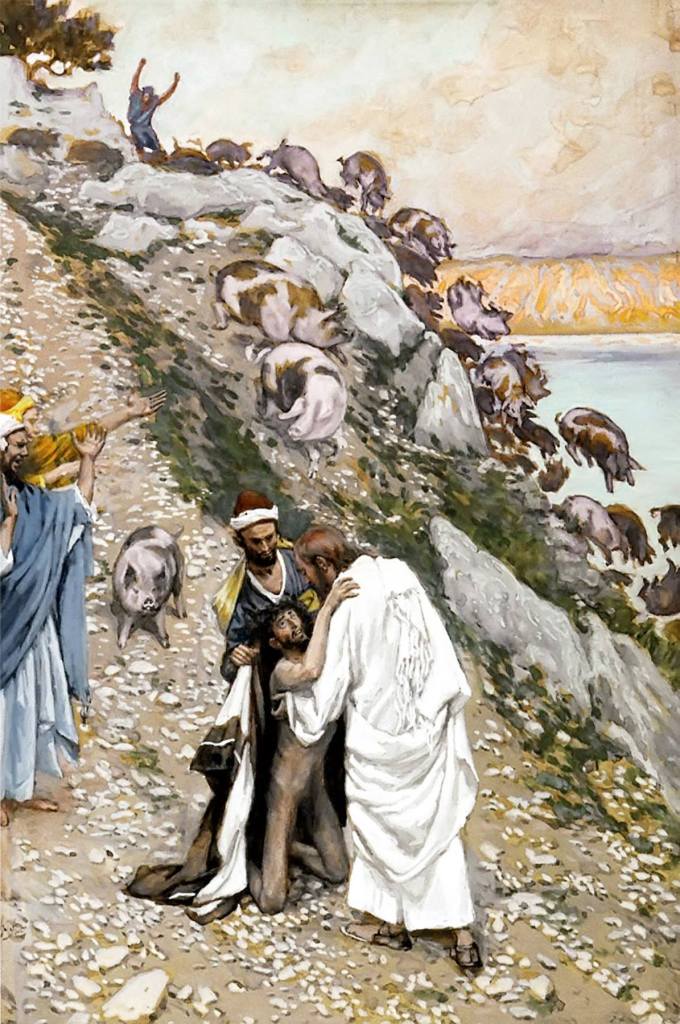
Swine Driven into the Sea by James Tissot

For reasons the Gospel does not reveal, demons rage inside this pathetic man. Jesus confronts them with an intensity even beyond Shimei’s, casting them into the subsequently nose-diving swine:

Catching sight of Jesus from a distance,
he ran up and prostrated himself before him,
crying out in a loud voice,
“What have you to do with me, Jesus, Son of the Most High God?
I adjure you by God, do not torment me!”
(Jesus had been saying to him, “Unclean spirit, come out of the man!”)
Jesus asked him, “What is your name?”
He replied, “Legion is my name. There are many of us.”
And he pleaded earnestly with Jesus
not to drive them away from that territory.

Now a large herd of swine was feeding there on the hillside.
And they pleaded with him,
“Send us into the swine. Let us enter them.”
And he let them, and the unclean spirits came out and entered the swine.
The herd of about two thousand rushed down a steep bank into the sea,
where they were drowned.

Mark 5:6-13

Wow! I mean, really, these two readings are Cecil B. DeMille stuff! Certainly there is a lesson for each of us somewhere in all this drama.

  • Might David’s plight remind us to keep our lives in alignment with God’s hope and will for us?
  • Might Shimei’s rage and brutal honesty help us to consider any retained hurts and vengeances we harbor?
  • Might the poor, chained tomb-dweller help us to place our own small demons squarely in the merciful light of God’s healing power before they get too powerful for us to face?
  • Might the devastated pigs caution us that innocent people can get hurt when our sinful inclinations derail us?

Even though many aspects of today’s readings are harsh, they hold a central message of God’s enduring mercy toward us even in times of desperation and apparent hopelessness. May we hold on to this truth if we ever come to a place of darkness in our lives. And may we offer that Light to those we encounter who are bearing such suffering.


Poetry: Excerpt from “Love Song to the Demon-Possessed Pigs of Gadara” – William Fargason

William Fargason is the author of Love Song to the Demon-Possessed Pigs of Gadara (University of Iowa Press, 2020), winner of the 2019 Iowa Poetry Prize and the 2020 Florida Book Award in Poetry (Gold Medal). In this collection, Fargason inspects the pain of memory alongside the pain of the physical body. Fargason takes language to its limits to demonstrate how grief is given a voice. His speaker confronts illness, grapples with grief, and heals after loss in its most crushing forms. (from Iowa University Press).


The silence just before and just after,
and the black eyes as you leapt— “
no protest, no acceptance either.

You ran almost in unison,
a dance without music,
a curtain call,
and the crowd standing knowing this is what happens
once we find beauty:

                                      we must watch it leave.


Music: Healing Time on Earth – John Denver

Listen Tenderly

Fourth Sunday in Ordinary Time
January 28, 2024

Today’s Readings:

https://bible.usccb.org/bible/readings/012824.cfm


Today, in God’s Lavish Mercy, we pray with Psalm 95, once again a call to a holy tenderheartedness – that mix of love, discernment, and generosity that magnetizes us into dynamic relationship with God.

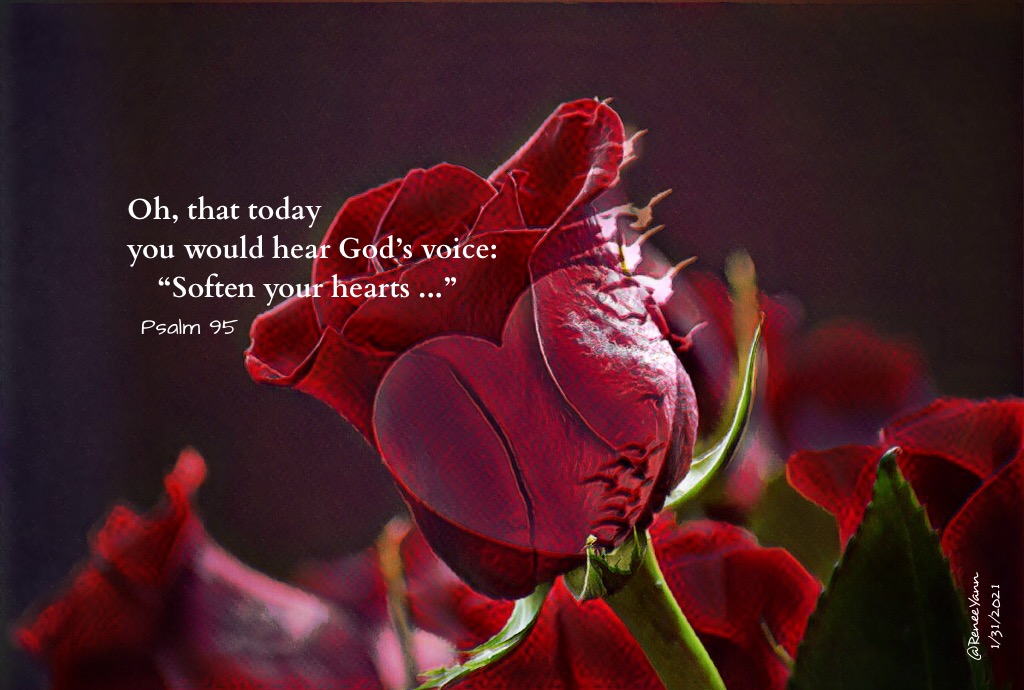
Oh, that today you would hear his voice:
    “Harden not your hearts as at Meribah,
    as in the day of Massah in the desert,
Where your fathers tempted me;
    they tested me though they had seen my works.

Psalm 95: 7-9

Our other Sunday readings, which Psalm 95 anchors, clarify the reason we seek this tenderheartedness. It is so that we might not only hear, but really listen and respond to the Truth of God in our lives.

Those who will not listen to my words 
which a prophet speaks in my name,
I myself will make them answer for it.

Deuteronomy 18:18

In our first reading from Deuteronomy, the people were confused. They were passing into a new land with lots of rivaling religions and spiritualities. Moses was nearing the end of his life and leadership over them. They wanted to know who to listen to and how to behave in order to stay in God’s favor.

God promises that God’s voice will come through a prophet like Moses:

I will raise up for them a prophet like you from among their kin,
and will put my words into his mouth;
he shall tell them all that I command him.

Deuteronomy 18:19

In our Gospel, we see Jesus – the fulfillment of the Deuteronomic Promise. The people witnessing his power are amazed. They struggle with whether they can believe in him when he seems just one of them, a Nazarene, Joseph’s son.

But some could believe – readily. Some, like the disciples, discerned quickly the Truth Jesus was. They heard, listened, believed and obeyed the Word.

Our psalm suggests that such readiness, such tenderheartedness comes from the consistent practice of relationship with God through praise, witness, thanksgiving, prayer, worship, humility, and obedience.


To me, it boils down to this:

  • let your life unfold in God’s Presence
  • be silent under God’s loving gaze
  • thank God for all you have been given
  • realize you are nothing without God
  • listen to your life as God speaks it to you
  • act on what you hear
Come, let us sing joyfully to the LORD;
    let us acclaim the rock of our salvation.
Let us come into God’s presence with thanksgiving;
    let us joyfully sing psalms to the Lord.
R. If today you hear God’s voice, harden not your hearts.
Come, let us bow down in worship;
    let us kneel before the LORD who made us.
For the Lord is our God,
    and we are the people God shepherds, the flock God guides.

Poetry: Rumi

I keep telling my heart,
“Go easy now.
I am submerged in golden treasure.”
It replies,
“Why should I be afraid of love?”

Music: Soften My Heart – by Music Meets Heaven

Do You Not Yet Have Faith?

Saturday of the Third Week in Ordinary Time
January 27, 2024

Today’s Readings:

https://bible.usccb.org/bible/readings/012724.cfm


Today, in God’s Lavish Mercy, our readings say something about Divine Order, about Sacred Balance – and our ability to let go and trust.

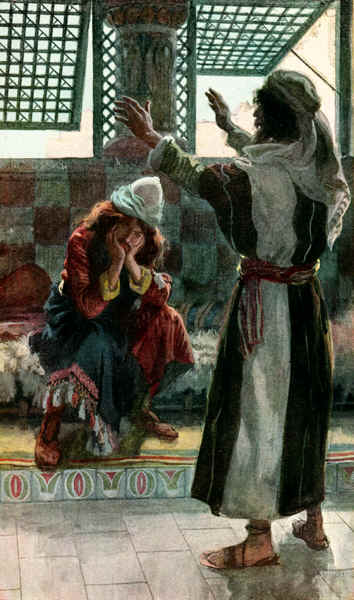
Nathan Rebukes David – by James Tissot

In our first reading, the prophet Nathan confronts David regarding his relationship with Bathsheba. The beautiful Bathsheba was the wife of Uriah, an elite soldier in David’s army. From far away one day, David spies her bathing in a pool. Full of covetousness and lust, he engineers a heartless plot to have her as his own.

The story is complex, intriguing, and extremely dramatic. You can read it for yourself in 2 Samuel. But the point I would like to draw out for today is about covetousness. What is that, really, and does it play any part in my life?


“Covet” is an intransitive verb that we learned when we were taught the Ten Commandments. Like all the other sins, my six-year-old self decided I would try hard not to commit it … but I had no idea what it even meant! I was pretty sure I didn’t have to be worried about coveting my neighbor’s wife, but I did like Jimmy Clark’s bike enough to covet it. (But, I didn’t steal it.)


Honestly, I don’t think I’ve ever used the verb “covet” in a sentence before today. So I turned to Meriam-Webster who defines covetousness like this: to desire (what belongs to another) inordinately or culpably

Do we “covet” when we wish we had some of the great things others have? Material things like money, mansions, and limousines? Or immaterial things like talent, beauty, and popularity?

I don’t think so. We may have to deal with the concupiscence of jealousy or envy, but it’s not quite the same as coveting. As Merriam-Webster indicates, coveting implies an inordinance or culpability. In other words, we act on our jealousy or envy in some way, creating an imbalance in our moral life. 

  • We resent, judge, or ostracize the person who has what we want.
  • We plot to take away the other’s prized possession or status.
  • We create a deficit in our own responsibilities by directing essential resources to our plot.
  • And what may be the worst and most likely situation, we use our power to indifferently usurp what belongs to others.

When I examine my conscience I remind myself that the world belongs to me, but it also belongs to others — all others. Peace, a decent level of sustenance, the goods of Creation, the right to life — these belong to me but also to others. I may not be aware of “coveting” these things to the detriment of others, but how do my choices and actions in any way limit that right for others?

It could be as simple as this:

  • Do I vote for leaders who continually foster negotiation over militaristic responses?
  • Do I support trade agreements that establish sustainable practices for producers as well as consumers?
  • Do I recognize that climate deterioration and refugee intensification are inextricably connected to abusive environmental practices and that I have a role in promoting change?
  • Do I have a single-issue or a holistic approach to life concerns for the unborn, impoverished, incarcerated, unhoused, immigrant, and medically needy populations?

When we find ourselves entangled in greed or covetousness, it’s not necessarily that we are bad people. We might be more like the disciples described in today’s Gospel – fearful people, so insecure that we amass material protections around us.

A violent squall came up and waves were breaking over the boat,
so that it was already filling up.
Jesus was in the stern, asleep on a cushion.
They woke him and said to him,
“Teacher, do you not care that we are perishing?”
He woke up,
rebuked the wind, 
and said to the sea, “Quiet! Be still!”
The wind ceased and there was great calm.
Then he asked them, “Why are you terrified?
Do you not yet have faith?”

Mark 4: 37-40

Jesus calls us to live a life grounded in faith not material protections. Only faith is invulnerable to life’s storms. Within its eternal securities, we become more deeply aware of our sacred relationship to all creatures and to Creation Itself.


If David had exercised such faith, the taking of Bathsheba and murder of Uriah would have been incomprehensible to him. As we deepen in our faith, what awarenesses will awaken in us?


Quote: Wisdom from Ramana Maharshi (1879 – 1950) who is considered an Indian Hindu sage and “jivanmukta” (liberated being). He is regarded by many as an outstanding enlightened being and, as a charismatic person, attracted many devotees. I particularly value this quote which leads me to consider my oneness with all beings:

Questioner: How are we to treat others?
Ramana Maharshi: There are no others.


Music: Imagine – John Lennon

… the seed would sprout…

Memorial of Saints Timothy and Titus, bishops
January 26, 2024

Today”s Readings:

https://bible.usccb.org/bible/readings/012624.cfm


Today, in God’s Lavish Mercy, we have two beautiful readings to enrich our prayer.

In our first reading, Paul blesses and encourages his young disciple Timothy. Reminding Timothy of his faith heritage, received from his mother and grandmother, Paul inspires Timothy to live a spiritually courageous life:

I remind you to stir into flame
the gift of God that you have through the imposition of my hands.
For God did not give us a spirit of cowardice
but rather of power and love and self-control.
So do not be ashamed of your testimony to our Lord,
nor of me, a prisoner for his sake;
but bear your share of hardship for the Gospel
with the strength that comes from God.

2 Timothy 1: 6-8

Praying with this passage, we can look both back and forward – to those who have encouraged our faith, and to those who depend on us for edification.


Image by Rosy / Bad Homburg / Germany from Pixabay

In our Gospel, Jesus paints a picture for his disciples of what the Kingdom of Heaven is like. This is a realm in which we already live – the eternal universe of the Creator’s love and grace. But our time-bound eyes can’t see that world clearly. It is more real than our physical world, but perceptible only to the awakened spirit.

Jesus tries to explain this “kingdom” to his followers. He says that like the growth of a seed, this world is a sacred mystery whose energy is generated by God, not by us:

This is how it is with the Kingdom of God;
it is as if someone were to scatter seed on the land
and would sleep and rise night and day
and the seed would sprout and grow,
they know not how.
Of its own accord the land yields fruit,
first the blade, then the ear, then the full grain in the ear.
And when the grain is ripe, they wield the sickle at once,
for the harvest has come.

Mark 4: 26-29

Paul and Jesus encouraged their followers to live in joyous alignment with this Divine Order – the “Kingdom of God”, as scripture calls it. In our prayer today, let’s listen to their counsel, for it is meant for us as well.


Poetry: Let This Darkness Be a Bell Tower – Rainer Maria Rilke, Sonnets to Orpheus II, 29

“Quiet friend who has come so far,
feel how your breathing makes more space around you.
Let this darkness be a bell tower
and you the bell. As you ring,
what batters you becomes your strength.
Move back and forth into the change.
What is it like, such intensity of pain?
If the drink is bitter, turn yourself to wine.
In this uncontainable night,
be the mystery at the crossroads of your senses,
the meaning discovered there.
And if the world has ceased to hear you,
say to the silent earth: I flow.
To the rushing water, speak: I am.”

Music: Lamb of God – from the Mass of St. Timothy – Matt Maher

A Striking Light!

Feast of the Conversion of Saint Paul, Apostle
January 25, 2024

Today’s Readings:

https://bible.usccb.org/bible/readings/012524.cfm


The Conversion of St. Paul – Caravaggio

Today, in God’s Lavish Mercy, we have the thrilling story of the conversion of St. Paul.

“On that journey as I drew near to Damascus,
about noon a great light from the sky suddenly shone around me.
I fell to the ground and heard a voice saying to me,
‘Saul, Saul, why are you persecuting me?’
I replied, ‘Who are you, sir?’
And he said to me,
‘I am Jesus the Nazorean whom you are persecuting.’

Acts of the Apostles 22; 6-8

God was not subtle with Paul! And it’s a good thing because Paul wasn’t subtle. He was the kind of guy who lived on the edge of life, always pushing the limits of his existence. He reminds me of a spiritual “Evel Knievel”.

God had to make a real impression in order to get Paul’s attention and turn his life around. When a lightning bolt knocks you off your horse, you tend to notice!


Our Gospel summarizes Jesus’s choice of his twelve apostles. Again, there was some pretty dramatic divine intervention used to get these men to take heed:

  • Andrew heard a voice from the sky sanctify Jesus’s Baptism in the Jordan
  • Nathaniel was miraculously observed under the fig tree
  • Peter and his fishing buddies caught an incredible, net-breaking haul
  • Philip asked, “What’s for dinner?’ and got twelve baskets of leftovers
  • Thomas placed his fingers in the resurrected wounds
  • Matthew got the grace to make an astounding career change
  • and John, in the first Eucharistic moment, rested his ear against God’s heart

God’s daily call to us may come in softer garments. We all have a few dramatic moments in our lives, when we must grasp our faith to make it through. But for the most part, life may seem hypnotizingly ordinary. Our readings today encourage us to pay attention to grace — to open ourselves to God’s eternal promptings even in their ordinary costumes. Every sunrise offers such an invitation. How blessed we are when we recognize them!


Poetry: The Conversion of St. Paul – Christopher Smart (1722-1771)

Each line in he poem refers to a miracle in the scriptures. The son of Nun was Joshua who opens the poem.

Thro ' him, the chief, begot by Nun,
Controul'd the progress of the sun;
The shadow too, through him, retir'd
The ten degrees it had acquir'd.
The barren could her fruit afford,
The woman had her dead restor'd,
The statesman could himself demean
To seek the river, and be clean.
At his command, ev'n Christ I Am,
The cruse was fill'd, and iron swam;
The floods were dry'd to make a track,
And Jordan's wave was driven back.
All these in ancient days occurr'd,
The great atchievements of the Word,
By Joshua's hand, by Moses' rod,
By virtue of the men of God.
But greater is the mighty deed
To make a profligate recede,
And work a boist'rous madman mild,
To walk with Jesus like a child.
To give a heart of triple steel
The Lord's humanity to feel;
And there, where pity had no place,
To fill the measure of his grace;
To wash internal blackness white,
To call the worse than dead to light;
To make the fruitless soil to hold
Ten thousand times ten thousand fold.
To turn a servant of the times
From modish and ambitious crimes;
To pour down a resistless blaze,
‘Go, persecutor, preach and praise.’

Video: Instead of music today, I’ve included this video analysis of Caravaggio’s painting “The Conversion of St. Paul on the Road to Damascus”. It is one of at least two paintings by Caravaggio on the same subject. The other famous painting, “The Conversion of St. Paul” is seen at the top of this blog post.

I found that the video spoke to both art appreciation and spirituality. I hope you enjoy it.

Just Listen!

Memorial of Saint Francis de Sales, Bishop and Doctor of the Church
Wednesday of the Third Week in Ordinary Time
January 24, 2024

Today’s Readings:

https://bible.usccb.org/bible/readings/012424.cfm


Today, in God’s Lavish Mercy, Jesus tells us the parable of the sower and the seed.

And he taught them at length in parables, 
and in the course of his instruction he said to them, 
“Hear this! A sower went out to sow.
And as he sowed, some seed fell on the path, 
and the birds came and ate it up.
Other seed fell on rocky ground where it had little soil.
It sprang up at once because the soil was not deep.
And when the sun rose, it was scorched and it withered for lack of roots. 
Some seed fell among thorns, and the thorns grew up and choked it 
and it produced no grain.
And some seed fell on rich soil and produced fruit.
It came up and grew and yielded thirty, sixty, and a hundredfold.”
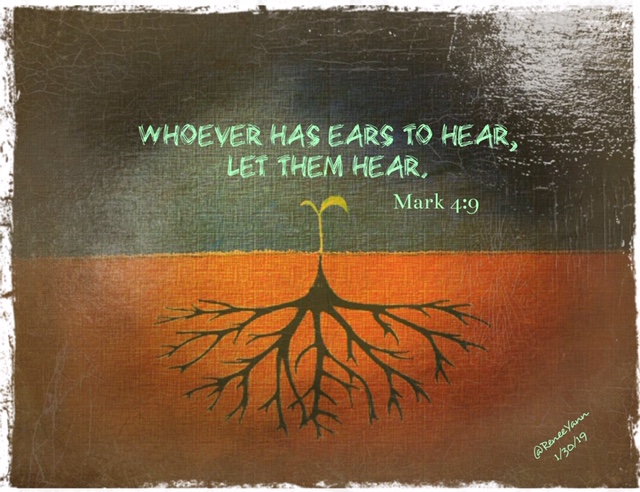
He added, “Whoever has ears to hear ought to hear.”

Mark 4: 2-9

How many times have we heard or read this passage over the years? Maybe so many times that we’ve become a little impervious to it. Maybe we can hear something too much.

For example, as a group of us watched the 76ers basketball game last night, the commercials seemed endless. At one point Anne Marie asked me, “Would you ever buy that?”. Although I was staring at the commercial, I had no idea what it was saying. I had tuned it out and was looking right through it!

Here’s the thing: I could hear the commercial, but I wasn’t listening to it.


I think it’s like that with today’s parable and other scripture passages as well.

We’re probably not farmers. If you’re like me, the best you’ve done is to plant an orange seed in a ten-cent flower pot when you were kindergartners! So the parable might not catch our hearts when we hear it for the 100th time unless we have learned to listen as well as hear!


But when we listen to this parable we might realize that, maybe, for us:

  • the seed fell on the path and got devoured by birds that time when we let up on our dedicated prayer time and took up some useless distraction
  • the seed fell on rocky ground when we failed to study a politically charged issue in the light of the Gospel and instead got caught in a media-spun theory
  • the seed fell among thorns when we allowed our morality to be influenced by gossip, cheap judgments, self-serving agendas, or biased opinion
  • the seed fell on rich ground when we gave our spirits quiet time, prayer, good spiritual reading, the companionship of graced friends, and all the other holy kindnesses that can make us better persons

As I write this blog, it’s so cold where I live that, unless you had a jackhammer, you couldn’t even plant a seed. We don’t want our hearts to be like that. We want supple hearts, ready for the amazing graces God scatters over our lives daily. Let’s do the work to be ready.


Poetry: The Sower – William Cowper (1731 – 1800) was an English poet and Anglican hymnwriter.

One of the most popular poets of his time, Cowper changed the direction of 18th-century nature poetry by writing of everyday life and scenes of the English countryside. In many ways, he was one of the forerunners of Romantic poetry. Samuel Taylor Coleridge called him “the best modern poet”, whilst William Wordsworth particularly admired his poem “Yardley-Oak”.

Cowper’s religious sentiment and association with John Newton (who wrote the hymn “Amazing Grace”) led to much of the poetry for which he is best remembered, and to the series of Olney Hymns. His poem “Light Shining out of Darkness” gave English the phrase: “God moves in a mysterious way/ His wonders to perform.” (Wikipedia)


Ye child of earth prepare the plough,
Break up your fallow ground;
The sower is gone forth to sow,
And scatter blessings round.
The seed that finds a stony soil
Shoots forth a hasty blade;
But ill repays the sower's toil,
Soon wither'd, scorch'd, and dead.
The thorny ground is sure to balk
All hopes of harvest there;
We find a tall and sickly stalk,
But not the fruitful ear.
The beaten path and highway side,
Receive the trust in vain;
The watchful birds the spoil divide,
And pick up all the grain.
But where the Lord of grace and power
Has bless'd the happy field,
How plenteous is the golden store
The deep-wrought furrows yield!
Father of mercies, we have need
Of thy preparing grace;
Let the same Hand that give me seed
Provide a fruitful place!

Music: Amazing Grace

The Soul’s Rhythm

Tuesday of the Third Week in Ordinary Time
January 23, 2024

Today’s Readings:

https://bible.usccb.org/bible/readings/012324.cfm


David danced

Today, in God’s Lavish Mercy Mercy, vigorous, grace-filled David dances with abandon before the Lord. It is a beautiful moment to imagine!

David went to bring up the ark of God from the house of Obed-edom
into the City of David amid festivities.
As soon as the bearers of the ark of the LORD had advanced six steps,
he sacrificed an ox and a fatling.
Then David, girt with a linen apron,
came dancing before the LORD with abandon,
as he and all the house of Israel were bringing up the ark of the LORD
with shouts of joy and to the sound of the horn.

2 Samuel 6: 12-15

David dances with unselfconscious joy because he has brought the Presence of God home to the heart of the community. The joy comes from recognizing that God wants to be with the People. This joy, inexpressible in words, takes the form of a dance with the Spirit of God.


Let’s pause today with that dancing image, to consider all the ways God longs to dance with us throughout our lives, and we with God — dances of both:

joy and sorrow,
faith and questioning,
hope and shadow

… dances in which we must abandon ourselves to the moment’s sacred music and respond to God’s mysterious, leading step.


Whatever the emotion we bring to prayer, what matters is only that we carry it close to God’s heart, listening to our circumstances for the Divine Heartbeat. We may not be the “Fred Astaire” or “Ginger Rodgers” of prayer, but each one of us has a holy dance somewhere in their heart.

I think our children can teach us something about this kind of uninhibited prayer – one filled with trust, hope, joy, and innocence.


Poetry: T. S. Eliot

IMG_2326


At the still point of the turning world.
Neither flesh nor fleshless;
Neither from nor towards;
at the still point, there the dance is,
But neither arrest nor movement.
And do not call it fixity,
Where past and future are gathered.
Neither movement from nor towards,
Neither ascent nor decline.
Except for the point, the still point,
There would be no dance,
~ T.S. Eliot


A second lovely poem, even though it is not Easter 🙂

IMG_2327


Easter Exultet

Shake out your qualms.
Shake up your dreams.
Deepen your roots.
Extend your branches.

Trust deep water
and head for the open,
even if your vision
shipwrecks you.

Quit your addiction
to sneer and complain.
Open a lookout.
Dance on a brink.

Run with your wildfire.
You are closer to glory
leaping an abyss
than upholstering a rut.

Not dawdling.
Not doubting.
Intrepid all the way
Walk toward clarity.

At every crossroad
Be prepared
to bump into wonder.
Only love prevails.

Enroute to disaster
insist on canticles.
Lift your ineffable
out of the mundane.

Nothing perishes;
nothing survives;
everything transforms!
Honeymoon with Big Joy!
~ James Broughton


Music: No Reason Not to Dance – Kathryn Kaye

Rise and Fall of Kings

Day of Prayer for the Legal Protection of Unborn Children
Monday of the Third Week in Ordinary Time
January 22, 2024

Today’s Readings:

https://bible.usccb.org/bible/readings/012224.cfm


Today, in God’s Lavish Mercy, our readings place us at watershed moments in the lives of David and Jesus.

All the tribes of Israel came to David in Hebron and said:
“Here we are, your bone and your flesh.
In days past, when Saul was our king, 
it was you who led the children of Israel out and brought them back.
And the LORD said to you, ‘You shall shepherd my people Israel 
and shall be commander of Israel.’”
When all the elders of Israel came to David in Hebron, 
King David made an agreement with them there before the LORD, 
and they anointed him king of Israel.

2 Samuel 5:1-4

In 2 Samuel 5, David fully assumes the kingship through the approbation of the community. The scene marks the culmination of his rise to power and “the beginning of the rest of his life”.

Through our readings in Samuel until now, we have ascended with David to the pinnacle of his life. We are about to begin weeks of moving down “the other side of the mountain”.


Scholars generally see the David narrative in two primary units, the Rise of David (I Sam. 16:1—II Sam. 5:10) and the Succession Narrative (II Sam. 9:1—20:26; I Kings 1:1—2:46). Chapters 5:11—8:18, fall between two larger units. Whereas the first presents David in his ascendancy, the second presents David in his demise and expresses pathos and ambiguity. Our chapters thus come after the raw vitality of the rise of David and before the terrible pathos of the succession narrative. They show the painful process whereby this beloved chieftain is transformed into a hardened monarch, who now has more power than popular affection.

Walter Brueggemann: First and Second Samuel

In our Gospel, Jesus also comes to a sort of “continental divide”. But rather than community approbation, Jesus encounters the condemnation of the scribes who have come from Jerusalem to assess him.

The scribes who had come from Jerusalem said of Jesus, 
“He is possessed by Beelzebul,” and
“By the prince of demons he drives out demons.”

Mark 3: 22

From this moment in his life, Jesus too launches into his “kingship”, one that looks very different from David’s. The ensuing chapters of Samuel will reveal how David struggles and succumbs to the temptations of power and domination. The Gospels, on the other hand, describe Jesus’s “kingdom” as one of humility, mercy, and love for those who are poor and suffering.


Only through faith can we understand the inverse power of God present in the Life, Death and Resurrection of Jesus, and in our own lives. Jesus, the “new David”, is anointed in the Spirit to reveal and incorporate us into the kingdom of God.


Prose: from Immanuel Jakobovits who was the Chief Rabbi of the United Hebrew Congregations of the Commonwealth from 1967 to 1991.

To those without faith
there are no answers.
To those with faith, 
there are no questions.


Music: King David, music by Herbert Howells, sung by Sarah Connolly from a poem by Walter de la Mare

King David – Walter de la Mare

King David was a sorrowful man:
    No cause for his sorrow had he;
    And he called for the music of a hundred harps,
    To ease his melancholy.

    They played till they all fell silent:
    Played-and play sweet did they;
    But the sorrow that haunted the heart of King David
    They could not charm away.

    He rose; and in his garden
    Walked by the moon alone,
    A nightingale hidden in a cypress-tree
    Jargoned on and on.

    King David lifted his sad eyes
    Into the dark-boughed tree-
    ''Tell me, thou little bird that singest,
    Who taught my grief to thee?'

    But the bird in no wise heeded
    And the king in the cool of the moon
    Hearkened to the nightingale's sorrowfulness,
    Till all his own was gone.

Time Passes

Third Sunday in Ordinary Time
January 21, 2024

Today’s Readings:

https://bible.usccb.org/bible/readings/012124.cfm


Today, in God’s Lavish Mercy, each of our readings speaks to us of time.

The concept of time has always fascinated me. I remember being aware of the fascination as a very little girl walking beside my mother and aunt along the Wildwood boardwalk arcade.

Some of you who live locally may remember the spot, an extension of the seaside boardwalk at Oak Avenue. Its main attractions were bumper cars and a booth where little piglets ran along a path, picking a random door that, for a nickel, might earn you a stuffed animal.

On that particular summer day, about 1950, there was a new booth – Miranda, the Fortune Teller. Miranda read Tarot cards, an exercise Mom and Aunt Peg were unfamiliar with. Nevertheless, they decided to try it, and each went separately into the tiny veiled room to learn her future as I stood completely entranced by the piglet race.


Later, as the three of us sauntered side-by-side in the salted air, I heard Aunt Peg ask Mom, “Did she tell you how old you will be when you die?”. My ears leaped to attention! What? My mom could die???? And that lady knew when????

I heard my thirty-three year old mother answer, “She said when I am seventy-two.”

“Oh, God! How soon is that?”, I wondered. My little five-year-old mind tried to calculate the expanse of time but failed. However, the prediction planted itself inextricably in my heart.


Decades later, when Mom did pass away (just before her 72nd year) the memory returned to me. And the nearly forty years in between seemed compressed into an incomprehensible moment that had passed as quickly as that sweet seaside breeze.


How many times do we ask the Universe this unanswerable question, “Where did the time go?” It is a question that has a thousand answers and no answer, much like the question, “Who is God?”.


In our readings today, Jonah, Paul, and John the Baptist want us to think about time in relationship to God.

  • For Jonah, time is captured in the forty days of grace to seek repentance.
  • For Paul, time – in the worldly sense – is running out, requiring us to turn our attention to eternity.
  • For Jesus, it is the time of fulfillment – a fulfillment that can be achieved by living the Gospel.

Praying with today’s readings, we might ask ourselves, “What time is it for me?

  • Are there places in my life requiring “repentance“, a turning of my heart away from selfishness and toward the mercy of God?
  • Do I need to widen my perspective with a deeper awareness of eternal rather than worldly values?
  • Am I making a choice every day to live a life patterned on the Gospel?

Poetry: Endless Time – Rabindranath Tagore

Time is endless in thy hands, my lord.
There is none to count thy minutes.
Days and nights pass and ages bloom and fade like flowers.
Thou knowest how to wait.
Thy centuries follow each other perfecting a small wild flower.
We have no time to lose,
and having no time we must scramble for a chance.
We are too poor to be late.
And thus it is that time goes by
while I give it to every querulous person who claims it,
and thine altar is empty of all offerings to the last.

At the end of the day I hasten in fear lest thy gate be shut;
but I find that yet, with you, there is always time.


Music: What’s It All About, Alfie? – written by Burt Bacharach, sung by Dionne Warwick this modern song seems to deal with the timeless questions.

What’s it all about Alfie
Is it just for the moment we live

What’s it all about
When you sort it out, Alfie
Are we meant to take more than we give
Or are we meant to be kind?

And if, if only fools are kind, Alfie
Then I guess it is wise to be cruel
And if life belongs only to the strong, Alfie
What will you lend on an old golden rule?

As sure as I believe there’s a heaven above
Alfie, I know there’s something much more
Something even non-believers can believe in

I believe in love, Alfie
Without true love we just exist, Alfie
Until you find the love you’ve missed
You’re nothing, Alfie

When you walk let your heart lead the way
And you’ll find love any day Alfie, Alfie