Eyes Unveiled

Wednesday of the First Week of Advent
December 6, 2023

Today’s Readings:

https://bible.usccb.org/bible/readings/120623.cfm


Today, in God’s Lavish Mercy, Isaiah tantalizes us with his vision of the sumptuous heavenly banquet:

On this mountain the LORD of hosts
will provide for all peoples
A feast of rich food and choice wines,
juicy, rich food and pure, choice wines.

Isaiah 25:6-7

I can picture myself at that table munching on a savory turkey leg washed down by a bottomless pilsner. But if I stop there in my meditation I will have missed the whole point! The menu is not even the tip of the treasures to be had when we gather on Isaiah’s “Parousia Mountain”.

On that mountain, the veil will be lifted from our perception. The tangly web of our stresses and confusions will be wiped away. We will see ourselves and all Creation with God’s clear and loving eyes. Death – the lurking intruder threatening every earthly table – will have been eradicated, dissolved into Eternal Being.

On this mountain God will destroy
the veil that veils all peoples,
The web that is woven over all nations;
God will destroy death forever.

Isaiah 25:7-8

In our first reading, Isaiah paints the picture of a mountain lifted from time and transformed with heaven. In our Gospel, Jesus too is on a mountain when he pulls heaven down to heal and feed the yearning crowd.

Jesus walked by the Sea of Galilee,
went up on the mountain, and sat down there. 
Great crowds came to him,
having with them the lame, the blind, the deformed, the mute,
and many others. 
They placed them at his feet, and he cured them. 

Matthew 15:29-30

No doubt the gathered people, cured of their nagging maladies, were stunned into an instant faith. But Jesus knows that they can not stay on this heaven-charged mountain forever. They have their life’s journey ahead of them, and the energy of nascent faith may wane on the long road. So he reinforces the healing miracles with the comfort and sustenance of common food:

My heart is moved with pity for the crowd,
for they have been with me now for three days
and have nothing to eat. 
I do not want to send them away hungry,
for fear they may collapse on the way.

Matthew 15:32

In this incident, which is another version of the miracle in Matthew 14, the simple common folk have with them only the merest provisions. It is these that Jesus uses to fuel an enduring faith in these earth-bound believers:

Jesus said to them, “How many loaves do you have?” 
“Seven,” they replied, “and a few fish.” 
He ordered the crowd to sit down on the ground. 
Then he took the seven loaves and the fish,
gave thanks, broke the loaves,
and gave them to the disciples, who in turn gave them to the crowds. 
They all ate and were satisfied. 
They picked up the fragments left over–seven baskets full.

Matthew 15:34-37

God uses our merest provisions too to charge our daily life with faith’s energy. But we must take the holy time to let any misleading webs and obstructive veils fall from our perceptions. Our godless culture layers the world with so many distractions and fallacies that we are hard-pressed to see what’s really essential to true life.

Especially at Christmas time, God is nearly buried in tinsel, hype, and commercialism. A good Advent, spent in the awe-filled silence of scriptural reflection, is the antidote to this malady. Let’s be committed to it.


Poetry: Adult Advent Announcement – by David A. Redding, (from If I Could Pray Again – 1965)

O Lord,
Let Advent begin again
In us,
Not merely in commercials;
For that first Christmas was not
Simply for children,
But for the
Wise and the strong.
It was
Crowded around that cradle,
With kings kneeling.
Speak to us
Who seek an adult seat this year.
Help us to realize,
As we fill stockings,
Christmas is mainly
For the old folks —
Bent backs
And tired eyes
Need relief and light
A little more.
No wonder
It was grown-ups
Who were the first
To notice
Such a star.

Music: When I Can Read My Title Clear – arranged by Tim Sharpe
This is an acapella version of the hymn text by Isaac Watts (1674 – 1748) interpreting Isaiah 25:8.It is set to the tune PISGAH, an American Folk Melody by the 19th-century composer Joseph C. Lowry

A Budding Promise

Tuesday of the First Week of Advent
December 5, 2023

Today’s Readings:

https://bible.usccb.org/bible/readings/120523.cfm


Today, in God’s Lavish Mercy, Isaiah challenges us with his outrageously hopeful poetry.

After describing, in lyrical magnificence, the Messianic Ruler, Isaiah tells us this:

Then the wolf shall be a guest of the lamb,
and the leopard shall lie down with the kid;
The calf and the young lion shall browse together,
with a little child to guide them.
The cow and the bear shall be neighbors,
together their young shall rest;
the lion shall eat hay like the ox.
The baby shall play by the cobra’s den,
and the child lay his hand on the adder’s lair.
There shall be no harm or ruin on all my holy mountain;
for the earth shall be filled with knowledge of the LORD,
as water covers the sea.

Isaiah 11:6-10

We love this lilting Advent balladry, don’t we? Its movement is laced with hidden bells and waft of pine. It makes us remember Handel’s Messiah and resolve to find and play the CD we put away last January.

But as much as we might love the passage, do we believe it? Is the era of messianic peace possible, and will it be realized through the mystery of Divine Love incarnate in Jesus Christ?


Well, here are the facts:

Isaiah lived and prophesied a redeemed kingdom about 700 years before Christ. When Christ was born, the world was in pretty much the same sad shape as it was when Isaiah wrote.

Jesus lived 2000 years ago, speaking and modeling specific instructions for the world’s transformation. But the world is in pretty much the same sad shape today as it was when Jesus lived.

So where is all this “peaceable kingdom” stuff happening? Is it non-existent or just invisible? Is it just the rather lunatic imagining of ancient prophets?


Today’s Gospel offers us an understanding of God’s Reign too deep for the world’s logic. By the gift of faith and the grace of Baptism, we have been given a new set of eyes, charged with the same outrageous yet real hope evident in Isaiah and enfleshed in Christ.

I give you praise, Father, Lord of heaven and earth,
for although you have hidden these things
from the wise and the learned
you have revealed them to the childlike…

… Turning to the disciples in private he said,
“Blessed are the eyes that see what you see.
For I say to you,
many prophets and kings desired to see what you see,
but did not see it,
and to hear what you hear, but did not hear it.

Luke 10:21-24

If we can give ourselves to the vulnerable simplicity Jesus describes, faith can transform us. The “Kingdom” can live in us and because of us!

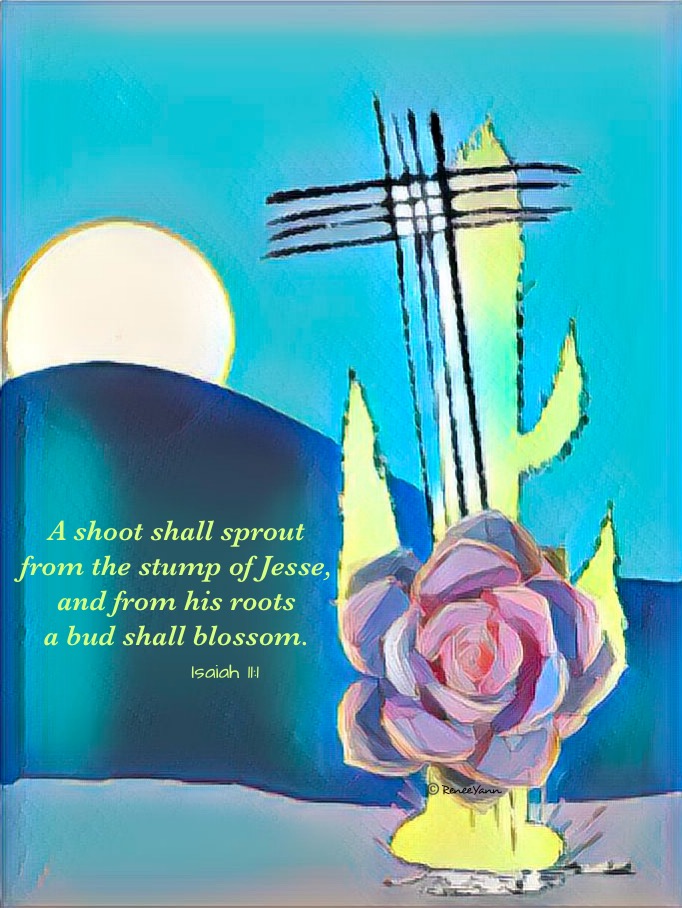
We too will see the bud beyond the stump. New life will arise from what appears lifeless. The worldly fears and inhospitalities that prey on us will be tamed by a holy confidence. In life’s sinuous circumstances, we will see the Holy Mystery unfolding.

The Kingdom, so indiscernible in our fractious world, will “advent” in us. This is what we long for in our Advent prayer.


Poetry: Advent Credo – Allan Boesak, a South African pastor in the Dutch Reformed Church, politician, anti-apartheid activist, and author of fifteen books. This poem is taken from his book Walking on Thorns (Eerdmans, 1984), and is often but wrongly attributed to Daniel Berrigan.


It is not true that creation and the human family are doomed to destruction and loss—
This is true: For God so loved the world that He gave his only begotten Son, that whoever believes in Him shall not perish but have everlasting life;
It is not true that we must accept inhumanity and discrimination, hunger and poverty, death and destruction—
This is true: I have come that they may have life, and that abundantly.
It is not true that violence and hatred should have the last word, and that war and destruction rule forever—
This is true: Unto us a child is born, unto us a Son is given, and the government shall be upon his shoulder, his name shall be called wonderful councilor, mighty God, the Everlasting, the Prince of peace.
It is not true that we are simply victims of the powers of evil who seek to rule the world—
This is true: To me is given authority in heaven and on earth, and lo I am with you, even until the end of the world.
It is not true that we have to wait for those who are specially gifted, who are the prophets of the Church before we can be peacemakers—
This is true: I will pour out my spirit on all flesh and your sons and daughters shall prophesy, your young men shall see visions and your old men shall have dreams.

It is not true that our hopes for liberation of humankind, of justice, of human dignity of peace are not meant for this earth and for this history—
This is true: The hour comes, and it is now, that the true worshipers shall worship God in spirit and in truth.

So let us enter Advent in hope, even hope against hope. Let us see visions of love and peace and justice. Let us affirm with humility, with joy, with faith, with courage: Jesus Christ—the life of the world.

Music: Lo, How a Rose E’er Blooming – pre-17th century anonymous hymn

From Wikipedia: The hymn was originally written with two verses that describe the fulfillment of the prophecy of Isaiah foretelling the birth of Jesus. It emphasizes the royal genealogy of Jesus and Christian messianic prophecies. The hymn describes a rose sprouting from the stem of the Tree of Jesse, a symbolic device that depicts the descent of Jesus from Jesse of Bethlehem, the father of King David. The image was especially popular in medieval times, and it features in many works of religious art from the period. It has its origin in the Book of Isaiah:

And there shall come forth a rod out of the stem of Jesse, and a Branch shall grow out of his roots.— Isaiah 11:1

All Nations …

Monday of the First Week of Advent
December 4, 2023

Today’s Readings:

https://bible.usccb.org/bible/readings/120423.cfm


Today, in God’s Lavish Mercy, Isaiah opens our prayer with this amazingly inclusive passage, both a vision and an invitation:

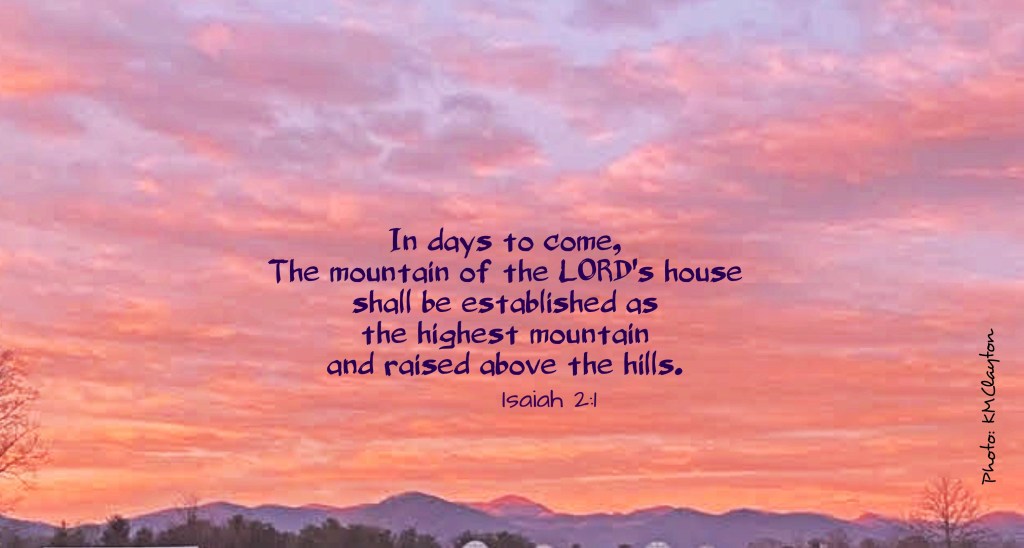
In days to come,
The mountain of the LORD’s house
shall be established as the highest mountain
and raised above the hills.
All nations shall stream toward it;
many peoples shall come and say:
“Come, let us climb the LORD’s mountain,
to the house of the God of Jacob,
That he may instruct us in his ways,
and we may walk in his paths.”

Isaiah 2:2-3

These first chapters of Isaiah were written about 8oo years before Christ, near the time of the Babylonian Captivity. The faith, vision, and hope of Israel were being sorely tested. Isaiah’s core message to these beleaguered people is that even when we do not see God, God abides. This abiding God will lead them to a new reality … to the “highest mountain” as opposed to their current valley of tears.

Isaiah is clear that this abiding promise is extended not only to Israel, but to all nations! What a surprising statement to find in the precious literature of Israel’s exceptionalism!


Jesus Heals a Centurion’s Servant – William Brassey Hole

To confirm this open invitation to “all nations”, our Gospel relates a complementary story. One of the first figures presented to us early in this Advent journey is the Gospel centurion, a Gentile with imperceptible religion but striking faith. His humble response to Jesus acknowledges that he, with all Creation, is subject to an infinitely loving Authority:

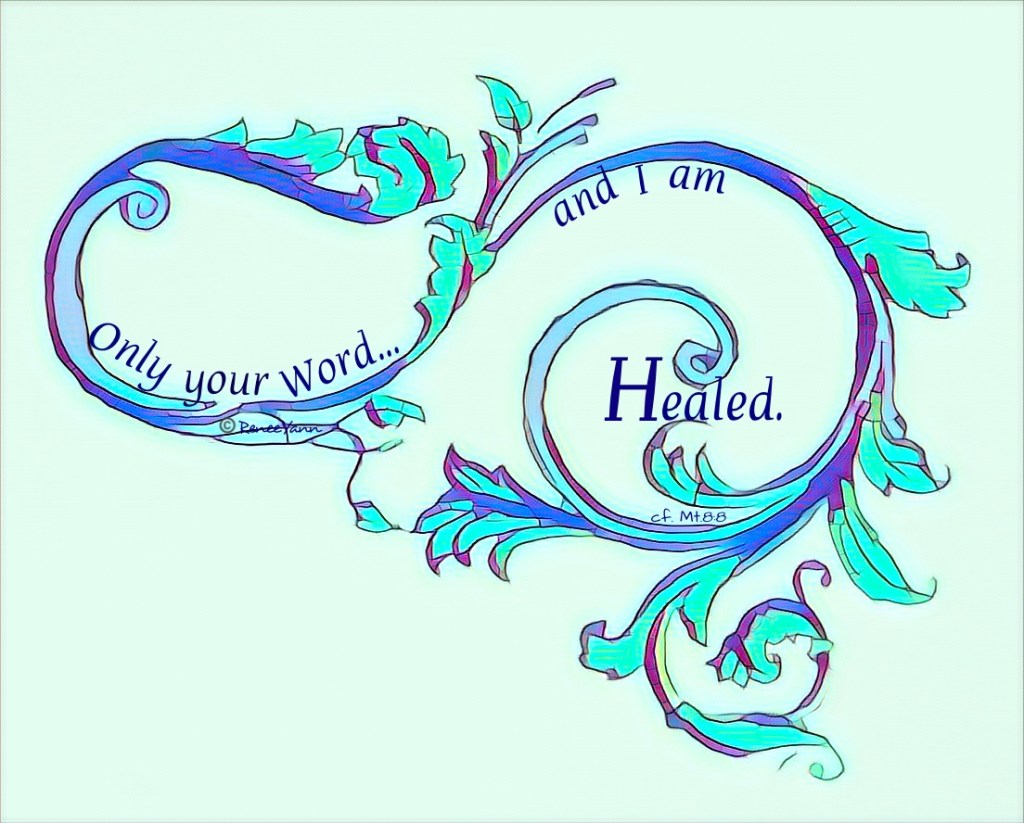
Lord, I am not worthy to have you enter under my roof;
only say the word and my servant will be healed.
For I too am a man subject to authority,
with soldiers subject to me.
And I say to one, ‘Go,’ and he goes;
and to another, ‘Come here,’ and he comes;
and to my slave, ‘Do this,’ and he does it.” 

Matthew 8:6-9

Our Advent lesson? Maybe this. To bring, as the centurion did, our beloved hopes and needs before God. To place them lovingly, confidently in the Divine Heart. To trust and receive God’s answers with all the faith we can gather. And to look, not past the moment, but through it to the holy mountain in the distance – a distance which is shortened by our faithful Advent prayer.


Poetry: I couldn’t come up with a written poem today, so I drew one:


Music: Healing – Peter Kater

Watch!

First Sunday of Advent
December 3, 2023

Today’s Readings:

https://bible.usccb.org/bible/readings/120323.cfm


Today, in God’s Lavish Mercy, we begin the Advent Watch, that annual time of acute spiritual awareness and hope-filled expectation.

We’ve all kept watch at various times in our lives, perhaps without even realizing it. It may have been as simple as waiting for a delayed but highly anticipated letter, or as worrisome as the anxious vigil over a feverish child. It may be as unnoticeable as waiting for an elevator, a green light, or a “transaction complete” at the ATM, or as marvelous as the nine-month expectancy of new life.

We should be good at waiting because we do it all the time, but maybe we’re not so good at it after all.


Good waiting requires our consciousness. We may idly consider the “waiting space” a neutral zone that we can fill with anything we choose – impatience, daydreaming, or distraction. But pivotal waiting can offer us an invaluable invitation – to meet God in a new way as we anticipate what we cannot yet see or comprehend. But sometimes we don’t pay enough attention to hear the invitation.

This kind of “keeping watch” can be a sacramental experience. It is a time when we are stilled before a reality or mystery we cannot control. We can only wait, hope, release any fear, and cleanse our demanding prayer of its useless stipulations. It is a time of confident abandonment into God’s loving will for our good. Advent is such a blessed time.


Praying with our Advent scriptures provides us with a curriculum for good waiting. Our teachers will be the divinely lyrical Isaiah, the Psalms, Matthew and Luke, and the glorious O Antiphons.

We begin today with this heartfelt entreaty to God:

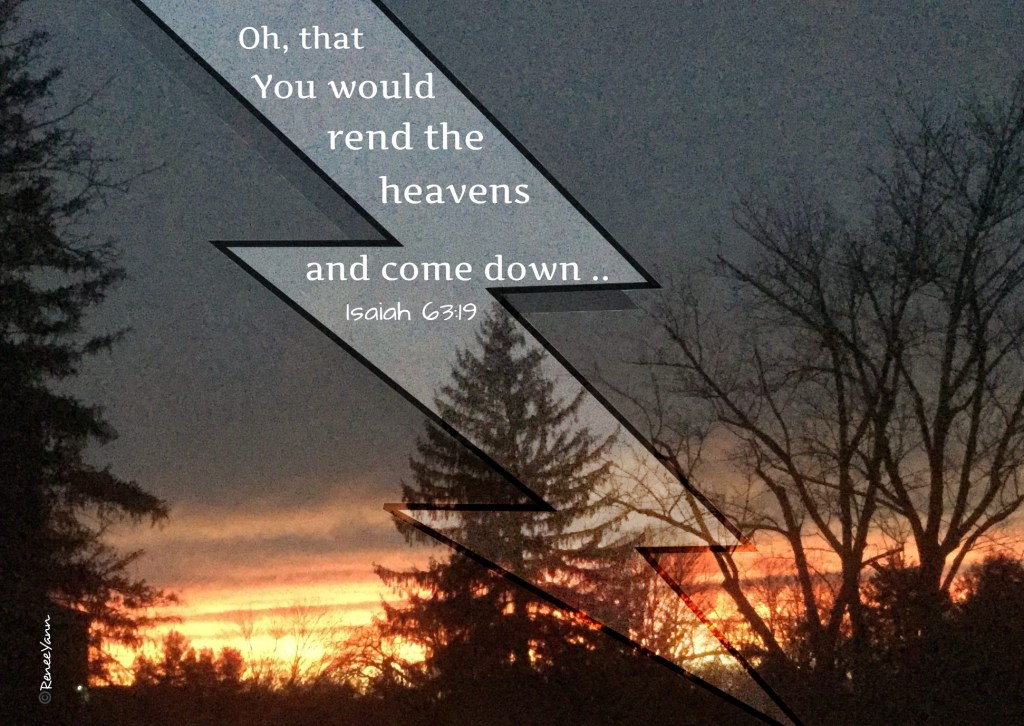
Oh, that you would rend the heavens and come down,
with the mountains quaking before you,
while you wrought awesome deeds we could not hope for,
such as they had not heard of from of old.
No ear has ever heard, no eye ever seen, any God but you
doing such deeds for those who wait for him.
Would that you might meet us doing right,
that we were mindful of you in our ways!


Each one of us can look into our own hearts today, into our own perception of the world, to see where God is most sorely needed. As we pray Isaiah’s plea, we can do so assured by Paul’s blessing that God desires to answer us:

I give thanks to my God always on your account
for the grace of God bestowed on you in Christ Jesus,
that in him you were enriched in every way,
with all discourse and all knowledge,
as the testimony to Christ was confirmed among you,
so that you are not lacking in any spiritual gift
as you wait for the revelation of our Lord Jesus Christ.
He will keep you firm to the end,
irreproachable on the day of our Lord Jesus Christ.
God is faithful,
and by him you were called to fellowship with his Son,
Jesus Christ our Lord.


Poetry: Advent (On a theme by Dietrich Bonhoeffer) – by Pamela Cranston

Look how long
the tired world waited,
locked in its lonely cell,
guilty as a prisoner.
As you can imagine,
it sang and whistled in the dark.
It hoped. It paced and puttered about,
tidying its little piles of inconsequence.
It wept from the weight of ennui
draped like shackles on its wrists.
It raged and wailed against the walls
of its own plight.
But there was nothing
the world could do
to find its freedom.
The door was shut tight.
It could only be opened
from the outside.
Who could believe the latch
would be turned by the flower
of a newborn hand?

Music: Wachet auf! ruft uns die Stimme – J.S. Bach

Wachet auf, ruft uns die Stimme
Wake up, the voice calls us
Der Wächter sehr hoch auf der Zinne,
of the watchmen high up on the battlements,
Wach auf, du Stadt Jerusalem!
wake up, you city of Jerusalem!
Mitternacht heißt diese Stunde;
This hour is called midnight;
Sie rufen uns mit hellem Munde:
they call us with a clear voice:
Wo seid ihr klugen Jungfrauen?
where are you, wise virgins ?
Wohl auf, der Bräutgam kömmt;
Get up, the bridegroom comes;
Steht auf, die Lampen nehmt! Alleluja!
Stand up, take your lamps! Hallelujah!
Macht euch bereit
Make yourselves ready
Zu der Hochzeit,
for the wedding,
Ihr müsset ihm entgegen gehn!
you must go to meet him!

On the Edge

Saturday of the Thirty-fourth Week in Ordinary Time
December 2, 2023

Today’s Readings:

https://bible.usccb.org/bible/readings/120223.cfm


Today, in God’s Lavish Mercy, we finally stand at the edge of the diving board before our plunge into the sublime days of Advent!


Daniel, at the end of a daunting passage, closes with this conviction that foreshadows the Messiah’s reign:

Then the kingship and dominion and majesty
of all the kingdoms under the heavens
shall be given to the holy people of the Most High,
Whose Kingdom shall be everlasting:
all dominions shall serve and obey him.

Daniel 7:27

In our Gospel, Jesus uses a tone similar to Daniel to encourage our vigilance:

Jesus said to his disciples:
“Beware that your hearts do not become drowsy
from carousing and drunkenness
and the anxieties of daily life,
and that day catch you by surprise like a trap.
For that day will assault everyone
who lives on the face of the earth.
Be vigilant at all times
and pray that you have the strength
to escape the tribulations that are imminent
and to stand before the Son of Man.”

Luke 21:34-36

I take these words as an imperative to engage the days of Advent for what they are supposed to be – a time of thoughtful, prayerful preparation to receive the gift and mystery of Christ in all its splendor.

The Gospel seems to suggest that we might become too tired for such prayer during all our frenetic Christmas preparations, or that we might break out the spiked egg nog a little too early. We are admonished to be alert, sober, and unanxious. We are advised to “Be vigilant” – that is, to light the heart’s candle and to wait patiently for God.


Poetry: Tug and Sigh – May Sarton, from “The Silence Now”

Like the datura’s yellow trumpets
I am waiting for the breath of angels
to perfume the twilight
of this ordinary day
and play the vigil hymn
reminding me
that heaven and earth
wed long ago.

I too am married
to the unseen
sigh and scent,
filling and returning,
thus never full –
always longing,
often failing,
yet ever blessed
with heaven’s pull.

Music: Silent Vigil – Tony O’Connor

A Message in Crisis

Friday of the Thirty-fourth Week in Ordinary Time
December 1, 2023

Today’s Readings:

https://bible.usccb.org/bible/readings/120123.cfm


Today, in God’s Lavish Mercy, our Responsorial Psalm from Daniel gives us a beautiful prayer. But, in the first reading, we pray with some pretty dramatic passages from the Book of Daniel. I mean, it’s the stuff of a rather scary special effects movie!

Even Daniel indicates how disturbing his visions are:

Because of this, my spirit was anguished and I, Daniel,
was terrified by my visions.

Daniel 7:15

So does the Church, or maybe even God, want us to be disturbed in our prayer today and tomorrow with our last two readings before Advent?

Listen! If you’re not disturbed already by the strain of unholiness in the world, then Daniel isn’t going to rock your boat! But if you, like most good people, have trouble even watching the evening news without anguish, then Daniel is speaking to you.


The writer of Daniel was delivering a message to the people of their time. The visions of chapters 7–12 reflect the crisis which took place in Judea in 167–164 BCE when Antiochus IV Epiphanes, the Greek king of the Seleucid Empire, threatened to destroy traditional Jewish worship in Jerusalem.

The message was:

  • pay attention to the changing world
  • focus on God in the disturbing change
  • choose to be faithful, hopeful, and brave
  • God will always remain faithful to us and most important of all:
  • God is coming to deliver us!

As with all Scripture, texts that spoke to an ancient people continue to speak to us. Our world suffers and hopes in the same way Daniel’s did. For us, the elements of today’s passage can serve as pre-Advent encouragements. Trusting them, we are moved to pray with all Creation which is ever steadfast in praising God:

Give glory and eternal praise to him!
“Mountains and hills, bless the Lord;
    praise and exalt him above all forever.”
“Everything growing from the earth
“You springs, bless the Lord;
“Seas and rivers, bless the Lord;
“You dolphins and all water creatures, bless the Lord;
“All you birds of the air, bless the Lord;
“All you beasts, wild and tame, bless the Lord;
    praise and exalt him above all forever.”
R.    Give glory and eternal praise to him!

Poetry: The Second Coming – William Butler Yeats

Turning and turning in the widening gyre
The falcon cannot hear the falconer;
Things fall apart; the centre cannot hold;
Mere anarchy is loosed upon the world,
The blood-dimmed tide is loosed, and everywhere
The ceremony of innocence is drowned;
The best lack all conviction, while the worst
Are full of passionate intensity.
Surely some revelation is at hand;
Surely the Second Coming is at hand.
The Second Coming! Hardly are those words out
When a vast image out of Spritus Mundi
Troubles my sight: somewhere in the sands of the desert.

A shape with lion body and the head of a man,
A gaze blank and pitiless as the sun,
Is moving its slow thighs, while all about it
Reel shadows of the indignant desert birds.
The darkness drops again; but now I know
That twenty centuries of stony sleep
were vexed to nightmare by a rocking cradle,
And what rough beast, its hour come round at last,
Slouches towards Bethlehem to be born?


Music: Michael Hoppé – Shadows Fall

Miracles

Feast of Saint Andrew, Apostle
November 30, 2023

Today’s Readings:

https://bible.usccb.org/bible/readings/113023.cfm


Rom 10_17 Andrew

Today, in God’s Lavish Mercy, we celebrate the Feast of St. Andrew, the brother of Peter, also a fisherman, a beloved Apostle and friend of Jesus.

Our Gospel tells the story of Andrew’s call.

As Jesus was walking by the Sea of Galilee, he saw two brothers,
Simon who is called Peter, and his brother Andrew,
casting a net into the sea; they were fishermen.
He said to them,
“Come after me, and I will make you fishers of men.”
At once they left their nets and followed him.

Matthew 4;18-20

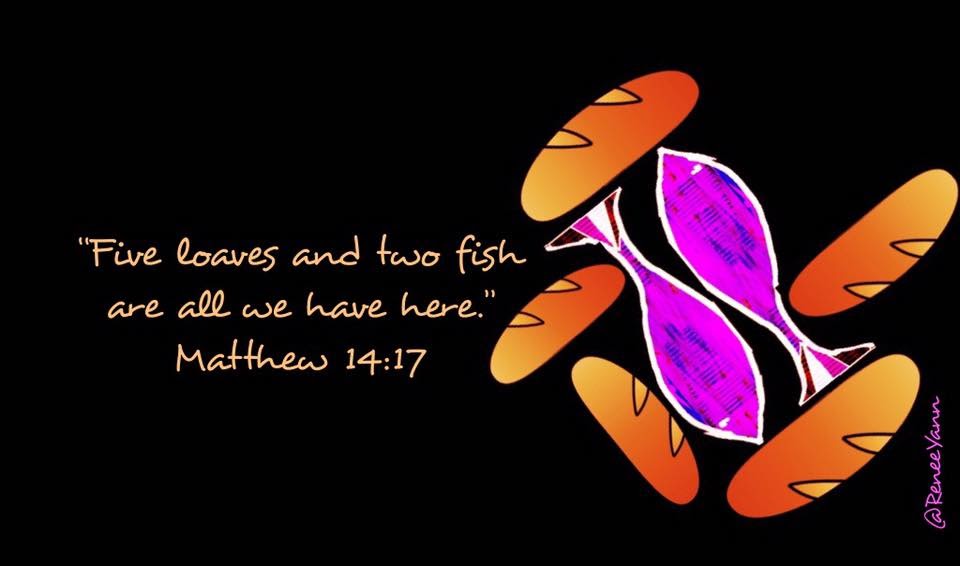
Another favorite passage about Andrew is when he points out to Jesus that, in the hungry crowd, there is a young boy with five loaves and two fish. 

One of the disciples—it was Andrew, brother to Simon Peter—said,
“There’s a little boy here who has five barley loaves and two fish.
But that’s a drop in the bucket for a crowd like this.”
Jesus said, “Make the people sit down.”
There was a nice carpet of green grass in this place.
They sat down, about five thousand of them.
Then Jesus took the bread and, having given thanks,
gave it to those who were seated.
He did the same with the fish.
All ate as much as they wanted.

John 6:8-11

How simple and complete was Andrew’s faith! Those seven little groceries must have seemed so minute among 5000. Can you picture Andrew looking into Jesus’s eyes as if to say, “I know it’s not much but you can do anything!” Maybe it was that one devoted look that prompted Jesus to perform this amazing miracle!


We trust that our deep devotion and faith can move God’s heart too – or, more accurately, can move our hearts to embrace God’s Presence. On this feast of St. Andrew, many people begin a prayer which carries them through to Christmas. Praying it, we ask for particular favors from God.

I love this prayer because it was taught to me by my mother, a woman blessed with simple faith like Andrew’s. As I recite it, I ask to be gifted with the same kind of faith.

( Another reason I love it is this: how often in life do you get a chance to say a word like “vouchsafe“! )

St. Andrew Christmas Novena
Hail and blessed be the hour and moment
in which the Son of God was born of the most pure Virgin Mary,
at midnight, in Bethlehem, in the piercing cold.
In that hour vouchsafe, I beseech Thee, O my God,
to hear my prayer and grant my desires
through the merits of Our Savior Jesus Christ,
and of His blessed Mother. Amen.


As we draw near to the Season of great blessings, we see our world filled with conflict and violence. Let’s fold our Advent prayers around its many wounds.


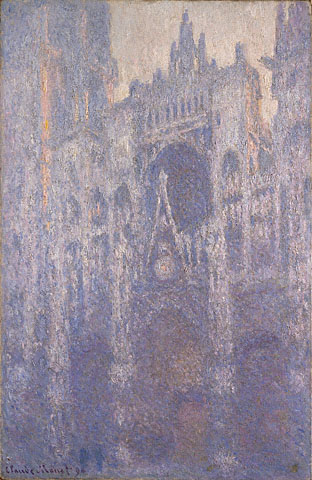
Poetry: Monet Refuses the Operation – Lisel Mueller

How wonderful to allow ourselves to see the world differently – to see it charged with heavenly illuminations and latent miracles!

Rouen Cathedral: Morning Light (1894) – Claude Monet

Doctor, you say there are no haloes
around the streetlights in Paris
and what I see is an aberration
caused by old age, an affliction.
I tell you it has taken me all my life
to arrive at the vision of gas lamps as angels,
to soften and blur and finally banish
the edges you regret I don’t see,
to learn that the line I called the horizon
does not exist and sky and water,
so long apart, are the same state of being.
Fifty-four years before I could see
Rouen cathedral is built
of parallel shafts of sun,
and now you want to restore
my youthful errors: fixed
notions of top and bottom,
the illusion of three-dimensional space,
wisteria separate
from the bridge it covers.
What can I say to convince you
the Houses of Parliament dissolve
night after night to become
the fluid dream of the Thames?
I will not return to a universe
of objects that don’t know each other,
as if islands were not the lost children
of one great continent. The world
is flux, and light becomes what it touches,
becomes water, lilies on water,
above and below water,
becomes lilac and mauve and yellow
and white and cerulean lamps,
small fists passing sunlight
so quickly to one another
that it would take long, streaming hair
inside my brush to catch it.
To paint the speed of light!
Our weighted shapes, these verticals,
burn to mix with air
and change our bones, skin, clothes
to gases. Doctor,
if only you could see
how heaven pulls earth into its arms
and how infinitely the heart expands
to claim this world, blue vapor without end.

Music:  Hear my prayer, O Lord is an eight-part choral anthem by the English composer Henry Purcell (1659–1695). The anthem is a setting of the first verse of Psalm 102 in the version of the Book of Common Prayer. Purcell composed it c. 1682 at the beginning of his tenure as Organist and Master of the Choristers for Westminster Abbey.

Forgeries?

Wednesday of the Thirty-fourth Week in Ordinary Time
November 29. 2023

Today’s Readings:

https://bible.usccb.org/bible/readings/112923.cfm


Today, in God’s Lavish Mercy, we have a fascinating passage from the Book of Daniel, a masterpiece in apocalyptic literature. I enjoyed imagining the scene described by the author in which a magical hand appears to execute “the handwriting on the wall”.

As King Balshazzar and his thousand guests drank sacrilegiously from the sacred Temple chalices, this fabulous thing happened:

Suddenly, opposite the lampstand,
the fingers of a human hand appeared,
writing on the plaster of the wall in the king’s palace.
When the king saw the wrist and hand that wrote, his face blanched;
his thoughts terrified him, his hip joints shook,
and his knees knocked.

Daniel 5:5-6

The image is so wonderful that it has peppered our language and imagination for over two thousand years!

Belshazzar’s Feast – Rembrandt


Morris Bender, an American neuroscientist, offered this clever quip:

A skeptic is a person who, 
when he sees the handwriting on the wall, 
claims it is a forgery.

After a little chuckle, I realized how wise and accurate Bender is. How many times have I not only missed, but actively ignored, the handwriting on the wall! Our minds, hearts, and spirits continually give us signs to direct us in life. How well do we do at discerning these gifts.


The fruit of a deep spiritual life is to become more attentive to the suggestions of grace, and to respond to them with faith and courage. In our Gospel, Jesus makes it clear to his followers that this kind of faithful response will cost them much — possibly even their lives.

Jesus said to the crowd:
“They will seize and persecute you,
they will hand you over to the synagogues and to prisons,
and they will have you led before kings and governors
because of my name.

Luke 21:12

Still, Jesus tells them not to be afraid, that their lives are “secured” by their faith:

You will even be handed over by parents,
brothers, relatives, and friends,
and they will put some of you to death.
You will be hated by all because of my name,
but not a hair on your head will be destroyed.
By your perseverance you will secure your lives.

Luke 21:16-19

The Church uses the apocalyptic stories from Daniel and the dire warnings from Jesus to remind us that we do not live for this world alone. The fullness of eternal life awaits us after the completion of our earthly journey. We have to keep ourselves aware that our life is infinitely larger than it may appear to us in any given moment.

Faith, prayer, and the practice of interior silence can help us to live in that infinite largeness even though we have limited vision of it in this world. The coming days of Advent offer us a dedicated time to renew ourselves in these practices.


Poetry: from Rumi

O love,
O heart,
Find the way to heaven.
Set your sights on a place
Higher than your eyes can see.
For it was the higher aim
That brought you here
In the first place.
Now be silent.
Let the One who creates the words speak.
He made the door.
He made the lock.
He also made the key.
How many men have found tragic ends
Running after beauty?
Why don’t they look for you? -
The heart and spirit of all beauty.

Music: Secrets and Dreams – Fairborn Lachini

Breaking into Newness

Tuesday of the Thirty-fourth Week in Ordinary Time
November 28, 2023

Today’s Readings:

https://bible.usccb.org/bible/readings/112823.cfm


Today, in God’s Lavish Mercy, Daniel interprets a dream in which a statue spontaneously breaks apart, and Jesus warns that the beloved Temple will someday do the same thing. Our scriptures beg the question: how does one find strength to rebuild again?


We don’t like things to break apart that we hadn’t expected to break apart – even stupid things. I had a favorite old plastic mug that I loved to pack with ice and B.O.C. (beverage of choice) as I headed to the beach on a hot summer day. It was about a thousand years old but part of its famed origin was still visible on the faded side:

For some inexplicable reason, one morning I decided to pour my hot tea into that irreplaceable mug. It basically melted into itself like the wicked witch in the Wizard of Oz. It wasn’t a tragedy tantamount to Daniel’s dream or the Temple collapsing, but I’ll tell you, I have NEVER since had a matching drink on the beach!


My treasured mug disintegrated because I used it for the wrong purpose. And that is also the point of both our readings. Daniel describes how the ensuing generations, who misuse their power, will disappear one after the other until God establishes the permanent reign of justice:

… the kingdom shall be partly strong and partly fragile.
The iron mixed with clay tile
means that they shall seal their alliances by intermarriage,
but they shall not stay united, any more than iron mixes with clay.
In the lifetime of those kings
the God of heaven will set up a kingdom
that shall never be destroyed or delivered up to another people;
rather, it shall break in pieces all these kingdoms
and put an end to them, and it shall stand forever.

Daniel 2:42-44

Jesus describes the same dynamic in relationship to the Temple because its use has been diverted into material show and adornment rather than worship and the works of justice:

While some people were speaking about
how the temple was adorned with costly stones and votive offerings,
Jesus said, “All that you see here–
the days will come when there will not be left
a stone upon another stone that will not be thrown down.”

Luke 21:5

But, here’s the thing about God’s action to break up in our lives that which is no longer life-giving — the breakup will always yield new life if we can open our hearts to its grace.

As we look back over 2023, we may see a lot of disassembled pieces scattered across the landscape. Maybe some of the plans we had never flew, or maybe the string broke on some of the kites we’d been flying for years! There may have been small losses that seemed monumental at the time, or truly monumental losses whose significance has only deepened.

Wherever we stand amid our dreams and our temples, we can be sure of this as 2024 approaches: grace is always with us, renewing us in the ever clearer image of God.


This final week before Advent is a great time to take inventory of our spiritual lives. What needs to go and what needs to be strengthened? Most likely, we already know the answers. Now let’s gather the courage and focus to do what grace suggests.


Poem: Beginners – Denise Levertov

Levertov writes about hope, courage, justice, and mercy. The poem begins with a stanza from The Garden of Proserpine by Algernon Charles Swinburne, introduced by a dedication to activists Karen Silkwood and Eliot Gralia.

𝘋𝘦𝘥𝘪𝘤𝘢𝘵𝘦𝘥 𝘵𝘰 𝘵𝘩𝘦 𝘮𝘦𝘮𝘰𝘳𝘺 𝘰𝘧 𝘒𝘢𝘳𝘦𝘯 𝘚𝘪𝘭𝘬𝘸𝘰𝘰𝘥 𝘢𝘯𝘥 𝘌𝘭𝘪𝘰𝘵 𝘎𝘳𝘢𝘭𝘭𝘢

“From too much love of living,
Hope and desire set free,
Even the weariest river
Winds somewhere to the sea—“
– – – – – – –

But we have only begun
To love the earth.

We have only begun
To imagine the fullness of life.

How could we tire of hope?
— so much is in bud.

How can desire fail?
— we have only begun

to imagine justice and mercy,
only begun to envision

how it might be
to live as siblings with beast and flower,
not as oppressors.

Surely our river
cannot already be hastening
into the sea of nonbeing?

Surely it cannot
drag, in the silt,
all that is innocent?

Not yet, not yet—
there is too much broken
that must be mended,

too much hurt we have done to each other
that cannot yet be forgiven.

We have only begun to know
the power that is in us if we would join
our solitudes in the communion of struggle.

So much is unfolding that must
complete its gesture,

so much is in bud.

Music: Sacred River – Gandalf
As you experience this beautiful video, allow your spirit to remember the challenges and blessings of this past year that have brought you to this place with God, ready for a new beginning and a deeper love.