… the Time Will Come

Monday of the Thirty-fourth Week in Ordinary Time
November 27, 2023

Today’s Readings:

https://bible.usccb.org/bible/readings/112723.cfm


Today, in God’s Lavish Mercy, we begin a series of readings from the Book of Daniel. It is the only time throughout the Liturgical Year that we get a good dose of Daniel. And it is well placed, coming in this final week before Advent.

Daniel is apocalyptic literature, a genre that conveys the author’s perception of the end times through dreams, visions, and prophecies. Like many of our readings of the past weeks, Daniel focuses us on God’s Final Coming into time by interpreting current circumstances in a spiritual light.


Today’s Gospel also focuses us on our “end times”, but in a little different way from Daniel. 

Jesus tells the story of the poor widow who gave everything she had for the sake of the poor. This widow, in a sense, already lives in the “end times”, a time when our only “possessions” will be the good we have done in our lives.

Jesus said, “I tell you truly,
this poor widow put in more than all the rest;
for those others have all made offerings from their surplus wealth,
but she, from her poverty, has offered her whole livelihood.”

Luke 21:3-4

Both these readings orient us to reflect on our lives and times as we approach Advent. This sacred season is the annual reenactment of Christ’s First Coming in order to prepare us for:

  • Christ’s daily revelation in our lives
  • Christ’s Final Coming at the end of time
Mt24_awake

All of Daniel’s complex visions and prophecies can feel a little confusing, but we can focus on this:

  • God is continually revealing the Face of the Trinity in the ordinary circumstances of time.
  • We can open ourselves to this revelation by our humble prayer and good works.
  • Staying awake like this in our hearts and souls will allow us to pass seamlessly into God’s Presence when the end times come.

Poetry: Psalm 96 – Isaac Watts (1674-1748)

Christ's first and second coming.
Sing to the Lord, ye distant lands,
Ye tribes of every tongue;
His new-discovered grace demands
A new and nobler song.
Say to the nations, Jesus reigns,
God's own almighty Son;
His power the sinking world sustains,
And grace surrounds his throne.
Let heav'n proclaim the joyful day,
Joy through the earth be seen;
Let cities shine in bright array,
And fields in cheerful green.
Let an unusual joy surprise
The islands of the sea:
Ye mountains, sink; ye valleys, rise;
Prepare the Lord his way.
Behold, he comes, he comes to bless
The nations as their God;
To show the world his righteousness,
And send his truth abroad.
But when his voice shall raise the dead,
And bid the world draw near,
How will the guilty nations dread
To see their Judge appear!

Music: Be Thou My Vision

Cradled in Mercy’s Arms

The Solemnity of Our Lord Jesus Christ, King of the Universe
November 26, 2023

Today’s Readings:

https://bible.usccb.org/bible/readings/112623.cfm


Today, in God’s Lavish Mercy, on this feast of Christ the King, we might expect our readings to be filled with triumphal metaphors for God – conquerer, ruler, omnipotent and, yes, distant from us.

Instead, today’s passages offer us images of God as a devoted, simple, and caring shepherd – the tenderest of roles in our natural world.

Thus says the Lord GOD:
I myself will look after and tend my sheep.
As a shepherd tends his flock
when he finds himself among his scattered sheep,
so will I tend my sheep.
I will rescue them from every place where they were scattered
when it was cloudy and dark.


What an unexpected “King” this is! Rather than groveling before his majesty, we are lifted shivering to his warm shoulders. We are rescued from our cloudy shadows and raised into his light.


In Corinthians, Paul instructs us that Christ is King for one reason: he has conquered death. Death is the darkest of shadows from which we long to be rescued – both the small deaths of loss, bereavement, failure, addiction, illness, depression – and the inevitable ending of the life we cherish in ourselves and others. Christ, the kingly shepherd, finds us even when we are lost and confused in fears such as these.


In our Gospel, Jesus says that he will easily find us in our shadows because we are already marked by a certain light – our acts of mercy toward his least ones:

‘Lord, when did we see you hungry and feed you,
or thirsty and give you drink? 
When did we see you a stranger and welcome you,
or naked and clothe you? 
When did we see you ill or in prison, and visit you?’
And the king will say to them in reply,
‘Amen, I say to you, whatever you did
for one of the least brothers of mine, you did for me.’


For our prayer today, we might just ask the kingly shepherd to lift us close to the Divine Heart, to hum Mercy over us in a healing lullaby, so that we might return it freely to our wounded world.


Prayer: Our beautiful Responsorial Psalm will be our poetry for today.

The LORD is my shepherd; I shall not want.
In verdant pastures I rest.
Beside restful waters God leads me;
refreshing my soul.
guiding me in right paths
in the safety of God's Name.
You spread the table before me
in the sight of my foes;
you anoint my head with oil;
my cup overflows.
Only goodness and kindness follow me
all the days of my life;
and I shall dwell in the house of the LORD
for years to come.

Music: Shepherd Me, O God – Marty Haugen

Heavenly Peace

Saturday of the Thirty-third Week in Ordinary Time
November 25, 2023

Today’s Readings:

https://bible.usccb.org/bible/readings/112523.cfm


Lk20_36 eternal life

Today, in God’s Lavish Mercy, Maccabees gives us a colorful account of the defeat, dismay, and ultimate death of Antiochus IV, persecutor of the Jews. The account, like most of the Books of Maccabees, is primarily historical, not spiritual or theological. But threaded through the books, of course, is the underlying biblical orientation that God-Yahweh is present and active in all life’s circumstances.

Today’s passage has even pagan Antiochus considering how God/Fate has brought him to judgement- to “payback” time:

But I now recall the evils I did in Jerusalem,
when I carried away all the vessels of gold and silver
that were in it, and for no cause
gave orders that the inhabitants of Judah be destroyed.
I know that this is why these evils have overtaken me;
and now I am dying, in bitter grief, in a foreign land.

1 Maccabees 6:12-13

Our Gospel describes an incident in which some Sadducees question Jesus about marriage laws and the afterlife. Their questioning reminds me of modern songwriter Eric Clapton’s musings in his song:

Tears in Heaven – Eric Clapton

Jesus doesn’t sing to the Sadducees, as far as I know. Rather, he answers them this way:

Those who are deemed worthy to attain to the coming age
and to the resurrection of the dead
neither marry nor are given in marriage.
They can no longer die,
for they are like angels;
and they are the children of God
because they are the ones who will rise.

Luke 20:35-36

So for us today, the questions and concerns of both Antiochus and the Sadducees might lead us to consider how we feel about the “afterlife”.

Do you ever wonder what heaven will be like? Will we see our beloveds once again? Will we see our “unbeloveds” too and what will that be like!! Do you calculate whether or not you’ll even make the cut through the Pearly Gates?

When I think about heaven these two promises of Jesus sustain, comfort and animate me. Maybe you’ll consider their power too as you pray today.

I have come that you may have life,
and have it to the full.
John 10:10


Eternal life is this, that they know you,
the only true God,
and Jesus Christ, whom you have sent.
John 17:3


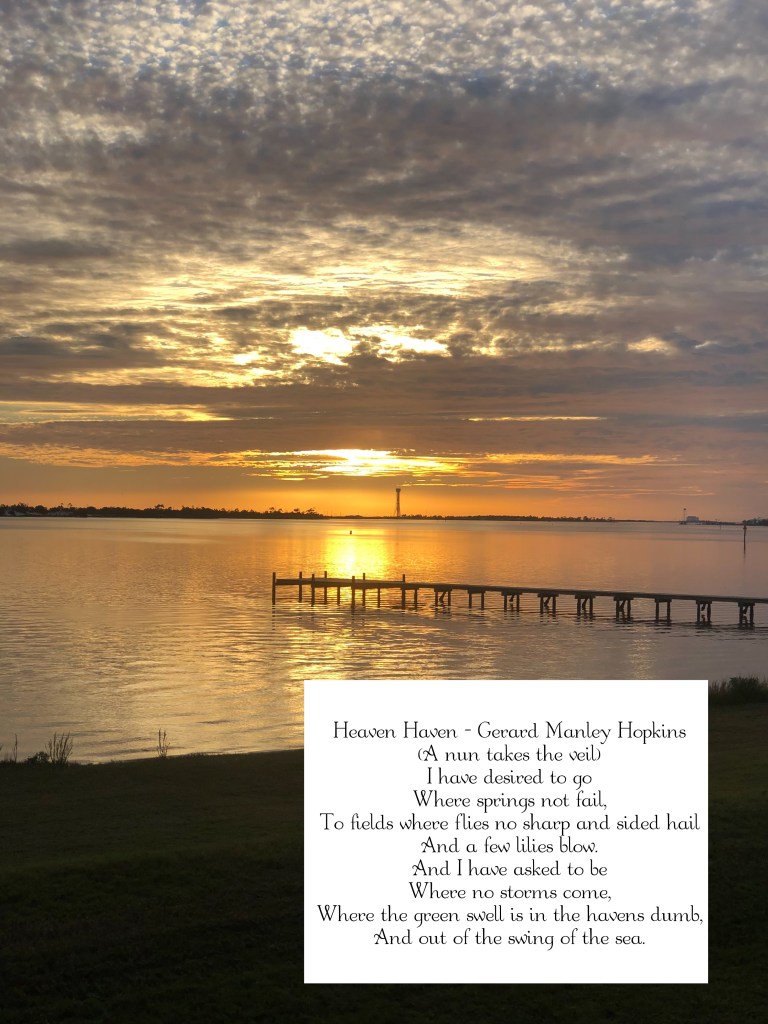
Poetry: Heaven Haven – Gerard Manley Hopkins

In this poem, Hopkins expresses his longing for a heavenly peace similar to that of a contemplative nun.

(A nun takes the veil)
I have desired to go
Where springs not fail,
To fields where flies no sharp and sided hail
And a few lilies blow.
And I have asked to be
Where no storms come,
Where the green swell is in the havens dumb,
And out of the swing of the sea.

Music: That You May Have Life – André Crouch
(Lyrics below)

(I come that you might have life more abundantly)
(I come that you might have life through eternity)
I didn’t come to condemn the world
nor to shame you for your wrong no no
but I came to mend your broken heart and give your heart a song
(I come to give you life more abundantly – more abundantly)
Your life without Christ
is like a star that will never never shine
It’s like a winding road that goes nowhere
Woah but Jesus said (I come) I come (to give you life) to give you life (more)
(I come) I come (to give you joy) to give you joy
(I come to give you life more abundantly ee ee ee ee more abundantly)
but Jesus said (I come to give you life more) oh I left my home in glory
(I come) I come (to give you joy) just to bring you joy
(I come) I love you I love you (to give you life) and I want to give you life
(more abundantly) more abundantly
Mmmm (ee ee ee ee) more abundantly (more abundantly)
People all over the world (all I want to do is give you life)
listen to the LORD speaking right now
(more abundantly ooh ooh ooh ooh) people all over the world
(all I want to do is give you joy more abundantly ooh ooh ooh ooh)
(all I want to do is give you life . . 

You are a Temple

Memorial of Saint Andrew Dung-Lac, Priest, and Companions, Martyrs
Friday of the Thirty-third Week in Ordinary Time
November 24, 2023

Today’s Readings:

https://bible.usccb.org/bible/readings/112423.cfm


Today, in God’s Lavish Mercy, both readings are set in the Temple. After the victory of Judas Maccabeus, the Jewish people restore their Temple with exuberant celebration, recognizing it as a symbol of God’s Presence among them. This is the origin of the celebration of Hanukkah, a word that means “dedication”.

For eight days they celebrated the dedication of the altar
and joyfully offered burnt offerings and sacrifices
of deliverance and praise.
They ornamented the facade of the temple with gold crowns and shields;
they repaired the gates and the priests’ chambers
and furnished them with doors.
There was great joy among the people
now that the disgrace of the Gentiles was removed.
Then Judas and his brothers and the entire congregation of Israel
decreed that the days of the dedication of the altar
should be observed with joy and gladness
on the anniversary every year for eight days,
from the twenty-fifth day of the month Chislev.

1 Maccabees 4: 56-59

In today’s Gospel. Jesus also “restores” the Temple by driving out the merchants who have diverted the Temple’s purpose as representative of God’s Presence.

Jesus entered the temple area and proceeded to drive out
those who were selling things, saying to them,
“It is written, My house shall be a house of prayer,
but you have made it a den of thieves.”

Luke 19:45-46

Our bodies too are temples of the Holy Spirit.
Paul, in his letter to the Corinthians tells us:

Do you not know
that your bodies are temples of the Holy Spirit,
who is in you, whom you have received from God?
You are not your own; you were bought at a price.

1 Corinthians 6:19-20

Through our Baptism into the Passion, Death and Resurrection of Christ, the Holy Spirit dwells in us. We are called to be transformed by this Indwelling. As in any relationship, this transformation is accomplished through transparency, communication, listening and acting on behalf of the Beloved.


Poetry: Heart Cave by Geoffrey Brown – a deeply spiritual poet, Brown offers us this imaginative image of waiting for, and welcoming, the transformative Presence of God in our lives:

I must remember to go down to the heart cave
And sweep it clean, make it warm, with fire on the hearth
And candles in their niches
The pictures on the walls glowing with quiet lights
I must remember to go down to the heart cave
And make the bed with the quilt from home
Strew rushes on the floor
And hang lavender and sage from the corners
I must remember to go down to the heart cave
And be there when you come.

Music:  J. S. Bach – Arioso from Cantata 156 – Susanne Beer on cello

If you have a little extra leisure on this Friday after Thanksgiving, you may enjoy the entire Cantata performed beautifully here by the Choir and Orchestra of the J. S. Bach Foundation

Blessed and Grateful

Thanksgiving Day
November 23, 2023

Today’s Readings:

https://bible.usccb.org/bible/readings/112323-thankgiving.cfm


And now, bless the God of all,
who has done wondrous things on earth;
Who nurtures us from our mother’s womb,
and fashions us in Lavish Mercy.
May God grant you joy of heart
and may peace abide among you;
May God’s goodness toward us endure
to deliver us to holy joy.

Sirach 50: 22-24

You’re Welcome

Bill was a big Midwestern guy with the boots and belt buckles to prove it. His wife of thirty years was a patient in our East Coast cancer wing. Hearing of a breakthrough experimental treatment, they had come seeking a cure despite every indication of its hopelessness.

Being away from home, Bill had a lot of empty time outside of visiting hours. He spent much of it observing things that would ordinarily go unnoticed in the bustle of his regular life: weather, nature and human idiosyncrasies.

During one cafeteria lunch, over a bowl of hot soup, he observed, “People around here don’t say ‘You’re welcome’. They hold a door. You say ‘Thank you’. They just say ‘Uh huh'”. Bill didn’t like that. It made him feel invisible. He said it was like one hand clapping.


In this season of Thanksgiving, it’s something to consider. Thanks are not offered in a vacuum. They are given to benefactors, both human and Divine, on whom we depend for a reciprocity of love, companionship, care and courage. Bill, at such a vulnerable, lonely place in his life, was infinitely sensitive when his thanks received no answer.


During this special time, we may hear a “Thank You” offered to us. In this cold age of our digital distractions, can we receive it consciously? Can we return it with a mutuality of gratitude that says, “You’re welcome! You are welcome in the embrace of my life. I see you as a unique and precious life and I rejoice at any kindness I can give you.”? A simple, sincere smile can say all that. Such is the power of our conscious spirits!

Doing this, we might even hear the Creator’s whisper, saying the same thing to us as we offer our Thanksgiving prayers: “I have created you from an abundance of love. You are precious to me and I believe in you. I hear your “Thank You” and you are welcome in the embrace of my infinite love.”


I pray for a blessed and happy Thanksgiving for all of you, dear readers, and for your loved ones. Thank you sincerely for all your kindness to me and your encouragement for Lavish Mercy. May our dear and precious God fill your hearts with peace and joy.


Prayer: Blessing for the Fullness of This Day – by Pierre Pradervand

I bless this day for the good it already contains,
in the many occasions it offers to listen deeply,
to be of service to others,
to express gratitude moment by moment
and to keep my mind so filled with love, beauty and joy.
I bless this day in the infinite opportunities it gives me to love:
to love and bless each person I meet,
every animal or bird I see,
every plant I behold,
for all are expressions of the infinite Life that breathes in all of us.
Truly, I bless this day for the wonderful awareness it can bring
As I walk through it with the eyes of wonder and appreciation.
Thank you, God, for loving me
And for giving me the gift of this day.

Music: Thankful by Josh Groban

Trust not Fear

Memorial of Saint Cecilia, Virgin and Martyr
Wednesday of the Thirty-third Week in Ordinary Time
November 22, 2023

Today’s Readings:

https://bible.usccb.org/bible/readings/112223.cfm


Today, in God’s Lavish Mercy, our two readings are dramatically intense. 

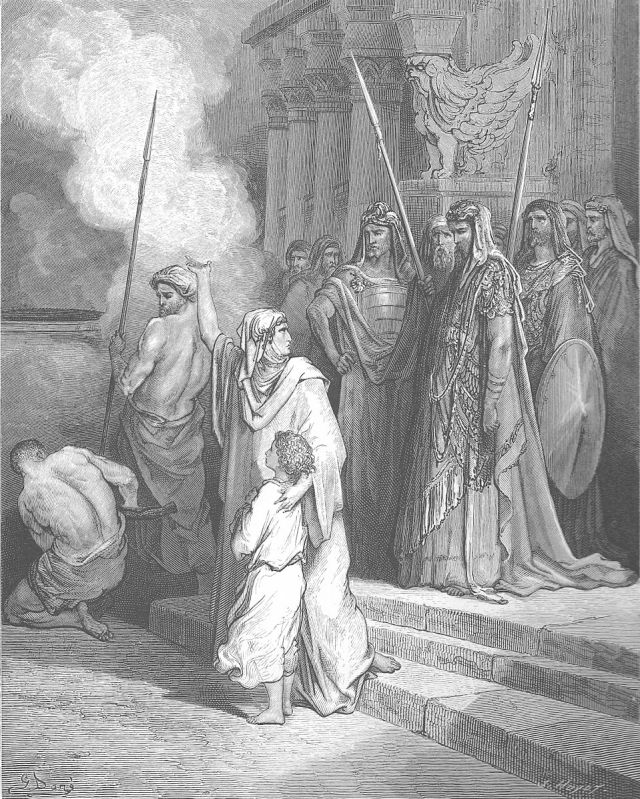
Who can read the story of the Maccabean Martyrs without a mix of horror, empathy, and astonishment?

It happened that seven brothers with their mother were arrested
and tortured with whips and scourges by the king,
to force them to eat pork in violation of God’s law.
Most admirable and worthy of everlasting remembrance was the mother,
who saw her seven sons perish in a single day,
yet bore it courageously because of her hope in the Lord.

2 Maccabees 7: 1;20

And don’t we all feel a pang of pity for the poor, fearful servant who hid his talent in a handkerchief much to the King’s displeasure?

‘Sir, here is your gold coin;
I kept it stored away in a handkerchief,
for I was afraid of you, because you are a demanding man;
you take up what you did not lay down
and you harvest what you did not plant.’
He said to him,
‘With your own words I shall condemn you,
you wicked servant.
You knew I was a demanding man,
taking up what I did not lay down
and harvesting what I did not plant;
why did you not put my money in a bank?

Luke 19:20-23

The two stories paint a contrasting picture of courageous faith against fearful subservience. The difference between the actors lies in their capacity, or lack thereof, to look beyond themselves toward eternal life.

The Courage of a Mother – Gustave Doré

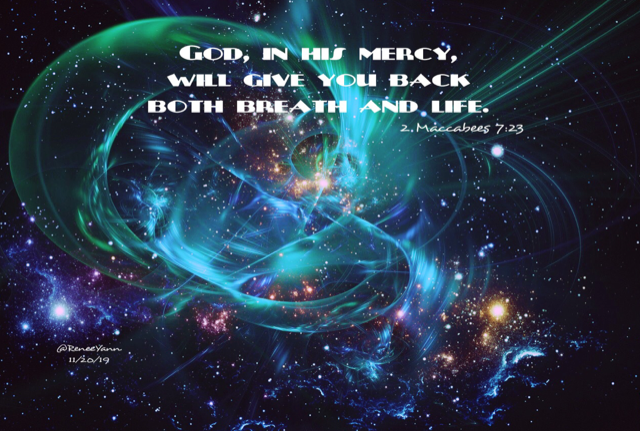
Mother Maccabee bolsters her sons with her faith in a life beyond their current circumstances:

… the Creator of the universe
who shapes each man’s beginning,
as he brings about the origin of everything,
he, in his mercy,
will give you back both breath and life,
because you now disregard yourselves
for the sake of his law.


The poor soul in Jesus’s parable doesn’t have that faith and vision. His perception of God, represented by the King, is one of only harsh judgment. His fear causes him to bury not only his talent, but also his openness to the possibilities of grace and transformed relationship with God.


Jesus told his parable because indeed the Kingdom was at hand. He and his disciples were near Jerusalem where the Passion, Death and Resurrection events would begin.

He wants his followers to realize the challenging gift they have been given in their call to be his disciples. He wants them to see that it is now on them to magnify his message courageously and generously until he returns to perfect the Kingdom.

He wants us to understand that too.


Poetry – John Milton, Sonnet 19

Milton (1608- 1674) is widely considered one of the preeminent writers of the English language. By 1652, Milton had become totally blind and had to dictate his verse. He appears to wonder, in this sonnet, how his God-given talent for writing will be enhanced now that he is “light denied”. He looks to another parable for his answer – the Parable of the Workers. Even those who only stood and waited were rewarded.

When I consider how my light is spent,
Ere half my days, in this dark world and wide,
And that one Talent which is death to hide
Lodged with me useless, though my Soul more bent
To serve therewith my Maker, and present
My true account, lest he returning chide;
“Doth God exact day-labor, light denied?”
I fondly ask. But patience, to prevent
That murmur, soon replies, “God doth not need
Either man’s work or his own gifts; who best
Bear his mild yoke, they serve him best. His state
Is Kingly. Thousands at his bidding speed
And post o’er Land and Ocean without rest:
They also serve who only stand and wait.”

Music:   Be Not Afraid – written by Bob Dufford, SJ, sung here by Cat Jahnke

Stretching for God

Memorial of the Presentation of the Blessed Virgin Mary
Tuesday of the Thirty-third Week in Ordinary Time
November 21, 2023

Today’s Readings:

https://bible.usccb.org/bible/readings/112123.cfm


Today, in God’s Lavish Mercy, our readings are about living in the big picture of God’s vision for us.

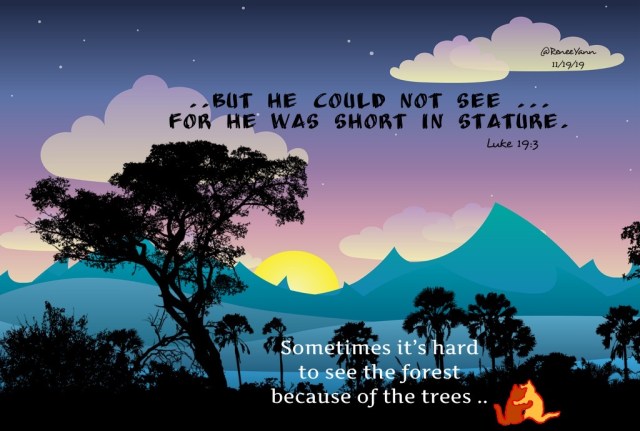
Lk19_3 forest_trees

Once again, we meet Zacchaeus who, due to his short stature, was unable to get a glimpse of Jesus walking nearby. He wasn’t getting the whole picture but he wanted to!

Zacchaeus ran ahead and climbed a sycamore tree in order to see Jesus,
who was about to pass that way.
When he reached the place, Jesus looked up and said,
“Zacchaeus, come down quickly,
for today I must stay at your house.”
And he came down quickly and received him with joy.

Luke 19:4-5

Sometimes we miss Christ in our midst, don’t we? It may be because we’re “short” on time, patience, faith, attention, courage, peace, desire … you name it.

Zacchaeus may have been physically short, but he was tall in will and intention to see Jesus. The trees became his tools, not his obstacles.


In our first reading, Eleazar was a giant in the virtues necessary to “see beyond the trees” of his current circumstances. A more spiritually short-sighted person might have succumbed to the temptation to save himself at the cost of his faith and witness.

But Eleazar’s faith was long, both in years and in depth. He kept the eyes of his heart focused on that faith and was delivered beyond any short-sighted choices.

Eleazar made up his mind in a noble manner,
worthy of his years, the dignity of his advanced age,
the merited distinction of his gray hair,
and of the admirable life he had lived from childhood;
and so he declared that above all
he would be loyal to the holy laws given by God.

2 Maccabees 6:23

It’s hard sometimes to see the forest beyond the trees – to direct our choices, attitudes, and actions by a vision we glimpse only in the stretch of faith and prayer.

Perhaps these two God-seekers can inspire us today by their courage, steadfastness and faith to always live within God’s long eternal vision for us.


Zaccheus – by Richard Medrington

I hope you enjoy this clever poem as much as I did.

Here’s a man we all despise,
Damn his hide and damn his eyes.
Pray that God will some day free us,
From that loathsome leech Zacchaeus.
See him sitting at his table,
Takes as much tax as he’s able,
Stashes some away for later,
Dirty, double-dealing traitor.
Lord of liars, chief of crooks,
Look at how he cooks the books!
Renders what is ours to Caesar,
Cheating, money-grubbing geezer.
He’s the man we love to hate,
Vulgar, vapid reprobate,
Lounging in his lavish house,
Cringing toady, thieving louse.
Wonder how he got so rich?
Greedy, filching, little snitch.
We would lynch the poison gnome,
Were he not employed by Rome.
Then when Jesus comes to town,
See his smile turn to a frown!
Though he’s arrogant and proud,
He cannot see above the crowd.
How we laugh to see him squirm,
Nasty, creeping, crawling worm,
But here’s a thing not seen before:
A sell-out in a sycamore!
Now he’s shouting from the tree,
“Jesus, Jesus look at me!”
Hope he falls, the tiresome tyke,
Falls and lands upon a spike.
Careful Jesus. Don’t be conned,
Just ignore him, don’t respond.
Move on quickly, if you linger
He will twist you round his finger.
Then a voice rings loud and clear,
“Zack mate, get yourself down here!
I spy you in that sycamore,
And you’re the man I’m looking for.”
Now he’s off to have his dinner
With a man who is a sinner
And a traitor to our nation!
He’s gone down in our estimation.
Fraternising with our foe,
Of all the places he could go!
Who would think a man like that
Would take his meals with such a rat?
I beg your pardon, did you say
Zach’s giving half his wealth away?
Dispensing money to the poor?
This too has not been seen before.
And if he’s asked for too much tax
He’s giving fourfold rebates back?
Well, that’s amazing! If it’s true,
There’s going to be a massive queue.
I’m not that easy to deceive.
When I see it, I’ll believe.
He’ll fleece us when the Master’s gone,
It’s just another taxman’s con.
But Jesus says, “It is no scam,
He is a son of Abraham.
Salvation landed here today,
I seek for those who’ve gone astray,
And even though you think it strange,
Occasionally people change,
So do not look at him askance
But give the man a second chance.”
Of course at first this all seemed grand,
The thought of all that cash in hand!
But very soon we came to see
That nothing in this world is free.
In righteous wrath we had estranged him,
Then someone came along and changed him!
Thank you, Jesus. Smashing! Great!
Now there’s no one left to hate!
Since Zach is generous and kind
We’ve nothing left to hide behind.
He radiates with joy and thus
His kindly light exposes us.
His very presence seems to say,
“My life has changed from night to day.
Now tell me what is stopping you
From changing things in your life too?”
So here’s the source of our complaints:
Zacchaeus made us feel like saints,
But now we must admit it’s true
That we are rotten sinners too.
We pray that God will soon restore
Zacchaeus as he was before,
Or Jericho shall rue the day
That Jesus chose to pass this way.

Music: Zacchaeus – An oldie but goodie from Sister Miriam Therese Winter and the Medical Mission Sisters

Endurance

Monday of the Thirty-third Week in Ordinary Time
November 20, 2023

Today’s Readings:

https://bible.usccb.org/bible/readings/112023.cfm


Today, in God’s Lavish Mercy, we enter the liturgical year’s final two weeks. Our companions from the Hebrew Scriptures will be the Maccabees and Daniel. Our New Testament companion will continue to be the eloquent Luke.


The singular virtue proclaimed through the Books of Maccabees and Daniel is this: FAITHFUL ENDURANCE. As we approach the “end times” of our Liturgical Year, the Church is reminding us to pursue and value this virtue in our own lives.

Anthiochos – Michel Francois DandrE Bardon
(Anthiochos IV Epiphanes Orders the Massacre of the Maccabees)

In today’s passage from Maccabees, we read about King Antiochus Epiphanes’s sacrilegious enculturation of the Israelites in an attempt to gain civil appeasement and material prosperity. Antiochus was a mean and bad guy. Likely because he felt his power threatened by them, he tried – in the vilest of ways – to suppress the Jews and their religious culture. The Book of Maccabees is the story of Jews who stood up to the suppression.


In our Gospel, Jesus meets a blind person who pleads with him, “Lord, please let me see!”. Jesus restores the person’s vision with the assurance that faith has wrought the miracle. In other words, the blind person already “saw” in a deeper way because of faith. That faith offered the insight to engage Jesus’s Divine Power for complete healing.


Because of their profound faith, the Maccabees could see through the king’s faithless campaign. They could endure ruthless persecution to remain faithful to the God they believed in.

Few of us will meet the kind of physical persecution for the faith endured by the Maccabees. But throughout our lives, our fidelity will be ruthlessly tested by our culture. We will continually be tempted to compromise our faithful practice for the sake of convenience, appeasement, material prosperity, or advantage over others.


And so often we are blind to these enculturations. We become insensitive or indifferent to the injustices and fallacies of our culture and how they might be affecting our attitudes, choices, and behavior.

As we journey with the Maccabees, Daniel, and Luke over these two weeks, let’s pray for clear vision and courageous action around the profound sacrileges of our times: war, violence, irreverence for life, exaltation of gun culture, economic domination, immigration injustice, and the many systemic “isms” by which we marginalize our sisters and brothers.


Prayer: Our Responsorial Psalm today offers a powerful plea to be delivered from the culture of death so predominant in our world:

R. Give me life, O Lord, and I will do your commands.
Indignation seizes me because of the wicked
who forsake your law.
R. Give me life, O Lord, and I will do your commands.
Though the snares of the wicked are twined about me,
your law I have not forgotten.
R. Give me life, O Lord, and I will do your commands.
Redeem me from the oppression about me,
that I may keep your precepts.
R. Give me life, O Lord, and I will do your commands.
I am attacked by malicious persecutors
who are far from your law.
R. Give me life, O Lord, and I will do your commands.
Far from sinners is salvation,
because they seek not your statutes.
R. Give me life, O Lord, and I will do your commands.
I beheld the apostates with loathing,
because they kept not to your promise.
R. Give me life, O Lord, and I will do your commands.


Music: For What It’s Worth – Buffalo Springfield

Well Done!

Thirty-third Sunday in Ordinary Time
November 19, 2023

Today’s Readings:

https://bible.usccb.org/bible/readings/111923.cfm


Today, in God’s Lavish Mercy, we have reached the next-to-last Sunday of Liturgical Year 2023. It’s a time when the Church asks us to step back from our lives and take a good look at them – much in the way we would look at a painting or building project we have almost finished.


When a couple of us moved into a new apartment over thirty years ago, I was still pretty nimble and handy with home improvement projects. I decided to fit out an old closet space with new shelving. The project went really well until near the end when I stepped back and realized that the top shelf was too high for anybody to reach but six-foot me. The “aha moment” called for a lot of reassessment and redesign.


With today’s readings, we are encouraged to step back and take a look at our lives from the perspective of the end times. Have we done our best to make the pieces of our lives fit with God’s design? Are there elements we need to remove or re-order to come into alignment with God’s hope for us?


Kudos to the “worthy wife” from Proverbs! She seems to have gotten it right. Her “worthiness” is rooted in these virtues: goodness, hard work, care for those who are poor, natural sincerity, and reverence for God.

Charm is deceptive and beauty fleeting;
the woman who fears the LORD is to be praised.
Give her a reward for her labors,
and let her works praise her at the city gates.

Proverbs 31:30-31


Paul’s Thessalonian community seems in good shape too. Paul says that they already are awake and well aware of the coming end times:

But you, brothers and sisters, are not in darkness,
for that day to overtake you like a thief.
For all of you are children of the light
and children of the day.
We are not of the night or of darkness.
Therefore, let us not sleep as the rest do,
but let us stay alert and sober.

1 Thessalonians 5:4-6

Jesus tells the story of a few stewards, some who used their talents well and some who didn’t. He’s alerting us that we too have been given immeasurable gifts against which we will be measured at the end of our earthly lives.

This next-to-last Sunday poses some questions for us:

  • Did we bury our talents in selfishness looking to advantage only ourselves?
  • Or did we “reach out” like the worthy wife?
  • Did we live in light like the Thessalonians?
  • Like the good servant, did we double our graces by using them generously among our sisters and brothers?

Prose: from C.S. Lewis – The Weight of Glory – I will leave the bulk of your time today to this wonderful passage from Lewis, taken from a sermon preached originally in the Church of St. Mary the Virgin, Oxford, on June 8, 1942.


When I began to look into this matter I was shocked to find such different Christians as Milton, Johnson and Thomas Aquinas taking heavenly glory quite frankly in the sense of fame or good report. But not fame conferred by our fellow creatures—fame with God, approval or (I might say) “appreciation’ by God. And then, when I had thought it over, I saw that this view was scriptural; nothing can eliminate from the parable the divine accolade, “Well done, thou good and faithful servant.” 

With that, a good deal of what I had been thinking all my life fell down like a house of cards. I suddenly remembered that no one can enter heaven except as a child; and nothing is so obvious in a child—not in a conceited child, but in a good child—as its great and undisguised pleasure in being praised. Not only in a child, either, but even in a dog or a horse. 

Apparently what I had mistaken for humility had, all these years. prevented me from understanding what is in fact the humblest, the most childlike, the most creaturely of pleasures— nay, the specific pleasure of the inferior: the pleasure a beast before men, a child before its father, a pupil before his teacher, a creature before its Creator. 

I am not forgetting how horribly this most innocent desire is parodied in our human ambitions, or how very quickly, in my own experience, the lawful pleasure of praise from those whom it was my duty to please turns into the deadly poison of self-admiration. But I thought I could detect a moment—a very, very short moment—before this happened, during which the satisfaction of having pleased those whom I rightly loved and rightly feared was pure. 

And that is enough to raise our thoughts to what may happen when the redeemed soul, beyond all hope and nearly beyond belief, learns at last that she has pleased Him whom she was created to please. There will be no room for vanity then. She will be free from the miserable illusion that it is her doing. With no taint of what we should now call self-approval she will most innocently rejoice in the thing that God has made her to be, and the moment which heals her old inferiority complex for ever will also drown her pride deeper than Prospero’s book. Perfect humility dispenses with modesty. If God is satisfied with the work, the work may be satisfied with itself; “it is not for her to bandy compliments with her Sovereign.” 

I can imagine someone saying that he dislikes my idea of heaven as a place where we are patted on the back. But proud misunderstanding is behind that dislike. In the end that Face which is the delight or the terror of the universe must be turned upon each of us either with one expression or with the other, either conferring glory inexpressible or inflicting shame that can never be cured or disguised.

Music: Benedictus – Karl Jenkins

The Midnights of Our Lives

Saturday of the Thirty-second Week in Ordinary Time
November 18, 2023

Today’s Readings:

https://bible.usccb.org/bible/readings/111823.cfm


Today, in God’s Lavish Mercy, we are blessed with some of the most beautiful passages in scripture.

Psalm 105 invites us to sing praise as we confidently seek God in our lives, and to always remember God’s merciful goodness to us:

Sing to God, sing praise,
    proclaim all God’s wondrous deeds.
Glory in the holy name;
    rejoice, O hearts that seek the LORD!
Remember the marvels the Lord has done!

Psalm 105: 2-3

Our first reading from Wisdom gives us one of the most gloriously imaginative images in Scripture.

Although the passage is a poetic recounting of the Exodus experience, it always makes me think of Christmas. 

  • Midnight on a starry night
  • Peaceful stillness over the earth
  • The all-powerful Word transformed 
  • Appearing among us like a comet in our darkness
  • Hope renewed for an otherwise doomed land

Praying with the passage this morning, I realize that my “Christmas lens” on the reading is right on target.

The Christmas event begins our Exodus story, a story completed in the Passion, Death and Resurrection of Christ.

Just as the God of Moses reached into ancient Israel’s life to free them, transform them and make them God’s People, so God reaches into our lives. God does this not only on Christmas, but in every moment of our experience.


As our media and consumer culture bombards us, all too early, with all the secularized images of Christmas, let today’s verses bring us back to the true startling grace of our own Christ/Exodus stories:

We are not alone in the midnights of our lives. 
Listen underneath all the distractions 
to the, at first, softly emerging sound of Love 
humming under all things. 
Watch for the small lights of heaven 
longing to break into our human darkness. 
Give yourself to their Light.

No matter where we are in our lives right now, 
no matter the joy or pain of our present circumstances, 
God wants to use these realities to be with us 
and to teach us Love. 
Let us invite God 
into our willingness
to learn that Love, 

to become that Love.


Music: Winter Cold Night – John Foley, SJ

Yes, it is an Advent/ Christmas song. But it fits so perfectly. Please forgive me if I am rushing the season too. 😉

Oh, the depth of the riches of God
And the breadth of the wisdom and knowledge of God
For who has known the mind of God
To Him be glory forever

A virgin will carry a child and give birth
And His name shall be called Emmanuel
For who has known the mind of God
To Him be glory forever

The people in darkness have seen a great light
For a child has been born, His dominion is wide
For who has known the mind of God
To Him be glory forever