Universal Call

Friday of the Thirteenth Week in Ordinary Time
July 7, 2023

Today’s Readings:

https://bible.usccb.org/bible/readings/070723.cfm

Today, in God’s Lavish Mercy, each of our readings presents a story of vocation and how it is fulfilled in a lifespan.

Our reading from Genesis describes four people at different stages of their life’s vocation: Abraham and Sarah in its fulfillment, Isaac and Rebekah in its initial hope.


For my prayer, I focused on Abraham who is closing out his story in peace, prosperity, and active hope for a future he will not see:

Abraham had now reached a ripe old age,
and the LORD had blessed him in every way.
Abraham said to the senior servant of his household,
who had charge of all his possessions:
“Put your hand under my thigh,
and I will make you swear by the LORD,
the God of heaven and the God of earth, …
… that you will go to my own land and to my kindred
to get a wife for my son Isaac.”

Genesis 24:1-4

Both Abraham and Sarah lived long and fruitful lives, matured in faith, and died in peace. Through the extensive history of their lives, they listened to and trusted God (on and off!), acted for God’s glory, and guided their household in God’s way.

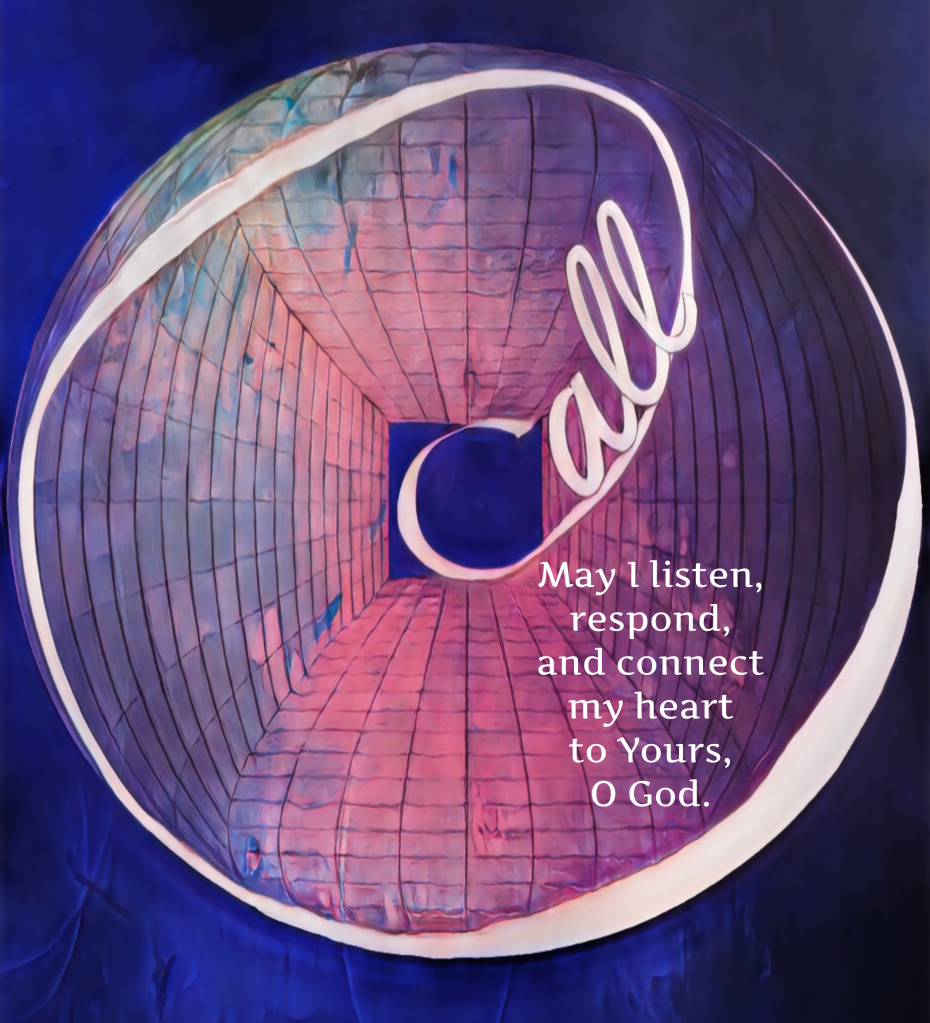
They listened, responded and connected their lives irrevocably to God’s vision.
It is at once a simple and a challenging formula for spiritual fulfillment.

In our Gospel, Matthew is called to the same formula which is the underpinning of any vocation:

As Jesus passed by,
he saw a man named Matthew sitting at the customs post.
He said to him, “”Follow me.””
And he got up and followed him.
While he was at table in his house,
many tax collectors and sinners came
and sat with Jesus and his disciples.
The Pharisees saw this and said to his disciples,
“”Why does your teacher eat with tax collectors and sinners?””
He heard this and said,
“Those who are well do not need a physician, but the sick do.
Go and learn the meaning of the words,
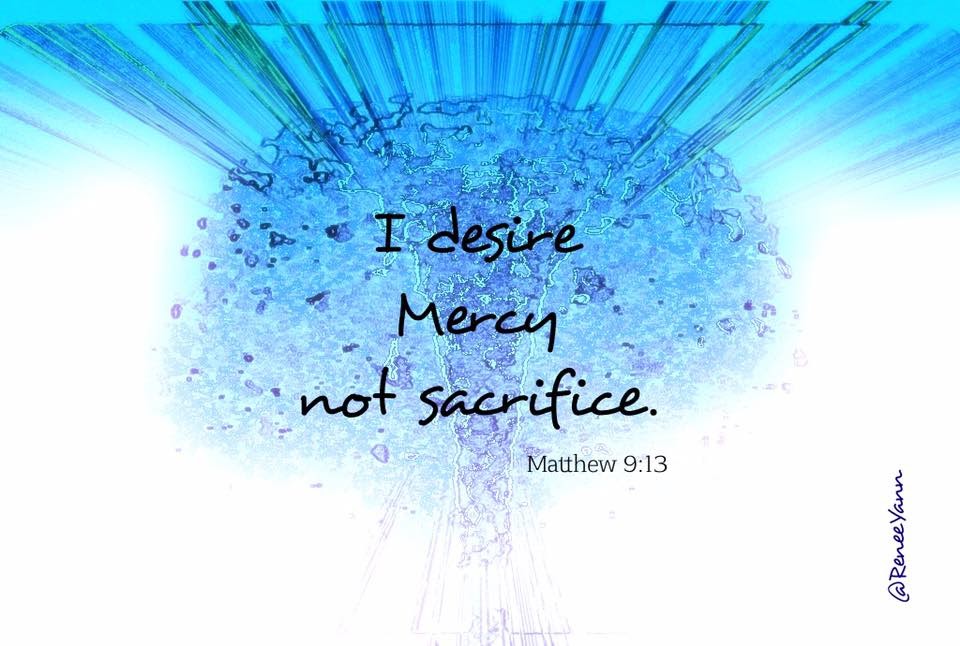
I desire mercy, not sacrifice.”

Matthew 9:9-12

Matthew listens to Jesus’ call, responds,
and connects his life irrevocably to Jesus’ vision.


The continuing call for each of us is clear. Each of our lives offers us a particular expression of “vocation”. It may be as religious, priest, parent, spouse, family member, teacher, caregiver, public servant, or any other role that places us in loving and responsible relationship with our neighbor.

In that role, can we/do we:

  • listen for God in every circumstance
  • respond in faith, hope, and love
  • witness a Christ-rooted life by our actions for Gospel justice and mercy

Poetry: Vocation by William E. Stafford

This dream the world is having about itself 
includes a trace on the plains of the Oregon trail, 
a groove in the grass my father showed us all 
one day while meadowlarks were trying to tell
something better about to happen. 

I dreamed the trace to the mountains, over the hills, 
and there a girl who belonged wherever she was; 
but then my mother called us back to the car: 
she was afraid; she always blamed the place,
the time, anything my father planned. 

Now both of my parents, the long line through the plain, 
the meadowlarks, the sky, the world's whole dream 
remain, and I hear him say while I stand between the two,
helpless, both of them part of me:
"Your job is to find what the world is trying to be."

Music: The Call – Celtic Women sing a song written by Anthony Downes


Faith Begets Miracles!

Friday of the Twelfth Week in Ordinary Time
June 30, 2023

Today’s Readings:

https://bible.usccb.org/bible/readings/063023.cfm


Today, in God’s Lavish Mercy, our readings offer us a contrast in faith between Genesis’s unconvinced Abraham and Matthew’s expectant leper.


Like any relationship, deepening our friendship with God takes time, attention, patience, and love. In our first reading, Abraham struggles with his part in that deepening. God has been promising Abraham an heir, but almost-centenarian Abraham is impatient to see the incredible promise fulfilled. He basically tells God to forget about “the promise” and just let his illegitimate son Ishmael serve as his heir.

Abraham prostrated himself and laughed as he said to himself,
“Can a child be born to a man who is a hundred years old?
Or can Sarah give birth at ninety?”
Then Abraham said to God,
“Let but Ishmael live on by your favor!”

Genesis 17:17-18

The entire text of Genesis 17 concerns binding Abraham to God in radical faith. Yet by verses 17–18, Abraham completely doubts the promise, laughs a mocking laugh, and appeals to the son already in hand. Abraham, the father of faith, is here again presented as the unfaithful one, unable to trust, and willing to rely on an alternative to the promise.

Walter Brueggemann. Genesis: Interpretation: A Bible Commentary for Teaching and Preaching

When you get right down to it, you really can’t blame Abraham, can you? After all, he is 99 years old! His wife Sarah is 90! It would take a humongous amount of faith to believe that a newborn in going to pop out of this relationship. Right?


Not right.
That transcendent and absolute faith
is exactly what God is asking for
– from Abraham, and from you and me.

Today’s Gospel helps us understand what that kind of faith looks like.

When Jesus came down from the mountain, great crowds followed him.
And then a leper approached, did him homage, and said,
“Lord, if you wish, you can make me clean.”

Matthew 8:1-2

  • This unnamed believer’s faith was so great that he trusts the promise without it needing to be spoken. He believes Jesus can heal him.
  • He expresses his relationship to Jesus in reverence and trust. He believes Jesus has divine power.
  • He speaks his need, and let’s it go, knowing that it will be heard.

The leper’s faith immediately releases the mercy in Jesus’s heart.

Jesus stretched out his hand, touched him, and said,
“I will do it. Be made clean.”

Mark 8:3

The passage seems to suggest that God cannot be fully God for us unless we allow it by our faith, worship, and trust. Abraham took a little more time to learn this kind of faith. The leper, perhaps deepened by his long-suffering prayer, came to Jesus already convinced that God fulfills promises. And Christ’s answering healing was immediate.


Poetry: To Be Held – Linda Hogan ( maybe this is all the leper really wanted, or any of us when we pray.)

To be held
by the Light
was what I wanted,
to be a tree drinking the rain,
no longer parched in this hot land.
To be roots in a tunnel growing
but also to be sheltering the inborn leaves
and the green slide of mineral
down the immense distances
into infinite comfort
and the land here, only clay,
still contains and consumes
the thirsty need
the way a tree always shelters the unborn life
waiting for the healing
after the storm
which has been our life.


Music: Loving Touch – Deuter


Bearing Fruit

Memorial of Saint Irenaeus, Bishop and Martyr
Wednesday of the Twelfth Week in Ordinary Time
June 28, 2023

Today, in God’s Lavish Mercy, both our readings speak to the call to bear holy fruit for God.

In the passage from Genesis, we are witnesses to a delightful conversation between Abraham and the Lord. The homey tone and mutuality of their exchange reveals Abraham’s great comfort in God’s Presence – to the point of his feeling free to give God some advice:

The Lord said, “Fear not, Abram!
I am your shield;
I will make your reward very great.”

But Abram said,
“O Lord GOD, what good will your gifts be,
if I keep on being childless
and have as my heir the steward of my house, Eliezer?”
Abram continued,
“See, you have given me no offspring,
and so one of my servants will be my heir.”

Genesis 15:1-3

Like many of us, what Abraham doesn’t realize is that God already has him covered. God has a desire and plan for Abraham’s fruitfulness – a dream far beyond any that Abraham can himself conceive.

God took him outside and said:
“Look up at the sky and count the stars, if you can.
Just so,” he added, “shall your descendants be.”
Abram put his faith in the LORD,
who credited it to him as an act of righteousness.

Genesis 15:5-6

The “act of righteousness” described here in Genesis is an offering God asks of each of us in our lives: confident faith expressed in loving action.

Think about it. Abraham and Sarah have waited and waited (for five chapters now) for God’s promise of fruitfulness to transform their barren lives. It hasn’t happened yet! Abraham asks God, “What’s going on????”


Brueggemann says:

The large question (posed in this chapter) is that the promise does delay, even to the point of doubt. It is part of the destiny of our common faith that those who believe the promise and hope against barrenness nevertheless must live with the barrenness.


… the promise does delay,
even to the point of doubt

Oh, my dears, have we not all been there? Have we not all, at some time or another, anguished over the questions of our own fruitfulness, destiny, meaning, survival, relevance in this life? Have we not sometimes wondered if God is even there?


But God is, and will arise out of any barreness or darkness if we can be faithful. God says to us, as to Abraham, “Take it easy, Abe. I gotcha’. Trust me and believe. The “fire pot” and the “flaming torch” are coming. Keep your heart ready!”

When the sun had set and it was dark,
there appeared a smoking fire pot and a flaming torch,
which passed between those pieces.
It was on that occasion that the LORD made a covenant with Abram,
saying: “To your descendants I give this land,
from the Wadi of Egypt to the Great River the Euphrates.”

Genesis 15:17-18

Poetry: The Night Abraham Called to the Stars – Robert Bly

Do you remember the night Abraham first saw
The stars? He cried to Saturn: "You are my Lord!" 
How happy he was! When he saw the Dawn Star,

He cried, "You are my Lord!' 
How destroyed he was 
When he watched them set. 

Friends, he is like us:
We take as our Lord the stars that go down.
We are faithful companions to the unfaithful stars.

We are diggers, like badgers; we love to feel 
The dirt flying out from behind our back claws.
And no one can convince us that mud is not 

Beautiful. It is our badger soul that thinks so.
We are ready to spend the rest of our life
Walking with muddy shoes in the wet fields.

We resemble exiles in the kingdom of the serpent.
We stand in the onion fields looking up at the night.
My heart is a calm potato by day, and a weeping

Abandoned woman by night. 
Friend, tell me what to do,
Since I am a man in love with the setting stars.

Music: Promise Keeper – David Joost

God’s Promises

Monday of the Twelfth Week in Ordinary Time
June 26, 2023

Today’s Readings:

https://bible.usccb.org/bible/readings/062623.cfm


Today, in God’s Lavish Mercy, we begin a pilgrimage with the ancient believers who first received God’s call into a community of faith.

Today’s liturgy initiates a seven-week reading of the Pentateuch (the first five books of the Bible), starting with three weeks of Genesis.


Walter Brueggemann, renowned Hebrew Scriptures scholar, writes that Genesis tells the story of two Divine calls:

  • the call of Creation as God’s handiwork (Genesis 1-11)
  • the call of the faith community as God’s witness (Genesis 12-50)

Gen. 1—11 concerns the affirmation that God calls the world into being to be God’s faithful world.
Gen. 12—50 concerns the affirmation that God calls a special people to be faithfully God’s people.
Genesis is a reflection upon and witness to these two calls. It is concerned with the gifts given in these calls, the demands announced in them, and the various responses evoked by them.

Walter Brueggemann – Genesis: Interpretation: A Bible Commentary for Teaching and Preaching

Our three weeks of readings, from Genesis 12 to 50, focus on that second call of the faith community and can offer us graced insights into our life in the Church and in the world.


As Genesis 11 closes, the condition of the world is rather dire. The descendants of Adam and Noah had been wandering around the Middle East, finally trying to settle down in ancient Babylonia. There they decide to build a city and a tower which they think will make them self-sufficient enough to avoid a second flood. God isn’t pleased. God wants them to be faithful and depend on God not themselves.

So the LORD scattered them from there over all the earth,
and they stopped building the city.
That is why it was called Babel,
because there the LORD confused the speech of all the world.

Genesis 11:8-9

Then, in Genesis 12 (our reading today), God reaches into the scattered chaos with an astounding promise for two elderly, barren, and probably hopeless people. It is a call to renewed and deeper relationship, a call that God has been offering again and again since the beginning of time:

The LORD said to Abram:
“Go forth from the land of your kinsfolk
and from your father’s house to a land that I will show you.

“I will make of you a great nation,
and I will bless you;
I will make your name great,
so that you will be a blessing.
I will bless those who bless you
and curse those who curse you.
All the communities of the earth
shall find blessing in you.”

Genesis 12:1-3

In prayer, we can take any scripture passage and separate its wordy threads to find ourselves. Each one of us, at least at some time in our lives, has been Abraham or Sarah – maybe a little bit alone, confused, feeling disconnected from God and neighbor. Or maybe feeling the weight of aging, tangled in familial labyrinths, or wounded from accumulated miscalculations in our life’s wanderings.

In whatever scattered chaos we may find ourselves, today’s first reading tells us to listen. God’s irrevocable promises are encircling and guiding us to renewed stability. Hearing God’s voice, “Abram went as the LORD directed him”. As we begin these weeks with Genesis, we are invited to do the same.


Poetry: from Selected Poetry of Jessica Powers

    I love Abraham, that old weather-beaten
unwavering nomad; when God called to him,
no tender hand wedged time into his stay.
His faith erupted him into a way
far-off and strange.  How many miles are there
from Ur to Haran?  Where does Canaan lie,
or slow mysterious Egypt sit and wait?
How could he think his ancient thigh would bear
nations, or how consent that Isaac die,
with never an outcry or an anguished prayer?
I think, alas, how I manipulate
dates and decisions, pull apart the dark,
dally with doubts here and with counsels there,
take out old maps and stare.
Was there a call at all, my fears remark.
I cry out: Abraham, old nomad you,
are you my father?  Come to me in pity.
Mine is a far and lonely journey too.

Music: The Yearning – Nicholas Gunn

Lent: Toward a Future Unimagined

April 7, 2022
Thursday of the Fifth Week of Lent

Abraham
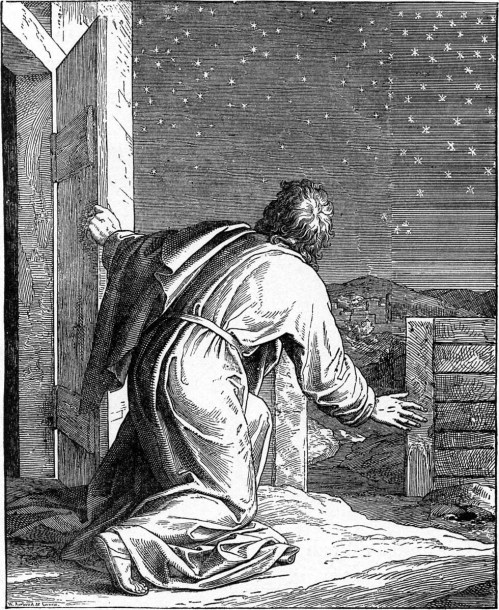
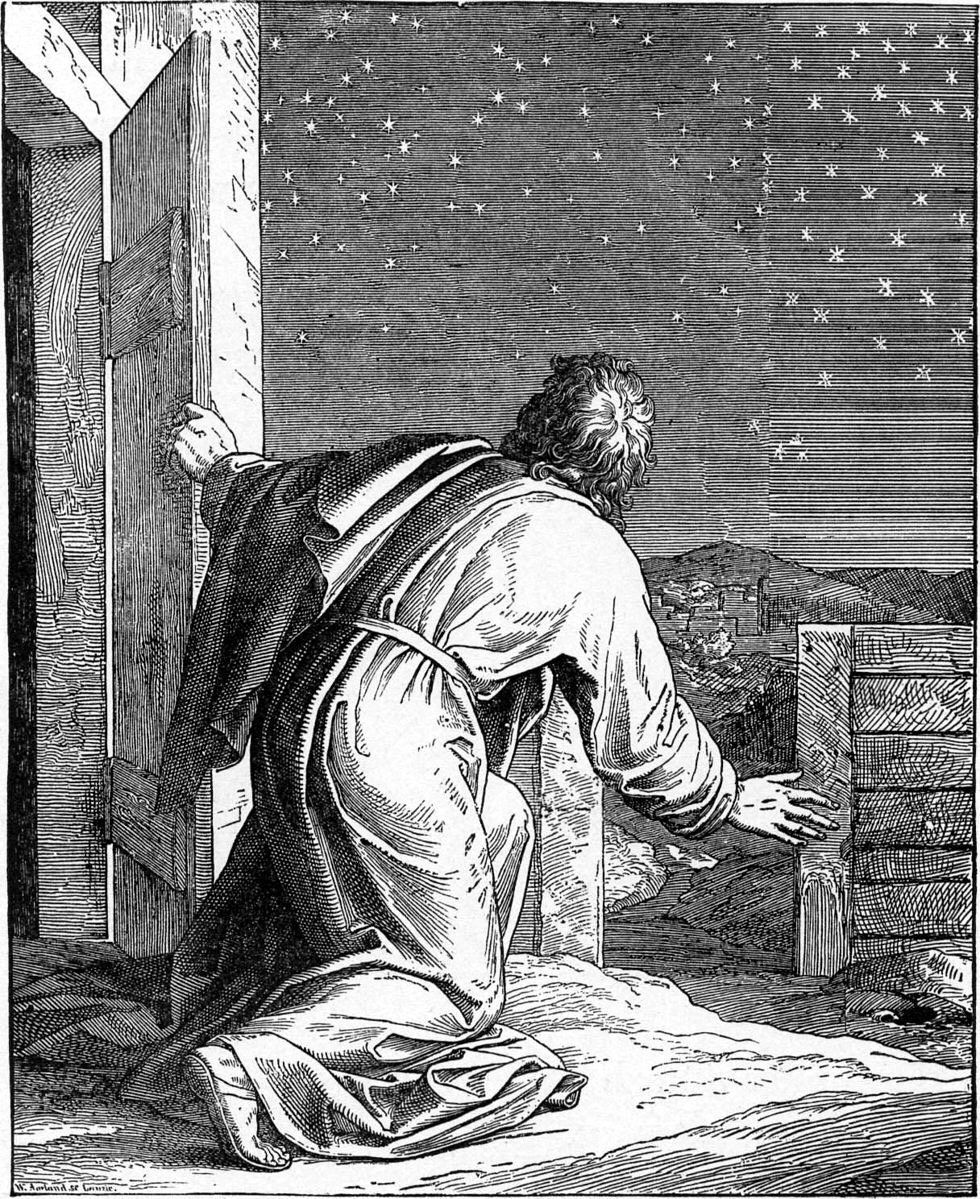
Abraham Looks to the Heavens from Bible Pictures by Charles Foster (1897)

Today, in God’s Lavish Mercy, Yahweh is very clear with Abram that he is now in a life-changing situation:

My covenant with you is this:
you are to become the father of a host of nations.
No longer shall you be called Abram;
your name shall be Abraham,
for I am making you the father of a host of nations.

Genesis 17: 3-4

pregnant

Having witnessed how young fathers are upended by the news of impending fatherhood, I can’t even imagine what Abraham felt like when he heard this:

I will render you exceedingly fertile;
I will make nations of you;
kings shall stem from you.

But aside from the practical ramifications of God’s promise, what Abraham is invited to is a whole new outlook on the world.  God lays out before him a vision of the ages, infinitely beyond the confines of Abraham’s current understanding.

dangles

It is an existence beyond time and human definition. It is the infinite place of God’s timelessness, where we all exist, but forget when we are born. Our lifetime is a spiritual journey back to remembrance.


In our Gospel, Jesus uses a rather cryptic phrase as he challenges his listeners to look beyond their circumscribed perspectives:

Amen, amen, I say to you,
whoever keeps my word will never see death….
Abraham your father rejoiced to see my day;
he saw it and was glad.

John 8:51
Jn8_56 Abraham

By fully embracing his covenant with God, Abraham saw beyond death.  The vision of heaven was opened to him and he lived his life by its power. He lived then within the Day of the Lord, not within any small confined perspective.

Jesus offers us the same invitation. We can choose to see with God’s eyes, or with only our own. We can choose to live within God’s infinity, or in only our own earthbound borders.

In our current global situation, where some humans have lost the sense of anything beyond themselves, it may be a good time to remember the eternal character of our heart.  It may be time to have a sit-down with God about our covenant, like the conversation God had with Abraham.


Poetry: The Unwavering Nomad – Jessica Powers

I love Abraham, that old weather-beaten
unwavering nomad; when God called to him
no tender hand wedged time into his stay.
His faith erupted him into a way
far-off and strange. How many miles are there
from Ur to Haran? Where does Canaan lie,
or slow mysterious Egypt sit and wait?
How could he think his ancient thigh would bear
nations, or how consent that Isaac die,
with never an outcry nor an anguished prayer?
I think, alas, how I manipulate
dates and decisions, pull apart the dark
dally with doubts here and with counsel there,
take out old maps and stare.
Was there a call after all, my fears remark.
I cry out: Abraham, old nomad you,
are you my father? Come to me in pity.
Mine is a far and lonely journey, too.

Music: In the Day of the Lord  – M.D. Ridge

Refrain:
In the day of the Lord, the sun will shine
like the dawn of eternal day.
All creation will rise to dance and sing
the glory of the Lord!

1.
“And on that day will justice triumph,
on that day will all be free:
free from want, free from fear, free to live! Refrain

2.
Then shall the nations throng together
to the mountain of the Lord:
they shall walk in the light of the Lord! Refrain

3.
And they shall beat their swords to plowshares;
there will be an end to war:
one in peace, one in love, one in God! Refrain

4.
For Israel shall be delivered,
and the desert lands will bloom.
Say to all, “Do not fear. Here is your God!” Refrain

5.
And on that day of Christ in glory,
God will wipe away our tears,
and the dead shall rise up from their graves! Refrain

6.
O give us eyes to see your glory,
give us hearts to understand.
Let our ears hear your voice ’til you come! Refrain

Lent: The Way Home

March 13, 2022
Second Sunday of Lent

Today, in God’s Lavish Mercy, our readings are about types of citizenship, that condition of knowing we are fully and irrevocably home.


In Genesis, Abraham is given a land for himself and his descendants as a sign of God’s abiding Presence.

“I am the LORD who brought you from Ur of the Chaldeans
to give you this land as a possession.”

Genesis 15:5

In Philippians, Paul tells us that, truly, “our citizenship is in heaven”.

But our citizenship is in heaven,
and from it we also await a savior, the Lord Jesus Christ.

Philippians 3:20

In Luke, the transfigured Jesus shows us what that heavenly reality will be like. It is a kind of glorious belonging that Peter wants to hold on to … to capture in a tent.

Jesus took Peter, John, and James
and went up the mountain to pray.
While he was praying his face changed in appearance
and his clothing became dazzling white.

Luke 9:28

But the Creator makes it clear this dwelling and citizenship exists only in the heart of Christ where we are called to listen and live our lives.

While Peter was still speaking,
a cloud came and cast a shadow over them,
and they became frightened when they entered the cloud.
Then from the cloud came a voice that said,
“This is my chosen Son; listen to him.”

Luke 9:34-35

These readings confirm that, in God, we are a people not bound by borders, ethnicities, religious cult, or any other human categorization.

Every human being belongs to God and is called to live in the fullness of that Creation. This is our shared Divine citizenship demanding a reverent mutuality for one another’s lives.


Think about that in contrast to the incomprehensible outrage of Putin’s unprovoked war against the Ukrainian people. Think about it relative to the many armed conflicts in Africa, Asia and Latin and South America.

Think of our Oneness in God compared to talk of border walls, ethnic and religious bans, white supremacy, anti-semitism, islamophobia and all the other manufactured ways we try to isolate people from this Divine citizenship which makes us brothers and sisters in God.

On this Sunday when our readings remind us of where and to whom each of our hearts belongs, let us pray for our world – for those suffering from war and isolation, and for the unfortunate lost souls executing that suffering. In differing ways, each of them, and we, need continuing redemption.


Poetry: The Man He Killed – Thomas Hardy

Had he and I but met
By some old ancient inn,
We should have sat us down to wet
Right many a nipperkin!

But ranged as infantry,
And staring face to face,
I shot at him as he at me,
And killed him in his place.

I shot him dead because –
Because he was my for,
Just so: my foe of course he was;
That’s clear enough; although

He thought he’d ‘list, perhaps,
Off-hand like – just as I –
Was out of work — had sold his traps —
No other reason why.

Yes; quaint and curious war is!
You shoot a fellow down
You’d treat if met where any bar is,
Or help to half-a-crown.


Music: The Sins of War – Timothy Shortell

Promise Remembered

Saturday of the Twenty-eighth Week in Ordinary Time
October 16, 2021

Today, in God’s Lavish Mercy, we pray with Psalm 105, a recounting of the marvelous works God has done from the Abrahamic covenant to the Exodus. Indeed, our psalm celebrates God”s faithfulness to Abraham and to all generations, even us!

God remembers forever the sacred covenant
    which God made binding for a thousand generations –

Psalm 105:8

In our reading from Romans, Paul preaches about that Covenantal Promise. The text is a little deep, and I had to dig a bit to get my inspiration. But there are gems in these dense words!

It was not through the law
that the promise was made to Abraham and his descendants
that he would inherit the world,
but through the righteousness that comes from faith.

This is a spiritually freeing passage. It assures us that God is with us through our faith, not through the perfection with which we keep laws and rules.


Our Gospel reinforces the message:

Everyone who speaks a word against the Son of Man will be forgiven,
but the one who blasphemes against the Holy Spirit
will not be forgiven

… the proverbial “bad apple”!

The passage is a little scary when first read, because we all hope we haven’t done anything to offend the Holy Spirit. But I think what Jesus is telling his listeners is this:

If a person criticizes or rejects my life and teaching, forgiveness is still possible when they come to their senses and repent. It’s like cutting the bad spot out of an otherwise good apple.

But if a person chooses to live a life which blasphemes (mocks, dismisses) the Spirit of life, love, mercy and peace, that person can never be forgiven — because they can never repent. They will be rotten to the core.


So the advice of Paul and Jesus boils down to this. Befriend the Holy Spirit by your life of faithful choices. Listen to the Spirit’s inspiration. Help others to do the same. And do not worry when you make a few mistakes. God stands by the promise to be with us always.


Poetry: The Promise Written by Rumi
Translated and read by Fatemeh Keshavarz

(Remember when reading that, for the Sufi mystic poets, everything was about God. Modern users often apply these poetic sentiments to human relationships, but they were not composed in that light.)

When pain arrives side by side with your love
I promise not to flee
When you ask me for my life
I promise not to fight

I am holding a cup in my hand
By God if you do not come
Till the end of time
I promise not to pour out the wine
Nor to drink a sip

Your bright face is my day
Your dark curls bring the night
If you do not let me near you
I promise not to go to sleep…nor rise

Your magnificence has made me a wonder
Your charm has taught me the way of love
I am the progeny of Abraham
I’ll find my way through fire

Please, let me drink water from the jug
This love is not a short-lived fancy
It is the daily prayer, the year-after-year fast
I live it, like an act of worship, till the end of my life

But then, a tree
Blessed not with fruits of your bounty
Will be dry wood for fire
Even if it drinks the ocean

On the wings of the Friend, fly o my heart!
Fly and look upward
For high on the peak of presence
Earthlings like you will not be let in

Others praise God at the time of affliction
You stay awake day and night
Steady, watchful like the wheel of the firmament

Time to stop speaking of the Friend
Jealousy won’t let me scatter the perfume to the wind


Music: Spirit of the Living God – Divine Hymns

Thursday of the Thirteenth Week in Ordinary Time

July 1, 2021

Today, in God’s Lavish Mercy, we pray with Psalm 115, bringing a welcome comfort after the always disturbing story of Isaac’s aborted sacrifice.

This story fascinated Rembrandt. Notice the differences between the 1635 and 1655 interpretations. The old man in the 1655 image has darkened eyes, covers his son’s eyes – not his mouth, and embraces the boy in his lap not laid out on an altar. Old age has gentled what Rembrandt found in the story.


But here’s what I think. It was never about a human sacrifice. God was never going to let that happen.

It was about whether Abraham’s trust would allow him to really see God – God who is never a God of death, but always of life.

As Abraham looked about,
he spied a ram caught by its horns in the thicket.
So he went and took the ram
and offered it up as a burnt offering in place of his son.
Abraham named the site Yahweh-yireh;
hence people now say, “On the mountain the LORD will see.”


We live in a world full of choices that run the gamut from death-dealing to life-giving. They may be small, personal choices like what we eat, or how we drive. Or they may be more consequential choices such as the political views we foster or the global ideologies we embrace.

Psalm 115 helps us to solve any confusion we might have about our choices. Always make the choices that lead ourselves and others to the land of the living.

Abraham must have been thrown into the dark by what he believed was God’s expectation of him. But it was really Abraham’s own expectation that had to be broken through. He did this by staying with his pain while trusting that God was bigger than it.

Christine Robinson’s interpretation of Psalm 115 fits well here:

O Great Mystery
   We must love and praise you without understanding.
You are not a little tin god
   with eyes that do not see and ears that do not hear
   and a mouth that does not speak.
You can not be described or boxed up or tamed
   You are beyond our understanding.
Still, we yearn to hear you, know you,
   feel your love, and in mystery, we do.
We know awe at the intricate majesty of the heavens,
We cherish the work of caring for each other 
and the Earth.
We praise you, Great Mystery
   all the days of our lives.

Poetry: Silence – Rabbi Rachel Barenblat

Abraham failed the test.
For Sodom and Gomorrah he argued
but when it came to his son
no protest crossed his lips.
God was mute with horror.
Abraham, smasher of idols
and digger of wells
was meant to talk back.
Sarah would have been wiser
but Abraham avoided her tent,
didn’t lay his head in her lap
to unburden his secret heart.
In stricken silence God watched
as Abraham saddled his ass
and took Isaac on their final hike
to the place God would show him.
The angel had to call him twice.
Abraham’s eyes were red, his voice hoarse
he wept like a man pardoned
but God never spoke to him again.

(It is true that, in Genesis, this is the last recorded exchange between God and Abraham!)


Music: Story of Isaac – Leonard Cohen

(If there’s no picture below, just click on the underlined phrase “Watch on Youtube

The door, it opened slowly
My father, he came in
I was nine years old
And he stood so tall above me
Blue eyes, they were shining
And his voice was very cold
Said, "I've had a vision
And you know I'm strong and holy
I must do what I've been told"
So we started up the mountain
I was running, he was walking
And his axe was made of gold

Well, the trees, they got much smaller
The lake, a lady's mirror
When we stopped to drink some wine
Then he threw the bottle over
Broke a minute later
And he put his hand on mine
Thought I saw an eagle
But it might have been a vulture
I never could decide
Then my father built an altar
He looked once behind his shoulder
He knew I would not hide

You who build these altars now
To sacrifice these children
You must not do it anymore
A scheme is not a vision
And you never have been tempted
By a demon or a god
You, who stand above them now
Your hatchets blunt and bloody
You were not there before
When I lay upon a mountain
And my father's hand was trembling
With the beauty of the word

And if you call me brother now
Forgive me if I inquire
Just according to whose plan?
When it all comes down to dust
I will kill you if I must
I will help you if I can
When it all comes down to dust
I will help you if I must
I will kill you if I can
And mercy on our uniform
Man of peace or man of war
The peacock spreads his fan

God’s Starry Calendar

Thursday of the Fifth Week of Lent

April 2, 2020

Click here for readings

Abraham
Abraham Looks to the Heavens from Bible Pictures by Charles Foster (1897)

Today, in Mercy, Yahweh is very clear with Abram that he is now in a life-changing situation:

My covenant with you is this:
you are to become the father of a host of nations.
No longer shall you be called Abram;
your name shall be Abraham,
for I am making you the father of a host of nations.


pregnantHaving witnessed how young fathers are upended by the news of impending fatherhood, I can’t even imagine what Abraham felt like when he heard this:
I will render you exceedingly fertile;
I will make nations of you;
kings shall stem from you.

But aside from the practical ramifications of God’s promise, what Abraham is invited to is a whole new outlook on the world.  God lays out before him a vision of the ages, infinitely beyond the confines of Abraham’s current understanding.

dangles

It is an existence beyond time and human definition. It is the infinite place of God’s timelessness, where we all exist, but forget when we are born. Our lifetime is a spiritual journey back to remembrance.


In our Gospel, Jesus uses a rather cryptic phrase as he challenges his listeners to look beyond their circumscribed perspectives:

Amen, amen, I say to you,
whoever keeps my word will never see death….
Abraham your father rejoiced to see my day;
he saw it and was glad.

Jn8_56 Abraham

By fully embracing his covenant with God, Abraham saw beyond death.  The vision of heaven was opened to him and he lived his life by its power. He lived then within the Day of the Lord, not within any small confined reality.

Jesus offers us the same invitation. We can choose to see with God’s eyes, or with only our own. We can choose to live within God’s infinity, or in only our own earthbound borders.

In our current global situation, when time has lost its shape and days silently morph into one another, it may be a good time to remember the eternal character of our heart.  It may be time to have a sit-down with God about our covenant, like the conversation God had with Abraham.

Music: In the Day of the Lord  – M.D. Ridge

https://www.youtube.com/watch?v=LMq5_v7eMo0&feature=youtu.be

Promise


Sixteenth Sunday in Ordinary Time

July 21, 2019

Click here for readings

Today, in Mercy, our readings are all about making and keeping promises.

Our first reading refers to Genesis and God’s promise to Abraham of land and posterity. Through his hospitality to three disguised angels, Abraham secures God’s promise to bless Sara and him with a child.

Luke8_15 promise

In today’s second reading from Colossians, Paul assures us that God has brought that promise to its full completion in the gift of Jesus Christ living in us.

…the mystery hidden from ages and from generations past
has now been manifested to his holy ones,
to whom God chose to make known the riches of the glory
of this mystery among the Gentiles;
it is Christ in you, the hope for glory. 

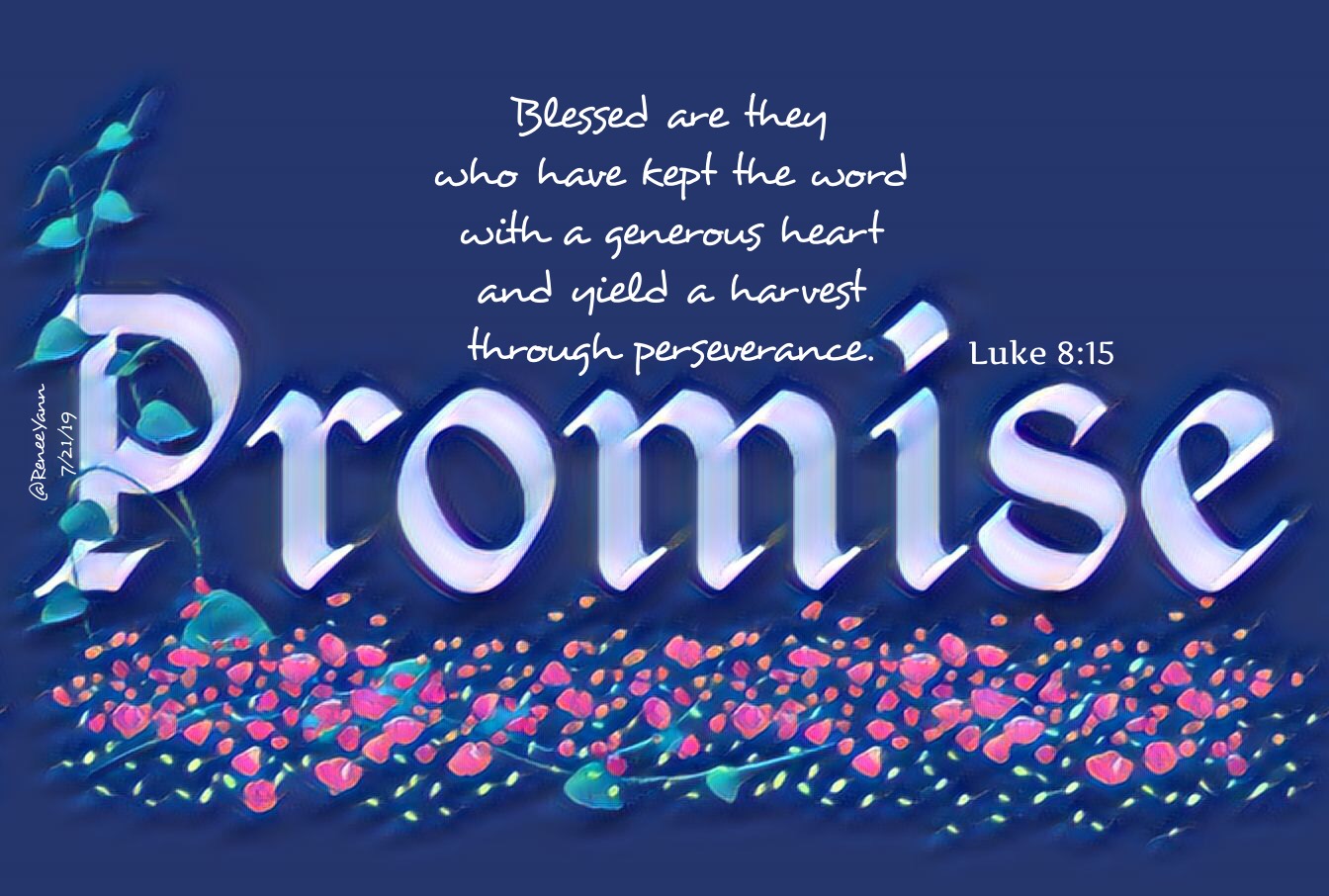
In our Gospel, Jesus encourages Martha to give her attention to the presence of this promise revealed in her life. Mary sees the promise fulfilled in Jesus, the living presence of God. She gives her full heart to it. Martha, maybe like us sometimes, is preoccupied by other distractions.


Our readings invite us to rejoice in God’s promise to us
of “land” and “posterity”.

In Jesus, we are brought home to God.
In Jesus, the fruitfulness of our life is eternally secured.


We make promises to God too.

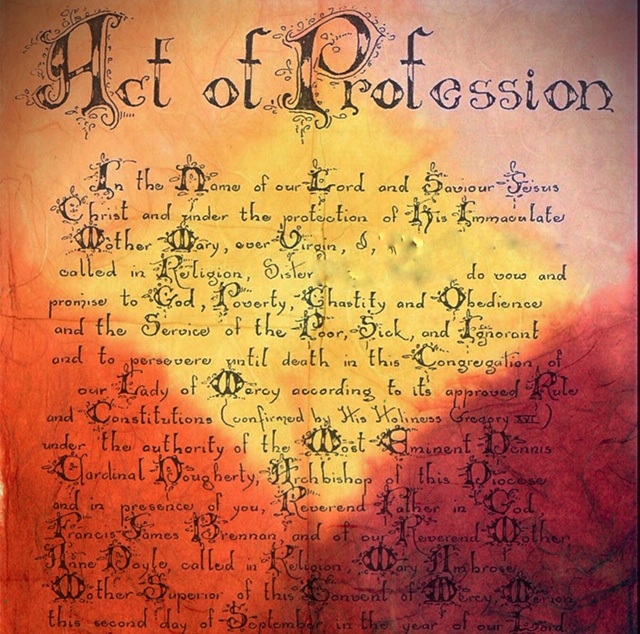
vowsAs I think about my vows today, I am so aware of the recent deaths of two of our Sisters. At all of our funerals, our vows rest near us for our wakes – a profound symbol of promises given and promises fulfilled. God bless you, Margaret and Mary Ellen! Thank you for your witness among us!
Today, as we pray about God’s faithful promises to us, we might want to reflect on and deepen the commitments of our Baptism, our religious profession, our marriage, our covenants to communities of faith and service.

Like Martha, we might hear Jesus encourage us to give our fullest heart to that which is most important.

Music: God’s Promise – Brooklyn Tabernacle Choir  (Lyrics below)

https://www.youtube.com/watch?v=bNjPl94y5EU&feature=youtu.be

God’s Promise

Chorus:
Everything He said
In His word
He will do it for you.
Every prophecy He gave
Every promise he made

He will do it for you.
If you only trust Him
And let Him have his way
He’ll work things out for you.

If you only believe and
You will see
That He will do it
For you.

(Repeated several times)

He’ll do it
He will do it/
My God is a faithful God
He will do it

And He’s always there
To answer every payer
He will do it.
He’ll do it.

No matter what you’re going through.
He’ll do it.
Remember His word is true.
He’ll do it.

Cause He understands
He’ll do it.
You can always trust and lean on Him
My God will do it
For you….