
Solemnity of the Body and Blood of Christ
June 11, 2023
Today’s Readings:
https://bible.usccb.org/bible/readings/061123.cfm

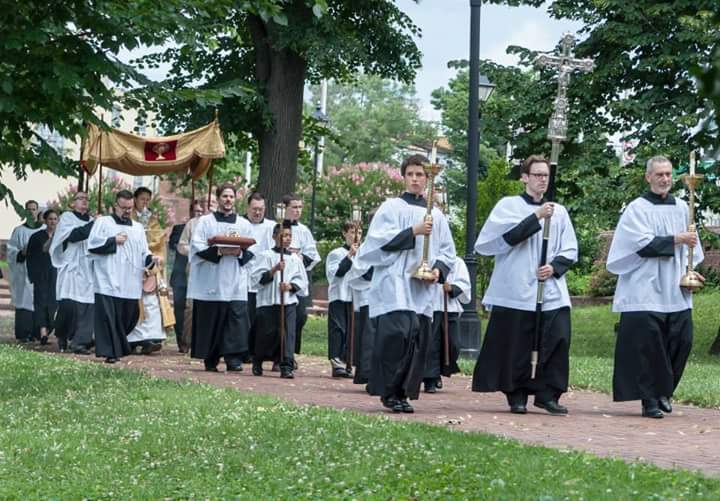
Today, in God’s Lavish Mercy, we celebrate the Body and Blood of Christ present to us in Eucharist and in the Church. This is one of the great and unfathonable mysteries of our faith. It is also the source of our greatest blessing in Christ because through this gift Jesus continues to live among us and within us.
No life can be sustained without food. This is true of our physical life but even more so of our spiritual life. God has invited all of us to live in eternal life through the gift of Jesus Christ. We are fed for this Life by Christ’s own Body and Blood.
As our Gospel indicates, from the very beginning, some people gave Jesus a hard time about this gift.
Jesus said to the Jewish crowds:
John 6: 51-53
“I am the living bread that came down from heaven;
whoever eats this bread will live forever;
and the bread that I will give
is my flesh for the life of the world.”
The Jews quarreled among themselves, saying,
“How can this man give us his flesh to eat?”
Jesus said to them,
“Amen, amen, I say to you,
unless you eat the flesh of the Son of Man and drink his blood,
you do not have life within you.
In all honesty, Jesus’s statement is not easy to accept if we hear it only on the level of our practical, tactical experience. But there are many other invisible levels within us and within our world. These deeper levels allow us to move beyond the explicable dimension into the mysteries which defy definition.
I’m not talking about big theological mysteries. I’m talking about the everyday wonders that make our lives beautiful and sublime. Let’s consider a newborn baby. We know all the mechanical and medical reasons why a new life comes into the world. But can we explain the infant eyes that seem to carry profound mysteries, or the first smile that causes us to tear up in thanksgiving. Can we define the immediate love and life-giving protection we willingly give this child perhaps before we even know his or her name? Can we truly analyze the desire and hope we feel for this newborn’s future?

All of these unwordable realities are generated from a place we cannot see but which is nonetheless real. The scriptures describe it as “Eternal Life” – “the God-place” that transcends our comprehension. It is from this place that we learn to live in faith and mystery. We come to understand that we will never really understand in a worldly sense. By accepting that fact in trust, we actually embrace a deeper wisdom that no longer needs definitions.
Jesus wanted his listeners to meet him in that place of sacred mystery and faith so that he could gift them with a gift beyond price. Some were able to do so; others were not.
Whoever eats my flesh and drinks my blood
John 6:54
has eternal life,
and I will raise them on the last day.
Today’s feast looks forward to the Last Supper when Jesus will bring his promise to fruition. The beautiful sequence “Lauda Sion” gives us a poetic remembrance of the institution of the Eucharist. The sequence was written by St. Thomas Aquinas when he also composed Pange Lingua, Sacris Solemniis, and Verbum Supernum Prodiens, prayers which are used in the Divine Office.
As we pray with today’s readings and sequence, may our hearts be opened to that deep faith which allows Christ to unite us with him in the fullness of eternal life even as we live within this world.
Music: Lauda Sion – Felix Mendelssohn
Poetry: Lauda Sion – Thomas Aquinas
Latin text
Lauda Sion Salvatórem
Lauda ducem et pastórem
In hymnis et cánticis.
Quantum potes, tantum aude:
Quia major omni laude,
Nec laudáre súfficis.
Laudis thema speciális,
Panis vivus et vitális,
Hódie propónitur.
Quem in sacræ mensa cœnæ,
Turbæ fratrum duodénæ
Datum non ambígitur.
Sit laus plena, sit sonóra,
Sit jucúnda, sit decóra
Mentis jubilátio.
Dies enim solémnis ágitur,
In qua mensæ prima recólitur
Hujus institútio.
In hac mensa novi Regis,
Novum Pascha novæ legis,
Phase vetus términat.
Vetustátem nóvitas,
Umbram fugat véritas,
Noctem lux elíminat.
Quod in cœna Christus gessit,
Faciéndum hoc expréssit
In sui memóriam.
Docti sacris institútis,
Panem, vinum, in salútis
Consecrámus hóstiam.
Dogma datur Christiánis,
Quod in carnem transit panis,
Et vinum in sánguinem.
Quod non capis, quod non vides,
Animósa firmat fides,
Præter rerum ordinem.
Sub divérsis speciébus,
Signis tantum, et non rebus,
Latent res exímiæ.
Caro cibus, sanguis potus:
Manet tamen Christus totus,
Sub utráque spécie.
A suménte non concísus,
Non confráctus, non divísus:
Integer accípitur.
Sumit unus, sumunt mille:
Quantum isti, tantum ille:
Nec sumptus consúmitur.
Sumunt boni, sumunt mali:
Sorte tamen inæquáli,
Vitæ vel intéritus.
Mors est malis, vita bonis:
Vide paris sumptiónis
Quam sit dispar éxitus.
Fracto demum Sacraménto,
Ne vacílles, sed memento,
Tantum esse sub fragménto,
Quantum toto tégitur.
Nulla rei fit scissúra:
Signi tantum fit fractúra:
Qua nec status nec statúra
Signáti minúitur.
Ecce panis Angelórum,
Factus cibus viatórum:
Vere panis filiórum,
Non mitténdus cánibus.
In figúris præsignátur,
Cum Isaac immolátur:
Agnus paschæ deputátur
Datur manna pátribus.
Bone pastor, panis vere,
Jesu, nostri miserére:
Tu nos pasce, nos tuére:
Tu nos bona fac vidére
In terra vivéntium.
Tu, qui cuncta scis et vales:
Qui nos pascis hic mortáles:
Tuos ibi commensáles,
Cohærédes et sodáles,
Fac sanctórum cívium.
Amen. Allelúja.
English Translation
Sion, lift up thy voice and sing:
Praise thy Savior and thy King,
Praise with hymns thy shepherd true.
All thou canst, do thou endeavour:
Yet thy praise can equal never
Such as merits thy great King.
See today before us laid
The living and life-giving Bread,
Theme for praise and joy profound.
The same which at the sacred board
Was, by our incarnate Lord,
Giv’n to His Apostles round.
Let the praise be loud and high:
Sweet and tranquil be the joy
Felt today in every breast.
On this festival divine
Which records the origin
Of the glorious Eucharist.
On this table of the King,
Our new Paschal offering
Brings to end the olden rite.
Here, for empty shadows fled,
Is reality instead,
Here, instead of darkness, light.
His own act, at supper seated
Christ ordain’d to be repeated
In His memory divine;
Wherefore now, with adoration,
We, the host of our salvation,
Consecrate from bread and wine.
Hear, what holy Church maintaineth,
That the bread its substance changeth
Into Flesh, the wine to Blood.
Doth it pass thy comprehending?
Faith, the law of sight transcending
Leaps to things not understood.
Here beneath these signs are hidden
Priceless things, to sense forbidden,
Signs, not things, are all we see.
Flesh from bread, and Blood from wine,
Yet is Christ in either sign,
All entire, confessed to be.
They, who of Him here partake,
Sever not, nor rend, nor break:
But, entire, their Lord receive.
Whether one or thousands eat:
All receive the self-same meat:
Nor the less for others leave.
Both the wicked and the good
Eat of this celestial Food:
But with ends how opposite!
Here ‘t is life: and there ‘t is death:
The same, yet issuing to each
In a difference infinite.
Nor a single doubt retain,
When they break the Host in twain,
But that in each part remains
What was in the whole before.
Since the simple sign alone
Suffers change in state or form:
The signified remaining one
And the same for evermore.
Behold the Bread of Angels,
For us pilgrims food, and token
Of the promise by Christ spoken,
Children’s meat, to dogs denied.
Shewn in Isaac’s dedication,
In the manna’s preparation:
In the Paschal immolation,
In old types pre-signified.
Jesu, shepherd of the sheep:
Thou thy flock in safety keep,
Living bread, thy life supply:
Strengthen us, or else we die,
Fill us with celestial grace.
Thou, who feedest us below:
Source of all we have or know:
Grant that with Thy Saints above,
Sitting at the feast of love,
We may see Thee face to face.
Amen. Alleluia.


 Lavish Mercy