
April 5, 2022
Tuesday of the Fifth Week of Lent
Today, in God’s Lavish Mercy, there are some common threads running through our readings.
In the passage from Numbers, we have a restless crowd, confused and hungry, feeling directionless in a vast wilderness. They demand an answer from Moses:
Why have you brought us up from Egypt to die in this desert,
where there is no food or water?
We are disgusted with this wretched food!”
To make things worse, God, annoyed at their complaints, sends a bunch of snakes to hassle them.
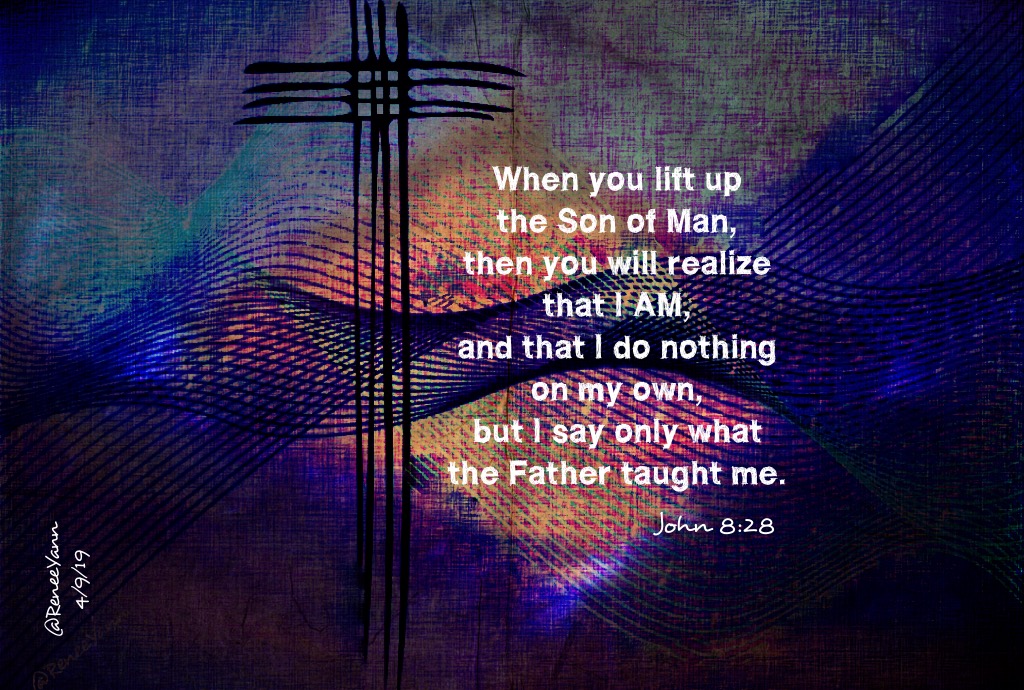
In John’s Gospel, a disgruntled gathering of Pharisees pesters Jesus for a resolution to their questions. Even after all Jesus’ signs and preaching, they ask Him, “Who are you?”
- In both instances, it is impossible for the questioners to receive the answer they seek because they lack faith.
- In both instances, they are told that a sign will be lifted up before them and that then they will understand.
We’re on a life’s journey, at times confused and disgruntled, just like those ancient Hebrews.
We may be locked in faithless expectations of God, just like those debating Pharisees.
In our difficulties and challenges,
will we be able to see
the sign that God offers us?
Not the one we design or demand –
but the unexpected one rising up
out of the depths of our faith?
Poetry: The Crosse – George Herbert
What is this strange and uncouth thing?

To make me sigh, and seek, and faint, and die,

Untill I had some place, where I might sing,

          And serve thee; and not onely I,

But all my wealth and familie might combine

To set thy honour up, as our designe.

          And then when after much delay,

Much wrastling, many a combate, this deare end,

So much desir’d, is giv’n, to take away

          My power to serve thee; to unbend

All my abilities, my designes confound,

And lay my threatnings bleeding on the ground.

          One ague dwelleth in my bones,

Another in my soul (the memorie

What I would do for thee, if once my grones

          Could be allow’d for harmonie):

I am in all a weak disabled thing,

Save in the sight thereof, where strength doth sting.

          Besides, things sort not to my will,

Ev’n when my will doth studie thy renown:

Thou turnest th’ edge of all things on me still,

          Taking me up to throw me down:

So that, ev’n when my hopes seem to be sped,

I am to grief alive, to them as dead.

          To have my aim, and yet to be

Further from it then when I bent my bow;

To make my hopes my torture, and the fee

          Of all my woes another wo,

Is in the midst of delicates to need,

And ev’n in Paradise to be a weed.

          Ah my deare Father, ease my smart!

These contrarieties crush me: these crosse actions

Doe winde a rope about, and cut my heart:

          And yet since these thy contradictions

Are properly a crosse felt by the Sonne,

With but foure words, my words, Thy will be done.
( George Herbert (3 April 1593 – 1 March 1633) was a Welsh poet, orator, and priest of the Church of England. His poetry is associated with the writings of the metaphysical poets, and he is recognized as “one of the foremost British devotional lyricists.” He was born into an artistic and wealthy family and largely raised in England. He received a good education that led to his admission to Trinity College, Cambridge, in 1609. He went there with the intention of becoming a priest, but he became the University’s Public Orator and attracted the attention of King James I. He served in the Parliament of England in 1624 and briefly in 1625.
After the death of King James, Herbert renewed his interest in ordination. He gave up his secular ambitions in his mid-thirties and took holy orders in the Church of England, spending the rest of his life as the rector of the rural parish of Fugglestone St Peter, just outside Salisbury. He was noted for unfailing care for his parishioners, bringing the sacraments to them when they were ill and providing food and clothing for those in need. Henry Vaughan called him “a most glorious saint and seer”.[4] He was never a healthy man and died of consumption at age 39. ~ from Wikipedia)
Music: By Grace Alone – David Ward

 Lavish Mercy