I hear the whisperings of many: “Terror on every side! Denounce! let us denounce him!” All those who were my friends are on the watch for any misstep of mine.
Jeremiah 20:10
Oh, the deadly power of a fragile whisper! Its insidious influence seeps into souls, germinates, and grows into fictional suggestions, untested prejudices, and effective shunning by the “in” set.
Whispers are the emanations of fear – we may fear what is different, what we cannot control, what challenges us, what actually exposes pretense in us.
Jeremiah and Jesus encountered the ugly entanglement of such whispers. But they were not trapped because they believed.
Today, in God’s Lavish Mercy: We pray their prayer for ourselves and for all who suffer the persecution of “whisperings”.
The LORD is with me, like a mighty champion: my persecutors will stumble, they will not triumph. O LORD of hosts, you who test the just, who probe mind and heart, Let me witness the recompense you take on them, for to You I have entrusted my cause.
Poetry: A Word – Emily Dickinson
A word is dead
When it is said,
Some say.
I say it just
Begins to live
That day.
Music: from Handel’s Messiah: He trusted in God that He would deliver him
Today, in God’s Lavish Mercy, our readings lead us in prayer to the concept of responsible membership in community, specifically the Church.
Paul counsels Timothy in this regard, reminding the Ephesian community, whom Timothy shepherded, how profoundly graced they are in their Church membership :
… you should know how to behave in the household of God, which is the Church of the living God, the pillar and foundation of truth. Undeniably great is the mystery of devotion, Who was manifested in the flesh, vindicated in the spirit, seen by angels, proclaimed to the Gentiles, believed in throughout the world, taken up in glory.
In today’s Gospel, Jesus assesses the “membership potential” of the surrounding crowd and finds it wanting. He compares them to a gaggle of immature children taunting and gossiping in the streets:
Jesus said to the crowds: “To what shall I compare the people of this generation? What are they like? They are like children who sit in the marketplace and call to one another,
‘We played the flute for you, but you did not dance. We sang a dirge, but you did not weep.’
Membership in any community is a serious commitment. It requires our sincere and charitable investment in the daily give-and-take of life.
As a creature of God, Who exists in the Trinitarian Community, every human being – even a hermit in the desert – subsists in some dimension of sustaining community. We live, and exchange life, in our families, neighborhoods, countries, world, and universe. We choose communities of faith, ministry, political belief, philosophical understanding, and social interaction. We have a bearing on the lives of those with whom we share the gifts of time and space.
These commitments, to be life-giving, demand our sincere, honest, and reverent participation. Community is never a perfect circle, but more like an interlaced wreath requiring courage to navigate, as David Whyte describes here:
Courage is the measure of our heartfelt participation with life, with another, with a community, a work; a future. To be courageous is not necessarily to go anywhere or do anything except to make conscious those things we already feel deeply and then to live through the unending vulnerabilities of those consequences.
Pope Francis has called all of us to a “culture of encounter”, a way of living together in compassionate community:
An invitation to work for “the culture of encounter”, in a simple way, “as Jesus did”: not just seeing, but looking; not just hearing, but listening; not just passing people by, but stopping with them; not just saying “what a shame, poor people!”, but allowing yourself to be moved with compassion; “and then to draw near, to touch and to say: ‘Do not weep’ and to give at least a drop of life”.
Pope Francis, in a 2016 homily on the Gospel of the Widow of Nain
Pope Francis has also said that the most common and insidious way to kill this culture of encounter is the evil of gossip:
Gossip is a weapon and it threatens the human community every day; it sows envy, jealousy and power struggles. It has even caused murder. Therefore, discussing peace must take into account the evil that can be done with one’s tongue.
Sometimes we become so used to gossip that we don’t even recognize it in ourselves and others. Sometimes our motivations, unexamined, seem innocent enough. However, consider this:
Some bad motivations are more wicked than others. Backstabbing gossip bent on revenge is birthed in malice and threatens to sink whole fellowships (2 Corinthians 12:19–13:2; 3 John 9–10). That kind of gossip is worse than being a busybody who is too interested in other peoples’ business (2 Thessalonians 3:11; 1 Peter 4:15). Yet Jesus said that we will give an account for every careless word we have spoken (Matthew 12:36), not just for the malicious ones.
Matt Mitchell, author – Resisting Gossip: Winning the War on the Wagging Tongue
We don’t want to be like the thoughtless children mocking and teasing in the streets. I know that, for me, it warrants taking a good look at myself, my investment in my many communities, and the reverence of my conversations about them.
Poetry: A Word by Emily Dickinson
A word is dead
When it is said,
     Some say.
I say it just
Begins to live
     That day.
Music: Neighbor, Neighbor – Jimmy Hughes
While this song presents a rather isolationist interpretation of relationships, it still has its valid points — and definitely a great beat to wake up your morning. 😉
Neighbor, neighbor, don’t wonder what goes on in my home You’re always lookin’ for somethin’ to gossip about You’re goin’ around from door to door Runnin’ your mouth about things you don’t know Neighbor, neighbor, don’t wonder what goes on in my home
[Verse 2] Neighbor, neighbor, don’t worry how I make my bread ‘Cause my success is drivin’ you out of your head You got in those troubles, my trouble, too Something bad’s gonna happen to you Neighbor, neighbor, don’t worry what goes on in my home
[Guitar Solo]
[Verse 3] Neighbor, neighbor, don’t worry how I treat my wife Quit tellin’ ev’rybody we fuss and fight ev’ry night You’re sweepin’, peepin’ through the hall Keepin’ your big ears glued to my wall Neighbor, neighbor, don’t worry what goes on in my home
[Verse 4] Neighbor, neighbor, don’t worry who knocks on my front door You’re walkin’, a-talkin’, a-pacin’ all over the floor You’re sweepin’, peepin’ through the hall Keepin’ your big ears glued to my wall Neighbor, neighbor, don’t worry who goes in and out of my door
Today, in God’s Lavish Mercy, we pray with Psalm 31, just three of its twenty-five passionate verses in today’s liturgy. These three will echo in you, as will many others if you read the whole psalm. The images are so strong and yet comforting, the prayer so sincere.
In you, LORD, I take refuge.
Let me never be put to shame.
Incline your ear to me;
For you are my rock and my fortress.
I will rejoice and be glad in your mercy.
Let your face shine on your servant.
Save me in your mercy.
You hide your beloved in the shelter of your presence.
You heard my voice, my cry for mercy.
In my prayer, I focused on this line:
You hide your beloved in the shelter of your presence from the plottings of evil hearts; You screen them within your abode from the strife of tongues.
“The strife of tongues”. What a phrase! And what a reality! Our divisive culture is drowning in it – in political, religious and civic contexts. It is often very hard for us to know whom to listen to and believe. But the psalmist helps us to understand a key characteristic of destructive speech – pride and boasting:
Love the LORD, all you his faithful ones! The LORD keeps those who are constant, but more than requites those who act proudly.
Today, I prayed for anyone caught in a persecution of words. Specifically, I prayed for Pope Francis and for the Archbishop of Washington, DC, Wilton Gregory. Both men have been victims of “the strife of tongues”.
In a publicized letter written to Donald Trump, Pope Francis was targeted by reactionary clergyman Carlo Viganò who dabbles in conspiracy theories and misinformation in order to undermine Francis’s ministry.
Archbishop Gregory described Donald Trump’s photo op at the Shrine of St. John Paul II as “reprehensible“, condemning the politicization of religion for “manipulative” purposes. As a result, the Archbishop, who is Black, has been racially and sexually slurred by, among others, a far-right hate group claiming to be “Catholic”.
As I prayed for these good priests, and for all others condemned for truthful and compassionate testimony, I asked God to enfold them in the verse from Psalm 31, part of which Jesus prayed on the cross:
Into your hands I commend my spirit; you will redeem me, LORD, God of truth.
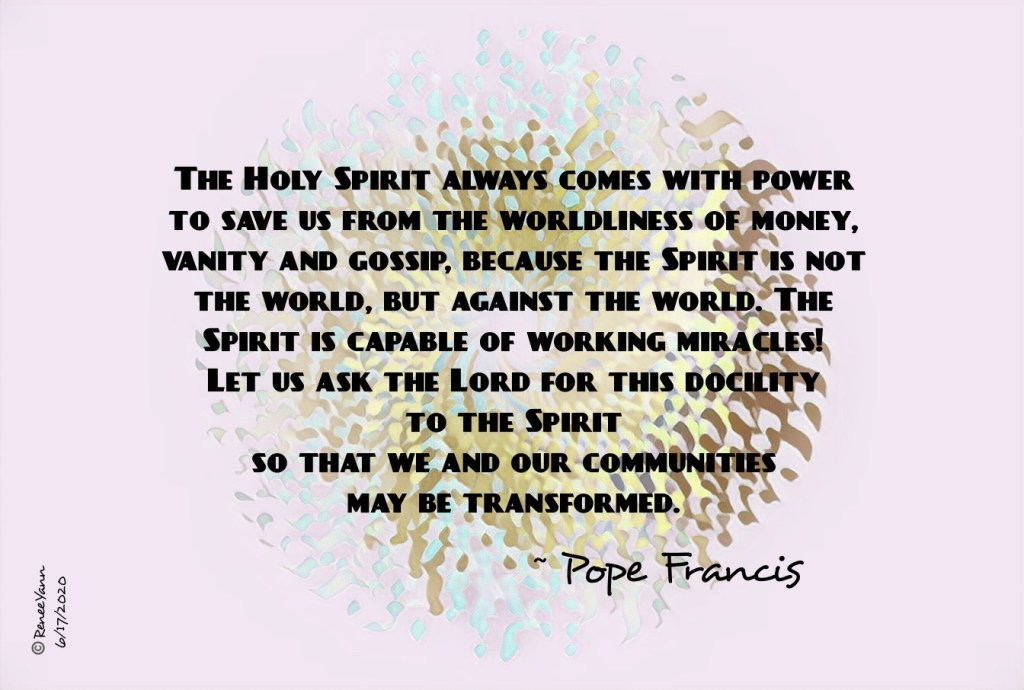
It is painful to witness this kind of sinful negativity in the Church, and the pain does enter into our prayer. Pope Francis points to a way to heal that pain:
Poetry: Our poem today is by a 19th century poet, Susan S. Button from her only book I could find which she published herself. She strikes me as an Emily Dickinson type without the same degree of literary accomplishment. There is very little information on her although she was notable enough in society to have a portrait by John Sartain (currently in the Pennsylvania Academy of Fine Arts.)
The poem, although on a serious topic, still provided a level of delight about what happens to those who slander the innocent. I offer just a few verses of the long composition and hope you enjoy it as much as I did!
Slander

What is the slander’s tongue? An arrow strong,
And sharp, and fierce, empoisoning many a word,
Such as to devil’s only do belong,
When they, by Envy and by Malice stirred,
Do contemplate dark deeds, and souls do gird
For vilest crimes, and with their deadly bane,
The good man rob of fame — with lies absurd
Asunder rend kind Friendship’s gold-linked chain,
And break the three-fold, silken cord of Love amain.
——
For though Slander’s pliant bow was newly strung,
And thick and fast her feathered arrows flew,
And through the misty air their echoes rung,
The light around his head more lustrous grew;
For Innonence forth from her treasures drew
A golden shield, and clasped it o’er his heart,
While Truth held up a golden lamp and new!
While through its lucent flame flew on the dart
From Slander’s quiver, brighter light it did impart.

It trembled on the shield of Innocence—
The good man gazed, and by its blood-stained shade
He knew full well who formed it, and from whence
It came — he plucked it from the shield and bade
The innocent “tremble not, nor be afraid.”
With force redoubled Slander drew her bow
And furious all her cruel haste betrayed,
But soon was heard a horrid shriek of woe,
As her rebounding dart did to her forehead go.

~ Susan S. Button (1858)
Music: Herr, auf dich traue ich – Otto Nicolai (1810-1849j, one of the founders of the Vienna Philharmonic
Psalm 31:1-2
Herr, auf dich traue ich, Laß mich nimmermehr zu Schanden werden, Errette mich nach deiner Barmherzigkeit, Und hilf mir aus. Neige deine Ohren zu mir, und hilf mir; Sei mir ein starker Hort, Ein Hort, dahin ich immer fliehen möge, Der du hast zugesaget mir zu helfen.
Lord, I trust in you, Let me never be ashamed; Deliver me in your mercy And assist me. Incline your ear to me and help me; Be a strong refuge for me, A refuge to which I may always flee, Which you have promised to me for my aid.



 Lavish Mercy