
Memorial of Saint Pius of Pietrelcina, Priest … also commonly known as Padre Pio.
Padre Pio died during the night of 23 September 1968, at the age of 81. On 16 June 2002, he was proclaimed a saint by Pope John Paul II. In his homily, the Pope said, “The life and mission of Padre Pio prove that difficulties and sorrows, if accepted out of love, are transformed into a privileged way of holiness, which opens onto the horizons of a greater good, known only to the Lord.”
September 23, 2020
Today, in God’s Lavish Mercy, we continue praying with Psalm 119 which, with its 176 verses, is the longest psalm as well as the longest chapter in the Bible. So this could go on forever, right?
Well, it doesn’t. Even though Psalm 119 is used for the Responsorial a total of 22 times during the total liturgical cycle, we won’t see it again for a week or so.
However, the liturgical frequency of this psalm should alert us to the importance of its teachings. Although long and somewhat complex in its acrostic structure, the psalm is direct and simple in its message:
Learn, love and live God’s ways.
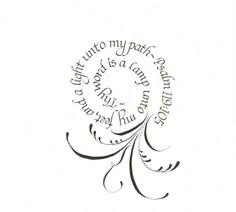
Today’s verses liken such pursuit to finding a lamp in the darkness:

Praying with this refrain, we might be able to recall a time we were enveloped in darkness, either material, emotional, or spiritual. Most of us become at least a little frightened by such conditions. We get disoriented. We don’t know if we will be able to find our way out.
The psalmist attests to similar experiences, and voices a confident call on God for deliverance. That confidence grows from the psalmist’s desire and commitment to walk in holy discernment:
From every evil way I withhold my feet,
that I may keep your words.
Through your precepts I gain discernment;
therefore I hate every false way.
Falsehood I hate and abhor;
your law I love.
In this beautiful verse, the psalmist’s confidence is confirmed by God’s faithful endurance:
The law of your mouth is to me more precious
than thousands of gold and silver pieces.
Your word, O LORD, endures forever;
it is firm as the heavens.
Poetry: One, One, One – Rumi
The lamps are different.
But the Light is the same.
So many garish lamps in the dying brain's lamp shop,
Forget about them.
Concentrate on essence, concentrate on Light.
In lucid bliss, calmly smoking off its own holy fire,
The Light streams toward you from all things,
All people, all possible permutations of good, evil, thought, passion.

The lamps are different,
But the Light is the same.
One matter, one energy, one Light, one Light-mind,
Endlessly emanating all things.
One turning and burning diamond,
One, one, one.

Ground yourself, strip yourself down,
To blind loving silence.
Stay there, until you see
You are gazing at the Light
With its own ageless eyes.
Music: Beati Quorem Via – Charles Villiers Stanford, sung by voces 8
The title of this hymn is the first verse of Psalm 119 in Latin. Translation below.
Blessed are they whose road is straight,
who walk in the law of the Lord.
Beati quorum via integra est:
qui ambulant in lege Domini
 Lavish Mercy